REVIEW 3 major objections 6 minor 49 references
Pura: An Efficient Privacy-Preserving Solution for Face Recognition
T0 review · 3 major / 6 minor · reviewed 2026-08-07 · deepseek-v4-flash
Pith's one-line read Pura computes face recognition entirely over encrypted features: neither cloud server learns the probe, the database, or the match, and recognition runs up to 16 times faster than prior protocols.
desk verdict The architecture is neat and the benchmarks are real, but the core 2-SMIN security proof is a load-bearing gap that the paper's own theorems don't cover. read the letter →
The pith
A machine-rendered reading of the paper's core claim, the machinery that carries it, and where it could break.
The reading
What carries the argument
Three mechanisms carry the argument. First, the (2,2)-threshold Paillier cryptosystem splits decryption into two partial keys so that no single server can decrypt on its own. Second, BatchSquare, a batch secure-squaring protocol, packs many blinded ciphertexts into one Paillier ciphertext using a shared constant L, lets the second server perform a single threshold decryption to recover the blinded values, and then removes the blinding homomorphically; it extends the earlier BatchSMUL protocol and handles negative inputs by adding a shared offset δ. Third, n-SMIN, a secure minimum protocol built by iterating a two-input comparison 2-SMIN, hides the comparison direction with a random bit π and masks the difference with random numbers r1 and r2. The twin-server split plus an offline random-number generation phase lets both servers compute in parallel, which is what delivers the speedup.
What would settle it
Allow the two servers to exchange their partial keys sk1 and sk2 and run one recognition query; the claim predicts they still learn nothing, whereas a colluding pair would decrypt the probe, the database rows, and the masked result, recovering the user's face and the match identity.
Extended reading notes
Core claim
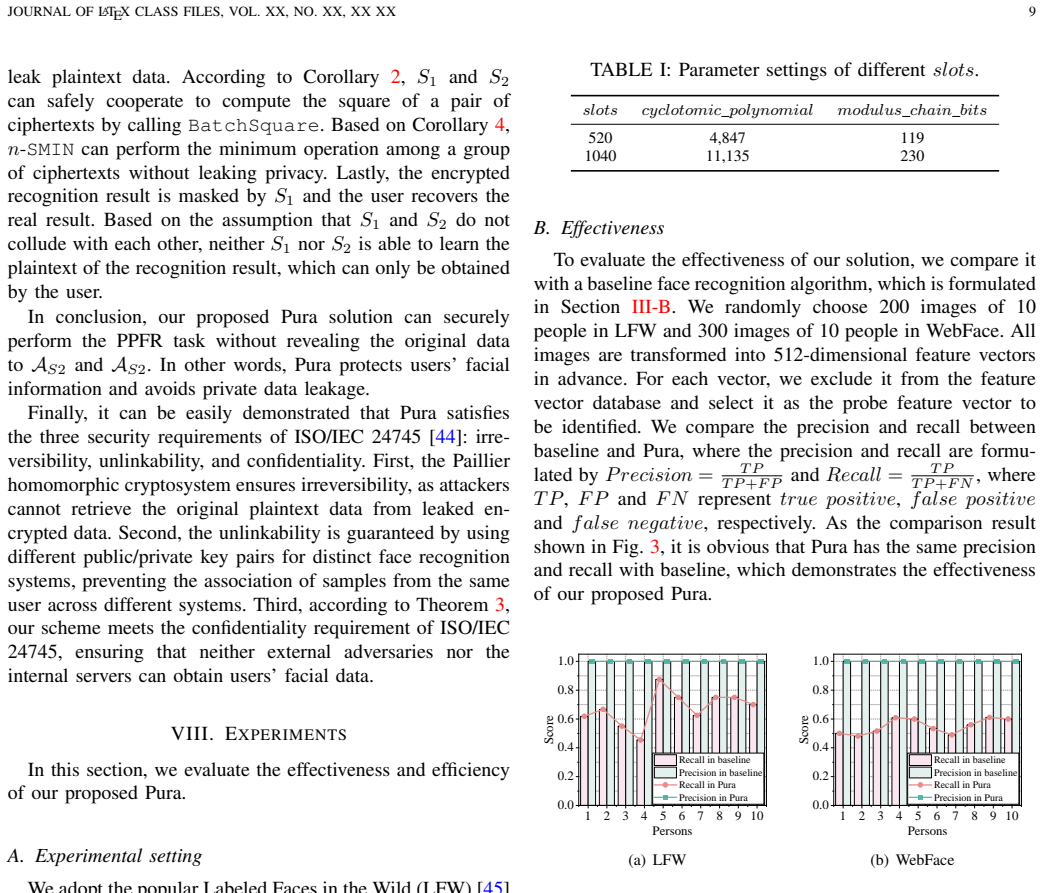
Pura claims that face recognition can be performed as a non-interactive computation over encrypted data with complete privacy toward both servers. The organization encrypts the feature-vector database under a (2,2)-threshold Paillier public key and horizontally splits the ciphertexts between servers S1 and S2, each holding one partial private key. A user encrypts a probe feature vector and sends it to both servers; the servers jointly compute the squared Euclidean distance between the probe and every database row using the BatchSquare protocol, find the minimum distance with n-SMIN, compare it with an encrypted threshold, and return a masked value that only the user can unmask. Neither server learns the probe, the database contents, the minimum distance, or the identity of the match, provided the two servers are semi-honest and non-colluding. The empirical part reports that Pura matches a plaintext baseline exactly in precision, recall, and EER, and is up to 16 times faster than the BFV-plus-garbled-circuit protocol of Huang and Wang.
Load-bearing premise
The entire privacy guarantee assumes the two cloud servers are honest-but-curious and never collude; if they combined their partial private keys, they could decrypt the probe, the database, and the recognition result together.
Editorial extensions
If this is right
- Users interact once: they encrypt a probe, send it to both servers, and receive a masked result they alone can decrypt; no client-server round trips are needed during recognition.
- Database updates are cheap because the encrypted database is stored row-wise rather than column-wise, so a new face is appended to one server's share without re-encrypting the whole database.
- Recognition accuracy is unchanged: precision, recall, and equal error rate match a plaintext baseline exactly, because all operations are exact over integers after scaling features by a constant.
- A single server storing the encrypted database consumes about 1 GB for 10,000 identities, far less than the BFV-based schemes compared in the paper.
- The runtime advantage grows with dataset size: Pura is 16x faster than the best comparison scheme at 1,000 identities and still about 2x faster at 10,000.
Reading between the lines
- The privacy guarantee is only as strong as the business incentive against collusion; if a threat model with active or colluding servers is required, the same protocols would need to be wrapped in hardware enclaves or reputation-based slashing to keep the two cloud providers apart.
- The same BatchSquare-plus-n-SMIN machinery applies to any nearest-neighbor or threshold-matching task over encrypted fixed-length vectors, not just faces—fingerprints, iris codes, or embeddings for arbitrary objects.
- Because communication grows linearly with the database size (about 0.2 GB per 1,000 rows), the scheme will suit moderate galleries; very large galleries would need a hierarchical or indexed search to avoid a full scan.
- One could test the protocols on higher-dimensional embeddings (e.g., 1,024-d) and larger galleries to map where BatchSquare's packing limit, which depends on the modulus N and the parameter L, starts to degrade throughput.
Editorial analysis
A structured set of objections, weighed in public.
Referee Report
Summary. This paper proposes Pura, a twin-server privacy-preserving face recognition scheme based on the threshold Paillier cryptosystem. The authors design two building blocks: BatchSquare, which securely computes squares of encrypted integers in batches via a packing technique, and 2-SMIN/n-SMIN, which securely compute the minimum of encrypted values. The recognition phase encrypts the probe and the database, computes squared Euclidean distances homomorphically, finds the minimum distance via n-SMIN, and compares it with an encrypted threshold. The paper claims exact accuracy, no client-server interaction after submission, and runtime up to 16 times faster than the state-of-the-art, with experiments on LFW and CASIA-WebFace using 512-dimensional FaceNet features.
Significance. If the security claims were fully proven, Pura would be a practically relevant PPFR construction: the exact-accuracy property is achieved by construction (identical integer arithmetic on plaintext and ciphertext), the architecture is non-interactive for the user, and the benchmarks are concrete and reproducible in the sense that the protocol algebra is spelled out. The main weakness is that the security of the minimum-selection core (2-SMIN) is not rigorously established; the proof for S2's view does not follow from the cited theorem, which only addresses the sign of a blinded comparison. Since the no-leakage claim of the whole system depends on this core, the significance of the contribution is currently limited by an unproven load-bearing step.
major comments (3)
- [Section VII, Corollary 3 and Algorithm 3] The proof that 2-SMIN hides x and y from S2 is incomplete. In Algorithm 3, when π=0, S2 obtains D = r1(x−y+1)+r2, and when π=1, D = r1(y−x)+r2, with r2 ∈ (N/2−r1, N/2]. Theorem 2 only establishes that the sign of D−N/2 is balanced, but S2 also sees the exact integer D. The distribution of D−N/2 is uniform on an interval of length r1 whose location is shifted by r1(x−y+1) (or −r1(y−x)), so the observed value carries information about the magnitude of x−y. Since n-SMIN invokes 2-SMIN n−1 times on distance values that depend on the probe and database, S2 accumulates multiple such observations, which can leak ordinal information about the distances and ultimately about the recognition result. A valid security proof must show that D is statistically or computationally independent of x and y, or provide a simulator for S2's view that does not use x or y; the current proof does neither.
- [Section VII, Theorem 2] Theorem 2 is stated without proof and delegated to reference [40], which shares authors with this paper. The theorem's formal claim (Pr[d>N/2]=Pr[d≤N/2]=1/2) is only about the sign of the comparison; it does not state that the distribution of d is independent of x−y, which is what Corollary 3 needs. Moreover, the +1 offset in the π=0 expression is not explicitly covered by the theorem as stated. Please provide a self-contained proof or a precise statement of the result from [40] that covers the exact distribution of d in Algorithm 3, and explain why that result implies that S2 cannot learn x, y, or min(x,y).
- [Section VII, Proof of Corollary 3] The proof for A_S2 says that 'according to Theorem 1 and Theorem 2, A_S2 fails to obtain x, y and min(x,y) from r1(x−y)+(r1+r2) or r1(y−x)+r2.' This is a non-sequitur: Theorem 1 applies to x+r (an additive one-time pad), while the expression observed by S2 is r1·(x−y)+(r1+r2), in which the difference is multiplied by the secret r1. The proof does not construct a simulator for S2's view, and it does not account for the fact that S2 sees the exact decrypted D, not merely whether D>N/2. Please replace this argument with a full simulation-based proof that handles the actual expression observed by S2.
minor comments (6)
- [Section VII, last paragraph] The phrase 'A_S2 and A_S2' should read 'A_S1 and A_S2'.
- [Section VIII-B] The sentence 'the proposed encryption scheme has no affect on the performance' contains a typo; 'affect' should be 'effect'.
- [Figure 4] Figure 4 appears corrupted in the manuscript, with raw font codes such as '/uni00000013' visible; please regenerate the figure.
- [Table II] The Wilcoxon p-values are reported as exactly 1 for all entries; since Pura and baseline perform identical integer arithmetic, this is expected, but the table should state that the outputs are identical or report the actual test statistic.
- [Section V-B, Algorithm 3] The constraint on r2 is described as 'r2 ≤ N/2 and r1+r2 > N/2'; please write it explicitly as r2 ∈ (N/2−r1, N/2] for clarity and to aid reproducibility.
- [Abstract and Section VIII-C] The abstract's claim of being 'up to 16 times faster' should be contextualized; from Fig. 7(b), the speedup relative to [28] is about 16x at dataset size 1,000 but only about 2x at 10,000.
Circularity Check
No significant circularity: Pura's accuracy claim is exact by construction and its efficiency claims are empirical; the security proof imports prior results via self-citation, but those are external published results, not the paper's own inputs.
full rationale
Pura's derivation chain does not reduce any claimed output to an input. The accuracy claim is exact-by-construction: after integerization, Pura evaluates the same squared Euclidean distance formula (Eq. 5) homomorphically via BatchSquare and additive homomorphism, so matching the plaintext baseline is a correctness check, not a fitted prediction or a circular derivation. The runtime and communication results are empirical benchmarks against [23], [28], and garbled circuits. The only place where prior work is load-bearing is the privacy proof: Theorem 1 and Theorem 2 are cited to SOCI [40], which shares an author with this paper, and Corollary 3's no-leakage conclusion for 2-SMIN is asserted rather than fully proven in this text. I flag this explicitly as a proof gap: Theorem 2 as stated only proves that the sign of D is randomized by the hidden bit pi, namely Pr[d>N/2]=Pr[d<=N/2]=1/2; it does not by itself prove that the exact value of D hides x-y, and the detailed proof is deferred to [40]. This is a legitimate security/correctness concern, but it is not a circularity: [40] is an external peer-reviewed prior result whose stated assumptions do not include Pura's conclusion, and the paper's central efficiency and exactness claims do not depend on that theorem. Therefore, no circular step is present, and the circularity score is 0.
Assumptions & free parameters
free parameters (3)
- quantization_factor =
10000
- delta_shift =
absolute value of the smallest plaintext in a batch
- recognition_threshold_epsilon =
not disclosed
assumptions (4)
- domain assumption S1 and S2 are semi-honest and non-colluding.
- standard math Threshold Paillier is semantically secure and supports additive and scalar-multiplication homomorphism.
- domain assumption Theorems 1 and 2 from SOCI [40] are correct.
- domain assumption Feature values and protocol operands stay within the plaintext domain so packing has no carries.
Cite this review
Pith. "Pith review of Pura: An Efficient Privacy-Preserving Solution for Face Recognition." pith.science (2026). https://pith.science/paper/XW4P6UIC
@misc{pith2026250515476,
  author       = {Pith},
  title        = {Pith review of: Pura: An Efficient Privacy-Preserving Solution for Face Recognition},
  year         = {2026},
  howpublished = {\url{https://pith.science/paper/XW4P6UIC}},
  note         = {Machine review of arXiv:2505.15476}
}
read the original abstract
Face recognition is an effective technology for identifying a target person by facial images. However, sensitive facial images raises privacy concerns. Although privacy-preserving face recognition is one of potential solutions, this solution neither fully addresses the privacy concerns nor is efficient enough. To this end, we propose an efficient privacy-preserving solution for face recognition, named Pura, which sufficiently protects facial privacy and supports face recognition over encrypted data efficiently. Specifically, we propose a privacy-preserving and non-interactive architecture for face recognition through the threshold Paillier cryptosystem. Additionally, we carefully design a suite of underlying secure computing protocols to enable efficient operations of face recognition over encrypted data directly. Furthermore, we introduce a parallel computing mechanism to enhance the performance of the proposed secure computing protocols. Privacy analysis demonstrates that Pura fully safeguards personal facial privacy. Experimental evaluations demonstrate that Pura achieves recognition speeds up to 16 times faster than the state-of-the-art.
Figures


Figures from the paper (3 more)


Reference graph
Works this paper leans on
-
[40]
Secureml: A system for scalable privacy- preserving machine learning,
P. Mohassel and Y . Zhang, “Secureml: A system for scalable privacy- preserving machine learning,” in2017 IEEE symposium on security and privacy (SP). IEEE, 2017, pp. 19–38
2017
-
[28]
Out- sourceable two-party privacy-preserving biometric authentication,
H. Chun, Y . Elmehdwi, F. Li, P. Bhattacharya, and W. Jiang, “Out- sourceable two-party privacy-preserving biometric authentication,” in Proceedings of the 9th ACM symposium on Information, computer and communications security, 2014, pp. 401–412
work page 2014
-
[1]
V . Manjula, L. Babooet al., “Face detection identification and tracking by prdit algorithm using image database for crime investigation,”Int. J. Comput. Appl., vol. 38, no. 10, pp. 40–46, 2012
work page 2012
-
[2]
K. Lander, V . Bruce, and M. Bindemann, “Use-inspired basic research on individual differences in face identification: Implications for criminal investigation and security,”Cognitive Research: Principles and Implica- tions, vol. 3, no. 1, pp. 1–13, 2018
work page 2018
-
[3]
Face recognition system for financial identity theft protection,
T. Pinthong, W. Yimyam, N. Chumuang, and M. Ketcham, “Face recognition system for financial identity theft protection,” in2020 15th International Joint Symposium on Artificial Intelligence and Natural Language Processing (iSAI-NLP). IEEE, 2020, pp. 1–6
work page 2020
-
[4]
Real time face recognition system (rtfrs),
S. Haji and A. Varol, “Real time face recognition system (rtfrs),” in2016 4th International Symposium on Digital Forensic and Security (ISDFS). IEEE, 2016, pp. 107–111
work page 2016
-
[5]
Eigenfaces for recognition,
M. Turk and A. Pentland, “Eigenfaces for recognition,”Journal of cognitive neuroscience, vol. 3, no. 1, pp. 71–86, 1991
1991
-
[6]
Distance measures for pca-based face recognition,
V . Perlibakas, “Distance measures for pca-based face recognition,” Pattern recognition letters, vol. 25, no. 6, pp. 711–724, 2004
work page 2004
Show all 49 references
-
[7]
Face recognition in the edge cloud,
N. Muslim and S. Islam, “Face recognition in the edge cloud,” inPro- ceedings of the International Conference on Imaging, Signal Processing and Communication, 2017, pp. 5–9
2017
-
[8]
Face recognition system (frs) on cloud computing for user authentication,
A. A. Pawle and V . P. Pawar, “Face recognition system (frs) on cloud computing for user authentication,”International Journal of Soft Computing and Engineering (IJSCE), vol. 3, no. 4, pp. 189–192, 2013
2013
-
[9]
Human face recognition using eigenface in cloud computing environment,
S. Siregar, M. Syahputra, and R. Rahmat, “Human face recognition using eigenface in cloud computing environment,” inIOP conference series: materials science and engineering, vol. 308, no. 1. IOP Publishing, 2018, p. 012013
2018
-
[10]
Toward a privacy- preserving face recognition system: A survey of leakages and solutions,
L. Laishram, M. Shaheryar, J. T. Lee, and S. K. Jung, “Toward a privacy- preserving face recognition system: A survey of leakages and solutions,” ACM Computing Surveys, 2024
2024
-
[11]
Celebgate: Two methodological approaches to the 2014 celebrity photo hacks,
R. Fallon, “Celebgate: Two methodological approaches to the 2014 celebrity photo hacks,” inInternet Science: Second International Con- ference, INSCI 2015, Brussels, Belgium, May 27-29, 2015, Proceedings
2014
-
[12]
Springer, 2015, pp. 49–60. JOURNAL OF LATEX CLASS FILES, VOL. XX, NO. XX, XX XX 12
2015
-
[13]
Leaky images: Targeted privacy attacks in the web,
C.-A. Staicu and M. Pradel, “Leaky images: Targeted privacy attacks in the web,” in28th USENIX Security Symposium (USENIX Security 19), 2019, pp. 923–939
2019
-
[14]
Homomorphic encryption,
M. Ogburn, C. Turner, and P. Dahal, “Homomorphic encryption,” Procedia Computer Science, vol. 20, pp. 502–509, 2013
2013
-
[15]
Secret-sharing schemes: A survey,
A. Beimel, “Secret-sharing schemes: A survey,” inInternational confer- ence on coding and cryptology. Springer, 2011, pp. 11–46
2011
-
[16]
A comprehensive survey on local differential privacy,
X. Xiong, S. Liu, D. Li, Z. Cai, and X. Niu, “A comprehensive survey on local differential privacy,”Security and Communication Networks, vol. 2020, no. 1, p. 8829523, 2020
2020
-
[17]
Towards efficient privacy-preserving image feature extraction in cloud computing,
Z. Qin, J. Yan, K. Ren, C. W. Chen, and C. Wang, “Towards efficient privacy-preserving image feature extraction in cloud computing,” in Proceedings of the 22nd ACM international conference on Multimedia, 2014, pp. 497–506
2014
-
[18]
Towards efficient privacy-preserving face recognition in the cloud,
S. Guo, T. Xiang, and X. Li, “Towards efficient privacy-preserving face recognition in the cloud,”Signal Processing, vol. 164, pp. 320–328, 2019
2019
-
[19]
Privacy-preserving face recognition,
Z. Erkin, M. Franz, J. Guajardo, S. Katzenbeisser, I. Lagendijk, and T. Toft, “Privacy-preserving face recognition,” inPrivacy Enhancing Technologies: 9th International Symposium, PETS 2009, Seattle, WA, USA, August 5-7, 2009. Proceedings 9. Springer, 2009, pp. 235–253
2009
-
[20]
Efficient privacy- preserving face recognition,
A.-R. Sadeghi, T. Schneider, and I. Wehrenberg, “Efficient privacy- preserving face recognition,” inInternational conference on information security and cryptology. Springer, 2009, pp. 229–244
2009
-
[21]
Privface: Fast privacy- preserving face authentication with revocable and reusable biometric credentials,
J. Lei, Q. Pei, Y . Wang, W. Sun, and X. Liu, “Privface: Fast privacy- preserving face authentication with revocable and reusable biometric credentials,”IEEE Transactions on Dependable and Secure Computing, vol. 19, no. 5, pp. 3101–3112, 2021
2021
-
[22]
Efficient privacy-preserving biometric identification,
D. Evans, Y . Huang, J. Katz, and L. Malka, “Efficient privacy-preserving biometric identification,” inProceedings of the 17th conference Network and Distributed System Security Symposium, NDSS, vol. 68, 2011, pp. 90–98
2011
-
[23]
Privacy-preserving face recogni- tion with outsourced computation,
C. Xiang, C. Tang, Y . Cai, and Q. Xu, “Privacy-preserving face recogni- tion with outsourced computation,”Soft Computing, vol. 20, pp. 3735– 3744, 2016
2016
-
[24]
On the application of homomorphic encryption to face identification,
P. Drozdowski, N. Buchmann, C. Rathgeb, M. Margraf, and C. Busch, “On the application of homomorphic encryption to face identification,” in2019 International Conference of the Biometrics Special Interest Group (BIOSIG). IEEE, 2019, pp. 1–5
2019
-
[25]
Secure outsourced computation of iris matching,
M. Blanton and M. Aliasgari, “Secure outsourced computation of iris matching,”Journal of Computer Security, vol. 20, no. 2-3, pp. 259–305, 2012
2012
-
[26]
Privacy preserving face recognition utilizing differential privacy,
M. A. P. Chamikara, P. Bertok, I. Khalil, D. Liu, and S. Camtepe, “Privacy preserving face recognition utilizing differential privacy,”Com- puters & Security, vol. 97, p. 101951, 2020
2020
-
[27]
Faceidp: Face identification differential privacy via dictionary learning neural networks,
L. Ou, Y . He, S. Liao, Z. Qin, Y . Hong, D. Zhang, and X. Jia, “Faceidp: Face identification differential privacy via dictionary learning neural networks,”IEEE Access, vol. 11, pp. 31 829–31 841, 2023
2023
-
[29]
Efficient privacy-preserving face identification protocol,
H. Huang and L. Wang, “Efficient privacy-preserving face identification protocol,”IEEE Transactions on Services Computing, vol. 16, no. 4, pp. 2632–2641, 2023
2023
-
[30]
Adaptive security in the threshold setting: From cryptosystems to signature schemes,
A. Lysyanskaya and C. Peikert, “Adaptive security in the threshold setting: From cryptosystems to signature schemes,” inAdvances in Cryptology—ASIACRYPT 2001: 7th International Conference on the Theory and Application of Cryptology and Information Security Gold Coast, Australi...
2001
-
[31]
Face recogni- tion: A literature review,
N. H. Barnouti, S. S. M. Al-Dabbagh, and W. E. Matti, “Face recogni- tion: A literature review,”International Journal of Applied Information Systems, vol. 11, no. 4, pp. 21–31, 2016
2016
-
[32]
SOCIˆ+: An enhanced toolkit for secure outsourcedcomputation on integers,
B. Zhao, W. Deng, X. Li, X. Liu, Q. Pei, and R. H. Deng, “SOCIˆ+: An enhanced toolkit for secure outsourcedcomputation on integers,”arXiv preprint arXiv:2309.15406, 2023
2023 arXiv
-
[33]
A deep dive into dataset imbalance and bias in face identification,
V . Cherepanova, S. Reich, S. Dooley, H. Souri, J. Dickerson, M. Gold- blum, and T. Goldstein, “A deep dive into dataset imbalance and bias in face identification,” inProceedings of the 2023 AAAI/ACM Conference on AI, Ethics, and Society, 2023, pp. 229–247
2023
-
[34]
Facenet: A unified embed- ding for face recognition and clustering,
F. Schroff, D. Kalenichenko, and J. Philbin, “Facenet: A unified embed- ding for face recognition and clustering,” inProceedings of the IEEE conference on computer vision and pattern recognition, 2015, pp. 815– 823
2015
-
[35]
A multi- algorithmic face recognition system,
S. Kar, S. Hiremath, D. G. Joshi, V . K. Chadda, and A. Bajpai, “A multi- algorithmic face recognition system,” in2006 International Conference on Advanced Computing and Communications. IEEE, 2006, pp. 321– 326
2006
-
[36]
Face recognition methods & applica- tions,
D. N. Parmar and B. B. Mehta, “Face recognition methods & applica- tions,”arXiv preprint arXiv:1403.0485, 2014
2014 arXiv
-
[37]
Face recognition using pca and different distance classifiers,
M. P. Gawande and D. G. Agrawal, “Face recognition using pca and different distance classifiers,”IOSR Journal of Electronics and Communication Engineering (IOSR-JECE), vol. 9, no. 1, pp. 1–5, 2014
2014
-
[38]
Generating private recommendations efficiently using homomorphic encryption and data packing,
Z. Erkin, T. Veugen, T. Toft, and R. L. Lagendijk, “Generating private recommendations efficiently using homomorphic encryption and data packing,”IEEE transactions on information forensics and security, vol. 7, no. 3, pp. 1053–1066, 2012
2012
-
[39]
Secure k-nearest neighbor query over encrypted data in outsourced environments,
Y . Elmehdwi, B. K. Samanthula, and W. Jiang, “Secure k-nearest neighbor query over encrypted data in outsourced environments,” in 2014 IEEE 30th International Conference on Data Engineering. IEEE, 2014, pp. 664–675
2014
-
[41]
SOCI: A toolkit for secure outsourced computation on integers,
B. Zhao, J. Yuan, X. Liu, Y . Wu, H. H. Pang, and R. H. Deng, “SOCI: A toolkit for secure outsourced computation on integers,”IEEE Transactions on Information Forensics and Security, vol. 17, pp. 3637– 3648, 2022
2022
-
[42]
FREED: An efficient privacy-preserving solution for person re-identification,
B. Zhao, Y . Li, X. Liu, H. H. Pang, and R. H. Deng, “FREED: An efficient privacy-preserving solution for person re-identification,” in2022 IEEE Conference on Dependable and Secure Computing (DSC). IEEE, 2022, pp. 1–8
2022
-
[43]
Privacy-preserving outsourced calculation on floating point numbers,
X. Liu, R. H. Deng, W. Ding, R. Lu, and B. Qin, “Privacy-preserving outsourced calculation on floating point numbers,”IEEE Transactions on Information Forensics and Security, vol. 11, no. 11, pp. 2513–2527, 2016
2016
-
[44]
Katz and Y
J. Katz and Y . Lindell,Introduction to modern cryptography: principles and protocols. Chapman and hall/CRC, 2007
2007
-
[45]
Iso/iec 24745: 2011. information technology-security techniques-biometric information pro- tection,
K. ISO/IEC JTC1 SC27 Security Techniques, “Iso/iec 24745: 2011. information technology-security techniques-biometric information pro- tection,” 2011
2011
-
[46]
Labeled faces in the wild: A database forstudying face recognition in unconstrained environments,
G. B. Huang, M. Mattar, T. Berg, and E. Learned-Miller, “Labeled faces in the wild: A database forstudying face recognition in unconstrained environments,” inWorkshop on faces in’Real-Life’Images: detection, alignment, and recognition, 2008
2008
-
[47]
Learning face representation from scratch,
D. Yi, Z. Lei, S. Liao, and S. Z. Li, “Learning face representation from scratch,”arXiv preprint arXiv:1411.7923, 2014
2014 arXiv
-
[48]
(leveled) fully ho- momorphic encryption without bootstrapping,
Z. Brakerski, C. Gentry, and V . Vaikuntanathan, “(leveled) fully ho- momorphic encryption without bootstrapping,”ACM Transactions on Computation Theory (TOCT), vol. 6, no. 3, pp. 1–36, 2014
2014
-
[49]
Algorithms in helib,
S. Halevi and V . Shoup, “Algorithms in helib,” inAdvances in Cryptology–CRYPTO 2014: 34th Annual Cryptology Conference, Santa Barbara, CA, USA, August 17-21, 2014, Proceedings, Part I 34. Springer, 2014, pp. 554–571. Guotao Xureceived the B.S. degree in Information Security f...
2014
Reviewed August 7, 2026 · model on record in the stance chip above.
Discussion (0). Continue with ORCID to comment.