BHaHAHA: A Fast, Robust Apparent Horizon Finder Library for Numerical Relativity
Pith reviewed 2026-05-22 13:29 UTC · model grok-4.3
The pith
A new library recasts the elliptic equation for apparent horizons as a damped nonlinear wave equation to speed up black hole detection in simulations.
A machine-rendered reading of the paper's core claim, the machinery that carries it, and where it could break.
Core claim
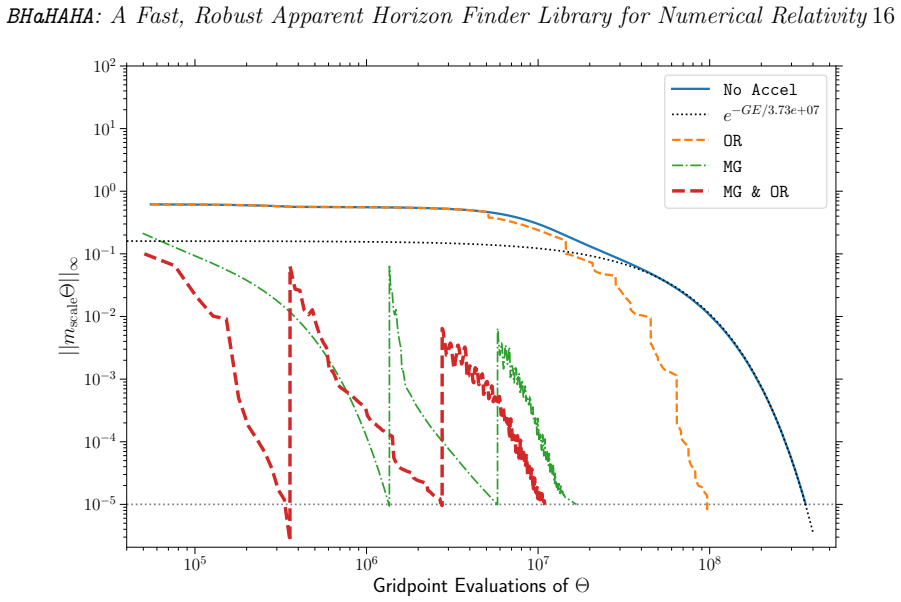
BHaHAHA implements the first hyperbolic flow-based approach by recasting the elliptic PDE for a marginally outer trapped surface as a damped nonlinear wave equation, and with multigrid-inspired refinement, over-relaxation, and OpenMP achieves 64x speedups for difficult common-horizon finds and is approximately 2.1 times faster than AHFinderDirect for dynamic tracking at typical HPC core counts.
What carries the argument
Hyperbolic relaxation that converts the elliptic PDE for marginally outer trapped surfaces into a damped nonlinear wave equation, accelerated by multigrid-inspired refinement, over-relaxation, and OpenMP parallelization.
If this is right
- Runtimes stay within 10 percent of single-core AHFinderDirect while beating it once multiple cores are used.
- 64x faster common-horizon searches than a basic hyperbolic implementation on a single spacetime slice.
- Approximately 2.1 times faster dynamic tracking than AHFinderDirect at accuracies set by host-metric interpolation.
- Portable across different numerical relativity codes, as shown by successful use in both the Einstein Toolkit and BlackHoles@Home.
Where Pith is reading between the lines
- The same damped-wave reformulation might speed up other elliptic problems that appear in general-relativity initial-data solvers.
- Adding GPU kernels for the wave evolution step could push the speedup well beyond the current OpenMP gains on large clusters.
- Faster horizon finding opens the possibility of updating excision regions more frequently during long binary-black-hole runs without extra cost.
Load-bearing premise
The hyperbolic relaxation method converges to the correct marginally outer trapped surface for all spacetimes and resolutions used in production runs without adding systematic bias beyond interpolation error in the input metric data.
What would settle it
Compare the horizon radius returned by BHaHAHA on a Schwarzschild or Kerr initial slice against the known analytic value, checking agreement to within the metric interpolation error reported by the host code.
Figures



read the original abstract
Apparent horizon (AH) finders are essential for characterizing black holes and excising their interiors in numerical relativity (NR) simulations. However, open-source AH finders to date are tightly coupled to individual NR codes. We introduce BHaHAHA, the BlackHoles@Home Apparent Horizon Algorithm, the first open-source, infrastructure-agnostic library for AH finding in NR. BHaHAHA implements the first-ever hyperbolic flow-based approach, recasting the elliptic partial differential equation for a marginally outer trapped surface as a damped nonlinear wave equation. To enhance performance, BHaHAHA incorporates a multigrid-inspired refinement strategy, an over-relaxation technique, and OpenMP parallelization. When compared to a na\"ive hyperbolic relaxation implementation, these enhancements result in 64x speedups for difficult common-horizon finds on a single spacetime slice, enabling BHaHAHA to achieve runtimes within 10% of the widely used (single-core) AHFinderDirect and outperform it on multiple cores. For dynamic horizon tracking with typical core counts on a high-performance-computing cluster, BHaHAHA is approximately 2.1 times faster than AHFinderDirect at accuracies limited by interpolation of metric data from the host NR code. Implemented and tested in both the Einstein Toolkit and BlackHoles@Home, BHaHAHA demonstrates that hyperbolic relaxation can be a robust, versatile, and performant approach for AH finding.
Editorial analysis
A structured set of objections, weighed in public.
Referee Report
Summary. The paper introduces BHaHAHA, an open-source, infrastructure-agnostic library for apparent horizon finding in numerical relativity. It presents the first hyperbolic flow-based method that recasts the elliptic PDE for a marginally outer trapped surface as a damped nonlinear wave equation, augmented by multigrid-inspired refinement, over-relaxation, and OpenMP parallelization. Performance claims include 64x speedups over a naive hyperbolic implementation for common-horizon finds and approximately 2.1 times faster dynamic tracking than AHFinderDirect at typical HPC core counts, with runtimes within 10% of single-core AHFinderDirect; the library is tested in the Einstein Toolkit and BlackHoles@Home.
Significance. If the central performance and robustness claims hold, the work supplies a valuable, freely available AH finder that decouples from specific NR codes and demonstrates that hyperbolic relaxation can be competitive with established elliptic solvers. The open-source release, infrastructure independence, and concrete wall-clock comparisons constitute clear strengths for the NR community.
major comments (2)
- [Methods / Convergence tests] The manuscript asserts that the stationary state of the damped nonlinear wave equation solves the original elliptic MOTS condition, but does not report explicit checks that the final surface satisfies vanishing expansion (or the equivalent elliptic residual) to within the claimed accuracy, independent of damping coefficient and relaxation parameters. This verification is load-bearing for the robustness claim.
- [Results / Performance benchmarks] Table or figure reporting the 64x speedup and 2.1x dynamic-tracking comparison: the error budget relative to interpolation error from the host metric data is not quantified, nor is it shown that the hyperbolic method introduces no additional systematic offset beyond that interpolation error.
minor comments (2)
- [Results] Clarify the precise definition of 'common-horizon finds' and the range of spacetime slices and resolutions used in the single-slice timing tests.
- [Implementation] Add a brief statement on how the library handles the transition from initial guess to converged surface in highly dynamical spacetimes.
Simulated Author's Rebuttal
We thank the referee for their careful reading of the manuscript and for the constructive comments, which help clarify important aspects of the method and its validation. We address each major comment below and have revised the manuscript to strengthen the presentation of the results.
read point-by-point responses
-
Referee: [Methods / Convergence tests] The manuscript asserts that the stationary state of the damped nonlinear wave equation solves the original elliptic MOTS condition, but does not report explicit checks that the final surface satisfies vanishing expansion (or the equivalent elliptic residual) to within the claimed accuracy, independent of damping coefficient and relaxation parameters. This verification is load-bearing for the robustness claim.
Authors: We agree that explicit numerical verification of the elliptic residual is necessary to support the robustness claim. While the equivalence follows from the derivation of the damped wave equation, we have added a new subsection to the Methods section in the revised manuscript. This subsection reports the computed expansion scalar (and equivalent elliptic residual) on the final surfaces for multiple values of the damping coefficient and over-relaxation parameter. The results confirm that the residual remains below the target tolerance across the tested parameter range and is insensitive to the specific choices, thereby verifying that the stationary state satisfies the MOTS condition to the claimed accuracy. revision: yes
-
Referee: [Results / Performance benchmarks] Table or figure reporting the 64x speedup and 2.1x dynamic-tracking comparison: the error budget relative to interpolation error from the host metric data is not quantified, nor is it shown that the hyperbolic method introduces no additional systematic offset beyond that interpolation error.
Authors: We acknowledge the importance of a quantified error budget. The manuscript already states that the reported accuracies are limited by interpolation of the metric data from the host NR code. In the revised Results section we have added an explicit quantification of this interpolation error (obtained by comparing interpolated fields against higher-resolution reference data) and a direct comparison of the hyperbolic solver output against a reference elliptic solution on the same interpolated data. These additions demonstrate that any additional systematic offset introduced by the hyperbolic method lies within the interpolation error and does not exceed it, with the relevant tables and figures updated to include error estimates and this comparison. revision: yes
Circularity Check
No circularity: implementation claims rest on external timings and benchmarks
full rationale
The paper describes a software library implementing a hyperbolic relaxation method by recasting an elliptic MOTS PDE into a damped nonlinear wave equation, with performance enhancements like multigrid refinement and OpenMP. Central claims are empirical speedups (64x vs naive, 2.1x vs AHFinderDirect) measured against independent codes and wall-clock data on production spacetimes. No equation reduces to a fitted parameter renamed as prediction, no load-bearing self-citation chain justifies the core method, and the stationary-state equivalence to the original elliptic condition is asserted via standard relaxation theory rather than by construction within the paper's own inputs. The work is self-contained against external benchmarks.
Axiom & Free-Parameter Ledger
axioms (1)
- domain assumption The elliptic PDE for a marginally outer trapped surface can be recast as a damped nonlinear wave equation whose steady state solves the original problem.
Lean theorems connected to this paper
-
IndisputableMonolith/Foundation/RealityFromDistinction.leanreality_from_one_distinction unclear?
unclearRelation between the paper passage and the cited Recognition theorem.
recasting the elliptic partial differential equation for a marginally outer trapped surface as a damped nonlinear wave equation
What do these tags mean?
- matches
- The paper's claim is directly supported by a theorem in the formal canon.
- supports
- The theorem supports part of the paper's argument, but the paper may add assumptions or extra steps.
- extends
- The paper goes beyond the formal theorem; the theorem is a base layer rather than the whole result.
- uses
- The paper appears to rely on the theorem as machinery.
- contradicts
- The paper's claim conflicts with a theorem or certificate in the canon.
- unclear
- Pith found a possible connection, but the passage is too broad, indirect, or ambiguous to say the theorem truly supports the claim.
Reference graph
Works this paper leans on
-
[1]
Abbott B Pet al.(LIGO Scientific, Virgo) 2016Phys. Rev. Lett.116061102 (Preprint 1602.03837)
work page internal anchor Pith review Pith/arXiv arXiv
-
[2]
Abbott T Det al.(LIGO Scientific, Virgo) 2016Phys. Rev. X6041014 (Preprint1606.01210)
work page internal anchor Pith review Pith/arXiv arXiv
-
[3]
Abbott B Pet al.(LIGO Scientific, Virgo) 2019Phys. Rev. X9031040 (Preprint1811.12907)
work page internal anchor Pith review Pith/arXiv arXiv
-
[4]
Abbott Ret al.(LIGO Scientific, Virgo) 2021Phys. Rev. X11021053 (Preprint2010.14527)
work page internal anchor Pith review Pith/arXiv arXiv
-
[5]
Abbott Ret al.(LIGO Scientific, VIRGO) 2024Phys. Rev. D109022001 (Preprint 2108.01045)
work page internal anchor Pith review Pith/arXiv arXiv
-
[6]
Abbott Ret al.(KAGRA, VIRGO, LIGO Scientific) 2023Phys. Rev. X13041039 (Preprint 2111.03606)
work page internal anchor Pith review Pith/arXiv arXiv
-
[7]
LIGO Scientific Collaboration and Virgo Collaboration (Virgo, LIGO Scientific) 2017Phys. Rev. Lett.119161101:1–18 (Preprint1710.05832)
work page internal anchor Pith review Pith/arXiv arXiv
-
[8]
Abbott B Pet al.(LIGO Scientific, Virgo, Fermi GBM, INTEGRAL, IceCube, AstroSat Cadmium Zinc Telluride Imager Team, IPN, Insight-Hxmt, ANTARES, Swift, AGILE Team, 1M2H Team, BHaHAHA: A Fast, Robust Apparent Horizon Finder Library for Numerical Relativity27 Dark Energy Camera GW-EM, DES, DLT40, GRAWITA, Fermi-LAT, ATCA, ASKAP, Las Cumbres Observatory Group...
work page internal anchor Pith review Pith/arXiv arXiv
-
[9]
Penrose R 1965Phys. Rev. Lett.1457–59
-
[10]
Senovilla J M M 2011Int. J. Mod. Phys. D202139 (Preprint1107.1344)
work page internal anchor Pith review Pith/arXiv arXiv
- [11]
- [12]
-
[13]
Quantum Grav.22425–451 (Preprintgr-qc/0407110)
Pretorius F 2005Class. Quantum Grav.22425–451 (Preprintgr-qc/0407110)
- [14]
- [15]
-
[16]
Etienne Z B, Liu Y T, Paschalidis V and Shapiro S L 2012Phys. Rev. D85064029 (Preprint 1112.0568)
work page internal anchor Pith review Pith/arXiv arXiv
-
[17]
Zilh˜ ao M and L¨ offler F 2013Int. J. Mod. Phys. A281340014 (Preprint1305.5299)
work page internal anchor Pith review Pith/arXiv arXiv
-
[18]
Christodoulou D 1970Phys. Rev. Lett.251596–1597
- [19]
-
[20]
Smarr L 1973Phys. Rev. D7289–295
- [21]
-
[22]
Rel.710 (Preprintgr-qc/0407042)
Ashtekar A and Krishnan B 2004Living Rev. Rel.710 (Preprintgr-qc/0407042)
-
[23]
Rel.103 (Preprintgr-qc/0512169)
Thornburg J 2007Living Rev. Rel.103 (Preprintgr-qc/0512169)
-
[24]
Fran¸ ca T 2023Binary Black Holes in Modified GravityPh.D. thesis Queen Mary, U. of London (main) (Preprint2308.12037)
-
[25]
Andrade et al.,GRChombo: An adaptable numerical relativity code for fundamental physics,J
Andrade Tet al.2021J. Open Source Softw.63703 (Preprint2201.03458)
-
[26]
2025GRChomboGitHub repositoryhttps://github.com/GRTLCollaboration/GRChombo
- [27]
- [28]
- [29]
-
[30]
2025Dendro-GRGitHub repositoryhttps://github.com/paralab/Dendro-GR
- [31]
-
[32]
2025SpECTREGitHub repositoryhttps://github.com/sxs-collaboration/spectre
- [33]
-
[34]
The Einstein Toolkit: A Community Computational Infrastructure for Relativistic Astrophysics
L¨ offler Fet al.2011Class. Quantum Grav.29115001:1–56 (PreprintarXiv:1111.3344[gr-qc])
work page internal anchor Pith review Pith/arXiv arXiv
-
[35]
R¨ uter H R, Hilditch D, Bugner M and Br¨ ugmann B 2018Phys. Rev. D98084044 (Preprint 1708.07358)
work page internal anchor Pith review Pith/arXiv arXiv
- [36]
- [37]
- [38]
- [39]
-
[40]
Brown J D 2009Phys. Rev. D80084042 (Preprint0908.3814) BHaHAHA: A Fast, Robust Apparent Horizon Finder Library for Numerical Relativity28
work page internal anchor Pith review Pith/arXiv arXiv
-
[41]
Montero P J and Cordero-Carrion I 2012Phys. Rev. D85124037:1–10 (Preprint1204.5377)
work page internal anchor Pith review Pith/arXiv arXiv
-
[42]
Baumgarte T W, Montero P J, Cordero-Carrion I and M¨ uller E 2013Phys. Rev. D87044026:1–14 (Preprint1211.6632)
work page internal anchor Pith review Pith/arXiv arXiv
-
[43]
2025NRPyGitHub repositoryhttps://github.com/nrpy/nrpy
-
[44]
Ruchlin I, Etienne Z B and Baumgarte T W 2018Phys. Rev. D97064036 (Preprint arXiv: 1712.07658[gr-qc])
work page internal anchor Pith review Pith/arXiv arXiv
- [45]
-
[46]
Arnowitt R L, Deser S and Misner C W 2008Gen. Rel. Grav.401997–2027 (Preprint gr-qc/0405109)
work page internal anchor Pith review Pith/arXiv arXiv 2027
- [47]
-
[48]
Meurer A, Smith C P, Paprocki M, ˇCert´ ık O, Kirpichev S B, Rocklin M, Kumar A, Ivanov S, Moore J K, Singh S, Rathnayake T, Vig S, Granger B E, Muller R P, Bonazzi F, Gupta H, Vats S, Johansson F, Pedregosa F, Curry M J, Terrel A R, Rouˇ cka v, Saboo A, Fernando I, Kulal S, Cimrman R and Scopatz A 2017PeerJ Computer Science3e103:1–27 ISSN 2376-5992 URL h...
-
[49]
Gottlieb S, Shu C W and Tadmor E 2001SIAM Review4389–112 URL https://www.jstor. org/stable/3649684
- [50]
-
[51]
Evolutions in 3D numerical relativity using fixed mesh refinement
Schnetter E, Hawley S H and Hawke I 2004Class. Quantum Grav.211465–1488 (Preprint gr-qc/0310042)
work page internal anchor Pith review Pith/arXiv arXiv
-
[52]
2024 Carpet: Adaptive mesh refinement for the Cactus Framework http://www.carpetcode.org/
work page 2024
-
[53]
Wardell B, Hinder I and Bentivegna E 2016 Simulation of GW150914 binary black hole merger using the Einstein Toolkit URLhttps://doi.org/10.5281/zenodo.155394
-
[54]
2024 Einstein Toolkit Consortium Homepagehttp://einsteintoolkit.org/
work page 2024
-
[55]
Abbott B Pet al.(LIGO Scientific, Virgo) 2016Phys. Rev. Lett.116241102 (Preprint 1602.03840)
work page internal anchor Pith review Pith/arXiv arXiv
- [56]
-
[57]
Etienne Z 2024 Updated BaikalVacuum with all improvements implemented available at https: //github.com/zachetienne/baikalvacimproved
work page 2024
-
[58]
Schnetter E, Herrmann F and Pollney D 2005Phys. Rev. D71044033 (Preprint gr-qc/0410081)
work page internal anchor Pith review Pith/arXiv arXiv
- [59]
- [60]
-
[61]
Silberman Z J, Adams T R, Faber J A, Etienne Z B and Ruchlin I 2019J. Comput. Phys.379 421–437 (Preprint1803.10207)
work page internal anchor Pith review Pith/arXiv arXiv
-
[62]
Idaho C3+3 Collaboration 2022 Falcon: High Performance Supercomputer DOI: 10.7923/falcon.id
discussion (0)
Sign in with ORCID, Apple, or X to comment. Anyone can read and Pith papers without signing in.