REVIEW 4 major objections 6 minor 2 cited by
BioDSA-1K: Benchmarking Data Science Agents for Biomedical Research
T0 review · 4 major / 6 minor · reviewed 2026-08-07 · deepseek-v4-flash
Pith's one-line read This paper introduces BioDSA-1K, a benchmark of 1,029 hypothesis-validation tasks drawn from 329 published biomedical studies, and shows that current AI agents reduce errors with explicit reasoning but still align only weakly with human…
desk verdict Large useful benchmark, but ground-truth extraction is unvalidated and the same-model loop is real; treat results as pilot numbers until revision. read the letter →
The pith
A machine-rendered reading of the paper's core claim, the machinery that carries it, and where it could break.
The reading
What carries the argument
The load-bearing mechanism is the benchmark-construction and evaluation pipeline: GPT-4o extracts binary hypotheses and structured evidence from publication abstracts via a fixed JSON prompt, the extracted variables are mapped to schema-based captions of the linked cBioPortal data tables (so agents reason over column statistics, not patient-level records), and the agent's final output is scored by four quantitative metrics. That same pipeline produces the deliberately non-verifiable cases by attaching claims to unrelated datasets, which turns abstention into a measurable capability rather than a failure mode.
What would settle it
Take a random sample of, say, 100 BioDSA-1K tasks and have two biomedical expert annotators independently check (a) whether the extracted hypothesis matches the source paper's conclusion, (b) whether the listed analysis variables actually exist in the linked cBioPortal table, and (c) whether the reported evidence value (e.g., r = 0.65) can be reproduced from the data. If the two annotators disagree with the benchmark label on more than a small fraction of tasks, or if a substantial share of tasks lack the listed variables, the ground truth cannot support the claimed evaluation axes.
Extended reading notes
Core claim
BioDSA-1K is presented as a benchmark of 1,029 hypothesis-centric tasks paired with 1,177 analysis plans, curated from 329 cBioPortal-linked publications. Each task contains an affirmative hypothesis derived from the abstract, a perturbed counter-hypothesis, and one or more structured evidence entries specifying an analysis plan, the input variables, the result variable, and its reported value. The benchmark evaluates agents along four axes: hypothesis decision accuracy measured by Type I and Type II errors, evidence alignment scored by an LLM judge comparing agent observations against reported evidence, code executability, and the detection of non-verifiable hypotheses where the data are insufficient. In the reported experiments, reasoning-augmented agents (CodeGen-Reasoning and ReAct-Reasoning) achieve lower Type I and Type II errors than their single-shot counterparts, evidence alignment scores hover near 0.20–0.25 across all methods, and the best non-verifiable detection rate reaches 92% for ReAct-Reasoning, while one-shot code generators wrongly assert verifiable claims in more than a third of strictly non-verifiable cases.
Load-bearing premise
The benchmark's ground truth is produced by GPT-4o extracting hypotheses and evidence from publication abstracts, with no human validation of whether those extractions match the original studies' actual methods or whether the linked datasets contain the needed variables.
Editorial extensions
If this is right
- A benchmark at this scale makes agent performance on realistic biomedical workflows reproducible and directly comparable across methods.
- Reasoning-augmented, plan-then-execute agents reduce both false-positive and false-negative hypothesis decisions compared with single-shot code generation.
- The uniformly low evidence alignment scores imply that correct final decisions do not guarantee faithful analysis, so future agent evaluation should include process-level metrics.
- Non-verifiable hypotheses form a distinct scoring axis where current agents over-assert, indicating that calibration and abstention skills are underdeveloped.
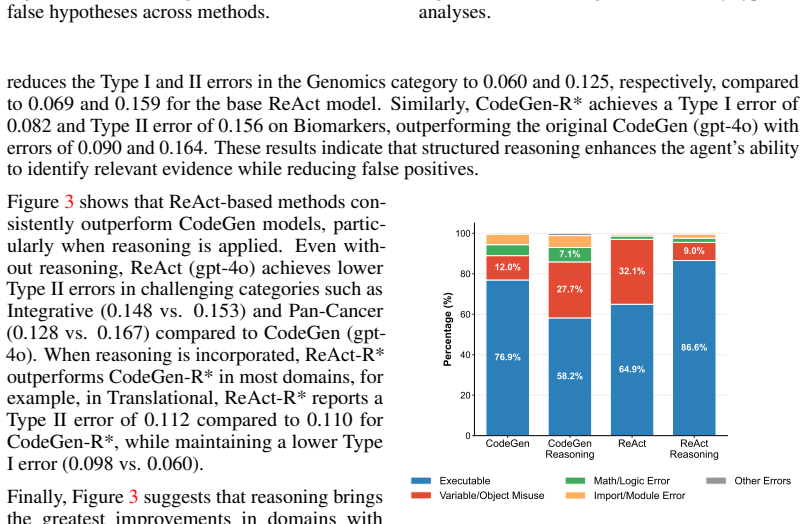
- Code executability varies by agent design, and variable/object misuse is the most common failure, pointing to concrete technical improvements.
Reading between the lines
- If the extraction pipeline were expanded with human-in-the-loop verification, the benchmark could be used to train agents to request missing variables or state what additional data would be needed before declaring a hypothesis non-verifiable.
- The low alignment scores suggest that an agent could game the decision axis by guessing the majority outcome, which implies the benchmark's real signal may lie more in evidence alignment and code executability than in decision accuracy alone.
- The same publication-to-task recipe could be applied to other data-driven fields with accessible public datasets and linked abstracts, extending the approach beyond biomedicine.
- A natural stress test would be to vary the amount of noise or missingness in the provided data tables to see whether agents' false-confidence rates track data completeness.
Editorial analysis
A structured set of objections, weighed in public.
Referee Report
Summary. The paper introduces BioDSA-1K, a benchmark of 1,029 hypothesis-validation tasks and 1,177 analysis plans derived from 329 biomedical publications linked to cBioPortal datasets. Each task contains a hypothesis, a counter-hypothesis, and one or more pieces of supporting evidence extracted from publication abstracts using GPT-4o. The benchmark evaluates agents along four axes: hypothesis decision accuracy (Type I/II errors), evidence alignment, reasoning quality, and code executability, and it includes non-verifiable hypotheses. The authors benchmark four agent variants (CodeGen, ReAct, and reasoning-augmented versions) and report that reasoning augmentation reduces error rates and that alignment scores are low overall.
Significance. If the ground-truth extraction is reliable, BioDSA-1K would be a valuable resource: it is substantially larger and more diverse than prior biomedical data-science benchmarks, uses openly available cBioPortal data, introduces a four-axis evaluation scheme that goes beyond code generation, and explicitly targets non-verifiable hypotheses, which is a realistic and underexplored scenario. The appendices provide prompts, schema-captioning details, and error taxonomies that support reproduction. The central risk is that the automatically extracted hypotheses and analysis variables are not shown to be anchored to actual data columns, which would undermine every downstream metric.
major comments (4)
- [Section 2.3, Appendix C] The extraction pipeline constructs ground-truth hypotheses and evidence from abstracts alone. The Appendix C prompt receives only the title and abstract (plus a cBioPortal result summary) and instructs GPT-4o that 'analysis_variables must be specific data columns or features that exist in the dataset', but no dataset schema or table caption is provided in that context, so the model cannot verify existence. The paper reports no post-hoc schema check, human review, or error analysis of the extracted variables. If a nontrivial fraction of the 1,029 tasks references columns that are absent from the linked cBioPortal tables, then the True/False/Non-verifiable ground-truth labels in Eqs. (1)-(4), the Type I/II error rates in Table 2, and the alignment scores in Eq. (3) are all affected: agents that correctly answer 'Non-verifiable' because the data lack the variables could be scored as Type II errors, and agents that invent analyses over non-existent columns could appear to align with evidence. I request a validation step that checks every analysis_variables and result_variable entry against the actual table schemas, reports the fraction of tasks with fully grounded variables, and either recomputes all metrics on the validated subset or replaces ungrounded entries.
- [Section 3.4, Figure 8] The construction of the 100 non-verifiable hypotheses is underspecified. The text says they are 'curated by taking claims from other publications that reference unrelated datasets', but it does not state the selection criteria, how 'unrelated' is determined, whether the absence of relevant columns was manually verified, or how often the authors had to discard candidate claims because the data actually contained the relevant variables. Since the correct label is defined as Non-verifiable, any contamination in this set directly changes the TPR in Figure 8. Please provide the full list or a detailed construction protocol with human-verified labels for this subset.
- [Equation (3), Section 3.3] The evidence alignment score relies on an LLM-as-a-judge to compute |O ∩ E|, but no rubric, calibration set, human agreement, or examples of matched/unmatched observations are provided. The judge is in the same model family (GPT-4o) as the extractor and as the evaluated agents, so the uniformly low alignment scores (0.20–0.25 in Figure 5) could reflect judge strictness or same-model bias rather than genuine agent divergence from the evidence. I request a human-annotated sample (e.g., 50–100 tasks) with inter-annotator agreement, a released judge prompt and scoring rubric, and a comparison of LLM-judge scores against human judgments.
- [Section 3.2, Table 2, Figure 3] The paper claims that reasoning-augmented agents 'consistently outperform' base agents, but Table 2 and Figure 3 contain no error bars, confidence intervals, or significance tests. Several differences are small and in opposite directions across categories (e.g., Genomics Type I error 0.060 vs. 0.069; Translational Type II error 0.110 vs. 0.112 the other way). The NeurIPS checklist answers 'Yes' to the statistical-significance question, which is inconsistent with the absence of any variability estimate. Please report per-seed or bootstrap variability, or soften the performance comparisons to 'numerically lower in most categories'.
minor comments (6)
- [Figure 4 and Section 3.3] The figure caption and the first sentence of Section 3.3 use 'Code excitability' / 'excitability analysis' where 'executability' is meant; please correct the typo.
- [Figure 4 uses and Section 3.4] Figure 4 is referenced for two different purposes: Section 3.3 describes it as the executability and error-breakdown figure, and Section 3.4 again says 'Figure 4 illustrates the proportion of executable versus non-executable code'. Please renumber or re-reference so each figure is discussed in one place.
- [Table 1] The BioDSA-1K row reads '6 879 1029' under the columns 'Avg. # Tables', 'Avg. # Columns*', and '# Tasks'; if these are meant as separate values, please add separators or a note so the table is unambiguous.
- [Section 2.1 and Section 2.3] Section 2.1 states that filtering ambiguous cases 'avoids introducing non-verifiable hypotheses into the benchmark', but Section 2.3 and Section 3.4 explicitly include non-verifiable hypotheses; the wording should be reconciled, e.g., by saying that filtering avoids unintentional non-verifiability.
- [Appendix A and Appendix C] The schema in Appendix A uses 'null_hypothesis' while the extraction prompt in Appendix C requests 'wrong_hypothesis'; using a single consistent field name would avoid confusion.
- [Section 2.2 and Appendix B] The claim that 'we do not send any patient-level records to LLMs' should be clarified, since the captioning includes most-frequent entries and value ranges for categorical columns, which can be near-identifying in small cohorts.
Circularity Check
The benchmark's ground truth is GPT-4o-generated from abstracts, and the evidence-alignment metric uses an LLM judge to score GPT-4o-family agents against that GPT-4o target; the evaluation loop is self-referential, though the measured numbers are not trivially forced.
-
self definitional
[Section 2.3 and Appendix C (extraction prompt)]
"All data science challenges in BIODSA-1K are extracted from published biomedical studies using a GPT-4o model. ... 'hypothesis': a specific, binary hypothesis that can be tested statistically, from the abstract, the one which is considered to be true from the study ... 'wrong_hypothesis': make a random perturbation of the hypothesis so that it is a wrong hypothesis ... Analysis variables must be specific data columns or features that exist in the dataset."
The True/False ground-truth labels are defined by the GPT-4o extraction prompt: the True hypothesis is the one 'considered to be true from the study' and the False hypothesis is a 'random perturbation' labeled wrong by construction. The prompt instructs that analysis variables must exist in the dataset, but no dataset schema is supplied to the extractor, and no post-hoc schema check or human validation is reported. Agents are then scored on reproducing these generator-defined labels from the tables, so the 'hypothesis decision accuracy' axis measures agreement with GPT-4o's abstract interpretation rather than an independently data-grounded truth.
-
other
[Section 2.4, Eq. (3); Section 3.1; Appendix C]
"We use a large language model (LLM)-as-a-judge [25] approach to measure the evidence alignment score: Alignment Score = |O ∩ E| / |E|. ... All data science challenges in BIODSA-1K are extracted from published biomedical studies using a GPT-4o model. ... We evaluate two variants of CodeGen: one powered by GPT-4o and the other by O3-mini."
The ground-truth evidence set E in Eq. (3) is generated by GPT-4o from the abstract/result summary; the overlap |O ∩ E| is judged by an LLM; and the agents whose observations O are scored are GPT-4o or O3-mini based. Thus the evidence-alignment metric is a closed same-model loop: LLM-generated observations are compared, by an LLM judge, against an LLM-generated target. It measures self-consistency within the GPT-4o family rather than alignment with verified evidence from the original studies or data tables, so the 'evidence grounding' axis is circular by construction.
full rationale
The central contribution is a benchmark, not a theorem, so most of the paper is a straightforward measurement rather than a derivation chain. I found no load-bearing self-citation: references [10] and [5] are prior work by the same group, but they appear only as comparisons or contextual background and do not supply an unverified premise on which the benchmark's claims rest. The circularity concern is in the benchmark construction itself. Section 2.3 states that all challenges are extracted by GPT-4o, and Appendix C shows the extractor receives only the title and abstract (plus a result summary) and is told that analysis variables must exist in the dataset without being given the dataset schema; no human validation, inter-annotator agreement, or schema-existence filter is reported. Consequently, the True/False/Non-verifiable labels are not independently shown to match the linked cBioPortal tables. The evidence-alignment score (Eq. 3) compounds this: the target evidence E is GPT-4o-generated, the judge is an LLM, and the evaluated agents are GPT-4o/o3-mini, so the metric measures a same-model loop rather than alignment with verified publication evidence. I did not set a higher score because the reported measurements are not trivially forced by this loop: alignment scores are low and vary by method and analysis type, which would not happen if the evaluation were a tautology. The non-verifiable subset is defined by dataset linkage rather than by schema inspection, which is a further grounding gap but not itself a derivation loop. Overall, the partial circularity is real and affects the benchmark's validity, but it does not reduce the whole paper's empirical content to a definition.
Assumptions & free parameters
assumptions (3)
- domain assumption Publication abstracts accurately contain the primary hypotheses and quantitative results, and the linked cBioPortal datasets are sufficient to test those hypotheses.
- ad hoc to paper GPT-4o can extract testable hypotheses and supporting evidence that faithfully reflect the original studies' analyses and dataset content.
- ad hoc to paper The LLM-as-a-judge alignment score (Eq. 3) reflects true correspondence between agent observations and the evidence reported in the original publication.
Cite this review
Pith. "Pith review of BioDSA-1K: Benchmarking Data Science Agents for Biomedical Research." pith.science (2026). https://pith.science/paper/CHCYCGYT
@misc{pith2026250516100,
  author       = {Pith},
  title        = {Pith review of: BioDSA-1K: Benchmarking Data Science Agents for Biomedical Research},
  year         = {2026},
  howpublished = {\url{https://pith.science/paper/CHCYCGYT}},
  note         = {Machine review of arXiv:2505.16100}
}
read the original abstract
Validating scientific hypotheses is a central challenge in biomedical research, and remains difficult for artificial intelligence (AI) agents due to the complexity of real-world data analysis and evidence interpretation. In this work, we present BioDSA-1K, a benchmark designed to evaluate AI agents on realistic, data-driven biomedical hypothesis validation tasks. BioDSA-1K consists of 1,029 hypothesis-centric tasks paired with 1,177 analysis plans, curated from over 300 published biomedical studies to reflect the structure and reasoning found in authentic research workflows. Each task includes a structured hypothesis derived from the original study's conclusions, expressed in the affirmative to reflect the language of scientific reporting, and one or more pieces of supporting evidence grounded in empirical data tables. While these hypotheses mirror published claims, they remain testable using standard statistical or machine learning methods. The benchmark enables evaluation along four axes: (1) hypothesis decision accuracy, (2) alignment between evidence and conclusion, (3) correctness of the reasoning process, and (4) executability of the AI-generated analysis code. Importantly, BioDSA-1K includes non-verifiable hypotheses: cases where the available data are insufficient to support or refute a claim, reflecting a common yet underexplored scenario in real-world science. We propose BioDSA-1K as a foundation for building and evaluating generalizable, trustworthy AI agents for biomedical discovery.
Figures


Figures from the paper (4 more)



Forward citations
Cited by 2 Pith papers
-
Imaging-101: Benchmarking LLM Coding Agents on Scientific Computational Imaging
A 57-task, expert-verified benchmark shows frontier LLM coding agents systematically fail on physical conventions, inverse-solver choice, and end-to-end imaging pipelines.
-
Plato-Bio: verification-first biological novelty screening with temporal rediscovery and structural benchmarks
Plato-Bio is a reproducible, audit-friendly biology agent pipeline whose full test suite passes, whose one historical evidence-bridge task ranks before TF-IDF, and whose 15-protein structure screen finds 11 targets un...
Reference graph
Works this paper leans on
-
[1]
The rise and potential of large language model based agents: A survey
Zhiheng Xi, Wenxiang Chen, Xin Guo, Wei He, Yiwen Ding, Boyang Hong, Ming Zhang, Junzhe Wang, Senjie Jin, Enyu Zhou, et al. The rise and potential of large language model based agents: A survey. Science China Information Sciences, 68(2):121101, 2025
2025
-
[2]
Large language model based multi-agents: a survey of progress and challenges
Taicheng Guo, Xiuying Chen, Yaqi Wang, Ruidi Chang, Shichao Pei, Nitesh V Chawla, Olaf Wiest, and Xiangliang Zhang. Large language model based multi-agents: a survey of progress and challenges. In Proceedings of the Thirty-Third International Joint Conference on Artificial Intelligence, pages 8048–8057, 2024
2024
-
[3]
Juraj Gottweis, Wei-Hung Weng, Alexander Daryin, Tao Tu, Anil Palepu, Petar Sirkovic, Artiom Myaskovsky, Felix Weissenberger, Keran Rong, Ryutaro Tanno, et al. Towards an ai co-scientist. arXiv preprint arXiv:2502.18864, 2025
arXiv 2025
-
[4]
Autonomous chemical research with large language models
Daniil A Boiko, Robert MacKnight, Ben Kline, and Gabe Gomes. Autonomous chemical research with large language models. Nature, 624(7992):570–578, 2023
2023
-
[5]
A foundation model for human-ai collaboration in medical literature mining
Zifeng Wang, Lang Cao, Qiao Jin, Joey Chan, Nicholas Wan, Behdad Afzali, Hyun-Jin Cho, Chang-In Choi, Mehdi Emamverdi, Manjot K Gill, et al. A foundation model for human-ai collaboration in medical literature mining. arXiv preprint arXiv:2501.16255, 2025
arXiv 2025
-
[6]
Position: data-driven discovery with large generative models
Bodhisattwa Prasad Majumder, Harshit Surana, Dhruv Agarwal, Sanchaita Hazra, Ashish Sabharwal, and Peter Clark. Position: data-driven discovery with large generative models. In Forty-first International Conference on Machine Learning, 2024
work page 2024
-
[7]
Empow- ering biomedical discovery with ai agents
Shanghua Gao, Ada Fang, Yepeng Huang, Valentina Giunchiglia, Ayush Noori, Jonathan Richard Schwarz, Yasha Ektefaie, Jovana Kondic, and Marinka Zitnik. Empow- ering biomedical discovery with ai agents. Cell, 187(22):6125–6151, 2024
work page 2024
-
[8]
Josh Achiam, Steven Adler, Sandhini Agarwal, Lama Ahmad, Ilge Akkaya, Florencia Leoni Aleman, Diogo Almeida, Janko Altenschmidt, Sam Altman, Shyamal Anadkat, et al. Gpt-4 technical report. arXiv preprint arXiv:2303.08774, 2023
arXiv 2023
Show all 54 references
-
[9]
Healthcare data scientist qualifications, skills, and job focus: a content analysis of job postings
Melanie A Meyer. Healthcare data scientist qualifications, skills, and job focus: a content analysis of job postings. Journal of the American Medical Informatics Association , 26(5): 383–391, 2019
2019
-
[10]
Can large language models replace data scientists in biomedical research? arXiv preprint arXiv:2410.21591, 2024
Zifeng Wang, Benjamin Danek, Ziwei Yang, Zheng Chen, and Jimeng Sun. Can large language models replace data scientists in biomedical research? arXiv preprint arXiv:2410.21591, 2024
2024 arXiv
-
[11]
BioDiscoveryAgent: An ai agent for designing genetic perturbation experiments
Yusuf H Roohani, Jian V ora, Qian Huang, Percy Liang, and Jure Leskovec. BioDiscoveryAgent: An ai agent for designing genetic perturbation experiments. InICLR 2024 Workshop on Machine Learning for Genomics Explorations, 2024
2024
-
[12]
BioCoder: a benchmark for bioinformatics code generation with large language models
Xiangru Tang, Bill Qian, Rick Gao, Jiakang Chen, Xinyun Chen, and Mark B Gerstein. BioCoder: a benchmark for bioinformatics code generation with large language models. Bioin- formatics, 40(Supplement_1):i266–i276, 2024
2024
-
[13]
Automated hypothesis validation with agentic sequential falsifications
Kexin Huang, Ying Jin, Ryan Li, Michael Y Li, Emmanuel Candès, and Jure Leskovec. Automated hypothesis validation with agentic sequential falsifications. arXiv preprint arXiv:2502.09858, 2025
2025 arXiv
-
[14]
Discoverybench: Towards data-driven discovery with large language models
Bodhisattwa Prasad Majumder, Harshit Surana, Dhruv Agarwal, Bhavana Dalvi Mishra, Abhi- jeetsingh Meena, Aryan Prakhar, Tirth V ora, Tushar Khot, Ashish Sabharwal, and Peter Clark. Discoverybench: Towards data-driven discovery with large language models. In The Thirteenth Inte...
2024
-
[15]
Scienceagentbench: Toward rigorous assessment of language agents for data-driven scientific discovery
Ziru Chen, Shijie Chen, Yuting Ning, Qianheng Zhang, Boshi Wang, Botao Yu, Yifei Li, Zeyi Liao, Chen Wei, Zitong Lu, et al. Scienceagentbench: Toward rigorous assessment of language agents for data-driven scientific discovery. arXiv preprint arXiv:2410.05080, 2024. 10
-
[16]
Onur Sumer, Yichao Sun, Anders Jacobsen, Rileen Sinha, Erik Larsson, Ethan Cerami, Chris Sander, and Nikolaus Schultz
Jianjiong Gao, Bülent Arman Aksoy, Ugur Dogrusoz, Gideon Dresdner, Benjamin Gross, S. Onur Sumer, Yichao Sun, Anders Jacobsen, Rileen Sinha, Erik Larsson, Ethan Cerami, Chris Sander, and Nikolaus Schultz. Integrative analysis of complex cancer genomics and clinical profiles us...
2013 doi
-
[17]
https://opendatacommons.org/ licenses/odbl/1-0/
Open data commons open database license (odbl) v1.0. https://opendatacommons.org/ licenses/odbl/1-0/. Accessed: 2025-05-01
2025
-
[18]
Cancer genome landscapes
Bert V ogelstein, Nickolas Papadopoulos, Victor E Velculescu, Shibin Zhou, Luis A Diaz Jr, and Kenneth W Kinzler. Cancer genome landscapes. Science, 339(6127):1546–1558, 2013
2013
-
[19]
DS-1000: A natural and reliable benchmark for data science code generation
Yuhang Lai, Chengxi Li, Yiming Wang, Tianyi Zhang, Ruiqi Zhong, Luke Zettlemoyer, Wen- tau Yih, Daniel Fried, Sida Wang, and Tao Yu. DS-1000: A natural and reliable benchmark for data science code generation. In International Conference on Machine Learning, pages 18319–18345. ...
2023
-
[20]
Mlagentbench: Evaluating language agents on machine learning experimentation
Qian Huang, Jian V ora, Percy Liang, and Jure Leskovec. Mlagentbench: Evaluating language agents on machine learning experimentation. InForty-first International Conference on Machine Learning, 2024
2024
-
[21]
DSBench: How far are data science agents from becoming data science experts? In The Thirteenth International Conference on Learning Representations,
Liqiang Jing, Zhehui Huang, Xiaoyang Wang, Wenlin Yao, Wenhao Yu, Kaixin Ma, Hongming Zhang, Xinya Du, and Dong Yu. DSBench: How far are data science agents from becoming data science experts? In The Thirteenth International Conference on Learning Representations,
-
[22]
BLADE: Benchmarking language model agents for data-driven science
Ken Gu, Ruoxi Shang, Ruien Jiang, Keying Kuang, Richard-John Lin, Donghe Lyu, Yue Mao, Youran Pan, Teng Wu, Jiaqian Yu, et al. BLADE: Benchmarking language model agents for data-driven science. In Findings of the Association for Computational Linguistics: EMNLP 2024, pages 139...
2024
-
[23]
Scicode: A research coding benchmark curated by scientists
Minyang Tian, Luyu Gao, Shizhuo Zhang, Xinan Chen, Cunwei Fan, Xuefei Guo, Roland Haas, Pan Ji, Kittithat Krongchon, Yao Li, et al. Scicode: A research coding benchmark curated by scientists. Advances in Neural Information Processing Systems, 37:30624–30650, 2024
2024
-
[24]
Large language models streamline automated machine learning for clinical studies
Soroosh Tayebi Arasteh, Tianyu Han, Mahshad Lotfinia, Christiane Kuhl, Jakob Nikolas Kather, Daniel Truhn, and Sven Nebelung. Large language models streamline automated machine learning for clinical studies. Nature Communications, 15(1):1603, 2024
2024
-
[25]
GPTScore: Evaluate as you desire
Jinlan Fu, See Kiong Ng, Zhengbao Jiang, and Pengfei Liu. GPTScore: Evaluate as you desire. In Proceedings of the 2024 Conference of the North American Chapter of the Association for Computational Linguistics: Human Language Technologies (Volume 1: Long Papers), pages 6556–6576, 2024
2024
-
[26]
Code generation with alphacodium: From prompt engineering to flow engineering
Tal Ridnik, Dedy Kredo, and Itamar Friedman. Code generation with alphacodium: From prompt engineering to flow engineering. arXiv preprint arXiv:2401.08500, 2024
2024 arXiv
-
[27]
React: Synergizing reasoning and acting in language models
Shunyu Yao, Jeffrey Zhao, Dian Yu, Nan Du, Izhak Shafran, Karthik Narasimhan, and Yuan Cao. React: Synergizing reasoning and acting in language models. In International Conference on Learning Representations (ICLR), 2023
2023
-
[28]
Spider2-v: How far are multi- modal agents from automating data science and engineering workflows? Advances in Neural Information Processing Systems, 37:107703–107744, 2024
Ruisheng Cao, Fangyu Lei, Haoyuan Wu, Jixuan Chen, Yeqiao Fu, Hongcheng Gao, Xinzhuang Xiong, Hanchong Zhang, Wenjing Hu, Yuchen Mao, et al. Spider2-v: How far are multi- modal agents from automating data science and engineering workflows? Advances in Neural Information Proces...
2024
-
[29]
DS-Agent: Automated data science by empowering large language models with case-based reasoning
Siyuan Guo, Cheng Deng, Ying Wen, Hechang Chen, Yi Chang, and Jun Wang. DS-Agent: Automated data science by empowering large language models with case-based reasoning. In International Conference on Machine Learning, pages 16813–16848. PMLR, 2024
2024
-
[30]
Large language models orchestrating structured reasoning achieve kaggle grandmaster level
Antoine Grosnit, Alexandre Maraval, James Doran, Giuseppe Paolo, Albert Thomas, Refinath Shahul Hameed Nabeezath Beevi, Jonas Gonzalez, Khyati Khandelwal, Ignacio Iacobacci, Abdelhakim Benechehab, et al. Large language models orchestrating structured reasoning achieve kaggle g...
2024
-
[31]
Autokaggle: A multi-agent framework for autonomous data science competitions
Ziming Li, Qianbo Zang, David Ma, Jiawei Guo, Tuney Zheng, Minghao Liu, Xinyao Niu, Yue Wang, Jian Yang, Jiaheng Liu, et al. Autokaggle: A multi-agent framework for autonomous data science competitions. arXiv preprint arXiv:2410.20424, 2024
-
[32]
BioAgents: Democratizing bioinformatics analysis with multi-agent systems
Nikita Mehandru, Amanda K Hall, Olesya Melnichenko, Yulia Dubinina, Daniel Tsirulnikov, David Bamman, Ahmed Alaa, Scott Saponas, and Venkat S Malladi. BioAgents: Democratizing bioinformatics analysis with multi-agent systems. arXiv preprint arXiv:2501.06314, 2025. 12 NeurIPS P...
2025 arXiv
-
[34]
• The abstract and/or introduction should clearly state the claims made, including the contributions made in the paper and important assumptions and limitations
Claims Question: Do the main claims made in the abstract and introduction accurately reflect the paper’s contributions and scope? Answer: [Yes] Justification: [NA] Guidelines: • The answer NA means that the abstract and introduction do not include the claims made in the paper....
-
[35]
Limitations
Limitations Question: Does the paper discuss the limitations of the work performed by the authors? Answer: [Yes] Justification: [NA] Guidelines: • The answer NA means that the paper has no limitation while the answer No means that the paper has limitations, but those are not d...
-
[36]
Guidelines: • The answer NA means that the paper does not include theoretical results
Theory assumptions and proofs Question: For each theoretical result, does the paper provide the full set of assumptions and a complete (and correct) proof? Answer: [NA] 13 Justification: This paper does not involve theoretical results. Guidelines: • The answer NA means that th...
-
[37]
Experimental result reproducibility Question: Does the paper fully disclose all the information needed to reproduce the main ex- perimental results of the paper to the extent that it affects the main claims and/or conclusions of the paper (regardless of whether the code and da...
-
[38]
• Please see the NeurIPS code and data submission guidelines ( https://nips.cc/ public/guides/CodeSubmissionPolicy) for more details
Open access to data and code Question: Does the paper provide open access to the data and code, with sufficient instruc- tions to faithfully reproduce the main experimental results, as described in supplemental material? 14 Answer: [Yes] Justification: [NA] Guidelines: • The a...
-
[39]
• The experimental setting should be presented in the core of the paper to a level of detail that is necessary to appreciate the results and make sense of them
Experimental setting/details Question: Does the paper specify all the training and test details (e.g., data splits, hyper- parameters, how they were chosen, type of optimizer, etc.) necessary to understand the results? Answer: [Yes] Justification: [NA] Guidelines: • The answer...
-
[40]
Experiment statistical significance Question: Does the paper report error bars suitably and correctly defined or other appropriate information about the statistical significance of the experiments? Answer: [Yes] Justification: [NA] Guidelines: • The answer NA means that the pa...
-
[41]
• The paper should indicate the type of compute workers CPU or GPU, internal cluster, or cloud provider, including relevant memory and storage
Experiments compute resources Question: For each experiment, does the paper provide sufficient information on the com- puter resources (type of compute workers, memory, time of execution) needed to reproduce the experiments? Answer: [Yes] Justification: [NA] Guidelines: • The ...
-
[42]
• If the authors answer No, they should explain the special circumstances that require a deviation from the Code of Ethics
Code of ethics Question: Does the research conducted in the paper conform, in every respect, with the NeurIPS Code of Ethics https://neurips.cc/public/EthicsGuidelines? Answer: [Yes] Justification: [NA] Guidelines: • The answer NA means that the authors have not reviewed the N...
-
[43]
• If the authors answer NA or No, they should explain why their work has no societal impact or why the paper does not address societal impact
Broader impacts Question: Does the paper discuss both potential positive societal impacts and negative societal impacts of the work performed? Answer: [Yes] Justification: [NA] Guidelines: • The answer NA means that there is no societal impact of the work performed. • If the a...
-
[44]
Safeguards Question: Does the paper describe safeguards that have been put in place for responsible release of data or models that have a high risk for misuse (e.g., pretrained language models, image generators, or scraped datasets)? Answer: [Yes] Justification: [NA] Guideline...
-
[45]
• The authors should cite the original paper that produced the code package or dataset
Licenses for existing assets Question: Are the creators or original owners of assets (e.g., code, data, models), used in the paper, properly credited and are the license and terms of use explicitly mentioned and properly respected? Answer: [Yes] Justification: [NA] Guidelines:...
-
[46]
• Researchers should communicate the details of the dataset/code/model as part of their submissions via structured templates
New assets Question: Are new assets introduced in the paper well documented and is the documentation provided alongside the assets? 17 Answer: [Yes] Justification: [NA] Guidelines: • The answer NA means that the paper does not release new assets. • Researchers should communica...
-
[47]
Crowdsourcing and research with human subjects Question: For crowdsourcing experiments and research with human subjects, does the paper include the full text of instructions given to participants and screenshots, if applicable, as well as details about compensation (if any)? A...
-
[48]
• Depending on the country in which research is conducted, IRB approval (or equivalent) may be required for any human subjects research
Institutional review board (IRB) approvals or equivalent for research with human subjects Question: Does the paper describe potential risks incurred by study participants, whether such risks were disclosed to the subjects, and whether Institutional Review Board (IRB) approvals...
-
[49]
hypotheses
Declaration of LLM usage Question: Does the paper describe the usage of LLMs if it is an important, original, or non-standard component of the core methods in this research? Note that if the LLM is used only for writing, editing, or formatting purposes and does not impact the ...
2025
-
[50]
Each hypothesis must be testable using statistical analysis or machine learning methods 23
-
[51]
All evidence must include specific, measurable quantities or statistical relationships
-
[52]
Result values must be numerical (e.g., percentages, counts, p-values, correlation coefficients) or categorical with clear classifications
-
[53]
hypotheses
Analysis variables must be specific data columns or features that exist in the dataset Return your answer as a JSON object in the following format: ‘‘‘json { "hypotheses": [ { "hypothesis": a specific, binary hypothesis that can be tested statistically, from the abstract, the ...
-
[54]
"" 27 CODE_GENERATION_PROMPT_TEMPLATE =
print hello world </analysis_plan> """ 27 CODE_GENERATION_PROMPT_TEMPLATE = """ # TASK Given the user-provided analysis plan for the user’s scientific hypothesis, you **Must** write {language} code to fulfill the plan so that user can execute the code later to evaluate the hyp...
-
[2025]
URL https://openreview.net/forum?id=DSsSPr0RZJ
Reviewed August 7, 2026 · model on record in the stance chip above.
Discussion (0). Sign in to comment.