REVIEW 2 major objections 5 minor 37 references
Learning Genomic Structure from $k$-mers
T0 review · 2 major / 5 minor · reviewed 2026-08-07 · deepseek-v4-flash
Pith's one-line read This paper claims that contrastive learning over short DNA k-mers produces a continuous embedding of genomic order, and that small prediction heads on that embedding match the gold-standard aligner BWA-aln on ancient DNA read mapping for…
desk verdict Contrastive k-mer embedding is a genuine new idea with decent E. coli accuracy, but the runtime parity claim ignores the alignment step that would make it slower. read the letter →
The pith
A machine-rendered reading of the paper's core claim, the machinery that carries it, and where it could break.
The reading
What carries the argument
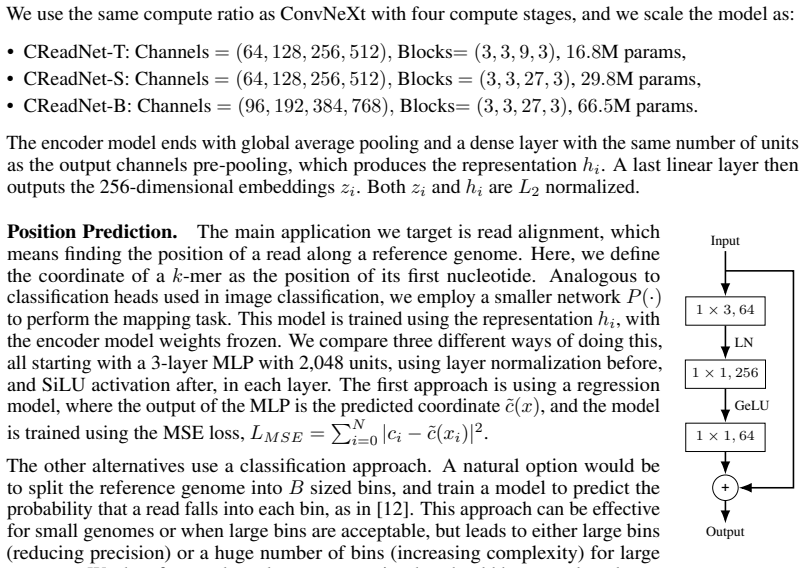
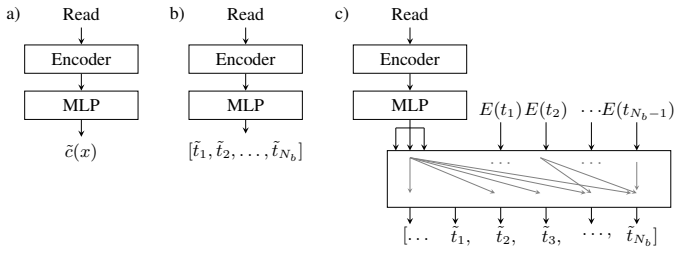
The load-bearing object is the contrastively trained k-mer encoder together with the coordinate-thresholded contrastive loss. Two k-mers are sampled within a maximum offset $d$, each augmented by reverse-complement flips, a flat 1% substitution rate, and elevated C-to-T and G-to-A rates near the ends to mimic ancient-DNA deamination; the loss attracts the pair and repels other batch samples. When reference coordinates are known, a threshold $\Gamma$ promotes every k-mer within $\Gamma$ base pairs of an anchor from negative to positive, with contributions weighted by genomic distance, so large batches do not accidentally repel the anchor's closest neighbors. The second mechanism is the bitwise coordinate head: the position is written in base 3 and predicted digit by digit, either independently by an MLP or sequentially by a small GPT with a causal mask over previously predicted bits, which turns one genome-sized classification into a logarithmic number of small ones.
What would settle it
Measure end-to-end throughput of the complete CReadNet pipeline, including embedding, bit prediction, and an optimized local-alignment kernel, on the same E. coli ancient-DNA benchmark and hardware; if total throughput falls below BWA-aln's 0.375 million reads per second while maintaining comparable accuracy, the central parity claim is falsified.
Extended reading notes
Core claim
On the paper's own terms, the discovery is that a contrastive encoder trained on k-mer pairs extracts the sequential order of a genome: k-mers drawn within a small offset end up close in embedding space, reverse complements of the same sequence are mapped nearby, and noisy versions of a k-mer remain attached to its clean location. The supervised loss with threshold $\Gamma$ converts every k-mer within $\Gamma$ base pairs of an anchor into a positive, so nearby sequences are never repelled and the embedding becomes a smooth trajectory over genomic coordinates. On simulated ancient DNA reads from E. coli, a bitwise classification head and a small causally-masked transformer that predicts coordinate bits one at a time recover positions accurately enough that local alignment reaches 94–98% correct mapping, matching BWA-aln; the bitwise formulation replaces one classification over the whole genome with a logarithmic number of small classifications. The same embedding flags inversions and duplications as abnormally large pairwise distances between k-mers from one read, and a fully self-supervised variant separates disjoint sequences, which the authors read as evidence for metagenomic and reference-free applications.
Load-bearing premise
The load-bearing premise is that after the model predicts a read's approximate position, the local-alignment step can be made fast enough to be effectively free; only an unoptimized implementation at 0.68 million reads per second was measured, and if a production version cannot keep total end-to-end throughput at or above BWA-aln's 0.375 million reads per second, the runtime-parity claim fails.
Editorial extensions
If this is right
- If the central claim holds, read mapping can be done without a linear reference or suffix-array index: inference cost per read stays essentially constant as the reference genome grows, because the model size does not depend on genome length.
- The bitwise prediction head turns one genome-sized classification problem into a logarithmic number of small ones, so fine-grained positioning remains feasible for genomes orders of magnitude larger than E. coli.
- The same pre-trained embedding supports multiple tasks, including read mapping, inversion and duplication detection, and discrimination of disjoint sequences, so a single representation could replace task-specific pipelines.
- Because the model can be trained fully self-supervised on reads alone, it offers a route to reference-free analysis and de novo assembly that does not require a hand-built reference genome.
- Domain-specific augmentation with aDNA damage lets the embedding tolerate degraded reads, and training on heavier noise transfers to cleaner data, implying the augmentation scheme is a reusable recipe for noisy sequencing data.
Reading between the lines
- Beyond the paper's demonstrations, the constant inference cost suggests a route to pangenome references: train the encoder on several genomes so that shared and divergent regions form one common trajectory, sidestepping reference bias without a linear reference.
- The bitwise-plus-GPT prediction head is a general decoding recipe for coordinate-like outputs with huge ranges; the paper only applies it to genomic positions, but the same hierarchical bit prediction with causal dependence could transfer to other large-domain regression tasks.
- A testable extension the paper does not run is transfer learning: fine-tune an encoder pretrained on one genome on a second, related genome; if the embedding transfers, the expensive training step could be amortized across species, easing the paper's acknowledged training-cost limitation.
- Since $\Gamma$ controls how tightly reads map, setting it locally according to repeat density could improve accuracy in repetitive regions without flattening the global trajectory; the paper uses a single global threshold.
Editorial analysis
A structured set of objections, weighed in public.
Referee Report
Summary. The paper introduces CReadNet, a contrastive learning framework that embeds k-mers of a reference genome into a continuous vector space so that genomically nearby k-mers are close in embedding space. A pre-trained encoder is then frozen and small prediction heads (regression, per-bit classification, and a GPT-style sequential bit predictor) are trained to predict read coordinates from the embedding. The authors evaluate on simulated 30 bp ancient DNA reads from the E. coli reference genome, comparing accuracy and throughput against BWA-aln, BWA-mem, and Bowtie2. They report accuracy on par with BWA-aln n=3 (e.g., 98.71% vs 98.02% on the 10% benchmark; 97.47% vs 97.08% on the 100% benchmark for the best bitwise head) and higher throughput, with the explicit caveat that local alignment timings are omitted. Additional experiments demonstrate inversion detection using embedding distances and a toy metagenomic separation with self-supervised training.
Significance. If the results hold, the framework offers a new representation of genomic k-mers whose inference cost is largely independent of reference genome size, potentially enabling reference-free read mapping and metagenomic analysis. The paper is strengthened by transparent reporting: three seeds for all main results, detailed hyperparameter tables, architecture specifications, and a clear limitations section. The bitwise coordinate prediction idea is a useful contribution that avoids the linear output scaling of binning approaches. However, the headline claim of runtime parity with BWA-aln is currently not supported because the reported throughput excludes the local alignment step, which is the very step that converts raw coordinate predictions into mapped reads. The accuracy comparison is also limited to a single reference genome with simulated reads, so the generality of the representation remains a promising direction rather than a demonstrated property. These issues make the central two-part claim only partially established.
major comments (2)
- [Section 3, Read Alignment of aDNA Reads, Table 1] The runtime half of the central claim is not supported as stated. Table 1 reports CReadNet throughput with the caveat that 'the timings for the local alignment step are omitted,' while the BWA-aln throughput includes the full alignment pipeline. The authors' own measured local-alignment implementation runs at 0.68 MR/s on an A100. For the fastest model row on the 10% benchmark (CReadNet-T CCE, 0.424 MR/s), a serial pipeline would run at 1/(1/0.424 + 1/0.68) ≈ 0.26 MR/s, below BWA-aln n=3's 0.375 MR/s. For the 100% benchmark, CReadNet-B CCE at 0.139 MR/s would drop to ≈ 0.115 MR/s, about half of BWA-aln's 0.230 MR/s. The sentence 'better optimized approaches should yield negligible overhead' is an assumption, not a measurement, and the local alignment is the step that determines whether a read is correctly mapped. The authors must either provide an end-to-end throughput measurement or a benchmarked local-alignment implementation that meets the assumed overhead; otherwise the 'on par ... runtime' statement in the abstract and conclusions should be revised.
- [Section 3, Read Alignment of aDNA Reads, and Appendix Figure 9] The reported accuracy depends critically on the 5000 bp local alignment window, but the paper does not analyze how accuracy and throughput vary with this window size. The appendix eCDF plots show that for the 100% genome, a non-negligible fraction of reads have raw coordinate prediction errors approaching 2500 bp, so the window size is a genuine operating-point parameter: larger windows improve accuracy but increase alignment cost, and smaller windows may degrade accuracy below the reported values. Since the runtime claim assumes the alignment overhead can be made negligible, the authors should provide a sensitivity analysis of Table 1 with respect to the window size, or at minimum report the raw prediction-error distribution in the main text to justify the chosen operating point.
minor comments (5)
- [Abstract] There is a typo in the abstract: 'BW A-aln' should be 'BWA-aln'.
- [Appendix A.6, Table 5] The architecture table contains apparent inconsistencies: 'Stage 3 ResBlocks B = 9, C= 256' is listed with output shape (batch, 8, 128), and the following 'Stage 3 ResBlocks B = 3, C= 512' has output (batch, 15, 512), which does not match the described downsampling pattern. These rows appear to be copied from different model variants and should be corrected.
- [Section 3, Genome Embeddings and Thresholding Parameter] Figure 5 uses the symbol '□' in the subplot labels where the text uses 'Γ'; this should be made consistent.
- [Section 3, Disjoint Sequences and Non-Model Species] The self-supervised experiment is only a toy demonstration on two 10 kbp disjoint sequences; the paper should explicitly state in the main text that this is a proof of concept and not a quantitative benchmark for metagenomic species identification.
- [Conclusions] The sentence 'Table 1 shows that the prediction models perform on par with the default values for the gold-standard BWA-aln in aDNA mapping' should be qualified to the specific E. coli benchmark used here, since only one reference genome and simulated reads are evaluated.
Circularity Check
No circularity: the contrastive representation and prediction heads are trained on coordinate labels and evaluated on held-out simulated reads from the same reference, which is standard supervised learning rather than a self-referential derivation.
full rationale
The paper's derivation chain is self-contained and non-circular. The encoder is trained with a contrastive loss whose positives are defined by genomic coordinate proximity (Eq. 3), and the prediction heads are trained on the same coordinate labels; this is supervised representation learning, not a circular reduction, because the evaluation uses held-out Gargammel-simulated reads and measures mapping accuracy through local alignment. No equation in the paper defines a predicted quantity in terms of itself, and no load-bearing result is imported from a self-citation. The one self-citation ([33], Günther and Nettelblad) concerns reference bias and is contextual, not load-bearing. The most significant evidentiary gap is not circular: in Section 3, Read Alignment of aDNA Reads, the paper states 'The timings for the local alignment step are omitted' and assumes 'better optimized approaches should yield negligible overhead,' while its own measured CuPy implementation runs at 0.68 MR/s. This makes the runtime-parity half of the headline claim unsupported, but that is a missing measurement/correctness risk, not a reduction of the result to its inputs. The accuracy numbers are end-to-end and the training/evaluation split is standard, so the central derivation is independent.
Assumptions & free parameters
free parameters (7)
- Gamma (distance threshold) =
1000 (default)
- d (maximum positive offset) =
50 bp
- Augmentation substitution rates =
1% flat; 10% C to T in first 10 bp and G to A in last 10 bp
- Temperature tau =
0.1
- Local alignment window size =
5000 bp
- k-mer length =
30
- Base b of bitwise representation =
3
assumptions (4)
- domain assumption The reference genome is a linear sequence with a single coordinate system, and reads originate from this genome.
- domain assumption The augmentation scheme (reverse complement, substitutions, deamination) adequately covers the distribution of noise in the test reads.
- domain assumption Local alignment within a 5000 bp window around the predicted coordinate will contain the true read position with high probability.
- standard math Standard contrastive learning assumptions (sufficient batch size, positive/negative sampling) hold; the loss in Equation 2 with Gamma-thresholding is a valid objective.
Cite this review
Pith. "Pith review of Learning Genomic Structure from $k$-mers." pith.science (2026). https://pith.science/paper/HW6G6R4N
@misc{pith2026250516680,
  author       = {Pith},
  title        = {Pith review of: Learning Genomic Structure from $k$-mers},
  year         = {2026},
  howpublished = {\url{https://pith.science/paper/HW6G6R4N}},
  note         = {Machine review of arXiv:2505.16680}
}
abstract
Sequencing a genome to determine an individual's DNA produces an enormous number of short nucleotide subsequences known as reads, which must be reassembled to reconstruct the full genome. We present a method for analyzing this type of data using contrastive learning, in which an encoder model is trained to produce embeddings that cluster together sequences from the same genomic region. The sequential nature of genomic regions is preserved in the form of trajectories through this embedding space. Trained solely to reflect the structure of the genome, the resulting model provides a general representation of $k$-mer sequences, suitable for a range of downstream tasks involving read data. We apply our framework to learn the structure of the $E.\ coli$ genome, and demonstrate its use in simulated ancient DNA (aDNA) read mapping and identification of structural variations. Furthermore, we illustrate the potential of using this type of model for metagenomic species identification. We show how incorporating a domain-specific noise model can enhance embedding robustness, and how a supervised contrastive learning setting can be adopted when a linear reference genome is available, by introducing a distance thresholding parameter $\Gamma$. The model can also be trained fully self-supervised on read data, enabling analysis without the need to construct a full genome assembly using specialized algorithms. Small prediction heads based on a pre-trained embedding are shown to perform on par with BWA-aln, the current gold standard approach for aDNA mapping, in terms of accuracy and runtime for short genomes. Given the method's favorable scaling properties with respect to total genome size, inference using our approach is highly promising for metagenomic applications and for mapping to genomes comparable in size to the human genome.
Figures


Figures from the paper (8 more)


Reference graph
Works this paper leans on
-
[1]
Michael L. Metzker. Sequencing technologies — the next generation. Nature Reviews Genetics, 11(1):31–46, Jan 2010. ISSN 1471-0064. doi: 10.1038/nrg2626. URL https://doi.org/10. 1038/nrg2626
-
[2]
Mohammed Alser, Jeremy Rotman, Dhrithi Deshpande, Kodi Taraszka, Huwenbo Shi, Pelin Icer Baykal, Harry Taegyun Yang, Victor Xue, Sergey Knyazev, Benjamin D. Singer, Brunilda Balliu, David Koslicki, Pavel Skums, Alex Zelikovsky, Can Alkan, Onur Mutlu, and Serghei Mangul. Technology dictates algorithms: recent developments in read alignment. Genome Biology,...
-
[3]
Glennis A. Logsdon, Mitchell R. V ollger, and Evan E. Eichler. Long-read human genome sequencing and its applications. Nature Reviews Genetics , 21(10):597–614, Oct 2020. ISSN 1471-0064. doi: 10.1038/s41576-020-0236-x. URL https://doi.org/10.1038/ s41576-020-0236-x
-
[4]
Sara Goodwin, John D. McPherson, and W. Richard McCombie. Coming of age: ten years of next-generation sequencing technologies. Nature Reviews Genetics, 17(6):333–351, Jun 2016. ISSN 1471-0064. doi: 10.1038/nrg.2016.49. URL https://doi.org/10.1038/nrg.2016. 49
-
[5]
Method of the year: long-read sequencing
Vivien Marx. Method of the year: long-read sequencing. Nature Methods, 20(1):6–11, Jan
-
[6]
Read length dominates phylogenetic placement accuracy of ancient DNA reads
Ben Bettisworth, Nikolaos Psonis, Nikos Poulakakis, Pavlos Pavlidis, and Alexandros Sta- matakis. Read length dominates phylogenetic placement accuracy of ancient DNA reads. Mol Biol Evol, 42(2), February 2025
work page 2025
-
[7]
Adrian W. Briggs, Udo Stenzel, Philip L. F. Johnson, Richard E. Green, Janet Kelso, Kay Prüfer, Matthias Meyer, Johannes Krause, Michael T. Ronan, Michael Lachmann, and Svante Pääbo. Patterns of damage in genomic DNA sequences from a Neandertal. Proceedings of the National Academy of Sciences , 104(37):14616–14621, 2007. doi: 10.1073/pnas.0704665104. URL ...
-
[8]
BetaAlign: a deep learning approach for multiple sequence alignment
Edo Dotan, Elya Wygoda, Noa Ecker, Michael Alburquerque, Oren Avram, Yonatan Belinkov, and Tal Pupko. BetaAlign: a deep learning approach for multiple sequence alignment. Bioinfor- matics, 41(1):btaf009, 01 2025. ISSN 1367-4811. doi: 10.1093/bioinformatics/btaf009. URL https://doi.org/10.1093/bioinformatics/btaf009
Show all 37 references
-
[9]
Deep reinforcement learning-based pairwise DNA sequence alignment method compatible with embedded edge devices
Aryan Lall and Siddharth Tallur. Deep reinforcement learning-based pairwise DNA sequence alignment method compatible with embedded edge devices. Scientific Reports, 13(1):2773, Feb 2023. ISSN 2045-2322. doi: 10.1038/s41598-023-29277-6. URL https://doi.org/10. 1038/s41598-023-29277-6
2023 doi
-
[10]
Hill, and Lila Kari
Pablo Millán Arias, Fatemeh Alipour, Kathleen A. Hill, and Lila Kari. DeLUCS: Deep learning for unsupervised clustering of DNA sequences. PLOS ONE, 17(1):1–25, 01 2022. doi: 10. 1371/journal.pone.0261531. URL https://doi.org/10.1371/journal.pone.0261531. 10
2022 doi
-
[11]
A deep learning approach to pattern recognition for short DNA sequences
Akosua Busia, George Dahl, Clara Fannjiang, David Alexander, Lizzie Dorfman, Ryan Poplin, Cory McLean, Pi-Chuan Chang, and Mark DePristo. A deep learning approach to pattern recognition for short DNA sequences. bioArxiv, 2018. URL https://www.biorxiv.org/ content/early/2018/06...
2018
-
[12]
Read alignment using deep neural networks
Akash Shrestha. Read alignment using deep neural networks. bioArxiv, 2019. URL https: //mountainscholar.org/items/1a3b3cef-6994-45f3-b9c0-dcddeb1ea5c4
2019
-
[13]
FaceNet: A unified embedding for face recognition and clustering
Florian Schroff, Dmitry Kalenichenko, and James Philbin. FaceNet: A unified embedding for face recognition and clustering. In 2015 IEEE Conference on Computer Vision and Pattern Recognition (CVPR), page 815–823. IEEE, June 2015. doi: 10.1109/cvpr.2015.7298682. URL http://dx.do...
2015
-
[14]
A simple framework for contrastive learning of visual representations
Ting Chen, Simon Kornblith, Mohammad Norouzi, and Geoffrey Hinton. A simple framework for contrastive learning of visual representations. In Proceedings of the 37th International Conference on Machine Learning, ICML’20. JMLR.org, 2020
2020
-
[15]
Improved deep metric learning with multi-class N-pair loss objec- tive
Kihyuk Sohn. Improved deep metric learning with multi-class N-pair loss objec- tive. In D. Lee, M. Sugiyama, U. Luxburg, I. Guyon, and R. Garnett, editors, Advances in Neural Information Processing Systems , volume 29. Curran Associates, Inc., 2016. URL https://proceedings.neu...
2016
-
[16]
Travis C. Glenn. Field guide to next-generation DNA sequencers.Molecular Ecology Resources, 11(5):759–769, 2011. doi: https://doi.org/10.1111/j.1755-0998.2011.03024.x. URL https: //onlinelibrary.wiley.com/doi/abs/10.1111/j.1755-0998.2011.03024.x
2011
-
[17]
Supervised contrastive learning
Prannay Khosla, Piotr Teterwak, Chen Wang, Aaron Sarna, Yonglong Tian, Phillip Isola, Aaron Maschinot, Ce Liu, and Dilip Krishnan. Supervised contrastive learning. In H. Larochelle, M. Ranzato, R. Hadsell, M.F. Balcan, and H. Lin, editors, Advances in Neu- ral Information Proc...
2020
-
[18]
A ConvNet for the 2020s
Zhuang Liu, Hanzi Mao, Chao-Yuan Wu, Christoph Feichtenhofer, Trevor Darrell, and Saining Xie. A ConvNet for the 2020s. In Proceedings of the IEEE/CVF Conference on Computer Vision and Pattern Recognition (CVPR), pages 11976–11986, June 2022
2022
-
[19]
Analog bits: Generating discrete data using diffusion models with self-conditioning, 2023
Ting Chen, Ruixiang Zhang, and Geoffrey Hinton. Analog bits: Generating discrete data using diffusion models with self-conditioning, 2023. URL https://arxiv.org/abs/2208.04202
2023 arXiv
-
[20]
Improving language understanding by generative pre-training, 2018
Alec Radford and Karthik Narasimhan. Improving language understanding by generative pre-training, 2018
2018
-
[21]
Escherichia coli str
National Center for Biotechnology Information (NCBI). Escherichia coli str. K-12 substr. MG1655, complete genome. https://www.ncbi.nlm.nih.gov/nuccore/NC_000913.3,
-
[22]
gargammel: a sequence simulator for ancient DNA.Bioinformatics, 33(4):577–579, 11 2016
Gabriel Renaud, Kristian Hanghøj, Eske Willerslev, and Ludovic Orlando. gargammel: a sequence simulator for ancient DNA.Bioinformatics, 33(4):577–579, 11 2016. ISSN 1367-4803. doi: 10.1093/bioinformatics/btw670. URL https://doi.org/10.1093/bioinformatics/ btw670
2016 doi
-
[23]
Myers, and Gabor T
Weichun Huang, Leping Li, Jason R. Myers, and Gabor T. Marth. ART: a next-generation sequencing read simulator. Bioinformatics, 28(4):593–594, 12 2011. ISSN 1367-4803. doi: 10. 1093/bioinformatics/btr708. URL https://doi.org/10.1093/bioinformatics/btr708
2011 doi
-
[24]
Additional evaluations show that specific BW A-aln settings still outperform BW A-mem for ancient DNA data alignment
Adrien Oliva, Raymond Tobler, Bastien Llamas, and Yassine Souilmi. Additional evaluations show that specific BW A-aln settings still outperform BW A-mem for ancient DNA data alignment. Ecol Evol, 11(24):18743–18748, December 2021. 11
2021
-
[25]
Ultrafast and memory- efficient alignment of short DNA sequences to the human genome
Ben Langmead, Cole Trapnell, Mihai Pop, and Steven L Salzberg. Ultrafast and memory- efficient alignment of short DNA sequences to the human genome. Genome Biology, 10(3):R25, March 2009
2009
-
[26]
Systematic benchmark of ancient DNA read mapping
Adrien Oliva, Raymond Tobler, Alan Cooper, Bastien Llamas, and Yassine Souilmi. Systematic benchmark of ancient DNA read mapping. Brief Bioinform, 22(5), September 2021
2021
-
[27]
CuPy: A NumPy-compatible library for NVIDIA GPU calculations
Ryosuke Okuta, Yuya Unno, Daisuke Nishino, Shohei Hido, and Crissman Loomis. CuPy: A NumPy-compatible library for NVIDIA GPU calculations. In Proceedings of Workshop on Machine Learning Systems (LearningSys) in The Thirty-first Annual Conference on Neural Information Processin...
2017
-
[28]
UMAP: Uniform manifold approximation and projection for dimension reduction, 2020
Leland McInnes, John Healy, and James Melville. UMAP: Uniform manifold approximation and projection for dimension reduction, 2020. URL https://arxiv.org/abs/1802.03426
2020 arXiv
-
[29]
Thousands of missed genes found in bacterial genomes and their analysis with COMBREX
Derrick E Wood, Henry Lin, Ami Levy-Moonshine, Rajiswari Swaminathan, Yi-Chien Chang, Brian P Anton, Lais Osmani, Martin Steffen, Simon Kasif, and Steven L Salzberg. Thousands of missed genes found in bacterial genomes and their analysis with COMBREX. Biol Direct, 7: 37, October 2012
2012
-
[30]
Lintner, Qiong Ding, Zou Wang, Jiang Hu, Depeng Wang, Feng Wang, Lin Wang, Gholson J
Lingling Shi, Yunfei Guo, Chengliang Dong, John Huddleston, Hui Yang, Xiaolu Han, Aisi Fu, Quan Li, Na Li, Siyi Gong, Katherine E. Lintner, Qiong Ding, Zou Wang, Jiang Hu, Depeng Wang, Feng Wang, Lin Wang, Gholson J. Lyon, Yongtao Guan, Yufeng Shen, Oleg V . Evgrafov, James A....
2016
-
[31]
De novo assembly of two swedish genomes reveals missing segments from the human GRCh38 reference and improves variant calling of Population-Scale sequencing data
Adam Ameur, Huiwen Che, Marcel Martin, Ignas Bunikis, Johan Dahlberg, Ida Höijer, Susana Häggqvist, Francesco Vezzi, Jessica Nordlund, Pall Olason, Lars Feuk, and Ulf Gyllensten. De novo assembly of two swedish genomes reveals missing segments from the human GRCh38 reference a...
2018
-
[32]
Human pangenome analysis of sequences missing from the reference genome reveals their widespread evolutionary, phenotypic, and functional roles
Zhikun Wu, Tong Li, Zehang Jiang, Jingjing Zheng, Yizhou Gu, Yizhi Liu, Yun Liu, and Zhi Xie. Human pangenome analysis of sequences missing from the reference genome reveals their widespread evolutionary, phenotypic, and functional roles. Nucleic Acids Res, 52(5):2212–2230, March 2024
2024
-
[33]
The presence and impact of reference bias on population genomic studies of prehistoric human populations
Torsten Günther and Carl Nettelblad. The presence and impact of reference bias on population genomic studies of prehistoric human populations. PLoS Genet, 15(7):e1008302, July 2019
2019
-
[34]
Martín Abadi, Ashish Agarwal, Paul Barham, Eugene Brevdo, Zhifeng Chen, Craig Citro, Greg S. Corrado, Andy Davis, Jeffrey Dean, Matthieu Devin, Sanjay Ghemawat, Ian Goodfellow, Andrew Harp, Geoffrey Irving, Michael Isard, Yangqing Jia, Rafal Jozefowicz, Lukasz Kaiser, Manjunat...
2015
-
[35]
Fast and accurate short read alignment with Burrows-Wheeler transform
Heng Li and Richard Durbin. Fast and accurate short read alignment with Burrows-Wheeler transform. Bioinformatics, 25(14):1754–1760, May 2009. A Technical Appendices and Supplementary Material A.1 Additional position-prediction results In addition to the mapping scores shown i...
2009
-
[2022]
GenBank acces- sion: NC_000913.3
URL https://www.ncbi.nlm.nih.gov/nuccore/NC_000913.3. GenBank acces- sion: NC_000913.3
-
[2023]
doi: 10.1038/s41592-022-01730-w
ISSN 1548-7105. doi: 10.1038/s41592-022-01730-w. URL https://doi.org/10. 1038/s41592-022-01730-w
Reviewed August 7, 2026 · model on record in the stance chip above.
Discussion (0). Continue with ORCID to comment.