REVIEW 4 major objections 4 minor 12 references
CaseReportBench: An LLM Benchmark Dataset for Dense Information Extraction in Clinical Case Reports
T0 review · 4 major / 4 minor · reviewed 2026-08-07 · deepseek-v4-flash
Pith's one-line read CaseReportBench shows that a compact open-weight model, Qwen2.5-7B, extracts structured clinical case-report information more faithfully than GPT-4o.
desk verdict Valuable new benchmark, but the headline Qwen-beats-GPT-4o claim rests on token-overlap metrics the paper itself admits penalize paraphrase, so it needs a semantic or clinician-grounded comparison before being believed. read the letter →
The pith
A machine-rendered reading of the paper's core claim, the machinery that carries it, and where it could break.
The reading
What carries the argument
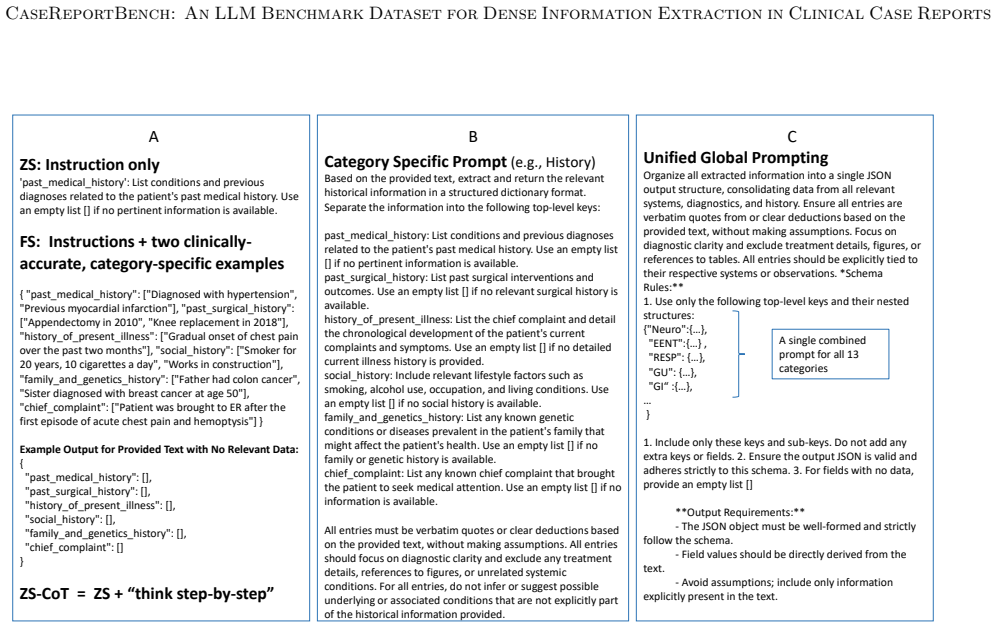
The load-bearing machinery is CaseReportBench itself: 138 case reports curated from open-access PubMed Central, annotated by two rare-disease specialists into 14 categories such as History, Lab Image, Neurology, and Pregnancy, with disagreements reconciled by a third reviewer. The primary evaluation metric is Token Set Ratio (TSR), a fuzzy string-similarity score over token sets, alongside Levenshtein similarity and exact match. The prompting strategies compared are category-specific prompting (each category gets a tailored prompt) versus unified global prompting, combined with few-shot examples and with subheading-filtered text integration (FCSP) versus unfiltered full-text application (UCP). The paper's key methodological claim is that category-specific, few-shot prompting with filtered subheadings gives the best alignment with expert annotations, while a single unified prompt collapses.
What would settle it
Run the same extraction task with a clinician-graded semantic metric, or have clinicians rate whether GPT-4o's paraphrased outputs contain the same clinical facts as the gold annotations; if GPT-4o's facts are judged clinically equivalent, the token-similarity ranking collapses.
Extended reading notes
Core claim
The paper's core claim is that for dense information extraction from clinical case reports, the open-source Qwen2.5-7B-Instruct model outperforms all tested alternatives, including GPT-4o and the larger Qwen2.5-32B, under string-based evaluation metrics. With few-shot category-specific prompting and filtered subheading data integration, Qwen2.5-7B reaches a Token Set Ratio of 56.4%, Exact Match of 38.3%, and the lowest hallucination rate among the five models, while GPT-4o scores lowest on these metrics. The authors attribute GPT-4o's weak numerical performance partly to evaluation metrics that penalize synonym use and rephrasing, and they argue that instruction fidelity and output-format compliance matter more than model size for structured clinical extraction. Clinician evaluations of Llama3-8B outputs rate readability and trustworthiness highly but note lower actionability and omissions of negative findings, suggesting that token-level accuracy does not automatically equal clinical utility.
Load-bearing premise
The ranking of models rests on the assumption that string-level token similarity (TSR) captures what matters in clinical information extraction; if synonym use and rephrasing are clinically acceptable, GPT-4o's lower scores may overstate its deficiency.
Editorial extensions
If this is right
- A 7-billion-parameter open-weight model can serve as a practical extractor for structured clinical information from case reports, reducing dependence on proprietary APIs.
- Category-specific prompting with few-shot examples is a transferable recipe for dense extraction tasks that require many output fields.
- Unified global prompting is poorly suited to this task because models fail to follow the full output schema, suggesting that multi-category extraction should be decomposed.
- Token-level similarity metrics and hallucination rate can distinguish instruction-following ability among LLMs, even when traditional fluency metrics do not.
- LLM-assisted extraction can reduce manual annotation time by roughly 24 hours across 138 cases while still needing expert oversight, especially to catch negative findings.
Reading between the lines
- If a clinician-grounded or semantic similarity metric replaced TSR, the model ranking might shift, since the paper notes GPT-4o's paraphrases are penalized; a clinician study with meaning-based scoring could test this.
- The benchmark's category imbalance (e.g., Lymphatic System appears in only 2 of 138 reports) means per-category conclusions about rare categories are weak; rebalancing or pooling across more reports could sharpen comparisons.
- The same category-specific prompting recipe may transfer to other rare-disease domains beyond inborn errors of metabolism, since the 14 categories are drawn from a standard inpatient work-up form rather than an IEM-specific ontology.
- Future work could use CaseReportBench to test whether semantic evaluators, such as an LLM judge with clinical grounding, change the ranking, or whether explicitly extracting negative findings improves differential-diagnosis support.
Editorial analysis
A structured set of objections, weighed in public.
Referee Report
Summary. The paper introduces CaseReportBench, an expert-annotated benchmark for dense information extraction from 138 clinical case reports focused on inborn errors of metabolism, using 14 structured clinical categories. The authors evaluate five LLMs (Qwen2-7B, Qwen2.5-7B, Qwen2.5-32B, Llama3-8B, and GPT-4o) under three data integration methods (FCSP, UCP, UGP) and several prompting strategies, and report that Qwen2.5-7B outperforms GPT-4o on string-based metrics. They also present a clinician evaluation of Llama3-8B outputs. The dataset and code are publicly released.
Significance. If the central claim is upheld, the benchmark would be a useful resource for evaluating clinical dense extraction, and the finding that a compact open-weight model outperforms GPT-4o would be notable for practical medical NLP. The paper has concrete strengths: a publicly released, expert-annotated dataset with a documented reconciliation pipeline; systematic comparisons of prompting and data integration strategies; and a clinician assessment that goes beyond automatic metrics. The main weakness is that the headline model ranking is established exclusively through token-overlap metrics, which the authors themselves acknowledge penalize clinically valid paraphrases, and the clinician evaluation was not applied to the models being compared in that ranking.
major comments (4)
- [Section 5, Tables 2 and 3] The headline claim that Qwen2.5-7B outperforms GPT-4o is supported only by TSR, Levenshtein, exact match, BLEU, and ROUGE. These metrics penalize synonyms and rewording, as the paper concedes in Section 5: GPT-4o's lower performance is 'likely due to the stringent evaluation metrics used, which penalize minor variations (e.g., synonyms, rewording).' The clinician evaluation in Section 5.1 was run only on Llama3-8B outputs, not on Qwen2.5-7B versus GPT-4o, so there is no human or semantic check on the comparison that drives the abstract's main claim. Without a metric that credits semantically equivalent extractions, or a clinician adjudication of the two models' outputs, the ranking may reflect formatting fidelity rather than clinical extraction quality. The authors should either add such an evaluation or substantially soften the comparative claim.
- [Appendix C, Table 7 and Appendix B, Table 5] Inter-annotator agreement is low in key categories: pairwise F1 is 0.18 for ENDO, 0.33 for GU, 0.33 for Vitals Hema, and 0.36 for MSK, and the average TSR between the two specialists is only 74.65, with History at 42.50. This means the gold standard is one of several acceptable extractions, and a model that chooses a different but clinically equivalent wording is heavily discounted. The evaluation should report model performance against each annotator's original annotations as a robustness check, and the discussion should explicitly address how the reconciled gold standard interacts with the string-based metrics.
- [Section 5, Tables 2 and 3] All results appear to come from a single run per configuration, with no error bars, confidence intervals, or significance tests. Differences among the top configurations (e.g., qwen2.5:7b FS FCSP TSR 56.377 versus qwen2.5:32b FS FCSP 51.467 versus llama3:8b FS FCSP 50.351) may be within run-to-run noise, especially for greedy or low-temperature decoding with quantized local models. At minimum, the authors should report multiple runs or bootstrap resampling to establish that the ordering is stable.
- [Section 5, hallucination definition] Hallucination is defined as the percentage of LLM-extracted information not present in the benchmark set. Given the low inter-annotator agreement documented in Appendix C, many non-gold extractions may be clinically valid details that the annotators simply did not include or assigned to a different category. The hallucination metric therefore conflates clinically false content with format deviation and missing from gold. The paper should distinguish these cases, for example by having clinicians review a sample of non-matching extractions for the models being compared, rather than labeling all non-gold content as hallucination.
minor comments (4)
- [Figure 3C] The figure caption says 'a single combined prompt for all 13 categories,' while the text describes 14 clinical categories; please make the count consistent.
- [Section 5 and Table 3] The model identifier 'qwen2.532b' appears without a colon in Table 3, unlike the other Qwen entries; please standardize the notation.
- [Section 5, 'Open-Source Models and GPT-4o' paragraph] The text contains the typo 'textbffactual precision' and should read 'textual precision' or similar.
- [Section 5 and throughout] The abbreviation is introduced as FCSP, but the text later uses 'FSCSP' in the clinician evaluation section and in the conclusions; please use one consistent abbreviation.
Circularity Check
No circularity: the benchmark evaluation is an empirical measurement, not a derived result that reduces to its inputs.
full rationale
CaseReportBench reports an empirical benchmark evaluation rather than a derivation. The central comparison (Qwen2.5-7B vs. GPT-4o) is measured directly with TSR, Levenshtein, exact match, BLEU, and ROUGE against an expert-annotated gold set; no fitted parameter is renamed as a prediction, and no equation-level reduction connects the inputs to the headline result. The authors' statement that GPT-4o's lower scores are 'likely due to the stringent evaluation metrics used, which penalize minor variations' (Section 5) is a validity caveat, not circularity: it does not make the ranking true by construction. The clinician assessment being limited to Llama3-8B outputs likewise weakens generalization but does not create a definitional loop. Self-citations are not load-bearing in the evaluation chain. Under the required standard that circularity be exhibited through specific quoted reductions, no circular step can be identified; the possible metric-validity concern belongs to correctness risk, not circularity.
Assumptions & free parameters
free parameters (1)
- TSR reconciliation threshold =
30
assumptions (5)
- domain assumption Expert annotations after reconciliation are a valid gold standard for dense clinical information extraction.
- ad hoc to paper String-based similarity metrics (TSR, Levenshtein, EM) capture clinically meaningful agreement.
- domain assumption LLM outputs under 4-bit quantization via Ollama are representative of the models' capabilities.
- domain assumption Case reports selected via IEMbase terms and regex filtering are representative of IEM case reports.
- domain assumption The five-case clinician evaluation by the same annotators who built the gold standard provides unbiased assessment.
Cite this review
Pith. "Pith review of CaseReportBench: An LLM Benchmark Dataset for Dense Information Extraction in Clinical Case Reports." pith.science (2026). https://pith.science/paper/S4MVFVYM
@misc{pith2026250517265,
  author       = {Pith},
  title        = {Pith review of: CaseReportBench: An LLM Benchmark Dataset for Dense Information Extraction in Clinical Case Reports},
  year         = {2026},
  howpublished = {\url{https://pith.science/paper/S4MVFVYM}},
  note         = {Machine review of arXiv:2505.17265}
}
read the original abstract
Rare diseases, including Inborn Errors of Metabolism (IEM), pose significant diagnostic challenges. Case reports serve as key but computationally underutilized resources to inform diagnosis. Clinical dense information extraction refers to organizing medical information into structured predefined categories. Large Language Models (LLMs) may enable scalable information extraction from case reports but are rarely evaluated for this task. We introduce CaseReportBench, an expert-annotated dataset for dense information extraction of case reports, focusing on IEMs. Using this dataset, we assess various models and prompting strategies, introducing novel approaches such as category-specific prompting and subheading-filtered data integration. Zero-shot chain-of-thought prompting offers little advantage over standard zero-shot prompting. Category-specific prompting improves alignment with the benchmark. The open-source model Qwen2.5-7B outperforms GPT-4o for this task. Our clinician evaluations show that LLMs can extract clinically relevant details from case reports, supporting rare disease diagnosis and management. We also highlight areas for improvement, such as LLMs' limitations in recognizing negative findings important for differential diagnosis. This work advances LLM-driven clinical natural language processing and paves the way for scalable medical AI applications.
Figures


Figures from the paper (3 more)


Reference graph
Works this paper leans on
-
[1]
Large language models are few-shot clinical information extractors
Monica Agrawal, Stefan Hegselmann, Hunter Lang, Yoon Kim, and David Sontag. Large language models are few-shot clinical information extractors. arXiv preprint arXiv:2205.12689 ,
-
[4]
Abhimanyu Dubey, Abhinav Jauhri, Abhinav Pandey, Abhishek Kadian, Ahmad Al-Dahle, Aiesha Letman, Akhil Mathur, Alan Schelten, Amy Yang, Angela Fan, et al. The llama 3 herd of models. arXiv preprint arXiv:2407.21783,
-
[7]
Biocreative v cdr task corpus: a resource for chemical disease relation extraction
Jiao Li, Yueping Sun, Robin J Johnson, Daniela Sci- aky, Chih-Hsuan Wei, Robert Leaman, Allan Peter Davis, Carolyn J Mattingly, Thomas C Wiegers, and Zhiyong Lu. Biocreative v cdr task corpus: a resource for chemical disease relation extraction. Database, 2016,
work page 2016
-
[10]
Health- prompt: a zero-shot learning paradigm for clinical natural language processing
Sonish Sivarajkumar and Yanshan Wang. Health- prompt: a zero-shot learning paradigm for clinical natural language processing. In AMIA Annual Sym- posium Proceedings, volume 2022, page 972,
work page 2022
-
[12]
Zhengyun Zhao, Qiao Jin, Fangyuan Chen, Tuorui Peng, and Sheng Yu. Pmc-patients: A large- scale dataset of patient summaries and relations for benchmarking retrieval-based clinical decision support systems. arXiv preprint arXiv:2202.13876 ,
-
[2014]
Alexander Braylan, Omar Alonso, and Matthew Lease. Measuring annotator agreement generally across complex structured, multi-object, and free-text an- notation tasks. In Proceedings of the ACM Web Conference 2022, pages 1720–1730,
work page 2022
-
[2017]
Lessons from natural language inference in the clinical do- main
Alexey Romanov and Chaitanya Shivade. Lessons from natural language inference in the clinical do- main. arXiv preprint arXiv:1808.06752 ,
-
[2018]
Ollama. Ollama framework. https://ollama.ai. Phillip Richter-Pechanski, Philipp Wiesenbach, Do- minic M Schwab, Christina Kiriakou, Nicolas Geis, Christoph Dieterich, and Anette Frank. Clini- cal information extraction for low-resource lan- guages with few-shot learning using pre-trained language models and prompting. arXiv preprint arXiv:2403.13369,
Show all 12 references
-
[2021]
Medical information ex- traction with large language models
Raffaello Fornasiere, Nicol` o Brunello, Vincenzo Scotti, Mark James Carman, et al. Medical information ex- traction with large language models. In Proceedings of the 7th International Conference on Natural Lan- guage and Speech Processing (ICNLSP 2024), pages 1–10. Associatio...
2024
-
[2022]
Derek A Applegarth, Jennifer R Toone, R. T. Lowry, and R. Brian. Incidence of inborn errors of metabolism in british columbia, 1969–1996. Pe- diatrics, 105(1):e10–e10,
1969
-
[2023]
Binyuan Hui, Jian Yang, Zeyu Cui, Jiaxi Yang, Day- iheng Liu, Lei Zhang, Tianyu Liu, Jiajun Zhang, Bowen Yu, Keming Lu, et al. Qwen2. 5-coder techni- cal report. arXiv preprint arXiv:2409.12186 ,
-
[2024]
An Yang, Baosong Yang, Beichen Zhang, Binyuan Hui, Bo Zheng, Bowen Yu, Chengyuan Li, Dayiheng Liu, Fei Huang, Haoran Wei, et al. Qwen2. 5 technical report. arXiv preprint arXiv:2412.15115 ,
Reviewed August 7, 2026 · model on record in the stance chip above.
Discussion (0). Continue with ORCID to comment.