REVIEW 4 major objections 5 minor 11 cited by
EGA-V2: An End-to-end Generative Framework for Industrial Advertising
T0 review · 4 major / 5 minor · reviewed 2026-08-07 · deepseek-v4-flash
Pith's one-line read A single generative model can replace the multi-stage cascade of industrial advertising, deciding which ads and creatives to show and what to charge them, all in one pass.
desk verdict A plausible industrial system paper whose architecture is worth discussing, but the central empirical claim is not established because the offline metrics are computed from the same reward model that selects the ads. read the letter →
The pith
A machine-rendered reading of the paper's core claim, the machinery that carries it, and where it could break.
The reading
What carries the argument
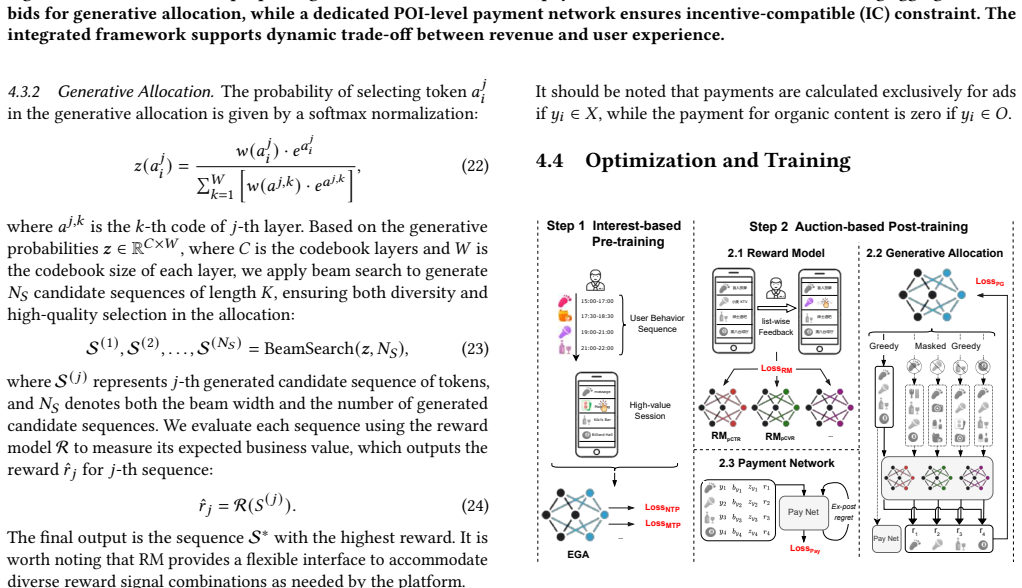
The load-bearing machinery is the decoupled allocation-and-payment pipeline. Allocation runs on token-level bids: each token's weight is $w(a_j^i)=[\max(b_1,\dots,b_{N_i})]^\alpha+\beta$, normalized by a softmax over the codebook, and beam search generates candidate sequences that a permutation-aware reward model scores. Payment is computed separately at the POI level by a network $p=\hat{p}\odot b$ with $\hat{p}=\sigma(\mathrm{MLP}(S^*;B_-;Z\cdot\Theta))$, trained under the Lagrangian loss $-\sum_{y_i\in S^*} p_i \hat{r}_i^{\mathrm{pctr}} - \sum_i \lambda_i \mathrm{crgt}_i - \frac{\rho}{2}\sum_i(\mathrm{crgt}_i)^2$, alternating payment-network updates with multiplier updates on empirical ex-post regret. The RQ-VAE tokenizer, multi-token prediction heads, and two-phase training (interest-based pretraining then frozen-backbone auction post-training) supply the generative backbone; the ex-post regret Lagrangian is what carries the incentive-compatibility claim.
What would settle it
Recompute RPM and CTR on the held-out test days using real logged clicks and conversions instead of the reward model's predicted pCTR and pCVR, and compare EGA-V2 to MCA; if the reported advantage shrinks to noise, the paper's central claim fails.
Extended reading notes
Core claim
The central claim is that allocation and payment can be decoupled inside a single generative advertising model, and that this decoupling preserves approximate incentive compatibility while improving revenue. Items are tokenized with RQ-VAE into hierarchical semantic tokens; a pretrained encoder-decoder with multi-token prediction generates both POI recommendations and creative tokens; a permutation-aware reward model scores full sequences; token-level bidding aggregates advertiser bids over the tokens; and a separate POI-level payment network charges advertisers using a sigmoid payment rate. The payment network is trained with a Lagrangian objective that maximizes expected payment while driving empirical ex-post regret toward zero. The paper states that this yields 'approximate incentive compatibility at the POI level.' In offline experiments, EGA-V2 reports RPM of 230.41, CTR-poi of 0.0612, CTR-img of 0.0583, and IC regret of 2.7%, beating both the multi-stage cascade (MCA) and generative recommendation (GR) baselines on all four metrics.
Load-bearing premise
The weakest load-bearing premise is that the reward model's predicted click and conversion rates faithfully reflect real user behavior, because these predicted values are used both to pick the generated sequences and to compute every offline metric reported in the paper.
Editorial extensions
If this is right
- If EGA-V2 is right, ad systems no longer need separate recall, ranking, creative-selection, and auction modules; a single model can emit the final list, creatives, and payments.
- A learned payment network trained with ex-post regret can keep advertisers roughly truthful at the POI level, with IC regret of 2.7% in offline tests versus 8.4% for a GSP-based generative baseline.
- Token-level bidding gives operators two dials: α controls how strongly bids influence allocation, and β controls the ad-to-organic ratio, allowing a real-time trade-off between revenue and user experience.
- The multi-phase training recipe—interest-based pretraining followed by frozen-backbone auction post-training—outperforms single-stage end-to-end training in the ablation, with RPM 230.41 versus 218.21.
- Offline results position the architecture for online A/B testing, which the paper identifies as future work.
Reading between the lines
- Editorial inference: the same allocation-payment decoupling could be tested in generative retrieval systems outside advertising; any generator that emits candidates under a budget could use a separate learned pricing head with an ex-post regret penalty.
- Editorial inference: the IC guarantee is explicitly at the POI level and approximate, so an adversarial advertiser could still attempt to game the creative token or image branch, since creative-level payments are not directly constrained—this is an untested boundary.
- Editorial inference: if the reward model is miscalibrated, the paper's own reported gains may be objective-fitting artifacts; a calibration check on out-of-sample real clicks would settle whether the architecture genuinely improves user experience or only the proxy.
- Editorial inference: the ablation suggests max-aggregation of bids at token level is doing real work for IC; a monotone, differentiable alternative such as log-sum-exp with temperature could give similar revenue with smoother gradients.
Editorial analysis
A structured set of objections, weighed in public.
Referee Report
Summary. EGA-V2 is an end-to-end generative framework for industrial advertising that unifies POI recommendation, creative generation, ad allocation, and payment computation in a single encoder-decoder model. The paper uses RQ-VAE tokenization, multi-token prediction, a permutation-aware reward model, token-level bidding, and a decoupled payment network trained with a Lagrangian objective on empirical ex-post regret. The claimed contributions are a multi-phase training strategy (interest-based pre-training followed by auction-based post-training) and approximately incentive-compatible payment at the POI level. Offline experiments on a Meituan industrial dataset report that EGA-V2 outperforms a multi-stage cascading architecture (MCA) and a generative recommendation baseline (GR) in RPM, CTR, and IC regret, with ablations attributing gains to each component.
Significance. If the empirical results hold, the paper would make a meaningful engineering contribution: it demonstrates a concrete way to fold retrieval, ranking, creative selection, allocation, and payment into a single generative model while respecting auction constraints. The strengths are the large-scale industrial dataset (200 million requests), the clear system description, and the ablation study that isolates the MTP module, multi-phase training, max-pooled token-level bidding, and the learned payment network. The main weakness is that all offline metrics are computed with predictions from the same reward model that selects the output sequence, making the evaluation partially self-referential. No online A/B test, calibration analysis, or debiased offline evaluation is provided, and the paper itself notes that online A/B testing is future work. The approximate-incentive-compatibility claim is also presented as a guarantee, although the optimization is non-convex and the regret is measured against the model's own predicted pCTR. The contribution is therefore promising but not yet established as reported.
major comments (4)
- [§5.1.2 and Eq. (24)] The evaluation loop closes: Section 5.1.2 states that "For offline experiments, evaluation metrics are computed using the predicted values from the reward model," and Eq. (24) uses the same reward model R to score and select the winning sequence S*. Therefore the RPM, CTR, and IC regret numbers in Table 2 are computed from the very model that the policy optimizes against. If R is miscalibrated or reward-hacked, the reported lifts (e.g., RPM 230.41 vs. 206.73 and IC regret 2.7% vs. 8.4%) can be artifacts of the optimization objective rather than genuine improvements in user behavior or advertiser utility. The paper should add a calibration analysis of R (e.g., reliability diagrams and expected calibration error), evaluate at least one metric from logged real outcomes or an unbiased offline estimator, and ideally report online A/B results; without this, the headline outperformance claim is not supported.
- [§4.4.2, Eqs. (31)–(32)] The post-training stage is underspecified with respect to which parameters are actually trained. The text says "Following the pre-training phase, we freeze its parameters and optimize the generative advertising model under auction constraints," but it does not state which parameters the policy-gradient loss LPG in Eq. (32) updates. If the pre-trained backbone is frozen, only the allocation weights in Eq. (22) are trainable, and alpha and beta are listed as hyperparameters; this would make the ``generative allocation training'' hard to interpret. The paper needs to state the exact parameterization of the policy, which parameters are frozen and which are updated in each step, and how gradients flow through Eq. (22).
- [§4.4.2, Eq. (33), and abstract] The abstract's claim of "guaranteeing approximate incentive compatibility" is stronger than what the method supports. The Lagrangian objective in Eq. (33) minimizes a penalty on empirical ex-post regret, but the paper acknowledges immediately after Eq. (35) that the objective is non-convex and convergence to the global optimum is not theoretically guaranteed. Moreover, the ex-post regret crgt_i and the utility u_i used to define the IC metric are computed with predicted pCTR from the reward model and with payments from the very payment network being optimized, so a low in-sample regret is partly a self-fulfilling outcome. The claim should be weakened to something like ``empirically reduces ex-post regret under model-estimated pCTR,'' or the paper should provide a formal IC guarantee or validation on held-out advertiser payoffs with real outcomes.
- [§4.4.2, Eq. (31)] The marginal contribution r_yi in Eq. (31) is not well defined because S*_{-i}, the ``best alternative ad sequence excluding y_i,'' is not specified. It is unclear how this alternative sequence is generated, whether it is recomputed after removing y_i from the beam search, and how the exclusion interacts with the token-level generative process. Since this quantity is the reward signal for the policy-gradient loss in Eq. (32), the training objective is currently not reproducible without additional specification.
minor comments (5)
- [Eq. (28)] The MTP loss uses Y_{1:t-1} in the conditioning term, but the summation index is i; this should presumably be Y_{1:i-1} to be consistent with the probabilistic decomposition in Eq. (13).
- [Footnote 3] The statement that reported results have been ``transformed in a way that preserves their statistical properties'' is too vague; the paper should clarify which statistical properties are preserved (e.g., ranks, relative differences, or margins) so readers can judge whether the reported absolute values and lift percentages are meaningful for comparison.
- [Section 1 and contributions] There are minor language issues, such as ``by an unified single generative model'' and ``Last but not least ,''; these should be corrected in a polish pass.
- [Figure 3] The figure label ``All Valid POIs'' is not explained in the text; the paper should define what makes a POI valid in the generative allocation step.
- [Footnote 2] The note that evaluation is limited to offline experiments because of computational complexity is an important limitation and deserves more discussion in the conclusion, especially because the paper describes the framework as ready for industrial deployment.
Circularity Check
Offline RPM/CTR/IC metrics are computed from the reward model and payment network being optimized, so the reported gains are partially self-fulfilling.
-
fitted input called prediction
[Section 5.1.2 (Evaluation Metrics); Eqs. (20), (24), (31)-(32)]
"For offline experiments, evaluation metrics are computed using the predicted values from the reward model. ... ˆr_j = R(S^(j)). ... The final output is the sequence S∗ with the highest reward."
The same reward model R provides the pCTR predictions in Eq. (20), selects the winning sequence S∗ in Eq. (24), and supplies the 'clicks' used to compute offline RPM and CTR in Section 5.1.2. The generative allocation policy is trained to maximize Σ_j b_j·ˆr^{pctr}_j (Eqs. 31-32), so the evaluation metric is essentially the objective being optimized. Reported lifts over MCA/GR therefore measure how well the model optimizes its own reward model, not an independent estimate of user behavior; no logged-outcome or debiased offline evaluation is provided.
-
fitted input called prediction
[Section 4.4.2 Eq. (33); Section 5.1.2 IC Metric]
"IC Metric: Ψ = 1/|D| Σ_{d∈D} Σ_{i∈k} crgt^d_i / u_i(v^d_i; b^d), where crgt^d_i denotes the empirical ex-post regret ... as defined in Equation (7). ... LPay = ... Σ_{y_i∈S*} λ_i crgt_i − ρ/2 Σ_{y_i∈S*} (crgt_i)^2."
The reported IC metric Ψ is the same empirical ex-post regret crgt that the payment network is trained to minimize in Eq. (33). The payment network is fitted with a Lagrangian objective that drives crgt toward zero, and the paper then reports crgt/u as evidence of approximate incentive compatibility. Thus the low Ψ value (2.7%) is an in-sample training objective, not an independent counterfactual test of truthfulness; it is forced by construction rather than verified externally.
full rationale
EGA-V2's architecture and training losses are not themselves derived from the reported metrics, so this is not total circularity. The circularity is concentrated in the offline evaluation loop used to support the headline empirical claims. Eq. (20) defines the reward model's predicted pCTR; Eq. (24) uses that reward model to select the final sequence; Eqs. (31)-(32) train the generator to maximize revenue computed with those same predictions; and Section 5.1.2 explicitly states that offline RPM, CTR, and IC metrics are computed from the reward model's predicted values. Similarly, the IC metric Ψ is the averaged empirical ex-post regret crgt, which is exactly the quantity the payment network's loss in Eq. (33) is designed to minimize. The reported RPM increase (230.41 vs 206.73) and IC regret reduction (2.7% vs 8.4%) therefore partly reduce to the model optimizing its own evaluation function. The reward model is trained on real user feedback, which gives the loop some independent grounding, but no calibration or debiased offline evaluation is supplied. Overall, the central 'significantly outperforms' claim is partially circular, warranting a score of 6 rather than a higher score that would imply the derivation itself is an identity.
Assumptions & free parameters
free parameters (5)
- alpha (bid weight exponent) =
1.2
- beta (organic/ad balance) =
2
- beam width N_S =
64
- Lagrangian penalty rho =
not reported
- number of sampled valuations N_v =
not reported
assumptions (6)
- domain assumption User historical behavior sequences are a reliable predictor of future click and conversion behavior.
- domain assumption The learned reward model's predicted pCTR and pCVR are faithful proxies for real user engagement.
- ad hoc to paper Aggregating item bids by taking the maximum over items sharing a token preserves advertiser incentives and supports an approximately incentive-compatible allocation.
- ad hoc to paper Minimizing empirical ex-post regret with a Lagrangian penalty yields a payment rule that is approximately incentive compatible.
- ad hoc to paper The marginal contribution of an item to revenue is correctly estimated by comparing the current sequence with the best alternative sequence without that item.
- domain assumption The organic content order is fixed and known a priori.
Cite this review
Pith. "Pith review of EGA-V2: An End-to-end Generative Framework for Industrial Advertising." pith.science (2026). https://pith.science/paper/6ROQFBNY
@misc{pith2026250517549,
  author       = {Pith},
  title        = {Pith review of: EGA-V2: An End-to-end Generative Framework for Industrial Advertising},
  year         = {2026},
  howpublished = {\url{https://pith.science/paper/6ROQFBNY}},
  note         = {Machine review of arXiv:2505.17549}
}
read the original abstract
Traditional online industrial advertising systems suffer from the limitations of multi-stage cascaded architectures, which often discard high-potential candidates prematurely and distribute decision logic across disconnected modules. While recent generative recommendation approaches provide end-to-end solutions, they fail to address critical advertising requirements of key components for real-world deployment, such as explicit bidding, creative selection, ad allocation, and payment computation. To bridge this gap, we introduce End-to-End Generative Advertising (EGA-V2), the first unified framework that holistically models user interests, point-of-interest (POI) and creative generation, ad allocation, and payment optimization within a single generative model. Our approach employs hierarchical tokenization and multi-token prediction to jointly generate POI recommendations and ad creatives, while a permutation-aware reward model and token-level bidding strategy ensure alignment with both user experiences and advertiser objectives. Additionally, we decouple allocation from payment using a differentiable ex-post regret minimization mechanism, guaranteeing approximate incentive compatibility at the POI level. Through extensive offline evaluations we demonstrate that EGA-V2 significantly outperforms traditional cascaded systems in both performance and practicality. Our results highlight its potential as a pioneering fully generative advertising solution, paving the way for next-generation industrial ad systems.
Figures


Figures from the paper (2 more)

Forward citations
Cited by 11 Pith papers
-
Gryphon-v2: One Model in Place of a Cascade - Generate-and-Rank Recommender with Rollout Distillation
A single generate-and-rank model with a distilled ranking module replaces a 15-plus stage production recommender cascade and lifts active users by 1.41% in an online A/B test.
-
HGenPush: A Heterogeneous Generative Recommendation Architecture for Industrial Push Notification Systems
HGenPush jointly generates video and author recommendations via Chained-MTP and GSISPO preference alignment, raising Kuaishou push DAU by 0.181%.
-
UniVA: Unified Value Alignment for Generative Recommendation in Online Advertising at Tencent
UniVA unifies value alignment in generative recommendation via a Commercial SID tokenizer, eCPM-aware RL decoder, and personalized beam search, reporting 37% offline Hit Rate gains and 1.5% online GMV lift on Tencent ...
-
GFlowGR: Fine-tuning Generative Recommendation Frameworks with Generative Flow Networks
GFlowGR fine-tunes generative recommender LLMs with GFlowNet losses and multi-signal rewards, beating SFT, DPO, and GRPO baselines on three datasets and in production.
-
OneSug: The Unified End-to-End Generative Framework for E-commerce Query Suggestion
A unified encoder-decoder model with prefix representation enhancement and reward-weighted DPO outperforms Kuaishou's online multi-stage query suggestion system in offline and live A/B evaluations.
-
UniGD: A Unified Generative-Discriminative Framework for Industrial Retrieval
UniGD couples generative retrieval with explicit relevance scoring in one model, reporting +5.78% ad revenue, 33.1% lower latency at Kuaishou, and improved Recall@10 on NQ320K and MS300K.
-
TSGR: Taobao Search Generative Retrieval
TSGR makes Taobao search retrieval value-aware by ordering item IDs by clicks and query intent and re-ranking generated candidates with a value module, improving HR@1000 and GMV.
-
Noise is not always detrimental: the capacity of quantum batteries is enhanced in black holes
Hawking radiation is claimed to enhance quantum battery capacity for bipartite mixed states, while environmental noise generally degrades it in type-dependent ways.
-
FORGE: Forming Semantic Identifiers for Generative Retrieval in Industrial Datasets
FORGE shows that balancing codebook usage and adding multimodal side information improves semantic identifiers for generative retrieval, validated offline and on Taobao.
-
NGA: Non-autoregressive Generative Auction with Global Externalities for Advertising Systems
NGA is a non-autoregressive generative auction that models effects of adjacent organic content and computes rewards and payments in parallel, reporting gains in RPM, CTR, CVR, and latency over CGA.
-
Coarse-to-Fine Long-term Interest Modeling for Generative Recommendation
GLASS extends generative retrieval with a tiered long-term interest vector and a first-SID-keyed search of long histories, reporting consistent gains over Tiger and DualGR on two public datasets.
Reference graph
Works this paper leans on
-
[1]
Yoram Bachrach, Sofia Ceppi, Ian A Kash, Peter Key, and David Kurokawa. 2014. Optimising trade-offs among stakeholders in ad auctions. In Proceedings of the fifteenth ACM conference on Economics and computation . 75–92
work page 2014
-
[2]
Dagui Chen, Qi Yan, Chunjie Chen, Zhenzhe Zheng, Yangsu Liu, Zhenjia Ma, Chuan Yu, Jian Xu, and Bo Zheng. 2022. Hierarchically constrained adaptive ad exposure in feeds. In Proceedings of the 31st ACM International Conference on Information & Knowledge Management . 3003–3012
work page 2022
-
[3]
Nicola De Cao, Gautier Izacard, Sebastian Riedel, and Fabio Petroni. 2020. Au- toregressive entity retrieval. arXiv preprint arXiv:2010.00904 (2020)
arXiv 2020
-
[4]
Jiaxin Deng, Shiyao Wang, Kuo Cai, Lejian Ren, Qigen Hu, Weifeng Ding, Qiang Luo, and Guorui Zhou. 2025. OneRec: Unifying Retrieve and Rank with Generative Recommender and Iterative Preference Alignment. arXiv preprint arXiv:2502.18965 (2025)
arXiv 2025
-
[5]
Yuan Deng, Sébastien Lahaie, Vahab Mirrokni, and Song Zuo. 2020. A data- driven metric of incentive compatibility. In Proceedings of The Web Conference
work page 2020
-
[6]
Paul Duetting, Vahab Mirrokni, Renato Paes Leme, Haifeng Xu, and Song Zuo
-
[7]
Paul Dütting, Zhe Feng, Harikrishna Narasimhan, David Parkes, and Sai Srivatsa Ravindranath. 2019. Optimal auctions through deep learning. In International Conference on Machine Learning . PMLR, 1706–1715
work page 2019
-
[8]
Benjamin Edelman, Michael Ostrovsky, and Michael Schwarz. 2007. Internet advertising and the generalized second-price auction: Selling billions of dollars worth of keywords. American economic review 97, 1 (2007), 242–259
work page 2007
Show all 44 references
-
[9]
Nicola Gatti, Alessandro Lazaric, and Francesco Trovo. 2012. A truthful learning mechanism for contextual multi-slot sponsored search auctions with externalities. In Proceedings of the 13th ACM Conference on Electronic Commerce . 605–622
2012
-
[10]
Fabian Gloeckle, Badr Youbi Idrissi, Baptiste Rozière, David Lopez-Paz, and Gabriel Synnaeve. 2024. Better & faster large language models via multi-token prediction. arXiv preprint arXiv:2404.19737 (2024)
2024 arXiv
-
[11]
Siyu Gu and Xiangrong Sheng. 2022. On Ranking Consistency of Pre-ranking Stage. arXiv preprint arXiv:2205.01289 (2022)
2022 arXiv
-
[12]
Patrick Hummel and R Preston McAfee. 2014. Position auctions with externalities. In Web and Internet Economics: 10th International Conference, WINE 2014, Beijing, China, December 14-17, 2014. Proceedings 10 . Springer, 417–422
2014
-
[13]
Xuejian Li, Ze Wang, Bingqi Zhu, Fei He, Yongkang Wang, and Xingxing Wang
-
[14]
Guogang Liao, Xuejian Li, Ze Wang, Fan Yang, Muzhi Guan, Bingqi Zhu, Yongkang Wang, Xingxing Wang, and Dong Wang. 2022. NMA: neural multi-slot auctions with externalities for online advertising. arXiv preprint arXiv:2205.10018 (2022)
2022 arXiv
-
[15]
Deep automated mechanism design for integrating ad auction and allocation Woodstock ’18, June 03–05, 2018, Woodstock, NY Zheng et al. in feed. In Proceedings of the 47th International ACM SIGIR Conference on Research and Development in Information Retrieval . 1211–1220
2018
-
[16]
Guogang Liao, Ze Wang, Xiaoxu Wu, Xiaowen Shi, Chuheng Zhang, Yongkang Wang, Xingxing Wang, and Dong Wang. 2022. Cross DQN: Cross deep Q network for ads allocation in feed. In Proceedings of the ACM Web Conference 2022 . 401– 409
2022
-
[17]
Guogang Liao, Xiaowen Shi, Ze Wang, Xiaoxu Wu, Chuheng Zhang, Yongkang Wang, Xingxing Wang, and Dong Wang. 2022. Deep page-level interest net- work in reinforcement learning for ads allocation. In Proceedings of the 45th International ACM SIGIR Conference on Research and Devel...
2022
-
[18]
Han Liu, Yinwei Wei, Xuemeng Song, Weili Guan, Yuan-Fang Li, and Liqiang Nie. 2024. Mmgrec: Multimodal generative recommendation with transformer model. arXiv preprint arXiv:2404.16555 (2024)
2024 arXiv
-
[19]
Aixin Liu, Bei Feng, Bing Xue, Bingxuan Wang, Bochao Wu, Chengda Lu, Cheng- gang Zhao, Chengqi Deng, Chenyu Zhang, Chong Ruan, et al. 2024. Deepseek-v3 technical report. arXiv preprint arXiv:2412.19437 (2024)
2024 arXiv
-
[20]
Shashank Rajput, Nikhil Mehta, Anima Singh, Raghunandan Hulikal Keshavan, Trung Vu, Lukasz Heldt, Lichan Hong, Yi Tay, Vinh Tran, Jonah Samost, et al
-
[21]
Xiangyu Liu, Chuan Yu, Zhilin Zhang, Zhenzhe Zheng, Yu Rong, Hongtao Lv, Da Huo, Yiqing Wang, Dagui Chen, Jian Xu, et al. 2021. Neural auction: End-to- end learning of auction mechanisms for e-commerce advertising. In Proceedings of the 27th ACM SIGKDD Conference on Knowledge ...
2021
-
[22]
Juntao Tan, Shuyuan Xu, Wenyue Hua, Yingqiang Ge, Zelong Li, and Yongfeng Zhang. 2024. Idgenrec: Llm-recsys alignment with textual id learning. In Proceed- ings of the 47th International ACM SIGIR Conference on Research and Development in Information Retrieval. 355–364
2024
-
[23]
Yubao Tang, Ruqing Zhang, Jiafeng Guo, and Maarten de Rijke. 2023. Recent advances in generative information retrieval. In Proceedings of the Annual In- ternational ACM SIGIR Conference on Research and Development in Information Retrieval in the Asia Pacific Region . 294–297
2023
-
[24]
Zihua Si, Zhongxiang Sun, Jiale Chen, Guozhang Chen, Xiaoxue Zang, Kai Zheng, Yang Song, Xiao Zhang, Jun Xu, and Kun Gai. 2024. Generative Retrieval with Semantic Tree-Structured Identifiers and Contrastive Learning. In Proceedings of the 2024 Annual International ACM SIGIR Co...
2024
-
[25]
Yiqing Wang, Xiangyu Liu, Zhenzhe Zheng, Zhilin Zhang, Miao Xu, Chuan Yu, and Fan Wu. 2022. On designing a two-stage auction for online advertising. In Proceedings of the ACM Web Conference 2022 . 90–99
2022
-
[26]
Yidan Wang, Zhaochun Ren, Weiwei Sun, Jiyuan Yang, Zhixiang Liang, Xin Chen, Ruobing Xie, Su Yan, Xu Zhang, Pengjie Ren, et al. 2024. Content-Based Collaborative Generation for Recommender Systems. In Proceedings of the 33rd ACM International Conference on Information and Know...
2024
-
[27]
Yi Tay, Vinh Tran, Mostafa Dehghani, Jianmo Ni, Dara Bahri, Harsh Mehta, Zhen Qin, Kai Hui, Zhe Zhao, Jai Gupta, et al. 2022. Transformer memory as a differentiable search index. Advances in Neural Information Processing Systems 35 (2022), 21831–21843
2022
-
[28]
Ruobing Xie, Shaoliang Zhang, Rui Wang, Feng Xia, and Leyu Lin. 2021. Hierar- chical reinforcement learning for integrated recommendation. In Proceedings of the AAAI conference on artificial intelligence , Vol. 35. 4521–4528
2021
-
[29]
Yue Xu, Qijie Shen, Jianwen Yin, Zengde Deng, Dimin Wang, Hao Chen, Lixi- ang Lai, Tao Zhuang, and Junfeng Ge. 2023. Multi-channel Integrated Recom- mendation with Exposure Constraints. In Proceedings of the 29th ACM SIGKDD Conference on Knowledge Discovery and Data Mining . 5338–5349
2023
-
[30]
Ze Wang, Guogang Liao, Xiaowen Shi, Xiaoxu Wu, Chuheng Zhang, Yongkang Wang, Xingxing Wang, and Dong Wang. 2022. Learning List-wise Representation in Reinforcement Learning for Ads Allocation with Multiple Auxiliary Tasks. In Proceedings of the 31st ACM International Conferenc...
2022
-
[31]
Yuhao Yang, Zhi Ji, Zhaopeng Li, Yi Li, Zhonglin Mo, Yue Ding, Kai Chen, Zijian Zhang, Jie Li, Shuanglong Li, et al. 2025. Sparse Meets Dense: Unified Generative Recommendations with Cascaded Sparse-Dense Representations. arXiv preprint arXiv:2503.02453 (2025)
2025 arXiv
-
[32]
Zhiguang Yang, Liufang Sang, Haoran Wang, Wenlong Chen, Lu Wang, Jie He, Changping Peng, Zhangang Lin, Chun Gan, and Jingping Shao. 2024. Parallel ranking of ads and creatives in real-time advertising systems. In Proceedings of the AAAI Conference on Artificial Intelligence , ...
2024
-
[33]
Jinyun Yan, Zhiyuan Xu, Birjodh Tiwana, and Shaunak Chatterjee. 2020. Ads allocation in feed via constrained optimization. In Proceedings of the 26th ACM SIGKDD International Conference on Knowledge Discovery & Data Mining . 3386– 3394
2020
-
[34]
Jiaqi Zhai, Lucy Liao, Xing Liu, Yueming Wang, Rui Li, Xuan Cao, Leon Gao, Zhao- jie Gong, Fangda Gu, Michael He, et al. 2024. Actions speak louder than words: Trillion-parameter sequential transducers for generative recommendations.arXiv preprint arXiv:2402.17152 (2024)
2024 arXiv
-
[35]
Zhanhao Zhang. 2021. A survey of online auction mechanism design using deep learning approaches. arXiv preprint arXiv:2110.06880 (2021)
2021 arXiv
-
[36]
Neil Zeghidour, Alejandro Luebs, Ahmed Omran, Jan Skoglund, and Marco Tagliasacchi. 2021. Soundstream: An end-to-end neural audio codec. IEEE/ACM Transactions on Audio, Speech, and Language Processing 30 (2021), 495–507
2021
-
[37]
Zhilin Zhang, Xiangyu Liu, Zhenzhe Zheng, Chenrui Zhang, Miao Xu, Junwei Pan, Chuan Yu, Fan Wu, Jian Xu, and Kun Gai. 2021. Optimizing multiple performance metrics with deep GSP auctions for e-commerce advertising. InProceedings of the 14th ACM International Conference on Web ...
2021
-
[38]
Xiangyu Zhao, Changsheng Gu, Haoshenglun Zhang, Xiwang Yang, Xiaobing Liu, Jiliang Tang, and Hui Liu. 2021. Dear: Deep reinforcement learning for online advertising impression in recommender systems. In Proceedings of the AAAI conference on artificial intelligence , Vol. 35. 750–758
2021
-
[39]
Zhixuan Zhang, Yuheng Huang, Dan Ou, Sen Li, Longbin Li, Qingwen Liu, and Xiaoyi Zeng. 2023. Rethinking the role of pre-ranking in large-scale e-commerce searching system. arXiv preprint arXiv:2305.13647 (2023)
2023 arXiv
-
[40]
Bowen Zheng, Yupeng Hou, Hongyu Lu, Yu Chen, Wayne Xin Zhao, Ming Chen, and Ji-Rong Wen. 2024. Adapting large language models by integrating collaborative semantics for recommendation. In 2024 IEEE 40th International Conference on Data Engineering (ICDE) . IEEE, 1435–1448
2024
-
[41]
Ruitao Zhu, Yangsu Liu, Dagui Chen, Zhenjia Ma, Chufeng Shi, Zhenzhe Zheng, Jie Zhang, Jian Xu, Bo Zheng, and Fan Wu. 2024. Contextual Generative Auction with Permutation-level Externalities for Online Advertising. arXiv preprint arXiv:2412.11544 (2024)
2024 arXiv
-
[42]
Zhishan Zhao, Jingyue Gao, Yu Zhang, Shuguang Han, Siyuan Lou, Xiang-Rong Sheng, Zhe Wang, Han Zhu, Yuning Jiang, Jian Xu, et al. 2023. COPR: Consistency- Oriented Pre-Ranking for Online Advertising. In Proceedings of the 32nd ACM International Conference on Information and Kn...
2023
-
[2023]
Advances in Neural Information Processing Systems 36 (2023), 10299–10315
Recommender systems with generative retrieval. Advances in Neural Information Processing Systems 36 (2023), 10299–10315
2023
-
[2024]
In Proceedings of the ACM Web Conference 2024
Mechanism design for large language models. In Proceedings of the ACM Web Conference 2024. 144–155
2024
Reviewed August 7, 2026 · model on record in the stance chip above.
Discussion (0). Continue with ORCID to comment.