REVIEW 5 major objections 5 minor 2 cited by
EVADE-Bench: Multimodal Benchmark for Evaluating and Enhancing Evasive Content Detection
T0 review · 5 major / 5 minor · reviewed 2026-08-07 · deepseek-v4-flash
Pith's one-line read A new Chinese multimodal benchmark shows that even top AI models frequently miss evasive e-commerce content.
desk verdict Genuinely useful e-commerce moderation benchmark, but the headline accuracy claims hinge on a label-independence audit the paper does not provide. read the letter →
The pith
A machine-rendered reading of the paper's core claim, the machinery that carries it, and where it could break.
The reading
What carries the argument
The load-bearing mechanism is the All-in-One prompt design: a single instruction that fuses six product-specific rule sets into 26 mutually clarified violation categories, applied identically to text and image inputs. This is what lets the authors attribute performance changes to rule clarity: the same underlying data and models are tested under short single-category prompts and under the merged taxonomy, with prompt length rising from about 1K to 7K tokens while labels grow to 26. Because performance improves rather than degrades under the longer, denser prompt, the comparison isolates the effect of removing semantic overlap between categories. The iterative annotation-refinement pipeline, in which model disagreements trigger re-annotation by human experts, is the supporting machinery that gives the ground-truth labels their claimed consistency.
What would settle it
Take a random subset of the flagged samples from the iterative annotation step, have fresh annotators label them without seeing any model outputs, and compare against the released ground truth; high disagreement, or anomalously high agreement between model-referenced labels and those same models' predictions, would indicate the failure rates and rule-clarity conclusion are partly artifacts.
Extended reading notes
Core claim
EVADE-Bench is presented as a rigorous standard for evasive-content detection in real-world Chinese e-commerce. Each sample is annotated by legal-domain experts against six rule sets derived from Chinese advertising law, and the benchmark intentionally separates two capabilities that the task demands: fine-grained rule comprehension and inference about deliberately obfuscated intent. The paper's key discovery is that models perform much better when overlapping policy categories are merged into a single, clearer 26-category taxonomy: smaller models improve by more than 10 percentage points in both partial and full accuracy, and the partial-versus-full accuracy gap narrows across the whole model suite from over 10% to roughly 5%. The authors interpret this as evidence that semantic ambiguity, not context length or the number of labels, is the primary constraint on model reasoning, and they further show that retrieval-augmented generation improves precision on ambiguous inputs.
Load-bearing premise
Every reported accuracy number depends on ground-truth labels being independent of the models being evaluated, because the iterative re-annotation step used outputs from those same model families as references for human annotators.
Editorial extensions
If this is right
- Moderation systems should invest in disambiguating policy taxonomies before scaling models, because smaller models gain more from clear categories than from added parameters.
- EVADE-Bench gives e-commerce platforms a standard way to measure whether a moderation model actually understands evasive phrasing rather than matching keywords.
- The narrowing of the partial/full accuracy gap implies that merged rule sets align model judgments with human ground truth, making partial matches a more reliable signal in All-in-One evaluations.
- Retrieval-augmented generation on this benchmark improves precision on ambiguous inputs, suggesting policy-aligned example stores could be a practical mitigation for deployed moderators.
- Public release of the dataset lets future work directly compare evasion-detection ability across Chinese-language LLMs and VLMs.
Reading between the lines
- The rule-clarity result is strongest if the merging step is the only thing that changes; because the All-in-One prompt also grows sixfold and adds 26 labels, the paper's causal attribution would be sharpened by an ablation that holds prompt length fixed while varying category overlap.
- The annotation protocol used model outputs as reference during re-annotation of precisely the most ambiguous samples, so an independent human re-labeling without model exposure is the natural check on whether reported failure rates are partially inherited from the six models used in labeling.
- If the mechanism generalizes, moderation taxonomies for other regulatory domains, for example English-language health claims, should show the same pattern: de-overlapping categories may improve compliance accuracy more than upgrading the model.
- The error analysis implies that VLM performance on this benchmark may be lifted more by better embedded-text recognition and grounding than by larger vision encoders, a split that a dedicated OCR-strength study could test.
Editorial analysis
A structured set of objections, weighed in public.
Referee Report
Summary. The paper introduces EVADE-Bench, described as the first expert-curated Chinese multimodal benchmark for detecting evasive e-commerce content, comprising 2,833 text samples and 13,961 images across six product categories. The benchmark defines two tasks: Single-Violation, which tests fine-grained judgments under short per-category prompts, and All-in-One, which merges overlapping rules into a single long prompt with 26 categories. The authors evaluate 26 open- and closed-source LLMs and VLMs, report generally low partial and full accuracies with a large partial-vs-full gap, and attribute the All-in-One improvements to clearer rule categorization. They also explore RAG-based augmentation and multi-agent decomposition, claiming notable accuracy gains. The dataset and code are released on Hugging Face.
Significance. If the ground-truth labels are genuinely independent of the evaluated models and the task comparisons are properly controlled, EVADE-Bench fills a clear gap: no existing benchmark combines regulatory-rule reasoning, multimodal input, and deliberately evasive e-commerce content. The paper's strengths include a public dataset, a systematic 26-model baseline, transparent prompt documentation in Appendix C, explicit accuracy metrics in Section 4.3, and detailed bad-case analysis in Appendix E. The headline observation that even strong models frequently misclassify evasive samples is plausible from Tables 3 and 5, but the causal claims about rule clarity and the RAG results are not yet supported by the presented evidence. The label-anchoring concern in Section 3.2 is real and load-bearing, since all reported accuracies depend on the independence of the annotation process from the models being scored.
major comments (5)
- [Section 3.2] The annotation-refinement procedure compromises the independence of the ground-truth labels from the evaluated models. Predictions from GPT-o1mini, DeepSeek-R1, QwenMax, GPT-4o, Claude-3.7, and Gemini-2.5-Pro are used to flag samples where model outputs diverge from human labels, and the discrepant cases are re-annotated "using model outputs as reference"; these same model families appear later in the evaluation tables (Tables 2, 3, and 5). If human annotators were anchored by model suggestions, the reported failure rates, the partial-vs-full gap, and the All-in-One comparison could be artifacts of label construction. The paper reports no inter-annotator agreement, no statistics on how many labels changed across rounds, and no model-blind re-annotation audit. Please add an independent audit, e.g., re-annotate a random subset and all flagged discrepancies without access to model outputs, and report agreement with the final labels; without this, the central validity claim is conditional.
- [Section 5.2 and Appendix B] The claim that "clearer category boundaries" drive the All-in-One improvement is confounded. Section 4.1 states that All-in-One increases prompt length from about 1K to 7K tokens and expands the label set from an average of 5 to 26 categories, while also merging overlapping rules; the experimental design does not separate the effect of taxonomy clarity from the effects of prompt length and label-set size. Appendix B asserts that the improvement "was not merely due to exposure to longer contexts" but provides no ablation supporting that assertion. Please run at least one controlled comparison, for example the merged 26-category taxonomy in a short prompt against the original Single-Violation prompts, or the unified prompt without the category merging, and report partial and full accuracy in both conditions. Without such a control, the rule-clarity conclusion is not established.
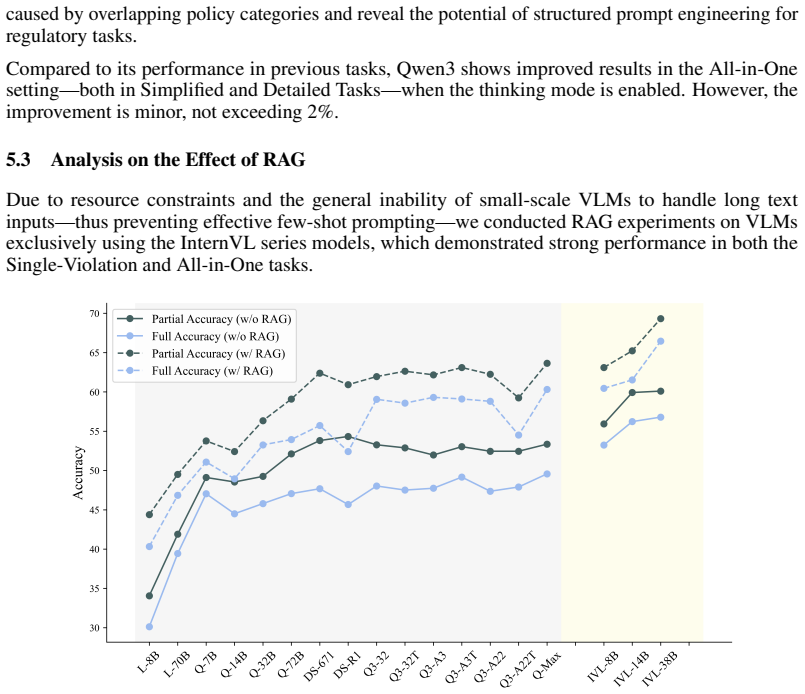
- [Section 4.4 and Section 5.3] The RAG results are internally inconsistent and not fully reported. The abstract and conclusion claim "notable accuracy gains" and "significant performance improvements," while Section 5.3 describes the gains as "modest" and "highly variable"; Figure 2 is not accompanied by a numeric table, axis labels, or error bars. In addition, Section 5.3 says RAG experiments were run only on InternVL-series VLMs, yet Figure 2 is captioned as a comparison of LLMs and VLMs. Please report the RAG-condition numbers separately for each model, clarify whether retrieved examples come from the same EVADE distribution and whether their ground-truth labels are shown to the model, and reconcile the discrepancy between the abstract and Section 5.3.
- [Appendix A and Table 7] The text states that "an error rate of less than 1%" has a negligible impact, but Table 7 reports an error rate of 0.14 for Llama-3.1-8B and 0.03 for MiniCPM-V2.6-8B, which are 14% and 3% respectively. Please reconcile these numbers, clarify the denominator of the error rate, and state how malformed or refusal responses are treated in Equations (1) and (2); if these responses are excluded or counted as incorrect, the accuracy figures in Tables 3 and 5 need to be adjusted accordingly.
- [Section 3.1 and Section 4.1] The evaluation unit of the benchmark is ambiguous. Section 3.1 reports 2,833 text samples and 13,961 images as separate totals, while Section 4.1 evaluates, for example, "202 texts and 2,134 images" under the body-shaping prompt, and Figure 1 depicts a sample with both text and image inputs. If each sample is a separate text-only or image-only instance, the "multimodal" claim should be stated as two single-modality tracks; if they are paired, the counts should match and joint multimodal results should be reported. Please clarify the data structure and the composition of the evaluation set for each task.
minor comments (5)
- [Section 4.3] All experiments use temperature 0.8, but no multiple runs or confidence intervals are reported; given the small differences in Table 4 (e.g., thinking-mode changes under 1%), the authors should either report variance or avoid over-interpreting such differences.
- [Section 3.2, Stage 3] The description of "ten rounds of random sampling" with "200 items from each sub-domain" is ambiguous about the total number of reviewed items and how majority agreement was computed; please specify the procedure precisely.
- [Abstract and Section 1] The claim of being the "first" expert-curated Chinese multimodal benchmark of this kind should be supported by a direct comparison with prior Chinese e-commerce moderation or safety benchmarks, or the claim should be qualified.
- [Table 3] There are minor typographical issues in Table 3 and its caption, including "Parital Acc." and "LLama-3.1-70B"; these should be corrected.
- [Section 5.3] The phrase "RAG improves the model's precision" uses the term "precision" in a nonstandard way, since the paper's metrics are partial and full accuracy; please rephrase to avoid confusion.
Circularity Check
Ground-truth labels were co-constructed with the very models later benchmarked; headline accuracies are conditional on label independence.
-
self definitional
[Section 3.2, Data Annotation paragraph; labels used in Tables 2-5 and Sections 5.1-5.2]
"Predictions from three LLMs (GPT-o1mini, DeepSeek-R1, QwenMax) and three VLMs (GPT-4o, Claude-3.7, Gemini-2.5-Pro) were then used to identify samples that diverged from human judgment. These discrepant cases were flagged for re-annotation by professional annotators in the second and third rounds, using model outputs as reference."
The six models named in the annotation-refinement step are the same model families later scored on the benchmark (they appear in Table 2 and throughout the Section 5 results). The final ground-truth labels G are therefore not independent of the model outputs M being evaluated: G was revised 'using model outputs as reference.' Accuracy is computed by comparing M to G (Equations 1-2), so the headline finding that 'even state-of-the-art models frequently misclassify evasive samples' is partly a comparison of M against labels that may have been shifted toward M. No model-blind re-annotation, inter-annotator agreement, or audit of label revisions is reported, so the bias direction and size are unmeasured.
full rationale
This is a benchmark paper, not an equation-level derivation chain, so the usual circularity modes (fitting a parameter and renaming it a prediction, importing a self-cited uniqueness theorem, smuggling in an ansatz) do not apply. The one load-bearing circular dependency is in benchmark construction: Section 3.2 explicitly uses predictions from six frontier models to flag discrepant cases and then re-annotates those cases 'using model outputs as reference.' Those same six models are later evaluated against the resulting labels in Section 5. Thus the reported failure rates and the claim that even state-of-the-art models frequently misclassify evasive content are not fully self-contained; they depend on an unverified assumption that the human re-annotation was not anchored to the model outputs. This is a genuine partial circularity, not merely a self-citation or a data-quality nitpick, because the ground-truth labels are part of the benchmark's central contribution. However, the human-expert re-annotation provides an independent component, and the All-in-One versus Single-Violation comparison is a prompt-level design choice that does not itself reduce to the label-construction process. No self-citation chain or imported uniqueness theorem is load-bearing, so the score is moderate rather than severe.
Assumptions & free parameters
free parameters (1)
- Data stratification: number of clusters and samples per cluster =
300 clusters; 20 samples per cluster
assumptions (4)
- domain assumption The six rule sets, developed with legal experts, are a faithful operationalization of Chinese advertising law and platform norms for evasive content.
- ad hoc to paper Using model predictions to flag discrepancies and as reference in re-annotation does not bias final human labels.
- domain assumption The implicit rule that 'Z. other' cannot be selected together with any regulated category is a valid constraint that models should follow.
- ad hoc to paper Improvement in All-in-One over Single-Violation can be attributed to rule clarity rather than to other prompt changes.
Cite this review
Pith. "Pith review of EVADE-Bench: Multimodal Benchmark for Evaluating and Enhancing Evasive Content Detection." pith.science (2026). https://pith.science/paper/HS7OMI6J
@misc{pith2026250517654,
  author       = {Pith},
  title        = {Pith review of: EVADE-Bench: Multimodal Benchmark for Evaluating and Enhancing Evasive Content Detection},
  year         = {2026},
  howpublished = {\url{https://pith.science/paper/HS7OMI6J}},
  note         = {Machine review of arXiv:2505.17654}
}
read the original abstract
E-commerce platforms increasingly rely on Large Language Models (LLMs) and Vision Language Models (VLMs) to detect illicit or misleading product content. However, these models remain vulnerable to evasive content, which refers to inputs that have been deliberately modified through techniques such as word splitting, euphemistic language, or image cropping to conceal policy violations while still conveying prohibited claims. Crucially, detecting such content requires a model to simultaneously master two capabilities: accurately comprehending complex rules, and correctly inferring the true intent behind deliberately obfuscated multimodal inputs. While prior work has separately explored LLM reasoning over complex rules and LLM-based detection of evasive content, no existing benchmark combines both within a unified evaluation framework. This gap is particularly consequential in e-commerce, where accurate moderation demands that both capabilities operate in concert. To address this gap, we introduce EVADE-Bench, the first expert-curated Chinese multimodal benchmark specifically designed to evaluate LLMs and VLMs on evasive content detection in real-world e-commerce scenarios. Our comprehensive evaluation of 26 open- and closed-source LLMs and VLMs reveals that even state-of-the-art models frequently misclassify evasive samples. We further demonstrate that clearer rule categorization significantly improves model prediction consistency and reduces false predictions, highlighting the critical role of benchmark design in enabling reliable evaluation. To explore paths for performance improvement, we investigate the feasibility of multi-agent decomposition for multimodal reasoning, wherein visual description and logical inference are decoupled into separate agents, and find that this strategy yields notable accuracy gains.
Figures


Figures from the paper (8 more)


Forward citations
Cited by 2 Pith papers
-
Generative AI-Enabled Refund Fraud in Chinese E-Commerce: Investigation on Merchants and Platform Workers
This qualitative study develops a taxonomy of four GenAI-enabled threat vectors for refund fraud in Chinese e-commerce from stakeholder interviews and discusses mitigation challenges and design implications.
-
Yuvion VL: A Multimodal Foundation Model for Adversarial Content and AI Safety
Yuvion VL is a multimodal LLM family using adversarial-aware data construction, three-stage training, and contrastive fine-tuning that claims industry-leading safety performance on new benchmarks while retaining gener...
Reference graph
Works this paper leans on
-
[1]
Qwen3.https://qwenlm.github.io/blog/qwen3//, 2025
Alibaba. Qwen3.https://qwenlm.github.io/blog/qwen3//, 2025. 10
work page 2025
-
[2]
Qwen-vl-max.https://huggingface.co/spaces/Qwen/Qwen-VL-Max/, 2025
Alibaba. Qwen-vl-max.https://huggingface.co/spaces/Qwen/Qwen-VL-Max/, 2025
work page 2025
-
[3]
M. Altakrori, T. Scialom, B. C. M. Fung, and J. C. K. Cheung. A multifaceted framework to evaluate evasion, content preservation, and misattribution in authorship obfuscation techniques. In Y . Goldberg, Z. Kozareva, and Y . Zhang, editors,Proceedings of the 2022 Conference on Empirical Methods in Natural Language Processing, pages 2391–2406, Abu Dhabi, U...
-
[4]
S. W. Azumah, N. Elsayed, Z. ElSayed, M. Ozer, and A. L. Guardia. Deep learning approaches for detecting adversarial cyberbullying and hate speech in social networks, 2024. URLhttps://arxiv.org/ abs/2406.17793
work page Pith review arXiv 2024
-
[5]
S. Bai, K. Chen, X. Liu, J. Wang, W. Ge, S. Song, K. Dang, P. Wang, S. Wang, J. Tang, H. Zhong, Y . Zhu, M. Yang, Z. Li, J. Wan, P. Wang, W. Ding, Z. Fu, Y . Xu, J. Ye, X. Zhang, T. Xie, Z. Cheng, H. Zhang, Z. Yang, H. Xu, and J. Lin. Qwen2.5-vl technical report, 2025. URL https://arxiv.org/abs/2502. 13923
work page 2025
-
[6]
Z. Bai, P. Wang, T. Xiao, T. He, Z. Han, Z. Zhang, and M. Z. Shou. Hallucination of multimodal large language models: A survey, 2025. URLhttps://arxiv.org/abs/2404.18930
arXiv 2025
-
[7]
Y . Chen, F. Xue, D. Li, Q. Hu, L. Zhu, X. Li, Y . Fang, H. Tang, S. Yang, Z. Liu, E. He, H. Yin, P. Molchanov, J. Kautz, L. Fan, Y . Zhu, Y . Lu, and S. Han. Longvila: Scaling long-context visual language models for long videos, 2024. URLhttps://arxiv.org/abs/2408.10188
arXiv 2024
-
[8]
A. G. Chowdhury, M. M. Islam, V . Kumar, F. H. Shezan, V . Kumar, V . Jain, and A. Chadha. Breaking down the defenses: A comparative survey of attacks on large language models, 2024. URL https: //arxiv.org/abs/2403.04786
arXiv 2024
Show all 48 references
-
[9]
Claude 3.7 sonnet.https://www.anthropic.com/claude/sonnet, 2025
Claude. Claude 3.7 sonnet.https://www.anthropic.com/claude/sonnet, 2025
2025
-
[10]
DeepSeek-AI, D. Guo, D. Yang, H. Zhang, J. Song, R. Zhang, R. Xu, Q. Zhu, S. Ma, P. Wang, X. Bi, X. Zhang, X. Yu, Y . Wu, Z. F. Wu, Z. Gou, Z. Shao, Z. Li, Z. Gao, A. Liu, B. Xue, B. Wang, B. Wu, B. Feng, C. Lu, C. Zhao, C. Deng, C. Zhang, C. Ruan, D. Dai, D. Chen, D. Ji, E. L...
2025 arXiv
-
[11]
DeepSeek-AI, A. Liu, B. Feng, B. Xue, B. Wang, B. Wu, C. Lu, C. Zhao, C. Deng, C. Zhang, C. Ruan, D. Dai, D. Guo, D. Yang, D. Chen, D. Ji, E. Li, F. Lin, F. Dai, F. Luo, G. Hao, G. Chen, G. Li, H. Zhang, H. Bao, H. Xu, H. Wang, H. Zhang, H. Ding, H. Xin, H. Gao, H. Li, H. Qu, ...
2025 arXiv
-
[12]
Gholamian, G
S. Gholamian, G. Romani, B. Rudnikowicz, and S. Skylaki. LLM-based robust product classifica- tion in commerce and compliance. In S. Kumar, V . Balachandran, C. Y . Park, W. Shi, S. A. Hay- ati, Y . Tsvetkov, N. Smith, H. Hajishirzi, D. Kang, and D. Jurgens, editors,Proceeding...
2024
-
[13]
Gemini 2.5
Google. Gemini 2.5. https://blog.google/technology/google-deepmind/ gemini-model-thinking-updates-march-2025/, 2025
2025
-
[14]
Grattafiori, A
A. Grattafiori, A. Dubey, A. Jauhri, A. Pandey, A. Kadian, A. Al-Dahle, A. Letman, A. Mathur, A. Schelten, A. Vaughan, A. Yang, A. Fan, A. Goyal, A. Hartshorn, A. Yang, A. Mitra, A. Sravankumar, A. Korenev, A. Hinsvark, A. Rao, A. Zhang, A. Rodriguez, A. Gregerson, A. Spataru,...
2024 arXiv
-
[15]
Hackett, L
W. Hackett, L. Birch, S. Trawicki, N. Suri, and P. Garraghan. Bypassing prompt injection and jailbreak detection in llm guardrails, 2025. URLhttps://arxiv.org/abs/2504.11168
2025 arXiv
-
[16]
Huang, W
L. Huang, W. Yu, W. Ma, W. Zhong, Z. Feng, H. Wang, Q. Chen, W. Peng, X. Feng, B. Qin, and T. Liu. A survey on hallucination in large language models: Principles, taxonomy, challenges, and open questions. ACM Transactions on Information Systems, 43(2):1–55, Jan. 2025. ISSN 155...
2025 doi
-
[17]
Jiang, J
C. Jiang, J. Wang, W. Ma, C. L. A. Clarke, S. Wang, C. Wu, and M. Zhang. Beyond utility: Evaluating llm as recommender, 2024. URLhttps://arxiv.org/abs/2411.00331
2024 arXiv
-
[18]
Kiela, H
D. Kiela, H. Firooz, A. Mohan, V . Goswami, A. Singh, P. Ringshia, and D. Testuggine. The hateful memes challenge: Detecting hate speech in multimodal memes, 2021. URL https://arxiv.org/abs/2005. 04790
2021
-
[19]
C. Li, Z. Gan, Z. Yang, J. Yang, L. Li, L. Wang, and J. Gao. Multimodal foundation models: From specialists to general-purpose assistants, 2023. URLhttps://arxiv.org/abs/2309.10020
2023 arXiv
-
[20]
C. X. Liang, P. Tian, C. H. Yin, Y . Yua, W. An-Hou, L. Ming, T. Wang, Z. Bi, and M. Liu. A comprehensive survey and guide to multimodal large language models in vision-language tasks, 2024. URL https: //arxiv.org/abs/2411.06284
2024
-
[21]
D. Liu, M. Yang, X. Qu, P. Zhou, Y . Cheng, and W. Hu. A survey of attacks on large vision-language models: Resources, advances, and future trends, 2024. URLhttps://arxiv.org/abs/2407.07403
2024 arXiv
-
[22]
Liu and M
M. Liu and M. Poesio. Data augmentation for fake reviews detection in multiple languages and multiple domains, 2025. URLhttps://arxiv.org/abs/2504.06917
2025 arXiv
-
[23]
X. Liu, Y . Zhu, J. Gu, Y . Lan, C. Yang, and Y . Qiao. Mm-safetybench: A benchmark for safety evaluation of multimodal large language models, 2024. URLhttps://arxiv.org/abs/2311.17600
2024 arXiv
-
[24]
R. Lou, K. Zhang, and W. Yin. Large language model instruction following: A survey of progresses and challenges, 2024. URLhttps://arxiv.org/abs/2303.10475
2024 arXiv
-
[25]
Matarazzo and R
A. Matarazzo and R. Torlone. A survey on large language models with some insights on their capabilities and limitations, 2025. URLhttps://arxiv.org/abs/2501.04040
2025 arXiv
-
[26]
G. Mou, P. Ye, and K. Lee. Swe2: Subword enriched and significant word emphasized framework for hate speech detection. InProceedings of the 29th ACM International Conference on Information Knowledge Management, CIKM ’20, page 1145–1154. ACM, Oct. 2020. doi: 10.1145/3340531.341...
2020
-
[27]
Murthy, P
R. Murthy, P. Venkateswaran, P. Kumar, and D. Contractor. Evaluating the instruction-following abilities of language models using knowledge tasks, 2025. URLhttps://arxiv.org/abs/2410.12972
2025 arXiv
-
[28]
N. B. Ocampo, E. Cabrio, and S. Villata. Playing the part of the sharp bully: Generating adversarial examples for implicit hate speech detection. In A. Rogers, J. Boyd-Graber, and N. Okazaki, editors, Findings of the Association for Computational Linguistics: ACL 2023, pages 2...
2023 doi
-
[29]
Gpt-o1mini
Openai. Gpt-o1mini. https://openai.com/index/openai-o1-mini-advancing-cost-efficient-reasoning/ , 2024
2024
-
[30]
Gpt-4.1.https://openai.com/index/gpt-4-1/, 2025
Openai. Gpt-4.1.https://openai.com/index/gpt-4-1/, 2025
2025
-
[31]
Hurst, A
OpenAI, :, A. Hurst, A. Lerer, A. P. Goucher, A. Perelman, A. Ramesh, A. Clark, A. Ostrow, A. Welihinda, A. Hayes, A. Radford, A. M ˛ adry, A. Baker-Whitcomb, A. Beutel, A. Borzunov, A. Carney, A. Chow, A. Kirillov, A. Nichol, A. Paino, A. Renzin, A. T. Passos, A. Kirillov, A....
2024 arXiv
-
[32]
Achiam, S
OpenAI, J. Achiam, S. Adler, S. Agarwal, L. Ahmad, I. Akkaya, F. L. Aleman, D. Almeida, J. Altenschmidt, S. Altman, S. Anadkat, R. Avila, I. Babuschkin, S. Balaji, V . Balcom, P. Baltescu, H. Bao, M. Bavarian, J. Belgum, I. Bello, J. Berdine, G. Bernadett-Shapiro, C. Berner, L...
2024 arXiv
-
[33]
Palen-Michel, R
C. Palen-Michel, R. Wang, Y . Zhang, D. Yu, C. Xu, and Z. Wu. Investigating llm applications in e-commerce, 2024. URLhttps://arxiv.org/abs/2408.12779
2024 arXiv
-
[34]
Qwen, :, A. Yang, B. Yang, B. Zhang, B. Hui, B. Zheng, B. Yu, C. Li, D. Liu, F. Huang, H. Wei, H. Lin, J. Yang, J. Tu, J. Zhang, J. Yang, J. Yang, J. Zhou, J. Lin, K. Dang, K. Lu, K. Bao, K. Yang, L. Yu, M. Li, M. Xue, P. Zhang, Q. Zhu, R. Men, R. Lin, T. Li, T. Tang, T. Xia, ...
2025 arXiv
-
[35]
Radford, J
A. Radford, J. W. Kim, C. Hallacy, A. Ramesh, G. Goh, S. Agarwal, G. Sastry, A. Askell, P. Mishkin, J. Clark, G. Krueger, and I. Sutskever. Learning transferable visual models from natural language supervision, 2021. URLhttps://arxiv.org/abs/2103.00020
2021 arXiv
-
[36]
Ramteke, S
A. Ramteke, S. Tembhurne, G. Sonawane, and R. N. Bhimanpallewar. Detecting deceptive dark patterns in e-commerce platforms, 2024. URLhttps://arxiv.org/abs/2406.01608
2024 arXiv
-
[37]
S. Raza, A. Vayani, A. Jain, A. Narayanan, V . R. Khazaie, S. R. Bashir, E. Dolatabadi, G. Uddin, C. Emmanouilidis, R. Qureshi, and M. Shah. Vldbench: Vision language models disinformation detection benchmark, 2025. URLhttps://arxiv.org/abs/2502.11361
2025
-
[38]
Q. Ren, Z. Jiang, J. Cao, S. Li, C. Li, Y . Liu, S. Huo, T. He, and Y . Chen. A survey on fairness of large language models in e-commerce: progress, application, and challenge, 2024. URL https: //arxiv.org/abs/2405.13025
2024 arXiv
-
[39]
W. Wang, X. Liu, K. Gao, J. tse Huang, Y . Yuan, P. He, S. Wang, and Z. Tu. Can’t see the forest for the trees: Benchmarking multimodal safety awareness for multimodal llms, 2025. URL https: //arxiv.org/abs/2502.11184
2025 arXiv
-
[40]
X. Wang, M. Salmani, P. Omidi, X. Ren, M. Rezagholizadeh, and A. Eshaghi. Beyond the limits: A survey of techniques to extend the context length in large language models, 2024. URL https: //arxiv.org/abs/2402.02244
2024 arXiv
-
[41]
Z. Wu, X. Chen, Z. Pan, X. Liu, W. Liu, D. Dai, H. Gao, Y . Ma, C. Wu, B. Wang, Z. Xie, Y . Wu, K. Hu, J. Wang, Y . Sun, Y . Li, Y . Piao, K. Guan, A. Liu, X. Xie, Y . You, K. Dong, X. Yu, H. Zhang, L. Zhao, Y . Wang, and C. Ruan. Deepseek-vl2: Mixture-of-experts vision-langua...
2024 arXiv
-
[42]
H. Xiao, F. Zhou, X. Liu, T. Liu, Z. Li, X. Liu, and X. Huang. A comprehensive survey of large language models and multimodal large language models in medicine.Information Fusion, 117:102888, May 2025. ISSN 1566-2535. doi: 10.1016/j.inffus.2024.102888. URLhttp://dx.doi.org/10....
2025
-
[43]
Y . Yao, T. Yu, A. Zhang, C. Wang, J. Cui, H. Zhu, T. Cai, H. Li, W. Zhao, Z. He, Q. Chen, H. Zhou, Z. Zou, H. Zhang, S. Hu, Z. Zheng, J. Zhou, J. Cai, X. Han, G. Zeng, D. Li, Z. Liu, and M. Sun. Minicpm-v: A gpt-4v level mllm on your phone, 2024. URLhttps://arxiv.org/abs/2408.01800
2024 arXiv
-
[44]
W. X. Zhao, K. Zhou, J. Li, T. Tang, X. Wang, Y . Hou, Y . Min, B. Zhang, J. Zhang, Z. Dong, Y . Du, C. Yang, Y . Chen, Z. Chen, J. Jiang, R. Ren, Y . Li, X. Tang, Z. Liu, P. Liu, J.-Y . Nie, and J.-R. Wen. A survey of large language models, 2025. URLhttps://arxiv.org/abs/2303.18223
2025 arXiv
-
[45]
J. Zhu, W. Wang, Z. Chen, Z. Liu, S. Ye, L. Gu, H. Tian, Y . Duan, W. Su, J. Shao, Z. Gao, E. Cui, X. Wang, Y . Cao, Y . Liu, X. Wei, H. Zhang, H. Wang, W. Xu, H. Li, J. Wang, N. Deng, S. Li, Y . He, T. Jiang, J. Luo, Y . Wang, C. He, B. Shi, X. Zhang, W. Shao, J. He, Y . Xion...
2025 arXiv
-
[46]
骨瘦 如柴”、“皮包骨
A. Zou, Z. Wang, N. Carlini, M. Nasr, J. Z. Kolter, and M. Fredrikson. Universal and transferable adversarial attacks on aligned language models, 2023. URLhttps://arxiv.org/abs/2307.15043. 15 A The statistics of erroneous data During the All-in-One experiment, due to the limit...
2023 arXiv
-
[47]
权威引用:若文本明确引用百度百科、搜狗百科、维基百科、书籍内容或书名等权威信息来源,判 断为“不相关”返回Z.其他。
-
[48]
不相关”返回Z.其 他。 4.患病人群描述:若文本仅描述患病人群(如描述艾滋病人、心脏病患者的书籍或活动),判断为“不 相关
科普内容:若文本仅为科普(如书籍、电影等),且未出现具体商品名称,判断为“不相关”返回Z.其 他。 4.患病人群描述:若文本仅描述患病人群(如描述艾滋病人、心脏病患者的书籍或活动),判断为“不 相关”返回Z.其他。 5.通用治疗效果:文本可能会出现通用治疗效果相关的词汇,这些效果表现类词汇主要用于描述 事物在功能或状态上的变化,突出其带来的积极效果。它们可以分为多个类别:上升类词汇如“拯 救”、“改善”、“提高”、“增强”、“加强”、“提升”等,强调对某种能力或状态的提升和优化;下降类词 汇如“抗”、“抑制”、“降”、“镇”、“缓解”、“控制”等,...
Reviewed August 7, 2026 · model on record in the stance chip above.
Discussion (0). Sign in to comment.