REVIEW 4 major objections 6 minor 1 cited by
ComfyMind: Toward General-Purpose Generation via Tree-Based Planning and Reactive Feedback
T0 review · 4 major / 6 minor · reviewed 2026-08-07 · deepseek-v4-flash
Pith's one-line read ComfyMind claims that composing prebuilt, semantically described workflow modules with tree-based planning and localized feedback lets an open-source system match or beat a closed unified generative model on standard generation, editing…
desk verdict A solid systems paper whose external-benchmark results deserve attention, but the ComfyBench resolve rate is self-scored by the system's own evaluator, which makes the central claim unsecured until independently verified. read the letter →
The pith
A machine-rendered reading of the paper's core claim, the machinery that carries it, and where it could break.
The reading
What carries the argument
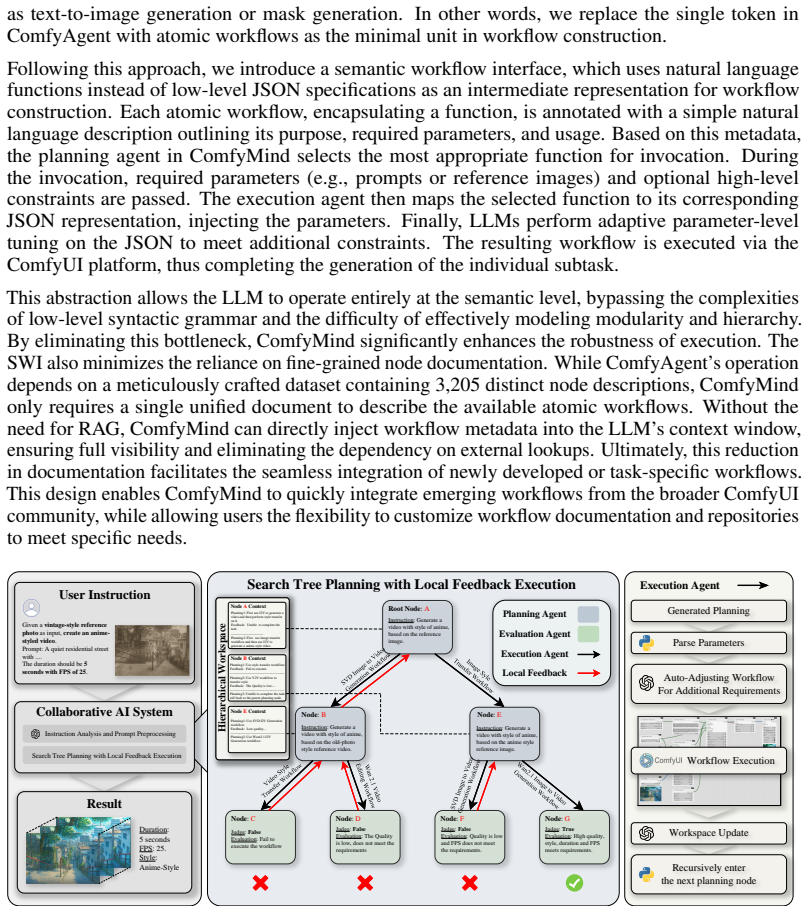
The load-bearing mechanism is the pair of the Semantic Workflow Interface (SWI) and Search Tree Planning with Local Feedback Execution. SWI abstracts low-level ComfyUI node graphs into atomic functions with natural-language descriptions, input/output specifications, and parameters; the search tree treats a task as a hierarchy of sub-tasks, with each edge an SWI invocation, and an Evaluation Agent returning a pass/fail signal plus diagnostic feedback so the planner backtracks locally rather than restarting. Together they replace token-level workflow synthesis with semantic composition and adaptive correction.
What would settle it
Have an independent human or a fixed third-party judge re-score ComfyMind's ComfyBench outputs using the original task rubrics, and compare the resulting resolve rate with the reported 83%; a large drop would show the internal evaluator is not a reliable success signal and would undermine the performance claims.
Extended reading notes
Core claim
On the paper's own terms, ComfyMind's central claim is that general-purpose visual generation does not require a single unified model; it can be achieved by a planner that composes atomic, community-validated workflow modules. The Semantic Workflow Interface turns low-level node graphs into callable natural-language functions, and the Search Tree Planning mechanism executes one step at a time, evaluates each intermediate result with a vision-language evaluator, and backtracks locally on failure. On ComfyBench the system reaches a 100% workflow pass rate and 83% task resolution, on GenEval an overall score of 0.90 (above GPT-Image-1's 0.84), and on Reason-Edit a GPT-score of 0.906, comparable to GPT-Image-1's 0.929.
Load-bearing premise
The system's own Evaluation Agent decides whether a generated output counts as successful, and that same judgment is used to compute the headline resolve rates, so a lenient or biased evaluator would inflate the claimed performance.
Editorial extensions
If this is right
- An open-source system built from existing workflow modules can match or exceed a closed unified model on compositional image generation, without training a new foundation model.
- Complex multi-stage generation becomes more robust because failures trigger local backtracking at the current tree level, preserving valid partial results.
- Adding new capabilities reduces to writing one semantic description for a workflow, so the system can track community-contributed tools quickly.
- The same framework extends beyond text-to-image to video generation, image editing, reasoning-based editing, and world-knowledge synthesis, as shown by the additional WISE benchmark results.
Reading between the lines
- If an independent evaluator were used across all baselines, the ranking might shift; the paper's internal Evaluation Agent is part of the system being tested, so cross-system comparisons inherit its judgment.
- The approach makes capability scaling a matter of library curation rather than model training: expanding the set of atomic workflows could improve performance faster than scaling any single generative model.
- The same semantic-interface-plus-search-tree design could be applied to other node-based or tool-based execution environments, because the interface hides the underlying syntax from the planner.
- Because prompt preprocessing optimizes every input before generation, ablating that preprocessing would reveal how much of the GenEval gain comes from the planner versus the prompt-enhancement workflow.
Editorial analysis
A structured set of objections, weighed in public.
Referee Report
Summary. ComfyMind proposes a collaborative AI system built on ComfyUI for general-purpose visual generation. The two main components are a Semantic Workflow Interface (SWI), which abstracts prebuilt atomic node graphs into natural-language callable functions, and a Search Tree Planning mechanism with local feedback execution, which composes those functions through hierarchical planning and iterative correction. The paper evaluates ComfyMind on ComfyBench, GenEval, and Reason-Edit, reporting a 100% pass rate and 83% resolve rate on ComfyBench, an overall GenEval score of 0.90, and a Reason-Edit GPT-score of 0.906. The central claim is that an open-source modular orchestrator can outperform existing open-source frameworks and reach performance comparable to GPT-Image-1.
Significance. If the reported results are valid, the contribution is significant: it demonstrates a practical path toward general-purpose generation without training a new foundation model, by composing community-validated workflows through semantic planning. The SWI abstraction and tree-based local feedback are well-motivated design ideas, and the paper includes useful ablations, a robustness check across two LLMs, and an unusually detailed appendix of system prompts that aids reproducibility. However, the strongest performance claims currently rest on a measurement that appears partly circular and on protocol details that are not reported. The GenEval and Reason-Edit benchmarks use external metrics and provide independent evidence, but the ComfyBench resolve rate, which is the centerpiece of the comparison against ComfyAgent and GPT-Image-1, needs independent verification before the headline claims can be accepted.
major comments (4)
- [§3.3 and Appendix C.3.3; Table 1] The ComfyBench resolve rate (Table 1: 83.0% overall) is measured by the system's own Evaluation Agent, which also decides when the search terminates. Section 3.3 states: "If the result passes evaluation, the search ends successfully." Appendix C.3.3 describes the evaluator as returning "a binary judgment indicating whether the current task is considered complete" and supporting "dynamic threshold adjustment." Consequently, the reported resolve rate is the rate at which the system accepted its own outputs, not an externally verified rate of satisfying ComfyBench task requirements; a lenient or miscalibrated evaluator inflates the number directly by terminating search on outputs an independent rater would reject. This is load-bearing because the claims of outperforming ComfyAgent and matching GPT-Image-1 rest on these labels. Please report the exact evaluation protocol, fix the threshold rather than allowing it to vary, and provide independent scoring, for example using ComfyBench's official judge or human raters blind to system identity.
- [§3.2 and §4.1; Table 1] The 100% pass rate on ComfyBench is partly by construction and does not measure the same capability as the baselines. The Semantic Workflow Interface restricts the planner to selecting prebuilt atomic workflows and preserving their DAGs during execution (Section 3.2 and Appendix C.3.2), so the system does not synthesize low-level node graphs from scratch in the way ComfyAgent must. The pass rate therefore largely reflects the coverage and quality of the atomic workflow library and the planner's retrieval accuracy, not the ability to construct valid ComfyUI workflows. The phrase "autonomous workflow construction" in Section 4.1 should be qualified, and Table 1 should be framed as a comparison between module composition over prevalidated workflows and generative construction of node-level workflows.
- [§4.2.1 and §4.3.1] The GenEval and Reason-Edit comparisons may not be protocol-matched. ComfyMind's pipeline includes prompt optimization, parameter adjustment, and iterative local feedback that can re-execute workflows until the internal Evaluation Agent passes (Section 3.3), whereas the baselines are single-pass generative models. If ComfyMind is allowed multiple generation attempts per prompt, the GenEval score of 0.90 and Reason-Edit score of 0.906 are not comparable to the baselines under equal inference budget. The paper should state the number of attempts allowed per prompt, whether only the first output is scored, and the compute or API budget consumed by each system.
- [§4, Tables 1-5] No statistical uncertainty or protocol details are reported for any of the main tables: no number of independent runs, seeds, trials, or confidence intervals. The only hardware description is one RTX A6000 in Appendix C.1. For a 200-task benchmark, point estimates such as 83.0% versus 32.5% need at least a confidence interval or an exact resolved-task count (e.g., 166/200). Additionally, key free parameters of the system are not reported: the Evaluation Agent's threshold, the search-tree budget, and the contents of the prompt-optimization dictionary. Since these parameters directly affect the reported numbers, the sensitivity of the headline results to them is unknown. Please provide run-level data and a precise specification of all tunable parameters.
minor comments (6)
- [§4.2.2 and Table 2] The term "Attribution Binding" is inconsistent with "Attr. Binding" in Table 2 and with the standard term "Attribute Binding" used in the GenEval benchmark; please standardize.
- [Figure 3] Figure 3 contains typos ("anima style", "Wam2.1" for what is presumably Wan2.1), and the small handwritten-style feedback text is difficult to read; please clean up the figure and increase legibility.
- [Appendix E] The system prompt for "Workflow Adaptive Adjustment" contains the typo "upsacle rate" (should be "upscale rate"), and the JSON schema in Figure 16 has the invalid entry "required(ALL PARAMETERS ARE OPTIONAL EXCEPT WORKFLOW_NAME)"; this should be corrected to a proper JSON Schema formulation.
- [Project page and code] No code, atomic workflow library, or evaluation scripts are released; including these would substantially improve reproducibility, especially given that the reported system behavior depends on the exact workflow metadata.
- [Appendix A.2, Table 5] The WISE results are presented without a description of the evaluation protocol (e.g., number of generations per prompt, whether retries are allowed, or how WiScore is computed for this system); the abstract-level claim of surpassing GPT-Image-1 on WISE should be either fully specified or removed from the claims.
- [References and Figure 5] Reference [14] is cited as "GPT-eval" in Section 4.3.2 but appears in the bibliography as "Gpt-imgeval"; please align the name and title. In Figure 5, the bar labels "GPT Ours" are ambiguous and should be "GPT-Image-1" and "Ours".
Circularity Check
ComfyBench resolve and pass rates reduce to the system's own evaluator and to a workflow library curated from ComfyBench itself; GenEval and Reason-Edit remain externally scored.
-
self definitional
[Section 3.3; Appendix C.3.3; Section 4.1 (Table 1)]
"If the result passes evaluation, the search ends successfully. ... Appendix C.3.3: Each evaluation returns two components: a binary judgment indicating whether the current task is considered complete, which guides the system on whether to proceed or backtrack; and a detailed failure analysis ... To accommodate varying tasks and application requirements, the Evaluation Agent supports dynamic threshold adjustment."
The ComfyBench resolve rate is defined in Section 4.1 as 'whether the output satisfies all task requirements,' but the paper does not describe an external scorer for that judgment. The described scorer is the in-system Evaluation Agent, and the same agent's 'binary judgment' also terminates the search (Section 3.3). A task is counted as resolved exactly when the system's own threshold-adjustable evaluator approves the output; the planner may keep revising until that internal approval is obtained. Consequently the 83% resolve figure is partially a measure of the system accepting its own outputs rather than an independent measure of task satisfaction. This is definitional circularity for the ComfyBench claim, not for GenEval or Reason-Edit, which use external metrics.
-
fitted input called prediction
[Appendix C.2 (workflow library construction) vs. Section 4.1 (ComfyBench evaluation)]
"First, standard workflows from the ComfyBench benchmark suite were systematically tested. Suboptimal examples were discarded to ensure overall quality. Second, a curated selection of high-quality workflows was extracted from the official ComfyUI website and documentation ... workflows with strong user ratings and proven effectiveness were sourced from popular communities such as Civitai and OpenArt, enhancing the practicality and robustness of the workflow library."
The atomic workflow library is the system's only source of executable modules, and it was built by testing and curating workflows taken from the ComfyBench benchmark suite itself. The same benchmark is then used in Table 1 to report 100% pass and 83% resolve. This is a fitted-input form of circularity: the test distribution contributed directly to selecting the modules that later 'resolve' its tasks, so the reported ComfyBench numbers are not predictions on an unseen benchmark. The effect is analogous to fitting a retrieval list or module set to the test set and then evaluating with that test set.
full rationale
The strongest independent evidence in the paper is GenEval (0.90) and Reason-Edit (0.906), both of which rely on external scoring conventions and would stand even if the ComfyBench numbers were discounted. The circularity is therefore partial: it attaches to the ComfyBench claim, which is the headline benchmark for autonomous workflow construction. There is no load-bearing self-citation here: ComfyBench is by other authors, and the claimed contributions are not justified by citing the authors' own prior work. However, the ComfyBench numbers are doubly entangled with the method: (i) the only completion signal described for final outputs is the system's own Evaluation Agent, which also decides when search stops and has adjustable thresholds; and (ii) the module library was curated by testing ComfyBench's own workflows. For these reasons the central '100% pass / 83% resolve' result is not a fully external validation of the planning mechanism, though it does not make the whole paper circular.
Assumptions & free parameters
free parameters (4)
- Atomic workflow library composition =
not released
- Evaluation dynamic threshold =
not reported
- Search tree search budget =
not reported
- Prompt optimization dictionary =
not released
assumptions (4)
- domain assumption The curated atomic workflow library covers the space of user tasks encountered in the benchmarks and beyond.
- domain assumption The internal Evaluation Agent's binary judgments and failure diagnoses are reliable.
- domain assumption Atomic workflows retrieved from the community are executable and semantically correct for their stated purpose.
- domain assumption Natural-language function descriptions in the SWI document are unambiguous enough for the LLM planner to select the right module.
Cite this review
Pith. "Pith review of ComfyMind: Toward General-Purpose Generation via Tree-Based Planning and Reactive Feedback." pith.science (2026). https://pith.science/paper/YGWB3APK
@misc{pith2026250517908,
  author       = {Pith},
  title        = {Pith review of: ComfyMind: Toward General-Purpose Generation via Tree-Based Planning and Reactive Feedback},
  year         = {2026},
  howpublished = {\url{https://pith.science/paper/YGWB3APK}},
  note         = {Machine review of arXiv:2505.17908}
}
read the original abstract
With the rapid advancement of generative models, general-purpose generation has gained increasing attention as a promising approach to unify diverse tasks across modalities within a single system. Despite this progress, existing open-source frameworks often remain fragile and struggle to support complex real-world applications due to the lack of structured workflow planning and execution-level feedback. To address these limitations, we present ComfyMind, a collaborative AI system designed to enable robust and scalable general-purpose generation, built on the ComfyUI platform. ComfyMind introduces two core innovations: Semantic Workflow Interface (SWI) that abstracts low-level node graphs into callable functional modules described in natural language, enabling high-level composition and reducing structural errors; Search Tree Planning mechanism with localized feedback execution, which models generation as a hierarchical decision process and allows adaptive correction at each stage. Together, these components improve the stability and flexibility of complex generative workflows. We evaluate ComfyMind on three public benchmarks: ComfyBench, GenEval, and Reason-Edit, which span generation, editing, and reasoning tasks. Results show that ComfyMind consistently outperforms existing open-source baselines and achieves performance comparable to GPT-Image-1. ComfyMind paves a promising path for the development of open-source general-purpose generative AI systems. Project page: https://github.com/LitaoGuo/ComfyMind
Figures


Figures from the paper (16 more)


Forward citations
Cited by 1 Pith paper
-
Knowledge-Centric Agents for Workflow Generation in ComfyUI
A knowledge-centric pipeline distills strategies and pseudo-codes from real workflows, fine-tunes a language model on those levels, and reconstructs executable ComfyUI graphs from task descriptions.
Reference graph
Works this paper leans on
-
[1]
Dustin Podell, Zion English, Kyle Lacey, Andreas Blattmann, Tim Dockhorn, Jonas Müller, Joe Penna, and Robin Rombach. Sdxl: Improving latent diffusion models for high-resolution image synthesis.arXiv preprint arXiv:2307.01952, 2023
arXiv 2023
-
[2]
Scaling rectified flow transformers for high-resolution image synthesis
Patrick Esser, Sumith Kulal, Andreas Blattmann, Rahim Entezari, Jonas Müller, Harry Saini, Yam Levi, Dominik Lorenz, Axel Sauer, Frederic Boesel, et al. Scaling rectified flow transformers for high-resolution image synthesis. InForty-first international conference on machine learning, 2024
2024
-
[3]
Flux, 2024
Black Forest Labs. Flux, 2024. URLhttps://github.com/black-forest-labs/flux
2024
-
[4]
Instructpix2pix: Learning to follow image editing instructions
Tim Brooks, Aleksander Holynski, and Alexei A Efros. Instructpix2pix: Learning to follow image editing instructions. InProceedings of the IEEE/CVF conference on computer vision and pattern recognition, pages 18392–18402, 2023
2023
- [5]
-
[6]
Smartedit: Exploring complex instruction-based image editing with multimodal large language models
Yuzhou Huang, Liangbin Xie, Xintao Wang, Ziyang Yuan, Xiaodong Cun, Yixiao Ge, Jiantao Zhou, Chao Dong, Rui Huang, Ruimao Zhang, et al. Smartedit: Exploring complex instruction-based image editing with multimodal large language models. InProceedings of the IEEE/CVF Conference on Computer Vision and Pattern Recognition, pages 8362–8371, 2024
2024
-
[7]
Ltx-video: Realtime video latent diffusion.arXiv preprint arXiv:2501.00103, 2024
Yoav HaCohen, Nisan Chiprut, Benny Brazowski, Daniel Shalem, Dudu Moshe, Eitan Richardson, Eran Levin, Guy Shiran, Nir Zabari, Ori Gordon, et al. Ltx-video: Realtime video latent diffusion.arXiv preprint arXiv:2501.00103, 2024
arXiv 2024
-
[8]
Tencent. Hunyuanvideo, 2024. URLhttps://github.com/Tencent/HunyuanVideo
work page 2024
Show all 80 references
-
[9]
Wan: Open and advanced large-scale video generative models.arXiv preprint arXiv:2503.20314, 2025
Ang Wang, Baole Ai, Bin Wen, Chaojie Mao, Chen-Wei Xie, Di Chen, Feiwu Yu, Haiming Zhao, Jianxiao Yang, Jianyuan Zeng, et al. Wan: Open and advanced large-scale video generative models.arXiv preprint arXiv:2503.20314, 2025
2025 arXiv
-
[10]
Seed-x: Multimodal models with unified multi-granularity comprehension and generation.arXiv preprint arXiv:2404.14396, 2024
Yuying Ge, Sijie Zhao, Jinguo Zhu, Yixiao Ge, Kun Yi, Lin Song, Chen Li, Xiaohan Ding, and Ying Shan. Seed-x: Multimodal models with unified multi-granularity comprehension and generation.arXiv preprint arXiv:2404.14396, 2024
2024 arXiv
-
[11]
Janus: Decoupling visual encoding for unified multimodal understanding and generation.arXiv preprint arXiv:2410.13848, 2024
Chengyue Wu, Xiaokang Chen, Zhiyu Wu, Yiyang Ma, Xingchao Liu, Zizheng Pan, Wen Liu, Zhenda Xie, Xingkai Yu, Chong Ruan, et al. Janus: Decoupling visual encoding for unified multimodal understanding and generation.arXiv preprint arXiv:2410.13848, 2024
-
[12]
Got: Unleashing reasoning capability of multimodal large language model for visual generation and editing.arXiv preprint arXiv:2503.10639, 2025
Rongyao Fang, Chengqi Duan, Kun Wang, Linjiang Huang, Hao Li, Shilin Yan, Hao Tian, Xingyu Zeng, Rui Zhao, Jifeng Dai, et al. Got: Unleashing reasoning capability of multimodal large language model for visual generation and editing.arXiv preprint arXiv:2503.10639, 2025
2025 arXiv
-
[13]
gpt-image-1, 2025
OpenAI. gpt-image-1, 2025. URLhttps://platform.openai.com/docs/models/gpt-image-1
2025
-
[14]
Gpt-imgeval: A comprehensive benchmark for diagnosing gpt4o in image generation.arXiv preprint arXiv:2504.02782, 2025
Zhiyuan Yan, Junyan Ye, Weijia Li, Zilong Huang, Shenghai Yuan, Xiangyang He, Kaiqing Lin, Jun He, Conghui He, and Li Yuan. Gpt-imgeval: A comprehensive benchmark for diagnosing gpt4o in image generation.arXiv preprint arXiv:2504.02782, 2025
2025 arXiv
-
[15]
Comfygen: Prompt-adaptive workflows for text-to-image generation.arXiv preprint arXiv:2410.01731, 2024
Rinon Gal, Adi Haviv, Yuval Alaluf, Amit H Bermano, Daniel Cohen-Or, and Gal Chechik. Comfygen: Prompt-adaptive workflows for text-to-image generation.arXiv preprint arXiv:2410.01731, 2024
2024 arXiv
-
[16]
Comfybench: Benchmark- ing llm-based agents in comfyui for autonomously designing collaborative ai systems.URL https://arxiv
Xiangyuan Xue, Zeyu Lu, Di Huang, Zidong Wang, Wanli Ouyang, and Lei Bai. Comfybench: Benchmark- ing llm-based agents in comfyui for autonomously designing collaborative ai systems.URL https://arxiv. org/abs/2409.01392, 2024
2024
-
[17]
ComfyUI: A powerful and modular stable-diffusion gui
ComfyUI Contributors. ComfyUI: A powerful and modular stable-diffusion gui. https://github.com/ comfyanonymous/ComfyUI, 2023. Accessed: 2025-05-14. 10
2023
-
[18]
Retrieval-augmented generation for knowledge- intensive nlp tasks.Advances in neural information processing systems, 33:9459–9474, 2020
Patrick Lewis, Ethan Perez, Aleksandra Piktus, Fabio Petroni, Vladimir Karpukhin, Naman Goyal, Heinrich Küttler, Mike Lewis, Wen-tau Yih, Tim Rocktäschel, et al. Retrieval-augmented generation for knowledge- intensive nlp tasks.Advances in neural information processing systems...
2020
-
[19]
Adding conditional control to text-to-image diffusion models
Lvmin Zhang, Anyi Rao, and Maneesh Agrawala. Adding conditional control to text-to-image diffusion models. InProceedings of the IEEE/CVF international conference on computer vision, pages 3836–3847, 2023
2023
-
[20]
Ip-adapter: Text compatible image prompt adapter for text-to-image diffusion models.arXiv preprint arXiv:2308.06721, 2023
Hu Ye, Jun Zhang, Sibo Liu, Xiao Han, and Wei Yang. Ip-adapter: Text compatible image prompt adapter for text-to-image diffusion models.arXiv preprint arXiv:2308.06721, 2023
2023 arXiv
-
[21]
An image is worth one word: Personalizing text-to-image generation using textual inversion
Rinon Gal, Yuval Alaluf, Yuval Atzmon, Or Patashnik, Amit H Bermano, Gal Chechik, and Daniel Cohen-Or. An image is worth one word: Personalizing text-to-image generation using textual inversion. arXiv preprint arXiv:2208.01618, 2022
2022 arXiv
-
[22]
Janusflow: Harmonizing autoregression and rectified flow for unified multimodal understanding and generation.arXiv preprint arXiv:2411.07975, 2024
Yiyang Ma, Xingchao Liu, Xiaokang Chen, Wen Liu, Chengyue Wu, Zhiyu Wu, Zizheng Pan, Zhenda Xie, Haowei Zhang, Liang Zhao, et al. Janusflow: Harmonizing autoregression and rectified flow for unified multimodal understanding and generation.arXiv preprint arXiv:2411.07975, 2024
2024 arXiv
-
[23]
Chameleon: Mixed-modal early-fusion foundation models.arXiv preprint arXiv:2405.09818, 2024
Chameleon Team. Chameleon: Mixed-modal early-fusion foundation models.arXiv preprint arXiv:2405.09818, 2024
2024 arXiv
-
[24]
Emu3: Next-token prediction is all you need.arXiv preprint arXiv:2409.18869, 2024
Xinlong Wang, Xiaosong Zhang, Zhengxiong Luo, Quan Sun, Yufeng Cui, Jinsheng Wang, Fan Zhang, Yueze Wang, Zhen Li, Qiying Yu, et al. Emu3: Next-token prediction is all you need.arXiv preprint arXiv:2409.18869, 2024
2024 arXiv
-
[25]
Vila-u: a unified foundation model integrating visual understanding and generation.arXiv preprint arXiv:2409.04429, 2024
Yecheng Wu, Zhuoyang Zhang, Junyu Chen, Haotian Tang, Dacheng Li, Yunhao Fang, Ligeng Zhu, Enze Xie, Hongxu Yin, Li Yi, et al. Vila-u: a unified foundation model integrating visual understanding and generation.arXiv preprint arXiv:2409.04429, 2024
2024 arXiv
-
[26]
Show-o: One single transformer to unify multimodal understanding and generation.arXiv preprint arXiv:2408.12528, 2024
Jinheng Xie, Weijia Mao, Zechen Bai, David Junhao Zhang, Weihao Wang, Kevin Qinghong Lin, Yuchao Gu, Zhijie Chen, Zhenheng Yang, and Mike Zheng Shou. Show-o: One single transformer to unify multimodal understanding and generation.arXiv preprint arXiv:2408.12528, 2024
2024 arXiv
-
[27]
Monoformer: One transformer for both diffusion and autoregression.arXiv preprint arXiv:2409.16280, 2024
Chuyang Zhao, Yuxing Song, Wenhao Wang, Haocheng Feng, Errui Ding, Yifan Sun, Xinyan Xiao, and Jingdong Wang. Monoformer: One transformer for both diffusion and autoregression.arXiv preprint arXiv:2409.16280, 2024
2024 arXiv
-
[28]
Omnigen: Unified image generation.arXiv preprint arXiv:2409.11340, 2024
Shitao Xiao, Yueze Wang, Junjie Zhou, Huaying Yuan, Xingrun Xing, Ruiran Yan, Chaofan Li, Shut- ing Wang, Tiejun Huang, and Zheng Liu. Omnigen: Unified image generation.arXiv preprint arXiv:2409.11340, 2024
2024 arXiv
-
[29]
Janus-pro: Unified multimodal understanding and generation with data and model scaling.arXiv preprint arXiv:2501.17811, 2025
Xiaokang Chen, Zhiyu Wu, Xingchao Liu, Zizheng Pan, Wen Liu, Zhenda Xie, Xingkai Yu, and Chong Ruan. Janus-pro: Unified multimodal understanding and generation with data and model scaling.arXiv preprint arXiv:2501.17811, 2025
2025 arXiv
-
[30]
AutoGPT.https://github.com/Significant-Gravitas/AutoGPT, 2023
Toran Bruce Richards. AutoGPT.https://github.com/Significant-Gravitas/AutoGPT, 2023
2023
-
[31]
Autogen: Enabling next-gen llm applications via multi-agent conversation
Qingyun Wu, Gagan Bansal, Jieyu Zhang, Yiran Wu, Beibin Li, Erkang Zhu, Li Jiang, Xiaoyun Zhang, Shaokun Zhang, Jiale Liu, et al. Autogen: Enabling next-gen llm applications via multi-agent conversation. arXiv preprint arXiv:2308.08155, 2023
2023 arXiv
-
[32]
Openagents: An open platform for language agents in the wild.arXiv preprint arXiv:2310.10634, 2023
Tianbao Xie, Fan Zhou, Zhoujun Cheng, Peng Shi, Luoxuan Weng, Yitao Liu, Toh Jing Hua, Junning Zhao, Qian Liu, Che Liu, et al. Openagents: An open platform for language agents in the wild.arXiv preprint arXiv:2310.10634, 2023
-
[33]
Re- act: Synergizing reasoning and acting in language models
Shunyu Yao, Jeffrey Zhao, Dian Yu, Nan Du, Izhak Shafran, Karthik Narasimhan, and Yuan Cao. Re- act: Synergizing reasoning and acting in language models. InInternational Conference on Learning Representations (ICLR), 2023
2023
-
[34]
Metagpt: Meta programming for multi-agent collaborative framework.arXiv preprint arXiv:2308.00352, 3(4):6, 2023
Sirui Hong, Xiawu Zheng, Jonathan Chen, Yuheng Cheng, Jinlin Wang, Ceyao Zhang, Zili Wang, Steven Ka Shing Yau, Zijuan Lin, Liyang Zhou, et al. Metagpt: Meta programming for multi-agent collaborative framework.arXiv preprint arXiv:2308.00352, 3(4):6, 2023
2023 arXiv
-
[35]
Flux.1-redux-dev, 2024
Black Forest Labs. Flux.1-redux-dev, 2024. URL https://huggingface.co/black-forest-labs/ FLUX.1-Redux-dev
2024
-
[36]
Ace++: Instruction-based image creation and editing via context-aware content filling.arXiv preprint arXiv:2501.02487, 2025
Chaojie Mao, Jingfeng Zhang, Yulin Pan, Zeyinzi Jiang, Zhen Han, Yu Liu, and Jingren Zhou. Ace++: Instruction-based image creation and editing via context-aware content filling.arXiv preprint arXiv:2501.02487, 2025. 11
2025 arXiv
-
[37]
Segment anything
Alexander Kirillov, Eric Mintun, Nikhila Ravi, Hanzi Mao, Chloe Rolland, Laura Gustafson, Tete Xiao, Spencer Whitehead, Alexander C Berg, Wan-Yen Lo, et al. Segment anything. In2023 IEEE/CVF International Conference on Computer Vision (ICCV), pages 3992–4003. IEEE, 2023
2023
-
[38]
Sam 2: Segment anything in images and videos.arXiv preprint arXiv:2408.00714, 2024
Nikhila Ravi, Valentin Gabeur, Yuan-Ting Hu, Ronghang Hu, Chaitanya Ryali, Tengyu Ma, Haitham Khedr, Roman Rädle, Chloe Rolland, Laura Gustafson, et al. Sam 2: Segment anything in images and videos.arXiv preprint arXiv:2408.00714, 2024
2024 arXiv
-
[39]
React: Synergizing reasoning and acting in language models
Shunyu Yao, Jeffrey Zhao, Dian Yu, Nan Du, Izhak Shafran, Karthik R Narasimhan, and Yuan Cao. React: Synergizing reasoning and acting in language models. InThe Eleventh International Conference on Learning Representations
-
[40]
Geneval: An object-focused framework for evaluating text-to-image alignment.Advances in Neural Information Processing Systems, 36:52132–52152, 2023
Dhruba Ghosh, Hannaneh Hajishirzi, and Ludwig Schmidt. Geneval: An object-focused framework for evaluating text-to-image alignment.Advances in Neural Information Processing Systems, 36:52132–52152, 2023
2023
-
[41]
Language models are few-shot learners
Tom Brown, Benjamin Mann, Nick Ryder, Melanie Subbiah, Jared D Kaplan, Prafulla Dhariwal, Arvind Neelakantan, Pranav Shyam, Girish Sastry, Amanda Askell, et al. Language models are few-shot learners. Advances in neural information processing systems, 33:1877–1901, 2020
1901
-
[42]
Chain-of-thought prompting elicits reasoning in large language models.Advances in neural information processing systems, 35:24824–24837, 2022
Jason Wei, Xuezhi Wang, Dale Schuurmans, Maarten Bosma, Fei Xia, Ed Chi, Quoc V Le, Denny Zhou, et al. Chain-of-thought prompting elicits reasoning in large language models.Advances in neural information processing systems, 35:24824–24837, 2022
2022
-
[43]
Self-consistency improves chain of thought reasoning in language models.arXiv preprint arXiv:2203.11171, 2022
Xuezhi Wang, Jason Wei, Dale Schuurmans, Quoc Le, Ed Chi, Sharan Narang, Aakanksha Chowdhery, and Denny Zhou. Self-consistency improves chain of thought reasoning in language models.arXiv preprint arXiv:2203.11171, 2022
2022 arXiv
-
[44]
High-resolution image synthesis with latent diffusion models
Robin Rombach, Andreas Blattmann, Dominik Lorenz, Patrick Esser, and Björn Ommer. High-resolution image synthesis with latent diffusion models. InProceedings of the IEEE/CVF conference on computer vision and pattern recognition, pages 10684–10695, 2022
2022
-
[45]
Hierarchical text-conditional image generation with clip latents.arXiv preprint arXiv:2204.06125, 1(2):3, 2022
Aditya Ramesh, Prafulla Dhariwal, Alex Nichol, Casey Chu, and Mark Chen. Hierarchical text-conditional image generation with clip latents.arXiv preprint arXiv:2204.06125, 1(2):3, 2022
2022 arXiv
-
[46]
Autore- gressive model beats diffusion: Llama for scalable image generation.arXiv preprint arXiv:2406.06525, 2024
Peize Sun, Yi Jiang, Shoufa Chen, Shilong Zhang, Bingyue Peng, Ping Luo, and Zehuan Yuan. Autore- gressive model beats diffusion: Llama for scalable image generation.arXiv preprint arXiv:2406.06525, 2024
2024 arXiv
-
[47]
World model on million-length video and language with ringattention.arXiv e-prints, pages arXiv–2402, 2024
Hao Liu, Wilson Yan, Matei Zaharia, and Pieter Abbeel. World model on million-length video and language with ringattention.arXiv e-prints, pages arXiv–2402, 2024
2024
-
[48]
Guiding instruction- based image editing via multimodal large language models.arXiv preprint arXiv:2309.17102, 2023
Tsu-Jui Fu, Wenze Hu, Xianzhi Du, William Yang Wang, Yinfei Yang, and Zhe Gan. Guiding instruction- based image editing via multimodal large language models.arXiv preprint arXiv:2309.17102, 2023
2023 arXiv
-
[49]
Magicbrush: A manually annotated dataset for instruction-guided image editing.Advances in Neural Information Processing Systems, 36:31428–31449, 2023
Kai Zhang, Lingbo Mo, Wenhu Chen, Huan Sun, and Yu Su. Magicbrush: A manually annotated dataset for instruction-guided image editing.Advances in Neural Information Processing Systems, 36:31428–31449, 2023
2023
-
[50]
Wise: A world knowledge-informed semantic evaluation for text-to-image generation.arXiv preprint arXiv:2503.07265, 2025
Yuwei Niu, Munan Ning, Mengren Zheng, Bin Lin, Peng Jin, Jiaqi Liao, Kunpeng Ning, Bin Zhu, and Li Yuan. Wise: A world knowledge-informed semantic evaluation for text-to-image generation.arXiv preprint arXiv:2503.07265, 2025
2025 arXiv
-
[51]
Fast training of diffusion transformer for photorealistic text-to-image synthesis.arXiv preprint arXiv:2310.00426, 2023
Junsong Chen, Jincheng Yu, Chongjian Ge, Lewei Yao, Enze Xie, Yue Wu, Zhongdao Wang, James Kwok, Ping Luo, Huchuan Lu, et al. Fast training of diffusion transformer for photorealistic text-to-image synthesis.arXiv preprint arXiv:2310.00426, 2023
-
[52]
Playground v2
Daiqing Li, Aleks Kamko, Ehsan Akhgari, Ali Sabet, Linmiao Xu, and Suhail Doshi. Playground v2. 5: Three insights towards enhancing aesthetic quality in text-to-image generation.arXiv preprint arXiv:2402.17245, 2024
2024 arXiv
-
[53]
if execution succeeds, proceed to the next subtask; if it fails, return to the current node for local backtracking
Siqi Kou, Jiachun Jin, Zhihong Liu, Chang Liu, Ye Ma, Jian Jia, Quan Chen, Peng Jiang, and Zhijie Deng. Orthus: Autoregressive interleaved image-text generation with modality-specific heads.arXiv preprint arXiv:2412.00127, 2024. 12 A Supplementary Experiments A.1 Supplementary...
2024 arXiv
-
[54]
A close-up of an old scholar's hands delicately flipping the pages of an ancient manuscript
Camera Language Shot Types (Framing): Close-up Shot: Captures fine details, expressions, or objects in high focus.Example: "A close-up of an old scholar's hands delicately flipping the pages of an ancient manuscript." Medium Shot: Shows the subject from the waist up, providing...
-
[55]
A lively marketplace where children laugh and vendors showcase colorful handmade goods under warm sunlight
Atmosphere (Mood & Emotion) Energetic / Joyful / Uplifting: Bright lighting, vibrant colors, and lively movement.Example: "A lively marketplace where children laugh and vendors showcase colorful handmade goods under warm sunlight." Dreamlike / Surreal / Mystical: Soft focus, f...
-
[56]
A hacker in a hooded jacket, surrounded by glowing holographic data streams in a futuristic Tokyo street
Style (Artistic Direction) Cyberpunk: Neon lights, dark cityscapes, high-tech elements.Example: "A hacker in a hooded jacket, surrounded by glowing holographic data streams in a futuristic Tokyo street." Post-Apocalyptic (Wasteland Style): Rugged, destroyed environments, muted...
-
[57]
Carefully analyze the current input and search history
-
[58]
Evaluate the applicability of available workflows
-
[59]
*Must* consider previous failed workflow attempts—workflows that have been recorded as incapable of completing a task should not be selected again
-
[60]
Apply logical reasoning: if a workflow has been recorded as failing for a follow-up task (not the current one due to possible workflow errors), selecting a similar workflow should be done with caution
-
[61]
Achieving the desired result is the top priority! If there are no suitable workflows to proceed with the task, but reordering the workflow sequence can help, the generation order requested by the user can be adjusted when necessary
-
[62]
If no single workflow can advance the task, think deeply and creatively—combine multiple workflows and execute them sequentially to complete the task
-
[63]
If no suitable workflow can proceed with the task, return a failure signal
Do not arbitrarily select workflows—only choose them if they can advance the task. If no suitable workflow can proceed with the task, return a failure signal
-
[64]
Think step by step: if only one workflow call is needed, remaining_steps = 0
Based on the planned workflow sequence, determine the remaining steps (remaining_steps). Think step by step: if only one workflow call is needed, remaining_steps = 0. If two sequential workflow calls are needed, remaining_steps = 1, and so on
-
[65]
The Object
You need to be aware of the difference between instructions and prompts. Instructions are descriptions of tasks, while prompts are just descriptions of the images in the tasks. For example, a task to remove an object should have the prompt "The Object" instead of "Remove the object"
-
[66]
Analyze whether the user has additional requirements for the generated result, such as video duration, resolution, frame rate, upscaling factor, object placement, position, or any other requirements not covered by tool_input
-
[67]
Note: Additional requirements for generation results do not include vague terms like high quality, seamless integration, without visible artifacts, etc
-
[68]
Replace Object
If the context indicates that a certain workflow cannot complete the task, it is strictly forbidden to select that workflow again. Instead, try a more complex, multi-step workflow chain to solve the problem. For example, if a direct "Replace Object" workflow fails, do not sele...
-
[69]
Create a video of the cityscape with the perspective changing based on the image
Use past failed results to refine workflow selection and modify additional requirement parameters. For example, if an evaluation shows that the generated video duration is too short, recognize the user's intended duration and add it to additional_requirements. # Tools You have...
-
[70]
Totally follow the JSON schema of the input
Your output should be a JSON object. Totally follow the JSON schema of the input
-
[71]
Then add the content of the new added input parameters and them to instruction
You should read the information of the workflow and the chain of thought, accroding the workflow's function guess what steps you have completed and what steps you may next complete. Then add the content of the new added input parameters and them to instruction. This may includ...
-
[72]
For example, the user asked you to generate an image first and then upscale it
You should update the instructions for the workflow that you just completed. For example, the user asked you to generate an image first and then upscale it. At this time, you noticed that the workflow you just ran performed the task of generating an image. At this time, you sh...
-
[73]
For example, The instruction:generate an image with a resolution of XXX or a video with a duration of XXX
You should pay attention to the timeliness of the user's instructions. For example, The instruction:generate an image with a resolution of XXX or a video with a duration of XXX. Such instructions are permanent. Therefore, it should continue to be passed, and at the same time r...
-
[74]
file_meta_info
*IMPORTANT* You MUST add information and introduction for the new generated file to "file_meta_info"(*Do not* leave it empty)
-
[75]
the image, the video, ...etc.)
*IMPORTANT* You MUST maintain ALL Previous step 'file_meta_info' of the previous files(e.g. the image, the video, ...etc.). If the previous files are not mentioned in the 'file_meta_info', you should add them to the 'file_meta_info'. E.g: This image is the original input image...
-
[76]
- Identify any specific features or areas relevant to the user's request (e.g., determining where to place an object like a small dog)
Analyze Visual Input: - Carefully examine the provided visual content to understand its key elements and context. - Identify any specific features or areas relevant to the user's request (e.g., determining where to place an object like a small dog)
-
[77]
- Ensure you fully grasp the requirements before proceeding with any changes
Understand User Requirements: - Clearly interpret the user's specific demands, such as adding an object to an image or modifying certain aspects of the workflow. - Ensure you fully grasp the requirements before proceeding with any changes. - Ignore requests about generation qu...
-
[78]
- Identify which hyperparameters control the aspects you need to modify based on the user's request (e.g
Review Workflow Structure: - Analyze the given workflow to understand its current structure and node connections. - Identify which hyperparameters control the aspects you need to modify based on the user's request (e.g. The length of the video is controled by video frames and ...
-
[79]
- Base your modifications on the analysis of the visual input and the user's specific demands
Modify Hyperparameters: - Adjust only the necessary hyperparameters to meet the user's requirements, ensuring the workflow's structure and node connections remain unchanged. - Base your modifications on the analysis of the visual input and the user's specific demands
-
[80]
- Ensure the output is easy to understand and directly addresses the user's needs
Provide Clear Output: - Return the modified workflow with a clear explanation of the changes made. - Ensure the output is easy to understand and directly addresses the user's needs. Workflow Adaptive Adjustment Figure 18: System Prompt for Workflow Adaptive Adjustment, Part 1 ...
Reviewed August 7, 2026 · model on record in the stance chip above.
Discussion (0). Sign in to comment.