REVIEW 3 major objections 5 minor 1 cited by
The Hawaii Infrared Supernova Study (HISS): Spectroscopic Data Release 1
T0 review · 3 major / 5 minor · reviewed 2026-08-07 · deepseek-v4-flash
Pith's one-line read This paper releases 90 near-infrared spectra of 48 transients and argues that the sample reveals unburnt carbon, core structure, carbon monoxide, and a helium-based split among Type II supernovae that optical spectra cannot show.
desk verdict A useful NIR spectral data release whose main science claim about strong vs weak SNe II is confounded by epoch; the data itself is the real contribution. read the letter →
The pith
A machine-rendered reading of the paper's core claim, the machinery that carries it, and where it could break.
The reading
What carries the argument
The carrying mechanism is the released spectral sample itself, organized around a set of NIR diagnostic features that are stronger and less blended than their optical counterparts. The main objects are the C I 1.0693 μm feature for unburnt carbon in SNe Ia; the He I 1.083 μm line, whose pseudo-equivalent width and high-velocity component separate strong from weak SNe II; nebular emission profiles (He I/Pa-gamma, O I/Fe I, Pa-beta, Si I) fitted with Lorentzians to yield core FWHMs; and the CO first overtone (2.3–2.5 μm) as a ground-based molecular probe of dust formation. These features carry the argument because each is presented as a measurement that optical spectroscopy cannot make cleanly.
What would settle it
Compare the flux-calibrated HISS spectrum of one object to simultaneous ground-based NIR photometry of the same object; if the integrated spectrum disagrees with the photometry by more than the photometric uncertainty in a wavelength-dependent way, the release's quantitative claims lose support.
Extended reading notes
Core claim
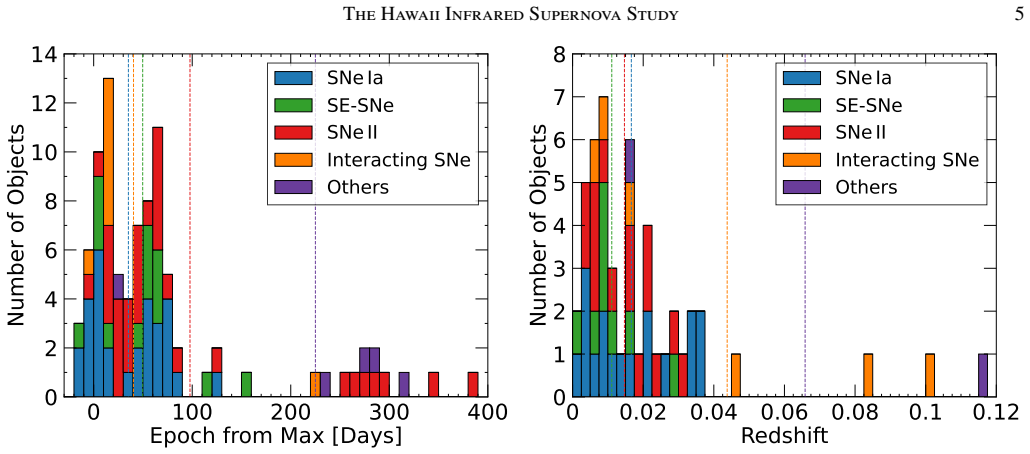
The discovery claim is that a coherent NIR spectral library of this breadth can be assembled and that it already resolves physics that is heavily blended in the optical. On the paper's own terms, DR1 contains 90 spectra of 48 objects—17 SNe Ia, 15 SNe II, 8 stripped-envelope SNe, 6 interacting SNe, 1 TDE, and 1 SLSN-I—reduced systematically and released publicly. The paper reports that template comparisons match well, and it identifies four NIR-only results: a clear detection of unburnt C I 1.0693 μm in the 91bg-like SN 2021qvv; nebular SNe II line widths that place the hydrogen envelope at higher velocity than the iron core except where iron is blended outward; CO first-overtone emission between 2.3 and 2.5 μm in four core-collapse SNe; and a He I 1.083 μm pseudo-equivalent-width dichotomy that splits five SNe II into 'strong' (pEW exceeding 50 Å) and 'weak' groups.
Load-bearing premise
The entire quantitative use of the release rests on the assumption that the wavelength and flux calibration is unbiased, but no arc-lamp calibration or uncertainty estimate is provided for the largest subset of spectra.
Editorial extensions
If this is right
- The 90 released spectra substantially increase the public NIR transient sample and give template builders a multi-type, multi-epoch benchmark.
- Pre-maximum SNe Ia spectra show at least three shapes of the 1 μm feature (flat, V, and W), so early-time diversity in outer ejecta is measurable and can be tied to explosion models.
- Nebular NIR line FWHMs in SNe II let observers estimate the velocity structure of the ejecta core and identify mixing or asymmetry of iron-group material.
- Ground-based CO first-overtone detections in four core-collapse SNe show that molecular formation and dust precursors can be monitored without space-based facilities.
- The He I 1.083 μm pseudo-equivalent-width boundary at 50 Å offers a practical way to split SNe II into two groups that likely correspond to different progenitor and circumstellar configurations.
Reading between the lines
- If the calibration holds, the same spectra could be used to build quantitative early-time SNe Ia templates before about -5 days, a phase the paper notes is under-sampled.
- The He I pEW dichotomy suggests a testable prediction: 'weak' SNe II in this sample should decline more slowly in luminosity than 'strong' ones, a link the paper states but does not verify with light curves here.
- The CO detections at about +269 and +289 days imply significant CO survival; a radiative-transfer model of these spectra could constrain CO mass and temperature and predict when dust should form.
- Comparing the released NIR line velocities with optical velocities of the same objects at the same epochs would provide a straightforward external check on the wavelength calibration.
Editorial analysis
A structured set of objections, weighed in public.
Referee Report
Summary. The paper presents the first data release of the Hawaii Infrared Supernova Study (HISS), comprising 90 near-infrared spectra (0.7–2.5 μm) of 48 transient events obtained with Keck-II/NIRES and IRTF/SpeX between 2021 and 2024. The sample includes Type Ia, Type II, stripped-envelope, and interacting SNe, plus one TDE and one SLSN-I. The authors describe the observations and reduction pipelines (Pypeit and Spextool), present the full spectral atlas, compare representative spectra to existing templates, and highlight four science applications: detection of unburnt carbon in SNe Ia, measurement of nebular line widths in SNe II, identification of the CO first overtone, and a proposed dichotomy in SNe II based on the He I 1.083 μm pseudo-equivalent width. The spectra are publicly released via WISeREP.
Significance. If the calibration and data products are validated, HISS DR1 is a valuable community resource that materially increases the number of publicly available NIR transient spectra, complementing larger samples such as CSP II and KITS. A particular strength is that the paper does not derive its scientific conclusions from the templates it compares against; the template comparison is used only for benchmarking, so there is no circularity concern despite overlapping authorship. The four science highlights are presented as demonstrations of the dataset's utility, and several are genuinely novel for a data release paper (e.g., the epoch-resolved He I pEW behavior). The release of the spectra through WISeREP is a concrete, reproducible contribution. However, the quantitative support for at least one headline result and the calibration reproducibility need strengthening before the paper can be accepted.
major comments (3)
- [§3.1, §3.2, §9] The strong/weak SNe II classification is epoch-confounded. SN2021tiq is classified as the sole weak SN II based on pEW = 27.95 Å at +57.58 d, but the same object at +123.91 d has pEW = 135.13 Å, which exceeds the paper's own 50 Å strong threshold. The four strong SNe are observed at +61 to +84 d, so the comparison is not epoch-matched. No pEW uncertainties, continuum-fitting prescription, or epoch-correction are provided. Because this dichotomy is listed in the abstract and conclusions as one of the four key science results, the current data do not support the claimed weak category or the associated high-velocity helium interpretation. The authors should either restrict the classification to a narrow phase bin, apply a phase correction, or explicitly reframe this as a single-epoch tentative observation rather than a supported dichotomy.
- [§5.4] The NIRES flux calibration and telluric correction rely on custom Python scripts that are not released, and no uncertainty estimates or photometric cross-checks are provided for the final flux calibration. Since the paper encourages quantitative use (pEW, FWHM, velocities), the absence of calibration validation or error spectra limits the reproducibility and reliability of derived quantities. The authors should release the reduction scripts and provide at least one validation check (e.g., comparison with photometry or repeat observations of the same object), and clearly state whether error arrays are included in the WISeREP data files.
- [§5.4] The mass-loss rate for SN2020aekp (Mdot ≈ 10^-3 M_sun/yr, M_CSM ≈ 1 M_sun) is derived from a single Pa-beta FWHM (102 ± 15 km/s) using equations from Yang et al. (2023) with assumed expansion velocity (7000 km/s), spherical geometry, and 20% kinetic-to-radiation conversion efficiency, but no uncertainty propagation or discussion of systematic errors is given. This quantitative claim should be presented as an illustrative estimate with the stated assumptions and a caveat that the derived values carry large unquantified uncertainties.
minor comments (5)
- [§4.6] The caption refers to 'SN2020fpl' but the text and Table A1 consistently identify the object as SN2021fpl; please correct the typo.
- [§5] The text says uncertainties on t_max were determined from photometric cadence and the fitting procedure, but no uncertainty values are reported in Table A1 or elsewhere, so phase uncertainties cannot be assessed by users.
- [§6.1] The Gaussian smoothing is described as 'sigma value of 3' but the units (pixels, wavelength bins, or velocity) are not specified; please state the smoothing scale explicitly.
- [Abstract] The sBV template-matching procedure is described only qualitatively ('the template spectra that most accurately reproduce the features'); please specify the matching metric or fitting procedure used to select the adopted sBV value.
- [Abstract] The claim that this is 'one of the largest NIR samples of transients available to the astrophysical community' is difficult to reconcile with the larger CSP II (909 spectra) and KITS (274 spectra) samples cited in the introduction; please rephrase to 'one of the largest publicly available NIR samples of transients spanning multiple types' or similar.
Circularity Check
No significant circularity: HISS DR1 is a data release whose templates and classification benchmarks are external comparisons, not inputs that force the released spectra.
full rationale
The central deliverable is a set of 90 reduced NIR spectra obtained from raw Keck-II/NIRES and IRTF/SpeX observations, reduced with Pypeit and Spextool. The four science highlights are identifications and measurements made on those spectra, not outputs of a model fitted to the same spectra. The template comparisons in Section 6 use templates from Lu et al. (2023), Davis et al. (2019), and Shahbandeh et al. (2022), which have overlapping authorship, but the paper uses them as external benchmarks for visual comparison rather than deriving the spectra from them. The sBV matching in Section 6.1 is explicitly a tuning step ('the sBV value was varied between 0 and 1.5 to construct an array of template spectra for each epoch'), and the paper does not present the resulting match as a prediction; it merely displays the best-matching template. The §7.4 'strong' vs 'weak' SNe II classification applies the pEW threshold from Davis et al. (2019) to five objects; this is a reproduction of an existing classification scheme on new data, not a circular derivation. The notable weakness that SN2021tiq has pEW = 27.95 Å at +57.6 d but 135.13 Å at +123.9 d is an epoch-confounding and measurement-validity concern, not a circularity: it does not reduce a predicted quantity to an input. No fitted parameter is renamed as a prediction, no uniqueness theorem is imported from the authors' prior work, and no ansatz is smuggled in via citation. The paper is largely self-contained as a spectroscopic data release, so the circularity score is low.
Assumptions & free parameters
free parameters (4)
- sBV template matching range =
0 to 1.5
- Gaussian smoothing sigma =
3 pixels
- Expansion velocity for SN2020aekp mass-loss rate =
7000 km/s
- Kinetic-to-radiation conversion efficiency =
20%
assumptions (4)
- domain assumption Milky Way extinction correction with Rv=3.1
- domain assumption TNS classifications are reliable
- domain assumption Template line identifications from prior literature
- domain assumption Distance-limited sample D<=125 Mpc
Cite this review
Pith. "Pith review of The Hawaii Infrared Supernova Study (HISS): Spectroscopic Data Release 1." pith.science (2026). https://pith.science/paper/UDIOV2RW
@misc{pith2026250518507,
  author       = {Pith},
  title        = {Pith review of: The Hawaii Infrared Supernova Study (HISS): Spectroscopic Data Release 1},
  year         = {2026},
  howpublished = {\url{https://pith.science/paper/UDIOV2RW}},
  note         = {Machine review of arXiv:2505.18507}
}
abstract
We present the first data release of the Hawaii Infrared Supernova Study (\textit{HISS}), consisting of a large sample of near-infrared (NIR) spectra, $0.7 - 2.5 \mathrm{\mu m}$, obtained with the Keck-II/NIRES and IRTF/SpeX spectrographs. This sample is comprised of 90 NIR spectra of 48 transient events, spanning from hours after explosion to $\geq + 350$ days. Acquired over three years (2021-2024), this data release includes 17 Type Ia SNe, 15 Type II SNe, 8 Stripped Envelope SNe, 6 interacting SNe, 1 TDE, and 1 SLSN-I. These spectra were all systematically reduced using either the \textsc{Python}-based reduction code \textsc{Pypeit} or the \textsc{IDL}-based \textsc{Spextool} and constitute one of the largest NIR samples of transients available to the astrophysical community. We show the utility of NIR spectra and identify the key spectral features across multiple types of SNe. We show how both early-time and nebular-phase NIR spectra can be used to investigate the physics of the explosion, and to reveal the properties of the progenitor. With the addition of this dataset, the number of publicly available NIR spectra spanning multiple transient types has been substantially increased. In its next phase, \textit{HISS} will leverage target-of-opportunity spectral observations and NIR imaging from telescopes on Maunakea. Expanding the NIR dataset of SNe is vital to the transient community, particularly in light of the increasing emphasis on the infrared regime following the recent launch of the \textit{James Webb Space Telescope} and the forthcoming launch of the \textit{Nancy Grace Roman Space Telescope}.
Figures


Figures from the paper (8 more)


Forward citations
Cited by 1 Pith paper
-
JWST Observations of SN 2023ixf II: The Panchromatic Evolution Between 250 and 720 Days After the Explosion
New panchromatic spectra of SN 2023ixf show hydrogen Balmer through Humphreys series lines, forbidden Ne, Ar, Fe, Co, Ni lines, CO bands, and a growing 10 and 18 micron dust excess between days 250 and 720.
Reference graph
Works this paper leans on
-
[1]
2006, ApJ, 650, 510, doi: 10.1086/507020
Aldering, G., Antilogus, P., Bailey, S., et al. 2006, ApJ, 650, 510, doi: 10.1086/507020
doi:10.1086/507020 2006
-
[2]
Anderson, J. P. 2019, A&A, 628, A7, doi: 10.1051/0004-6361/201935027
-
[3]
2011, ApJL, 742, L18, doi: 10.1088/2041-8205/742/2/L18
Arcavi, I., Gal-Yam, A., Yaron, O., et al. 2011, ApJL, 742, L18, doi: 10.1088/2041-8205/742/2/L18
-
[4]
1992, A&A, 254, 49
Vangioni-Flam, E. 1992, A&A, 254, 49
1992
-
[5]
Ashall, C., Mazzali, P. A., Stritzinger, M. D., et al. 2018, MNRAS, 477, 153, doi: 10.1093/mnras/sty632
-
[6]
Ashall, C., Hsiao, E. Y., Hoeflich, P., et al. 2019a, ApJL, 875, L14, doi: 10.3847/2041-8213/ab1654
-
[7]
Ashall, C., Hoeflich, P., Hsiao, E. Y., et al. 2019b, ApJ, 878, 86, doi: 10.3847/1538-4357/ab204b
-
[8]
Ashall, C., Lu, J., Hsiao, E. Y., et al. 2021, ApJ, 922, 205, doi: 10.3847/1538-4357/ac19ac
Show all 194 references
-
[9]
2024, ApJ, 975, 203, doi: 10.3847/1538-4357/ad6608 Astropy Collaboration, Robitaille, T
Ashall, C., Hoeflich, P., Baron, E., et al. 2024, ApJ, 975, 203, doi: 10.3847/1538-4357/ad6608 Astropy Collaboration, Robitaille, T. P., Tollerud, E. J., et al. 2013, A&A, 558, A33, doi: 10.1051/0004-6361/201322068 Astropy Collaboration, Price-Whelan, A. M., Sipőcz, B. M., et ...
2024 doi
-
[10]
1934, Proceedings of the National Academy of Science, 20, 254, doi: 10.1073/pnas.20.5.254
Baade, W., & Zwicky, F. 1934, Proceedings of the National Academy of Science, 20, 254, doi: 10.1073/pnas.20.5.254
1934 doi
-
[11]
1967, PhRvL, 18, 379, doi: 10.1103/PhysRevLett.18.379
Barkat, Z., Rakavy, G., & Sack, N. 1967, PhRvL, 18, 379, doi: 10.1103/PhysRevLett.18.379
1967 doi
-
[12]
C., Kulkarni, S
Bellm, E. C., Kulkarni, S. R., Graham, M. J., et al. 2019, PASP, 131, 018002, doi: 10.1088/1538-3873/aaecbe
2019 doi
-
[13]
A., et al
Benetti, S., Cappellaro, E., Mazzali, P. A., et al. 2005, ApJ, 623, 1011, doi: 10.1086/428608 24Medler, Ashall, et al. 1.0 1.5 2.0 2.5 Rest Wavelength [ m] Log10(F ) + Con. SN 2022jli (Ic) 1.0 1.5 2.0 2.5 Rest Wavelength [ m] Log10(F ) + Con. SN 2022crv (IIb) 1.0 1.5 2.0 2.5 R...
2005 doi
-
[14]
McQuinn, K. B. W. 2019, ApJ, 874, 93, doi: 10.3847/1538-4357/ab020a
2019 doi
-
[15]
E., & Fabbro, S
Bi, C., Woods, T. E., & Fabbro, S. 2024, ApJ, 964, 193, doi: 10.3847/1538-4357/ad1b5a
2024 doi
-
[16]
Storey, P. J. 2023, A&A, 678, A170, doi: 10.1051/0004-6361/202347147
2023 doi
-
[17]
2015, ApJ, 806, 160, doi: 10.1088/0004-637X/806/2/160
Bose, S., Sutaria, F., Kumar, B., et al. 2015, ApJ, 806, 160, doi: 10.1088/0004-637X/806/2/160
2015 doi
- [18]
-
[19]
A., Dessart, L., Hillier, D
Bostroem, K. A., Dessart, L., Hillier, D. J., et al. 2023, ApJL, 953, L18, doi: 10.3847/2041-8213/ace31c
2023 doi
-
[20]
2021, Transient Name Server Discovery Report, 2021-843, 1
Bruch, R., Zimmerman, E., & Johansson, J. 2021, Transient Name Server Discovery Report, 2021-843, 1
2021
-
[21]
2009, ApJ, 700, 1456, doi: 10.1088/0004-637X/700/2/1456
Bufano, F., Immler, S., Turatto, M., et al. 2009, ApJ, 700, 1456, doi: 10.1088/0004-637X/700/2/1456
2009 doi
-
[22]
2014, MNRAS, 439, 1807, doi: 10.1093/mnras/stu065
Bufano, F., Pignata, G., Bersten, M., et al. 2014, MNRAS, 439, 1807, doi: 10.1093/mnras/stu065
2014 doi
-
[23]
R., Stritzinger, M., Phillips, M
Burns, C. R., Stritzinger, M., Phillips, M. M., et al. 2014, ApJ, 789, 32, doi: 10.1088/0004-637X/789/1/32
2014 doi
-
[24]
A., Clayton, G
Cardelli, J. A., Clayton, G. C., & Mathis, J. S. 1989, ApJ, 345, 245, doi: 10.1086/167900
1989 doi
-
[25]
2024, arXiv e-prints, arXiv:2410.21381, doi: 10.48550/arXiv.2410.21381
Cartier, R., Contreras, C., Stritzinger, M., et al. 2024, arXiv e-prints, arXiv:2410.21381, doi: 10.48550/arXiv.2410.21381
2024 doi
- [26]
-
[27]
C., Boer, T
Chambers, K. C., Boer, T. D., Bulger, J., et al. 2021, Transient Name Server Discovery Report, 2021-1760, 1 —. 2022, Transient Name Server Discovery Report, 2022-1597, 1 Chandra,P.2018,SSRv,214,27,doi:10.1007/s11214-017-0461-6
2021 doi
-
[28]
Chatzopoulos, E., & Wheeler, J. C. 2012, ApJ, 760, 154, doi: 10.1088/0004-637X/760/2/154
2012 doi
-
[29]
2013, ApJ, 773, 76, doi: 10.1088/0004-637X/773/1/76 The Hawaii Infrared Supernova Study27 1.0 1.25 1.5 1.75 2.0 2.25 Rest Wavelength [ m] Log10(F ) + Con
Nagy, A. 2013, ApJ, 773, 76, doi: 10.1088/0004-637X/773/1/76 The Hawaii Infrared Supernova Study27 1.0 1.25 1.5 1.75 2.0 2.25 Rest Wavelength [ m] Log10(F ) + Con. SLSN-I SN 2021fpl Figure B7.Same as FigureB1 but for the SLSN-I SN2020fpl
2013 doi
-
[30]
2024, Nature, 625, 253, doi: 10.1038/s41586-023-06787-x
Chen, P., Gal-Yam, A., Sollerman, J., et al. 2024, Nature, 625, 253, doi: 10.1038/s41586-023-06787-x
2024 doi
-
[31]
A., & Fransson, C
Chevalier, R. A., & Fransson, C. 2003, in Supernovae and Gamma-Ray Bursters, ed. K. Weiler, Vol. 598, 171–194, doi: 10.1007/3-540-45863-8_10
2003 doi
-
[32]
A., & Irwin, C
Chevalier, R. A., & Irwin, C. M. 2011, ApJL, 729, L6, doi: 10.1088/2041-8205/729/1/L6
2011 doi
-
[33]
N., Chevalier, R
Chugai, N. N., Chevalier, R. A., & Utrobin, V. P. 2007, ApJ, 662, 1136, doi: 10.1086/518160
2007 doi
-
[35]
2024, MNRAS, 528, 7076, doi: 10.1093/mnras/stae460 Côté, B., Eichler, M., Arcones, A., et al
Clark, P., Graur, O., Callow, J., et al. 2024, MNRAS, 528, 7076, doi: 10.1093/mnras/stae460 Côté, B., Eichler, M., Arcones, A., et al. 2019, ApJ, 875, 106, doi: 10.3847/1538-4357/ab10db
2024 doi
-
[36]
C., Vacca, W
Cushing, M. C., Vacca, W. D., & Rayner, J. T. 2004, PASP, 116, 362, doi: 10.1086/382907
2004 doi
-
[37]
Y., Ashall, C., et al
Davis, S., Hsiao, E. Y., Ashall, C., et al. 2019, ApJ, 887, 4, doi: 10.3847/1538-4357/ab4c40
2019 doi
-
[38]
2021a, Transient Name Server Discovery Report, 2021-2030, 1 —
De, K. 2021a, Transient Name Server Discovery Report, 2021-2030, 1 —. 2021b, Transient Name Server Discovery Report, 2021-3913, 1 —. 2023, Transient Name Server Discovery Report, 2023-2825, 1
2021
-
[39]
2020, Transient Name Server Discovery Report, 2020-2334, 1
De, K., & Hankins, M. 2020, Transient Name Server Discovery Report, 2020-2334, 1
2020
-
[40]
M., Paugh, S., Baron, E., et al
DerKacy, J. M., Paugh, S., Baron, E., et al. 2023a, MNRAS, 522, 3481, doi: 10.1093/mnras/stad1171
-
[41]
M., Ashall, C., Hoeflich, P., et al
DerKacy, J. M., Ashall, C., Hoeflich, P., et al. 2023b, ApJL, 945, L2, doi: 10.3847/2041-8213/acb8a8 —. 2024, ApJ, 961, 187, doi: 10.3847/1538-4357/ad0b7b
2024 doi
-
[42]
P., Ercolino, A., Jin, H., & Langer, N
Dessart, L., Gutiérrez, C. P., Ercolino, A., Jin, H., & Langer, N. 2024, A&A, 685, A169, doi: 10.1051/0004-6361/202349066
2024 doi
-
[43]
Dessart, L., & Hillier, D. J. 2020, A&A, 642, A33, doi: 10.1051/0004-6361/202038148 28Medler, Ashall, et al
2020 doi
-
[44]
Dong, S., Katz, B., Kushnir, D., & Prieto, J. L. 2015, MNRAS, 454, L61, doi: 10.1093/mnrasl/slv129
2015 doi
-
[45]
J., et al
Dong, Y., Valenti, S., Sand, D. J., et al. 2022, Transient Name Server Discovery Report, 2022-448, 1
2022
-
[46]
2024, ApJ, 974, 316, doi: 10.3847/1538-4357/ad710e
Dong, Y., Valenti, S., Ashall, C., et al. 2024, ApJ, 974, 316, doi: 10.3847/1538-4357/ad710e
2024 doi
-
[47]
2022, A&A, 666, A104, doi: 10.1051/0004-6361/202243448
Ergon, M., & Fransson, C. 2022, A&A, 666, A104, doi: 10.1051/0004-6361/202243448
2022 doi
-
[48]
R., & Kochanek, C
Evans, C. R., & Kochanek, C. S. 1989, ApJL, 346, L13, doi: 10.1086/185567
1989 doi
-
[49]
Filippenko, A. V. 1997, ARA&A, 35, 309, doi: 10.1146/annurev.astro.35.1.309
1997 doi
-
[50]
K., Hillebrandt, W., et al
Fink, M., Röpke, F. K., Hillebrandt, W., et al. 2010, A&A, 514, A53, doi: 10.1051/0004-6361/200913892
2010 doi
-
[51]
M., Morrell, N., et al
Folatelli, G., Phillips, M. M., Morrell, N., et al. 2012, ApJ, 745, 74, doi: 10.1088/0004-637X/745/1/74
2012 doi
-
[52]
E., Pignata, G., et al
Forster, F., Bauer, F. E., Pignata, G., et al. 2020, Transient Name Server Discovery Report, 2020-908, 1 —. 2021a, Transient Name Server Discovery Report, 2021-942, 1
2020
-
[53]
E., Munoz-Arancibia, A., et al
Forster, F., Bauer, F. E., Munoz-Arancibia, A., et al. 2021b, Transient Name Server Discovery Report, 2021-1237, 1
2021
- [54]
-
[55]
2021, Transient Name Server Discovery Report, 2021-561, 1 —
Fremling, C. 2021, Transient Name Server Discovery Report, 2021-561, 1 —. 2022a, Transient Name Server Discovery Report, 2022-540, 1 —. 2022b, Transient Name Server Discovery Report, 2022-1563, 1
2021
-
[56]
R., Vincenzi, M., et al
Frohmaier, C., Angus, C. R., Vincenzi, M., et al. 2021, MNRAS, 500, 5142, doi: 10.1093/mnras/staa3607
2021 doi
-
[57]
2012, Science, 337, 927, doi: 10.1126/science.1203601 —
Gal-Yam, A. 2012, Science, 337, 927, doi: 10.1126/science.1203601 —. 2019, ApJ, 882, 102, doi: 10.3847/1538-4357/ab2f79
2012 doi
-
[58]
2022, Nature, 601, 201, doi: 10.1038/s41586-021-04155-1
Gal-Yam, A., Bruch, R., Schulze, S., et al. 2022, Nature, 601, 201, doi: 10.1038/s41586-021-04155-1
2022 doi
-
[59]
2023, ApJ, 957, 100, doi: 10.3847/1538-4357/acfa94
Gangopadhyay, A., Maeda, K., Singh, A., et al. 2023, ApJ, 957, 100, doi: 10.3847/1538-4357/acfa94
2023 doi
-
[60]
L., Fesen, R
Gerardy, C. L., Fesen, R. A., Nomoto, K., et al. 2002, PASJ, 54, 905, doi: 10.1093/pasj/54.6.905
2002 doi
-
[61]
2022, MNRAS, 511, 691, doi: 10.1093/mnras/stac088
Gilkis, A., & Arcavi, I. 2022, MNRAS, 511, 691, doi: 10.1093/mnras/stac088
2022 doi
-
[62]
A., Livne, E., Steinberg, E., Yalinewich, A., & Truran, J
Glasner, S. A., Livne, E., Steinberg, E., Yalinewich, A., & Truran, J. W. 2018, MNRAS, 476, 2238, doi: 10.1093/mnras/sty421
2018 doi
-
[63]
A., Taubenberger, S., et al
Hachinger, S., Mazzali, P. A., Taubenberger, S., et al. 2012, MNRAS, 422, 70, doi: 10.1111/j.1365-2966.2012.20464.x
2012
-
[64]
I., et al
Hamuy, M., Folatelli, G., Morrell, N. I., et al. 2006, PASP, 118, 2, doi: 10.1086/500228
2006 doi
-
[66]
J., & Kobayashi, C
Haynes, C. J., & Kobayashi, C. 2019, MNRAS, 483, 5123, doi: 10.1093/mnras/sty3389
2019 doi
-
[67]
L., Woosley, S
Heger, A., Fryer, C. L., Woosley, S. E., Langer, N., & Hartmann, D. H. 2003, ApJ, 591, 288, doi: 10.1086/375341
2003 doi
-
[68]
T., Holoien, T
Hinkle, J. T., Holoien, T. W. S., Shappee, B. J., et al. 2022, ApJ, 930, 12, doi: 10.3847/1538-4357/ac5f54
2022 doi
- [69]
-
[70]
2024, ApJ, 964, 181, doi: 10.3847/1538-4357/ad2854
Hiramatsu, D., Matsumoto, T., Berger, E., et al. 2024, ApJ, 964, 181, doi: 10.3847/1538-4357/ad2854
2024 doi
-
[71]
Ho, A. Y. Q. 2023, Transient Name Server Discovery Report, 2023-533, 1
2023
-
[72]
T., Breedt, E., Delgado, A., et al
Hodgkin, S. T., Breedt, E., Delgado, A., et al. 2020, Transient Name Server Discovery Report, 2020-3948, 1
2020
-
[73]
1996, ApJ, 457, 500, doi: 10.1086/176748
Hoeflich, P., & Khokhlov, A. 1996, ApJ, 457, 500, doi: 10.1086/176748
1996 doi
-
[74]
2021, ApJ, 922, 186, doi: 10.3847/1538-4357/ac250d Höflich, P., Gerardy, C
Hoeflich, P., Ashall, C., Bose, S., et al. 2021, ApJ, 922, 186, doi: 10.3847/1538-4357/ac250d Höflich, P., Gerardy, C. L., Fesen, R. A., & Sakai, S. 2002a, ApJ, 568, 791, doi: 10.1086/339063 —. 2002b, ApJ, 568, 791, doi: 10.1086/339063
2021 doi
-
[75]
B., Shappee, B
Hoogendam, W. B., Shappee, B. J., Brown, P. J., et al. 2024a, ApJ, 966, 139, doi: 10.3847/1538-4357/ad33ba
-
[76]
B., Ashall, C., Galbany, L., et al
Hoogendam, W. B., Ashall, C., Galbany, L., et al. 2022, ApJ, 928, 103, doi: 10.3847/1538-4357/ac54aa
2022 doi
-
[77]
B., Hinkle, J
Hoogendam, W. B., Hinkle, J. T., Shappee, B. J., et al. 2024b, MNRAS, 530, 4501, doi: 10.1093/mnras/stae1121
- [78]
- [79]
-
[80]
D., Dong, Y., et al
Hosseinzadeh, G., Kilpatrick, C. D., Dong, Y., et al. 2022, ApJ, 935, 31, doi: 10.3847/1538-4357/ac75f0
2022 doi
-
[81]
Hoyle, F., & Fowler, W. A. 1960, ApJ, 132, 565, doi: 10.1086/146963
1960 doi
-
[82]
Y., Burns, C
Hsiao, E. Y., Burns, C. R., Contreras, C., et al. 2015, A&A, 578, A9, doi: 10.1051/0004-6361/201425297
2015 doi
-
[83]
Y., Phillips, M
Hsiao, E. Y., Phillips, M. M., Marion, G. H., et al. 2019, PASP, 131, 014002, doi: 10.1088/1538-3873/aae961
2019 doi
-
[84]
J., Valenti, S., Kotak, R., et al
Hunter, D. J., Valenti, S., Kotak, R., et al. 2009, A&A, 508, 371, doi: 10.1051/0004-6361/200912896
2009 doi
-
[85]
Iben, Jr., I., & Tutukov, A. V. 1984, ApJS, 54, 335, doi: 10.1086/190932
1984 doi
-
[86]
J., Jerkstrand, A., et al
Inserra, C., Smartt, S. J., Jerkstrand, A., et al. 2013, ApJ, 770, 128, doi: 10.1088/0004-637X/770/2/128
2013 doi
-
[87]
J., et al
Inserra, C., Fraser, M., Smartt, S. J., et al. 2016, MNRAS, 459, 2721, doi: 10.1093/mnras/stw825
2016 doi
-
[88]
2022, Transient Name Server Discovery Report, 2022-994, 1
Itagaki, K. 2022, Transient Name Server Discovery Report, 2022-994, 1
2022
-
[89]
J., Inserra, C., et al
Jerkstrand, A., Smartt, S. J., Inserra, C., et al. 2017, ApJ, 835, 13, doi: 10.3847/1538-4357/835/1/13 The Hawaii Infrared Supernova Study29
2017 doi
-
[90]
W., Maguire, K., & Sullivan, M
Jha, S. W., Maguire, K., & Sullivan, M. 2019, Nature Astronomy, 3, 706, doi: 10.1038/s41550-019-0858-0
2019 doi
-
[91]
Johnson, J. A. 2019, Science, 363, 474, doi: 10.1126/science.aau9540
2019 doi
-
[92]
2010, ApJ, 717, 245, doi: 10.1088/0004-637X/717/1/245
Kasen, D., & Bildsten, L. 2010, ApJ, 717, 245, doi: 10.1088/0004-637X/717/1/245
2010 doi
-
[93]
K., & Woosley, S
Kasen, D., Röpke, F. K., & Woosley, S. E. 2009, Nature, 460, 869, doi: 10.1038/nature08256
2009 doi
-
[94]
2012, ApJ, 744, 10, doi: 10.1088/0004-637X/744/1/10
Kiewe, M., Gal-Yam, A., Arcavi, I., et al. 2012, ApJ, 744, 10, doi: 10.1088/0004-637X/744/1/10
2012 doi
-
[95]
2024, A&A, 682, L22, doi: 10.1051/0004-6361/202349002
King, A., & Lasota, J.-P. 2024, A&A, 682, L22, doi: 10.1051/0004-6361/202349002
2024 doi
-
[96]
2009, ApJ, 707, 1466, doi: 10.1088/0004-637X/707/2/1466 Könyves-Tóth, R., & Vinkó, J
Kobayashi, C., & Nomoto, K. 2009, ApJ, 707, 1466, doi: 10.1088/0004-637X/707/2/1466 Könyves-Tóth, R., & Vinkó, J. 2021, ApJ, 909, 24, doi: 10.3847/1538-4357/abd6c8
2009 doi
-
[97]
Kotak, R., Meikle, W. P. S., Adamson, A., & Leggett, S. K. 2004, MNRAS, 354, L13, doi: 10.1111/j.1365-2966.2004.08306.x
2004
-
[98]
Y., Ashall, C., et al
Kumar, S., Hsiao, E. Y., Ashall, C., et al. 2023, ApJ, 945, 27, doi: 10.3847/1538-4357/acad73 —. 2025, arXiv e-prints, arXiv:2504.17134. https://arxiv.org/abs/2504.17134 Kurfürst, P., & Krtička, J. 2019, A&A, 625, A24, doi: 10.1051/0004-6361/201833429
2023
-
[99]
2017, MNRAS, 467, 540, doi: 10.1093/mnras/stx055
Lamperti, I., Koss, M., Trakhtenbrot, B., et al. 2017, MNRAS, 467, 540, doi: 10.1093/mnras/stx055
2017 doi
-
[100]
A., Caproni, A., & Soares, J
Lanfranchi, G. A., Caproni, A., & Soares, J. F. 2024, MNRAS, 535, 3758, doi: 10.1093/mnras/stae2622
2024 doi
- [101]
-
[102]
Y., Phillips, M
Lu, J., Hsiao, E. Y., Phillips, M. M., et al. 2023, ApJ, 948, 27, doi: 10.3847/1538-4357/acc100
2023 doi
-
[103]
2020, MNRAS, 492, 686, doi: 10.1093/mnras/stz3405
Lu, W., & Bonnerot, C. 2020, MNRAS, 492, 686, doi: 10.1093/mnras/stz3405
2020 doi
-
[104]
Lucy, L. B. 1991, ApJ, 383, 308, doi: 10.1086/170787
1991 doi
-
[105]
2022, Transient Name Server Discovery Report, 2022-3543, 1
Lundquist, M., Pearson, J., Paraskeva, E., et al. 2022, Transient Name Server Discovery Report, 2022-3543, 1
2022
-
[106]
D., Bersier, D., James, P
Lyman, J. D., Bersier, D., James, P. A., et al. 2016, MNRAS, 457, 328, doi: 10.1093/mnras/stv2983
2016 doi
-
[107]
2010, ApJ, 708, 1703, doi: 10.1088/0004-637X/708/2/1703
Maeda, K., Taubenberger, S., Sollerman, J., et al. 2010, ApJ, 708, 1703, doi: 10.1088/0004-637X/708/2/1703
2010 doi
-
[108]
A., Shingles, L., et al
Maguire, K., Sim, S. A., Shingles, L., et al. 2018, MNRAS, 477, 3567, doi: 10.1093/mnras/sty820
2018 doi
-
[109]
2017, ApJ, 848, 25, doi: 10.3847/1538-4357/aa8b6e
Maoz, D., & Graur, O. 2017, ApJ, 848, 25, doi: 10.3847/1538-4357/aa8b6e
2017 doi
-
[110]
H., Höflich, P., Gerardy, C
Marion, G. H., Höflich, P., Gerardy, C. L., et al. 2009, AJ, 138, 727, doi: 10.1088/0004-6256/138/3/727
2009 doi
-
[111]
1986, A&A, 154, 279
Matteucci, F., & Greggio, L. 1986, A&A, 154, 279
1986
-
[113]
A., Maurer, I., Valenti, S., Kotak, R., & Hunter, D
Mazzali, P. A., Maurer, I., Valenti, S., Kotak, R., & Hunter, D. 2010,MNRAS,408,87,doi:10.1111/j.1365-2966.2010.17133.x
2010
-
[114]
S., Becklin, E
McLean, I. S., Becklin, E. E., Bendiksen, O., et al. 1998, in Society of Photo-Optical Instrumentation Engineers (SPIE) Conference
1998
-
[115]
3354, Infrared Astronomical Instrumentation, ed
Series, Vol. 3354, Infrared Astronomical Instrumentation, ed. A. M. Fowler, 566–578, doi: 10.1117/12.317283
-
[116]
J., & Dessart, L
McLeod, C., Hillier, D. J., & Dessart, L. 2024, MNRAS, 532, 549, doi: 10.1093/mnras/stae1513
2024 doi
-
[117]
A., Ashall, C., et al
Medler, K., Mazzali, P. A., Ashall, C., et al. 2023, MNRAS, 518, L40, doi: 10.1093/mnrasl/slac127
2023 doi
-
[118]
A., Teffs, J., et al
Medler, K., Mazzali, P. A., Teffs, J., et al. 2022, MNRAS, 513, 5540, doi: 10.1093/mnras/stac1192
2022 doi
-
[119]
2022, Transient Name Server Discovery Report, 2022-1198, 1
Monard, L. 2022, Transient Name Server Discovery Report, 2022-1198, 1
2022
-
[120]
J., Nicholl, M., et al
Moore, T., Smartt, S. J., Nicholl, M., et al. 2023, ApJL, 956, L31, doi: 10.3847/2041-8213/acfc25
2023 doi
-
[121]
J., Maeda, K., Taddia, F., et al
Moriya, T. J., Maeda, K., Taddia, F., et al. 2014, MNRAS, 439, 2917, doi: 10.1093/mnras/stu163
2014 doi
-
[122]
J., Stritzinger, M
Moriya, T. J., Stritzinger, M. D., Taddia, F., et al. 2020, A&A, 641, A148, doi: 10.1051/0004-6361/202038118 Müller-Bravo, T. E., Galbany, L., Karamehmetoglu, E., et al. 2022, A&A, 665, A123, doi: 10.1051/0004-6361/202243845
2020 doi
-
[123]
2020, Transient Name Server Discovery Report, 2020-3534, 1
Munoz-Arancibia, A., Mourao, A., Forster, F., et al. 2020, Transient Name Server Discovery Report, 2020-3534, 1
2020
-
[124]
E., et al
Munoz-Arancibia, A., Forster, F., Bauer, F. E., et al. 2021a, Transient Name Server Discovery Report, 2021-956, 1
2021
-
[125]
2021b, Transient Name Server Discovery Report, 2021-1968, 1 —
Munoz-Arancibia, A., Mourao, A., Forster, F., et al. 2021b, Transient Name Server Discovery Report, 2021-1968, 1 —. 2021c, Transient Name Server Discovery Report, 2021-2265, 1
2021
-
[126]
E., et al
Munoz-Arancibia, A., Forster, F., Bauer, F. E., et al. 2021d, Transient Name Server Discovery Report, 2021-2432, 1 —. 2021e, Transient Name Server Discovery Report, 2021-3767, 1
2021
-
[127]
E., Forster, F., et al
Munoz-Arancibia, A., Bauer, F. E., Forster, F., et al. 2022a, Transient Name Server Discovery Report, 2022-1685, 1 —. 2022b, Transient Name Server Discovery Report, 2022-2118, 1 Nicholl,M.,Smartt,S.J.,Jerkstrand,A.,etal.2015,MNRAS,452, 3869, doi: 10.1093/mnras/stv1522
2022 doi
-
[128]
J., et al
Nicholl, M., Berger, E., Smartt, S. J., et al. 2016, ApJ, 826, 39, doi: 10.3847/0004-637X/826/1/39
2016 doi
-
[129]
K., & Yokoi, K
Nomoto, K., Thielemann, F. K., & Yokoi, K. 1984, ApJ, 286, 644, doi: 10.1086/162639
1984 doi
-
[130]
2020, Transient Name Server Discovery Report, 2020-1248, 1
Nordin, J., Brinnel, V., Giomi, M., et al. 2020, Transient Name Server Discovery Report, 2020-1248, 1
2020
-
[131]
V., et al
Nordin, J., Brinnel, V., Santen, J. V., et al. 2021, Transient Name Server Discovery Report, 2021-3768, 1
2021
-
[132]
2017, A&A, 605, A6, doi: 10.1051/0004-6361/201629906 O’Hora, J., Ashall, C., Shahbandeh, M., et al
Nyholm, A., Sollerman, J., Taddia, F., et al. 2017, A&A, 605, A6, doi: 10.1051/0004-6361/201629906 O’Hora, J., Ashall, C., Shahbandeh, M., et al. 2024, arXiv e-prints, arXiv:2412.09352, doi: 10.48550/arXiv.2412.09352 30Medler, Ashall, et al
-
[133]
G., et al
Onori, F., Cannizzaro, G., Jonker, P. G., et al. 2022, MNRAS, 517, 76, doi: 10.1093/mnras/stac2673
2022 doi
-
[134]
2012, ApJL, 747, L10, doi: 10.1088/2041-8205/747/1/L10
Pakmor, R., Kromer, M., Taubenberger, S., et al. 2012, ApJL, 747, L10, doi: 10.1088/2041-8205/747/1/L10
2012 doi
-
[135]
2007, in American Institute of Physics Conference
Panagia, N. 2007, in American Institute of Physics Conference
2007
-
[136]
937, Supernova 1987A: 20 Years After: Supernovae and Gamma-Ray Bursters, ed
Series, Vol. 937, Supernova 1987A: 20 Years After: Supernovae and Gamma-Ray Bursters, ed. S. Immler, K. Weiler, & R. McCray (AIP), 236–245, doi: 10.1063/1.3682909
-
[137]
J., Mattila, S., et al
Pastorello, A., Smartt, S. J., Mattila, S., et al. 2007, Nature, 447, 829, doi: 10.1038/nature05825
2007 doi
-
[138]
M., Crockett, R
Pastorello, A., Kasliwal, M. M., Crockett, R. M., et al. 2008, MNRAS, 389, 955, doi: 10.1111/j.1365-2966.2008.13618.x
2008
-
[139]
Pauldrach, A. W. A., Vanbeveren, D., & Hoffmann, T. L. 2012, A&A, 538, A75, doi: 10.1051/0004-6361/201117621
2012 doi
-
[140]
J., Lundqvist, P., et al
Pearson, J., Sand, D. J., Lundqvist, P., et al. 2024, ApJ, 960, 29, doi: 10.3847/1538-4357/ad0153
2024 doi
-
[141]
A., Terreran, G., et al
Pellegrino, C., Howell, D. A., Terreran, G., et al. 2022, ApJ, 938, 73, doi: 10.3847/1538-4357/ac8ff6
2022 doi
-
[142]
2021, Transient Name Server Discovery Report, 2021-443, 1
Perley, D., Yao, Y., & Ho, A. 2021, Transient Name Server Discovery Report, 2021-443, 1
2021
-
[143]
A., Sollerman, J., Schulze, S., et al
Perley, D. A., Sollerman, J., Schulze, S., et al. 2022, ApJ, 927, 180, doi: 10.3847/1538-4357/ac478e
2022 doi
-
[144]
M., Contreras, C., Hsiao, E
Phillips, M. M., Contreras, C., Hsiao, E. Y., et al. 2019, PASP, 131, 014001, doi: 10.1088/1538-3873/aae8bd
2019 doi
-
[145]
Podsiadlowski, P., Hsu, J. J. L., Joss, P. C., & Ross, R. R. 1993, Nature, 364, 509, doi: 10.1038/364509a0
1993 doi
- [146]
-
[147]
2020a, The Journal of Open Source Software, 5, 2308, doi: 10.21105/joss.02308
Prochaska, J., Hennawi, J., Westfall, K., et al. 2020a, The Journal of Open Source Software, 5, 2308, doi: 10.21105/joss.02308
-
[148]
X., Hennawi, J., Cooke, R., et al
Prochaska, J. X., Hennawi, J., Cooke, R., et al. 2020b, pypeit/PypeIt: Release 1.0.0, v1.0.0, Zenodo, doi: 10.5281/zenodo.3743493
-
[149]
M., Kulkarni, S
Quimby, R. M., Kulkarni, S. R., Kasliwal, M. M., et al. 2011, Nature, 474, 487, doi: 10.1038/nature10095
2011 doi
-
[150]
T., Toomey, D
Rayner, J. T., Toomey, D. W., Onaka, P. M., et al. 2003, PASP, 115, 362, doi: 10.1086/367745
2003 doi
-
[151]
Rees, M. J. 1988, Nature, 333, 523, doi: 10.1038/333523a0
1988 doi
-
[152]
R., Banerjee, D
Rho, J., Geballe, T. R., Banerjee, D. P. K., et al. 2018, ApJL, 864, L20, doi: 10.3847/2041-8213/aad77f Risin,S.,Jacobus,C.,Altunin,I.,etal.2023,ResearchNotesofthe American Astronomical Society, 7, 229, doi: 10.3847/2515-5172/ad0732
2018 doi
-
[153]
F., Aitken, D
Roche, P. F., Aitken, D. K., & Smith, C. H. 1991, MNRAS, 252, 39P, doi: 10.1093/mnras/252.1.39P
1991 doi
-
[154]
2016, ApJ, 827, 3, doi: 10.3847/0004-637X/827/1/3
Roth, N.,Kasen, D., Guillochon,J., & Ramirez-Ruiz,E. 2016, ApJ, 827, 3, doi: 10.3847/0004-637X/827/1/3
2016 doi
-
[155]
A., Hachinger, S., & Hotokezaka, K
Saito, S., Tanaka, M., Mazzali, P. A., Hachinger, S., & Hotokezaka, K. 2024, ApJ, 967, 13, doi: 10.3847/1538-4357/ad39e8
2024 doi
-
[156]
F., & Finkbeiner, D
Schlafly, E. F., & Finkbeiner, D. P. 2011, ApJ, 737, 103, doi: 10.1088/0004-637X/737/2/103
2011 doi
-
[157]
Schlegel, E. M. 1990, MNRAS, 244, 269
1990
- [158]
-
[159]
Y., Ashall, C., et al
Shahbandeh, M., Hsiao, E. Y., Ashall, C., et al. 2022, ApJ, 925, 175, doi: 10.3847/1538-4357/ac4030
2022 doi
- [160]
-
[161]
Z., et al
Shappee, B., Prieto, J., Stanek, K. Z., et al. 2014, in American Astronomical Society Meeting Abstracts, Vol. 223, American Astronomical Society Meeting Abstracts #223, 236.03
2014
-
[162]
M., Nugent, P
Silverman, J. M., Nugent, P. E., Gal-Yam, A., et al. 2013, ApJS, 207, 3, doi: 10.1088/0067-0049/207/1/3
2013 doi
-
[163]
A., Röpke, F
Sim, S. A., Röpke, F. K., Hillebrandt, W., et al. 2010, ApJL, 714, L52, doi: 10.1088/2041-8205/714/1/L52
2010 doi
-
[164]
J., Valenti, S., Fraser, M., et al
Smartt, S. J., Valenti, S., Fraser, M., et al. 2015, A&A, 579, A40, doi: 10.1051/0004-6361/201425237
2015 doi
-
[165]
2006, arXiv e-prints, astro, doi: 10.48550/arXiv.astro-ph/0607457 —
Smith, N. 2006, arXiv e-prints, astro, doi: 10.48550/arXiv.astro-ph/0607457 —. 2014, ARA&A, 52, 487, doi: 10.1146/annurev-astro-081913-040025 —. 2017, in Handbook of Supernovae, ed. A. W. Alsabti & P. Murdin, 403, doi: 10.1007/978-3-319-21846-5_38
-
[166]
Smith, N., & Owocki, S. P. 2006, ApJL, 645, L45, doi: 10.1086/506523
2006 doi
-
[167]
Stanek, K. Z. 2020, Transient Name Server Discovery Report, 2020-2076, 1 —. 2022, Transient Name Server Discovery Report, 2022-2111, 1
2020
-
[168]
Z., & Kochanek, C
Stanek, K. Z., & Kochanek, C. S. 2020, Transient Name Server Discovery Report, 2020-3922, 1
2020
-
[169]
2018, A&A, 615, A45, doi: 10.1051/0004-6361/201732357
Stanishev, V., Goobar, A., Amanullah, R., et al. 2018, A&A, 615, A45, doi: 10.1051/0004-6361/201732357
2018 doi
-
[170]
D., Baron, E., Taddia, F., et al
Stritzinger, M. D., Baron, E., Taddia, F., et al. 2024, A&A, 686, A79, doi: 10.1051/0004-6361/202347883
2024 doi
-
[171]
D., Sollerman, J., et al
Taddia, F., Stritzinger, M. D., Sollerman, J., et al. 2013, A&A, 555, A10, doi: 10.1051/0004-6361/201321180 Takáts, K., & Vinkó, J. 2012, MNRAS, 419, 2783, doi: 10.1111/j.1365-2966.2011.19921.x
2013
-
[172]
A., et al
Taubenberger, S., Pastorello, A., Mazzali, P. A., et al. 2006, MNRAS, 371, 1459, doi: 10.1111/j.1365-2966.2006.10776.x
2006
-
[173]
Teffs, J., Ertl, T., Mazzali, P., Hachinger, S., & Janka, H. T. 2020, MNRAS, 499, 730, doi: 10.1093/mnras/staa2549
2020 doi
-
[174]
C., Aldering, G., Antilogus, P., et al
Thomas, R. C., Aldering, G., Antilogus, P., et al. 2011, ApJ, 743, 27, doi: 10.1088/0004-637X/743/1/27
2011 doi
-
[175]
X., Woosley, S
Timmes, F. X., Woosley, S. E., & Weaver, T. A. 1995, ApJS, 98, 617, doi: 10.1086/192172
1995 doi
-
[176]
J., Taggart, K., et al
Tinyanont, S., Foley, R. J., Taggart, K., et al. 2024, PASP, 136, 014201, doi: 10.1088/1538-3873/ad1b39 The Hawaii Infrared Supernova Study31
2024 doi
-
[177]
2020, Transient Name Server Discovery Report, 2020-3733, 1 —
Tonry, J., Denneau, L., Heinze, A., et al. 2020, Transient Name Server Discovery Report, 2020-3733, 1 —. 2021a, Transient Name Server Discovery Report, 2021-481, 1 —. 2021b, Transient Name Server Discovery Report, 2021-752, 1 —. 2021c, Transient Name Server Discovery Report, 2...
2020
-
[178]
2021h, Transient Name Server Discovery Report, 2021-3769, 1 —
Tonry, J., Denneau, L., Weiland, H., et al. 2021h, Transient Name Server Discovery Report, 2021-3769, 1 —. 2021i, Transient Name Server Discovery Report, 2021-4122, 1 —. 2022a, Transient Name Server Discovery Report, 2022-779, 1 —. 2022b, Transient Name Server Discovery Report...
2021
-
[179]
L., Denneau, L., Heinze, A
Tonry, J. L., Denneau, L., Heinze, A. N., et al. 2018, PASP, 130, 064505, doi: 10.1088/1538-3873/aabadf
2018 doi
-
[180]
M., Miles, B
Townsley, D. M., Miles, B. J., Shen, K. J., & Kasen, D. 2019, ApJL, 878, L38, doi: 10.3847/2041-8213/ab27cd
2019 doi
-
[181]
1995, MNRAS, 277, 945, doi: 10.1093/mnras/277.3.945
Tsujimoto, T., Nomoto, K., Yoshii, Y., et al. 1995, MNRAS, 277, 945, doi: 10.1093/mnras/277.3.945
1995 doi
-
[182]
A., Shappee, B
Tucker, M. A., Shappee, B. J., Huber, M. E., et al. 2022, PASP, 134, 124502, doi: 10.1088/1538-3873/aca719
2022 doi
-
[183]
D., Cushing, M
Vacca, W. D., Cushing, M. C., & Rayner, J. T. 2003, PASP, 115, 389, doi: 10.1086/346193
2003 doi
-
[184]
2012, ApJ, 749, 115, doi: 10.1088/0004-637X/749/2/115
Wang, T.-G., Zhou, H.-Y., Komossa, S., et al. 2012, ApJ, 749, 115, doi: 10.1088/0004-637X/749/2/115
2012 doi
-
[185]
Webbink, R. F. 1984, ApJ, 277, 355, doi: 10.1086/161701
1984 doi
-
[186]
C., Höflich, P., Harkness, R
Wheeler, J. C., Höflich, P., Harkness, R. P., & Spyromilio, J. 1998, ApJ, 496, 908, doi: 10.1086/305427
1998 doi
-
[187]
1973, ApJ, 186, 1007, doi: 10.1086/152565
Whelan, J., & Iben, Jr., I. 1973, ApJ, 186, 1007, doi: 10.1086/152565
1973 doi
-
[188]
2021, ApJ, 908, 150, doi: 10.3847/1538-4357/abd244
Williamson, M., Kerzendorf, W., & Modjaz, M. 2021, ApJ, 908, 150, doi: 10.3847/1538-4357/abd244
2021 doi
-
[189]
Woosley, S. E. 2010, ApJL, 719, L204, doi: 10.1088/2041-8205/719/2/L204
2010 doi
-
[190]
E., Heger, A., & Weaver, T
Woosley, S. E., Heger, A., & Weaver, T. A. 2002, Reviews of Modern Physics, 74, 1015, doi: 10.1103/RevModPhys.74.1015
2002 doi
-
[191]
D., Sand, D
Wyatt, S. D., Sand, D. J., Hsiao, E. Y., et al. 2021, ApJ, 914, 57, doi: 10.3847/1538-4357/abf7c3
2021 doi
-
[192]
2017, ApJ, 840, 57, doi: 10.3847/1538-4357/aa6b02
Yan, L., Quimby, R., Gal-Yam, A., et al. 2017, ApJ, 840, 57, doi: 10.3847/1538-4357/aa6b02
2017 doi
-
[193]
2023, MNRAS, 519, 1618, doi: 10.1093/mnras/stac3477
Yang, Y., Baade, D., Hoeflich, P., et al. 2023, MNRAS, 519, 1618, doi: 10.1093/mnras/stac3477
2023 doi
-
[194]
2012, PASP, 124, 668, doi: 10.1086/666656
Yaron, O., & Gal-Yam, A. 2012, PASP, 124, 668, doi: 10.1086/666656
2012 doi
-
[195]
2015, PASA, 32, e015, doi: 10.1017/pasa.2015.16
Yoon, S.-C. 2015, PASA, 32, e015, doi: 10.1017/pasa.2015.16
2015 doi
-
[196]
2024, ApJ, 973, 155, doi: 10.3847/1538-4357/ad5fe8
Zhao, Z., Zhang, J., Li, L., et al. 2024, ApJ, 973, 155, doi: 10.3847/1538-4357/ad5fe8
2024 doi
-
[197]
A., Irani, I., Chen, P., et al
Zimmerman, E. A., Irani, I., Chen, P., et al. 2024, Nature, 627, 759, doi: 10.1038/s41586-024-07116-6
2024 doi
Reviewed August 7, 2026 · model on record in the stance chip above.
Discussion (0). Sign in to comment.