REVIEW 4 major objections 6 minor 33 references
An Empirical Study on Strong-Weak Model Collaboration for Repo-level Code Generation
T0 review · 4 major / 6 minor · reviewed 2026-08-07 · deepseek-v4-flash
Pith's one-line read A strong model's issue-fix rate can be matched by a strong-plus-weak pipeline at roughly 60% of the cost.
desk verdict A valuable empirical survey of strong-weak collaboration strategies whose headline cost-equivalence claim rests on an unmeasured 0.67% variance assumption that exactly matches the observed gap. read the letter →
The pith
A machine-rendered reading of the paper's core claim, the machinery that carries it, and where it could break.
The reading
What carries the argument
The central instrument is a two-step retrieval-augmented code generation loop built on the Agentless Lite framework: retrieve the top-k relevant files, then have a language model iteratively emit SEARCH/REPLACE patches, with temperature raised by 0.1 on each failed attempt up to ten retries. Onto this loop the paper grafts its taxonomy of strong-weak collaboration methods, covering static context augmentation (repo summaries, FAQs, repo-structure graphs, few-shot examples, planning), pipeline division (Strong LM First, Weak LM First, Prompt Reduction), and dynamic routing (Weak Router, Strong Router). The results are summarized as performance-versus-cost curves, with generation cost measured in dollars and resolution rate measured as the share of the 300 SWE-Bench Lite issues whose patch is accepted; those curves, rather than average efficiency alone, are what let the paper recommend a method for a given budget and accuracy floor.
What would settle it
Rerun the headline O3-mini plus Qwen2.5-Coder-32B comparison ten times with different random seeds; if the spread of Strong LM First's resolution rate overlaps or overtakes the strong-model-alone rate at comparable cost, the claim of equivalent performance at 40% lower cost is not supported.
Extended reading notes
Core claim
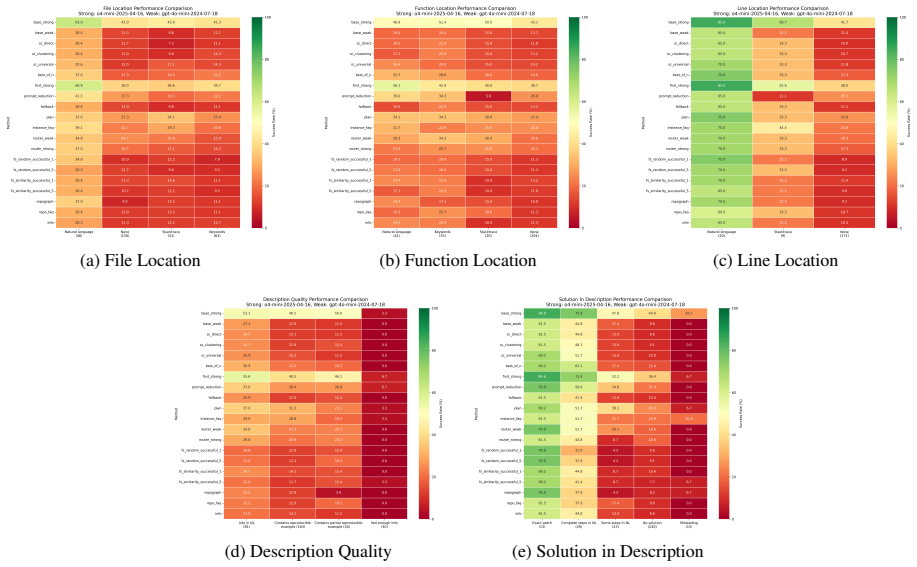
The paper's central discovery is that collaboration between a strong and a weak code model can closely match the strong model's resolution rate on real GitHub issues while spending about 40% less on generation. The load-bearing comparison is the O3-mini plus Qwen2.5-Coder-32B pair in Table 7: Strong LM First reaches 0.3300 resolution at $27.74, while O3-mini alone reaches 0.3367 at $46.22. The same pattern holds broadly across model pairs: pipeline and context-augmentation methods are the most cost-efficient on average, while cost-equated weak-only sampling, including self-consistency and best-of-n, underperforms and sometimes hurts the weak model. The paper also reports that repo-level context such as summaries and FAQs usually does not help, instance-level planning and QA help, and a weak router can beat a strong router, which the authors attribute to stronger models overthinking routing decisions. From the cost-performance curves, the paper concludes that the optimal method depends on the budget: Weak LM First and Weak Router lead at low spend, while Strong LM First dominates once more budget is available.
Load-bearing premise
The quantitative ranking rests on the assumption that one run per configuration, with temperature nudged up after failed patch attempts, gives resolution rates accurate to about 0.67 percentage points; no repeated runs measure the actual run-to-run noise.
Editorial extensions
If this is right
- Cost-equated weak-only baselines, which spend the strong model's budget on repeated weak-model samples and then select a patch, are not a reliable way to close the accuracy gap; collaboration beats them across nearly all model pairs.
- Under tight budgets, Weak LM First and Weak Router give the most resolution per dollar because they call the strong model only on harder instances.
- When the budget allows one strong call plus weak refinement, Strong LM First approaches or matches the strong model's resolution rate at lower cost, making it the default for higher-budget deployments.
- Repo-level context such as summaries, FAQs, and structure graphs, as well as few-shot examples, adds little or hurts; instance-level plans and QA pairs are the context augmentations worth their cost.
- The optimal method is budget-dependent, so a deployment should be chosen from cost-performance curves rather than from average efficiency.
Reading between the lines
- Because each configuration was run once, the ordering of methods separated by less than the assumed 0.67-point noise should be read as tentative; repeated seeded runs could tighten or reorder the comparisons.
- The explanation that stronger routers overthink is a hypothesis; a testable extension is to log routing decisions on instances where the weak router sends too many or too few cases to the strong model.
- The 40% cost saving is API generation cost only; including retrieval, latency, or energy could change the break-even point for real deployments.
- The taxonomy could transfer to other agentic retrieval-augmented tasks, such as documentation repair or data-science issue fixing, where localization and patch generation have similar cost asymmetries.
Editorial analysis
A structured set of objections, weighed in public.
Referee Report
Summary. The paper presents an empirical comparison of strong-weak language model collaboration strategies for repository-level code generation. It defines a taxonomy of methods (cost-equated weak-only baselines, context augmentation, pipeline division, and dynamic routing) and evaluates them on SWE-Bench Lite using the Agentless Lite framework across six strong-weak model pairs. The main reported findings are that pipeline and context-based methods are the most cost-efficient, that cost-equated weak-only sampling underperforms collaboration, and that the best collaborative strategy (Strong LM First with O3-mini as the strong model and Qwen2.5-Coder-32B as the weak model) achieves a resolution rate of 0.3300 versus 0.3367 for the strong model alone, at roughly 60% of the generation cost. The paper also provides performance-cost curves and practical guidelines for method selection under budget and accuracy constraints, and it releases the code.
Significance. If its quantitative conclusions hold, this is a useful empirical contribution: it maps a broad design space of strong-weak collaboration strategies under a unified cost-accounting framework, uses a standard benchmark, and provides actionable guidance for practitioners. The paper's strengths include the breadth of the taxonomy, the use of a realistic repository-level benchmark, the explicit reporting of generation cost, the inclusion of open-source and API model pairs, and the public release of the evaluation code. The central cost-equivalence claim, however, rests on a single run per instance and an assumed 0.67% variance threshold that is not validated by repeated runs; this affects the headline result and the method rankings. The statistical analysis in Appendix A.4 also appears to lack replication for the claimed significance tests. These issues are fixable but currently limit the strength of the conclusions.
major comments (4)
- [§5, Tables 3–8 footnotes] The headline claim that Strong LM First achieves 'equivalent performance to the strong model' at ~60% cost is based on resolution rates of 0.3300 versus 0.3367 in Table 7, a drop of exactly 0.0067. The tables state: 'We consider a variance of 0.67% owing to the non-determinism introduced by the growing temperature values so a drop less than or equal to this is not marked in red.' No repeated runs, confidence intervals, or paired tests are reported to justify this threshold. For a binomial proportion near 0.33 over 300 instances, the standard error is about 2.7 percentage points, so a 0.67 percentage point difference is far below ordinary sampling noise. The equivalence claim is therefore not supported by the data as presented. I recommend repeating at least the key comparisons with multiple seeds, or reporting per-instance paired outcomes and a proper confidence interval; at minimum, the language 'equivalent performance' should be softened to 'nominal performance within the assumed threshold,' and the assumed threshold should be justified empirically.
- [§A.4, Table 2] The ANOVA analysis claims highly significant effects (p < .00001) for model pair and method group, and the letter-based groupings in Table 2 are used to assert that pipeline and context methods are significantly better than self-consistency and dynamic methods. However, the experimental design appears to have one observation per method-model pair (one run per instance), so there is no within-cell replication with which to estimate the residual error. If the ANOVAs are computed on the summarized resolution/cost/efficiency values with one value per cell, the p-values do not have a valid error term. To support the significance claims, the analysis should either model per-instance binary outcomes (e.g., logistic regression with instance-level data) or report the design explicitly, including how the error term was obtained and whether any repeated measurements exist.
- [Abstract, §5, Tables 3–4] The abstract's unqualified phrase 'Our most effective collaborative strategy achieves equivalent performance' overstates the evidence because equivalence holds only in one of the six model-pair configurations. In Table 3 (O4-mini/GPT-4o-mini), Strong LM First drops from 0.4533 to 0.4167, a loss of 3.67 percentage points, and in Table 4 (O3-mini/GPT-4o-mini) it drops from 0.3367 to 0.3000, also 3.67 percentage points; both exceed the paper's own 0.67% threshold. The paper should qualify the conclusion by identifying the specific model pair and by noting that the 'equivalence' is not observed consistently across configurations.
- [§3, Table 1, Appendix A.2] The cost-equated weak-only baselines set n ≈ Cost_strong / Cost_weak, where for the Qwen models the paper uses 'Estimated cost based on comparable API pricing.' Since n determines the number of samples in self-consistency and Best-of-n, the comparison between these baselines and collaborative methods depends on the accuracy of these API-price estimates. A large error in the estimated per-token cost would change n and could alter the conclusion that cost-equated weak-only baselines underperform. The paper should state the source of the price estimates, give the per-1K-token rates used, and ideally report sensitivity of the results to alternative pricing assumptions.
minor comments (6)
- [§5.1] There is a typo in 'Qwen2,5-Coder-32B' (comma instead of period) in the Weak Router paragraph.
- [Figure 2 caption] The caption 'O3 - O3-mini; O4 - O4-mini; 4o - GPT-4o-mini' is ambiguous about whether 'O3' refers to O3-mini or to a distinct O3 model; please use consistent model-pair labels throughout.
- [Tables 3–8] The tables say 'Red denotes drop,' but in a printed or monochrome copy the color is not visible; the paper should additionally mark drops with a symbol or footnote so the comparisons are readable without color.
- [Table 1 vs. Table 5] The base Qwen2.5-Coder-7B valid patch rate is 0.617 in Table 1 but 0.600 in Table 5; the inconsistency should be reconciled.
- [Appendix references] The main text refers to 'Appendix Figure 4' twice in the same sentence at the start of §5, and Appendix A.4 refers to 'Appendix Table 2' when the table is labeled simply 'Table 2' in the appendix; please clean up the cross-references.
- [Metrics definition] The cost metric excludes retrieval cost, which is constant across methods; this is reasonable, but the abstract's 'reducing the cost by 40%' could be misread as total system cost. Please clarify early that the reported cost is generation cost only.
Circularity Check
The headline 'equivalent performance' is entailed by the paper's own 0.67pp tolerance, and the observed drop is exactly 0.67pp, so the central equivalence claim is true by construction of the decision rule.
-
self definitional
[Abstract; Section 5 (main results, O3-mini + Qwen2.5-Coder-32B example); Table 7 footnote (page 17).]
"We consider a variance of 0.67% owing to the non-determinism introduced by the growing temperature values so a drop less than or equal to this is not marked in red. (Table 7 footnote) ... Our most effective collaborative strategy achieves equivalent performance to the strong model while reducing the cost by 40%. (Abstract)"
The paper's operative criterion for 'equivalent performance' is the 0.67 percentage-point tolerance stated in the table footnotes: a drop at or below it is not marked red and is therefore treated as a non-degradation. The headline comparison (Strong LM First with O3-mini/Qwen2.5-Coder-32B: 0.3300 vs strong-alone 0.3367) differs by exactly 0.0067, i.e., exactly the tolerance. Thus the equivalence conclusion is generated by applying the paper's own threshold to the data, not by an independent statistical test; no repeated runs, confidence intervals, or paired tests are provided. The claim is true by construction of the decision rule, and the threshold itself is an unmeasured assumption.
full rationale
This is otherwise an empirical benchmark study: all resolution rates, costs, and rankings are measurements against the external SWE-Bench Lite set, with no self-citation chain, imported uniqueness, or ansatz. No other load-bearing step reduces to its own inputs. The single circularity is the operationalization of 'equivalent performance': the table footnotes define a 0.67 percentage-point tolerance for not marking a drop as significant, and the headline drop is exactly 0.67 percentage points, so the central equivalence claim is entailed by the paper's own threshold rather than by repeated-run evidence. The cost saving of ~40% is a separate arithmetic measurement and is not circular. Because the headline claim is partially circular while the cost component and all other empirical findings remain independent, the score is 6.
Assumptions & free parameters
free parameters (5)
- Assumed variance threshold =
0.0067
- max_files for retrieval =
5
- Retry temperature schedule =
start 0.0, +0.1 per retry, max 10 retries
- Open-source model cost estimates =
comparable API pricing
- Self-consistency sample count n =
cost_strong/cost_weak, e.g., 78.38
assumptions (5)
- domain assumption SWE-Bench Lite is a representative testbed for repository-level code generation
- domain assumption Token/API cost is the relevant cost measure
- domain assumption Agentless Lite (RAG plus generation) is a suitable framework
- domain assumption Weak LMs localize bugs comparably to strong LMs
- domain assumption Router SIMPLE/COMPLEX classification is a meaningful delegate signal
Cite this review
Pith. "Pith review of An Empirical Study on Strong-Weak Model Collaboration for Repo-level Code Generation." pith.science (2026). https://pith.science/paper/UVPXUIOJ
@misc{pith2026250520182,
  author       = {Pith},
  title        = {Pith review of: An Empirical Study on Strong-Weak Model Collaboration for Repo-level Code Generation},
  year         = {2026},
  howpublished = {\url{https://pith.science/paper/UVPXUIOJ}},
  note         = {Machine review of arXiv:2505.20182}
}
read the original abstract
We study cost-efficient collaboration between strong and weak language models for repository-level code generation, where the weak model handles simpler tasks at lower cost, and the most challenging tasks are delegated to the strong model. While many works propose architectures for this task, few analyze performance relative to cost. We evaluate a broad spectrum of collaboration strategies: context-based, pipeline-based, and dynamic, on GitHub issue resolution. Our most effective collaborative strategy achieves equivalent performance to the strong model while reducing the cost by 40%. Based on our findings, we offer actionable guidelines for choosing collaboration strategies under varying budget and performance constraints. Our results show that strong-weak collaboration substantially boosts the weak model's performance at a fraction of the cost, pipeline and context-based methods being most efficient. We release the code for our work at https://github.com/shubhamrgandhi/codegen-strong-weak-collab.
Figures


Figures from the paper (2 more)

Reference graph
Works this paper leans on
-
[1]
Core Purpose and Functionality: - What specific problem does this repository solve? - What are its primary features and capabilities?
-
[6]
The end of the replace block: >>>>>>> REPLACE Here is an example: ```python ### mathweb/flask/app.py <<<<<<< SEARCH from flask import Flask ======= import math from flask import Flask >>>>>>> REPLACE ``` Please note that the *SEARCH/REPLACE* edit REQUIRES PROPER INDENTATION. If you would like to add the line ' print(x) ', you must fully write that out, wi...
-
[10]
Main Architectural Patterns: - Identify concrete architectural patterns used in this codebase - EXAMPLE: Plugin based architecture , layered architecture, etc
-
[11]
Module Organization: - Name the specific key modules and their exact responsibilities - EXAMPLE: I/O module, error- handling module, etc
-
[12]
Key Abstractions and Concepts: - List the actual fundamental abstractions used in the codebase - EXAMPLE: Quantity class for numerical values, Logger class for logging, etc
-
[13]
Design Patterns: - Identify specific recurring code patterns with examples - EXAMPLE: Factory methods, Decorators, etc
-
[14]
Error Handling Approaches: - Describe precise error handling mechanisms used in the codebase - EXAMPLE: Custom exception hierarchies, warnings, etc Focus on providing actionable architectural insights that would be valuable for understanding the repository 's design philosophy and core abstractions. Your response should contain specific implementation det...
-
[15]
Code Organization and Architecture: - How is the codebase structured? - What are the key modules and their responsibilities? - How do the different components interact?
Show all 33 references
-
[16]
Common Patterns and Conventions: - What design patterns are commonly used? - What are the naming conventions and code style expectations? - Are there specific patterns for implementing new features?
-
[17]
Typical Debugging Approaches: - What are common error patterns and their solutions? - How to debug specific types of issues in this codebase? - What are common pitfalls when modifying this code?
-
[18]
Implementation Details: - How are core abstractions implemented? - What are the key algorithms or data structures used? - How does the error handling system work?
-
[19]
Focus on information that would be most valuable to someone trying to fix bugs or implement new features
Testing Considerations: - How is testing typically done in this codebase? - What should be considered when writing tests? - Are there common test fixtures or utilities? For each question, provide detailed, specific answers with concrete examples from the codebase when possible...
-
[24]
If you would like to add the line ' print(x) ', you must fully write that out, with all those spaces before the code! Wrap the *SEARCH/REPLACE* edit in blocks ```python
The end of the replace block: >>>>>>> REPLACE Here is an example: ```python ### mathweb/flask/app.py <<<<<<< SEARCH from flask import Flask ======= import math from flask import Flask >>>>>>> REPLACE ``` Please note that the *SEARCH/REPLACE* edit REQUIRES PROPER INDENTATION. I...
-
[25]
The start of search block: <<<<<<< SEARCH
-
[26]
A contiguous chunk of lines to search for in the existing source code
-
[27]
The dividing line: =======
-
[28]
The lines to replace into the source code
-
[29]
If you would like to add the line ' print(x) ', you must fully write that out, with all those spaces before the code! Wrap the *SEARCH/REPLACE* edit in blocks ```python
The end of the replace block: >>>>>>> REPLACE Here is an example: ```python ### mathweb/flask/app.py <<<<<<< SEARCH from flask import Flask ======= import math from flask import Flask >>>>>>> REPLACE ``` Please note that the *SEARCH/REPLACE* edit REQUIRES PROPER INDENTATION. I...
-
[30]
Bug localization: Identify which file (s) contain the bug based on the issue statement
-
[31]
Root cause analysis: Explain why the bug is occurring
-
[32]
Solution approach: Describe conceptually how to fix the issue
-
[33]
A.3.7 Instance Level QA Pairs We are currently solving the following issue within our repository
Implementation strategy: Outline the logical steps needed to implement the solution Keep your analysis focused on the problem-solving approach rather than specific code changes. A.3.7 Instance Level QA Pairs We are currently solving the following issue within our repository. H...
-
[34]
actual behaviors? - What conditions trigger this issue?
Issue Understanding: - What is the exact problem described in the issue? - What are the expected vs. actual behaviors? - What conditions trigger this issue?
-
[35]
Codebase Navigation: - Which specific files and functions are most relevant to this issue? - What are the key components involved in this functionality? - How do these components interact?
-
[36]
Technical Analysis: - What are the potential root causes of this issue? - What code patterns or anti-patterns might be contributing to the bug ? - What specific edge cases might not be handled correctly?
-
[37]
Implementation Guidance: - What approaches could be used to fix this issue? - What implementation pitfalls should be avoided? - How should the solution be tested?
-
[38]
Avoid generic programming advice - focus on information that directly helps solve this specific issue
Codebase Specifics: - What patterns or conventions does this codebase use that are relevant to the fix? - What existing helper functions or utilities could be leveraged? - What dependencies or side effects need to be considered? Make your questions and answers detailed , speci...
-
[39]
Correctness (does it solve the issue described in the problem statement)
-
[40]
Consensus (do multiple solutions agree on a similar approach)
-
[41]
SELECTED_PATCH : X
Simplicity (does it make minimal necessary changes) Return your selection as "SELECTED_PATCH : X" where X is the number of the chosen patch (1 to {n_samples}) and then explain your reasoning. A.4 Statistical Analysis In order to systematically compare average effi- ciency, acc...
1933
-
[2023]
cheating
enhances weak LMs by sampling n di- verse outputs, where n ≈ Coststrong / Cost weak and selecting the most consistent one via: 1⃝ Majority V oting (SCm), where we select the most frequent patch, 2⃝ Clustering (SCc), where we cluster the n candidate patches and select a patch a...
2023
-
[2024]
that are able to achieve a significant perfor- mance on this task, it often comes at a steep cost involving multiple calls to expensive LLMs. On the other hand, Agentless (Xia et al., 2024) entirely avoids multi-turn agent calls and instead sticks to a fixed three-step process...
2024
-
[2025]
Preprint, arXiv:2502.08235
The danger of overthinking: Examining the reasoning-action dilemma in agentic tasks. Preprint, arXiv:2502.08235. Soren Dunn. 2025. Agentless-lite. https:// github.com/sorendunn/Agentless-Lite. Ac- cessed: 2025-05-02. Binyuan Hui, Jian Yang, Zeyu Cui, Jiaxi Yang, Day- iheng Liu...
2025 arXiv
Reviewed August 7, 2026 · model on record in the stance chip above.
Discussion (0). Continue with ORCID to comment.