REVIEW 3 major objections 5 minor 2 cited by
SeqPO-SiMT: Sequential Policy Optimization for Simultaneous Machine Translation
T0 review · 3 major / 5 minor · reviewed 2026-08-07 · deepseek-v4-flash
Pith's one-line read The paper claims that sequential policy optimization with a fused quality-minus-latency reward makes streaming translation both more accurate and faster than supervised fine-tuning, and that a 7B streaming model can match the offline…
desk verdict Solid GRPO-for-SiMT method paper with consistently directed gains, but the headline comparison is apples-to-oranges and the 'significant' claim lacks error bars. read the letter →
The pith
A machine-rendered reading of the paper's core claim, the machinery that carries it, and where it could break.
The reading
What carries the argument
The load-bearing object is the fused terminal reward in Eq. (2), $r_T^i = \lambda q^i - L^i$, with $q^i$ the quality score normalized across the sampled trajectories and $L^i$ the normalized latency score truncated from below at the chunk size $m$. This single scalar is computed only after the whole stream, then applied in the policy gradient of Algorithm 1 to every intermediate step's log-probability, which is how the model learns both when to wait and how much to say. Normalization puts quality and latency on the same scale, while truncation prevents the policy from gaming the latency term by emitting many meaningless tokens to appear fast. The group-relative baseline, computed from $B$ sampled trajectories, replaces a learned critic model, keeping memory and computation affordable for a 7B backbone.
What would settle it
Train the same model again with the terminal reward replaced by per-step rewards estimated from the quality of the partial translation available at each step, keeping latency scoring and the KL term fixed, then compare the COMET-versus-Average-Lagging curves on the same six benchmark settings: if the per-step version does not improve, the uniform terminal reward is doing its job; if it does, the uniform-credit assumption is the choke point.
Extended reading notes
Core claim
On its own terms, the discovery is that optimizing an entire simultaneous-translation trajectory with one terminal reward improves quality and latency simultaneously, rather than forcing a trade-off. The authors model each trajectory as a sequence of chunk-level decisions, score the finished trajectory with $r_T^i = \lambda q^i - L^i$, where $q^i$ is the group-normalized COMET score and $L^i$ is the truncated group-normalized Average Lagging, and then apply a policy-gradient update with a group-relative baseline and a KL constraint against a reference policy. Across the six benchmark settings, including formal and informal speech, specialized knowledge, and news domains, this procedure is reported to beat both the SFT baseline and the SFT-plus-wait-k baseline in quality at every latency level tested. The strong comparative claim is that low-latency streaming output from a 7B backbone can reach the level of offline translation from Qwen-2.5-7B-Instruct and LLaMA-3-8B-Instruct, meaning a model constrained to stream can still translate as well as models that see the full sentence.
Load-bearing premise
The load-bearing premise is that every wait-or-translate decision inside the stream deserves the same share of a single reward measured after the whole translation; if early versus late steps contribute differently to final quality, this uniform credit assignment would push the model toward the wrong decisions.
Editorial extensions
If this is right
- Simultaneous translation can be trained directly from streaming simulation with a reward that names both quality and latency, removing the reliance on noisy word-level alignments for generating partial translation data.
- The quality-latency trade-off is not forced: the same model can operate at lower latency without the usual drop in COMET, because both objectives live inside one reward.
- A 7B streaming model can reach offline-level translation quality on the tested language pair, so the streaming handicap can be offset by reward optimization rather than by larger models.
- The learned read-or-write policy is more flexible than fixed wait-k, yet it can still be combined with wait-k for very low latency regimes.
- The multi-step trajectory-reward scheme provides a template for other streaming generation tasks where output must be both timely and correct.
- The fused reward's normalization and truncation experimentally prevent latency overfitting, so models do not collapse into repetitive token dumping during training.
Reading between the lines
- Because the terminal reward is applied uniformly to each step, the method assumes equal credit for early and late decisions; replacing it with per-step quality estimates would test whether that uniform credit assignment is the limiting factor.
- The latency-truncation trick implicitly acknowledges that raw latency rewards are gameable; the same caps will likely be needed in live captioning, streaming summarization, and other latency-sensitive generation tasks.
- The paper's evidence is bilingual, so whether the gains persist for typologically distant language pairs or for long-distance ambiguity that needs very late context remains an open, testable question.
- If the offline comparison is read as evidence rather than as a headline, it suggests that reward optimization at a fixed 7B scale can close much of the streaming-offline quality gap.
Editorial analysis
A structured set of objections, weighed in public.
Referee Report
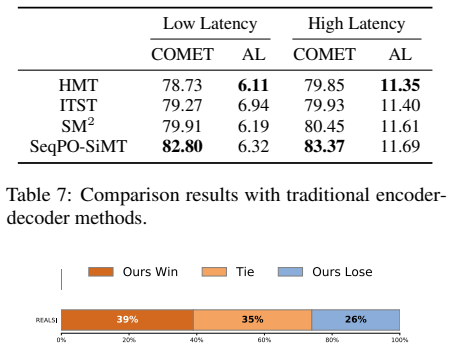
Summary. SeqPO-SiMT treats simultaneous machine translation (SiMT) as a sequential decision-making problem and optimizes an LLM policy with a policy-gradient method. The policy samples multi-step translation trajectories by receiving source chunks incrementally and deciding at each step how much to translate. A scalar reward is computed at the end of each trajectory as λ times a group-normalized COMET score minus a clamped, group-normalized Average Lagging (AL) penalty, with a KL constraint to a reference policy. Training uses GRPO-style group-relative normalization. The authors compare against an SFT baseline and an SFT+wait-k baseline on three Zh→En and three En→Zh datasets, reporting BLEURT, COMET, GPT-4, AL, and LAAL. They also compare SiMT results with offline translation of Qwen-2.5-7B-Instruct and LLaMA-3-8B-Instruct, and provide ablations of the normalization and truncation components. The central claim is that SeqPO-SiMT consistently and significantly improves translation quality while reducing latency relative to SFT, with averages of +1.3 COMET at low latency and +1.25 at high latency across the six datasets.
Significance. If the reported results are reproducible, this is a useful contribution to SiMT: it is a simple, critic-free RL formulation that directly optimizes quality and latency in an episodic manner, and it demonstrates consistent improvements across multiple domains and language directions. The paper is thorough in its evaluation breadth, including multiple automatic metrics, a human evaluation on 100 sentences, and ablations. The REINFORCE-style episodic reward is unbiased when the same terminal reward is applied to every decoding step, so the equal weighting across steps is a variance concern rather than a correctness flaw. The main weakness is the absence of any statistical reliability evidence: all numbers come from single runs, and the headline abstract claim mixes different latency operating points. The manuscript is therefore promising but requires additional experimental rigor before the central claim can be accepted.
major comments (3)
- [§4.1, Tables 2 and 3] All results are single runs with no error bars, no random seeds, and no significance tests, yet the text repeatedly uses the word 'significantly' (e.g., 'SeqPO-SiMT consistently and significantly outperforms'). Given that training samples B=5 trajectories with temperature=1.0, uses group-normalized rewards, and involves a manually selected λ, run-to-run variance is a real concern. Several reported gains are below the 1 COMET point threshold the paper itself invokes, such as Table 2 REALSI Zh→En (+0.74 COMET low latency, +0.65 high latency) and Table 3 REALSI En→Zh (+0.08 GPT-4 low latency). To support the central claim, please report mean±std over at least three seeds and provide a paired significance test or confidence intervals for the main comparisons.
- [Abstract and §4.1] The headline result that SeqPO-SiMT 'outperforms SFT by 1.13 points in COMET while reducing AL by 6.17' for NEWSTEST2021 En→Zh is an apples-to-oranges comparison. From Table 3, the SeqPO-SiMT numbers are from the low-latency row (COMET 87.41, AL 4.43) while the SFT numbers are from the high-latency row (COMET 86.28, AL 10.60). The within-latency improvements are +0.87 COMET at low latency (AL 4.43 vs 5.02) and +1.50 COMET at high latency (AL 10.32 vs 10.60). Please rephrase the claim to compare operating points at matched latency, or present the full COMET-vs-AL curve for this dataset.
- [§3 (Implementation Details)] The trade-off parameter λ is selected by manually evaluating scoring performance on 50 SiMT samples, and no sensitivity analysis is reported for λ, B, β, or the source chunk size m. Since the paper claims consistent gains across six datasets, the dependence of the main results on λ should be demonstrated; at minimum, a sweep over a few λ values (e.g., λ ∈ {1, 2, 4}) on one dataset would show whether the conclusions are robust to this manual choice.
minor comments (5)
- [§2.2 / Appendix A.1] The phrase 'we randomly sample five translations with greedy search and temperature = 1.0' is contradictory; given that do_sample=True and temperature=1.0 are listed in Table 6, this should presumably be 'random sampling with temperature = 1.0'.
- [Abstract and §4.1] The citation for the 1-point COMET claim is inconsistent: the abstract cites Kocmi et al. (2024b) while §4.1 cites Kocmi et al. (2024a). The relevant reference appears to be Kocmi et al. (2024b), 'Navigating the metrics maze'.
- [Equation (2) in §2.3] The operation Li = max(m, (Lhat_i - mean)/std) is a lower-bound clip, not a truncation in the usual sense. The text says 'truncate the L by the chunk size of x'; please clarify the terminology and explain why the source chunk size m is the natural clipping value for the normalized latency score.
- [Algorithm 1, line 12 and Equation (3)] The KL divergence term D_i_t depends on θ, so as written the gradient in Algorithm 1 is not the exact gradient of the objective in Eq. (3). In GRPO the KL term is typically treated as a reward-shaping penalty with stop-gradient. Please state explicitly whether D_i_t is detached from the gradient computation, and if so, add the stop-gradient notation.
- [§4.2, Table 4] The claim that SeqPO-SiMT 'rivals' or 'surpasses' offline Qwen-2.5-7B-Instruct should be tempered: in Table 4, on REALSI Zh→En the SFT baseline already exceeds offline Qwen-2.5 in COMET (83.49 vs 82.14), so part of that advantage is inherited from the SFT initialization rather than from the policy optimization itself.
Circularity Check
No significant circularity: the reward metrics overlap with two reported metrics, but independent BLEURT, GPT-4, and human evaluations support the central claim.
full rationale
SeqPO-SiMT is an empirical reinforcement-learning method, not a closed-form derivation, so the main risk of circularity is that the training reward is built from the same COMET and AL scores that are later reported as evaluation results. The reward in Eq. (2) is r_T = lambda*q - L, with q and L being group-normalized COMET and AL, and Tables 2 and 3 indeed report COMET and AL improvements. This overlap is real, but it does not reduce the central claim to the reward by construction: the paper also reports BLEURT, GPT-4, LAAL, and a human evaluation, and the improvements appear under those independent metrics as well (e.g., BLEURT and GPT-4 gains in Tables 2 and 3, and the human-evaluation win rate in Figure 7). The policy-gradient update in Eq. (3) and Algorithm 1 is a standard GRPO/REINFORCE update with a terminal trajectory reward, and no equation in the paper is equivalent to another by definition. The lambda hyperparameter is selected on 50 samples by manual inspection, which is ordinary hyperparameter tuning rather than a fitted parameter being renamed as a prediction. The few references to prior work with overlapping authorship, such as Cheng et al. (2024), are used only to motivate the LLM-as-policy design and SFT-data construction, and those choices are also attributed to non-overlapping work such as Koshkin et al. (2024); no load-bearing uniqueness theorem or fitted ansatz is imported from the authors' own previous work. Concerns about the lack of repeated-seed experiments, error bars, or significance tests are legitimate experimental-robustness concerns, but they are not evidence of circular reasoning. The paper is empirically self-contained against the SFT and wait-k baselines and against external offline models.
Assumptions & free parameters
free parameters (4)
- lambda (quality-latency trade-off) =
2
- beta (KL penalty weight) =
0.02 (En->Zh), 0.1 (Zh->En)
- B (number of sampled trajectories per source) =
5
- m (source chunk size in words) =
not reported
assumptions (3)
- domain assumption A chunked, policy-controlled wait/translate process is a faithful model of simultaneous translation.
- domain assumption COMET and AL, computed on the completed trajectory, are sufficient scalar rewards for optimizing both quality and latency.
- standard math GRPO's group-relative baseline is valid for the multi-step SiMT setting.
Cite this review
Pith. "Pith review of SeqPO-SiMT: Sequential Policy Optimization for Simultaneous Machine Translation." pith.science (2026). https://pith.science/paper/DAA4YGRJ
@misc{pith2026250520622,
  author       = {Pith},
  title        = {Pith review of: SeqPO-SiMT: Sequential Policy Optimization for Simultaneous Machine Translation},
  year         = {2026},
  howpublished = {\url{https://pith.science/paper/DAA4YGRJ}},
  note         = {Machine review of arXiv:2505.20622}
}
read the original abstract
We present Sequential Policy Optimization for Simultaneous Machine Translation (SeqPO-SiMT), a new policy optimization framework that defines the simultaneous machine translation (SiMT) task as a sequential decision making problem, incorporating a tailored reward to enhance translation quality while reducing latency. In contrast to popular Reinforcement Learning from Human Feedback (RLHF) methods, such as PPO and DPO, which are typically applied in single-step tasks, SeqPO-SiMT effectively tackles the multi-step SiMT task. This intuitive framework allows the SiMT LLMs to simulate and refine the SiMT process using a tailored reward. We conduct experiments on six datasets from diverse domains for En to Zh and Zh to En SiMT tasks, demonstrating that SeqPO-SiMT consistently achieves significantly higher translation quality with lower latency. In particular, SeqPO-SiMT outperforms the supervised fine-tuning (SFT) model by 1.13 points in COMET, while reducing the Average Lagging by 6.17 in the NEWSTEST2021 En to Zh dataset. While SiMT operates with far less context than offline translation, the SiMT results of SeqPO-SiMT on 7B LLM surprisingly rival the offline translation of high-performing LLMs, including Qwen-2.5-7B-Instruct and LLaMA-3-8B-Instruct.
Figures


Figures from the paper (9 more)




Forward citations
Cited by 2 Pith papers
-
Seed LiveInterpret 2.0: End-to-end Simultaneous Speech-to-speech Translation with Your Voice
An end-to-end simultaneous speech-to-speech translation model with voice cloning, trained with a two-stage reinforcement learning reward scheme, reports high accuracy and low latency on the authors' RealSI benchmark.
-
SynapseRoute: An Auto-Route Switching Framework on Dual-State Large Language Model
A learned router for a dual-mode LLM raises medical QA accuracy from 0.827 to 0.839 while cutting inference time by 36.8% and tokens by 39.7% versus always using thinking mode.
Reference graph
Works this paper leans on
-
[1]
Ashkan Alinejad, Maryam Siahbani, and Anoop Sarkar. 2018. https://doi.org/10.18653/v1/D18-1337 Prediction improves simultaneous neural machine translation . In Proceedings of the 2018 Conference on Empirical Methods in Natural Language Processing, pages 3022--3027, Brussels, Belgium. Association for Computational Linguistics
-
[2]
Naveen Arivazhagan, Colin Cherry, Wolfgang Macherey, Chung-Cheng Chiu, Semih Yavuz, Ruoming Pang, Wei Li, and Colin Raffel. 2019. https://doi.org/10.18653/v1/P19-1126 Monotonic infinite lookback attention for simultaneous machine translation . In Proceedings of the 57th Annual Meeting of the Association for Computational Linguistics, pages 1313--1323, Flo...
-
[3]
Lo \"i c Barrault, Ond r ej Bojar, Marta R. Costa-juss \`a , Christian Federmann, Mark Fishel, Yvette Graham, Barry Haddow, Matthias Huck, Philipp Koehn, Shervin Malmasi, Christof Monz, Mathias M \"u ller, Santanu Pal, Matt Post, and Marcos Zampieri. 2019. https://doi.org/10.18653/v1/W19-5301 Findings of the 2019 conference on machine translation ( WMT 19...
-
[4]
Guoguo Chen, Shuzhou Chai, Guan - Bo Wang, Jiayu Du, Wei - Qiang Zhang, Chao Weng, Dan Su, Daniel Povey, Jan Trmal, Junbo Zhang, Mingjie Jin, Sanjeev Khudanpur, Shinji Watanabe, Shuaijiang Zhao, Wei Zou, Xiangang Li, Xuchen Yao, Yongqing Wang, Zhao You, and Zhiyong Yan. 2021. https://doi.org/10.21437/INTERSPEECH.2021-1965 Gigaspeech: An evolving, multi-do...
-
[5]
Shanbo Cheng, Zhichao Huang, Tom Ko, Hang Li, Ningxin Peng, Lu Xu, and Qini Zhang. 2024. https://doi.org/10.48550/ARXIV.2407.21646 Towards achieving human parity on end-to-end simultaneous speech translation via LLM agent . CoRR, abs/2407.21646
-
[6]
Kyunghyun Cho and Masha Esipova. 2016. https://arxiv.org/abs/1606.02012 Can neural machine translation do simultaneous translation? CoRR, abs/1606.02012
arXiv 2016
-
[7]
Seamless Communication, Loïc Barrault, Yu-An Chung, Mariano Coria Meglioli, David Dale, Ning Dong, Mark Duppenthaler, Paul-Ambroise Duquenne, Brian Ellis, Hady Elsahar, Justin Haaheim, John Hoffman, Min-Jae Hwang, Hirofumi Inaguma, Christopher Klaiber, Ilia Kulikov, Pengwei Li, Daniel Licht, Jean Maillard, Ruslan Mavlyutov, Alice Rakotoarison, Kaushik Ram...
arXiv 2023
-
[8]
Josef Dai, Xuehai Pan, Ruiyang Sun, Jiaming Ji, Xinbo Xu, Mickel Liu, Yizhou Wang, and Yaodong Yang. 2023. Safe rlhf: Safe reinforcement learning from human feedback
work page 2023
Show all 43 references
-
[9]
DeepSeek-AI. 2025. https://api.semanticscholar.org/CorpusID:275789950 Deepseek-r1: Incentivizing reasoning capability in llms via reinforcement learning
2025
-
[10]
Di Gangi, Roldano Cattoni, Luisa Bentivogli, Matteo Negri, and Marco Turchi
Mattia A. Di Gangi, Roldano Cattoni, Luisa Bentivogli, Matteo Negri, and Marco Turchi. 2019. https://doi.org/10.18653/v1/N19-1202 M u ST - C : a M ultilingual S peech T ranslation C orpus . In Proceedings of the 2019 Conference of the North A merican Chapter of the Association...
2019 doi
-
[11]
Gomez, and J \" u rgen Schmidhuber
Alex Graves, Santiago Fern \' a ndez, Faustino J. Gomez, and J \" u rgen Schmidhuber. 2006. https://doi.org/10.1145/1143844.1143891 Connectionist temporal classification: labelling unsegmented sequence data with recurrent neural networks . In Machine Learning, Proceedings of t...
2006
-
[12]
Alvin Grissom II, He He, Jordan Boyd-Graber, John Morgan, and Hal Daum \'e III. 2014. https://doi.org/10.3115/v1/D14-1140 Don`t until the final verb wait: Reinforcement learning for simultaneous machine translation . In Proceedings of the 2014 Conference on Empirical Methods i...
2014 doi
-
[13]
Jiatao Gu, Graham Neubig, Kyunghyun Cho, and Victor O.K. Li. 2017. https://aclanthology.org/E17-1099/ Learning to translate in real-time with neural machine translation . In Proceedings of the 15th Conference of the E uropean Chapter of the Association for Computational Lingui...
2017
-
[14]
Shoutao Guo, Shaolei Zhang, and Yang Feng. 2024. https://doi.org/10.18653/v1/2024.acl-long.480 Decoder-only streaming transformer for simultaneous translation . In Proceedings of the 62nd Annual Meeting of the Association for Computational Linguistics (Volume 1: Long Papers), ...
2024 doi
-
[15]
Julia Ive, Andy Mingren Li, Yishu Miao, Ozan Caglayan, Pranava Madhyastha, and Lucia Specia. 2021. https://doi.org/10.18653/v1/2021.eacl-main.281 Exploiting multimodal reinforcement learning for simultaneous machine translation . In Proceedings of the 16th Conference of the Eu...
2021 doi
-
[16]
Tom Kocmi, Vil \'e m Zouhar, Eleftherios Avramidis, Roman Grundkiewicz, Marzena Karpinska, Maja Popovi \'c , Mrinmaya Sachan, and Mariya Shmatova. 2024 a . https://doi.org/10.18653/v1/2024.wmt-1.131 Error span annotation: A balanced approach for human evaluation of machine tra...
2024 doi
-
[17]
Tom Kocmi, Vil \'e m Zouhar, Christian Federmann, and Matt Post. 2024 b . https://doi.org/10.18653/v1/2024.acl-long.110 Navigating the metrics maze: Reconciling score magnitudes and accuracies . In Proceedings of the 62nd Annual Meeting of the Association for Computational Lin...
2024 doi
-
[18]
Buckley, Jason Phang, Samuel R
Tomasz Korbak, Kejian Shi, Angelica Chen, Rasika Vinayak Bhalerao, Christopher L. Buckley, Jason Phang, Samuel R. Bowman, and Ethan Perez. 2023. https://proceedings.mlr.press/v202/korbak23a.html Pretraining language models with human preferences . In International Conference o...
2023
-
[19]
Roman Koshkin, Katsuhito Sudoh, and Satoshi Nakamura. 2024. https://doi.org/10.18653/v1/2024.findings-emnlp.27 T rans LL a M a: LLM -based simultaneous translation system . In Findings of the Association for Computational Linguistics: EMNLP 2024, pages 461--476, Miami, Florida...
2024 doi
-
[20]
Mingbo Ma, Liang Huang, Hao Xiong, Renjie Zheng, Kaibo Liu, Baigong Zheng, Chuanqiang Zhang, Zhongjun He, Hairong Liu, Xing Li, Hua Wu, and Haifeng Wang. 2019. https://doi.org/10.18653/v1/P19-1289 STACL : Simultaneous translation with implicit anticipation and controllable lat...
2019 doi
-
[21]
Wainwright, Pamela Mishkin, Chong Zhang, Sandhini Agarwal, Katarina Slama, Alex Ray, John Schulman, Jacob Hilton, Fraser Kelton, Luke E
Long Ouyang, Jeff Wu, Xu Jiang, Diogo Almeida, Carroll L. Wainwright, Pamela Mishkin, Chong Zhang, Sandhini Agarwal, Katarina Slama, Alex Ray, John Schulman, Jacob Hilton, Fraser Kelton, Luke E. Miller, Maddie Simens, Amanda Askell, Peter Welinder, Paul Francis Christiano, Jan...
2022 arXiv
-
[22]
Sara Papi, Marco Gaido, Matteo Negri, and Marco Turchi. 2022. https://doi.org/10.18653/v1/2022.autosimtrans-1.2 Over-generation cannot be rewarded: Length-adaptive average lagging for simultaneous speech translation . In Proceedings of the Third Workshop on Automatic Simultane...
2022 doi
-
[23]
Rafael Rafailov, Archit Sharma, Eric Mitchell, Christopher D Manning, Stefano Ermon, and Chelsea Finn. 2024. Direct preference optimization: Your language model is secretly a reward model. Advances in Neural Information Processing Systems, 36
2024
-
[24]
Farinha, and Alon Lavie
Ricardo Rei, Craig Stewart, Ana C. Farinha, and Alon Lavie. 2020. https://arxiv.org/abs/2009.09025 COMET: A neural framework for MT evaluation . CoRR, abs/2009.09025
2020 arXiv
-
[25]
Harsh Satija. 2016. Simultaneous machine translation using deep reinforcement learning. In ICML 2016 Workshop on Abstraction in Reinforcement Learning
2016
-
[26]
John Schulman, Filip Wolski, Prafulla Dhariwal, Alec Radford, and Oleg Klimov. 2017. https://arxiv.org/abs/1707.06347 Proximal policy optimization algorithms . CoRR, abs/1707.06347
2017 arXiv
-
[27]
Thibault Sellam, Dipanjan Das, and Ankur Parikh. 2020. https://doi.org/10.18653/v1/2020.acl-main.704 BLEURT : Learning robust metrics for text generation . In Proceedings of the 58th Annual Meeting of the Association for Computational Linguistics, pages 7881--7892, Online. Ass...
2020 doi
-
[28]
Zhihong Shao, Peiyi Wang, Qihao Zhu, Runxin Xu, Junxiao Song, Xiao Bi, Haowei Zhang, Mingchuan Zhang, YK Li, Y Wu, et al. 2024. Deepseekmath: Pushing the limits of mathematical reasoning in open language models. arXiv preprint arXiv:2402.03300
2024 arXiv
-
[29]
Jiankai Sun, Chuanyang Zheng, Enze Xie, Zhengying Liu, Ruihang Chu, Jianing Qiu, Jiaqi Xu, Mingyu Ding, Hongyang Li, Mengzhe Geng, Yue Wu, Wenhai Wang, Junsong Chen, Zhangyue Yin, Xiaozhe Ren, Jie Fu, Junxian He, Yuan Wu, Qi Liu, Xihui Liu, Yu Li, Hao Dong, Yu Cheng, Ming Zhan...
2025 doi
-
[30]
Richard S Sutton and Andrew G Barto. 2018. Reinforcement learning: an introduction, 2nd edn. adaptive computation and machine learning
2018
-
[31]
Changhan Wang, Juan Pino, Anne Wu, and Jiatao Gu. 2020. https://aclanthology.org/2020.lrec-1.517/ C o V o ST : A diverse multilingual speech-to-text translation corpus . In Proceedings of the Twelfth Language Resources and Evaluation Conference, pages 4197--4203, Marseille, Fr...
2020
-
[32]
An Yang, Baosong Yang, Beichen Zhang, Binyuan Hui, Bo Zheng, Bowen Yu, Chengyuan Li, Dayiheng Liu, Fei Huang, Haoran Wei, et al. 2024. Qwen2. 5 technical report. arXiv preprint arXiv:2412.15115
2024 arXiv
-
[33]
Rong Ye, Chengqi Zhao, Tom Ko, Chutong Meng, Tao Wang, Mingxuan Wang, and Jun Cao. 2022. Gigast: A 10,000-hour pseudo speech translation corpus. arXiv preprint arXiv:2204.03939
2022 arXiv
-
[34]
Donglei Yu, Xiaomian Kang, Yuchen Liu, Yu Zhou, and Chengqing Zong. 2024. https://doi.org/10.18653/v1/2024.acl-long.528 Self-modifying state modeling for simultaneous machine translation . In Proceedings of the 62nd Annual Meeting of the Association for Computational Linguisti...
2024 doi
-
[35]
Donglei Yu, Yang Zhao, Jie Zhu, Yangyifan Xu, Yu Zhou, and Chengqing Zong. 2025. https://openreview.net/forum?id=XBF63bHDZw Simul PL : Aligning human preferences in simultaneous machine translation . In The Thirteenth International Conference on Learning Representations
2025
-
[36]
Binbin Zhang, Hang Lv, Pengcheng Guo, Qijie Shao, Chao Yang, Lei Xie, Xin Xu, Hui Bu, Xiaoyu Chen, Chenchen Zeng, Di Wu, and Zhendong Peng. 2022. https://doi.org/10.1109/ICASSP43922.2022.9746682 WENETSPEECH: A 10000+ hours multi-domain mandarin corpus for speech recognition . ...
2022
-
[37]
Jiarui Zhang. 2024. https://doi.org/10.18653/v1/2024.findings-emnlp.231 Guided profile generation improves personalization with large language models . In Findings of the Association for Computational Linguistics: EMNLP 2024, pages 4005--4016, Miami, Florida, USA. Association ...
2024 doi
-
[38]
Shaolei Zhang, Qingkai Fang, Shoutao Guo, Zhengrui Ma, Min Zhang, and Yang Feng. 2024. https://doi.org/10.18653/v1/2024.acl-long.485 S tream S peech: Simultaneous speech-to-speech translation with multi-task learning . In Proceedings of the 62nd Annual Meeting of the Associati...
2024 doi
-
[39]
Shaolei Zhang and Yang Feng. 2022. https://doi.org/10.18653/v1/2022.emnlp-main.65 Information-transport-based policy for simultaneous translation . In Proceedings of the 2022 Conference on Empirical Methods in Natural Language Processing, pages 992--1013, Abu Dhabi, United Ara...
2022 doi
-
[40]
Shaolei Zhang and Yang Feng. 2023. https://arxiv.org/abs/2303.00257 Hidden markov transformer for simultaneous machine translation . Preprint, arXiv:2303.00257
2023 arXiv
-
[41]
Baigong Zheng, Renjie Zheng, Mingbo Ma, and Liang Huang. 2019. https://doi.org/10.18653/v1/D19-1137 Simpler and faster learning of adaptive policies for simultaneous translation . In Proceedings of the 2019 Conference on Empirical Methods in Natural Language Processing and the...
2019 doi
-
[42]
online" 'onlinestring :=
ENTRY address archivePrefix author booktitle chapter edition editor eid eprint eprinttype howpublished institution journal key month note number organization pages publisher school series title type volume year doi pubmed url lastchecked label extra.label sort.label short.list...
-
[43]
write newline
" write newline "" before.all 'output.state := FUNCTION n.dashify 't := "" t empty not t #1 #1 substring "-" = t #1 #2 substring "--" = not "--" * t #2 global.max substring 't := t #1 #1 substring "-" = "-" * t #2 global.max substring 't := while if t #1 #1 substring * t #2 gl...
Reviewed August 7, 2026 · model on record in the stance chip above.
Discussion (0). Continue with ORCID to comment.