REVIEW 2 major objections 8 minor 1 cited by
ManiTaskGen: A Comprehensive Task Generator for Benchmarking and Improving Vision-Language Agents on Embodied Decision-Making
T0 review · 2 major / 8 minor · reviewed 2026-08-07 · deepseek-v4-flash
Pith's one-line read ManiTaskGen claims the full space of feasible mobile-manipulation tasks in a scene can be generated automatically from a receptacle-aware scene graph, yielding near-exhaustive benchmarks and training tasks.
desk verdict A genuinely useful pick-and-place task generator with a solid 40K dataset, but the near-exhaustiveness claim overreaches beyond the formalism; still deserves review. read the letter →
The pith
A machine-rendered reading of the paper's core claim, the machinery that carries it, and where it could break.
The reading
What carries the argument
The load-bearing object is the Receptacle-Aware 3D Scene Graph, a containment tree of scene objects whose free surface areas are segmented into anchor-relative directional receptacle regions, with empty surfaces divided into a 3x3 grid and adjacent regions mergeable into larger ones. It carries the argument by making the set of feasible atomic actions enumerable: every object-receptacle pair with sufficient space yields a candidate relocation, and simulating those relocations produces the state transitions needed to chain multi-step process tasks. The same graph supplies the platforms and objects that instantiate outcome-based task templates, while a 200-template curated dataset combined with VLM voting provides the abstract instruction coverage.
What would settle it
Take a scene with a closed drawer, an unlit lamp, and a loaf of bread with a knife; generate ManiTaskGen's full task set for it and check every instruction. If no generated instruction requires a non-pose state change, such as switching on, opening, pouring, or cutting, then the task set is not near-exhaustive over what a capable embodied agent could do in that scene.
Extended reading notes
Core claim
The central claim is that the task space for an embodied mobile manipulation agent with navigate, grasp, and place primitives is captured by the discrete interaction cycle: at each step the scene state, defined by object poses and containment states, restricts the set of feasible atomic actions, defined as parameterized object relocations. All tasks are then either feasible sequences of such actions, called process-based tasks, or reachable target states, called outcome-based tasks. ManiTaskGen operationalizes this by constructing a Receptacle-Aware 3D Scene Graph that segments free surface space into directional receptacle regions, enumerating every feasible object-to-receptacle relocation, and chaining these relocations through simulated state updates to generate multi-step instructions. Outcome-based tasks come from instantiating a set of 200 human-derived templates and filtering with a multi-model VLM vote. The authors report automatic generation of 39,871 tasks from three scenes, validity rates of 94.0% and 86.5%, low average success for current VLMs on the resulting benchmark, and measurable gains from self-reflection using the generated tasks.
Load-bearing premise
Near-exhaustiveness holds only if every feasible task can be expressed as relocating objects between receptacle regions; non-pose changes like toggling, opening, pouring, or cutting are outside the generated space, as the paper's own limitations state.
Editorial extensions
If this is right
- Any new scene with object poses, bounding boxes, and optionally meshes can be converted into a large benchmark without manual annotation, so task diversity no longer scales with human effort.
- Process-based tasks come with automatically checkable success conditions, enabling both final and intermediate-step scoring for embodied agents.
- Current vision-language agents succeed on under 30% of sampled generated tasks, with wrong placement the dominant failure, giving a concrete target for spatial-reasoning progress.
- An inference-time self-reflection loop that uses generated tasks and their automatic evaluations improved success rates by 10 to 22 percentage points and transferred from one scene to another.
- Outcome-based tasks add abstract instruction diversity such as clearing or organizing a surface, although automatic evaluation of those abstract tasks is left to future work.
Reading between the lines
- Editorial extension: the interaction-cycle argument generalizes; if atomic actions were extended to articulation and state toggles, the same graph-based enumeration would define a larger task space that remains near-exhaustive by the paper's own logic.
- Editorial extension: the automatic success predicates on process-based tasks turn the generator into a reward source, so generated tasks could support supervised or reinforcement fine-tuning of policies, not just inference-time reflection.
- Editorial extension: because Level 4 outcome tasks are not yet benchmarked, a human-judgment or learned-reward protocol is the natural next step, and the paper's template dataset makes that comparison reproducible.
- Editorial extension: a completeness measure could be defined as the fraction of reachable distinct scene states represented by generated tasks, allowing near-exhaustiveness to be quantified beyond the 40K sample.
Editorial analysis
A structured set of objections, weighed in public.
Referee Report
Summary. ManiTaskGen is a system that, given scene information (object poses, bounding boxes, and optionally mesh models), automatically generates mobile manipulation task instructions. It constructs a Receptacle-Aware 3D Scene Graph, enumerates feasible atomic pick-and-place actions as object-to-receptacle relocations, chains them into process-based tasks (single- and two-step with THEN/AND/OR connectors), and instantiates 200 human-curated templates into outcome-based tasks filtered by a GPT-4o/Gemini-2.5-pro/Claude-3.7-sonnet voting ensemble. The paper evaluates the generated tasks on three scenes (ReplicaCAD, AI2THOR, SUN-RGBD), reporting human-verified validity rates of 94.0% and 86.5% for process- and outcome-based tasks versus 29.4% and 21.1% for a GPT-4o baseline; benchmarks nine VLM agents in a simulator, finding average success rates below 30% on process-based tasks; and proposes an inference-time self-reflection method that improves three VLMs. The central claim is that the generated task collection is comprehensive and logically near-exhaustive for a given scene.
Significance. If appropriately scoped, this is a useful contribution: it replaces manual task annotation with an automated pipeline, enables large-scale benchmarks, and provides a route to training data for embodied VLMs. Concrete strengths include: (1) the generation mechanism for process-based tasks is deterministic and transparent given the scene graph, making it reproducible and independent of the measured outcomes; (2) the human validity check is a genuine comparative result, beating the GPT-4o baseline by a large margin; (3) the benchmark harness provides automatic, precise success verification for Levels 1–3; and (4) the improvement experiment (Table 4) demonstrates concrete cross-scene transfer. The main caveat is that the “near-exhaustive” claim is only defensible within the class of tasks achievable by navigate/pick/place primitives over pose/containment states; as stated in the abstract and introduction, it overreaches. With that claim re-scoped, the framework would be a valuable tool for scaling benchmark and training-task creation across arbitrary scenes.
major comments (2)
- [Sec. 1; Sec. 3.1; Sec. 6] The paper's headline claim — that ManiTaskGen generates task collections that are “logically near-exhaustive” for a scene (Sec. 1) and cover “the full spectrum of feasible tasks within any given scene” (Abstract) — is not supported by the formalization in Sec. 3.1. There, the scene state is defined solely by object poses and containment states, and atomic actions are parameterized object relocations; the assertion that this interaction cycle “inherently defines the space of all possible tasks” (Sec. 3.1 and Fig. 2) is a definitional choice rather than a derived result, and no argument is given that every feasible mobile manipulation task reduces to object relocation. Feasible tasks such as turning on a lamp, opening a drawer, or pouring from a pitcher are not expressible in this formalism, and Sec. 6 confirms that non-pose state changes and fine-grained manipulation are future work. Because near-exhaustiveness is the paper's primary novelty and scaling argument, the abstract and introduction should be re-scoped to “near-exhaustive within the class of tasks achievable by navigate/pick/place primitives,” with that caveat carried consistently into the conclusion.
- [Sec. 4, Table 2] The human-verified validity rates in Table 2 are the principal evidence for the feasibility of the generated tasks, but they are reported as bare point estimates: no sample size, no confidence interval, no annotator agreement, and no description of how tasks or annotators were selected for verification. With an unknown N, a rate of 94.0% could range from 47/50 to 940/1000, and the difference from the 29.4% baseline cannot be assessed for statistical significance; without agreement measures, the objectivity of the labeling is unverifiable. Please report per-condition sample sizes, the number of annotators and their agreement (e.g., Cohen's kappa), the sampling procedure (e.g., random stratified by level), and confidence intervals around the validity rates.
minor comments (8)
- [Sec. 3.3] There is a duplicated word: “explicitly encodes the the properties of every object” should read “the properties.”
- [Sec. 5.1] “The benchmark is constructed within an simulators [43]” is ungrammatical; it should be “within a simulator” or “within simulators.”
- [Sec. 4, Fig. 4] The diversity comparison is based on 100 sampled tasks and presented as qualitative “lightmap” visualizations; a quantitative diversity metric (e.g., number of unique objects and receptacles covered per 100 tasks, with the sampling procedure and variability across samples) would make the diversity claim testable.
- [Sec. 5.1.2] Level 4 (outcome-based) tasks are excluded from the benchmark (“We leave benchmarking Level 4 tasks in future work”), yet the abstract says the framework “thoroughly evaluat[es]” agents; the abstract and introduction should state that the reported evaluation covers only the process-based levels.
- [Sec. 5.2.2, Table 4] The improvement results are based on 10 trial episodes and 100 Level-1 test tasks; please state whether the numbers are single runs or averages over seeds, and add variance or per-seed results so the improvements can be interpreted.
- [Table 1] Comparing total task counts across datasets with very different numbers of scenes (e.g., M3Bench with 119 scenes versus 3 scenes here) conflates scale with density, and the “+∞” entry for ManiTaskGen-RAS is not a meaningful comparison to finite dataset sizes.
- [Appendix D.2] The failed-episode transcript is internally inconsistent with the successful-episode transcript: the task description shown at “Steps used: 1/20” is “Move kitchenware_white_paper_towel_holder…” although the episode's stated task is “Move Remote to Bowl's rear-left receptacles,” and the action names differ across the two transcripts (show_receptacle_of_object vs. show_receptacles_of_object; change_view vs. rotate_observation_view_of_current_platform); these transcripts appear to be taken from different runs and should be made consistent.
- [Sec. 4, Appendix C.2] The outcome-based task filter uses an ensemble of GPT-4o, Gemini-2.5-pro, and Claude-3.7-sonnet — the same model families later benchmarked in Sec. 5.1; the impact is limited because the benchmark covers only Levels 1–3, but the overlap should be explicitly acknowledged, and the filter's acceptance rate (how many template instantiations were rejected) should be reported.
Circularity Check
Near-exhaustiveness is a definitional consequence of restricting scene state to poses/containment and atomic actions to object relocation; the benchmark and validity results remain independent.
-
self definitional
[Sec. 3.1 (Premise and Formalization), incl. Fig. 2 caption; cf. Sec. 6 Limitations]
"Based on the agent’s core capabilities, we define an atomic action a ∈ A as a parameterized object relocation operation. ... This cycle, where executing atomic actions (e.g., single object relocation) updates the scene state and determines subsequent available actions, inherently defines the space of all possible tasks."
The 'logically near-exhaustive' claim is not derived from an independent characterization of mobile manipulation; it is a restatement of the paper's own state/action definitions. Scene state is restricted to object poses plus containment states, and atomic actions are restricted to parameterized relocations, so 'all possible tasks' means all tasks in the relocation-only space by construction. Feasible tasks that change non-pose state (turn on a lamp, open a drawer, pour, cut) are excluded by the state and action vocabulary, and the paper's Limitations section concedes that non-pose state changes are future work.
full rationale
ManiTaskGen's core generation pipeline—scene graph construction, receptacle segmentation, sampling of feasible relocation sequences, and human/template-based outcome tasks—is not fitted to the later benchmark outcomes. Human-verified validity (94.0% process, 86.5% outcome) and the VLM benchmark results are externally evaluated, and the improvement experiments explicitly avoid leakage by training on ReplicaCAD and testing on AI2THOR. No load-bearing self-citation chain or uniqueness theorem is invoked. The only definitional circularity is the near-exhaustiveness claim: because the formalization defines the task space as reachable object-relocation states and sequences, the generated task set is comprehensive for that space by construction. This is a scope stipulation, not a discovered property of all mobile manipulation tasks, and the paper's own limitation statement admits non-pose manipulation is excluded. The VLM voting for outcome tasks uses the same model families that later appear in the benchmark, but Level 4 benchmarking is explicitly deferred, so no measured performance claim is derived from that filter; it is therefore not counted as a fitted-input prediction.
Assumptions & free parameters
free parameters (7)
- walkable_space_threshold_50cm =
50 cm
- empty_surface_grid_3x3 =
3x3 grid
- directional_receptacles_8 =
8 regions per anchor object
- vlm_vote_threshold =
2 of 3 VLMs
- receptacle_merge_limit =
up to 4 regions
- level3_task_counts =
5,000 / 5,000 / 500 per scene
- episode_timestep_limits =
20 (Levels 1-2), 40 (Level 3)
assumptions (7)
- domain assumption The task space is captured by the process/outcome dichotomy based on the agent-environment interaction cycle.
- domain assumption Agent primitives are limited to navigate, pick, and place, and atomic actions are single-object relocations.
- domain assumption Input scene information (object poses, bounding boxes, optionally meshes) is accurate and sufficient.
- domain assumption Ground objects are immovable and only surface objects are manipulable.
- domain assumption MANI TASKOT-200 is a representative template basis for outcome-based tasks.
- domain assumption VLM ensemble votes are a reliable proxy for outcome-task feasibility.
- domain assumption The human validity sample is representative of the 39,871-task dataset.
Cite this review
Pith. "Pith review of ManiTaskGen: A Comprehensive Task Generator for Benchmarking and Improving Vision-Language Agents on Embodied Decision-Making." pith.science (2026). https://pith.science/paper/E7KJ6E62
@misc{pith2026250520726,
  author       = {Pith},
  title        = {Pith review of: ManiTaskGen: A Comprehensive Task Generator for Benchmarking and Improving Vision-Language Agents on Embodied Decision-Making},
  year         = {2026},
  howpublished = {\url{https://pith.science/paper/E7KJ6E62}},
  note         = {Machine review of arXiv:2505.20726}
}
read the original abstract
Building embodied agents capable of accomplishing arbitrary tasks is a core objective towards achieving embodied artificial general intelligence (E-AGI). While recent work has advanced such general robot policies, their training and evaluation are often limited to tasks within specific scenes, involving restricted instructions and scenarios. Existing benchmarks also typically rely on manual annotation of limited tasks in a few scenes. We argue that exploring the full spectrum of feasible tasks within any given scene is crucial, as they provide both extensive benchmarks for evaluation and valuable resources for agent improvement. Towards this end, we introduce ManiTaskGen, a novel system that automatically generates comprehensive, diverse, feasible mobile manipulation tasks for any given scene. The generated tasks encompass both process-based, specific instructions (e.g., "move object from X to Y") and outcome-based, abstract instructions (e.g., "clear the table"). We apply ManiTaskGen to both simulated and real-world scenes, demonstrating the validity and diversity of the generated tasks. We then leverage these tasks to automatically construct benchmarks, thoroughly evaluating the embodied decision-making capabilities of agents built upon existing vision-language models (VLMs). Furthermore, we propose a simple yet effective method that utilizes ManiTaskGen tasks to enhance embodied decision-making. Overall, this work presents a universal task generation framework for arbitrary scenes, facilitating both benchmarking and improvement of embodied decision-making agents.
Figures


Figures from the paper (26 more)




Forward citations
Cited by 1 Pith paper
-
Exploratory, Communicative, and Deployable: Vision-Driven Embodied Agents for Open-World Mobile Manipulation
REAL, a benchmark and trained vision-language agent for oracle-free mobile manipulation with user interaction, achieves 78.3% end-to-end success on 60 physical-robot episodes after simulation-only high-level training.
Reference graph
Works this paper leans on
-
[1]
From multimodal llms to generalist embodied agents: Methods and lessons
Andrew Szot, Bogdan Mazoure, Omar Attia, Aleksei Timofeev, Harsh Agrawal, Devon Hjelm, Zhe Gan, Zsolt Kira, and Alexander Toshev. From multimodal llms to generalist embodied agents: Methods and lessons. arXiv preprint arXiv:2412.08442, 2024
arXiv 2024
-
[2]
An embodied generalist agent in 3d world
Jiangyong Huang, Silong Yong, Xiaojian Ma, Xiongkun Linghu, Puhao Li, Yan Wang, Qing Li, Song-Chun Zhu, Baoxiong Jia, and Siyuan Huang. An embodied generalist agent in 3d world. arXiv preprint arXiv:2311.12871, 2023
arXiv 2023
-
[3]
Rearrangement: A Challenge for Embodied AI
Dhruv Batra, Angel Chang, Sonia Chernova, Andrew Davison, Jia Deng, Vladlen Koltun, Sergey Levine, Jitendra Malik, Igor Mordatch, Roozbeh Mottaghi, Manolis Savva, and Hao Su. Rearrangement: A Challenge for Embodied AI. arXiv preprint, 2020
2020
-
[4]
Do as i can, not as i say: Grounding language in robotic affordances
Michael Ahn, Anthony Brohan, Noah Brown, Yevgen Chebotar, Omar Cortes, Byron David, Chelsea Finn, Chuyuan Fu, Keerthana Gopalakrishnan, Karol Hausman, et al. Do as i can, not as i say: Grounding language in robotic affordances. arXiv preprint arXiv:2204.01691, 2022
arXiv 2022
-
[5]
Rt-2: Vision-language- action models transfer web knowledge to robotic control
Anthony Brohan, Noah Brown, Justice Carbajal, Yevgen Chebotar, Xi Chen, Krzysztof Choro- manski, Tianli Ding, Danny Driess, Avinava Dubey, Chelsea Finn, et al. Rt-2: Vision-language- action models transfer web knowledge to robotic control. arXiv preprint arXiv:2307.15818, 2023
arXiv 2023
-
[6]
Palm-e: An embodied multimodal language model
Danny Driess, Fei Xia, Mehdi SM Sajjadi, Corey Lynch, Aakanksha Chowdhery, Ayzaan Wahid, Jonathan Tompson, Quan Vuong, Tianhe Yu, Wenlong Huang, et al. Palm-e: An embodied multimodal language model. arXiv preprint, 2023
2023
-
[7]
Large language models as gen- eralizable policies for embodied tasks
Andrew Szot, Max Schwarzer, Harsh Agrawal, Bogdan Mazoure, Rin Metcalf, Walter Talbott, Natalie Mackraz, R Devon Hjelm, and Alexander T Toshev. Large language models as gen- eralizable policies for embodied tasks. In The Twelfth International Conference on Learning Representations, 2023
2023
-
[8]
Llama 3.2: Revolutionizing edge ai and vision with open, customizable models, 2024
Meta. Llama 3.2: Revolutionizing edge ai and vision with open, customizable models, 2024. URL https://ai.meta.com/blog/ llama-3-2-connect-2024-vision-edge-mobile-devices/ . Accessed: 2025-02- 15
2024
Show all 96 references
-
[9]
Gemma: Open models based on gemini research and technology
Gemma Team, Thomas Mesnard, Cassidy Hardin, Robert Dadashi, Surya Bhupatiraju, Shreya Pathak, Laurent Sifre, Morgane Rivière, Mihir Sanjay Kale, Juliette Love, et al. Gemma: Open models based on gemini research and technology. arXiv preprint arXiv:2403.08295, 2024
2024 arXiv
-
[10]
Qwen technical report
Jinze Bai, Shuai Bai, Yunfei Chu, Zeyu Cui, Kai Dang, Xiaodong Deng, Yang Fan, Wenbin Ge, Yu Han, Fei Huang, et al. Qwen technical report. arXiv preprint arXiv:2309.16609, 2023
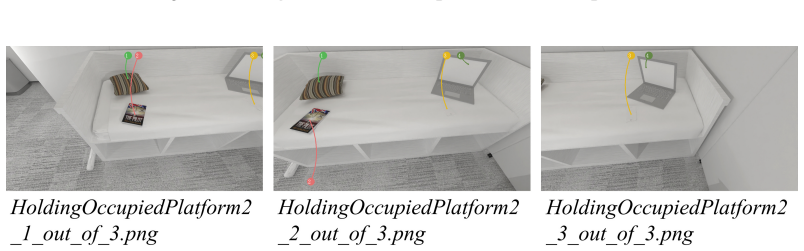
2023 arXiv
-
[11]
Physically grounded vision-language models for robotic manipulation
Jensen Gao, Bidipta Sarkar, Fei Xia, Ted Xiao, Jiajun Wu, Brian Ichter, Anirudha Majumdar, and Dorsa Sadigh. Physically grounded vision-language models for robotic manipulation. In 2024 IEEE International Conference on Robotics and Automation (ICRA), pages 12462–12469. IEEE, 2024
2024
-
[12]
Language models as zero-shot planners: Extracting actionable knowledge for embodied agents
Wenlong Huang, Pieter Abbeel, Deepak Pathak, and Igor Mordatch. Language models as zero-shot planners: Extracting actionable knowledge for embodied agents. In International conference on machine learning, pages 9118–9147. PMLR, 2022
2022
-
[13]
Multi-skill mobile manipula- tion for object rearrangement
Jiayuan Gu, Devendra Singh Chaplot, Hao Su, and Jitendra Malik. Multi-skill mobile manipula- tion for object rearrangement. arXiv preprint arXiv:2209.02778, 2022
2022 arXiv
-
[14]
Openvla: An open-source vision-language-action model
Moo Jin Kim, Karl Pertsch, Siddharth Karamcheti, Ted Xiao, Ashwin Balakrishna, Suraj Nair, Rafael Rafailov, Ethan Foster, Grace Lam, Pannag Sanketi, et al. Openvla: An open-source vision-language-action model. arXiv preprint arXiv:2406.09246, 2024
2024 arXiv
-
[15]
π0: A vision-language-action flow model for general robot control, 2024
Kevin Black, Noah Brown, Danny Driess, Adnan Esmail, Michael Equi, Chelsea Finn, Niccolo Fusai, Lachy Groom, Karol Hausman, Brian Ichter, et al. π0: A vision-language-action flow model for general robot control, 2024. URL https://arxiv. org/abs/2410.24164, 2024. 10
2024 arXiv
-
[16]
M3bench: Benchmarking whole-body motion generation for mobile manipulation in 3d scenes
Zeyu Zhang, Sixu Yan, Muzhi Han, Zaijin Wang, Xinggang Wang, Song-Chun Zhu, and Hangxin Liu. M3bench: Benchmarking whole-body motion generation for mobile manipulation in 3d scenes. arXiv preprint arXiv:2410.06678, 2024
2024 arXiv
-
[17]
Embodied agent interface: Benchmarking llms for embodied decision making
Manling Li, Shiyu Zhao, Qineng Wang, Kangrui Wang, Yu Zhou, Sanjana Srivastava, Cem Gokmen, Tony Lee, Erran Li Li, Ruohan Zhang, et al. Embodied agent interface: Benchmarking llms for embodied decision making. Advances in Neural Information Processing Systems, 37: 100428–100534, 2025
2025
-
[18]
Visualagentbench: Towards large multimodal models as visual foundation agents
Xiao Liu, Tianjie Zhang, Yu Gu, Iat Long Iong, Yifan Xu, Xixuan Song, Shudan Zhang, Hanyu Lai, Xinyi Liu, Hanlin Zhao, et al. Visualagentbench: Towards large multimodal models as visual foundation agents. arXiv preprint arXiv:2408.06327, 2024
2024 arXiv
-
[19]
Lota- bench: Benchmarking language-oriented task planners for embodied agents
Jae-Woo Choi, Youngwoo Yoon, Hyobin Ong, Jaehong Kim, and Minsu Jang. Lota- bench: Benchmarking language-oriented task planners for embodied agents. arXiv preprint arXiv:2402.08178, 2024
2024 arXiv
-
[21]
Behavior-1k: A benchmark for embodied ai with 1,000 everyday activities and realistic simulation
Chengshu Li, Ruohan Zhang, Josiah Wong, Cem Gokmen, Sanjana Srivastava, Roberto Martín- Martín, Chen Wang, Gabrael Levine, Michael Lingelbach, Jiankai Sun, et al. Behavior-1k: A benchmark for embodied ai with 1,000 everyday activities and realistic simulation. In Conference on...
2023
-
[22]
Embodiedeval: Evaluate multimodal llms as embodied agents
Zhili Cheng, Yuge Tu, Ran Li, Shiqi Dai, Jinyi Hu, Shengding Hu, Jiahao Li, Yang Shi, Tianyu Yu, Weize Chen, et al. Embodiedeval: Evaluate multimodal llms as embodied agents. arXiv preprint arXiv:2501.11858, 2025
2025 arXiv
-
[23]
Habitat 2.0: Training home assistants to rearrange their habitat
Andrew Szot, Alex Clegg, Eric Undersander, Erik Wijmans, Yili Zhao, John Turner, Noah Maestre, Mustafa Mukadam, Devendra Chaplot, Oleksandr Maksymets, Aaron Gokaslan, Vladimir V ondrus, Sameer Dharur, Franziska Meier, Wojciech Galuba, Angel Chang, Zsolt Kira, Vladlen Koltun, J...
2021
-
[24]
AI2-THOR: An Interactive 3D Environment for Visual AI
Eric Kolve, Roozbeh Mottaghi, Winson Han, Eli VanderBilt, Luca Weihs, Alvaro Herrasti, Daniel Gordon, Yuke Zhu, Abhinav Gupta, and Ali Farhadi. AI2-THOR: An Interactive 3D Environment for Visual AI. arXiv, 2017
2017
-
[25]
Sun rgb-d: A rgb-d scene understand- ing benchmark suite
Shuran Song, Samuel P Lichtenberg, and Jianxiong Xiao. Sun rgb-d: A rgb-d scene understand- ing benchmark suite. In Proceedings of the IEEE conference on computer vision and pattern recognition, pages 567–576, 2015
2015
-
[26]
Reflexion: Language agents with verbal reinforcement learning.Advances in Neural Information Processing Systems, 36:8634–8652, 2023
Noah Shinn, Federico Cassano, Ashwin Gopinath, Karthik Narasimhan, and Shunyu Yao. Reflexion: Language agents with verbal reinforcement learning.Advances in Neural Information Processing Systems, 36:8634–8652, 2023
2023
-
[27]
React: Synergizing reasoning and acting in language models
Shunyu Yao, Jeffrey Zhao, Dian Yu, Nan Du, Izhak Shafran, Karthik Narasimhan, and Yuan Cao. React: Synergizing reasoning and acting in language models. In International Conference on Learning Representations (ICLR), 2023
2023
-
[28]
Agentgen: Enhancing planning abilities for large language model based agent via environment and task generation
Mengkang Hu, Pu Zhao, Can Xu, Qingfeng Sun, Jianguang Lou, Qingwei Lin, Ping Luo, Sara- van Rajmohan, and Dongmei Zhang. Agentgen: Enhancing planning abilities for large language model based agent via environment and task generation. arXiv preprint arXiv:2408.00764, 2024
2024 arXiv
-
[29]
Mini-behavior: A procedurally generated benchmark for long-horizon decision- making in embodied ai
Emily Jin, Jiaheng Hu, Zhuoyi Huang, Ruohan Zhang, Jiajun Wu, Li Fei-Fei, and Roberto Martín-Martín. Mini-behavior: A procedurally generated benchmark for long-horizon decision- making in embodied ai. arXiv preprint arXiv:2310.01824, 2023. 11
-
[30]
Leveraging procedural generation to benchmark reinforcement learning
Karl Cobbe, Chris Hesse, Jacob Hilton, and John Schulman. Leveraging procedural generation to benchmark reinforcement learning. In International conference on machine learning, pages 2048–2056. PMLR, 2020
2020
-
[31]
Ride: Rewarding impact-driven exploration for procedurally-generated environments
Roberta Raileanu and Tim Rocktäschel. Ride: Rewarding impact-driven exploration for procedurally-generated environments. arXiv preprint arXiv:2002.12292, 2020
2002 arXiv
-
[32]
Adaptive procedural task generation for hard-exploration problems
Kuan Fang, Yuke Zhu, Silvio Savarese, and Li Fei-Fei. Adaptive procedural task generation for hard-exploration problems. arXiv preprint arXiv:2007.00350, 2020
2007 arXiv
-
[33]
Gensim: Generating robotic simulation tasks via large language models
Lirui Wang, Yiyang Ling, Zhecheng Yuan, Mohit Shridhar, Chen Bao, Yuzhe Qin, Bailin Wang, Huazhe Xu, and Xiaolong Wang. Gensim: Generating robotic simulation tasks via large language models. arXiv preprint arXiv:2310.01361, 2023
-
[34]
Alfred: A benchmark for interpreting grounded instructions for everyday tasks
Mohit Shridhar, Jesse Thomason, Daniel Gordon, Yonatan Bisk, Winson Han, Roozbeh Mot- taghi, Luke Zettlemoyer, and Dieter Fox. Alfred: A benchmark for interpreting grounded instructions for everyday tasks. In Proceedings of the IEEE/CVF conference on computer vision and patter...
2020
-
[35]
Open x- embodiment: Robotic learning datasets and rt-x models: Open x-embodiment collaboration 0
Abby O’Neill, Abdul Rehman, Abhiram Maddukuri, Abhishek Gupta, Abhishek Padalkar, Abraham Lee, Acorn Pooley, Agrim Gupta, Ajay Mandlekar, Ajinkya Jain, et al. Open x- embodiment: Robotic learning datasets and rt-x models: Open x-embodiment collaboration 0. In 2024 IEEE Interna...
2024
-
[36]
Habitat rearrangement challenge 2022
Andrew Szot, Karmesh Yadav, Alex Clegg, Vincent-Pierre Berges, Aaron Gokaslan, Angel Chang, Manolis Savva, Zsolt Kira, and Dhruv Batra. Habitat rearrangement challenge 2022. https://aihabitat.org/challenge/2022_rearrange, 2022
2022
-
[37]
Maniskill: Generalizable manipulation skill benchmark with large-scale demonstrations
Tongzhou Mu, Zhan Ling, Fanbo Xiang, Derek Yang, Xuanlin Li, Stone Tao, Zhiao Huang, Zhiwei Jia, and Hao Su. Maniskill: Generalizable manipulation skill benchmark with large-scale demonstrations. arXiv preprint arXiv:2107.14483, 2021
2021 arXiv
-
[38]
Embodiedbench: Comprehensive benchmarking multi-modal large language models for vision-driven embodied agents, 2025
Rui Yang, Hanyang Chen, Junyu Zhang, Mark Zhao, Cheng Qian, Kangrui Wang, Qineng Wang, Teja Venkat Koripella, Marziyeh Movahedi, Manling Li, Heng Ji, Huan Zhang, and Tong Zhang. Embodiedbench: Comprehensive benchmarking multi-modal large language models for vision-driven embod...
2025 arXiv
-
[39]
λ: A benchmark for data-efficiency in long-horizon indoor mobile manipulation robotics, 2025
Ahmed Jaafar, Shreyas Sundara Raman, Yichen Wei, Sudarshan Harithas, Sofia Juliani, Anneke Wernerfelt, Benedict Quartey, Ifrah Idrees, Jason Xinyu Liu, and Stefanie Tellex. λ: A benchmark for data-efficiency in long-horizon indoor mobile manipulation robotics, 2025. URL https:...
2025 arXiv
-
[40]
Gpt-4 technical report, 2024
Josh Achiam, Steven Adler, Sandhini Agarwal, Lama Ahmad, Ilge Akkaya, Florencia Leoni Aleman, Diogo Almeida, Janko Altenschmidt, Sam Altman, and Shyamal Anadkat et al. Gpt-4 technical report, 2024. URL https://arxiv.org/abs/2303.08774
2024 arXiv
-
[41]
Dai, and et al
Gemini Team, Rohan Anil, Sebastian Borgeaud, Jean-Baptiste Alayrac, Jiahui Yu, Radu Soricut, Johan Schalkwyk, Andrew M. Dai, and et al. Anja Hauth. Gemini: A family of highly capable multimodal models, 2024. URL https://arxiv.org/abs/2312.11805
2024 arXiv
-
[42]
About claude models
Anthropic. About claude models. https://docs.anthropic.com/en/docs/ about-claude/models, 2024. Accessed: 2024-09-03
2024
-
[43]
Sapien: A simulated part-based interactive environ- ment
Fanbo Xiang, Yuzhe Qin, Kaichun Mo, Yikuan Xia, Hao Zhu, Fangchen Liu, Minghua Liu, Hanxiao Jiang, Yifu Yuan, He Wang, et al. Sapien: A simulated part-based interactive environ- ment. In Proceedings of the IEEE/CVF conference on computer vision and pattern recognition, pages 1...
2020
-
[44]
Qwen2-vl: Enhancing vision-language model’s perception of the world at any resolution
Peng Wang, Shuai Bai, Sinan Tan, Shijie Wang, Zhihao Fan, Jinze Bai, Keqin Chen, Xuejing Liu, Jialin Wang, Wenbin Ge, et al. Qwen2-vl: Enhancing vision-language model’s perception of the world at any resolution. arXiv preprint arXiv:2409.12191, 2024. 12
2024 arXiv
-
[45]
Finetuned language models are zero-shot learners
Jason Wei, Maarten Bosma, Vincent Y Zhao, Kelvin Guu, Adams Wei Yu, Brian Lester, Nan Du, Andrew M Dai, and Quoc V Le. Finetuned language models are zero-shot learners. arXiv preprint arXiv:2109.01652, 2021
2021 arXiv
-
[46]
The flan collection: Designing data and methods for effective instruction tuning
Shayne Longpre, Le Hou, Tu Vu, Albert Webson, Hyung Won Chung, Yi Tay, Denny Zhou, Quoc V Le, Barret Zoph, Jason Wei, et al. The flan collection: Designing data and methods for effective instruction tuning. In International Conference on Machine Learning , pages 22631–22648. P...
2023
-
[47]
Fine-tuning large vision-language models as decision-making agents via reinforcement learning
Simon Zhai, Hao Bai, Zipeng Lin, Jiayi Pan, Peter Tong, Yifei Zhou, Alane Suhr, Saining Xie, Yann LeCun, Yi Ma, et al. Fine-tuning large vision-language models as decision-making agents via reinforcement learning. Advances in neural information processing systems , 37: 110935–...
2024
-
[48]
Cogagent: A visual language model for gui agents
Wenyi Hong, Weihan Wang, Qingsong Lv, Jiazheng Xu, Wenmeng Yu, Junhui Ji, Yan Wang, Zihan Wang, Yuxiao Dong, Ming Ding, et al. Cogagent: A visual language model for gui agents. In Proceedings of the IEEE/CVF Conference on Computer Vision and Pattern Recognition , pages 14281–1...
2024
-
[49]
Au- tonomous evaluation and refinement of digital agents
Jiayi Pan, Yichi Zhang, Nicholas Tomlin, Yifei Zhou, Sergey Levine, and Alane Suhr. Au- tonomous evaluation and refinement of digital agents. arXiv preprint arXiv:2404.06474, 2024
2024 arXiv
-
[50]
Reft: Reasoning with reinforced fine-tuning
Trung Quoc Luong, Xinbo Zhang, Zhanming Jie, Peng Sun, Xiaoran Jin, and Hang Li. Reft: Reasoning with reinforced fine-tuning. arXiv preprint arXiv:2401.08967, 3, 2024
2024 arXiv
-
[51]
Grounding multimodal llms to embodied agents that ask for help with reinforcement learning
Ram Ramrakhya, Matthew Chang, Xavier Puig, Ruta Desai, Zsolt Kira, and Roozbeh Mottaghi. Grounding multimodal llms to embodied agents that ask for help with reinforcement learning. arXiv preprint arXiv:2504.00907, 2025
2025
-
[52]
Rl-vlm-f: Reinforcement learning from vision language foundation model feedback
Yufei Wang, Zhanyi Sun, Jesse Zhang, Zhou Xian, Erdem Biyik, David Held, and Zackory Erickson. Rl-vlm-f: Reinforcement learning from vision language foundation model feedback. arXiv preprint arXiv:2402.03681, 2024
2024 arXiv
-
[53]
Grounding multimodal large language models in actions
Andrew Szot, Bogdan Mazoure, Harsh Agrawal, R Devon Hjelm, Zsolt Kira, and Alexander To- shev. Grounding multimodal large language models in actions. Advances in Neural Information Processing Systems, 37:20198–20224, 2024
2024
-
[54]
Trial and error: Exploration-based trajectory optimization for llm agents
Yifan Song, Da Yin, Xiang Yue, Jie Huang, Sujian Li, and Bill Yuchen Lin. Trial and error: Exploration-based trajectory optimization for llm agents. arXiv preprint arXiv:2403.02502, 2024
2024 arXiv
-
[55]
Agenttuning: Enabling generalized agent abilities for llms
Aohan Zeng, Mingdao Liu, Rui Lu, Bowen Wang, Xiao Liu, Yuxiao Dong, and Jie Tang. Agenttuning: Enabling generalized agent abilities for llms. arXiv preprint arXiv:2310.12823, 2023
2023 arXiv
-
[56]
Fine-tuning language models from human preferences
Daniel M Ziegler, Nisan Stiennon, Jeffrey Wu, Tom B Brown, Alec Radford, Dario Amodei, Paul Christiano, and Geoffrey Irving. Fine-tuning language models from human preferences. arXiv preprint arXiv:1909.08593, 2019
1909 arXiv
-
[57]
Vlm q-learning: Aligning vision-language models for interactive decision-making
Jake Grigsby, Yuke Zhu, Michael Ryoo, and Juan Carlos Niebles. Vlm q-learning: Aligning vision-language models for interactive decision-making. arXiv preprint arXiv:2505.03181, 2025
2025 arXiv
-
[58]
Training language models to follow instructions with human feedback
Long Ouyang, Jeffrey Wu, Xu Jiang, Diogo Almeida, Carroll Wainwright, Pamela Mishkin, Chong Zhang, Sandhini Agarwal, Katarina Slama, Alex Ray, et al. Training language models to follow instructions with human feedback. Advances in neural information processing systems, 35:2773...
2022
-
[59]
Grounding large language models in interactive environments with online reinforcement learning
Thomas Carta, Clément Romac, Thomas Wolf, Sylvain Lamprier, Olivier Sigaud, and Pierre- Yves Oudeyer. Grounding large language models in interactive environments with online reinforcement learning. In International Conference on Machine Learning, pages 3676–3713. PMLR, 2023
2023
-
[60]
Amazon mechanical turk
Amazon. Amazon mechanical turk. https://www.mturk.com/, 2024. 13
2024
-
[61]
center" region. For the surrounding eight regions, we designate their directions based on the surface’s heading: the direction aligned with the heading is labeled
Angela Dai, Angel X Chang, Manolis Savva, Maciej Halber, Thomas Funkhouser, and Matthias Nießner. Scannet: Richly-annotated 3d reconstructions of indoor scenes. In Proceedings of the IEEE conference on computer vision and pattern recognition, pages 5828–5839, 2017. 14 Appendix...
2017
-
[62]
Are all required objects present in the scene?
-
[63]
Is there sufficient free space on the target platform given the required object placement?
-
[64]
Are the required state achievable given the robot’s capabilities and the objects we have in the involved platforms?
-
[65]
Feasible
Would completing the task create any unstable or physically impossible object arrange- ments? Only output a single line: "Feasible", "Partially feasible", or "Not feasible". Do not output anything else. D Experiment Details D.1 Details of ManiTaskGen-RAS-40K To build ManiTaskG...
-
[66]
Naming Rules: - Each item name must be unique - Names should reflect the item’s category and characteristics - Use English naming format ’{category_name}_{specific_name}’, no non-alphabetic charac- ters allowed
-
[67]
front," with the remaining regions proceeding counterclockwise as
Naming Examples: - A red mug -> kitchenware_red_mug - A textbook -> book_textbook - A desk lamp -> electronics_desk_lamp Please review the images and provide standardized names according to the above rules. The following images are the items to be classified, one item per imag...
-
[74]
You will only receive the same hint informing you your invalid action
Important: Don’t output anything other than the action you want to take. You will only receive the same hint informing you your invalid action. If you make mistakes, just start output correct actions from the next prompt without any apologize. [*See Fig. 11] The task involves ...
-
[78]
You will only receive the same hint informing you your invalid action
Important: Don’t output anything other than the action you want to take. You will only receive the same hint informing you your invalid action. If you make mistakes, just start output correct actions from the next prompt without any apologize. Current task: Move kitchenware_wh...
-
[82]
front," with the remaining regions proceeding counterclockwise as
Important: Don’t output anything other than the action you want to take. You will only receive the same hint informing you your invalid action. If you make mistakes, just start output correct actions from the next prompt without any apologize. Current task: Move kitchenware_wh...
-
[86]
You will only receive the same hint informing you your invalid action
Important: Don’t output anything other than the action you want to take. You will only receive the same hint informing you your invalid action. If you make mistakes, just start output correct actions from the next prompt without any apologize. Current task: Move kitchenware_wh...
-
[88]
Specifically, for the task asking you put object to empty platforms, try combining adjacent receptacles may be very useful
When you want to place an object but cannot find enough space, you can try changing your standing position to find the correct orientation, try combining multiple receptacles, or remove objects that are blocking your way first(although you generally do not need to do this). Sp...
-
[90]
front," with the remaining regions proceeding counterclockwise as
Important: Don’t output anything other than the action you want to take. You will only receive the same hint informing you your invalid action. If you make mistakes, just start output correct actions from the next prompt without any apologize. Current task: Move kitchenware_wh...
-
[94]
You will only receive the same hint informing you your invalid action
Important: Don’t output anything other than the action you want to take. You will only receive the same hint informing you your invalid action. If you make mistakes, just start output correct actions from the next prompt without any apologize. Current task: Move kitchenware_wh...
-
[98]
front," with the remaining regions proceeding counterclockwise as
Important: Don’t output anything other than the action you want to take. You will only receive the same hint informing you your invalid action. If you make mistakes, just start output correct actions from the next prompt without any apologize. Current task: Move kitchenware_wh...
-
[102]
You will only receive the same hint informing you your invalid action
Important: Don’t output anything other than the action you want to take. You will only receive the same hint informing you your invalid action. If you make mistakes, just start output correct actions from the next prompt without any apologize. Current task: Move kitchenware_wh...
-
[106]
front," with the remaining regions proceeding counterclockwise as
Important: Don’t output anything other than the action you want to take. You will only receive the same hint informing you your invalid action. If you make mistakes, just start output correct actions from the next prompt without any apologize. Current task: Move kitchenware_wh...
-
[109]
This is important because the receptacles may not be intuitive
For tasks that involve placing objects near other objects, please remember to get a focused image of the target object and examine it carefully. This is important because the receptacles may not be intuitive. 48
-
[110]
front," with the remaining regions proceeding counterclockwise as
Important: Don’t output anything other than the action you want to take. You will only receive the same hint informing you your invalid action. If you make mistakes, just start output correct actions from the next prompt without any apologize. Current task: Move kitchenware_wh...
-
[114]
show_receptacle
Important: Don’t output anything other than the action you want to take. You will only receive the same hint informing you your invalid action. If you make mistakes, just start output correct actions from the next prompt without any apologize. Current task: Move kitchenware_wh...
-
[118]
show_receptacle
Important: Don’t output anything other than the action you want to take. You will only receive the same hint informing you your invalid action. If you make mistakes, just start output correct actions from the next prompt without any apologize. Current task: Move kitchenware_wh...
-
[122]
You will only receive the same hint informing you your invalid action
Important: Don’t output anything other than the action you want to take. You will only receive the same hint informing you your invalid action. If you make mistakes, just start output correct actions from the next prompt without any apologize. Current task: Move kitchenware_wh...
-
[126]
front," with the remaining regions proceeding counterclockwise as
Important: Don’t output anything other than the action you want to take. You will only receive the same hint informing you your invalid action. If you make mistakes, just start output correct actions from the next prompt without any apologize. Current task: Move kitchenware_wh...
-
[127]
At the beginning of a task, if the task involves objects on a platform that contains other objects of the same type (e.g., the object is a book on a bookshelf with many books), you will receive a notification and images of these objects to help you distinguish them
-
[128]
If the platform has no objects, a 3x3 grid will be marked on the platform to help you place objects
Whenever you move to a platform, you will see an image of the platform from your current perspective (or multiple images for longer platforms, indicating you can move horizontally to better observe the platform). If the platform has no objects, a 3x3 grid will be marked on the...
-
[129]
show_receptable_of_object_x_of_current_platform
If there are objects on a platform, you can use "show_receptable_of_object_x_of_current_platform" to get a focused image of that object with numbered receptacles around it. This allows you to see the available receptacles around the object. Here are some useful suggestions for...
-
[133]
You will only receive the same hint informing you your invalid action
Important: Don’t output anything other than the action you want to take. You will only receive the same hint informing you your invalid action. If you make mistakes, just start output correct actions from the next prompt without any apologize. Current task: Move Remote to Bowl...
-
[136]
This is important because the receptacles may not be intuitive
For tasks that involve placing objects near other objects, please remember to get a focused image of the target object and examine it carefully. This is important because the receptacles may not be intuitive
-
[137]
front," with the remaining regions proceeding counterclockwise as
Important: Don’t output anything other than the action you want to take. You will only receive the same hint informing you your invalid action. If you make mistakes, just start output correct actions from the next prompt without any apologize. Current task: Move kitchenware_wh...
-
[141]
front," with the remaining regions proceeding counterclockwise as
Important: Don’t output anything other than the action you want to take. You will only receive the same hint informing you your invalid action. If you make mistakes, just start output correct actions from the next prompt without any apologize. [*See Fig. 26] Here are 3 images,...
-
[143]
Specifically, for the task asking you put object to empty platforms, try combining adjacent receptacles may be very useful
When you want to place an object but cannot find enough space, you can try changing your standing position to find the correct orientation, try combining multiple receptacles, or remove objects that are blocking your way first(although you generally do not need to do 63 this)....
-
[145]
show_receptacles
Important: Don’t output anything other than the action you want to take. You will only receive the same hint informing you your invalid action. If you make mistakes, just start output correct actions from the next prompt without any apologize. [*See Fig. 27] Here are 2 images,...
-
[149]
You will only receive the same hint informing you your invalid action
Important: Don’t output anything other than the action you want to take. You will only receive the same hint informing you your invalid action. If you make mistakes, just start output correct actions from the next prompt without any apologize. [* See Fig. 28 HoldingOccupiedPla...
-
[150]
Your extra actions do not affect the success of the task, you only need to keep your steps within the total step limit
-
[151]
Specifically, for the task asking you put object to empty platforms, try combining adjacent receptacles may be very useful
When you want to place an object but cannot find enough space, you can try changing your standing position to find the correct orientation, try combining multiple receptacles, or remove objects that are blocking your way first(although you generally do not need to do this). Sp...
-
[152]
This is important because the regions may not be intuitive
For tasks that involve placing objects near other objects, please remember to get a focused image of the target object and examine it carefully. This is important because the regions may not be intuitive
-
[153]
You will only receive the same hint informing you your invalid action
Important: Don’t output anything other than the action you want to take. You will only receive the same hint informing you your invalid action. If you make mistakes, just start output correct actions from the next prompt without any apologize. [* See Fig. 29] Here are 2 images...
Reviewed August 7, 2026 · model on record in the stance chip above.
Discussion (0). Sign in to comment.