REVIEW 4 major objections 5 minor 48 references
Generative Image Compression by Estimating Gradients of the Rate-variable Feature Distribution
T0 review · 4 major / 5 minor · reviewed 2026-08-07 · deepseek-v4-flash
Pith's one-line read Compression itself can be the forward diffusion, so one reverse network handles all bit rates in two steps.
desk verdict A genuinely useful multi-rate generative codec with a plausible and promising empirical design, but the central score identity is asserted without proof and is false for uniform quantization noise, so the theoretical claims and the SOTA numbers should be treated as provisional. read the letter →
The pith
A machine-rendered reading of the paper's core claim, the machinery that carries it, and where it could break.
The reading
What carries the argument
The central object is the rate-variable compression forward process: scaling a latent $y$ by $q$ before quantization and rescaling after produces $y + U(-0.5, 0.5)\cdot q$, so the quantization scale $q(t)$ plays the role of diffusion time. The reverse machinery is the ODE $dx = -(dq/dt)\nabla \log p(x; q(t))\,dt$, discretized by Euler's method, with the score replaced by the trained denoiser through $\nabla \log p(x; q(t)) \approx (D_\theta(x, q) - x)/q$. This substitution is what carries the argument: it converts the compression-rate schedule into a reverse-time trajectory from compressed to original features, and the stochastic sampler in Eq. (12) with $\alpha_t = \beta\sqrt{q_t - q_{\min}}$ injects controlled randomness to improve perceptual fidelity.
What would settle it
Estimate $\nabla \log p(x; q)$ by Monte Carlo for a fixed latent distribution corrupted by $U(-0.5, 0.5)\cdot q$ and compare it with the paper's proxy $(D_\theta(x,q) - x)/q$; a systematic discrepancy would indicate that the Euler update in Eq. (11) is not reversing the forward process, breaking the claimed link between the compression schedule and the score.
Extended reading notes
Core claim
The paper claims that compression, implemented as quantization scaling of a latent feature, is a legitimate forward diffusion path described by a stochastic differential equation, and that reversing that path with an estimated score function yields the reconstructed image directly. The forward process is approximated by $x_t = x_0 + U(-0.5, 0.5)\cdot q(t)$, the reverse ODE is $dx = -(dq/dt)\nabla \log p(x; q(t))\,dt$, and the trained denoiser $D_\theta$ supplies the score through $\nabla \log p(x; q(t)) = (D_\theta(x_t, q_t) - x_t)/q_t$. Discretizing with Euler's method gives the update $x_{i+1} = x_i + \frac{q_i - q_{i+1}}{q_i}(D_\theta(x_i, q_i) - x_i)$, and adding a noise term with amplitude $\beta\sqrt{q_t - q_{\min}}$ yields the stochastic sampler. The reverse network is trained with a plain L2 reconstruction loss against the original latent, without adversarial or perceptual losses, and the authors report that their method outperforms existing generative compression approaches on perceptual distortion, statistical fidelity, and no-reference quality metrics across standard benchmarks.
Load-bearing premise
The paper assumes that the gradient of the log-probability of a compressed feature is exactly $(D_\theta(x, q) - x)/q$, an identity proven for Gaussian noise but assumed without proof for the uniform quantization noise that actually corrupts the features; if that equality is wrong, the reverse ODE and stochastic sampler are not following the true score, and the method's theoretical grounding collapses.
Editorial extensions
If this is right
- A single trained model covers all bit rates by varying the quantization scale $q$, removing the need to retrain separate models per rate.
- Only two reverse steps are needed at decode time, making the diffusion-based decoder faster than prior diffusion-based compression systems.
- No GAN or perceptual-loss finetuning is required; the score-based reverse alone is claimed to achieve competitive perceptual quality.
- The framework applies to any learned compression pipeline that can be expressed as additive uniform quantization noise.
- The rate-distortion curve becomes continuously adjustable through the quantization scale, enabling smooth rate control in deployment.
Reading between the lines
- The score formula $(D_\theta(x,q) - x)/q$ is proven for Gaussian noise, not for uniform noise; a variant using the exact score of a uniform-noise distribution would test whether the sampler's theoretical basis matters for the reported results.
- Because the entropy model already estimates the distribution of quantized features, one could combine that learned prior with the estimated score to compute an exact likelihood, enabling rate control under an information-theoretic objective.
- The randomness-injection amplitude $\alpha_t = \beta\sqrt{q_t - q_{\min}}$ is set empirically; a principled derivation from the reverse SDE's stationary distribution would turn this heuristic into a testable schedule.
- The method's two-step decoding suggests the effective forward corruption is mild relative to Gaussian diffusion, so the same reverse network might transfer to other bounded-noise corruption processes, such as dropout or JPEG-style quantization.
Editorial analysis
A structured set of objections, weighed in public.
Referee Report
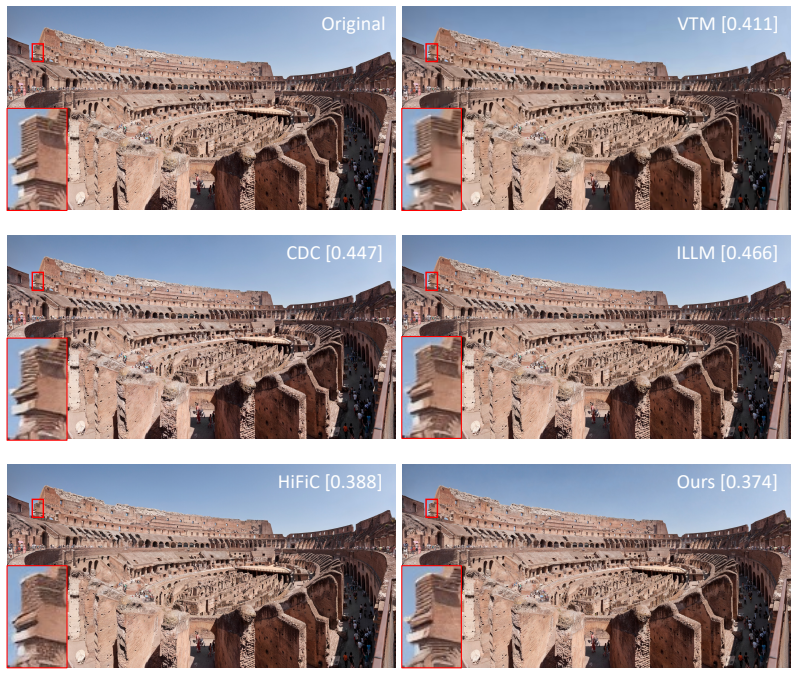
Summary. The paper proposes a diffusion-style generative image compression framework in which rate-variable quantization is reinterpreted as a forward diffusion process. A reverse network is trained with an L2 loss to invert quantization, and an ODE/SDE sampler is derived to reconstruct images from the compressed latent. Experiments on DIV2K, Kodak, and CLIC2020 report competitive perceptual metrics (LPIPS, FID, KID, MUSIQ, CLIPIQA) with only two reverse steps, and the method is claimed to outperform prior generative compression approaches without GAN or perceptual-loss finetuning.
Significance. If the theoretical framework were sound, this would be a meaningful contribution: it combines rate-variable compression with a minimal-step generative decoder and demonstrates strong perceptual results. The empirical study is broad, includes several benchmarks and metrics, and the design of the reverse network as a denoiser conditioned on the quantization scale is interesting. However, the central theoretical claim—that the learned network estimates the score of the corrupted feature distribution—is not established and, in the form stated, is false for the uniform quantization noise used in the forward process. The paper may still describe a useful heuristic denoiser, but the 'estimating gradients' framing and the SDE derivation do not hold as written.
major comments (4)
- [Sec. 3.2, Eq. (9)-(11)] The score identity ∇_x log p(x; q(t)) = (D_θ(x,q)-x)/q(t) is not valid for additive uniform quantization noise. For a data distribution p_data = δ_0 and q = 1, the corrupted density p(x; q) is uniform on [−0.5, 0.5], so the score is zero on the interior of the support, while the proposed formula gives −x, which is nonzero. The L2-trained denoiser D_θ (Eq. 15) estimates the posterior mean E[x_0 | x_t], not the score; for uniform noise there is no Tweedie-style identity connecting the MMSE denoiser to the score. Consequently, the Euler update in Eq. (11), and the reverse ODE/SDE steps derived from it, do not follow from the stated forward process.
- [Sec. 3.2, Eq. (10)] The probability-flow ODE dx = −(dq/dt) ∇_x log p(x; q(t)) dt is asserted without derivation. In standard score-based diffusion, this ODE is derived from the Fokker–Planck equation of a Gaussian SDE. Here the forward process is defined by Eq. (6)/(9) as quantization or additive uniform noise, and no such derivation is provided; the claim that the ODE preserves the marginal distributions p(x; q(t)) is an unproven assumption rather than a consequence of the construction.
- [Sec. 4.2, Fig. 3 and Eq. (13)] The stochastic sampler parameters are tuned on the evaluation benchmark. The randomness form ω and the coefficient β are selected by evaluating on DIV2K (Fig. 3), and the same DIV2K set is used for the main comparison in Fig. 2. This test-set tuning undermines the validity of the reported DIV2K superiority and makes the 'SOTA' claim hard to interpret. Additionally, the final model description does not state whether Gaussian or uniform noise is used for the reported results, so the experiments are not fully reproducible.
- [Algorithm 1, line 10] There is a clear implementation error in the displayed pseudocode: line 10, ¯y_{i+1} ← α(ϵ_i − d_i), overwrites the Euler update from line 8 instead of adding the stochastic term to it. The update should be ¯y_{i+1} ← ¯y_{i+1} + α(ϵ_i − d_i). This obscures the actual sampling procedure and should be corrected, along with a description of how the continuous Eq. (12) is discretized into lines 7–10.
minor comments (5)
- [Sec. 3.2 and Appendix A] The relation between the quantization scale q(t) and the time variable t is not stated in the main text; the substitution q(t) := t appears only in Appendix A. This should be clarified in Sec. 3.2, since the notation q(t_i) − q(t_{i+1}) in Eq. (11) depends on that choice.
- [Sec. 4.1] The definition of q_min as 'lower than the minimum support' is vague; it should be specified numerically or in terms of the entropy model's supported quantization range.
- [Eq. (13)] The text contains a typo: 'minimus' should be 'minimum'.
- [Abstract and Sec. 3.2] The statement 'without requiring Gaussian noise initialization' is confusing because the stochastic sampler in Eq. (12) and Algorithm 1 injects noise during decoding. The intended meaning is that the initial state is the compressed latent, not pure Gaussian noise; this should be stated explicitly.
- [Sec. 1 and reproducibility] The phrase 'The code is available here' is followed by no URL or link; provide the repository address or a supplementary archive for reproducibility.
Circularity Check
No circularity: the reverse sampler is a learned-denoiser interpolation, and the score identity is an unproven approximation rather than a circular reduction.
full rationale
The paper's derivation chain is not circular. The forward process is defined by rate-variable quantization approximated as additive uniform noise (Eq. 9), the reverse ODE is borrowed from score-based SDE theory (Eq. 10), and the score is replaced by the denoiser expression (x_hat_0 - x_t)/q(t). The denoiser D_theta is trained independently with an L2 loss (Eq. 15) on actual compressed latents produced by the entropy model, and the final sampler (Eq. 11) is a linear interpolation between the corrupted latent and D_theta's estimate. This is a direct use of a learned denoiser rather than a redefinition of the target in terms of the output; the sampler's behavior is not forced to equal a fitted parameter renamed as a prediction. The main weakness is that the score identity is mathematically unjustified for uniform quantization noise: the true score of a uniformly corrupted distribution is not generally (posterior_mean - x)/q, so the theoretical claim that the network estimates the score and thereby reverses the compression process is not established. That is a correctness and validity concern, not a circularity. Likewise, the stochasticity hyperparameter beta is selected using DIV2K metrics (Fig. 3) and then reported on DIV2K (Fig. 2), which is a benchmark-tuning weakness but does not make the reconstruction a consequence of the fit by construction. The only self-citation, [15], supplies the entropy-model backbone and is not load-bearing for the diffusion-sampler claim. No step reduces by construction to its own inputs, so no circularity is found.
Assumptions & free parameters
free parameters (2)
- β (stochasticity strength) =
0.075
- Number of reverse steps N =
2
assumptions (5)
- domain assumption The quantization operation is approximated as additive uniform noise: x_t = x0 + U(-0.5,0.5) q(t) (Eq 9).
- ad hoc to paper The probability-flow ODE dx = -(dq/dt) ∇ log p(x;q) dt (Eq 10) governs the evolution of samples under this forward process.
- ad hoc to paper The score equals (Dθ(x,q)-x)/q, where Dθ is an L2-trained denoiser.
- ad hoc to paper The reverse SDE in Eq 12 with random injection α(t) dω ± α(t) ∇ log p and schedule α_t = β sqrt(q_t - q_min) is a valid stochastic sampler.
- domain assumption A pretrained VAE (Rombach et al. [36]) and the rate-variable entropy model from Han et al. [15] provide a suitable latent space.
Cite this review
Pith. "Pith review of Generative Image Compression by Estimating Gradients of the Rate-variable Feature Distribution." pith.science (2026). https://pith.science/paper/7DVTIKLT
@misc{pith2026250520984,
  author       = {Pith},
  title        = {Pith review of: Generative Image Compression by Estimating Gradients of the Rate-variable Feature Distribution},
  year         = {2026},
  howpublished = {\url{https://pith.science/paper/7DVTIKLT}},
  note         = {Machine review of arXiv:2505.20984}
}
read the original abstract
While learned image compression (LIC) focuses on efficient data transmission, generative image compression (GIC) extends this framework by integrating generative modeling to produce photo-realistic reconstructed images. In this paper, we propose a novel diffusion-based generative modeling framework tailored for generative image compression. Unlike prior diffusion-based approaches that indirectly exploit diffusion modeling, we reinterpret the compression process itself as a forward diffusion path governed by stochastic differential equations (SDEs). A reverse neural network is trained to reconstruct images by reversing the compression process directly, without requiring Gaussian noise initialization. This approach achieves smooth rate adjustment and photo-realistic reconstructions with only a minimal number of sampling steps. Extensive experiments on benchmark datasets demonstrate that our method outperforms existing generative image compression approaches across a range of metrics, including perceptual distortion, statistical fidelity, and no-reference quality assessments.
Figures


Figures from the paper (6 more)



Reference graph
Works this paper leans on
-
[1]
In: Proceedings of the IEEE/CVF Conference on Computer Vision and Pattern Recognition
Agustsson, E., Minnen, D., Toderici, G., Mentzer, F.: Multi-realism image compression with a conditional generator. In: Proceedings of the IEEE/CVF Conference on Computer Vision and Pattern Recognition. pp. 22324–22333 (2023) 4, 8
work page 2023
-
[2]
In: The IEEE Conference on Computer Vision and Pattern Recognition (CVPR) Workshops (July 2017) 7, 8
Agustsson, E., Timofte, R.: Ntire 2017 challenge on single image super-resolution: Dataset and study. In: The IEEE Conference on Computer Vision and Pattern Recognition (CVPR) Workshops (July 2017) 7, 8
work page 2017
-
[3]
In: Proceedings of the IEEE/CVF international conference on computer vision
Agustsson, E., Tschannen, M., Mentzer, F., Timofte, R., Gool, L.V .: Generative adversarial net- works for extreme learned image compression. In: Proceedings of the IEEE/CVF international conference on computer vision. pp. 221–231 (2019) 1, 4
work page 2019
-
[4]
arXiv preprint arXiv:1611.01704 (2016) 1, 2, 3, 6
Ballé, J., Laparra, V ., Simoncelli, E.P.: End-to-end optimized image compression. arXiv preprint arXiv:1611.01704 (2016) 1, 2, 3, 6
arXiv 2016
-
[5]
arXiv preprint arXiv:1802.01436 (2018) 1, 2, 3, 6
Ballé, J., Minnen, D., Singh, S., Hwang, S.J., Johnston, N.: Variational image compression with a scale hyperprior. arXiv preprint arXiv:1802.01436 (2018) 1, 2, 3, 6
arXiv 2018
-
[6]
Bellard, F.: Bpg image format (2015), https://bellard.org/bpg 1, 8
work page 2015
-
[7]
arXiv preprint arXiv:1801.01401 (2018) 8
Bi´nkowski, M., Sutherland, D.J., Arbel, M., Gretton, A.: Demystifying mmd gans. arXiv preprint arXiv:1801.01401 (2018) 8
arXiv 2018
-
[8]
In: The Twelfth International Conference on Learning Representations (2023) 1, 4
Careil, M., Muckley, M.J., Verbeek, J., Lathuilière, S.: Towards image compression with perfect realism at ultra-low bitrates. In: The Twelfth International Conference on Learning Representations (2023) 1, 4
work page 2023
Show all 48 references
-
[9]
In: Proceedings of the IEEE/CVF conference on computer vision and pattern recognition
Cheng, Z., Sun, H., Takeuchi, M., Katto, J.: Learned image compression with discretized gaus- sian mixture likelihoods and attention modules. In: Proceedings of the IEEE/CVF conference on computer vision and pattern recognition. pp. 7939–7948 (2020) 1
2020
-
[10]
In: Proceedings of the IEEE/CVF international conference on computer vision
Choi, Y ., El-Khamy, M., Lee, J.: Variable rate deep image compression with a conditional autoencoder. In: Proceedings of the IEEE/CVF international conference on computer vision. pp. 3146–3154 (2019) 3
2019
-
[11]
In: Proceedings of the IEEE/CVF Conference on Computer Vision and Pattern Recognition
Cui, Z., Wang, J., Gao, S., Guo, T., Feng, Y ., Bai, B.: Asymmetric gained deep image compression with continuous rate adaptation. In: Proceedings of the IEEE/CVF Conference on Computer Vision and Pattern Recognition. pp. 10532–10541 (2021) 3
2021
-
[12]
In: 2009 IEEE conference on computer vision and pattern recognition
Deng, J., Dong, W., Socher, R., Li, L.J., Li, K., Fei-Fei, L.: Imagenet: A large-scale hierarchical image database. In: 2009 IEEE conference on computer vision and pattern recognition. pp. 248–255. Ieee (2009) 7
2009
-
[13]
In: Proceedings of the IEEE/CVF conference on computer vision and pattern recognition
Esser, P., Rombach, R., Ommer, B.: Taming transformers for high-resolution image synthesis. In: Proceedings of the IEEE/CVF conference on computer vision and pattern recognition. pp. 12873–12883 (2021) 1
2021
-
[14]
Advances in neural information processing systems 27 (2014) 1
Goodfellow, I.J., Pouget-Abadie, J., Mirza, M., Xu, B., Warde-Farley, D., Ozair, S., Courville, A., Bengio, Y .: Generative adversarial nets. Advances in neural information processing systems 27 (2014) 1
2014
-
[15]
arXiv preprint arXiv:2410.04847 (2024) 1, 6, 7
Han, M., Jiang, S., Li, S., Deng, X., Xu, M., Zhu, C., Gu, S.: Causal context adjustment loss for learned image compression. arXiv preprint arXiv:2410.04847 (2024) 1, 6, 7
2024 arXiv
-
[16]
In: Proceedings of the IEEE/CVF Conference on Computer Vision and Pattern Recognition
He, D., Yang, Z., Peng, W., Ma, R., Qin, H., Wang, Y .: Elic: Efficient learned image compression with unevenly grouped space-channel contextual adaptive coding. In: Proceedings of the IEEE/CVF Conference on Computer Vision and Pattern Recognition. pp. 5718–5727 (2022) 1
2022
-
[17]
Advances in neural information processing systems 30 (2017) 8 10
Heusel, M., Ramsauer, H., Unterthiner, T., Nessler, B., Hochreiter, S.: Gans trained by a two time-scale update rule converge to a local nash equilibrium. Advances in neural information processing systems 30 (2017) 8 10
2017
-
[18]
Advances in neural information processing systems 33, 6840–6851 (2020) 1
Ho, J., Jain, A., Abbeel, P.: Denoising diffusion probabilistic models. Advances in neural information processing systems 33, 6840–6851 (2020) 1
2020
-
[19]
arXiv preprint arXiv:2305.18231 (2023) 1, 4
Hoogeboom, E., Agustsson, E., Mentzer, F., Versari, L., Toderici, G., Theis, L.: High-fidelity image compression with score-based generative models. arXiv preprint arXiv:2305.18231 (2023) 1, 4
2023 arXiv
-
[20]
In: Proceedings of the IEEE/CVF Conference on Computer Vision and Pattern Recognition
Jia, Z., Li, J., Li, B., Li, H., Lu, Y .: Generative latent coding for ultra-low bitrate image compression. In: Proceedings of the IEEE/CVF Conference on Computer Vision and Pattern Recognition. pp. 26088–26098 (2024) 1, 4
2024
-
[21]
Advances in neural information processing systems35, 26565–26577 (2022) 4, 5, 6, 7
Karras, T., Aittala, M., Aila, T., Laine, S.: Elucidating the design space of diffusion-based generative models. Advances in neural information processing systems35, 26565–26577 (2022) 4, 5, 6, 7
2022
-
[22]
In: Proceedings of the IEEE/CVF international conference on computer vision
Ke, J., Wang, Q., Wang, Y ., Milanfar, P., Yang, F.: Musiq: Multi-scale image quality transformer. In: Proceedings of the IEEE/CVF international conference on computer vision. pp. 5148–5157 (2021) 8
2021
-
[23]
Kodak, E.: Kodak lossless true color image suite (photocd pcd0992) (1993), http://r0k.us/ graphics/kodak 7
1993
-
[24]
International journal of computer vision 128(7), 1956–1981 (2020) 7
Kuznetsova, A., Rom, H., Alldrin, N., Uijlings, J., Krasin, I., Pont-Tuset, J., Kamali, S., Popov, S., Malloci, M., Kolesnikov, A., et al.: The open images dataset v4: Unified image classification, object detection, and visual relationship detection at scale. International jou...
2020
-
[25]
arXiv preprint arXiv:2307.01944 (2023) 1, 4
Lei, E., Uslu, Y .B., Hassani, H., Bidokhti, S.S.: Text+ sketch: Image compression at ultra low rates. arXiv preprint arXiv:2307.01944 (2023) 1, 4
2023 arXiv
-
[26]
arXiv preprint arXiv:2406.00758 (2024) 1, 4, 8, 13
Li, A., Li, F., Liu, Y ., Cong, R., Zhao, Y ., Bai, H.: Once-for-all: Controllable generative image compression with dynamic granularity adaption. arXiv preprint arXiv:2406.00758 (2024) 1, 4, 8, 13
2024 arXiv
-
[27]
In: Proceedings of the IEEE/CVF Conference on Computer Vision and Pattern Recognition
Liu, J., Sun, H., Katto, J.: Learned image compression with mixed transformer-cnn architectures. In: Proceedings of the IEEE/CVF Conference on Computer Vision and Pattern Recognition. pp. 14388–14397 (2023) 1
2023
-
[28]
arXiv preprint arXiv:1711.05101 (2017) 7
Loshchilov, I., Hutter, F.: Decoupled weight decay regularization. arXiv preprint arXiv:1711.05101 (2017) 7
2017 arXiv
-
[29]
arXiv preprint arXiv:2504.00496 (2025) 1
Lu, J., Zhang, L., Zhou, X., Li, M., Li, W., Gu, S.: Learned image compression with dictionary- based entropy model. arXiv preprint arXiv:2504.00496 (2025) 1
2025 arXiv
-
[30]
In: 2024 Data Compression Conference (DCC)
Mao, Q., Yang, T., Zhang, Y ., Wang, Z., Wang, M., Wang, S., Jin, L., Ma, S.: Extreme image compression using fine-tuned vqgans. In: 2024 Data Compression Conference (DCC). pp. 203–212. IEEE (2024) 1
2024
-
[31]
Advances in neural information processing systems 33, 11913–11924 (2020) 1, 4, 8, 9, 13
Mentzer, F., Toderici, G.D., Tschannen, M., Agustsson, E.: High-fidelity generative image compression. Advances in neural information processing systems 33, 11913–11924 (2020) 1, 4, 8, 9, 13
2020
-
[32]
Advances in neural information processing systems 31 (2018) 1
Minnen, D., Ballé, J., Toderici, G.D.: Joint autoregressive and hierarchical priors for learned image compression. Advances in neural information processing systems 31 (2018) 1
2018
-
[33]
In: 2020 IEEE International Conference on Image Processing (ICIP)
Minnen, D., Singh, S.: Channel-wise autoregressive entropy models for learned image com- pression. In: 2020 IEEE International Conference on Image Processing (ICIP). pp. 3339–3343. IEEE (2020) 1
2020
-
[34]
In: International Conference on Machine Learning
Muckley, M.J., El-Nouby, A., Ullrich, K., Jégou, H., Verbeek, J.: Improving statistical fidelity for neural image compression with implicit local likelihood models. In: International Conference on Machine Learning. pp. 25426–25443. PMLR (2023) 1, 4, 8, 9, 13
2023
-
[35]
arXiv preprint arXiv:2202.05492 (2022) 1 11
Qian, Y ., Lin, M., Sun, X., Tan, Z., Jin, R.: Entroformer: A transformer-based entropy model for learned image compression. arXiv preprint arXiv:2202.05492 (2022) 1 11
2022 arXiv
-
[36]
In: Proceedings of the IEEE/CVF conference on computer vision and pattern recognition
Rombach, R., Blattmann, A., Lorenz, D., Esser, P., Ommer, B.: High-resolution image synthesis with latent diffusion models. In: Proceedings of the IEEE/CVF conference on computer vision and pattern recognition. pp. 10684–10695 (2022) 6
2022
-
[37]
The Bell system technical journal 27(3), 379–423 (1948) 3
Shannon, C.E.: A mathematical theory of communication. The Bell system technical journal 27(3), 379–423 (1948) 3
1948
-
[38]
arXiv preprint arXiv:2010.02502 (2020) 5, 6
Song, J., Meng, C., Ermon, S.: Denoising diffusion implicit models. arXiv preprint arXiv:2010.02502 (2020) 5, 6
2020 arXiv
-
[39]
Advances in neural information processing systems 32 (2019) 1, 2, 3, 4, 5
Song, Y ., Ermon, S.: Generative modeling by estimating gradients of the data distribution. Advances in neural information processing systems 32 (2019) 1, 2, 3, 4, 5
2019
-
[40]
arXiv preprint arXiv:2011.13456 (2020) 2, 3, 4, 5, 6
Song, Y ., Sohl-Dickstein, J., Kingma, D.P., Kumar, A., Ermon, S., Poole, B.: Score-based generative modeling through stochastic differential equations. arXiv preprint arXiv:2011.13456 (2020) 2, 3, 4, 5, 6
2020 arXiv
-
[41]
Team, J.V .E.: Versatile video coding reference software version 23.9(vtm-23.9) (2025),https: //vcgit.hhi.fraunhofer.de/jvet/VVCSoftware_VTM/-/tags/VTM-23.9 1, 8, 13
2025
-
[42]
arXiv preprint arXiv:1511.06085 (2015) 3
Toderici, G., O’Malley, S.M., Hwang, S.J., Vincent, D., Minnen, D., Baluja, S., Covell, M., Sukthankar, R.: Variable rate image compression with recurrent neural networks. arXiv preprint arXiv:1511.06085 (2015) 3
2015 arXiv
-
[43]
In: CVPR (2020) 7
Toderici, G., Shi, W., Timofte, R., Theis, L., Ballé, J., Agustsson, E., Johnston, N., Mentzer, F.: Workshop and challenge on learned image compression (clic2020). In: CVPR (2020) 7
2020
-
[44]
Advances in neural information processing systems 31 (2018) 1
Tschannen, M., Agustsson, E., Lucic, M.: Deep generative models for distribution-preserving lossy compression. Advances in neural information processing systems 31 (2018) 1
2018
-
[45]
arXiv preprint arXiv:2302.05071 (2023) 3
Wang, G.H., Li, J., Li, B., Lu, Y .: Evc: Towards real-time neural image compression with mask decay. arXiv preprint arXiv:2302.05071 (2023) 3
2023 arXiv
-
[46]
In: Proceedings of the AAAI conference on artificial intelligence
Wang, J., Chan, K.C., Loy, C.C.: Exploring clip for assessing the look and feel of images. In: Proceedings of the AAAI conference on artificial intelligence. vol. 37, pp. 2555–2563 (2023) 8
2023
-
[47]
Advances in Neural Information Processing Systems 36, 64971–64995 (2023) 1, 4, 8, 9, 13
Yang, R., Mandt, S.: Lossy image compression with conditional diffusion models. Advances in Neural Information Processing Systems 36, 64971–64995 (2023) 1, 4, 8, 9, 13
2023
-
[48]
method [bpp]
Zhang, R., Isola, P., Efros, A.A., Shechtman, E., Wang, O.: The unreasonable effectiveness of deep features as a perceptual metric. In: Proceedings of the IEEE conference on computer vision and pattern recognition. pp. 586–595 (2018) 8 12 A Derivation of Discrete ODE Solver A ...
2018
Reviewed August 7, 2026 · model on record in the stance chip above.
Discussion (0). Sign in to comment.