REVIEW 5 major objections 6 minor 35 references
Chain-of-Talkers (CoTalk): Fast Human Annotation of Dense Image Captions
T0 review · 5 major / 6 minor · reviewed 2026-08-07 · deepseek-v4-flash
Pith's one-line read Chain-of-Talkers, where each annotator speaks only the details earlier captions missed, produces more comprehensive image captions faster than parallel annotation, and improves downstream retrieval.
desk verdict CoTalk is a plausible workflow improvement for dense caption annotation, but the Pareto-optimality proof rests on an assumed premise and a sign error; the empirical speed gain is suggestive, not definitive. read the letter →
The pith
A machine-rendered reading of the paper's core claim, the machinery that carries it, and where it could break.
The reading
What carries the argument
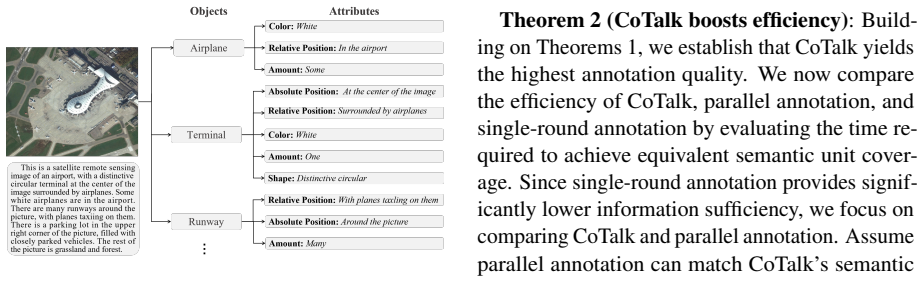
The argument rides on three mechanisms. (1) The residual semantic space: each CoTalk annotator samples from $Y - Y^{k-1}_\sigma$, the semantic units not yet covered by the merged caption, rather than from the full image description space. (2) The semantic-unit tree: captions are parsed by an LLM into (object, attribute) pairs whose edge count defines comprehensiveness, giving an intrinsic quality metric independent of caption length or model choice. (3) The multimodal interface: annotators read prior captions (text input at ~236 WPM) and speak new ones (speech output at ~161 WPM), a combination the paper measures as faster and more accurate than all-typing or all-audio alternatives. These feed an information-theoretic objective $J(\theta) = J_{\text{suf}}(\theta) - \beta J_{\min}(\theta) - \gamma J_{\text{int}}(\theta)$ taken from a prior caption-quality framework, which the paper uses to derive CoTalk's quality and Pareto-optimality theorems.
What would settle it
Take a diverse set of images, run a four-annotator CoTalk chain, and record the number of new semantic units contributed in rounds 2, 3, and 4; the claim predicts a strict decrease in each round's contribution, so observing flat or increasing contributions would falsify the diminishing-contribution assumption and with it the theoretical case for CoTalk's superiority. A second check: in Proof B, recalculate the time difference with the inequality direction as stated in the main text ($v_{\text{out}} > v_{\text{text in}}$) rather than the inverted direction used in the appendix, and verify the claimed $\Delta T > 0$ still follows.
Extended reading notes
Core claim
CoTalk's central claim is that sequential 'residual' annotation is strictly better than parallel annotation for dense image captioning. The discovery is this: when the first annotator provides a complete spoken description and every subsequent annotator reads the merged caption and talks only about visual content that is still missing, the total annotation captures more distinct semantic units per image (36.72 vs. 33.61), takes about 48% less time per annotator (raising speed from 0.30 to 0.42 units/second), and yields training captions that fine-tune a Long-CLIP model to higher retrieval accuracy (41.13% vs. 40.52% averaged over RSICD, RSITMD, and UCM-Captions). The paper frames this within an information-theoretic model of captions in which quality is the mutual information between image and caption minus redundancy minus a distance from natural language, and argues that CoTalk increases information sufficiency, matches single-annotator redundancy, and achieves the same coverage in fewer rounds than parallel annotation.
Load-bearing premise
The load-bearing premise is Assumption 1: each successive annotator in a CoTalk chain adds fewer new semantic units than the previous one, which the paper asserts without measuring, and if later annotators add as much or more semantic content the claimed time and Pareto advantages over parallel annotation no longer follow.
Editorial extensions
If this is right
- Fixed annotation budgets go further: at 0.42 units/second, CoTalk annotates roughly 40% more semantic content per hour than parallel annotation, so more images can be densely captioned for the same cost.
- Vision-language models trained on CoTalk captions retrieve images and text more accurately, suggesting that sequentially accumulated residual captions make better training data than aggregated parallel captions.
- The 69.12% to 29.76% drop in cross-annotator redundancy means a larger fraction of human effort is spent on genuinely new visual content rather than repeated descriptions.
- Because the read-and-talk interface beats all-typing and all-listening alternatives in both speed and accuracy, future annotation pipelines can adopt the same modality split even without the sequential chain.
- The semantic-unit tree provides a cheap intrinsic proxy for caption usefulness, letting annotation pipelines be tuned without re-running expensive retrieval fine-tuning at every step.
Reading between the lines
- A natural extension the paper leaves untested is seeding the chain with a model-generated first caption and using humans only for residual correction; if the diminishing-contribution assumption holds, human effort would be spent only on the hardest-to-capture details.
- The protocol's success with only eight participants suggests the efficiency gap might generalize to larger, more diverse annotator populations, but the reported numbers are small-sample and should be re-estimated with more images and annotators before being treated as population-level effects.
- The same read-text/speak-output interface could speed up other human data-labeling tasks that require dense structured output, such as video description, audio transcription of metadata, or grounded object tagging, where the bottleneck is verbal production rather than perception.
- If the semantic-unit metric continues to correlate with downstream retrieval across domains, it could become a standard cheap acceptance gate for deciding when a caption is 'dense enough', replacing the current practice of using caption length or expensive model evals.
Editorial analysis
A structured set of objections, weighed in public.
Referee Report
Summary. The paper proposes Chain-of-Talkers (CoTalk), an AI-in-the-loop annotation protocol in which annotators sequentially add only residual visual details to an existing caption, using speech for output and text for input. The authors claim that CoTalk is Pareto-optimal in the quality–efficiency trade-off, based on an information-theoretic framework adapted from Chen et al. (2024), and they report an experiment with eight participants showing higher annotation speed (0.42 vs. 0.30 semantic units/sec), higher semantic-unit counts (36.72 vs. 33.61), lower redundancy (29.76% vs. 69.12%), and higher downstream retrieval average (41.13% vs. 40.52%) relative to parallel annotation. The theoretical analysis rests on two assumptions: diminishing semantic contribution across successive CoTalk annotators (Assumption 1) and lossless, redundancy-eliminating LLM merging (Assumption 2). The empirical evaluation includes intrinsic semantic-unit metrics, a read-vs-listen and talk-vs-type comparison, and fine-tuning Long-CLIP on remote-sensing retrieval benchmarks.
Significance. If established, CoTalk would be a practical and useful methodology for building dense image-caption datasets, and the multimodal residual-annotation idea is genuinely appealing. The paper also provides a welcome attempt to connect annotation design to an information-theoretic framing, and the semantic-unit tree is an interpretable intrinsic metric. The talk-vs-type and read-vs-listen ablations are concrete and useful. However, the load-bearing theoretical results are not rigorously established: the central assumption is essentially the efficiency claim being proved, the proof in Appendix B contradicts the main text on a key inequality, and the stated equal-coverage comparison in Theorem 2 is not actually enforced. The empirical evidence is suggestive but limited (n=8, no significance tests, one of three retrieval benchmarks favors the baseline), and no data or code are released for independent verification. The paper's contribution is therefore currently a plausible hypothesis with supporting anecdotal evidence rather than a validated method.
major comments (5)
- [Section 3.1, Assumption 1; Limitations] Assumption 1 asserts that the amount of new semantic content added by each successive CoTalk annotator decreases (Y_k^CoTalk > Y_{k+1}^CoTalk). This is exactly the diminishing-return property needed for Theorem 1's Eq. (7) and for Theorem 2's claim that m > n. The paper never measures per-annotator residual semantic units, and the Limitations section explicitly concedes that 'later annotators may identify more residual information than earlier ones.' As written, the central Pareto-optimality result is an assumption rather than an established finding.
- [Appendix B, Proof 1, Eq. (17)] The main text in Section 3.1 states that v_out > v_text_in, but Proof 1 in Appendix B assumes v_out < v_text_in, and the derivation of ΔT > 0 in Eq. (18) requires v_out < v_text_in to replace 1/v_text_in by 1/v_out. The cited sources (Ruan et al., 2016; Brysbaert, 2019) actually support v_out < v_text_in, so Section 3.1's inequality appears to be a typo; nevertheless, the manuscript is internally inconsistent, and the proof should be rewritten with a consistent statement of its premises.
- [Appendix B, Proof 1, m=3 case] The proof's 'extreme case' m=3 does not enforce equal semantic coverage, despite Theorem 2's claim to compare annotations at the same coverage. With equal annotator abilities, parallel annotation produces 3·Y1 units while CoTalk produces Y1 + Y2 < 2·Y1; the time comparison is therefore between different amounts of annotation. If one instead imposes 3·Y1 = Y1 + Y2, then Y2 = 2·Y1, which directly contradicts Assumption 1. The proof needs a properly constructed equal-coverage comparison.
- [Section 3.1, Theorem 1; Eq. (7)] Theorem 1's information-sufficiency result is not derived; Eq. (7), the claim that the incremental information gain ΔI(Y_k^σ; X) is larger for CoTalk than for parallel annotation, is asserted as a consequence of Assumptions 1–2 without a proof. Since Theorem 2's premise that m > n is 'as implied by Equation 7,' the theoretical chain is circular. A direct derivation of Eq. (7), or a measurement of per-round information gain, is required before the Pareto-optimality claim can be accepted.
- [Table 3; Extrinsic Evaluation] The abstract and Section 4.1.2 claim that CoTalk 'consistently yields superior retrieval accuracy,' but Table 3 shows CoTalk is below parallel annotation on RSITMD (33.83 vs. 33.97), and the average advantage (41.13 vs. 40.52) is driven by RSICD and UCM-Captions. No statistical significance tests are reported, and with only eight participants the practical effect is uncertain. The absence of released code and data also prevents independent verification of the reported differences.
minor comments (6)
- [Section 1, Abstract] There is a typo in Section 1: 'an novel AI-in-the-loop annotation framework' should read 'a novel.'
- [Figure 9 caption] The caption 'The Suquential Subsequent Annotation Interface' contains a typo: 'Suquential' should be 'Sequential.'
- [Section 3.2] The argument that v_reading_in > v_listening_in uses the speaking rate of 161 WPM from Ruan et al. (2016) as if it were a listening-comprehension rate. The conclusion requires a listening-comprehension speed reference or a direct measurement; the cited 236 WPM reading rate and the speaking rate are not comparable quantities.
- [Section 3.1] The term 'Pareto optimal' is used without a formal definition of the feasible quality–efficiency set. Please state the Pareto frontier precisely, including the trade-off variables and the sense in which CoTalk approaches it.
- [Table 4] The claim that 'novices match experienced speeds' is based on a single 10-minute session (cycle 2), while cycle 4 shows a substantial drop to 0.25 units/sec. The statement should be qualified with respect to the observed fatigue effect.
- [Appendix B, notation] The proof inconsistently switches between notations such as eY1_CoTalk and |Y1_CoTalk|, and between tildes and absolute values; please standardize the notation for semantic-unit counts.
Circularity Check
Pareto-optimality proof assumes the diminishing-residual premise it needs to prove; the central theorem reduces to Assumption 1, with an internal sign error in Appendix B further blocking the derivation.
-
self definitional
[Section 3.1, Assumption 1 and Theorem 2; also Appendix B, Proof 1]
"Assumption 1 (Diminishing semantic contribution in CoTalk annotations) In CoTalk, the amount of new semantic content added by each successive annotator decreases due to the influence of prior annotations, resulting in Y k CoTalk > Yk+1 CoTalk. ... Assume parallel annotation can match CoTalk’s semantic coverage using m rounds, while CoTalk requires only n rounds (m > n, as implied by Equation 7). ... later annotators may identify more residual information than earlier ones."
Theorem 2's conclusion that CoTalk needs fewer rounds (m > n) and therefore less time is derived from the same diminishing-residual premise that the theorem is supposed to establish. Assumption 1 is not measured per annotator: the reported speed advantage (0.42 vs. 0.30 units/sec) is a group-level rate and does not verify Y_k^CoTalk > Y_{k+1}^{CoTalk}. The paper's own Limitations section concedes that later annotators may identify more residual information than earlier ones. Thus the Pareto-optimality proof is a restatement of the assumption rather than an independent derivation, and the efficiency 'prediction' is built into the premise.
-
self citation load bearing
[Section 1, paragraph 6 and Section 2.1, Preliminary]
"The design of CoTalk is theoretically grounded in an information-theoretic evaluation framework for image captions (Chen et al., 2024), which provides rigorous guidelines for developing efficient annotation methodologies. ... Chen et al. (2024) propose an information-theoretic framework for image captioning, systematically defining key criteria for high-quality annotations."
The cited framework is prior work by a co-author of the present paper (Delong Chen appears in both author lists), and it supplies the J_suf/J_min/J_int objectives and the semantic-vector formalism on which Theorems 1 and 2 rest. The paper invokes this framework as 'rigorous guidelines' without external verification or independent benchmark, so the theoretical grounding of the central claim is partly a self-citation chain. This is partially load-bearing, although the empirical speed and retrieval comparisons against the parallel method provide independent content that keeps the paper from being entirely circular.
full rationale
The main circularity is in the theoretical section. Assumption 1 asserts that successive CoTalk annotators add decreasing amounts of new semantic content, and Theorem 2 then uses that assumption to conclude that CoTalk requires fewer annotators and less total time. This is not an independent derivation: the efficiency benefit claimed by the theorem is exactly the diminishing-residual effect assumed as a premise. The empirical results do not close the gap because they report only overall annotation speed and retrieval averages, not per-position residual unit counts for each annotator, and the Limitations section explicitly acknowledges the assumption can fail. The self-citation of the authors' prior framework (Chen et al., 2024) is also load-bearing for the definitions of quality and for the semantic-unit formalism, though the empirical comparisons are self-contained and independently valuable. Appendix B contains an additional correctness flaw, not itself a circularity: the main text states v_out > v_text_in, but the proof uses v_out < v_text_in to force the lower bound Delta T > 0; with the correct inequality the bound no longer follows. Because the central theoretical claim reduces to an unverified assumption, but the paper also presents genuine empirical comparisons, a score of 6 reflects partial rather than complete circularity.
Assumptions & free parameters
assumptions (5)
- ad hoc to paper Assumption 1: Each successive CoTalk annotator adds strictly less new semantic content (Y_k > Y_{k+1}).
- ad hoc to paper Assumption 2: The LLM merger sigma is lossless, eliminates redundancy, and has positive input-output correlation.
- domain assumption Equal annotator ability and accuracy across all annotators.
- domain assumption Semantic-unit count from LLM parsing is a valid measure of annotation comprehensiveness.
- domain assumption Speech output is faster than typing and text input faster than listening.
invented entities (1)
-
object-attribute semantic unit tree
Cite this review
Pith. "Pith review of Chain-of-Talkers (CoTalk): Fast Human Annotation of Dense Image Captions." pith.science (2026). https://pith.science/paper/C7HI7ESF
@misc{pith2026250522627,
  author       = {Pith},
  title        = {Pith review of: Chain-of-Talkers (CoTalk): Fast Human Annotation of Dense Image Captions},
  year         = {2026},
  howpublished = {\url{https://pith.science/paper/C7HI7ESF}},
  note         = {Machine review of arXiv:2505.22627}
}
read the original abstract
While densely annotated image captions significantly facilitate the learning of robust vision-language alignment, methodologies for systematically optimizing human annotation efforts remain underexplored. We introduce Chain-of-Talkers (CoTalk), an AI-in-the-loop methodology designed to maximize the number of annotated samples and improve their comprehensiveness under fixed budget constraints (e.g., total human annotation time). The framework is built upon two key insights. First, sequential annotation reduces redundant workload compared to conventional parallel annotation, as subsequent annotators only need to annotate the ``residual'' -- the missing visual information that previous annotations have not covered. Second, humans process textual input faster by reading while outputting annotations with much higher throughput via talking; thus a multimodal interface enables optimized efficiency. We evaluate our framework from two aspects: intrinsic evaluations that assess the comprehensiveness of semantic units, obtained by parsing detailed captions into object-attribute trees and analyzing their effective connections; extrinsic evaluation measures the practical usage of the annotated captions in facilitating vision-language alignment. Experiments with eight participants show our Chain-of-Talkers (CoTalk) improves annotation speed (0.42 vs. 0.30 units/sec) and retrieval performance (41.13% vs. 40.52%) over the parallel method.
Figures


Figures from the paper (7 more)


Reference graph
Works this paper leans on
-
[1]
Keyu An, Qian Chen, Chong Deng, Zhihao Du, Changfeng Gao, Zhifu Gao, Yue Gu, Ting He, Hangrui Hu, Kai Hu, Shengpeng Ji, Yabin Li, Zerui Li, Heng Lu, Xiang Lv, Bin Ma, Ziyang Ma, Chongjia Ni, Changhe Song, and 13 others. 2024. https://api.semanticscholar.org/CorpusID:271039436 Funaudiollm: Voice understanding and generation foundation models for natural in...
arXiv 2024
-
[2]
Ali Athar, Xueqing Deng, and Liang-Chieh Chen. 2024. https://api.semanticscholar.org/CorpusID:274762940 Vicas: A dataset for combining holistic and pixel-level video understanding using captions with grounded segmentation . ArXiv, abs/2412.09754
arXiv 2024
-
[3]
Daniel Bolya, Po-Yao Huang, Peize Sun, Jang Hyun Cho, Andrea Madotto, Chen Wei, Tengyu Ma, Jiale Zhi, Jathushan Rajasegaran, Hanoona Abdul Rasheed, Junke Wang, Marco Monteiro, Hu Xu, Shiyu Dong, Nikhila Ravi, Daniel Li, Piotr Doll'ar, and Christoph Feichtenhofer. 2025. https://api.semanticscholar.org/CorpusID:277856792 Perception encoder: The best visual ...
work page 2025
-
[4]
Marc Brysbaert. 2019. https://api.semanticscholar.org/CorpusID:202267075 How many words do we read per minute? a review and meta-analysis of reading rate . Journal of Memory and Language
work page 2019
-
[5]
Delong Chen, Samuel Cahyawijaya, Etsuko Ishii, Ho Shu Chan, Yejin Bang, and Pascale Fung. 2024. https://api.semanticscholar.org/CorpusID:269484714 What makes for good image captions?
work page 2024
-
[6]
Lin Chen, Jinsong Li, Xiao wen Dong, Pan Zhang, Conghui He, Jiaqi Wang, Feng Zhao, and Dahua Lin. 2023. https://api.semanticscholar.org/CorpusID:265308687 Sharegpt4v: Improving large multi-modal models with better captions . In European Conference on Computer Vision
work page 2023
-
[7]
Xinlei Chen, Hao Fang, Tsung-Yi Lin, Ramakrishna Vedantam, Saurabh Gupta, Piotr Doll \'a r, and C. Lawrence Zitnick. 2015. https://api.semanticscholar.org/CorpusID:2210455 Microsoft coco captions: Data collection and evaluation server . ArXiv, abs/1504.00325
arXiv 2015
-
[8]
Jang Hyun Cho, Andrea Madotto, Effrosyni Mavroudi, Triantafyllos Afouras, Tushar Nagarajan, Muhammad Maaz, Yale Song, Tengyu Ma, Shuming Hu, Suyog Dutt Jain, Miguel Martin, Huiyu Wang, Hanoona Abdul Rasheed, Peize Sun, Po-Yao Huang, Daniel Bolya, Nikhila Ravi, Shashank Jain, Tammy Stark, and 10 others. 2025. https://api.semanticscholar.org/CorpusID:277856...
work page 2025
Show all 35 references
-
[9]
Matt Deitke, Christopher Clark, Sangho Lee, Rohun Tripathi, Yue Yang, Jae Sung Park, Mohammadreza Salehi, Niklas Muennighoff, Kyle Lo, Luca Soldaini, Jiasen Lu, Taira Anderson, Erin Bransom, Kiana Ehsani, Huong Ngo, YenSung Chen, Ajay Patel, Mark Yatskar, Christopher Callison-...
2024
-
[10]
Roopal Garg, Andrea Burns, Burcu Karagol Ayan, Yonatan Bitton, Ceslee Montgomery, Yasumasa Onoe, Andrew Bunner, Ranjay Krishna, Jason Baldridge, and Radu Soricut. 2024. https://api.semanticscholar.org/CorpusID:269606018 Imageinwords: Unlocking hyper-detailed image descriptions...
2024
-
[11]
Yunhao Ge, Xiaohui Zeng, Jacob Samuel Huffman, Tsung-Yi Lin, Ming-Yu Liu, and Yin Cui. 2024. https://api.semanticscholar.org/CorpusID:269457182 Visual fact checker: Enabling high-fidelity detailed caption generation . 2024 IEEE/CVF Conference on Computer Vision and Pattern Rec...
2024
-
[12]
Grignetti
Mario C. Grignetti. 1964. https://doi.org/10.1016/S0019-9958(64)90326-2 A note on the entropy of words in printed english . Information and Control, 7(3):304--306
1964 doi
-
[13]
Jack Hessel, Ari Holtzman, Maxwell Forbes, Ronan Le Bras, and Yejin Choi. 2021. https://api.semanticscholar.org/CorpusID:233296711 Clipscore: A reference-free evaluation metric for image captioning . ArXiv, abs/2104.08718
2021 arXiv
-
[14]
Shiyu Hu, Xuchen Li, Xuzhao Li, Jing Zhang, Yipei Wang, Xin Zhao, and Kang Hao Cheong. 2024. https://api.semanticscholar.org/CorpusID:273502426 Can lvlms describe videos like humans? a five-in-one video annotations benchmark for better human-machine comparison . ArXiv, abs/2410.15270
2024 arXiv
-
[15]
Yuan Hu, Jianlong Yuan, Congcong Wen, Xiaonan Lu, and Xiang Li. 2023. https://api.semanticscholar.org/CorpusID:260316172 Rsgpt: A remote sensing vision language model and benchmark . ArXiv, abs/2307.15266
2023 arXiv
-
[16]
Hang Hua, Qing Liu, Lingzhi Zhang, Jing Shi, Zhifei Zhang, Yilin Wang, Jianming Zhang, and Jiebo Luo. 2024. https://api.semanticscholar.org/CorpusID:274233870 Finecaption: Compositional image captioning focusing on wherever you want at any granularity . ArXiv, abs/2411.15411
2024 arXiv
-
[17]
Zhang Li, Biao Yang, Qiang Liu, Zhiyin Ma, Shuo Zhang, Jingxu Yang, Yabo Sun, Yuliang Liu, and Xiang Bai. 2023. https://api.semanticscholar.org/CorpusID:265150038 Monkey: Image resolution and text label are important things for large multi-modal models . 2024 IEEE/CVF Conferen...
2023
-
[18]
Zhenshi Li, Dilxat Muhtar, Feng Gu, Xueliang Zhang, Pengfeng Xiao, Guangjun He, and Xiaoxiang Zhu. 2024. https://api.semanticscholar.org/CorpusID:274023105 Lhrs-bot-nova: Improved multimodal large language model for remote sensing vision-language interpretation . ArXiv, abs/2411.09301
2024 arXiv
-
[19]
Xiaoqiang Lu, Binqiang Wang, Xiangtao Zheng, and Xuelong Li. 2017. https://api.semanticscholar.org/CorpusID:4246700 Exploring models and data for remote sensing image caption generation . IEEE Transactions on Geoscience and Remote Sensing, 56:2183--2195
2017
-
[20]
Chuofan Ma, Yi Jiang, Jiannan Wu, Zehuan Yuan, and Xiaojuan Qi. 2024. https://api.semanticscholar.org/CorpusID:269283071 Groma: Localized visual tokenization for grounding multimodal large language models . ArXiv, abs/2404.13013
2024 arXiv
-
[21]
Thao Nguyen, Samir Yitzhak Gadre, Gabriel Ilharco, Sewoong Oh, and Ludwig Schmidt. 2023. https://api.semanticscholar.org/CorpusID:259991316 Improving multimodal datasets with image captioning . ArXiv, abs/2307.10350
2023 arXiv
-
[22]
Yasumasa Onoe, Sunayana Rane, Zachary Berger, Yonatan Bitton, Jaemin Cho, Roopal Garg, Alexander Ku, Zarana Parekh, Jordi Pont-Tuset, Garrett Tanzer, Su Wang, and Jason Baldridge. 2024. https://api.semanticscholar.org/CorpusID:269457405 Docci: Descriptions of connected and con...
2024 arXiv
-
[23]
Ruizhe Ou, Yuan Hu, Fan Zhang, Jiaxin Chen, and Yu Liu. 2025. https://api.semanticscholar.org/CorpusID:275471375 Geopix: Multi-modal large language model for pixel-level image understanding in remote sensing . ArXiv, abs/2501.06828
2025 arXiv
-
[24]
Bo Qu, Xuelong Li, Dacheng Tao, and Xiaoqiang Lu. 2016. https://doi.org/10.1109/CITS.2016.7546397 Deep semantic understanding of high resolution remote sensing image . In 2016 International Conference on Computer, Information and Telecommunication Systems (CITS), pages 1--5
2016
-
[25]
Alec Radford, Jong Wook Kim, Chris Hallacy, Aditya Ramesh, Gabriel Goh, Sandhini Agarwal, Girish Sastry, Amanda Askell, Pamela Mishkin, Jack Clark, Gretchen Krueger, and Ilya Sutskever. 2021. https://api.semanticscholar.org/CorpusID:231591445 Learning transferable visual model...
2021
-
[26]
Alec Radford, Jong Wook Kim, Tao Xu, Greg Brockman, Christine McLeavey, and Ilya Sutskever. 2022. https://api.semanticscholar.org/CorpusID:252923993 Robust speech recognition via large-scale weak supervision . In International Conference on Machine Learning
2022
-
[27]
Nils Reimers and Iryna Gurevych. 2019. https://api.semanticscholar.org/CorpusID:201646309 Sentence-bert: Sentence embeddings using siamese bert-networks . In Conference on Empirical Methods in Natural Language Processing
2019
-
[28]
Wobbrock, Kenny Liou, Andrew Ng, and James Landay
Sherry Ruan, Jacob O. Wobbrock, Kenny Liou, Andrew Ng, and James Landay. 2016. Speech is 3x faster than typing for english and mandarin text entry on mobile devices
2016
-
[29]
Akashah Shabbir, Mohammed Zumri, Mohammed Bennamoun, Fahad Shahbaz Khan, and Salman Khan. 2025. https://api.semanticscholar.org/CorpusID:275820220 Geopixel: Pixel grounding large multimodal model in remote sensing . ArXiv, abs/2501.13925
2025 arXiv
-
[30]
Vasu Singla, Kaiyu Yue, Sukriti Paul, Reza Shirkavand, Mayuka Jayawardhana, Alireza Ganjdanesh, Heng Huang, Abhinav Bhatele, Gowthami Somepalli, and Tom Goldstein. 2024. https://api.semanticscholar.org/CorpusID:270559992 From pixels to prose: A large dataset of dense image cap...
2024 arXiv
-
[31]
Zhiqiang Yuan, Wenkai Zhang, Kun Fu, Xuan Li, Chubo Deng, Hongqi Wang, and Xian Sun. 2021. https://api.semanticscholar.org/CorpusID:236361995 Exploring a fine-grained multiscale method for cross-modal remote sensing image retrieval . IEEE Transactions on Geoscience and Remote ...
2021
-
[32]
Wenlian Zhan and Zhulin Shen. 2015. https://api.semanticscholar.org/CorpusID:3375230 Esl reading research based on eye tracking techniques . Indonesian Journal of Electrical Engineering and Computer Science, 13:360--368
2015
-
[33]
Beichen Zhang, Pan Zhang, Xiao wen Dong, Yuhang Zang, and Jiaqi Wang. 2024. https://api.semanticscholar.org/CorpusID:268667201 Long-clip: Unlocking the long-text capability of clip . In European Conference on Computer Vision
2024
-
[34]
online" 'onlinestring :=
ENTRY address archivePrefix author booktitle chapter edition editor eid eprint eprinttype howpublished institution journal key month note number organization pages publisher school series title type volume year doi pubmed url lastchecked label extra.label sort.label short.list...
-
[35]
write newline
" write newline "" before.all 'output.state := FUNCTION n.dashify 't := "" t empty not t #1 #1 substring "-" = t #1 #2 substring "--" = not "--" * t #2 global.max substring 't := t #1 #1 substring "-" = "-" * t #2 global.max substring 't := while if t #1 #1 substring * t #2 gl...
Reviewed August 7, 2026 · model on record in the stance chip above.
Discussion (0). Sign in to comment.