REVIEW 4 major objections 5 minor 87 references
Decomposing Elements of Problem Solving: What "Math" Does RL Teach?
T0 review · 4 major / 5 minor · reviewed 2026-08-07 · deepseek-v4-flash
Pith's one-line read GRPO reinforcement learning primarily sharpens how reliably models execute math steps they already know, without enabling them to solve any previously unsolvable problems.
desk verdict The coverage wall and temperature distillation are well-measured and credible; the paper's novel 'execution not planning' claim is the soft part, resting on one unvalidated automated grader. read the letter →
The pith
A machine-rendered reading of the paper's core claim, the machinery that carries it, and where it could break.
The reading
What carries the argument
The central object is the decomposition of mathematical problem solving into Plan (mapping a question to a sequence of solution steps), Execute (carrying those steps out correctly), and Verify (detecting and correcting errors), viewed as navigation through a solution tree whose nodes are intermediate steps. Planning locates the correct branch; execution is the reliable traversal of that branch; the tree visualization shows how sampled generations branch and how semantically irrelevant wording changes success probability. The metric for the coverage wall is Coverage(K, T*), the number of problems solved at least once in K samples at the optimal temperature, measured at K=64 after best-of-64 sampling over five seeds. The synthetic setup encodes actions in transitions of "problem states" and adds spurious context tokens correlated with actions during pretraining, which reproduces temperature distillation and the coverage wall in a controlled environment.
What would settle it
Re-annotate the same pre- and post-GRPO solution traces with human graders using the paper's own rubric; if humans find that GRPO changes the fraction of traces with correct plans, or if a second independent grader disagrees with GPT-4.1-mini on a substantial share of traces, the execution-only conclusion fails. Alternatively, find any held-out MATH-500 problem that is incorrect for all pre-GRPO samples yet correct in at least one post-GRPO sample within a pre-registered sample budget.
Extended reading notes
Core claim
The central claim is that GRPO produces a "temperature distillation" effect rather than an expansion of mathematical capability: after RL, precision curves flatten across sampling temperatures on problems the model already knows, but the coverage wall, defined as the limit of Pass@K as K increases, remains fixed. Using a Plan/Execute/Verify decomposition, the paper reports that planning ability is largely present even in a 0.5B model, execution is the bottleneck, and GRPO improves execution reliability by reducing elementary math and basic logic errors without reducing high-school-level factual errors. On the training split GRPO unlocks only two new problems; on the MATH-500 test set it solves no new problems. The authors build a minimal synthetic task in which states, actions, problem states, and spuriously correlated contexts mimic the structure of math problem solving, and in that setting they identify conditions under which RL does improve coverage: removing spurious correlations from pretraining, shrinking the action space, and increasing RL data diversity.
Load-bearing premise
The claim that GRPO improves execution rather than planning rests on automated grading by GPT-4.1-mini of whether a solution trace contains the correct plan and whether the steps are executed correctly, and the paper reports no human inter-rater agreement or benchmark to validate that split.
Editorial extensions
If this is right
- On MATH-500, Pass@64 at the optimal temperature does not significantly increase after GRPO, so increasing test-time sampling effort does not recover new problems post-RL.
- Per-problem precision gains concentrate on medium-difficulty problems the model already partially solves, with a training-to-test generalization gap in that regime.
- GRPO reduces elementary mathematical and basic logical errors in generated traces, stabilizing execution against spurious cues like word choice, but does not reduce high-school-level factual errors.
- The synthetic solution-tree task reproduces temperature distillation and limited coverage gains, and shows that removing spurious pretraining correlations, reducing the action space, or increasing RL data can turn coverage gains on.
- Because even a 0.5B model plans most MATH-500 problems correctly, the bottleneck for small-model math reasoning is execution, not knowing the overall approach.
Reading between the lines
- If the Plan/Execute distinction generalizes beyond MATH-500, then RL scaling on verifiable-reward benchmarks is likely to saturate on novel multi-step problems unless the training distribution exposes the model to new solution paths; a testable extension is to run the same matched-problem analysis on olympiad-level benchmarks where planning is harder.
- The synthetic result that more RL data helps only when coverage is already improving suggests a practical diagnostic: measure per-problem precision gains early in training, and if no medium-precision improvement appears, additional data alone may not break the coverage wall.
- Because the Plan/Execute labels come from a single automated grader, a direct human-annotation study of the same traces would be the cleanest check on whether "execution-only improvement" is a true capability boundary or partly an artifact of grading.
Editorial analysis
A structured set of objections, weighed in public.
Referee Report
Summary. The paper proposes a decomposition of mathematical problem-solving into Plan, Execute, and Verify capabilities, and uses this lens to analyze what GRPO-style reinforcement learning teaches LLMs. Based on experiments with Qwen2.5-Instruct models (0.5B, 1.5B, 7B) trained on MATH and evaluated on MATH-500, GSM8K, and AIME24, the authors report two main phenomena: a 'temperature distillation' effect in which GRPO makes correct solutions more robust to sampling temperature, and a 'coverage wall' in which GRPO does not increase the number of problems solvable by best-of-64 sampling. They further claim that GRPO primarily improves execution rather than planning, and they construct a synthetic solution-tree navigation task that reproduces the temperature distillation and coverage-wall effects, while identifying conditions under which RL can overcome the coverage wall in that toy setting.
Significance. If the findings hold, the paper provides a fine-grained, falsifiable account of what RLVR does and does not teach, going beyond aggregate Pass@1 metrics. The main measurements use external benchmarks (MATH-500, GSM8K, AIME24) rather than fitted parameters, and the synthetic environment makes concrete predictions about when coverage can improve. The paper is clearly written, releases code, reports multiple seeds and model scales, and engages with concurrent work on coverage. The most novel contribution—the Plan/Execute decomposition—is currently supported by an unvalidated LLM-based annotation pipeline, and the coverage-wall claim is made from finite-sampling experiments; both need strengthening before the central conclusions can be fully credited.
major comments (4)
- [Section 4.2, Appendix E] The Plan/Execute decomposition, which is the paper's central novel claim, rests entirely on annotations produced by GPT-4.1-mini. The only validation reported is the statement that 'Manual inspection confirms that GPT's annotations align closely with human judgment' and 20 examples in Appendix E. No inter-rater agreement statistic, no human benchmark set, and no second annotator are provided. Because the same model writes the approach summary and then grades whether a student trace 'contains the approach,' the Plan label may reflect lexical similarity to the generated summary rather than a distinct planning capability. Please provide a quantitative validation of the annotation (e.g., agreement with human labels on a held-out sample, with per-class precision and recall) or explicitly temper the planning-versus-execution conclusions to reflect the reliance on an unvalidated proxy.
- [Abstract versus Section 4.2] The abstract states that RL-trained models hit a 'coverage wall' due to insufficient planning skills, but Section 4.2 reports that even the 0.5B model achieves high plan grades (71% in Fig. 4) and identifies execution, not planning, as the primary bottleneck. If the unsolved problems in Section 3.3 are those whose plans are missing, the paper must show this directly, for example by reporting plan grades restricted to the problems that remain unsolved after GRPO. As written, the mechanism attributed to the coverage wall is internally inconsistent with the paper's own Plan/Execute measurements.
- [Section 3.3 and Appendix C] The coverage-wall claim is based on best-of-64 sampling across 5 seeds after 60 epochs of GRPO on models up to 7B. Appendix C justifies K=64 by citing log-linear pass@k scaling, but Fig. 9 does not show that the curve has plateaued by k=64; the trend appears to continue increasing through k=200. Since coverage is defined as the limit as K→∞, the observed 'no improvement' may be an artifact of finite K and limited compute. Furthermore, the statement that GRPO 'fails to solve any new problems' on the test set is a zero-count observation whose resolution depends on K and the number of seeds. Please either demonstrate saturation of pass@k for the relevant models and temperatures or soften the claim to 'no significant coverage gain under the compute budget explored.'
- [Section 5.3 and Fig. 8] The synthetic experiments identify conditions under which RL 'can' improve coverage, but these conditions involve substantial changes to the task itself: removing spurious context correlations, reducing the action space, and providing 4x more RL data. The paper does not test whether any of these manipulations transfer to real LLMs, nor does it connect them to the real-model experiments of Section 3. As presented, the claim that the paper 'suggests a path toward overcoming these barriers' is a conjecture based on a toy model, and the conclusion should state this clearly rather than imply an actionable recipe for real RL training.
minor comments (5)
- [Section 3.3] The word 'minimial' should be 'minimal.'
- [Section 4.3] The phrase 'high shcool' should be 'high school,' and in the Fig. 5 caption 'examinbe' should be 'examine.'
- [Section 5.3] The sentence 'RL still somehow doesn't reach 100% and his a wall' should read 'hits a wall.'
- [Fig. 2 caption] The word 'T emperature' should be 'Temperature.'
- [Appendix H.1] In Table 2, 'V ocabulary' should be 'Vocabulary.'
Circularity Check
No significant circularity; the Plan/Execute conclusion rests on an unvalidated proxy grader, but it is not a definitional or fitted reduction.
full rationale
The paper's central quantitative claims are measured against external benchmarks (MATH-500, GSM8K, AIME24) and are not derived from fitted parameters or from the paper's own definitions. The coverage-wall and temperature-distillation findings are empirical observations of pre/post-GRPO sampling behavior, not consequences of how those terms are defined. The synthetic environment in Section 5 is an explicitly designed analogy intended to reproduce observed phenomena; its perturbations in Fig. 8 are controlled experiments with falsifiable outcomes, not predictions that equal their inputs by construction. The main circularity-adjacent concern is the Plan/Execute decomposition in Section 4.2: GPT-4.1-mini both generates the approach summary from the ground-truth solution and grades whether student traces contain that plan and execute it correctly, and the only validation reported is 'Manual inspection confirms that GPT's annotations align closely with human judgment' with no inter-rater agreement or human benchmark. This is a real validity weakness for the claim that GRPO mainly improves execution rather than planning, but it is not circularity: the constructs Plan and Execute are defined independently of the GPT labels, and the labels are an external (if imperfectly validated) measurement instrument rather than a parameter fitted to the conclusion. The paper also contains minor author-overlapping citations (e.g., Refs. [54,56,57]) but they are contextual and not load-bearing for the empirical or synthetic results. No equation or definition reduces a claimed prediction to its own input, so the appropriate finding is no significant circularity, with a modest score reflecting the proxy-validation gap rather than any self-referential derivation.
Assumptions & free parameters
free parameters (5)
- alpha_train (synthetic) =
0.3
- beta_train (synthetic) =
0.3
- n_irr_ctx (synthetic) =
10
- k_min, k_max (synthetic) =
5, 10
- Coverage K for real models =
64
assumptions (3)
- domain assumption GPT-4.1-mini grades of plan and execution align with human judgment
- domain assumption The synthetic graph-navigation task is a faithful analogy to mathematical problem solving
- domain assumption Pass@64 at optimal temperature approximates asymptotic coverage
Cite this review
Pith. "Pith review of Decomposing Elements of Problem Solving: What "Math" Does RL Teach?." pith.science (2026). https://pith.science/paper/XIXGY6GD
@misc{pith2026250522756,
  author       = {Pith},
  title        = {Pith review of: Decomposing Elements of Problem Solving: What "Math" Does RL Teach?},
  year         = {2026},
  howpublished = {\url{https://pith.science/paper/XIXGY6GD}},
  note         = {Machine review of arXiv:2505.22756}
}
read the original abstract
Mathematical reasoning tasks have become prominent benchmarks for assessing the reasoning capabilities of LLMs, especially with reinforcement learning (RL) methods such as GRPO showing significant performance gains. However, accuracy metrics alone do not support fine-grained assessment of capabilities and fail to reveal which problem-solving skills have been internalized. To better understand these capabilities, we propose to decompose problem solving into fundamental capabilities: Plan (mapping questions to sequences of steps), Execute (correctly performing solution steps), and Verify (identifying the correctness of a solution). Empirically, we find that GRPO mainly enhances the execution skill-improving execution robustness on problems the model already knows how to solve-a phenomenon we call temperature distillation. More importantly, we show that RL-trained models struggle with fundamentally new problems, hitting a 'coverage wall' due to insufficient planning skills. To explore RL's impact more deeply, we construct a minimal, synthetic solution-tree navigation task as an analogy for mathematical problem-solving. This controlled setup replicates our empirical findings, confirming RL primarily boosts execution robustness. Importantly, in this setting, we identify conditions under which RL can potentially overcome the coverage wall through improved exploration and generalization to new solution paths. Our findings provide insights into the role of RL in enhancing LLM reasoning, expose key limitations, and suggest a path toward overcoming these barriers. Code is available at https://github.com/cfpark00/RL-Wall.
Figures


Figures from the paper (32 more)


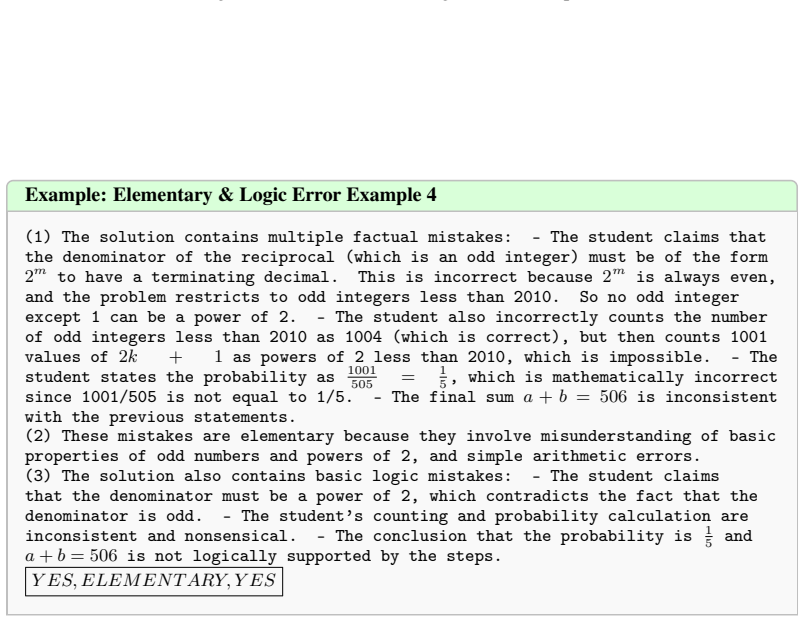


Reference graph
Works this paper leans on
-
[1]
Zhihong Shao, Peiyi Wang, Qihao Zhu, Runxin Xu, Junxiao Song, Mingchuan Zhang, Y K Li, Y Wu, and Daya Guo. DeepSeekMath: Pushing the limits of mathematical reasoning in open language models.arXiv [cs.CL], 2024. URLhttp://arxiv.org/abs/2402.03300
arXiv 2024
-
[2]
Paul R Sackett, Matthew J Borneman, and Brian S Connelly. High stakes testing in higher education and employment: appraising the evidence for validity and fairness.Am. Psychol., 63 (4):215–227, 2008. URLhttp://dx.doi.org/10.1037/0003-066X.63.4.215
-
[3]
High-stakes testing and curricular control: A qualitative metasynthesis.Educ
Wayne Au. High-stakes testing and curricular control: A qualitative metasynthesis.Educ. Res., 36(5):258–267, 2007. URLhttp://dx.doi.org/10.3102/0013189x07306523
-
[4]
Why g matters: The complexity of everyday life.Intelligence, 24(1): 79–132, 1997
Linda S Gottfredson. Why g matters: The complexity of everyday life.Intelligence, 24(1): 79–132, 1997. URLhttp://dx.doi.org/10.1016/s0160-2896(97)90014-3. 10
-
[5]
Homo heuristicus: Why biased minds make better inferences
Gerd Gigerenzer and Henry Brighton. Homo heuristicus: Why biased minds make better inferences. InHeuristics, pages 2–26. Oxford University Press, 2011. URL http://dx.doi. org/10.1093/acprof:oso/9780199744282.003.0001
arXiv 2011
-
[6]
Farrar, Straus and Giroux, 2011
Daniel Kahneman.Thinking, Fast and Slow. Farrar, Straus and Giroux, 2011
2011
-
[7]
Daniel Bobrow.Natural language input computer problem solving system. 1964
1964
-
[8]
MAWPS: A math word problem repository
Rik Koncel-Kedziorski, Subhro Roy, Aida Amini, Nate Kushman, and Hannaneh Hajishirzi. MAWPS: A math word problem repository. InProceedings of the 2016 Conference of the North American Chapter of the Association for Computational Linguistics: Human Language Technologies, Stroudsburg, PA, USA, 2016. Association for Computational Linguistics. URL http://dx.d...
Show all 87 references
-
[9]
Deep neural solver for math word problems
Yan Wang, Xiaojiang Liu, and Shuming Shi. Deep neural solver for math word problems. In Proceedings of the 2017 Conference on Empirical Methods in Natural Language Processing, Stroudsburg, PA, USA, 2017. Association for Computational Linguistics. URL http://dx. doi.org/10.1865...
2017 doi
-
[10]
MathQA: Towards interpretable math word problem solving with operation-based formalisms.arXiv [cs.CL], 2019
Aida Amini, Saadia Gabriel, Peter Lin, Rik Koncel-Kedziorski, Yejin Choi, and Hannaneh Hajishirzi. MathQA: Towards interpretable math word problem solving with operation-based formalisms.arXiv [cs.CL], 2019. URLhttp://arxiv.org/abs/1905.13319
2019 arXiv
-
[11]
Training verifiers to solve math word problems.arXiv [cs.LG], 2021
Karl Cobbe, Vineet Kosaraju, Mohammad Bavarian, Mark Chen, Heewoo Jun, Lukasz Kaiser, Matthias Plappert, Jerry Tworek, Jacob Hilton, Reiichiro Nakano, Christopher Hesse, and John Schulman. Training verifiers to solve math word problems.arXiv [cs.LG], 2021. URL http://arxiv.org...
2021 arXiv
-
[12]
Measuring mathematical problem solving with the MATH dataset
Dan Hendrycks, Collin Burns, Saurav Kadavath, Akul Arora, Steven Basart, Eric Tang, Dawn Song, and Jacob Steinhardt. Measuring mathematical problem solving with the MATH dataset. arXiv [cs.LG], 2021. URLhttp://arxiv.org/abs/2103.03874
2021 arXiv
-
[13]
A survey of deep learning for mathematical reasoning
Pan Lu, Liang Qiu, Wenhao Yu, Sean Welleck, and Kai-Wei Chang. A survey of deep learning for mathematical reasoning. InProceedings of the 61st Annual Meeting of the Association for Computational Linguistics (Volume 1: Long Papers), Stroudsburg, PA, USA, 2023. Association for C...
2023 doi
-
[14]
OlympiadBench: A challenging benchmark for promoting AGI with olympiad-level bilingual multimodal scientific problems.arXiv [cs.CL], 2024
Chaoqun He, Renjie Luo, Yuzhuo Bai, Shengding Hu, Zhen Leng Thai, Junhao Shen, Jinyi Hu, Xu Han, Yujie Huang, Yuxiang Zhang, Jie Liu, Lei Qi, Zhiyuan Liu, and Maosong Sun. OlympiadBench: A challenging benchmark for promoting AGI with olympiad-level bilingual multimodal scienti...
2024
-
[15]
PutnamBench: Evaluating neural theorem-provers on the putnam mathematical competition.arXiv [cs.AI], 2024
George Tsoukalas, Jasper Lee, John Jennings, Jimmy Xin, Michelle Ding, Michael Jennings, Amitayush Thakur, and Swarat Chaudhuri. PutnamBench: Evaluating neural theorem-provers on the putnam mathematical competition.arXiv [cs.AI], 2024. URL http://arxiv.org/ abs/2407.11214
2024 arXiv
-
[16]
Omni-MATH: A universal olympiad level mathematic benchmark for large language models
Bofei Gao, Feifan Song, Zhe Yang, Zefan Cai, Yibo Miao, Qingxiu Dong, Lei Li, Chenghao Ma, Liang Chen, Runxin Xu, Zhengyang Tang, Benyou Wang, Daoguang Zan, Shanghaoran Quan, Ge Zhang, Lei Sha, Yichang Zhang, Xuancheng Ren, Tianyu Liu, and Baobao Chang. Omni-MATH: A universal ...
2024 arXiv
-
[17]
MiniF2F: a cross-system benchmark for formal olympiad-level mathematics.arXiv [cs.AI], 2021
Kunhao Zheng, Jesse Michael Han, and Stanislas Polu. MiniF2F: a cross-system benchmark for formal olympiad-level mathematics.arXiv [cs.AI], 2021. URL http://arxiv.org/abs/ 2109.00110
2021 arXiv
-
[18]
NaturalProofs: Mathematical theorem proving in natural language.arXiv [cs.IR], 2021
Sean Welleck, Jiacheng Liu, Ronan Le Bras, Hannaneh Hajishirzi, Yejin Choi, and Kyunghyun Cho. NaturalProofs: Mathematical theorem proving in natural language.arXiv [cs.IR], 2021. URLhttp://arxiv.org/abs/2104.01112. 11
2021 arXiv
-
[19]
Learn to explain: Multimodal reasoning via thought chains for science question answering.arXiv [cs.CL], 2022
Pan Lu, Swaroop Mishra, Tony Xia, Liang Qiu, Kai-Wei Chang, Song-Chun Zhu, Oyvind Tafjord, Peter Clark, and Ashwin Kalyan. Learn to explain: Multimodal reasoning via thought chains for science question answering.arXiv [cs.CL], 2022. URL http://arxiv.org/abs/ 2209.09513
2022 arXiv
-
[20]
GeoQA: A geometric question answering benchmark towards multimodal numerical reasoning
Jiaqi Chen, Jianheng Tang, Jinghui Qin, Xiaodan Liang, Lingbo Liu, Eric P Xing, and Liang Lin. GeoQA: A geometric question answering benchmark towards multimodal numerical reasoning. arXiv [cs.AI], 2021. URLhttp://arxiv.org/abs/2105.14517
2021 arXiv
-
[21]
MMMU: A massive multi-discipline multimodal understanding and reasoning benchmark for expert AGI.arXiv [cs.CL], 2023
Xiang Yue, Yuansheng Ni, Kai Zhang, Tianyu Zheng, Ruoqi Liu, Ge Zhang, Samuel Stevens, Dongfu Jiang, Weiming Ren, Yuxuan Sun, Cong Wei, Botao Yu, Ruibin Yuan, Renliang Sun, Ming Yin, Boyuan Zheng, Zhenzhu Yang, Yibo Liu, Wenhao Huang, Huan Sun, Yu Su, and Wenhu Chen. MMMU: A m...
2023
-
[22]
Training language models to follow instructions with human feedback.arXiv [cs.CL], 2022
Long Ouyang, Jeff Wu, Xu Jiang, Diogo Almeida, Carroll L Wainwright, Pamela Mishkin, Chong Zhang, Sandhini Agarwal, Katarina Slama, Alex Ray, John Schulman, Jacob Hilton, Fraser Kelton, Luke Miller, Maddie Simens, Amanda Askell, Peter Welinder, Paul Christiano, Jan Leike, and ...
2022 arXiv
-
[23]
STaR: Bootstrapping reasoning with reasoning.arXiv [cs.LG], 2022
Eric Zelikman, Yuhuai Wu, Jesse Mu, and Noah D Goodman. STaR: Bootstrapping reasoning with reasoning.arXiv [cs.LG], 2022. URLhttp://arxiv.org/abs/2203.14465
2022 arXiv
-
[24]
How far can camels go? exploring the state of instruction tuning on open resources.arXiv [cs.CL], 2023
Yizhong Wang, Hamish Ivison, Pradeep Dasigi, Jack Hessel, Tushar Khot, Khyathi Raghavi Chandu, David Wadden, Kelsey MacMillan, Noah A Smith, Iz Beltagy, and Hannaneh Hajishirzi. How far can camels go? exploring the state of instruction tuning on open resources.arXiv [cs.CL], 2...
2023 arXiv
-
[25]
Reinforced self-training (ReST) for language modeling.arXiv [cs.CL], 2023
Caglar Gulcehre, Tom Le Paine, Srivatsan Srinivasan, Ksenia Konyushkova, Lotte Weerts, Abhishek Sharma, Aditya Siddhant, Alex Ahern, Miaosen Wang, Chenjie Gu, Wolfgang Macherey, Arnaud Doucet, Orhan Firat, and Nando de Freitas. Reinforced self-training (ReST) for language mode...
2023 arXiv
-
[26]
Proximal policy optimization algorithms.arXiv [cs.LG], 2017
John Schulman, Filip Wolski, Prafulla Dhariwal, Alec Radford, and Oleg Klimov. Proximal policy optimization algorithms.arXiv [cs.LG], 2017. URL http://arxiv.org/abs/1707. 06347
2017
-
[27]
VinePPO: Unlocking RL potential for LLM reasoning through refined credit assignment.arXiv [cs.LG], 2024
Amirhossein Kazemnejad, Milad Aghajohari, Eva Portelance, Alessandro Sordoni, Siva Reddy, Aaron Courville, and Nicolas Le Roux. VinePPO: Unlocking RL potential for LLM reasoning through refined credit assignment.arXiv [cs.LG], 2024. URL http://arxiv.org/abs/2410. 01679
2024
-
[28]
V APO: Efficient and reliable reinforcement learning for advanced reasoning tasks.arXiv [cs.AI], 2025
Yu Yue, Yufeng Yuan, Qiying Yu, Xiaochen Zuo, Ruofei Zhu, Wenyuan Xu, Jiaze Chen, Chengyi Wang, Tiantian Fan, Zhengyin Du, Xiangpeng Wei, Xiangyu Yu, Gaohong Liu, Juncai Liu, Lingjun Liu, Haibin Lin, Zhiqi Lin, Bole Ma, Chi Zhang, Mofan Zhang, Wang Zhang, Hang Zhu, Ru Zhang, X...
2025 arXiv
-
[29]
TÜLU 3: Pushing frontiers in open language model post-training.arXiv [cs.CL], 2024
Nathan Lambert, Jacob Morrison, Valentina Pyatkin, Shengyi Huang, Hamish Ivison, Faeze Brahman, Lester James V Miranda, Alisa Liu, Nouha Dziri, Shane Lyu, Yuling Gu, Saumya Malik, Victoria Graf, Jena D Hwang, Jiangjiang Yang, Ronan Le Bras, Oyvind Tafjord, Chris Wilhelm, Luca ...
2024 arXiv
-
[30]
Kimi k1.5: Scaling reinforcement learning with LLMs.arXiv [cs.AI], 2025
Kimi Team, Angang Du, Bofei Gao, Bowei Xing, Changjiu Jiang, Cheng Chen, Cheng Li, Chenjun Xiao, Chenzhuang Du, Chonghua Liao, Chuning Tang, Congcong Wang, Dehao Zhang, Enming Yuan, Enzhe Lu, Fengxiang Tang, Flood Sung, Guangda Wei, Guokun Lai, Haiqing Guo, Han Zhu, Hao Ding, ...
2025 arXiv
-
[31]
DeepSeek-R1: Incentivizing reasoning capability in LLMs via reinforcement learning.arXiv [cs.CL], 2025
DeepSeek-AI, Daya Guo, Dejian Yang, Haowei Zhang, Junxiao Song, Ruoyu Zhang, Runxin Xu, Qihao Zhu, Shirong Ma, Peiyi Wang, Xiao Bi, Xiaokang Zhang, Xingkai Yu, Yu Wu, Z F Wu, Zhibin Gou, Zhihong Shao, Zhuoshu Li, Ziyi Gao, Aixin Liu, Bing Xue, Bingxuan Wang, Bochao Wu, Bei Fen...
2025 arXiv
-
[32]
SimpleRL-zoo: Investigating and taming zero reinforcement learning for open base models in the wild, 2025
Weihao Zeng, Yuzhen Huang, Qian Liu, Wei Liu, Keqing He, Zejun Ma, and Junxian He. SimpleRL-zoo: Investigating and taming zero reinforcement learning for open base models in the wild, 2025. URLhttp://arxiv.org/abs/2503.18892
2025 arXiv
-
[33]
Light-R1: Curriculum SFT, DPO and RL for long COT from scratch and beyond.arXiv [cs.CL],
Liang Wen, Yunke Cai, Fenrui Xiao, Xin He, Qi An, Zhenyu Duan, Yimin Du, Junchen Liu, Lifu Tang, Xiaowei Lv, Haosheng Zou, Yongchao Deng, Shousheng Jia, and Xiangzheng Zhang. Light-R1: Curriculum SFT, DPO and RL for long COT from scratch and beyond.arXiv [cs.CL],
-
[34]
Let’s verify step by step.arXiv [cs.LG],
Hunter Lightman, Vineet Kosaraju, Yura Burda, Harri Edwards, Bowen Baker, Teddy Lee, Jan Leike, John Schulman, Ilya Sutskever, and Karl Cobbe. Let’s verify step by step.arXiv [cs.LG],
-
[35]
OpenAI o1 system card.arXiv [cs.AI], 2024
OpenAI, Aaron Jaech, Adam Kalai, Adam Lerer, Adam Richardson, Ahmed El-Kishky, Aiden Low, Alec Helyar, Aleksander Madry, Alex Beutel, Alex Carney, Alex Iftimie, Alex Karpenko, Alex Tachard Passos, Alexander Neitz, Alexander Prokofiev, Alexander Wei, Allison Tam, Ally Bennett, ...
2024 arXiv
-
[36]
Understanding R1-zero-like training: A critical perspective.arXiv [cs.LG], 2025
Zichen Liu, Changyu Chen, Wenjun Li, Penghui Qi, Tianyu Pang, Chao Du, Wee Sun Lee, and Min Lin. Understanding R1-zero-like training: A critical perspective.arXiv [cs.LG], 2025. URLhttp://arxiv.org/abs/2503.20783
2025 arXiv
-
[37]
DeepCoder: A fully open-source 14B coder at O3-mini level
Michael Luo, Sijun Tan, Roy Huang, Ameen Patel, Alpay Ariyak, Qingyang Wu, Xiaoxiang Shi, Rachel Xin, Colin Cai, Maurice Weber, Ce Zhang, Li Er- ran Li, Raluca Ada Popa, and Ion Stoica. DeepCoder: A fully open-source 14B coder at O3-mini level. https://pretty-radio-b75.notion....
2025
-
[38]
VLM-R1: A stable and generalizable R1-style large vision-language model.arXiv [cs.CV], 2025
Haozhan Shen, Peng Liu, Jingcheng Li, Chunxin Fang, Yibo Ma, Jiajia Liao, Qiaoli Shen, Zilun Zhang, Kangjia Zhao, Qianqian Zhang, Ruochen Xu, and Tiancheng Zhao. VLM-R1: A stable and generalizable R1-style large vision-language model.arXiv [cs.CV], 2025. URL http://arxiv.org/a...
2025 arXiv
-
[39]
GRPO-LEAD: A difficulty-aware reinforcement learning approach for concise mathematical reasoning in language models.arXiv [cs.CL], 2025
Jixiao Zhang and Chunsheng Zuo. GRPO-LEAD: A difficulty-aware reinforcement learning approach for concise mathematical reasoning in language models.arXiv [cs.CL], 2025. URL http://arxiv.org/abs/2504.09696. 14
2025
-
[40]
D1: Scaling reasoning in diffusion large language models via reinforcement learning.arXiv [cs.CL], 2025
Siyan Zhao, Devaansh Gupta, Qinqing Zheng, and Aditya Grover. D1: Scaling reasoning in diffusion large language models via reinforcement learning.arXiv [cs.CL], 2025. URL http://arxiv.org/abs/2504.12216
2025 arXiv
-
[42]
Does reinforcement learning really incentivize reasoning capacity in LLMs beyond the base model?arXiv [cs.AI], 2025
Yang Yue, Zhiqi Chen, Rui Lu, Andrew Zhao, Zhaokai Wang, Yang Yue, Shiji Song, and Gao Huang. Does reinforcement learning really incentivize reasoning capacity in LLMs beyond the base model?arXiv [cs.AI], 2025. URLhttp://arxiv.org/abs/2504.13837
2025 arXiv
-
[43]
Assessing diversity collapse in reasoning
Xingyu Dang, Christina Baek, J Zico Kolter, and Aditi Raghunathan. Assessing diversity collapse in reasoning. InScaling Self-Improving Foundation Models without Human Supervision,
-
[44]
Learning to summarize from human feedback
Nisan Stiennon, Long Ouyang, Jeff Wu, Daniel M Ziegler, Ryan Lowe, Chelsea V oss, Alec Radford, Dario Amodei, and Paul Christiano. Learning to summarize from human feedback. arXiv [cs.CL], 2020. URLhttp://arxiv.org/abs/2009.01325
2020 arXiv
-
[45]
Self-consistency improves chain of thought reasoning in language models.arXiv [cs.CL], 2022
Xuezhi Wang, Jason Wei, Dale Schuurmans, Quoc Le, Ed Chi, Sharan Narang, Aakanksha Chowdhery, and Denny Zhou. Self-consistency improves chain of thought reasoning in language models.arXiv [cs.CL], 2022. URLhttp://arxiv.org/abs/2203.11171
2022 arXiv
-
[46]
URLhttps://openreview.net/forum?id=AMiKsHLjQh
-
[47]
HybridFlow: A flexible and efficient RLHF framework
Guangming Sheng, Chi Zhang, Zilingfeng Ye, Xibin Wu, Wang Zhang, Ru Zhang, Yanghua Peng, Haibin Lin, and Chuan Wu. HybridFlow: A flexible and efficient RLHF framework. arXiv preprint arXiv: 2409. 19256, 2024
2024
-
[48]
Large language monkeys: Scaling inference compute with repeated sampling, 2024
Bradley Brown, Jordan Juravsky, Ryan Ehrlich, Ronald Clark, Quoc V Le, Christopher Ré, and Azalia Mirhoseini. Large language monkeys: Scaling inference compute with repeated sampling, 2024. URLhttp://arxiv.org/abs/2407.21787
2024 arXiv
-
[49]
Qwen2.5: A party of foundation models, 2024
Qwen Team. Qwen2.5: A party of foundation models, 2024. URL https://qwenlm.github. io/blog/qwen2.5/
2024
-
[50]
GLoRe: When, where, and how to im- prove LLM reasoning via global and local refinements.arXiv [cs.CL], 2024
Alex Havrilla, Sharath Raparthy, Christoforus Nalmpantis, Jane Dwivedi-Yu, Maksym Zhu- ravinskyi, Eric Hambro, and Roberta Raileanu. GLoRe: When, where, and how to im- prove LLM reasoning via global and local refinements.arXiv [cs.CL], 2024. URL http: //arxiv.org/abs/2402.10963
2024 arXiv
-
[51]
Cognitive behaviors that enable self-improving reasoners, or, four habits of highly effective STaRs.arXiv [cs.CL], 2025
Kanishk Gandhi, Ayush Chakravarthy, Anikait Singh, Nathan Lile, and Noah D Goodman. Cognitive behaviors that enable self-improving reasoners, or, four habits of highly effective STaRs.arXiv [cs.CL], 2025. URLhttp://arxiv.org/abs/2503.01307
2025 arXiv
-
[52]
Math-shepherd: Verify and reinforce LLMs step-by-step without human annotations
Peiyi Wang, Lei Li, Zhihong Shao, Runxin Xu, Damai Dai, Yifei Li, Deli Chen, Yu Wu, and Zhi- fang Sui. Math-shepherd: Verify and reinforce LLMs step-by-step without human annotations. InProceedings of the 62nd Annual Meeting of the Association for Computational Linguistics (Vo...
2024 doi
-
[53]
Bridging the human-ai knowledge gap: Concept discovery and transfer in alphazero, 2023
Lisa Schut, Nenad Tomasev, Tom McGrath, Demis Hassabis, Ulrich Paquet, and Been Kim. Bridging the human-ai knowledge gap: Concept discovery and transfer in alphazero, 2023. URL https://arxiv.org/abs/2310.16410
2023 arXiv
-
[54]
To backtrack or not to backtrack: When sequential search limits model reasoning, 2025
Tian Qin, David Alvarez-Melis, Samy Jelassi, and Eran Malach. To backtrack or not to backtrack: When sequential search limits model reasoning, 2025. URL https://arxiv.org/ abs/2504.07052. 15
2025
-
[55]
Mastering chess and shogi by self-play with a general reinforcement learning algorithm, 2017
David Silver, Thomas Hubert, Julian Schrittwieser, Ioannis Antonoglou, Matthew Lai, Arthur Guez, Marc Lanctot, Laurent Sifre, Dharshan Kumaran, Thore Graepel, Timothy Lillicrap, Karen Simonyan, and Demis Hassabis. Mastering chess and shogi by self-play with a general reinforce...
2017 arXiv
-
[56]
Emergence of hidden capabilities: Exploring learning dynamics in concept space, 2024
Core Francisco Park, Maya Okawa, Andrew Lee, Hidenori Tanaka, and Ekdeep Singh Lubana. Emergence of hidden capabilities: Exploring learning dynamics in concept space, 2024. URL https://arxiv.org/abs/2406.19370
2024 arXiv
-
[57]
Competition dynamics shape algorithmic phases of in-context learning, 2025
Core Francisco Park, Ekdeep Singh Lubana, Itamar Pres, and Hidenori Tanaka. Competition dynamics shape algorithmic phases of in-context learning, 2025. URL https://arxiv.org/ abs/2412.01003
2025 arXiv
-
[58]
Dick, and Hidenori Tanaka
Maya Okawa, Ekdeep Singh Lubana, Robert P. Dick, and Hidenori Tanaka. Compositional abilities emerge multiplicatively: Exploring diffusion models on a synthetic task, 2024. URL https://arxiv.org/abs/2310.09336
2024 arXiv
-
[59]
Dick, and Hidenori Tanaka
Ekdeep Singh Lubana, Kyogo Kawaguchi, Robert P. Dick, and Hidenori Tanaka. A percolation model of emergence: Analyzing transformers trained on a formal language, 2024. URL https://arxiv.org/abs/2408.12578
2024 arXiv
-
[60]
Samyak Jain, Ekdeep Singh Lubana, Kemal Oksuz, Tom Joy, Philip H. S. Torr, Amartya Sanyal, and Puneet K. Dokania. What makes and breaks safety fine-tuning? a mechanistic study, 2024. URLhttps://arxiv.org/abs/2407.10264
2024 arXiv
-
[61]
Physics of language models: Part 3.2, knowledge manipula- tion, 2024
Zeyuan Allen-Zhu and Yuanzhi Li. Physics of language models: Part 3.2, knowledge manipula- tion, 2024. URLhttps://arxiv.org/abs/2309.14402
2024 arXiv
-
[62]
Reinforcement learning for reasoning in large language models with one training example, 2025
Yiping Wang, Qing Yang, Zhiyuan Zeng, Liliang Ren, Lucas Liu, Baolin Peng, Hao Cheng, Xuehai He, Kuan Wang, Jianfeng Gao, Weizhu Chen, Shuohang Wang, Simon Shaolei Du, and Yelong Shen. Reinforcement learning for reasoning in large language models with one training example, 202...
2025 arXiv
-
[63]
Gomez, Lukasz Kaiser, and Illia Polosukhin
Ashish Vaswani, Noam Shazeer, Niki Parmar, Jakob Uszkoreit, Llion Jones, Aidan N. Gomez, Lukasz Kaiser, and Illia Polosukhin. Attention is all you need, 2023. URL https://arxiv. org/abs/1706.03762
2023 arXiv
-
[64]
Michaud, Ziming Liu, Uzay Girit, and Max Tegmark
Eric J. Michaud, Ziming Liu, Uzay Girit, and Max Tegmark. The quantization model of neural scaling, 2024. URLhttps://arxiv.org/abs/2303.13506
2024 arXiv
-
[65]
sharpens
Thomas Wolf, Lysandre Debut, Victor Sanh, Julien Chaumond, Clement Delangue, Anthony Moi, Pierric Cistac, Tim Rault, Rémi Louf, Morgan Funtowicz, Joe Davison, Sam Shleifer, Patrick von Platen, Clara Ma, Yacine Jernite, Julien Plu, Canwen Xu, Teven Le Scao, Sylvain Gugger, Mari...
2020
-
[67]
Qwen2 technical report.arXiv preprint arXiv:2407
An Yang, Baosong Yang, Binyuan Hui, Bo Zheng, Bowen Yu, Chang Zhou, Chengpeng Li, Chengyuan Li, Dayiheng Liu, Fei Huang, and Others. Qwen2 technical report.arXiv preprint arXiv:2407. 10671, 2024
2024
-
[69]
the first two decimal places are 0.27
Visualize and describe the region formed by the union of the nonagon and the 1-unit neighborhood around its perimeter. 2. Analyze the boundary of this region, identifying straight and curved parts. 3. Calculate the lengths of these boundary segments. 4. Sum these lengths to fi...
-
[70]
= 3 + 2 √ 2− √ 3− √ 6, not the original expression. Then the student writes: 1 + 2 √ 2 + 1− √ 3− √ 6 = (2 √ 2 + 1)−( √ 3 + √ 6) which is also incorrect because1+2 √ 2+1− √ 3− √ 6 = 2+2 √ 2− √ 3− √ 6, which is the original expression, but the grouping is not in the formA(1 + √ ...
-
[71]
Identify the units digit of8: The units digit of8is8
-
[72]
Determine the pattern in the units digits of powers of8: -8 1 = 8(units digit is8) -8 2 = 64(units digit is4) -8 3 = 512(units digit is2) -8 4 = 4096(units digit is6) -8 5 = 32768(units digit is8) -8 6 = 262144(units digit is4) -8 7 = 2097152(units digit is2) -8 8 = 16777216(u...
-
[73]
The prime numbers less than 30 are correctly listed as: 2, 3, 5, 7, 11, 13, 17, 19, 23, 29
-
[74]
The odd numbers greater than zero are correctly listed as: 1, 3, 5, 7, 9, 11, 13, 15, 17, 19, 21, 23, 25, 27
-
[75]
Since 2 is prime but not odd, it should not be in the intersection
The intersection should be the prime numbers less than 30 that are also odd numbers greater than zero. Since 2 is prime but not odd, it should not be in the intersection
-
[76]
The student incorrectly includes 2 in the intersection set, which is a factual mistake about the parity of 2 (2 is even, not odd)
-
[77]
The student concludes the intersection has 10 elements, but excluding 2, the intersection has 9 elements: 3, 5, 7, 11, 13, 17, 19, 23, 29
-
[78]
This is a basic mathematical fact error (2 is not odd)
-
[79]
There is no basic logic mistake; the student’s reasoning is consistent except for the factual error about 2. Final grading: (1) Basic mathematical factual mistake? YES (2 is not odd but included in intersection) (2) Is the mistake elementary or high school? ELEMENTARY (parity ...
-
[80]
2 is odd
This is a logical inconsistency but not a factual mathematical mistake. The sine function’s maximum occurs at π 2 plus multiples of2π, so the student’s equation and solution forCis correct. The confusion is in interpreting the phase shift and the smallest possiblec. There is n...
2010
-
[81]
unknown" token <unk>, beginning of sequence token <bos>, padding token <pad>, prompt/completion separation token “:
Dividing by 2 is a mistake because rows and columns are different lines and should not be double counted. Also, the student misses other lines with 3 points, such as the lines with slope 1 or -1 that pass through other points (e.g., the middle points in the grid). So the count...
-
[82]
An entry TS(s, a)specifies the next state s′ resulting from taking action a in state s
State Transition Table ( TS): This is a matrix of dimensions NS ×N A. An entry TS(s, a)specifies the next state s′ resulting from taking action a in state s. This ta- ble, ‘state_transitions‘, is initialized by drawing each entry uniformly at random from {0, . . . , NS −1}. 39
-
[83]
An entry TP (p, a)specifies the next problem state p′ when action a is taken while the current problem state is p
Problem State Transition Table (TP ): This is a matrix of dimensions NP ×N A. An entry TP (p, a)specifies the next problem state p′ when action a is taken while the current problem state is p. The table ‘problem_state_transitions’ is constructed such that for any given current...
-
[84]
Each row s contains the probability distribution Pα(A|S=s) over actions, generated from Dirichlet(αtrain ·1 NA )
Action Probability Table for Pre-training (Paction): This table, ‘action_probs’, has dimen- sions NS ×N A. Each row s contains the probability distribution Pα(A|S=s) over actions, generated from Dirichlet(αtrain ·1 NA ). This table is only used for action selection in the ‘tra...
-
[85]
Each row a contains the probability distribution Pβ(C|A=a) over contexts, generated from Dirichlet(βtrain ·1 NC )
Action-Context Probability Table for Pre-training ( Pcontext): This table, ‘ac- tion_context_prob_train’, has dimensions NA ×N C. Each row a contains the probability distribution Pβ(C|A=a) over contexts, generated from Dirichlet(βtrain ·1 NC ). This table is only used for cont...
-
[86]
question
Action-Context Probability Table for RL/Eval: For the ‘train_rl’ and ‘eval’ splits, the context ct for an action at is chosen uniformly. This is represented by ‘ac- tion_context_prob_test’, anN A ×N C matrix where each entry is1/N C. Each individual data instance, comprising a...
-
[87]
This k defines the length of the action sequence and consequently the number of state transitions
Determine Trajectory Length: The number of actions,k, for the current instance is selected by drawing an integer uniformly from the interval [kmin, kmax]. This k defines the length of the action sequence and consequently the number of state transitions. 2.Initialize Sequences:...
-
[88]
S <s 0>" Then, for each step j from 0 to k: Append problem state:
Generate Irrelevant Context Tokens: A sequence of nirr_ctx irrelevant to- kens, (i0, . . . , inirr_ctx−1), is generated by sampling each token uniformly at ran- dom from {0, . . . , ndim −1} . Note: ‘n_dim’ is used here as per the code ‘np.random.randint(0,n_dim,size=num_irr_c...
-
[2023]
URLhttp://arxiv.org/abs/2305.20050
-
[2025]
URLhttp://arxiv.org/abs/2503.10460
Reviewed August 7, 2026 · model on record in the stance chip above.
Discussion (0). Sign in to comment.