REVIEW 2 major objections 7 minor 14 references
Autoregressive Meta-Actions for Unified Controllable Trajectory Generation
T0 review · 2 major / 7 minor · reviewed 2026-08-07 · deepseek-v4-flash
Pith's one-line read Frame-level meta-actions fix a misalignment in controllable trajectory generation, boosting decision-following mAP from 0.635 to 0.718 on a curated autonomous-driving benchmark.
desk verdict The frame-level meta-action formulation is a genuinely useful reframing, but the headline mAP gain is not yet trustworthy because labels, benchmark, and metric all come from the same hand-tuned rules. read the letter →
The pith
A machine-rendered reading of the paper's core claim, the machinery that carries it, and where it could break.
The reading
What carries the argument
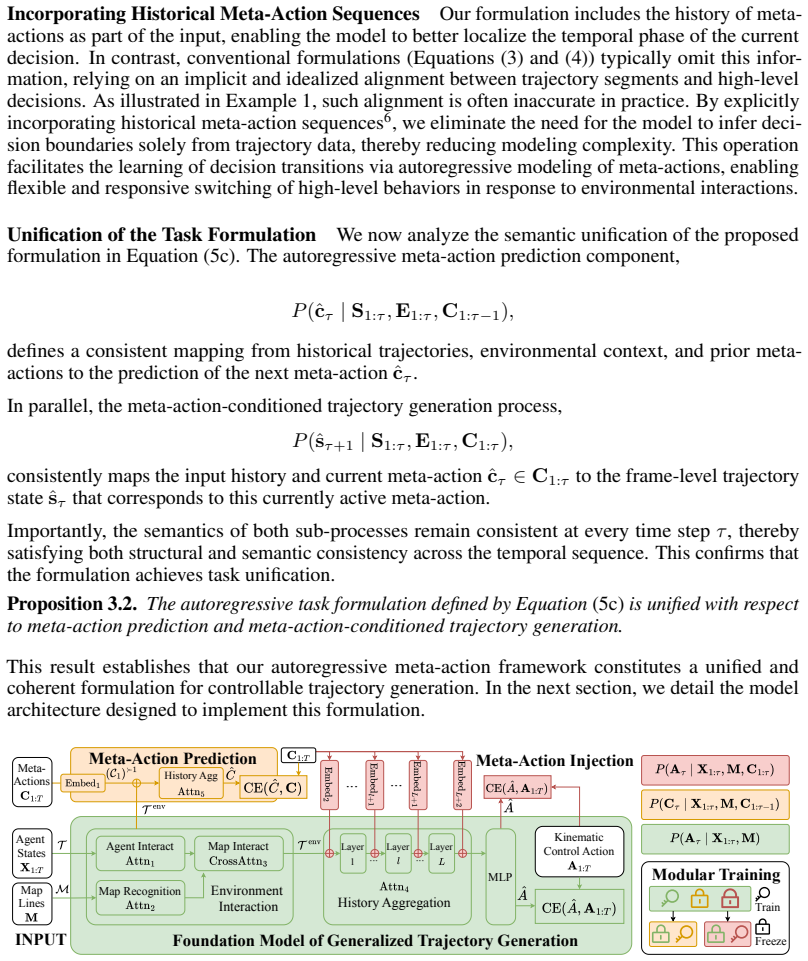
The central object is the frame-level meta-action, a discrete driving-decision label (stationary, keep lane, lane change, turn, U-turn) assigned to each trajectory frame rather than to a fixed multi-frame interval. The mechanism carrying the argument is the autoregressive factorization of Equation (5c): at each step $\tau$ predict the next meta-action $\hat{c}_\tau$ from history, then generate the next state $\hat{s}_{\tau+1}$ conditioned on that newly predicted meta-action, with injected meta-action embeddings placed strictly between environment interaction and history aggregation to preserve causality across agents. The frame-level labels are extracted from trajectories by hand-tuned kinematic and geometric rules.
What would settle it
Train the same model with frame-level labels generated by perturbed thresholds near decision boundaries (e.g., shifting $d_{\min}$ from 1.75 m to 1.0 m or 2.5 m, or varying the curvature sign window) and check whether the decision-following mAP gap between long-interval and frame-level conditioning persists; alternatively, on a hand-annotated subset of 100 scenes containing lane-change transitions, compare human labels against the heuristic rule labels at frames within one second of the lane-change boundary and measure whether disagreement predicts model mispredictions.
Extended reading notes
Core claim
The paper's central claim is that the established practice of conditioning trajectory generation on a single meta-action assigned over a long future horizon breaks temporal semantic consistency, because a horizon longer than one frame can always contain a meta-action transition, so the learned mapping from one meta-action to a trajectory segment has inconsistent meaning across samples (Example 1, Proposition 3.1). The proposed formulation, expressed in Equation (5c), predicts the next meta-action $\hat{c}_\tau$ at every frame and then generates the next state $\hat{s}_{\tau+1}$ conditioned on that meta-action, jointly modeling $P(\hat{c}_\tau \mid \text{history})$ and $P(\hat{s}_{\tau+1} \mid \text{history}, \hat{c}_\tau)$. Proposition 3.2 asserts that this frame-level autoregressive formulation is unified with respect to meta-action prediction and meta-action-conditioned trajectory generation, satisfying both structural and semantic consistency at every time step. The paper further claims this unification improves decision-following (mAP 0.718 vs 0.635 for long-interval autoregressive conditioning and 0.567 for regression-based conditioning) without degrading generation quality, and that a staged pretraining procedure (frozen foundation model plus fine-tuned meta-action prediction and injection modules) delivers comparable controllability at roughly 2.25x lower training time.
Load-bearing premise
The benefit of frame-level meta-actions rests on the quality of the heuristic labels (thresholds like $\epsilon_v = 0.3$ m/s, $\epsilon_s = 0.1$ m, $d_{\min} = 1.75$ m, $\kappa$ thresholds, $\theta_{\min} = 15^\circ$) that assign a meta-action to every frame; if these labels are noisy near decision boundaries, the reported alignment gain is partly an artifact of the labeling rules rather than of the formulation itself, a limitation the paper explicitly acknowledges.
Editorial extensions
If this is right
- A controllable trajectory generator built on long-interval meta-actions cannot be repaired by better network capacity or more data, because the task itself maps one decision to trajectory segments containing multiple decisions; the fix is to change the task formulation to frame-level conditioning.
- Predicting the meta-action at every frame lets the model autonomously switch decisions at transition boundaries, as shown in rollouts where an injected left-lane-change meta-action is followed by a return to keep-lane.
- Because the foundation model stays frozen and only meta-action prediction and injection modules are fine-tuned, adding new decision types to a deployed trajectory generator becomes a modular update that does not require retraining the whole model.
- The same objective used for trajectory generation (cross-entropy on kinematic control actions) can be repurposed for meta-action-conditioned generation without degrading the Waymo SimAgents metrics.
- Jointly predicting meta-actions as part of the model doubles as an interpretability output: generated trajectories come with per-frame high-level intent explanations.
Reading between the lines
- The unification argument is not limited to driving: any hierarchical control scheme that conditions low-level generation on a high-level command over a fixed interval faces the same transition-boundary ambiguity, so the frame-level decomposition could transfer to robot manipulation or multi-agent simulation tasks with discrete intentions.
- A testable consequence the paper does not state: if the label-generation rules (thresholds such as $d_{\min} = 1.75$ m and curvature sign checks) are perturbed near decision boundaries, the mAP gap between long-interval and frame-level conditioning should shrink or grow systematically, which would reveal how much of the benefit comes from the formulation versus the specific labeling procedure.
- The paper's restriction to a predefined discrete meta-action set suggests a natural extension where meta-actions are learned rather than hand-defined; such an extension would test whether the alignment benefit survives when the semantic labels are not derived from the same kinematic cues the model already sees.
- Because historical meta-action conditioning shows a 12.5% mAP drop when removed specifically for right lane changes, one could build a lightweight decision-boundary detector that runs on historical meta-action sequences alone, without generating full trajectories, as a cheap safety monitor.
Editorial analysis
A structured set of objections, weighed in public.
Referee Report
Summary. The paper proposes an autoregressive frame-level meta-action formulation for controllable trajectory generation. It argues that conventional long-interval meta-action conditioning is temporally misaligned when a prediction horizon overlaps a behavior transition, and it reformulates the task as joint autoregressive prediction of a frame-level meta-action and the next state at every step (Eq. 5c). The proposed model freezes a KiGRAS-style kinematic foundation model and fine-tunes two additional modules for meta-action prediction and injection. On a self-curated subset of 661 Waymo validation scenes with the authors' own frame-level labels, the method achieves decision-following mAP of 0.718 (reported elsewhere as 0.716), versus 0.635 for the long-interval autoregressive baseline and 0.567 for a regression-based baseline. The paper also contributes a heuristic frame-level label-generation method, a dataset, and qualitative case studies.
Significance. If the empirical results hold up, the frame-level autoregressive formulation is a clean conceptual contribution that unifies meta-action prediction and meta-action-conditioned trajectory generation, and the modular staged fine-tuning is a practical asset. The controlled comparison (same architecture, only conditioning granularity varied) is a strength, as is the decision to release the labeled dataset and qualitative rollouts. However, the main empirical claim currently rests on labels and metrics built from the same hand-tuned rules and on a single training run, so the evidence for the headline improvement is not yet robust.
major comments (2)
- [5.1, Appendix C.1, D.1-D.2] The headline decision-following comparison is confounded by the fact that both the frame-level meta-action labels and the evaluation constraints are generated from the same hand-tuned rules. In Eq. (31), the Keep Lane condition is a disjunction that includes |κ_t|<ε_κ, so a vehicle at the low-curvature midpoint of a lane change can be labeled Keep Lane despite a large lateral offset; Eq. (32) further requires a curvature sign change within the window, so asymmetric lane changes may never receive a Lane Change label. The evaluation approach in Appendix D.2 applies behavioral constraints derived from these same rules, meaning a model can score well by reproducing the labeler's thresholds rather than by genuinely following the imposed decision. The Limitations section acknowledges label noise near decision boundaries, but no quantification, no threshold-sensitivity analysis, and no validation against independent labels (e.g., human annotation) is provided. A robustness study over the thresholds ε_v, ε_s, d_min, κ_min, κ_max, θ_min, α, or an independent-label check on a subset, is needed before the 0.083 mAP gain over the long-interval autoregressive baseline can be attributed to the formulation.
- [5.1] All decision-following results are reported without any measure of variance: no multiple seeds, no confidence intervals, and no statistical tests. With a curated set of 661 scenes, the reported mAP gain from 0.635 to 0.718 could be within training or subset-selection noise. Please report mean±std over at least three seeds and state whether the paired differences are statistically significant.
minor comments (7)
- [5.1, Table 1] The text reports the proposed method's mAP as 0.716, while Table 1 and the abstract report 0.718; please reconcile this discrepancy.
- [4.2] The claim that injecting meta-action embeddings at the T_env level is "the only placement that preserves both semantic consistency and sufficiency" is not supported by ablation experiments, since no alternative injection points are compared.
- [3.1] The "Necessity of Frame-Level Meta-Actions" argument should be qualified: a prediction horizon T>1 can contain multiple meta-actions only if a behavior transition occurs within it; for transition-free trajectories, long-interval conditioning is not misaligned.
- [Appendix D.1] The manual verification procedure used to select the 661 scenes is not described; please provide the selection criteria or an inter-annotator agreement measure.
- [4.2] There is a typo in the subsection heading "Causal Contitioning", which should read "Causal Conditioning".
- [Appendix B.3] In the sentence introducing p_Q and p_K, "repetitively" should be "respectively".
- [5.1, 5.2] The tables reporting mAP results are not formatted as proper tables in the text; the header and data rows run together, making them hard to read. Please use actual table environments.
Circularity Check
Formal autoregressive formulation is independent, but the decision-following evaluation is closed-loop with the heuristic label-generation thresholds.
-
other
[Appendix D.2 (Metrics Design), with label rules in Appendix C.1 (eqs. 31–32)]
"Specifically, for a given meta-action, we sample N candidate trajectories. If all sampled trajectories satisfy the behavioral constraints associated with the target meta-action, the corresponding test scenario is counted as a true positive (TP). The recall is then computed as the proportion of TP scenarios among all evaluation samples."
The 'behavioral constraints' in the decision-following metric are the same hand-threshold rules used to generate the frame-level meta-action labels: Keep Lane is |κ_t|<0.015 or |d_y,t|<0.3 or Δl_t=0, and Lane Change requires |d_y,t|>1.75 m plus a curvature sign change (Appendix C.1). A trajectory is scored as decision-following exactly when it satisfies the labeler's threshold criteria, so the mAP comparison (0.635→0.718) rewards models that reproduce the annotation rules rather than an externally verified semantic ground truth. The paper concedes in Limitations that 'our meta-action labels are heuristically derived from trajectory data.' This is an evaluator closure, not a circularity in the Eq. (5c) derivation itself.
full rationale
The paper's formal contribution—the frame-level autoregressive factorization in Eq. (5c)—is a standard probability decomposition and is not circular: it does not assume the mAP gain it reports, and Proposition 3.2 merely unpacks the authors' own Definition 1. The incorporation of the KiGRAS control representation and directional RoPE are prior modules from the same group, but they are used as building blocks, not as evidence for the new unification claim. The main circularity concern is evaluative rather than derivational: the frame-level labels used for training (Appendix C.1) and the behavioral constraints used for the decision-following metric (Appendix D.2) are generated from the same hand-tuned kinematic/geometric thresholds. Thus the reported mAP improvement (0.635→0.718) measures how well a model reproduces the labeler's threshold rules, not an independently grounded semantic ground truth. The authors acknowledge the risk in Limitations. Since the central formulation is independent of this evaluation loop, the circularity score is modest (3).
Assumptions & free parameters
free parameters (6)
- Stationary velocity threshold epsilon_v =
0.3 m/s
- Stationary displacement threshold epsilon_s =
0.1 m
- Lane-change minimum lateral offset d_min =
1.75 m
- Turn curvature bounds kappa_min, kappa_max =
0.015 and 0.25 per meter
- Turn heading threshold theta_min =
15 degrees
- U-turn heading window alpha =
15 degrees
assumptions (4)
- standard math The CTRA kinematic model governs state transitions, x_{t+1}=K(x_t, a_t), and is used to derive discrete control labels.
- domain assumption High-level decisions determine motion outcomes, justifying the factorization P(s|c)P(c) in Equation (5c).
- domain assumption Meta-actions form a small predefined discrete set, and every trajectory frame has exactly one active meta-action.
- ad hoc to paper For any horizon T>1 there exists a prediction window spanning at least two meta-actions, making frame-level representation necessary.
Cite this review
Pith. "Pith review of Autoregressive Meta-Actions for Unified Controllable Trajectory Generation." pith.science (2026). https://pith.science/paper/KLR6USZM
@misc{pith2026250523612,
  author       = {Pith},
  title        = {Pith review of: Autoregressive Meta-Actions for Unified Controllable Trajectory Generation},
  year         = {2026},
  howpublished = {\url{https://pith.science/paper/KLR6USZM}},
  note         = {Machine review of arXiv:2505.23612}
}
read the original abstract
Controllable trajectory generation guided by high-level semantic decisions, termed meta-actions, is crucial for autonomous driving systems. A significant limitation of existing frameworks is their reliance on invariant meta-actions assigned over fixed future time intervals, causing temporal misalignment with the actual behavior trajectories. This misalignment leads to irrelevant associations between the prescribed meta-actions and the resulting trajectories, disrupting task coherence and limiting model performance. To address this challenge, we introduce Autoregressive Meta-Actions, an approach integrated into autoregressive trajectory generation frameworks that provides a unified and precise definition for meta-action-conditioned trajectory prediction. Specifically, We decompose traditional long-interval meta-actions into frame-level meta-actions, enabling a sequential interplay between autoregressive meta-action prediction and meta-action-conditioned trajectory generation. This decomposition ensures strict alignment between each trajectory segment and its corresponding meta-action, achieving a consistent and unified task formulation across the entire trajectory span and significantly reducing complexity. Moreover, we propose a staged pre-training process to decouple the learning of basic motion dynamics from the integration of high-level decision control, which offers flexibility, stability, and modularity. Experimental results validate our framework's effectiveness, demonstrating improved trajectory adaptivity and responsiveness to dynamic decision-making scenarios. We provide the video document and dataset, which are available at https://arma-traj.github.io/.
Figures


Figures from the paper (6 more)


Reference graph
Works this paper leans on
-
[1]
Josh Achiam, Steven Adler, Sandhini Agarwal, Lama Ahmad, Ilge Akkaya, Florencia Leoni Aleman, Diogo Almeida, Janko Altenschmidt, Sam Altman, Shyamal Anadkat, et al. Gpt-4 technical report. arXiv preprint arXiv:2303.08774,
-
[4]
Revisit mixture models for multi-agent simulation: Experimental study within a unified framework
Longzhong Lin, Xuewu Lin, Kechun Xu, Haojian Lu, Lichao Huang, Rong Xiong, and Yue Wang. Revisit mixture models for multi-agent simulation: Experimental study within a unified framework. arXiv preprint arXiv:2501.17015,
-
[8]
Demo: Decoupling motion forecasting into directional intentions and dynamic states
Bozhou Zhang, Nan Song, and Li Zhang. Demo: Decoupling motion forecasting into directional intentions and dynamic states. InNeurIPS, 2024a. Diankun Zhang, Guoan Wang, Runwen Zhu, Jianbo Zhao, Xiwu Chen, Siyu Zhang, Jiahao Gong, Qibin Zhou, Wenyuan Zhang, Ningzi Wang, et al. Sparsead: Sparse query-centric paradigm for efficient end-to-end autonomous drivin...
-
[9]
Jianbo Zhao, Taiyu Ban, Zhihao Liu, Hangning Zhou, Xiyang Wang, Qibin Zhou, Hailong Qin, Mu Yang, Lei Liu, and Bin Li. Drope: Directional rotary position embedding for efficient agent interaction modeling.arXiv preprint arXiv:2503.15029,
-
[11]
14 A Related Work In this section, we first review the mainstream scene representation approaches used in trajectory generation in Section A.1. Then, in Section A.2, we introduce two predominant modeling paradigms: generating long-horizon trajectories in a single step versus generating them incrementally in an au- toregressive manner. Finally, in Section ...
work page 2023
-
[12]
extended this direction by introducing rotary position embedding (RoPE) to the domain, proposing a directional variant to capture heading relationships. This significantly reduces the memory complexity by a factor of N, the number of agents in the scene, thereby accelerating training while maintaining strong performance. Motivated by its efficiency, we ad...
work page 2023
-
[13]
This adjustment ensures that the embedding retains the inherent2π-periodicity of directional angles
The other operations remain the same as RoPE. This adjustment ensures that the embedding retains the inherent2π-periodicity of directional angles. We adopt a head-by-head design to integrate relative spatial coordinates and heading directions in a mixed manner, following the approach introduced by Zhao et al. [2025, Section IV-A]. B.4 Kinematic Control Ac...
work page 2025
-
[64]
The environment fusion module is repeated three times to sufficiently capture scene-level interactions. Both the action prediction module and the meta-action prediction module consist of three transformer layers for temporal aggregation. We train the model using the Adan optimizer [Xie et al., 2024] with a fixed learning rate of 1e-2 and no learning rate ...
work page 2024
Show all 14 references
-
[2017]
Omnidrive: A holistic vision-language dataset for autonomous driving with counterfactual reasoning.arXiv preprint arXiv:2504.04348,
Shihao Wang, Zhiding Yu, Xiaohui Jiang, Shiyi Lan, Min Shi, Nadine Chang, Jan Kautz, Ying Li, and Jose M Alvarez. Omnidrive: A holistic vision-language dataset for autonomous driving with counterfactual reasoning.arXiv preprint arXiv:2504.04348,
-
[2019]
Shaoyu Chen, Bo Jiang, Hao Gao, Bencheng Liao, Qing Xu, Qian Zhang, Chang Huang, Wenyu Liu, and Xinggang Wang
Arxiv preprint: 1910.05449. Shaoyu Chen, Bo Jiang, Hao Gao, Bencheng Liao, Qing Xu, Qian Zhang, Chang Huang, Wenyu Liu, and Xinggang Wang. Vadv2: End-to-end vectorized autonomous driving via probabilistic planning. arXiv preprint arXiv:2402.13243, 2024a. Zhili Chen, Maosheng Y...
1910 arXiv
-
[2020]
Large trajectory models are scalable motion predictors and planners.arXiv preprint arXiv:2310.19620,
Qiao Sun, Shiduo Zhang, Danjiao Ma, Jingzhe Shi, Derun Li, Simian Luo, Yu Wang, Ningyi Xu, Guangzhi Cao, and Hang Zhao. Large trajectory models are scalable motion predictors and planners.arXiv preprint arXiv:2310.19620,
-
[2021]
Ctrl-sim: Reactive and controllable driving agents with offline reinforcement learning.arXiv preprint arXiv:2403.19918,
Luke Rowe, Roger Girgis, Anthony Gosselin, Bruno Carrez, Florian Golemo, Felix Heide, Liam Paull, and Christopher Pal. Ctrl-sim: Reactive and controllable driving agents with offline reinforcement learning.arXiv preprint arXiv:2403.19918,
-
[2024]
Gen-drive: Enhancing diffusion generative driving policies with reward modeling and reinforcement learning fine-tuning.arXiv preprint arXiv:2410.05582, 2024a
Zhiyu Huang, Xinshuo Weng, Maximilian Igl, Yuxiao Chen, Yulong Cao, Boris Ivanovic, Marco Pavone, and Chen Lv. Gen-drive: Enhancing diffusion generative driving policies with reward modeling and reinforcement learning fine-tuning.arXiv preprint arXiv:2410.05582, 2024a. Zhiyu H...
-
[2025]
Zikang Zhou, Jianping Wang, Yung-Hui Li, and Yu-Kai Huang
URLhttps://openreview.net/forum?id=wM2sfVgMDH. Zikang Zhou, Jianping Wang, Yung-Hui Li, and Yu-Kai Huang. Query-centric trajectory prediction. InProceedings of the IEEE/CVF Conference on Computer Vision and Pattern Recognition, pages 17863–17873, 2023a. Zikang Zhou, Zihao Wen,...
Reviewed August 7, 2026 · model on record in the stance chip above.
Discussion (0). Sign in to comment.