REVIEW 4 major objections 4 minor 2 cited by
Exploring the Landscape of Text-to-SQL with Large Language Models: Progresses, Challenges and Opportunities
T0 review · 4 major / 4 minor · reviewed 2026-08-07 · deepseek-v4-flash
Pith's one-line read This survey claims that LLM-based text-to-SQL research can be systematically mapped through four paradigms — Pre-Processing, In-Context Learning, Fine-Tuning, and Post-Processing — and uses that map to locate the field's crowded and empty…
desk verdict A useful, current survey of LLM-based text-to-SQL with a sensible four-paradigm taxonomy, but the internal count inconsistencies need fixing before the trend percentages can be trusted. read the letter →
The pith
A machine-rendered reading of the paper's core claim, the machinery that carries it, and where it could break.
The reading
What carries the argument
The carrying object is the four-paradigm taxonomy, a classification of LLM-based SQL generation methods into Pre-Processing, In-Context Learning, Fine-Tuning, and Post-Processing. The taxonomy organizes the 122 surveyed papers into subcategories such as schema linking, cell value acquisition, question rewriting, data augmentation, supplementary knowledge incorporation, example selection, reasoning enhancement, novel model architectures, model training strategies, direct SQL correction, feedback-guided SQL correction, and output consistency. It does the work of the survey: every trend count, every comparison of how crowded a technique is, and every claim about open problems is computed inside this classification.
What would settle it
Run an independent search using the same five keywords over the same April 2022 to October 2024 window, have two reviewers classify every returned paper into the four paradigms, and compare the corpus and per-category counts against the reported 122 papers; a materially different corpus or a shift in a headline category count would show that the survey's landscape conclusions are not stable.
Extended reading notes
Core claim
The paper claims that nearly all current LLM-based text-to-SQL work fits into a four-stage SQL-generation workflow. Pre-Processing covers schema linking, cell value acquisition, question rewriting, and data augmentation; In-Context Learning covers supplementary knowledge, example selection, and reasoning enhancement; Fine-Tuning covers novel model architectures and training strategies; and Post-Processing covers direct SQL correction, feedback-guided correction, and output consistency. On this map, the field is lopsided: schema linking (37 papers) and few-shot prompting (40 papers) dominate, while novel fine-tuning architectures (6 papers) and cross-consistency (1 paper) remain thin. The paper further claims that the same map, combined with its survey of datasets and metrics, supports seven named challenges and eight future directions for the field.
Load-bearing premise
The whole map depends on the literature search being complete and on the manual classification of the 122 papers into the four-paradigm taxonomy being correct; the authors themselves acknowledge that relevant studies may have been overlooked and that some papers may be misclassified.
Editorial extensions
If this is right
- A newcomer to text-to-SQL can use the taxonomy to find the crowded and empty regions of the field: schema linking, few-shot prompting, and feedback-guided correction are heavily studied, whereas novel fine-tuning architectures and cross-consistency are almost untouched.
- Benchmark practice is concentrated on a few standard datasets and metrics — Spider, BIRD, EX, and TS — while efficiency metrics such as VES/R-VES and robustness metrics such as QVT are newer and less established.
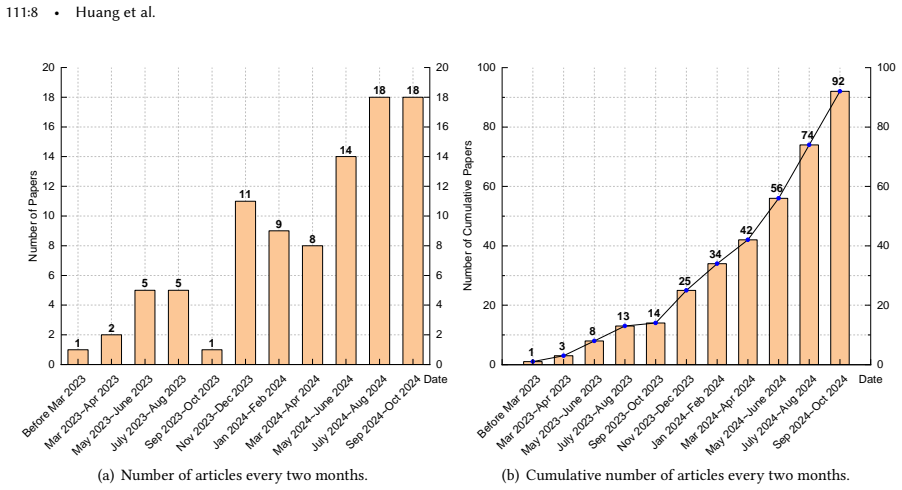
- The survey's trend data show the field accelerating sharply, with roughly 39% of surveyed methods published between July and October 2024, so the picture is one of rapid change rather than a settled landscape.
- Seven challenges (ambiguity, schema comprehension, cross-domain generalization, efficiency, data quality, privacy and reliability, and assorted technical issues) and eight future directions follow directly from the taxonomy and are presented as the agenda for the next round of research.
- Because the taxonomy organizes methods by workflow stage, it gives researchers a shared vocabulary for comparing new systems against existing ones.
Reading between the lines
- One consequence the paper leaves implicit is that the taxonomy's category counts are not mutually exclusive: a single paper such as DIN-SQL appears in schema linking, task decomposition, example selection, and self-correction, so readers should not sum the subcategory counts to recover the number of papers.
- If the trend reported here continues, the sparse fine-tuning side of the map is the most likely place for rapid growth, because in-context learning approaches that stuff whole schemas into prompts will hit context-length and cost limits on larger databases.
- A testable follow-up is to apply the same four-paradigm taxonomy to papers published after October 2024 and check whether the distribution shifts toward fine-tuning, multilingual, and context-dependent text-to-SQL, as the survey's future directions predict.
Editorial analysis
A structured set of objections, weighed in public.
Referee Report
Summary. This manuscript is a systematic literature review of text-to-SQL methods that use large language models. The authors formulate four research questions, describe a retrieval and screening process (Section 3), organize the surveyed papers into a taxonomy with four paradigms (Pre-Processing, In-Context Learning, Fine-Tuning, Post-Processing), tabulate datasets and metrics, and discuss challenges and future directions. The paper claims to analyze 122 relevant articles (with an earlier statement of 92 in the introduction) and makes trend claims about the field as of October 2024.
Significance. If accepted, this survey could serve as a reference for researchers entering the field: the four-paradigm taxonomy is intuitive, the dataset and metric summaries are useful, and the authors are transparent about threats to validity. The paper also explicitly documents inclusion/exclusion criteria and a collaborative screening process, which is good practice for a survey. However, because the paper's quantitative contributions (counts, percentages, trend conclusions) rest on an internally inconsistent enumeration of papers and a classification protocol that is not fully specified, the survey in its current form cannot be considered a reliable quantitative landscape of the field. The taxonomy and qualitative summaries may still be useful after the numeric and methodological issues are repaired.
major comments (4)
- [Section 1, Section 3.2.2, Table 3] The paper reports 'analyzing 92 relevant articles' in Section 1 while Section 3.2.2 states 'we gathered 122 relevant articles,' and Table 3 lists 92 methodology, 26 dataset, and 7 metric papers, which sum to 125; the percentages in the same table are computed against 122, so they sum to 102%. These inconsistencies must be reconciled, otherwise the RQ1 distributional claims (venue counts, contribution types, and time trends) are not grounded in a well-defined corpus.
- [Figure 4, Tables 4-7, Answer to RQ2] The category counts in the taxonomy are not mutually exclusive but are presented as if they were comparable percentages: the ICL subcategories alone total 135 entries (SKI 14+12+3, ES 20+40, RE 36+10), and the pre-processing table shows overlapping papers (e.g., reference [77] appears in Schema Linking, Cell Value Acquisition, and Question Rewriting). Since the manuscript does not define a multi-label coding scheme, the 'most widely used technique' conclusions in the Answer to RQ2 are not reproducible from the published tables.
- [Section 3.2, Section 8.2] The screening and classification process is described only qualitatively. No inter-annotator agreement statistic, no conflict-resolution log, and no operational definitions for edge cases (e.g., when a paper contributes to both pre-processing and in-context learning) are provided. Section 8.2 acknowledges that 'there is a possibility of misunderstanding LLM-based SQL generation techniques, which may result in the misclassification of relevant papers,' but without a protocol the effect of this risk cannot be assessed. This gap undermines the reproducibility of the survey's central classification claim.
- [Section 3.2.1-3.2.2] The paper does not report the number of records retrieved from each database, the number of duplicates removed, or the number of papers excluded at each inclusion/exclusion criterion, nor does it provide an explicit enumeration of the 122 included papers separate from the reference list (e.g., as a supplementary CSV). For a systematic review claiming to follow the Petersen et al. guidelines, this prevents an independent audit of the corpus and the reported trend analyses.
minor comments (4)
- [Equation (8) in Section 6.2] The fourth case of the R-VES piecewise definition writes '0.75 if ˆy is correct,' but the notation used elsewhere in the formula is 'ˆS_i' for the predicted SQL; this appears to be a typo.
- [Figure 3(a) and accompanying text] The rendered axis labels and data labels in Figure 3(a) are garbled (e.g., the sequence '41 81 8' before the axis), making the bimonthly counts hard to read and impossible to verify against the stated 122 total.
- [Answer to RQ2 (second bullet)] The text says 'task composition and question decomposition are often utilized,' but the body of Section 5.2 consistently uses the term 'task decomposition'; the phrasing should be harmonized.
- [Reference list] Reference [137] is cited as 'arXiv preprint arXiv:2402.148512'; the arXiv identifier appears to contain an extra digit (arXiv IDs are typically 4 digits after the dot, e.g., 2402.14851 or 2402.14852). Please verify.
Circularity Check
No significant circularity: the survey organizes external literature into a descriptive taxonomy, and its conclusions are not derived from its own definitions or self-citations.
full rationale
This paper is a systematic literature survey. Its central claims are descriptive: it categorizes 122 external papers into four paradigms (Pre-Processing, In-Context Learning, Fine-Tuning, Post-Processing) and reports counts and trends derived from manual classification. There is no derivation chain in which a predicted quantity is defined in terms of an input, no fitted parameter is renamed as a prediction, and no load-bearing conclusion is justified by a self-citation chain. The authors do cite their own prior works (e.g., DART-SQL [77], TCSR-SQL [142], QDA-SQL [112]), but these are surveyed items among many, and the survey's conclusions do not depend on the correctness of those works. The internal count inconsistencies noted in the paper (e.g., 92 vs 122 articles, Table 3 summing to 125, Figure 4 subcategory counts exceeding 122) and the admitted risk of misclassification in Section 8 are threats to reproducibility and validity, not circularity: they mean the taxonomy may be imperfectly executed, but they do not make the survey's claims equivalent to its inputs. The survey is therefore self-contained as a literature review, and no circular step can be exhibited.
Assumptions & free parameters
assumptions (2)
- domain assumption The selected databases and keywords capture the relevant LLM-based text-to-SQL literature.
- domain assumption Manual classification of the 122 papers into the four-paradigm taxonomy is accurate.
Cite this review
Pith. "Pith review of Exploring the Landscape of Text-to-SQL with Large Language Models: Progresses, Challenges and Opportunities." pith.science (2026). https://pith.science/paper/TUQF5QKZ
@misc{pith2026250523838,
  author       = {Pith},
  title        = {Pith review of: Exploring the Landscape of Text-to-SQL with Large Language Models: Progresses, Challenges and Opportunities},
  year         = {2026},
  howpublished = {\url{https://pith.science/paper/TUQF5QKZ}},
  note         = {Machine review of arXiv:2505.23838}
}
read the original abstract
Converting natural language (NL) questions into SQL queries, referred to as Text-to-SQL, has emerged as a pivotal technology for facilitating access to relational databases, especially for users without SQL knowledge. Recent progress in large language models (LLMs) has markedly propelled the field of natural language processing (NLP), opening new avenues to improve text-to-SQL systems. This study presents a systematic review of LLM-based text-to-SQL, focusing on four key aspects: (1) an analysis of the research trends in LLM-based text-to-SQL; (2) an in-depth analysis of existing LLM-based text-to-SQL techniques from diverse perspectives; (3) summarization of existing text-to-SQL datasets and evaluation metrics; and (4) discussion on potential obstacles and avenues for future exploration in this domain. This survey seeks to furnish researchers with an in-depth understanding of LLM-based text-to-SQL, sparking new innovations and advancements in this field.
Figures


Figures from the paper (2 more)


Forward citations
Cited by 2 Pith papers
-
Beyond Static Rules: Automated Discovery of Latent Vulnerabilities in Text-to-SQL
An evolving Vulnerability Codex plus hypothesis-driven perturbations exposes latent Text-to-SQL failures in LLMs far better than fixed expert rules, with transferable patterns and early remediation gains.
-
Text2Cypher Across Languages: Evaluating and Finetuning LLMs
A new multilingual Text2Cypher benchmark shows LLMs rank English highest, Spanish next, and Turkish lowest, and multilingual finetuning narrows the language gap more than English-only finetuning.
Reference graph
Works this paper leans on
-
[77]
Enhancing text-to-sql parsing through question rewriting and execution-guided refinement
Wenxin Mao, Ruiqi Wang, Jiyu Guo, Jichuan Zeng, Cuiyun Gao, Peiyi Han, and Chuanyi Liu. Enhancing text-to-sql parsing through question rewriting and execution-guided refinement. In Findings of the Association for Computational Linguistics ACL 2024 , pages 2009–2024, 2024
2024
-
[1]
Josh Achiam, Steven Adler, Sandhini Agarwal, Lama Ahmad, Ilge Akkaya, Florencia Leoni Aleman, Diogo Almeida, Janko Altenschmidt, Sam Altman, Shyamal Anadkat, et al. Gpt-4 technical report. arXiv preprint arXiv:2303.08774, 2023
arXiv 2023
-
[2]
Explainable artificial intelligence (xai): What we know and what is left to attain trustworthy artificial intelligence
Sajid Ali, Tamer Abuhmed, Shaker El-Sappagh, Khan Muhammad, Jose M Alonso-Moral, Roberto Confalonieri, Riccardo Guidotti, Javier Del Ser, Natalia Díaz-Rodríguez, and Francisco Herrera. Explainable artificial intelligence (xai): What we know and what is left to attain trustworthy artificial intelligence. Information fusion, 99:101805, 2023
2023
-
[3]
Adapt and decompose: Efficient generalization of text-to-sql via domain adapted least-to-most prompting
Aseem Arora, Shabbirhussain Bhaisaheb, Harshit Nigam, Manasi Patwardhan, Lovekesh Vig, and Gautam Shroff. Adapt and decompose: Efficient generalization of text-to-sql via domain adapted least-to-most prompting. In Proceedings of the 1st GenBench Workshop on (Benchmarking) Generalisation in NLP , pages 25–47, 2023
2023
-
[4]
Esm+: Modern insights into perspective on text-to-sql evaluation in the age of large language models
Benjamin Ascoli, Ram Kandikonda, and Jinho D Choi. Esm+: Modern insights into perspective on text-to-sql evaluation in the age of large language models. arXiv preprint arXiv:2407.07313, 2024
arXiv 2024
-
[5]
Magic: Generating self-correction guideline for in-context text-to-sql
Arian Askari, Christian Poelitz, and Xinye Tang. Magic: Generating self-correction guideline for in-context text-to-sql. arXiv preprint arXiv:2406.12692, 2024
arXiv 2024
-
[6]
Benchmarking and improving text-to-sql generation under ambiguity
Adithya Bhaskar, Tushar Tomar, Ashutosh Sathe, and Sunita Sarawagi. Benchmarking and improving text-to-sql generation under ambiguity. In Proceedings of the 2023 Conference on Empirical Methods in Natural Language Processing , pages 7053–7074, 2023
2023
-
[7]
E-sql: Direct schema linking via question enrichment in text-to-sql
Hasan Alp Caferoğlu and Özgür Ulusoy. E-sql: Direct schema linking via question enrichment in text-to-sql. arXiv preprint arXiv:2409.16751, 2024
arXiv 2024
Show all 170 references
-
[8]
Sqlfixagent: Towards semantic-accurate text-to-sql parsing via consistency- enhanced multi-agent collaboration
Jipeng Cen, Jiaxin Liu, Zhixu Li, and Jingjing Wang. Sqlfixagent: Towards semantic-accurate text-to-sql parsing via consistency- enhanced multi-agent collaboration. arXiv preprint arXiv:2406.13408, 2024
2024 arXiv
-
[9]
How to prompt llms for text-to-sql: A study in zero-shot, single-domain, and cross-domain settings
Shuaichen Chang and Eric Fosler-Lussier. How to prompt llms for text-to-sql: A study in zero-shot, single-domain, and cross-domain settings. In NeurIPS 2023 Second Table Representation Learning Workshop , 2023
2023
-
[10]
Selective demonstrations for cross-domain text-to-sql
Shuaichen Chang and Eric Fosler-Lussier. Selective demonstrations for cross-domain text-to-sql. In Findings of the Association for Computational Linguistics: EMNLP 2023 , pages 14174–14189, 2023
2023
-
[11]
Shuaichen Chang, Jun Wang, Mingwen Dong, Lin Pan, Henghui Zhu, Alexander Hanbo Li, Wuwei Lan, Sheng Zhang, Jiarong Jiang, Joseph Lilien, et al. Dr. spider: A diagnostic evaluation benchmark towards text-to-sql robustness. In ICLR 2023, 2023. ACM Comput. Surv., Vol. 37, No. 4, ...
2023
-
[12]
A survey on evaluation of large language models
Yupeng Chang, Xu Wang, Jindong Wang, Yuan Wu, Linyi Yang, Kaijie Zhu, Hao Chen, Xiaoyuan Yi, Cunxiang Wang, Yidong Wang, et al. A survey on evaluation of large language models. ACM Transactions on Intelligent Systems and Technology , 15(3):1–45, 2024
2024
-
[13]
Beaver: An enterprise benchmark for text-to-sql
Peter Baile Chen, Fabian Wenz, Yi Zhang, Moe Kayali, Nesime Tatbul, Michael Cafarella, Çağatay Demiralp, and Michael Stonebraker. Beaver: An enterprise benchmark for text-to-sql. arXiv preprint arXiv:2409.02038, 2024
2024 arXiv
-
[14]
Open-sql framework: Enhancing text-to-sql on open-source large language models
Xiaojun Chen, Tianle Wang, Tianhao Qiu, Jianbin Qin, and Min Yang. Open-sql framework: Enhancing text-to-sql on open-source large language models. arXiv preprint arXiv:2405.06674, 2024
2024 arXiv
-
[15]
Teaching large language models to self-debug
Xinyun Chen, Maxwell Lin, Nathanael Schärli, and Denny Zhou. Teaching large language models to self-debug. In The Twelfth International Conference on Learning Representations, ICLR 2024, Vienna, Austria, May 7-11, 2024 , 2024
2024
-
[16]
Binding language models in symbolic languages
Zhoujun Cheng, Tianbao Xie, Peng Shi, Chengzu Li, Rahul Nadkarni, Yushi Hu, Caiming Xiong, Dragomir Radev, Mari Ostendorf, Luke Zettlemoyer, et al. Binding language models in symbolic languages. InThe Eleventh International Conference on Learning Representations, 2022
2022
-
[17]
Ryansql: Recursively applying sketch-based slot fillings for complex text-to-sql in cross-domain databases
DongHyun Choi, Myeong Cheol Shin, EungGyun Kim, and Dong Ryeol Shin. Ryansql: Recursively applying sketch-based slot fillings for complex text-to-sql in cross-domain databases. Computational Linguistics, 47(2):309–332, 2021
2021
-
[18]
Introduction to algorithms
Thomas H Cormen, Charles E Leiserson, Ronald L Rivest, and Clifford Stein. Introduction to algorithms. MIT press, 2022
2022
-
[19]
Distillation matters: Empowering sequential recommenders to match the performance of large language models
Yu Cui, Feng Liu, Pengbo Wang, Bohao Wang, Heng Tang, Yi Wan, Jun Wang, and Jiawei Chen. Distillation matters: Empowering sequential recommenders to match the performance of large language models. InProceedings of the 18th ACM Conference on Recommender Systems, pages 507–517, 2024
2024
-
[20]
Recent advances in text-to-sql: A survey of what we have and what we expect
Naihao Deng, Yulong Chen, and Yue Zhang. Recent advances in text-to-sql: A survey of what we have and what we expect. In Proceedings of the 29th International Conference on Computational Linguistics , pages 2166–2187, 2022
2022
-
[21]
Structure-grounded pretraining for text-to-sql
Xiang Deng, Ahmed Hassan Awadallah, Christopher Meek, Oleksandr Polozov, Huan Sun, and Matthew Richardson. Structure-grounded pretraining for text-to-sql. In Proceedings of the 2021 Conference of the North American Chapter of the Association for Computational Linguistics: Huma...
2021
-
[22]
Qlora: Efficient finetuning of quantized llms
Tim Dettmers, Artidoro Pagnoni, Ari Holtzman, and Luke Zettlemoyer. Qlora: Efficient finetuning of quantized llms. Advances in Neural Information Processing Systems , 36, 2024
2024
-
[23]
C3: Zero-shot text-to-sql with chatgpt
Xuemei Dong, Chao Zhang, Yuhang Ge, Yuren Mao, Yunjun Gao, Jinshu Lin, Dongfang Lou, et al. C3: Zero-shot text-to-sql with chatgpt. arXiv preprint arXiv:2307.07306, 2023
2023 arXiv
-
[24]
Multispider: towards benchmarking multilingual text-to-sql semantic parsing
Longxu Dou, Yan Gao, Mingyang Pan, Dingzirui Wang, Wanxiang Che, Dechen Zhan, and Jian-Guang Lou. Multispider: towards benchmarking multilingual text-to-sql semantic parsing. In Proceedings of the AAAI Conference on Artificial Intelligence , volume 37, pages 12745–12753, 2023
2023
-
[25]
Sean Wang
Yuankai Fan, Zhenying He, Tonghui Ren, Can Huang, Yinan Jing, Kai Zhang, and X. Sean Wang. Metasql: A generate-then-rank framework for natural language to SQL translation. In 40th IEEE International Conference on Data Engineering, ICDE 2024 , pages 1765–1778, 2024
2024
-
[26]
Detecting hallucinations in large language models using semantic entropy
Sebastian Farquhar, Jannik Kossen, Lorenz Kuhn, and Yarin Gal. Detecting hallucinations in large language models using semantic entropy. Nature, 630(8017):625–630, 2024
2024
-
[27]
On the effectiveness of parameter-efficient fine-tuning
Zihao Fu, Haoran Yang, Anthony Man-Cho So, Wai Lam, Lidong Bing, and Nigel Collier. On the effectiveness of parameter-efficient fine-tuning. In Proceedings of the AAAI conference on artificial intelligence , volume 37, pages 12799–12807, 2023
2023
-
[28]
Measuring and improving compositional generalization in text-to-sql via component alignment
Yujian Gan, Xinyun Chen, Qiuping Huang, and Matthew Purver. Measuring and improving compositional generalization in text-to-sql via component alignment. In Findings of the Association for Computational Linguistics: NAACL 2022 , pages 831–843, 2022
2022
-
[29]
Towards robustness of text-to-sql models against synonym substitution
Yujian Gan, Xinyun Chen, Qiuping Huang, Matthew Purver, John R Woodward, Jinxia Xie, and Pengsheng Huang. Towards robustness of text-to-sql models against synonym substitution. In Proceedings of the 59th Annual Meeting of the Association for Computational Linguistics and the 1...
2021
-
[30]
Exploring underexplored limitations of cross-domain text-to-sql generalization
Yujian Gan, Xinyun Chen, and Matthew Purver. Exploring underexplored limitations of cross-domain text-to-sql generalization. In Proceedings of the 2021 Conference on Empirical Methods in Natural Language Processing , pages 8926–8931, 2021
2021
-
[31]
Text-to-sql empowered by large language models: A benchmark evaluation
Dawei Gao, Haibin Wang, Yaliang Li, Xiuyu Sun, Yichen Qian, Bolin Ding, and Jingren Zhou. Text-to-sql empowered by large language models: A benchmark evaluation. In International Conference on Very Large Data Bases (VLDB) , 2024
2024
-
[32]
Msc-sql: Multi-sample critiquing small language models for text-to-sql translation
Satya Krishna Gorti, Ilan Gofman, Zhaoyan Liu, Jiapeng Wu, Noël Vouitsis, Guangwei Yu, Jesse C Cresswell, and Rasa Hosseinzadeh. Msc-sql: Multi-sample critiquing small language models for text-to-sql translation. In NeurIPS 2024 Third Table Representation Learning Workshop, 2024
2024
-
[33]
Middleware for llms: Tools are instrumental for language agents in complex environments
Yu Gu, Yiheng Shu, Hao Yu, Xiao Liu, Yuxiao Dong, Jie Tang, Jayanth Srinivasa, Hugo Latapie, and Yu Su. Middleware for llms: Tools are instrumental for language agents in complex environments. arXiv preprint arXiv:2402.14672, 2024
2024 arXiv
-
[34]
Few-shot text-to-sql translation using structure and content prompt learning
Zihui Gu, Ju Fan, Nan Tang, Lei Cao, Bowen Jia, Sam Madden, and Xiaoyong Du. Few-shot text-to-sql translation using structure and content prompt learning. Proceedings of the ACM on Management of Data , 1(2):1–28, 2023
2023
-
[35]
Interleaving pre-trained language models and large language models for zero-shot nl2sql generation
Zihui Gu, Ju Fan, Nan Tang, Songyue Zhang, Yuxin Zhang, Zui Chen, Lei Cao, Guoliang Li, Sam Madden, and Xiaoyong Du. Interleaving pre-trained language models and large language models for zero-shot nl2sql generation. arXiv preprint arXiv:2306.08891, 2023. ACM Comput. Surv., Vo...
2023 arXiv
-
[36]
Retrieval-augmented gpt-3.5-based text-to-sql framework with sample-aware prompting and dynamic revision chain
Chunxi Guo, Zhiliang Tian, Jintao Tang, Shasha Li, Zhihua Wen, Kaixuan Wang, and Ting Wang. Retrieval-augmented gpt-3.5-based text-to-sql framework with sample-aware prompting and dynamic revision chain. In International Conference on Neural Information Processing, pages 341–3...
2023
-
[37]
Prompting gpt-3.5 for text-to-sql with de-semanticization and skeleton retrieval
Chunxi Guo, Zhiliang Tian, Jintao Tang, Pancheng Wang, Zhihua Wen, Kang Yang, and Ting Wang. Prompting gpt-3.5 for text-to-sql with de-semanticization and skeleton retrieval. In Pacific Rim International Conference on Artificial Intelligence , pages 262–274. Springer, 2023
2023
-
[38]
Daya Guo, Qihao Zhu, Dejian Yang, Zhenda Xie, Kai Dong, Wentao Zhang, Guanting Chen, Xiao Bi, Y. Wu, Y. K. Li, Fuli Luo, Yingfei Xiong, and Wenfeng Liang. Deepseek-coder: When the large language model meets programming – the rise of code intelligence. arXiv preprint arXiv:2401...
2024 arXiv
-
[39]
Chase: A large-scale and pragmatic chinese dataset for cross-database context-dependent text-to-sql
Jiaqi Guo, Ziliang Si, Yu Wang, Qian Liu, Ming Fan, Jian-Guang Lou, Zijiang Yang, and Ting Liu. Chase: A large-scale and pragmatic chinese dataset for cross-database context-dependent text-to-sql. In Proceedings of the 59th Annual Meeting of the Association for Computational L...
2021
-
[40]
Application of k-means clustering based on artificial intelligence in gene statistics of biological information engineering
Zheng He, Xinyu Shen, Yanlin Zhou, and Yong Wang. Application of k-means clustering based on artificial intelligence in gene statistics of biological information engineering. In Proceedings of the 2024 4th International Conference on Bioinformatics and Intelligent Computing, p...
2024
-
[41]
Knowledge-to-sql: Enhancing SQL generation with data expert LLM
Zijin Hong, Zheng Yuan, Hao Chen, Qinggang Zhang, Feiran Huang, and Xiao Huang. Knowledge-to-sql: Enhancing SQL generation with data expert LLM. In Findings of the Association for Computational Linguistics, ACL 2024 , pages 10997–11008, 2024
2024
-
[42]
Chatdb: Augmenting llms with databases as their symbolic memory
Chenxu Hu, Jie Fu, Chenzhuang Du, Simian Luo, Junbo Zhao, and Hang Zhao. Chatdb: Augmenting llms with databases as their symbolic memory. arXiv preprint arXiv:2306.03901, 2023
2023 arXiv
-
[43]
Lora: Low-rank adaptation of large language models
Edward J Hu, Phillip Wallis, Zeyuan Allen-Zhu, Yuanzhi Li, Shean Wang, Lu Wang, Weizhu Chen, et al. Lora: Low-rank adaptation of large language models. In International Conference on Learning Representations , 2021
2021
-
[44]
Towards reasoning in large language models: A survey
Jie Huang and Kevin Chen-Chuan Chang. Towards reasoning in large language models: A survey. In Findings of the Association for Computational Linguistics: ACL 2023, pages 1049–1065, 2023
2023
-
[45]
Ccoe: A compact llm with collaboration of experts
Shaomang Huang, Jianfeng Pan, and Hanzhong Zheng. Ccoe: A compact llm with collaboration of experts. arXiv preprint arXiv:2407.11686, 2024
2024 arXiv
-
[46]
Improving text-to-sql with schema dependency learning
Binyuan Hui, Xiang Shi, Ruiying Geng, Binhua Li, Yongbin Li, Jian Sun, and Xiaodan Zhu. Improving text-to-sql with schema dependency learning. arXiv preprint arXiv:2103.04399, 2021
2021 arXiv
-
[47]
Survey of hallucination in natural language generation
Ziwei Ji, Nayeon Lee, Rita Frieske, Tiezheng Yu, Dan Su, Yan Xu, Etsuko Ishii, Ye Jin Bang, Andrea Madotto, and Pascale Fung. Survey of hallucination in natural language generation. ACM Computing Surveys, 55(12):1–38, 2023
2023
-
[48]
Bert: Pre-training of deep bidirectional transformers for language understanding
Jacob Devlin Ming-Wei Chang Kenton and Lee Kristina Toutanova. Bert: Pre-training of deep bidirectional transformers for language understanding. In Proceedings of naacL-HLT, volume 1, page 2, 2019
2019
-
[49]
Privacy issues in large language models: A survey
Hareem Kibriya, Wazir Zada Khan, Ayesha Siddiqa, and Muhammad Khurrum Khan. Privacy issues in large language models: A survey. Computers and Electrical Engineering , 120:109698, 2024
2024
-
[50]
Tree of clarifications: Answering ambiguous questions with retrieval-augmented large language models
Gangwoo Kim, Sungdong Kim, Byeongguk Jeon, Joonsuk Park, and Jaewoo Kang. Tree of clarifications: Answering ambiguous questions with retrieval-augmented large language models. In Proceedings of the 2023 Conference on Empirical Methods in Natural Language Processing, pages 996–...
2023
-
[51]
i’m not sure, but
Sunnie SY Kim, Q Vera Liao, Mihaela Vorvoreanu, Stephanie Ballard, and Jennifer Wortman Vaughan. " i’m not sure, but... ": Examining the impact of large language models’ uncertainty expression on user reliance and trust. In The 2024 ACM Conference on Fairness, Accountability, ...
2024
-
[52]
You only read once (yoro): Learning to internalize database knowledge for text-to-sql
Hideo Kobayashi, Wuwei Lan, Peng Shi, Shuaichen Chang, Jiang Guo, Henghui Zhu, Zhiguo Wang, and Patrick Ng. You only read once (yoro): Learning to internalize database knowledge for text-to-sql. arXiv preprint arXiv:2409.12172, 2024
2024 arXiv
-
[53]
Crush4sql: Collective retrieval using schema halluci- nation for text2sql
Mayank Kothyari, Dhruva Dhingra, Sunita Sarawagi, and Soumen Chakrabarti. Crush4sql: Collective retrieval using schema halluci- nation for text2sql. In Proceedings of the 2023 Conference on Empirical Methods in Natural Language Processing , pages 14054–14066, 2023
2023
-
[54]
Cllms: Consistency large language models
Siqi Kou, Lanxiang Hu, Zhezhi He, Zhijie Deng, and Hao Zhang. Cllms: Consistency large language models. In Forty-first International Conference on Machine Learning, ICML 2024 , 2024
2024
-
[55]
A literature survey on open source large language models
Sanjay Kukreja, Tarun Kumar, Amit Purohit, Abhijit Dasgupta, and Debashis Guha. A literature survey on open source large language models. In Proceedings of the 2024 7th International Conference on Computers in Management and Business , pages 133–143, 2024
2024
-
[56]
Booksql: A large scale text-to-sql dataset for accounting domain
Rahul Kumar, Amar Raja Dibbu, Shrutendra Harsola, Vignesh Subrahmaniam, and Ashutosh Modi. Booksql: A large scale text-to-sql dataset for accounting domain. In Proceedings of the 2024 Conference of the North American Chapter of the Association for Computational Linguistics: Hu...
2024
-
[57]
Kaggledbqa: Realistic evaluation of text-to-sql parsers
Chia-Hsuan Lee, Oleksandr Polozov, and Matthew Richardson. Kaggledbqa: Realistic evaluation of text-to-sql parsers. In Proceedings of the 59th Annual Meeting of the Association for Computational Linguistics and the 11th International Joint Conference on Natural Language Proces...
2021
-
[58]
Mcs-sql: Leveraging multiple prompts and multiple-choice selection for text-to-sql generation
Dongjun Lee, Choongwon Park, Jaehyuk Kim, and Heesoo Park. Mcs-sql: Leveraging multiple prompts and multiple-choice selection for text-to-sql generation. arXiv preprint arXiv:2405.07467, 2024
2024 arXiv
-
[59]
Ehrsql: A practical text-to-sql benchmark for electronic health records
Gyubok Lee, Hyeonji Hwang, Seongsu Bae, Yeonsu Kwon, Woncheol Shin, Seongjun Yang, Minjoon Seo, Jong-Yeup Kim, and Edward Choi. Ehrsql: A practical text-to-sql benchmark for electronic health records. Advances in Neural Information Processing Systems , 35:15589–15601, 2022
2022
-
[60]
The dawn of natural language to SQL: are we fully ready? [experiment, analysis \u0026 benchmark ]
Boyan Li, Yuyu Luo, Chengliang Chai, Guoliang Li, and Nan Tang. The dawn of natural language to SQL: are we fully ready? [experiment, analysis \u0026 benchmark ]. Proc. VLDB Endow., 17(11):3318–3331, 2024
2024
-
[61]
Sea-sql: Semantic-enhanced text-to-sql with adaptive refinement
Chaofan Li, Yingxia Shao, and Zheng Liu. Sea-sql: Semantic-enhanced text-to-sql with adaptive refinement. arXiv preprint arXiv:2408.04919, 2024
2024 arXiv
-
[62]
Resdsql: Decoupling schema linking and skeleton parsing for text-to-sql
Haoyang Li, Jing Zhang, Cuiping Li, and Hong Chen. Resdsql: Decoupling schema linking and skeleton parsing for text-to-sql. In Proceedings of the AAAI Conference on Artificial Intelligence , volume 37, pages 13067–13075, 2023
2023
-
[63]
Codes: Towards building open-source language models for text-to-sql
Haoyang Li, Jing Zhang, Hanbing Liu, Ju Fan, Xiaokang Zhang, Jun Zhu, Renjie Wei, Hongyan Pan, Cuiping Li, and Hong Chen. Codes: Towards building open-source language models for text-to-sql. Proceedings of the ACM on Management of Data , 2(3):1–28, 2024
2024
-
[64]
Can llm already serve as a database interface? a big bench for large-scale database grounded text-to-sqls
Jinyang Li, Binyuan Hui, Ge Qu, Jiaxi Yang, Binhua Li, Bowen Li, Bailin Wang, Bowen Qin, Ruiying Geng, Nan Huo, et al. Can llm already serve as a database interface? a big bench for large-scale database grounded text-to-sqls. Advances in Neural Information Processing Systems, 36, 2024
2024
-
[65]
Using llm to select the right sql query from candidates
Zhenwen Li and Tao Xie. Using llm to select the right sql query from candidates. arXiv preprint arXiv:2401.02115, 2024
2024 arXiv
-
[66]
Pet-sql: A prompt-enhanced two-stage text-to-sql framework with cross-consistency
Zhishuai Li, Xiang Wang, Jingjing Zhao, Sun Yang, Guoqing Du, Xiaoru Hu, Bin Zhang, Yuxiao Ye, Ziyue Li, Rui Zhao, et al. Pet-sql: A prompt-enhanced two-stage text-to-sql framework with cross-consistency. arXiv preprint arXiv:2403.09732, 2024
2024 arXiv
-
[67]
Momq: Mixture-of-experts enhances multi-dialect query generation across relational and non-relational databases
Zhisheng Lin, Yifu Liu, Zhiling Luo, Jinyang Gao, and Yu Li. Momq: Mixture-of-experts enhances multi-dialect query generation across relational and non-relational databases. arXiv preprint arXiv:2410.18406, 2024
2024 arXiv
-
[68]
A comprehensive evaluation of chatgpt’s zero-shot text-to-sql capability
Aiwei Liu, Xuming Hu, Lijie Wen, and Philip S Yu. A comprehensive evaluation of chatgpt’s zero-shot text-to-sql capability. arXiv preprint arXiv:2303.13547, 2023
2023 arXiv
-
[69]
Divide and prompt: Chain of thought prompting for text-to-sql
Xiping Liu and Zhao Tan. Divide and prompt: Chain of thought prompting for text-to-sql. arXiv preprint arXiv:2304.11556, 2023
2023 arXiv
-
[70]
Epi-sql: Enhancing text-to-sql translation with error-prevention instructions
Xiping Liu and Zhao Tan. Epi-sql: Enhancing text-to-sql translation with error-prevention instructions. arXiv preprint arXiv:2404.14453, 2024
2024 arXiv
-
[71]
On llms-driven synthetic data generation, curation, and evaluation: A survey
Lin Long, Rui Wang, Ruixuan Xiao, Junbo Zhao, Xiao Ding, Gang Chen, and Haobo Wang. On llms-driven synthetic data generation, curation, and evaluation: A survey. In Findings of the Association for Computational Linguistics ACL 2024 , pages 11065–11082, 2024
2024
-
[72]
Ptd-sql: Partitioning and targeted drilling with llms in text-to-sql
Ruilin Luo, Liyuan Wang, Binghuai Lin, Zicheng Lin, and Yujiu Yang. Ptd-sql: Partitioning and targeted drilling with llms in text-to-sql. arXiv preprint 2409.14082, 2024
2024 arXiv
-
[73]
Enhancing text-to-sql capabilities of large language models via domain database knowledge injection
Xingyu Ma, Xin Tian, Lingxiang Wu, Xuepeng Wang, Xueming Tang, and Jinqiao Wang. Enhancing text-to-sql capabilities of large language models via domain database knowledge injection. In ECAI 2024 - 27th European Conference on Artificial Intelligence - Including 13th Conference ...
2024
-
[74]
Llm-pruner: On the structural pruning of large language models
Xinyin Ma, Gongfan Fang, and Xinchao Wang. Llm-pruner: On the structural pruning of large language models. Advances in neural information processing systems, 36:21702–21720, 2023
2023
-
[75]
The death of schema linking? text-to-sql in the age of well-reasoned language models
Karime Maamari, Fadhil Abubaker, Daniel Jaroslawicz, and Amine Mhedhbi. The death of schema linking? text-to-sql in the age of well-reasoned language models. In NeurIPS 2024 Third Table Representation Learning Workshop , 2024
2024
-
[76]
Learning metadata-agnostic representations for text-to-sql in-context example selection
Chuhong Mai, Ro-ee Tal, and Thahir Mohamed. Learning metadata-agnostic representations for text-to-sql in-context example selection. In NeurIPS 2024 Third Table Representation Learning Workshop , 2024
2024
-
[78]
Ai-enabled data-driven approaches for personalized medicine and healthcare analytics
Dinesh Mendhe, Akriti Dogra, Prabha Shreeraj Nair, S Punitha, KS Preetha, and S BG Tilak Babu. Ai-enabled data-driven approaches for personalized medicine and healthcare analytics. In 2024 Ninth International Conference on Science Technology Engineering and Mathematics (ICONST...
2024
-
[79]
A pilot study for chinese sql semantic parsing
Qingkai Min, Yuefeng Shi, and Yue Zhang. A pilot study for chinese sql semantic parsing. In Proceedings of the 2019 Conference on Empirical Methods in Natural Language Processing and the 9th International Joint Conference on Natural Language Processing (EMNLP-IJCNLP), pages 36...
2019
-
[80]
Towards an understanding of business intelligence and analytics usage: Evidence from the banking industry
Ashraf Bany Mohammed, Manaf Al-Okaily, Dhia Qasim, and Mohammad Khalaf Al-Majali. Towards an understanding of business intelligence and analytics usage: Evidence from the banking industry. International Journal of Information Management Data Insights , 4(1):100215, 2024
2024
-
[81]
Enhancing text-to-sql capabilities of large language models: A study on prompt design strategies
Linyong Nan, Yilun Zhao, Weijin Zou, Narutatsu Ri, Jaesung Tae, Ellen Zhang, Arman Cohan, and Dragomir Radev. Enhancing text-to-sql capabilities of large language models: A study on prompt design strategies. In Findings of the Association for Computational Linguistics: EMNLP 2...
2023
-
[82]
Lever: Learning to verify language-to-code generation with execution
Ansong Ni, Srini Iyer, Dragomir Radev, Veselin Stoyanov, Wen-tau Yih, Sida Wang, and Xi Victoria Lin. Lever: Learning to verify language-to-code generation with execution. In International Conference on Machine Learning , pages 26106–26128. PMLR, 2023
2023
-
[83]
Farhad Nooralahzadeh, Yi Zhang, Ellery Smith, Sabine Maennel, Cyril Matthey-Doret, Raphaël de Fondville, and Kurt Stockinger. Statbot. swiss: Bilingual open data exploration in natural language. In Findings of the Association for Computational Linguistics, ACL 2024, pages 5486...
2024
-
[84]
Few-shot transfer learning for knowledge base question answering: Fusing supervised models with in-context learning
Mayur Patidar, Riya Sawhney, Avinash Singh, Biswajit Chatterjee, Indrajit Bhattacharya, et al. Few-shot transfer learning for knowledge base question answering: Fusing supervised models with in-context learning. InProceedings of the 62nd Annual Meeting of the Association for C...
2024
-
[85]
Exploring dimensions of generalizability and few-shot transfer for text-to-sql semantic parsing
Rajaswa Patil, Manasi Patwardhan, Shirish Karande, Lovekesh Vig, and Gautam Shroff. Exploring dimensions of generalizability and few-shot transfer for text-to-sql semantic parsing. In Transfer Learning for Natural Language Processing Workshop , pages 103–114. PMLR, 2023
2023
-
[86]
Glove: Global vectors for word representation
Jeffrey Pennington, Richard Socher, and Christopher D Manning. Glove: Global vectors for word representation. In Proceedings of the 2014 conference on empirical methods in natural language processing (EMNLP) , pages 1532–1543, 2014
2014
-
[87]
Guidelines for conducting systematic mapping studies in software engineering: An update
Kai Petersen, Sairam Vakkalanka, and Ludwik Kuzniarz. Guidelines for conducting systematic mapping studies in software engineering: An update. Information and software technology , 64:1–18, 2015
2015
-
[88]
Mohammadreza Pourreza, Hailong Li, Ruoxi Sun, Yeounoh Chung, Shayan Talaei, Gaurav Tarlok Kakkar, Yu Gan, Amin Saberi, Fatma Ozcan, and Sercan O. Arik. Chase-sql: Multi-path reasoning and preference optimized candidate selection in text-to-sql. arXiv preprint 2410.01943, 2024
-
[89]
Din-sql: Decomposed in-context learning of text-to-sql with self-correction
Mohammadreza Pourreza and Davood Rafiei. Din-sql: Decomposed in-context learning of text-to-sql with self-correction. Advances in Neural Information Processing Systems , 36, 2024
2024
-
[90]
Dts-sql: Decomposed text-to-sql with small large language models
Mohammadreza Pourreza and Davood Rafiei. Dts-sql: Decomposed text-to-sql with small large language models. arXiv preprint arXiv:2402.01117, 2024
2024 arXiv
-
[91]
Sql-gen: Bridging the dialect gap for text-to-sql via synthetic data and model merging
Mohammadreza Pourreza, Ruoxi Sun, Hailong Li, Lesly Miculicich, Tomas Pfister, and Sercan O Arik. Sql-gen: Bridging the dialect gap for text-to-sql via synthetic data and model merging. arXiv preprint arXiv:2408.12733, 2024
2024 arXiv
-
[92]
A survey on text-to-sql parsing: Concepts, methods, and future directions
Bowen Qin, Binyuan Hui, Lihan Wang, Min Yang, Jinyang Li, Binhua Li, Ruiying Geng, Rongyu Cao, Jian Sun, Luo Si, et al. A survey on text-to-sql parsing: Concepts, methods, and future directions. arXiv preprint arXiv:2208.13629, 2022
2022 arXiv
-
[93]
Before generation, align it! A novel and effective strategy for mitigating hallucinations in text-to-sql generation
Ge Qu, Jinyang Li, Bowen Li, Bowen Qin, Nan Huo, Chenhao Ma, and Reynold Cheng. Before generation, align it! A novel and effective strategy for mitigating hallucinations in text-to-sql generation. In Findings of the Association for Computational Linguistics, ACL 2024 , pages 5...
2024
-
[94]
Direct preference optimization: Your language model is secretly a reward model
Rafael Rafailov, Archit Sharma, Eric Mitchell, Christopher D Manning, Stefano Ermon, and Chelsea Finn. Direct preference optimization: Your language model is secretly a reward model. Advances in Neural Information Processing Systems , 36, 2024
2024
-
[95]
Weiland, Kayla Margaret Gabriella Herrera, Tyler H
Daking Rai, Rydia R. Weiland, Kayla Margaret Gabriella Herrera, Tyler H. Shaw, and Ziyu Yao. Understanding the effect of algorithm transparency of model explanations in text-to-sql semantic parsing. arXiv preprint 2410.16283, 2024
-
[96]
Evaluating the text-to-sql capabilities of large language models
Nitarshan Rajkumar, Raymond Li, and Dzmitry Bahdanau. Evaluating the text-to-sql capabilities of large language models. arXiv preprint arXiv:2204.00498, 2022
2022 arXiv
-
[97]
A comparative study on the impact of model compression techniques on fairness in language models
Krithika Ramesh, Arnav Chavan, Shrey Pandit, and Sunayana Sitaram. A comparative study on the impact of model compression techniques on fairness in language models. In Proceedings of the 61st Annual Meeting of the Association for Computational Linguistics (Volume 1: Long Paper...
2023
-
[98]
Purple: Making a large language model a better sql writer
Tonghui Ren, Yuankai Fan, Zhenying He, Ren Huang, Jiaqi Dai, Can Huang, Yinan Jing, Kai Zhang, Yifan Yang, and Xiaoyang Sean Wang. Purple: Making a large language model a better sql writer. 2024 IEEE 40th International Conference on Data Engineering (ICDE) , pages 15–28, 2024
2024
-
[99]
The effect of sampling temperature on problem solving in large language models
Matthew Renze and Erhan Guven. The effect of sampling temperature on problem solving in large language models. arXiv preprint arXiv:2402.05201, 2024
2024 arXiv
-
[100]
Ehr-seqsql : A sequential text-to-sql dataset for interactively exploring electronic health records
Jaehee Ryu, Seonhee Cho, Gyubok Lee, and Edward Choi. Ehr-seqsql : A sequential text-to-sql dataset for interactively exploring electronic health records. In Findings of the Association for Computational Linguistics, ACL 2024 , pages 16388–16407, 2024
2024
-
[101]
Accelerating transformer inference for translation via parallel decoding
Andrea Santilli, Silvio Severino, Emilian Postolache, Valentino Maiorca, Michele Mancusi, Riccardo Marin, and Emanuele Rodola. Accelerating transformer inference for translation via parallel decoding. In Proceedings of the 61st Annual Meeting of the Association for Computation...
2023
-
[102]
Ambrosia: A benchmark for parsing ambiguous questions into database queries
Irina Saparina and Mirella Lapata. Ambrosia: A benchmark for parsing ambiguous questions into database queries. arXiv preprint arXiv:2406.19073, 2024
2024 arXiv
-
[103]
Improving generalization in semantic parsing by increasing natural language variation
Irina Saparina and Mirella Lapata. Improving generalization in semantic parsing by increasing natural language variation. InProceedings of the 18th Conference of the European Chapter of the Association for Computational Linguistics (Volume 1: Long Papers) , pages 1178–1193, 2024
2024
-
[104]
Peter Shaw, Ming-Wei Chang, Panupong Pasupat, and Kristina Toutanova. Compositional generalization and natural language variation: Can a semantic parsing approach handle both? In Proceedings of the 59th Annual Meeting of the Association for Computational Linguistics ACM Comput...
2024
-
[105]
Select-sql: Self-correcting ensemble chain-of-thought for text-to-sql
Ke Shen and Mayank Kejriwal. Select-sql: Self-correcting ensemble chain-of-thought for text-to-sql. arXiv preprint arXiv:2409.10007, 2024
2024 arXiv
-
[106]
Improving retrieval-augmented text-to-sql with ast-based ranking and schema pruning
Zhili Shen, Pavlos Vougiouklis, Chenxin Diao, Kaustubh Vyas, Yuanyi Ji, and Jeff Z Pan. Improving retrieval-augmented text-to-sql with ast-based ranking and schema pruning. arXiv preprint arXiv:2407.03227, 2024
2024 arXiv
-
[107]
Enhancing text-to-sql translation for financial system design
Yewei Song, Saad Ezzini, Xunzhu Tang, Cedric Lothritz, Jacques Klein, Tegawendé Bissyandé, Andrey Boytsov, Ulrick Ble, and Anne Goujon. Enhancing text-to-sql translation for financial system design. In Proceedings of the 46th International Conference on Software Engineering: S...
2024
-
[108]
A comprehensive survey of few-shot learning: Evolution, applications, challenges, and opportunities
Yisheng Song, Ting Wang, Puyu Cai, Subrota K Mondal, and Jyoti Prakash Sahoo. A comprehensive survey of few-shot learning: Evolution, applications, challenges, and opportunities. ACM Computing Surveys, 55(13s):1–40, 2023
2023
-
[109]
Reboost large language model-based text-to-sql, text-to-python, and text-to-function–with real applications in traffic domain
Guanghu Sui, Zhishuai Li, Ziyue Li, Sun Yang, Jingqing Ruan, Hangyu Mao, and Rui Zhao. Reboost large language model-based text-to-sql, text-to-python, and text-to-function–with real applications in traffic domain. arXiv preprint arXiv:2310.18752, 2023
-
[110]
Sqlprompt: In-context text-to-sql with minimal labeled data
Ruoxi Sun, Sercan Arik, Rajarishi Sinha, Hootan Nakhost, Hanjun Dai, Pengcheng Yin, and Tomas Pfister. Sqlprompt: In-context text-to-sql with minimal labeled data. In Findings of the Association for Computational Linguistics: EMNLP 2023 , pages 542–550, 2023
2023
-
[111]
Sql-palm: Improved large language model adaptation for text-to-sql (extended).arXiv preprint arXiv:2306.00739, 2023
Ruoxi Sun, Sercan Ö Arik, Alex Muzio, Lesly Miculicich, Satya Gundabathula, Pengcheng Yin, Hanjun Dai, Hootan Nakhost, Rajarishi Sinha, Zifeng Wang, et al. Sql-palm: Improved large language model adaptation for text-to-sql (extended).arXiv preprint arXiv:2306.00739, 2023
2023 arXiv
-
[112]
Qda-sql: Questions enhanced dialogue augmentation for multi-turn text-to-sql
Yinggang Sun, Ziming Guo, Haining Yu, Chuanyi Liu, Xiang Li, Bingxuan Wang, Xiangzhan Yu, and Tiancheng Zhao. Qda-sql: Questions enhanced dialogue augmentation for multi-turn text-to-sql. arXiv preprint arXiv:2406.10593, 2024
2024 arXiv
-
[113]
Exploring chain of thought style prompting for text-to-sql
Chang-Yu Tai, Ziru Chen, Tianshu Zhang, Xiang Deng, and Huan Sun. Exploring chain of thought style prompting for text-to-sql. In Proceedings of the 2023 Conference on Empirical Methods in Natural Language Processing , pages 5376–5393, 2023
2023
-
[114]
Chess: Contextual harnessing for efficient sql synthesis
Shayan Talaei, Mohammadreza Pourreza, Yu-Chen Chang, Azalia Mirhoseini, and Amin Saberi. Chess: Contextual harnessing for efficient sql synthesis. arXiv preprint arXiv:2405.16755, 2024
2024 arXiv
-
[115]
Enhancing text-to-sql capabilities of large language models through tailored promptings
Zhao Tan, Xiping Liu, Qing Shu, Xi Li, Changxuan Wan, Dexi Liu, Qizhi Wan, and Guoqiong Liao. Enhancing text-to-sql capabilities of large language models through tailored promptings. In Proceedings of the 2024 Joint International Conference on Computational Linguistics, Langua...
2024
-
[116]
Mavidsql: A model-agnostic visualization for interpretation and diagnosis of text-to-sql tasks
Jingwei Tang, Guodao Sun, Jiahui Chen, Gefei Zhang, Baofeng Chang, Haixia Wang, and Ronghua Liang. Mavidsql: A model-agnostic visualization for interpretation and diagnosis of text-to-sql tasks. IEEE Transactions on Cognitive and Developmental Systems , 2024
2024
-
[117]
Dubo-sql: Diverse retrieval-augmented generation and fine tuning for text-to-sql
Dayton G Thorpe, Andrew J Duberstein, and Ian A Kinsey. Dubo-sql: Diverse retrieval-augmented generation and fine tuning for text-to-sql. arXiv preprint arXiv:2404.12560, 2024
2024 arXiv
-
[118]
Kummerfeld, Toby Jia-Jun Li, and Tianyi Zhang
Yuan Tian, Jonathan K. Kummerfeld, Toby Jia-Jun Li, and Tianyi Zhang. Sqlucid: Grounding natural language database queries with interactive explanations. In Proceedings of the 37th Annual ACM Symposium on User Interface Software and Technology, UIST 2024 , pages 12:1–12:20. ACM, 2024
2024
-
[119]
Language models don’t always say what they think: unfaithful explanations in chain-of-thought prompting
Miles Turpin, Julian Michael, Ethan Perez, and Samuel Bowman. Language models don’t always say what they think: unfaithful explanations in chain-of-thought prompting. Advances in Neural Information Processing Systems , 36, 2024
2024
-
[120]
Attention is all you need but you don’t need all of it for inference of large language models
Georgy Tyukin, Gbetondji Jean-Sebastien Dovonon, Jean Kaddour, and Pasquale Minervini. Attention is all you need but you don’t need all of it for inference of large language models. In ICML 2024 Workshop on Theoretical Foundations of Foundation Models , 2024
2024
-
[121]
Itergen: Iterative structured llm generation
Shubham Ugare, Rohan Gumaste, Tarun Suresh, Gagandeep Singh, and Sasa Misailovic. Itergen: Iterative structured llm generation. arXiv preprint arXiv:2410.07295, 2024
2024 arXiv
-
[122]
Dfin-sql: Integrating focused schema with din-sql for superior accuracy in large-scale databases
Shai Volvovsky, Marco Marcassa, and Mustafa Panbiharwala. Dfin-sql: Integrating focused schema with din-sql for superior accuracy in large-scale databases. arXiv preprint arXiv:2403.00872, 2024
2024 arXiv
-
[123]
Mac-sql: A multi-agent collaborative framework for text-to-sql
Bing Wang, Changyu Ren, Jian Yang, Xinnian Liang, Jiaqi Bai, Linzheng Chai, Zhao Yan, Qian-Wen Zhang, Di Yin, Xing Sun, et al. Mac-sql: A multi-agent collaborative framework for text-to-sql. arXiv preprint arXiv:2312.11242, 2024
2024 arXiv
-
[124]
Dac: Decomposed automation correction for text-to-sql
Dingzirui Wang, Longxu Dou, Xuanliang Zhang, Qingfu Zhu, and Wanxiang Che. Dac: Decomposed automation correction for text-to-sql. arXiv preprint arXiv:2408.08779, 2024
2024 arXiv
-
[125]
Improving demonstration diversity by human-free fusing for text-to-sql
Dingzirui Wang, Longxu Dou, Xuanliang Zhang, Qingfu Zhu, and Wanxiang Che. Improving demonstration diversity by human-free fusing for text-to-sql. arXiv preprint arXiv:2402.10663, 2024
2024 arXiv
-
[126]
Dusql: A large-scale and pragmatic chinese text-to-sql dataset
Lijie Wang, Ao Zhang, Kun Wu, Ke Sun, Zhenghua Li, Hua Wu, Min Zhang, and Haifeng Wang. Dusql: A large-scale and pragmatic chinese text-to-sql dataset. In Proceedings of the 2020 Conference on Empirical Methods in Natural Language Processing (EMNLP) , pages 6923–6935, 2020
2020
-
[127]
Text-to-sql generation for question answering on electronic medical records
Ping Wang, Tian Shi, and Chandan K Reddy. Text-to-sql generation for question answering on electronic medical records. InProceedings of The Web Conference 2020, pages 350–361, 2020
2020
-
[128]
Large language models are good multi-lingual learners: When llms meet cross-lingual prompts
Teng Wang, Zhenqi He, Wing-Yin Yu, Xiaojin Fu, and Xiongwei Han. Large language models are good multi-lingual learners: When llms meet cross-lingual prompts. arXiv preprint arXiv:2409.11056, 2024. ACM Comput. Surv., Vol. 37, No. 4, Article 111. Publication date: June 2024. 111...
2024 arXiv
-
[129]
Dbcopilot: Scaling natural language querying to massive databases
Tianshu Wang, Hongyu Lin, Xianpei Han, Le Sun, Xiaoyang Chen, Hao Wang, and Zhenyu Zeng. Dbcopilot: Scaling natural language querying to massive databases. arXiv preprint arXiv:2312.03463, 2023
2023 arXiv
-
[130]
Beyond the limits: A survey of techniques to extend the context length in large language models
Xindi Wang, Mahsa Salmani, Parsa Omidi, Xiangyu Ren, Mehdi Rezagholizadeh, and Armaghan Eshaghi. Beyond the limits: A survey of techniques to extend the context length in large language models. arXiv preprint arXiv:2402.02244, 2024
2024 arXiv
-
[131]
Tool-assisted agent on sql inspection and refinement in real-world scenarios
Zhongyuan Wang, Richong Zhang, Zhijie Nie, and Jaein Kim. Tool-assisted agent on sql inspection and refinement in real-world scenarios. arXiv preprint arXiv:2408.16991, 2024
2024 arXiv
-
[132]
Finetuned language models are zero-shot learners
Jason Wei, Maarten Bosma, Vincent Zhao, Kelvin Guu, Adams Wei Yu, Brian Lester, Nan Du, Andrew M Dai, and Quoc V Le. Finetuned language models are zero-shot learners. In International Conference on Learning Representations , 2021
2021
-
[133]
Understanding the effects of noise in text-to-sql: An examination of the bird-bench benchmark
Niklas Wretblad, Fredrik Gordh Riseby, Rahul Biswas, Amin Ahmadi, and Oskar Holmström. Understanding the effects of noise in text-to-sql: An examination of the bird-bench benchmark. InProceedings of the 62nd Annual Meeting of the Association for Computational Linguistics, ACL ...
2024
-
[134]
I need help! evaluating llm’s ability to ask for users’ support: A case study on text-to-sql generation
Cheng-Kuang Wu, Zhi Rui Tam, Chao-Chung Wu, Chieh-Yen Lin, Hung-yi Lee, and Yun-Nung Chen. I need help! evaluating llm’s ability to ask for users’ support: A case study on text-to-sql generation. arXiv preprint arXiv:2407.14767, 2024
2024 arXiv
-
[135]
Datagpt-sql-7b: An open-source language model for text-to-sql
Lixia Wu, Peng Li, Junhong Lou, and Lei Fu. Datagpt-sql-7b: An open-source language model for text-to-sql. arXiv preprint arXiv:2409.15985, 2024
2024 arXiv
-
[136]
From language modeling to instruction following: Understanding the behavior shift in llms after instruction tuning
Xuansheng Wu, Wenlin Yao, Jianshu Chen, Xiaoman Pan, Xiaoyang Wang, Ninghao Liu, and Dong Yu. From language modeling to instruction following: Understanding the behavior shift in llms after instruction tuning. In Proceedings of the 2024 Conference of the North American Chapter...
2024
-
[137]
this is my sql, are you with me?
Hanchen Xia, Feng Jiang, Naihao Deng, Cunxiang Wang, Guojiang Zhao, Rada Mihalcea, and Yue Zhang.𝑟 3: "this is my sql, are you with me?" a consensus-based multi-agent system for text-to-sql tasks. arXiv preprint arXiv:2402.148512, 2024
2024 arXiv
-
[138]
Sql query evaluation with large language model and abstract syntax trees
Lili Xiang. Sql query evaluation with large language model and abstract syntax trees. In Proceedings of the 55th ACM Technical Symposium on Computer Science Education V. 2 , pages 1890–1890, 2024
2024
-
[139]
Mag-sql: Multi-agent generative approach with soft schema linking and iterative sub-sql refinement for text-to-sql
Wenxuan Xie, Gaochen Wu, and Bowen Zhou. Mag-sql: Multi-agent generative approach with soft schema linking and iterative sub-sql refinement for text-to-sql. arXiv preprint arXiv:2408.07930, 2024
2024 arXiv
-
[140]
Decomposition for enhancing attention: Improving llm-based text-to-sql through workflow paradigm
Yuanzhen Xie, Xinzhou Jin, Tao Xie, Matrixmxlin Matrixmxlin, Liang Chen, Chenyun Yu, Cheng Lei, Chengxiang Zhuo, Bo Hu, and Zang Li. Decomposition for enhancing attention: Improving llm-based text-to-sql through workflow paradigm. In Findings of the Association for Computation...
2024
-
[141]
Symbol-llm: Towards foundational symbol-centric interface for large language models
Fangzhi Xu, Zhiyong Wu, Qiushi Sun, Siyu Ren, Fei Yuan, Shuai Yuan, Qika Lin, Yu Qiao, and Jun Liu. Symbol-llm: Towards foundational symbol-centric interface for large language models. In Proceedings of the 62nd Annual Meeting of the Association for Computational Linguistics (...
2024
-
[142]
Tcsr-sql: Towards table content-aware text-to-sql with self-retrieval
Wenbo Xu, Liang Yan, Peiyi Han, Haifeng Zhu, Chuanyi Liu, Shaoming Duan, Cuiyun Gao, and Yingwei Liang. Tcsr-sql: Towards table content-aware text-to-sql with self-retrieval. arXiv preprint arXiv:2407.01183, 2024
2024
-
[143]
Intelliexplain: Enhancing interactive code generation through natural language explanations for non-professional programmers
Hao Yan, Thomas D Latoza, and Ziyu Yao. Intelliexplain: Enhancing interactive code generation through natural language explanations for non-professional programmers. arXiv preprint arXiv:2405.10250, 2024
2024 arXiv
-
[144]
Synthesizing text-to-sql data from weak and strong llms
Jiaxi Yang, Binyuan Hui, Min Yang, Jian Yang, Junyang Lin, and Chang Zhou. Synthesizing text-to-sql data from weak and strong llms. In Proceedings of the 62nd Annual Meeting of the Association for Computational Linguistics (Volume 1: Long Papers) , pages 7864–7875, 2024
2024
-
[145]
Harnessing the power of llms in practice: A survey on chatgpt and beyond
Jingfeng Yang, Hongye Jin, Ruixiang Tang, Xiaotian Han, Qizhang Feng, Haoming Jiang, Shaochen Zhong, Bing Yin, and Xia Hu. Harnessing the power of llms in practice: A survey on chatgpt and beyond. ACM Transactions on Knowledge Discovery from Data , 18(6):1–32, 2024
2024
-
[146]
Sql-to-schema enhances schema linking in text-to-sql
Sun Yang, Qiong Su, Zhishuai Li, Ziyue Li, Hangyu Mao, Chenxi Liu, and Rui Zhao. Sql-to-schema enhances schema linking in text-to-sql. In Database and Expert Systems Applications - 35th International Conference, DEXA 2024, Proceedings, Part I , volume 14910, pages 139–145, 2024
2024
-
[147]
Tabert: Pretraining for joint understanding of textual and tabular data
Pengcheng Yin, Graham Neubig, Wen-tau Yih, and Sebastian Riedel. Tabert: Pretraining for joint understanding of textual and tabular data. In Proceedings of the 58th Annual Meeting of the Association for Computational Linguistics , pages 8413–8426, 2020
2020
-
[148]
Grappa: Grammar- augmented pre-training for table semantic parsing
Tao Yu, Chien-Sheng Wu, Xi Victoria Lin, Yi Chern Tan, Xinyi Yang, Dragomir Radev, Caiming Xiong, et al. Grappa: Grammar- augmented pre-training for table semantic parsing. In International Conference on Learning Representations , 2020
2020
-
[149]
Cosql: A conversational text-to-sql challenge towards cross-domain natural language interfaces to databases
Tao Yu, Rui Zhang, Heyang Er, Suyi Li, Eric Xue, Bo Pang, Xi Victoria Lin, Yi Chern Tan, Tianze Shi, Zihan Li, et al. Cosql: A conversational text-to-sql challenge towards cross-domain natural language interfaces to databases. In Proceedings of the 2019 Conference on Empirical...
2019
-
[150]
Spider: A large-scale human-labeled dataset for complex and cross-domain semantic parsing and text-to-sql task
Tao Yu, Rui Zhang, Kai Yang, Michihiro Yasunaga, Dongxu Wang, Zifan Li, James Ma, Irene Li, Qingning Yao, Shanelle Roman, et al. Spider: A large-scale human-labeled dataset for complex and cross-domain semantic parsing and text-to-sql task. In Proceedings of the 2018 Conferenc...
2018
-
[151]
Sparc: Cross-domain semantic parsing in context
Tao Yu, Rui Zhang, Michihiro Yasunaga, Yi Chern Tan, Xi Victoria Lin, Suyi Li, Heyang Er, Irene Li, Bo Pang, Tao Chen, et al. Sparc: Cross-domain semantic parsing in context. In Proceedings of the 57th Annual Meeting of the Association for Computational Linguistics , pages 451...
2019
-
[152]
Benchmarking the text-to-sql capability of large language models: A comprehensive evaluation
Bin Zhang, Yuxiao Ye, Guoqing Du, Xiaoru Hu, Zhishuai Li, Sun Yang, Chi Harold Liu, Rui Zhao, Ziyue Li, and Hangyu Mao. Benchmarking the text-to-sql capability of large language models: A comprehensive evaluation. arXiv preprint arXiv:2403.02951, 2024
2024
-
[153]
Finsql: Model-agnostic llms-based text-to-sql framework for financial analysis
Chao Zhang, Yuren Mao, Yijiang Fan, Yu Mi, Yunjun Gao, Lu Chen, Dongfang Lou, and Jinshu Lin. Finsql: Model-agnostic llms-based text-to-sql framework for financial analysis. In Companion of the 2024 International Conference on Management of Data , pages 93–105, 2024
2024
-
[154]
Act-sql: In-context learning for text-to-sql with automatically- generated chain-of-thought
Hanchong Zhang, Ruisheng Cao, Lu Chen, Hongshen Xu, and Kai Yu. Act-sql: In-context learning for text-to-sql with automatically- generated chain-of-thought. In Findings of the Association for Computational Linguistics: EMNLP 2023 , pages 3501–3532, 2023
2023
-
[155]
Coe-sql: In-context learning for multi-turn text-to-sql with chain-of-editions
Hanchong Zhang, Ruisheng Cao, Hongshen Xu, Lu Chen, and Kai Yu. Coe-sql: In-context learning for multi-turn text-to-sql with chain-of-editions. In Proceedings of the 2024 Conference of the North American Chapter of the Association for Computational Linguistics: Human Language ...
2024
-
[156]
A survey of controllable text generation using transformer-based pre-trained language models
Hanqing Zhang, Haolin Song, Shaoyu Li, Ming Zhou, and Dawei Song. A survey of controllable text generation using transformer-based pre-trained language models. ACM Computing Surveys, 56(3):1–37, 2023
2023
-
[157]
Structure guided large language model for sql generation
Qinggang Zhang, Junnan Dong, Hao Chen, Wentao Li, Feiran Huang, and Xiao Huang. Structure guided large language model for sql generation. arXiv preprint arXiv:2402.13284, 2024
2024 arXiv
-
[158]
Federated learning for semantic parsing: Task formulation, evaluation setup, new algorithms
Tianshu Zhang, Changchang Liu, Wei-Han Lee, Yu Su, and Huan Sun. Federated learning for semantic parsing: Task formulation, evaluation setup, new algorithms. In Proceedings of the 61st Annual Meeting of the Association for Computational Linguistics (Volume 1: Long Papers), pag...
2023
-
[159]
Sqlfuse: Enhancing text-to-sql performance through comprehensive llm synergy
Tingkai Zhang, Chaoyu Chen, Cong Liao, Jun Wang, Xudong Zhao, Hang Yu, Jianchao Wang, Jianguo Li, and Wenhui Shi. Sqlfuse: Enhancing text-to-sql performance through comprehensive llm synergy. arXiv preprint arXiv:2407.14568, 2024
2024 arXiv
-
[160]
Sciencebenchmark: A complex real-world benchmark for evaluating natural language to sql systems
Yi Zhang, Jan Deriu, George Katsogiannis-Meimarakis, Catherine Kosten, Georgia Koutrika, and Kurt Stockinger. Sciencebenchmark: A complex real-world benchmark for evaluating natural language to sql systems. Proceedings of the VLDB Endowment , 17(4):685–698, 2023
2023
-
[161]
Se-hcl: Schema enhanced hybrid curriculum learning for multi-turn text-to-sql
Yiyun Zhang, Gengsheng Huang, et al. Se-hcl: Schema enhanced hybrid curriculum learning for multi-turn text-to-sql. IEEE Access, 2024
2024
-
[162]
Explainability for large language models: A survey
Haiyan Zhao, Hanjie Chen, Fan Yang, Ninghao Liu, Huiqi Deng, Hengyi Cai, Shuaiqiang Wang, Dawei Yin, and Mengnan Du. Explainability for large language models: A survey. ACM Transactions on Intelligent Systems and Technology , 15(2):1–38, 2024
2024
-
[163]
An actor-critic approach to boosting text-to-sql large language model
Ziyang Zheng, Haipeng Jing, Canyu Rui, Askar Hamdulla, and Dong Wang. An actor-critic approach to boosting text-to-sql large language model. arXiv preprint arXiv:2410.22082, 2024
2024 arXiv
-
[164]
Learning from imperfect data: Towards efficient knowledge distillation of autoregressive language models for text-to-sql
Qihuang Zhong, Kunfeng Chen, Liang Ding, Juhua Liu, Bo Du, and Dacheng Tao. Learning from imperfect data: Towards efficient knowledge distillation of autoregressive language models for text-to-sql. arXiv preprint 2410.11371, 2024
-
[165]
Semantic evaluation for text-to-sql with distilled test suites
Ruiqi Zhong, Tao Yu, and Dan Klein. Semantic evaluation for text-to-sql with distilled test suites. In Proceedings of the 2020 Conference on Empirical Methods in Natural Language Processing, EMNLP 2020 , pages 396–411, 2020
2020
-
[166]
Seq2sql: Generating structured queries from natural language using reinforcement learning
Victor Zhong, Caiming Xiong, and Richard Socher. Seq2sql: Generating structured queries from natural language using reinforcement learning. arXiv preprint arXiv:1709.00103, 2017
2017 arXiv
-
[167]
Least-to-most prompting enables complex reasoning in large language models
Denny Zhou, Nathanael Schärli, Le Hou, Jason Wei, Nathan Scales, Xuezhi Wang, Dale Schuurmans, Claire Cui, Olivier Bousquet, Quoc V Le, et al. Least-to-most prompting enables complex reasoning in large language models. InThe Eleventh International Conference on Learning Repres...
2022
-
[168]
Db-gpt-hub: Towards open benchmarking text-to-sql empowered by large language models
Fan Zhou, Siqiao Xue, Danrui Qi, Wenhui Shi, Wang Zhao, Ganglin Wei, Hongyang Zhang, Caigai Jiang, Gangwei Jiang, Zhixuan Chu, et al. Db-gpt-hub: Towards open benchmarking text-to-sql empowered by large language models. arXiv preprint arXiv:2406.11434, 2024
2024 arXiv
-
[169]
Db-gpt: Large language model meets database.Data Science and Engineering, 9(1):102–111, 2024
Xuanhe Zhou, Zhaoyan Sun, and Guoliang Li. Db-gpt: Large language model meets database.Data Science and Engineering, 9(1):102–111, 2024
2024
-
[170]
Huang, Jie Fu, Xiang Yue, and Wenhu Chen
Alex Zhuang, Ge Zhang, Tianyu Zheng, Xinrun Du, Junjie Wang, Weiming Ren, Stephen W. Huang, Jie Fu, Xiang Yue, and Wenhu Chen. Structlm: Towards building generalist models for structured knowledge grounding. arXiv preprint arXiv:2402.16671, 2024. ACM Comput. Surv., Vol. 37, No...
2024 arXiv
Reviewed August 7, 2026 · model on record in the stance chip above.
Discussion (0). Sign in to comment.