REVIEW 4 major objections 6 minor 35 references
Can Emotion Fool Anti-spoofing?
T0 review · 4 major / 6 minor · reviewed 2026-08-07 · deepseek-v4-flash
Pith's one-line read The paper shows that current anti-spoofing systems fail on emotionally expressive synthetic speech, and that a gated ensemble of emotion-specialized detectors significantly closes the gap.
desk verdict The dataset and the vulnerability result are real contributions; the GEM gating story needs an ablation before it earns the title. read the letter →
The pith
A machine-rendered reading of the paper's core claim, the machinery that carries it, and where it could break.
The reading
What carries the argument
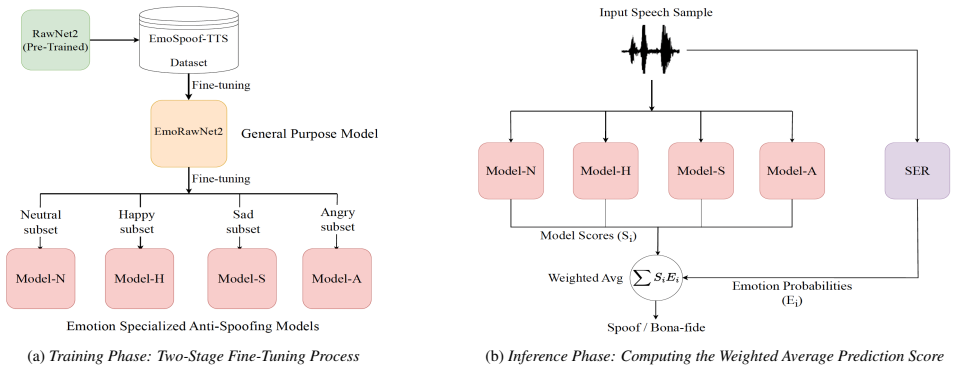
The load-bearing object is GEM's gating equation, $y_s = \sum_i S_i \cdot E_i$, where $S_i$ is the spoof score from the $i$-th emotion-specialized RawNet2 and $E_i$ is the SER model's probability that the input belongs to that emotion. Applying softmax with temperature $T=1.5$ to the SER logits makes the gate soft, letting the most relevant specialist dominate while still blending contributions, acknowledging that emotions are non-orthogonal. The supporting machinery is the EmoSpoof-TTS dataset itself: parallel spoof/bona-fide pairs matched on content, speaker, and emotion across three zero-shot TTS models, which lets the emotion effect be isolated.
What would settle it
Compute GEM's EER on the EmoSpoof-TTS test set using two variants: one with SER-predicted emotion probabilities and one with oracle emotion labels. If oracle gating does not beat SER gating by a wide margin, or if SER accuracy on the synthetic samples is near chance, then the gate is not actually directing weights, and the gains come from ensembling alone. Alternatively, run the same protocol on a fourth zero-shot TTS model (e.g., a codec-based model) or on emotions outside the four trained ones; if GEM's advantage over Emo-RawNet2 disappears or inverts, the method is tuned to this corpus rather than to emotion in general.
Extended reading notes
Core claim
The central discovery is that emotional prosody, not just synthesis quality, breaks current anti-spoofing. On EmoSpoof-TTS, the pre-trained RawNet2's EER for happy, angry, and sad speech combined is 42-44% across StyleTTS2, F5-TTS, and CosyVoice, higher than its 40.67% on ASVspoof 2024; within emotions, sadness is consistently the hardest (up to 47.5%). Fine-tuning on the emotional corpus improves the overall picture (overall EER 9.65%) but leaves a spread from 5.83% (neutral) to 13.67% (sad). The paper further shows that a soft-gated ensemble of emotion-specialized models, with a SER network's emotion probabilities as weights, reaches 5.33% overall EER and shrinks the emotional disparity, coming close to each specialist's best performance on its own emotion.
Load-bearing premise
GEM's performance depends on the external speech-emotion-recognition model, trained on natural podcast speech, correctly recognizing emotions in synthetic TTS output; if it mislabels the emotion, the weights push the decision toward the wrong specialist and the reported gains can shrink or vanish.
Editorial extensions
If this is right
- Emotion-targeted attacks are a real, unaddressed threat: current best models are less reliable on emotional synthetic speech than on ASVspoof 2024 data.
- Emotional training data alone does not fix the problem; Emo-RawNet2 still misclassifies sadness at 13.67% EER while neutral drops to 5.83%.
- A soft-gated ensemble over emotion-specialized models improves overall detection to 5.33% EER and narrows the gap between emotions, without sacrificing neutral performance.
- The released EmoSpoof-TTS corpus provides a speaker- and TTS-disjoint benchmark for future emotion-aware anti-spoofing work.
Reading between the lines
- If the emotion-blindness generalizes, the same failure should appear for emotional voice conversion (e.g., EmoFake-style data) and for unseen zero-shot TTS models; the paper only tests three TTS systems, so the vulnerability is probably wider than measured.
- The gate's ceiling is set by the SER model: whenever the natural-speech-trained SER mislabels a synthesized emotion, the ensemble weights shift to the wrong specialist, so improving SER transfer to synthetic speech is the most direct lever for further gains.
- A testable extension is oracle-gating: feeding true emotion labels instead of SER probabilities would quantify how much of GEM's remaining error is gate error versus specialist error.
- Because the dataset is parallel (same text, speaker, emotion in bona-fide and spoof), it can be mined for emotion-specific acoustic artifacts that neutral anti-spoofing never needed to see.
Editorial analysis
A structured set of objections, weighed in public.
Referee Report
Summary. The paper introduces EmoSpoof-TTS, a dataset of 36,000 emotionally expressive synthetic utterances generated by StyleTTS2, F5-TTS, and CosyVoice from ten ESD speakers across four emotion classes (Happiness, Anger, Sadness, Neutral). The authors evaluate a pre-trained RawNet2 model and show that its equal error rate (EER) on emotional synthetic speech is substantially higher than on ASVspoof 2019/2021, and in most cases higher than on ASVspoof 2024. They then fine-tune RawNet2 on EmoSpoof-TTS (called Emo-RawNet2), observe residual performance disparities across emotions, and propose GEM: a gated ensemble of four emotion-specialized Emo-RawNet2 models whose outputs are weighted by probabilities from an external speech emotion recognition (SER) model. Reported results on the StyleTTS2 test set show GEM reduces overall EER from 9.65% (Emo-RawNet2) to 5.33% and reduces cross-emotion variability. The dataset is publicly released.
Significance. If the GEM gains are genuinely attributable to emotion-based gating, the paper would make a useful contribution by identifying a vulnerability of current anti-spoofing systems to emotionally expressive TTS and by proposing a practical mitigation. The EmoSpoof-TTS corpus itself is a valuable resource: it is speaker- and content-parallel to bona-fide ESD speech, covers three recent zero-shot TTS systems, and the train/validation/test split is held out by speaker and TTS model, which is a methodological strength. The paper also provides machine-checkable reproducibility in the sense that the dataset and the recipes for the baseline models are publicly available. However, the full significance of the method hinges on evidence the manuscript does not currently provide: whether the SER gating, rather than ensemble averaging, drives the improvement, and whether the results extend beyond a single anti-spoofing architecture and a single test TTS model.
major comments (4)
- [§5.3, Eq. (3)] The central claim that emotion-based gating improves anti-spoofing is not established because the paper never compares GEM against a uniform-weight ensemble of the same four specialists, nor against oracle emotion labels, nor reports the SER model's accuracy or confusion matrix on the EmoSpoof-TTS test set. As written, the improvement in Table 4 (GEM EER 5.33 vs Emo-RawNet2 9.65) could result from simple score averaging across the four fine-tuned models rather than from the emotion probabilities used as weights in Eq. (3). Please add a uniform-weight baseline and an oracle-gating experiment, and report SER performance on the synthetic test utterances.
- [§2, §3.2] The abstract and introduction state that 'state-of-the-art anti-spoofing models' are unreliable on emotional synthetic speech, but the only architecture evaluated is RawNet2. No results for AASIST or any other recent countermeasure are presented for the vulnerability analysis or for GEM. Either evaluate additional architectures (at least one) or explicitly scope the claims to RawNet2-based systems throughout the paper.
- [§5.1] The validation-set description is internally inconsistent: it says 'total 4,800 utterances (2,800 bona-fide and 2,800 spoofed)', but 2,800 + 2,800 = 5,600. The train/validation/test splits also do not specify the number of utterances per emotion, per speaker, or per TTS condition, which is needed to reproduce the 4,800/9,600 totals. Please correct the arithmetic and provide a complete partition table.
- [§5.3, Table 4] GEM results are reported only on the StyleTTS2 test set, even though EmoSpoof-TTS contains speech from F5-TTS and CosyVoice. Since the paper claims that GEM 'improves defenses against spoofing attacks' more generally, the lack of held-out results on the other two TTS systems is a substantial gap. Please report GEM performance on test conditions generated by F5-TTS and CosyVoice (with the same speaker- and content-parallel protocol), or justify why only StyleTTS2 is used.
minor comments (6)
- [§3.3] The text says '13.25% for Sadness' but Table 3 lists 13.67%; please reconcile.
- [§3.3] The phrase 'described in section 3.2' refers to Emo-RawNet2, but the fine-tuning procedure is actually described in Section 3.3.
- [§3.2] The sentence 'with EER values higher than those for the ASVspoof 2024 dataset across all TTS models' is not correct for the Neutral condition: StyleTTS2 (39.00%) and F5-TTS (38.08%) are both lower than 40.67%. The statement holds for the HAS and Overall columns, so please qualify it.
- [§5.3, Table 4] Model-H achieves a lower overall EER (5.02%) than GEM (5.33%); the text should acknowledge this trade-off explicitly rather than only emphasizing GEM's balance across emotions.
- [§5.2] The softmax temperature T=1.5 is a hand-set hyperparameter, and no sensitivity analysis is provided; a small plot or table showing EER vs T would help.
- [Throughout] There are numerous typos and grammatical errors, e.g., 'address this limitations', 'V oice', 'we control the softness of this weights', and a reference to 'Figure 1(b)' where Figure 2(b) is meant. A careful proofreading pass is needed.
Circularity Check
No significant circularity: GEM's gating weights come from an externally trained SER, and all key evaluations use held-out speakers and a held-out TTS model.
full rationale
The paper's derivation chain is self-contained. EmoSpoof-TTS is a new corpus built from ESD reference speech and three zero-shot TTS models, so the emotional-robustness claim is not assumed by the corpus construction. The pre-trained RawNet2 evaluation (Table 2) is an external benchmark with no fitted parameters. Emo-RawNet2 and the emotion-specialized models are fine-tuned on train/validation splits, and the test set uses held-out speakers and a different TTS model (StyleTTS2), so their EERs are not forced by construction. GEM's gating weights come from a separately trained SER on MSP-Podcast via the Odyssey 2024 recipe [26]; although [26] shares authors with the present paper, it is an externally benchmarked challenge baseline with provided parameters, not a result fitted to EmoSpoof-TTS. The temperature T=1.5 is a hand-set hyperparameter, not an optimized fit to test labels. No equation in the paper makes a predicted quantity equal to its input by construction, no fitted parameter is renamed as a prediction, and no uniqueness theorem is imported from the authors to force the ensemble choice. The absence of an SER accuracy report on EmoSpoof-TTS and the lack of a uniform-weight ablation are experimental limitations that affect whether the gain can be attributed to emotion gating, but they are not circularity: the reported GEM scores do not reduce to any fitted input or to a self-citation chain.
Assumptions & free parameters
free parameters (1)
- softmax temperature T =
1.5
assumptions (4)
- domain assumption Emotion probabilities from the external SER reliably indicate which emotion-specialized anti-spoofing model is most appropriate for the input.
- domain assumption ESD bona-fide recordings are authentic ground truth for the bona-fide class in EER computation.
- domain assumption Emotions are non-orthogonal, so soft weighting is preferable to hard selection.
- domain assumption The TTS-model split (train CosyVoice, validate F5, test StyleTTS2) gives a fair estimate of generalization to unseen emotional TTS.
Cite this review
Pith. "Pith review of Can Emotion Fool Anti-spoofing?." pith.science (2026). https://pith.science/paper/TZJLZQK6
@misc{pith2026250523962,
  author       = {Pith},
  title        = {Pith review of: Can Emotion Fool Anti-spoofing?},
  year         = {2026},
  howpublished = {\url{https://pith.science/paper/TZJLZQK6}},
  note         = {Machine review of arXiv:2505.23962}
}
read the original abstract
Traditional anti-spoofing focuses on models and datasets built on synthetic speech with mostly neutral state, neglecting diverse emotional variations. As a result, their robustness against high-quality, emotionally expressive synthetic speech is uncertain. We address this by introducing EmoSpoof-TTS, a corpus of emotional text-to-speech samples. Our analysis shows existing anti-spoofing models struggle with emotional synthetic speech, exposing risks of emotion-targeted attacks. Even trained on emotional data, the models underperform due to limited focus on emotional aspect and show performance disparities across emotions. This highlights the need for emotion-focused anti-spoofing paradigm in both dataset and methodology. We propose GEM, a gated ensemble of emotion-specialized models with a speech emotion recognition gating network. GEM performs effectively across all emotions and neutral state, improving defenses against spoofing attacks. We release the EmoSpoof-TTS Dataset: https://emospoof-tts.github.io/Dataset/
Figures

Reference graph
Works this paper leans on
-
[1]
Introduction Anti-spoofing in the speech domain focuses on detecting spoofed speech produced through replay techniques, speech synthesis, and voice conversion [1]. Among these, the misuse of synthetic speech [1, 2] has become a growing concern, es- pecially with advancements in emotionally expressive text-to- speech (TTS) models. Recent TTS models can eff...
-
[2]
Related Work State-of-the-art anti-spoofing models, such as RawNet2 [12] and AASIST [13], are well known for their strong benchmark performance. These models employ an end-to-end architecture, eliminating the need for hand-crafted feature extraction and simplifying implementation. In this study, we select RawNet2 as our baseline anti-spoofing model due to...
work page 2019
-
[3]
Anti-spoofing vs Emotion The state-of-the-art anti-spoofing models are primarily evalu- ated on traditional datasets, which lack emotionally expres- sive speech and do not account for recent advancements in speech synthesis. As a result, they are unreliable with emo- tional speech, making them vulnerable to emotion-targeted at- tacks. This section introdu...
work page 2024
-
[4]
Proposed Method As discussed in Section 3, the performance of traditional anti- spoofing on emotional synthetic speech degrades significantly. Additionally, the uneven performance of anti-spoofing models across different emotions presents a security risk, as attackers Table 3:Performance of Emo-RawNet2 on the EmoSpoof-TTS test set (EER%) EmoSpoof-TTS (tes...
-
[5]
Experiments and Results 5.1. Dataset For the experiments in this paper, we partitioned the dataset into separate training, validation, and test sets based on speakers and TTS models to ensure a fair and unbiased evaluation: •EmoSpoof-TTS Train set: Includes 4 emotion categories and 4 speakers, with data generated byCosyVoice, totaling 9,600 utterances (4,...
-
[6]
Conclusion In this work we explored the effect of emotion on anti-spoofing, revealing emotion-related risks and the need of emotional as- pect for this task in terms of both dataset and methodol- ogy. Our analysis showed current anti-spoofing paradigm with datasets and methods without emotional focus strug- gle with emotion-targeted attacks. To facilitate...
-
[7]
Acknowledgment This work is supported by NSF CAREER award IIS-2338979
-
[8]
Neural codec language models are zero-shot text to speech synthesizers,
S. Chen, C. Wang, Y . Wu, Z. Zhang, L. Zhou, S. Liu, Z. Chen, Y . Liu, H. Wang, J. Li, L. He, S. Zhao, and F. Wei, “Neural codec language models are zero-shot text to speech synthesizers,”IEEE Transactions on Audio, Speech and Language Processing, vol. 33, pp. 705–718, 2025
2025
Show all 35 references
-
[9]
Battling voice spoofing: a review, comparative analysis, and generalizability evaluation of state-of-the-art voice spoofing counter measures,
A. Khan, K. M. Malik, J. Ryan, and M. Saravanan, “Battling voice spoofing: a review, comparative analysis, and generalizability evaluation of state-of-the-art voice spoofing counter measures,” Artificial Intelligence Review, vol. 56, no. Suppl 1, pp. 513–566, 2023
2023
-
[10]
Deepfakes generation and detection: State-of-the-art, open challenges, countermeasures, and way forward,
M. Masood, M. Nawaz, K. M. Malik, A. Javed, A. Irtaza, and H. Malik, “Deepfakes generation and detection: State-of-the-art, open challenges, countermeasures, and way forward,”Applied in- telligence, vol. 53, no. 4, pp. 3974–4026, 2023
2023
-
[11]
Emodiff: Intensity con- trollable emotional text-to-speech with soft-label guidance,
Y . Guo, C. Du, X. Chen, and K. Yu, “Emodiff: Intensity con- trollable emotional text-to-speech with soft-label guidance,” in ICASSP 2023 - 2023 IEEE International Conference on Acous- tics, Speech and Signal Processing (ICASSP), 2023, pp. 1–5
2023
-
[12]
Ed-tts: Multi-scale emotion modeling using cross-domain emotion di- arization for emotional speech synthesis,
H. Tang, X. Zhang, N. Cheng, J. Xiao, and J. Wang, “Ed-tts: Multi-scale emotion modeling using cross-domain emotion di- arization for emotional speech synthesis,” inICASSP 2024 - 2024 IEEE International Conference on Acoustics, Speech and Signal Processing (ICASSP), 2024, pp. ...
2024
-
[13]
Prompttts++: Controlling speaker identity in prompt-based text-to-speech using natural language descriptions,
R. Shimizu, R. Yamamoto, M. Kawamura, Y . Shirahata, H. Doi, T. Komatsu, and K. Tachibana, “Prompttts++: Controlling speaker identity in prompt-based text-to-speech using natural language descriptions,” inICASSP 2024-2024 IEEE Interna- tional Conference on Acoustics, Speech an...
2024
-
[14]
and the Audio Deep Synthesis Detection (ADD) Chal- lenge [15, 16], have been introduced to raise awareness about anti-spoofing. These initiatives have led to the development of large-scale datasets, including ASVspoof 2019 [17], ASVspoof 2021 [18], and ASVspoof 2024 [19], whic...
2019 arXiv
-
[15]
Hierspeech: Bridging the gap between text and speech by hierarchical variational inference using self-supervised representations for speech synthesis,
S.-H. Lee, S.-B. Kim, J.-H. Lee, E. Song, M.-J. Hwang, and S.-W. Lee, “Hierspeech: Bridging the gap between text and speech by hierarchical variational inference using self-supervised representations for speech synthesis,” inAdvances in Neural Information Processing Systems, A...
2022
-
[16]
V oicebox: Text-guided multilingual universal speech generation at scale,
M. Le, A. Vyas, B. Shi, B. Karrer, L. Sari, R. Moritz, M. Williamson, V . Manohar, Y . Adi, J. Mahadeokar, and W.-N. Hsu, “V oicebox: Text-guided multilingual universal speech generation at scale,” inThirty-seventh Conference on Neural Information Processing Systems, 2023. [On...
2023
-
[17]
Styletts 2: Towards human-level text-to-speech through style diffusion and adversarial training with large speech language models,
Y . A. Li, C. Han, V . Raghavan, G. Mischler, and N. Mes- garani, “Styletts 2: Towards human-level text-to-speech through style diffusion and adversarial training with large speech language models,” inAdvances in Neural Informa- tion Processing Systems, A. Oh, T. Naumann, A. G...
2023
-
[18]
F5-tts: A fairytaler that fakes fluent and faithful speech with flow matching,
Y . Chen, Z. Niu, Z. Ma, K. Deng, C. Wang, J. Zhao, K. Yu, and X. Chen, “F5-tts: A fairytaler that fakes fluent and faithful speech with flow matching,”arXiv preprint arXiv:2410.06885, 2024
2024 arXiv
-
[19]
Cosyvoice: A scalable multi- lingual zero-shot text-to-speech synthesizer based on supervised semantic tokens,
Z. Du, Q. Chen, S. Zhang, K. Hu, H. Lu, Y . Yang, H. Hu, S. Zheng, Y . Gu, Z. Maet al., “Cosyvoice: A scalable multi- lingual zero-shot text-to-speech synthesizer based on supervised semantic tokens,”arXiv preprint arXiv:2407.05407, 2024
2024 arXiv
-
[20]
End-to-end anti-spoofing with rawnet2,
H. Tak, J. Patino, M. Todisco, A. Nautsch, N. Evans, and A. Larcher, “End-to-end anti-spoofing with rawnet2,” inICASSP 2021 - 2021 IEEE International Conference on Acoustics, Speech and Signal Processing (ICASSP), 2021, pp. 6369–6373
2021
-
[21]
Aasist: Audio anti-spoofing using in- tegrated spectro-temporal graph attention networks,
J.-w. Jung, H.-S. Heo, H. Tak, H.-j. Shim, J. S. Chung, B.-J. Lee, H.-J. Yu, and N. Evans, “Aasist: Audio anti-spoofing using in- tegrated spectro-temporal graph attention networks,” inICASSP 2022 - 2022 IEEE International Conference on Acoustics, Speech and Signal Processing ...
2022
-
[22]
Asvspoof 2015: Automatic speaker verification spoofing and countermea- sures challenge evaluation plan,
Z. Wu, T. Kinnunen, N. Evans, and J. Yamagishi, “Asvspoof 2015: Automatic speaker verification spoofing and countermea- sures challenge evaluation plan,”Training, vol. 10, no. 15, p. 3750, 2014
2015
-
[23]
Add 2022: the first audio deep synthe- sis detection challenge,
J. Yi, R. Fu, J. Tao, S. Nie, H. Ma, C. Wang, T. Wang, Z. Tian, Y . Bai, C. Fan, S. Liang, S. Wang, S. Zhang, X. Yan, L. Xu, Z. Wen, and H. Li, “Add 2022: the first audio deep synthe- sis detection challenge,” inICASSP 2022 - 2022 IEEE Interna- tional Conference on Acoustics, ...
2022
-
[24]
Add 2023: the second audio deepfake detection challenge,
J. Yi, J. Tao, R. Fu, X. Yan, C. Wang, T. Wang, C. Y . Zhang, X. Zhang, Y . Zhao, Y . Renet al., “Add 2023: the second audio deepfake detection challenge,”arXiv preprint arXiv:2305.13774, 2023
2023 arXiv
-
[25]
Asvspoof 2019: A large-scale public database of synthesized, converted and replayed speech,
X. Wang, J. Yamagishi, M. Todisco, H. Delgado, A. Nautsch, N. Evans, M. Sahidullah, V . Vestman, T. Kinnunen, K. A. Lee, L. Juvela, P. Alku, Y .-H. Peng, H.-T. Hwang, Y . Tsao, H.-M. Wang, S. L. Maguer, M. Becker, F. Henderson, R. Clark, Y . Zhang, Q. Wang, Y . Jia, K. Onuma, ...
2019
-
[26]
Asvspoof 2021: Towards spoofed and deepfake speech de- tection in the wild,
X. Liu, X. Wang, M. Sahidullah, J. Patino, H. Delgado, T. Kin- nunen, M. Todisco, J. Yamagishi, N. Evans, A. Nautsch, and K. A. Lee, “Asvspoof 2021: Towards spoofed and deepfake speech de- tection in the wild,”IEEE/ACM Transactions on Audio, Speech, and Language Processing, vo...
2021
-
[27]
Asvspoof 5: Crowdsourced speech data, deepfakes, and adversarial attacks at scale,
X. Wang, H. Delgado, H. Tak, J.-w. Jung, H.-j. Shim, M. Todisco, I. Kukanov, X. Liu, M. Sahidullah, T. Kinnunenet al., “Asvspoof 5: Crowdsourced speech data, deepfakes, and adversarial attacks at scale,”arXiv preprint arXiv:2408.08739, 2024
2024 arXiv
-
[28]
Light convolutional neu- ral network with feature genuinization for detection of synthetic speech attacks,
Z. Wu, R. K. Das, J. Yang, and H. Li, “Light convolutional neu- ral network with feature genuinization for detection of synthetic speech attacks,”arXiv preprint arXiv:2009.09637, 2020
2009 arXiv
-
[29]
Assert: Anti- spoofing with squeeze-excitation and residual networks,
C.-I. Lai, N. Chen, J. Villalba, and N. Dehak, “Assert: Anti- spoofing with squeeze-excitation and residual networks,”arXiv preprint arXiv:1904.01120, 2019
1904 arXiv
-
[30]
Spoof detection using voice contribution on lfcc features and resnet-34,
K. Z. Mon, K. Galajit, C. O. Mawalim, J. Karnjana, T. Isshiki, and P. Aimmanee, “Spoof detection using voice contribution on lfcc features and resnet-34,” in2023 18th International Joint Sympo- sium on Artificial Intelligence and Natural Language Processing (iSAI-NLP). IEEE, 2...
2023
-
[31]
Emofake: An initial dataset for emotion fake audio detection,
Y . Zhao, J. Yi, J. Tao, C. Wang, and Y . Dong, “Emofake: An initial dataset for emotion fake audio detection,” inChina National Con- ference on Chinese Computational Linguistics. Springer, 2024, pp. 419–433
2024
-
[32]
Seen and unseen emo- tional style transfer for voice conversion with a new emotional speech dataset,
K. Zhou, B. Sisman, R. Liu, and H. Li, “Seen and unseen emo- tional style transfer for voice conversion with a new emotional speech dataset,” inICASSP 2021 - 2021 IEEE International Con- ference on Acoustics, Speech and Signal Processing (ICASSP), 2021, pp. 920–924
2021
-
[33]
Exploiting co-occurrence frequency of emotions in perceptual evaluations to train a speech emotion classifier,
H.-C. Chou, C.-C. Lee, and C. Busso, “Exploiting co-occurrence frequency of emotions in perceptual evaluations to train a speech emotion classifier,”Interspeech 2022, 2022
2022
-
[34]
Odyssey 2024-speech emotion recognition challenge: Dataset, baseline framework, and results,
L. Goncalves, A. N. Salman, A. R. Naini, L. M. Velazquez, T. Thebaud, L. P. Garcia, N. Dehak, B. Sisman, and C. Busso, “Odyssey 2024-speech emotion recognition challenge: Dataset, baseline framework, and results,”Development, vol. 10, no. 9,290, pp. 4–54, 2024
2024
-
[35]
Building naturalistic emotionally bal- anced speech corpus by retrieving emotional speech from existing podcast recordings,
R. Lotfian and C. Busso, “Building naturalistic emotionally bal- anced speech corpus by retrieving emotional speech from existing podcast recordings,”IEEE Transactions on Affective Computing, vol. 10, no. 4, pp. 471–483, 2019
2019
Reviewed August 7, 2026 · model on record in the stance chip above.
Discussion (0). Sign in to comment.