REVIEW 5 major objections 6 minor 77 references
EffiVLM-BENCH: A Comprehensive Benchmark for Evaluating Training-Free Acceleration in Large Vision-Language Models
T0 review · 5 major / 6 minor · reviewed 2026-08-07 · deepseek-v4-flash
Pith's one-line read EffiVLM-Bench shows training-free LVLM acceleration is best chosen by task: vision-guided token pruning wins at extreme budgets, KV-cache compression wins on loyalty, and quantization preserves performance best.
desk verdict Useful benchmark of LVLM acceleration methods, but the central ranking needs the loyalty metric and reimplementation details pinned down before the numbers become citable. read the letter →
The pith
A machine-rendered reading of the paper's core claim, the machinery that carries it, and where it could break.
The reading
What carries the argument
The carrying object is the benchmark suite itself together with its four standardized metrics: overall performance $OP_{m,c}$ (RMS of per-benchmark relative scores), generalization $OG_c$ (coefficient of variation of relative performance across benchmarks), loyalty $OL_c$ (agreement between compressed and original predictions), and efficiency $OE_c$ (measured latency speedup). EffiVLM-Bench fixes uniform token-retention and KV-cache budgets across layers (1%, 5%, 10%, 20%, 40%) and uses three LVLMs—LLaVA-OneVision-7B, Qwen2-VL-7B, and InternVL2.5-38B—across 17 single-image, multi-image, and video benchmarks. That machinery lets the paper attribute differences to the compression mechanism rather than to model or task, and it supports the ablations (sink-token retention, layer-adaptive vs uniform budgets, head-adaptive selection, within-modality merging) that explain the observed rankings.
What would settle it
Run FastV at a 1% budget on LLaVA-OneVision-7B using its original per-layer adaptive budget and decoding-time eviction rules instead of the benchmark's uniform allocation, and compare on DocVQA and OCRBench; if FastV then matches or beats VisionZip's roughly 75% relative performance (versus 48%), the claim that vision-guided pruning is intrinsically better at extreme budgets would be overturned.
Extended reading notes
Core claim
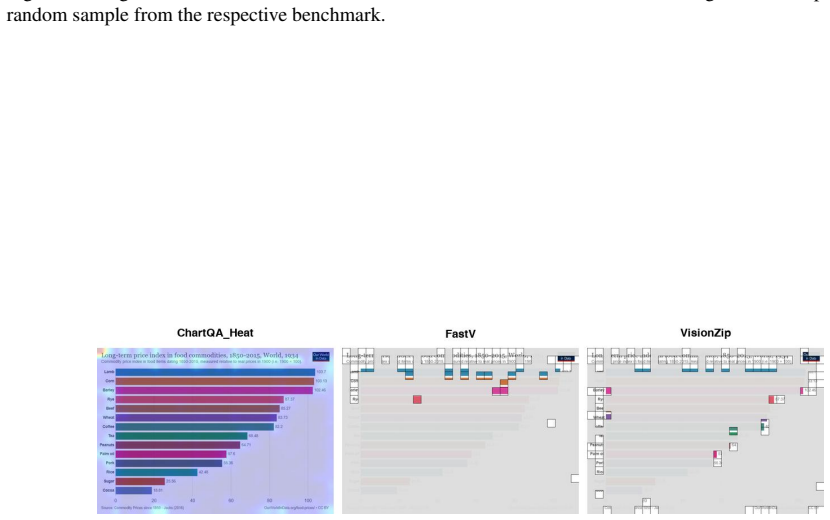
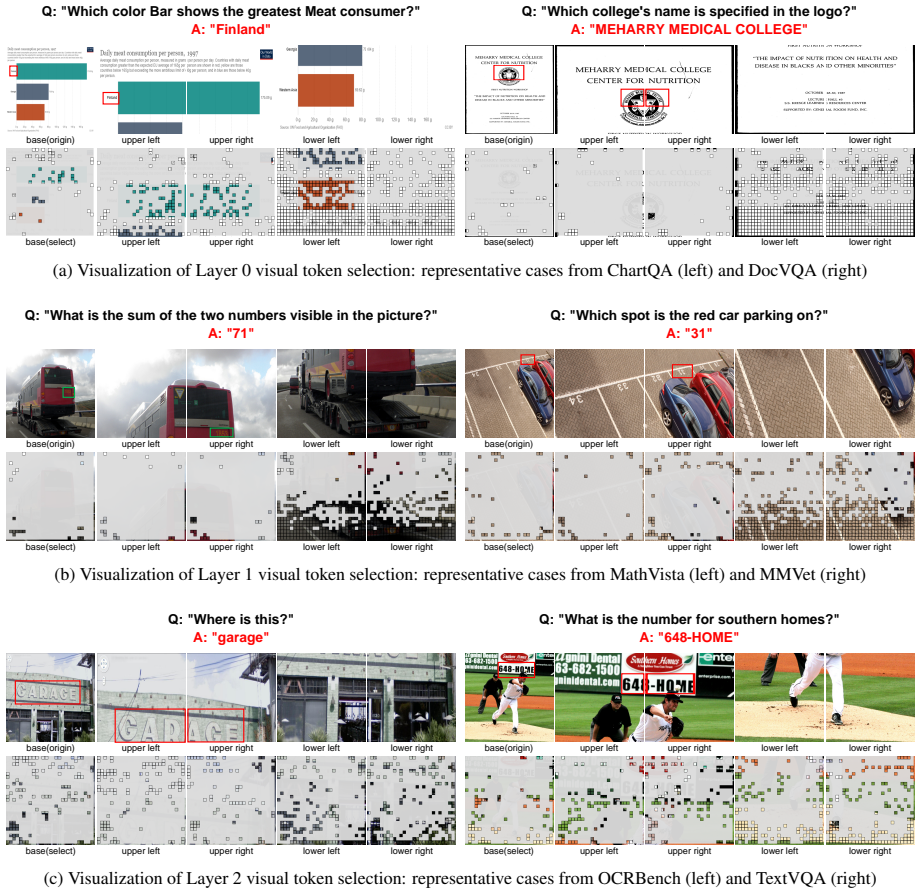
On the paper's own terms, the central discovery is that token-compression behavior in LVLMs is budget- and task-dependent, with a sharp divide at low budgets: pruning visual tokens inside the vision encoder (VisionZip, PruMerge+) retains far more relative performance than pruning inside the LLM using text-guided attention (FastV)—for instance 75% vs 48% on LLaVA-OneVision-7B at a 1% budget—because text-guided selection tends to discard visual "sink" tokens that carry disproportionate weight. KV cache compression methods (H2O, SnapKV, PyramidKV, VL-Cache) show better generalization across benchmarks and better loyalty to the original model's predictions than token pruning, at the cost of limited time-to-first-token speedup. Parameter compression (pruning and quantization) preserves overall performance much better than token compression even at 50% or 2:4 sparsity, with AWQ/GPTQ quantization ahead of pruning, and it combines orthogonally with token compression. The paper further argues that layer-adaptive budget allocation is not automatically beneficial in LVLMs—aggressive front-loading of early layers starves later ones—and that head-adaptive token selection and modality-specific merging of evicted tokens both help.
Load-bearing premise
The rankings rest on the assumption that the benchmark's standardized reimplementations of each published method preserve what made each method work; if the uniform budgets across layers and the decision not to evict during decoding misrepresent a method's original design, the relative ordering—and the main observations—could change.
Editorial extensions
If this is right
- For short-answer VQA at low budgets, vision-encoder-guided token pruning should be preferred because it cuts time-to-first-token by up to about 3.2× while keeping far more accuracy than text-guided pruning.
- For long-output tasks like LLaVA-Wilder or ImageDC, KV-cache compression is the safer choice: better loyalty and generalization, with decoding speedups comparable to token pruning.
- Parameter compression via quantization (AWQ, GPTQ) preserves performance well enough to be applied before token pruning, and the two can be stacked—combining AWQ with SnapKV gives a 1.65× speedup over AWQ alone at roughly stable performance.
- Layer-adaptive KV budgets should be rebalanced: an 80% uniform / 20% adaptive split outperforms the fully adaptive VL-Cache allocation at 5% budget on document and OCR tasks.
- Head-adaptive token selection improves KV-cache compression at 1% budgets across H2O, SnapKV, and VL-Cache, so shared-head selection is a needless handicap under extreme compression.
Reading between the lines
- Going beyond the paper, the sink-token mechanism predicts that any text-guided pruning method—not just FastV—can be repaired by explicitly reserving a small fraction of the budget for the highest-attention visual tokens; that is directly testable on the benchmark's own 1% setting.
- If the Pareto-front observations transfer, task statistics (input token count, expected output length, image resolution) could be fed into a simple decision rule that picks between token pruning and KV-cache compression without per-method tuning, which the paper does not itself propose.
- The loyalty metric, measured here on generative tasks, could be used as a cheap proxy for detecting compression-induced hallucination or task shift on new benchmarks, since low $OL_c$ flags when a method changes what the model would have said.
- The finding that LLaVA-OneVision (thousands of visual tokens) tolerates 1% budgets better than Qwen2-VL (fewer tokens) suggests a token-count-normalized budget, rather than a fixed percentage, is the fairer comparison across architectures; the paper reports the raw numbers but does not draw this design recommendation.
Editorial analysis
A structured set of objections, weighed in public.
Referee Report
Summary. The paper introduces EffiVLM-Bench, a unified evaluation framework for training-free acceleration of large vision-language models (LVLMs). It evaluates token pruning (FastV, VisionZip, PruMerge+, plus iLLaVA and SparseVLM in the appendix), KV-cache compression (StreamingLLM, H2O, SnapKV, PyramidKV, LOOK-M, VL-Cache), and parameter compression (EcoFLAP, Wanda, SparseGPT, AWQ, GPTQ) across three LVLMs and 17 benchmarks. The paper defines four metrics—performance (OP), generalization (OG), loyalty (OL), and efficiency (OE)—and reports extensive tables and Pareto-style trade-off analyses. Its main observations are that vision-encoder-guided token pruning outperforms text-guided pruning at very low budgets, that KV-cache compression methods generalize better and are more loyal than token pruning methods, that the choice between pruning and cache compression depends on the TTFT versus decoding bottleneck, and that these trends extend to multi-image and video tasks. The paper also proposes a hybrid layer-budget allocation for VL-Cache and a modality-specific merge variant of LOOK-M.
Significance. If the empirical claims are made fully verifiable, this would be a useful benchmark contribution. The paper broadens the evaluation of training-free LVLM acceleration beyond a single architecture and accuracy metric, and the analyses of layer/head adaptivity, visual attention sinks, and cross-modal merging generate concrete, testable hypotheses for method design. The experimental scope is large—three model families, 17 benchmarks, and both token- and parameter-level methods—and the appendix contains abundant raw results that can support future comparisons. However, the central ranking currently rests on an underspecified loyalty metric, a generalization metric that does not measure cross-model variance as claimed, and a reimplementation harness whose exact modifications to published methods are not described. The paper also promises open-source code but provides only a project page URL. These issues must be resolved before the headline observations can be relied upon.
major comments (5)
- [Section 3.1, Eq. (3)] The loyalty metric OLc is defined as the expectation of I(P^{m,c}_b, P^m_b), but the agreement function I(P1,P2) is never specified anywhere in the paper. The Table 2 caption further states that loyalty is computed on a subset (MathVista, LLaVA-Wilder, MMVet), which is inconsistent with the all-benchmark expectation in Eq. (3). Because Observation 2's claim that KV-cache compression is more loyal than token pruning depends directly on this metric, the paper must define I concretely (e.g., exact-match accuracy, token-level F1, or a GPT-judged similarity score), state how predictions were collected and compared, and report the per-benchmark loyalty values.
- [Section 3.1, Eq. (2)] The generalization metric OGc is introduced as the coefficient of variation 'across benchmarks and models,' but the formula applies σb only after averaging over models inside the numerator, while the denominator is a pooled average over b and m. Model-to-model variation therefore never enters the variance term; a method that is stable across benchmarks but highly unstable across models would receive the same OG as one that is stable across both. Please either redefine OG to include a total or two-way variance over (b,m), or revise the prose to say that generalization is measured across benchmarks after model-averaging. The current definition weakens the cross-model component of Observation 2.
- [Appendix A.4 and Section 4.1] The paper states that 'we standardize average token retention rates across layers' and that methods were 'adapted consistently across all evaluated LVLMs,' but it never specifies what this standardization does to FastV. In the original FastV, visual tokens are pruned once after the second LLM layer and the same subset is used for all subsequent layers; if the harness instead re-selects tokens or enforces a per-layer budget in every layer, the 1% rankings in Table 1 could be an artifact of the harness rather than a property of the algorithms. Please provide the exact adaptation for each method (layer index, re-selection schedule, threshold computation), release the code and configuration files, and include a sensitivity check showing that the qualitative rankings are unchanged when each method is run in its original unmodified form where feasible.
- [Section 5.1, Table 5] The hybrid allocation strategy is introduced and the U-80% variant is selected as best on the same set of benchmarks and models (LLaVA-OneVision-7B and Qwen2-VL-7B) that are then used to demonstrate its benefit. Because the choice among A-Only, U-40%, and U-80% is made after seeing these results, the comparison is subject to selection-on-the-test-set bias. Table 5 also omits InternVL2.5-38B, so the cross-model generality of the recommendation is not established. Please validate the strategy on held-out benchmarks/models or report it explicitly as a post-hoc observation rather than a tested recommendation.
- [Section 4.1, Tables 1 and 15] Headline point estimates such as 'FastV retains 48% while VisionZip retains 75%' are reported without error bars, repeated runs, or seed information, and several benchmarks (MathVista, MMVet, LLaVA-Wilder, ImageDC) use GPT-based scoring that is stochastic. For a benchmark whose purpose is comparative ranking, at least the headline numbers in Tables 1 and 2 need variance estimates, such as bootstrap over evaluation samples or multiple evaluation runs, to establish that the observed gaps are not within noise.
minor comments (6)
- [Section 3.1, Eq. (4)] The efficiency metric uses T^{m,c}_b in the displayed equation but the prose refers to T^{*,c} and T^{*}; please harmonize the notation.
- [Section 4.2, Observation 5] The sentence 'the two types of compression are orthogonal that can be effectively combined, Crucially, these two compression types are orthogonal...' is duplicated and grammatically broken; please fix.
- [Section 5.3, Table 7] The ablation requires a definition of the 'top 10% most critical visual tokens'; without specifying how this set is computed, the evidence for the visual-sink hypothesis cannot be evaluated.
- [Appendix A.4] Please report the lmms-eval version and the exact prompt templates used for GPT-scored benchmarks, since those scores are prompt-sensitive and important for reproducibility.
- [References] The H2O reference appears twice as Zhang et al. 2023a and Zhang et al. 2023b; please consolidate and ensure all citations have complete bibliographic information.
- [Title and abstract] The benchmark name is rendered inconsistently as 'EffiVLM-Bench' and 'EFFIVLM-B ENCH'; please choose one consistent spelling.
Circularity Check
No significant circularity: the paper benchmarks external methods on external benchmarks; the U-80% hybrid and LOOK-M ablations are empirical comparisons, not fitted predictions, and self-citations are non-load-bearing.
full rationale
EffiVLM-BENCH is a comparative benchmark study. The central observations (Observations 1-5) are empirical rankings of externally published token-pruning, KV-cache, pruning, and quantization methods measured on standard benchmarks through the transparent normalized metrics of Eqs. (1)-(4). No target result is derived from a fitted parameter, and no evaluation quantity is defined in terms of the conclusion it supports. The Section 5.1 hybrid allocation experiment compares three allocation variants (A-Only, U-40%, U-80%) and reports which performed best on the same table; this is an exploratory ablation, not a prediction validated on withheld data, so it does not constitute a fit-then-predict cycle. The Section 5.3 attention-sink ablations and Section 5.4 LOOK-M modality-specific merging are controlled interventions that test stated hypotheses rather than renaming or re-deriving the hypotheses. The paper's Limitations section openly confines scope to a subset of models, tasks, and training-free methods, which is a scope limitation, not circularity. The only self-citations (e.g., Wang et al., 2024b for avoiding structured pruning without recovery training, and Qiu et al., 2025 as future work) are ancillary and not used to force the paper's conclusions. The undefined agreement function I in Eq. (3) is an incompleteness or correctness concern, not a circular reduction. Because no load-bearing step reduces by definition or by self-citation to its own output, the appropriate circularity score is 0.
Assumptions & free parameters
free parameters (2)
- Recent-window fraction for KV compression =
10%
- Hybrid allocation uniform fraction U =
40% and 80% tested, 80% best
assumptions (3)
- domain assumption Benchmark accuracy and GPT-based scores measure capability relevant to deployment
- domain assumption The 128-sample COCO-Caption set is adequate for pruning and quantization calibration
- domain assumption Excluding decoding-time KV compression isolates the prefill effect fairly
Cite this review
Pith. "Pith review of EffiVLM-BENCH: A Comprehensive Benchmark for Evaluating Training-Free Acceleration in Large Vision-Language Models." pith.science (2026). https://pith.science/paper/CKRBALEE
@misc{pith2026250600479,
  author       = {Pith},
  title        = {Pith review of: EffiVLM-BENCH: A Comprehensive Benchmark for Evaluating Training-Free Acceleration in Large Vision-Language Models},
  year         = {2026},
  howpublished = {\url{https://pith.science/paper/CKRBALEE}},
  note         = {Machine review of arXiv:2506.00479}
}
read the original abstract
Large Vision-Language Models (LVLMs) have achieved remarkable success, yet their significant computational demands hinder practical deployment. While efforts to improve LVLM efficiency are growing, existing methods lack comprehensive evaluation across diverse backbones, benchmarks, and metrics. In this work, we systematically evaluate mainstream acceleration techniques for LVLMs, categorized into token and parameter compression. We introduce EffiVLM-Bench, a unified framework for assessing not only absolute performance but also generalization and loyalty, while exploring Pareto-optimal trade-offs. Our extensive experiments and in-depth analyses offer insights into optimal strategies for accelerating LVLMs. We open-source code and recipes for EffiVLM-Bench to foster future research.
Figures


Figures from the paper (6 more)




Reference graph
Works this paper leans on
-
[1]
Yongqi An, Xu Zhao, Tao Yu, Ming Tang, and Jinqiao Wang. 2024. https://doi.org/10.1609/aaai.v38i10.28960 Fluctuation-based adaptive structured pruning for large language models . In Thirty-Eighth AAAI Conference on Artificial Intelligence, AAAI 2024, Thirty-Sixth Conference on Innovative Applications of Artificial Intelligence, IAAI 2024, Fourteenth Sympo...
-
[2]
Anthropic. 2024. https://www.anthropic.com/news/developing-computer-use Developing a computer use model
work page 2024
-
[3]
Token merging: Your vit but faster
Daniel Bolya, Cheng-Yang Fu, Xiaoliang Dai, Peizhao Zhang, Christoph Feichtenhofer, and Judy Hoffman. Token merging: Your vit but faster. In The Eleventh International Conference on Learning Representations
-
[4]
Yuxuan Cai, Jiangning Zhang, Haoyang He, Xinwei He, Ao Tong, Zhenye Gan, Chengjie Wang, and Xiang Bai. 2024 a . https://doi.org/10.48550/ARXIV.2410.16236 Llava-kd: A framework of distilling multimodal large language models . CoRR, abs/2410.16236
-
[5]
Zefan Cai, Yichi Zhang, Bofei Gao, Yuliang Liu, Tianyu Liu, Keming Lu, Wayne Xiong, Yue Dong, Baobao Chang, Junjie Hu, and 1 others. 2024 b . Pyramidkv: Dynamic kv cache compression based on pyramidal information funneling. arXiv preprint arXiv:2406.02069
arXiv 2024
-
[6]
Junbum Cha, Wooyoung Kang, Jonghwan Mun, and Byungseok Roh. 2024. Honeybee: Locality-enhanced projector for multimodal LLM . In IEEE/CVF Conference on Computer Vision and Pattern Recognition, CVPR 2024, Seattle, WA, USA, June 16-22, 2024 , pages 13817--13827. IEEE
work page 2024
-
[7]
Guiming Hardy Chen, Shunian Chen, Ruifei Zhang, Junying Chen, Xiangbo Wu, Zhiyi Zhang, Zhihong Chen, Jianquan Li, Xiang Wan, and Benyou Wang. 2024 a . Allava: Harnessing gpt4v-synthesized data for A lite vision-language model. CoRR, abs/2402.11684
arXiv 2024
-
[8]
Liang Chen, Haozhe Zhao, Tianyu Liu, Shuai Bai, Junyang Lin, Chang Zhou, and Baobao Chang. 2024 b . An image is worth 1/2 tokens after layer 2: Plug-and-play inference acceleration for large vision-language models. In European Conference on Computer Vision, pages 19--35. Springer
work page 2024
Show all 77 references
-
[9]
Lin Chen, Jinsong Li, Xiaoyi Dong, Pan Zhang, Yuhang Zang, Zehui Chen, Haodong Duan, Jiaqi Wang, Yu Qiao, Dahua Lin, and 1 others. 2024 c . Are we on the right way for evaluating large vision-language models? arXiv preprint arXiv:2403.20330
2024 arXiv
-
[10]
Lawrence Zitnick
Xinlei Chen, Hao Fang, Tsung-Yi Lin, Ramakrishna Vedantam, Saurabh Gupta, Piotr Doll \'a r, and C. Lawrence Zitnick. 2015. https://api.semanticscholar.org/CorpusID:2210455 Microsoft coco captions: Data collection and evaluation server . ArXiv, abs/1504.00325
2015 arXiv
-
[11]
Zhe Chen, Weiyun Wang, Yue Cao, Yangzhou Liu, Zhangwei Gao, Erfei Cui, Jinguo Zhu, Shenglong Ye, Hao Tian, Zhaoyang Liu, and 1 others. 2024 d . Expanding performance boundaries of open-source multimodal models with model, data, and test-time scaling. arXiv preprint arXiv:2412.05271
2024 arXiv
-
[12]
Xiangxiang Chu, Limeng Qiao, Xinyang Lin, Shuang Xu, Yang Yang, Yiming Hu, Fei Wei, Xinyu Zhang, Bo Zhang, Xiaolin Wei, and 1 others. 2023. Mobilevlm: A fast, reproducible and strong vision language assistant for mobile devices. arXiv preprint arXiv:2312.16886
2023 arXiv
-
[13]
Tri Dao. 2024. Flash A ttention-2: Faster attention with better parallelism and work partitioning. In International Conference on Learning Representations (ICLR)
2024
-
[14]
Timoth \' e e Darcet, Maxime Oquab, Julien Mairal, and Piotr Bojanowski. 2024. Vision transformers need registers. In The Twelfth International Conference on Learning Representations, ICLR 2024, Vienna, Austria, May 7-11, 2024 . OpenReview.net
2024
-
[15]
Mostafa Dehghani, Basil Mustafa, Josip Djolonga, Jonathan Heek, Matthias Minderer, Mathilde Caron, Andreas Steiner, Joan Puigcerver, Robert Geirhos, Ibrahim M Alabdulmohsin, and 1 others. 2023. Patch n’pack: Navit, a vision transformer for any aspect ratio and resolution. Adva...
2023
- [16]
-
[17]
Elias Frantar and Dan Alistarh. 2023. Sparsegpt: Massive language models can be accurately pruned in one-shot. In International Conference on Machine Learning, pages 10323--10337. PMLR
2023
-
[18]
Elias Frantar, Saleh Ashkboos, Torsten Hoefler, and Dan Alistarh. 2022. Gptq: Accurate post-training quantization for generative pre-trained transformers. arXiv preprint arXiv:2210.17323
2022 arXiv
-
[19]
Chaoyou Fu, Peixian Chen, Yunhang Shen, Yulei Qin, Mengdan Zhang, Xu Lin, Jinrui Yang, Xiawu Zheng, Ke Li, Xing Sun, Yunsheng Wu, and Rongrong Ji. 2024. https://arxiv.org/abs/2306.13394 Mme: A comprehensive evaluation benchmark for multimodal large language models . Preprint, ...
2024 arXiv
-
[20]
Suyu Ge, Yunan Zhang, Liyuan Liu, Minjia Zhang, Jiawei Han, and Jianfeng Gao. 2024. Model tells you what to discard: Adaptive KV cache compression for llms. In The Twelfth International Conference on Learning Representations, ICLR 2024, Vienna, Austria, May 7-11, 2024 . OpenReview.net
2024
-
[21]
Lianyu Hu, Fanhua Shang, Liang Wan, and Wei Feng. 2024. illava: An image is worth fewer than 1/3 input tokens in large multimodal models. CoRR, abs/2412.06263
2024
-
[22]
Wenxuan Huang, Zijie Zhai, Yunhang Shen, Shaoshen Cao, Fei Zhao, Xiangfeng Xu, Zheyu Ye, and Shaohui Lin. 2024. Dynamic-llava: Efficient multimodal large language models via dynamic vision-language context sparsification. arXiv preprint arXiv:2412.00876
2024 arXiv
-
[23]
Drew A Hudson and Christopher D Manning. 2019. Gqa: A new dataset for real-world visual reasoning and compositional question answering. In Proceedings of the IEEE/CVF conference on computer vision and pattern recognition, pages 6700--6709
2019
-
[24]
Aniruddha Kembhavi, Mike Salvato, Eric Kolve, Minjoon Seo, Hannaneh Hajishirzi, and Ali Farhadi. 2016. https://arxiv.org/abs/1603.07396 A diagram is worth a dozen images . Preprint, arXiv:1603.07396
2016 arXiv
-
[25]
Bo Li, Kaichen Zhang, Hao Zhang, Dong Guo, Renrui Zhang, Feng Li, Yuanhan Zhang, Ziwei Liu, and Chunyuan Li. 2024 a . https://llava-vl.github.io/blog/2024-05-10-llava-next-stronger-llms/ Llava-next: Stronger llms supercharge multimodal capabilities in the wild
2024
-
[26]
Bo Li, Yuanhan Zhang, Dong Guo, Renrui Zhang, Feng Li, Hao Zhang, Kaichen Zhang, Peiyuan Zhang, Yanwei Li, Ziwei Liu, and 1 others. 2024 b . Llava-onevision: Easy visual task transfer. arXiv preprint arXiv:2408.03326
2024 arXiv
-
[27]
Wentong Li, Yuqian Yuan, Jian Liu, Dongqi Tang, Song Wang, Jie Qin, Jianke Zhu, and Lei Zhang. 2024 c . Tokenpacker: Efficient visual projector for multimodal llm. arXiv preprint arXiv:2407.02392
2024 arXiv
-
[28]
Yanwei Li, Yuechen Zhang, Chengyao Wang, Zhisheng Zhong, Yixin Chen, Ruihang Chu, Shaoteng Liu, and Jiaya Jia. 2024 d . Mini-gemini: Mining the potential of multi-modality vision language models. arXiv preprint arXiv:2403.18814
2024 arXiv
-
[29]
Yuhong Li, Yingbing Huang, Bowen Yang, Bharat Venkitesh, Acyr Locatelli, Hanchen Ye, Tianle Cai, Patrick Lewis, and Deming Chen. 2024 e . Snapkv: Llm knows what you are looking for before generation. arXiv preprint arXiv:2404.14469
2024 arXiv
-
[30]
Yunxin Li, Zhenyu Liu, Zitao Li, Xuanyu Zhang, Zhenran Xu, Xinyu Chen, Haoyuan Shi, Shenyuan Jiang, Xintong Wang, Jifang Wang, Shouzheng Huang, Xinping Zhao, Borui Jiang, Lanqing Hong, Longyue Wang, Zhuotao Tian, Baoxing Huai, Wenhan Luo, Weihua Luo, and 3 others. 2025. Percep...
2025 arXiv
-
[31]
Ji Lin, Jiaming Tang, Haotian Tang, Shang Yang, Wei-Ming Chen, Wei-Chen Wang, Guangxuan Xiao, Xingyu Dang, Chuang Gan, and Song Han. 2024. Awq: Activation-aware weight quantization for on-device llm compression and acceleration. Proceedings of Machine Learning and Systems, 6:87--100
2024
-
[32]
Haotian Liu, Chunyuan Li, Yuheng Li, and Yong Jae Lee. 2024 a . Improved baselines with visual instruction tuning. In IEEE/CVF Conference on Computer Vision and Pattern Recognition, CVPR 2024, Seattle, WA, USA, June 16-22, 2024 , pages 26286--26296
2024
-
[33]
Haotian Liu, Chunyuan Li, Qingyang Wu, and Yong Jae Lee. 2023. Visual instruction tuning. In Advances in Neural Information Processing Systems 36: Annual Conference on Neural Information Processing Systems 2023, NeurIPS 2023, New Orleans, LA, USA, December 10 - 16, 2023
2023
-
[34]
Yuan Liu, Haodong Duan, Yuanhan Zhang, Bo Li, Songyang Zhang, Wangbo Zhao, Yike Yuan, Jiaqi Wang, Conghui He, Ziwei Liu, Kai Chen, and Dahua Lin. 2024 b . https://arxiv.org/abs/2307.06281 Mmbench: Is your multi-modal model an all-around player? Preprint, arXiv:2307.06281
2024 arXiv
-
[35]
Yuliang Liu, Zhang Li, Mingxin Huang, Biao Yang, Wenwen Yu, Chunyuan Li, Xu-Cheng Yin, Cheng-Lin Liu, Lianwen Jin, and Xiang Bai. 2024 c . https://doi.org/10.1007/s11432-024-4235-6 Ocrbench: on the hidden mystery of ocr in large multimodal models . Science China Information Sc...
2024 doi
- [36]
- [37]
-
[38]
Pan Lu, Hritik Bansal, Tony Xia, Jiacheng Liu, Chunyuan Li, Hannaneh Hajishirzi, Hao Cheng, Kai-Wei Chang, Michel Galley, and Jianfeng Gao. 2024 b . Mathvista: Evaluating mathematical reasoning of foundation models in visual contexts. In International Conference on Learning Re...
2024
- [39]
-
[40]
Ahmed Masry, Do Xuan Long, Jia Qing Tan, Shafiq Joty, and Enamul Hoque. 2022. Chartqa: A benchmark for question answering about charts with visual and logical reasoning. arXiv preprint arXiv:2203.10244
2022 arXiv
-
[41]
Minesh Mathew, Dimosthenis Karatzas, R Manmatha, and CV Jawahar. 2020. Docvqa: A dataset for vqa on document images. corr abs/2007.00398 (2020). arXiv preprint arXiv:2007.00398
2020 arXiv
-
[42]
OpenAI. 2024. https://openai.com/index/hello-gpt-4o Hello gpt-4o
2024
-
[43]
OpenAI. 2025. https://openai.com/index/introducing-operator Introducing operator
2025
-
[44]
Zihan Qiu, Zekun Wang, Bo Zheng, Zeyu Huang, Kaiyue Wen, Songlin Yang, Rui Men, Le Yu, Fei Huang, Suozhi Huang, and 1 others. 2025. Gated attention for large language models: Non-linearity, sparsity, and attention-sink-free. arXiv preprint arXiv:2505.06708
2025 arXiv
-
[45]
Yuzhang Shang, Mu Cai, Bingxin Xu, Yong Jae Lee, and Yan Yan. 2024. Llava-prumerge: Adaptive token reduction for efficient large multimodal models. arXiv preprint arXiv:2403.15388
2024
- [46]
-
[47]
Amanpreet Singh, Vivek Natarjan, Meet Shah, Yu Jiang, Xinlei Chen, Dhruv Batra, Devi Parikh, and Marcus Rohrbach. 2019. Towards vqa models that can read. In Proceedings of the IEEE Conference on Computer Vision and Pattern Recognition, pages 8317--8326
2019
-
[48]
Enxin Song, Wenhao Chai, Guanhong Wang, Yucheng Zhang, Haoyang Zhou, Feiyang Wu, Xun Guo, Tian Ye, Yan Lu, Jenq-Neng Hwang, and 1 others. 2023. Moviechat: From dense token to sparse memory for long video understanding. arXiv preprint arXiv:2307.16449
2023 arXiv
-
[49]
Mingjie Sun, Zhuang Liu, Anna Bair, and J Zico Kolter. 2023. A simple and effective pruning approach for large language models. arXiv preprint arXiv:2306.11695
2023 arXiv
-
[50]
Yi-Lin Sung, Jaehong Yoon, and Mohit Bansal. 2023. Ecoflap: Efficient coarse-to-fine layer-wise pruning for vision-language models. arXiv preprint arXiv:2310.02998
2023 arXiv
-
[51]
Gemini Team, Petko Georgiev, Ving Ian Lei, Ryan Burnell, Libin Bai, Anmol Gulati, Garrett Tanzer, Damien Vincent, Zhufeng Pan, Shibo Wang, and 1 others. 2024. https://arxiv.org/abs/2403.05530 Gemini 1.5: Unlocking multimodal understanding across millions of tokens of context ....
2024 arXiv
-
[52]
Qwen Team. 2025. https://qwenlm.github.io/blog/qwen2.5-vl/ Qwen2.5-vl
2025
-
[53]
Rub \`e n Tito, Dimosthenis Karatzas, and Ernest Valveny. 2022. Hierarchical multimodal transformers for multi-page docvqa. arXiv preprint arXiv:2212.05935
2022 arXiv
-
[54]
Dezhan Tu, Danylo Vashchilenko, Yuzhe Lu, and Panpan Xu. 2024. Vl-cache: Sparsity and modality-aware kv cache compression for vision-language model inference acceleration. arXiv preprint arXiv:2410.23317
2024 arXiv
-
[55]
Zhongwei Wan, Ziang Wu, Che Liu, Jinfa Huang, Zhihong Zhu, Peng Jin, Longyue Wang, and Li Yuan. 2024. Look-m: Look-once optimization in kv cache for efficient multimodal long-context inference. In Findings of the Association for Computational Linguistics: EMNLP 2024, pages 4065--4078
2024
-
[56]
Peng Wang, Shuai Bai, Sinan Tan, Shijie Wang, Zhihao Fan, Jinze Bai, Keqin Chen, Xuejing Liu, Jialin Wang, Wenbin Ge, and 1 others. 2024 a . Qwen2-vl: Enhancing vision-language model's perception of the world at any resolution. arXiv preprint arXiv:2409.12191
2024 arXiv
-
[57]
Tiannan Wang, Wangchunshu Zhou, Yan Zeng, and Xinsong Zhang. 2023 a . Efficientvlm: Fast and accurate vision-language models via knowledge distillation and modal-adaptive pruning. In Findings of the Association for Computational Linguistics: ACL 2023, Toronto, Canada, July 9-1...
2023
- [58]
- [59]
-
[60]
Zekun Wang, Wenhui Wang, Haichao Zhu, Ming Liu, Bing Qin, and Furu Wei. 2021. https://arxiv.org/abs/2112.08723 Distilled dual-encoder model for vision-language understanding . CoRR, abs/2112.08723
2021 arXiv
-
[61]
https://x.ai/blog/grok-1.5v Grok-1.5 vision preview
x.ai. https://x.ai/blog/grok-1.5v Grok-1.5 vision preview
-
[62]
Guangxuan Xiao, Yuandong Tian, Beidi Chen, Song Han, and Mike Lewis. 2023. Efficient streaming language models with attention sinks. arXiv
2023
-
[63]
McAuley, and Furu Wei
Canwen Xu, Wangchunshu Zhou, Tao Ge, Ke Xu, Julian J. McAuley, and Furu Wei. 2021. Beyond preserved accuracy: Evaluating loyalty and robustness of BERT compression. In Proceedings of the 2021 Conference on Empirical Methods in Natural Language Processing, EMNLP 2021, Virtual E...
2021
- [64]
- [65]
-
[66]
Senqiao Yang, Yukang Chen, Zhuotao Tian, Chengyao Wang, Jingyao Li, Bei Yu, and Jiaya Jia. 2024. Visionzip: Longer is better but not necessary in vision language models. arXiv preprint arXiv:2412.04467
2024
-
[67]
Yuan Yao, Tianyu Yu, Ao Zhang, Chongyi Wang, Junbo Cui, Hongji Zhu, Tianchi Cai, Haoyu Li, Weilin Zhao, Zhihui He, and 1 others. 2024. Minicpm-v: A gpt-4v level mllm on your phone. arXiv preprint arXiv:2408.01800
2024 arXiv
-
[68]
JiangYong Yu, Sifan Zhou, Dawei Yang, Shuo Wang, Shuoyu Li, Xing Hu, Chen Xu, Zukang Xu, Changyong Shu, and Zhihang Yuan. 2025. Mquant: Unleashing the inference potential of multimodal large language models via full static quantization. arXiv preprint arXiv:2502.00425
2025 arXiv
-
[69]
Weihao Yu, Zhengyuan Yang, Linjie Li, Jianfeng Wang, Kevin Lin, Zicheng Liu, Xinchao Wang, and Lijuan Wang. 2023. https://arxiv.org/abs/2308.02490 Mm-vet: Evaluating large multimodal models for integrated capabilities . Preprint, arXiv:2308.02490
2023 arXiv
-
[70]
Xiang Yue, Yuansheng Ni, Kai Zhang, Tianyu Zheng, Ruoqi Liu, Ge Zhang, Samuel Stevens, Dongfu Jiang, Weiming Ren, Yuxuan Sun, Cong Wei, Botao Yu, Ruibin Yuan, Renliang Sun, Ming Yin, Boyuan Zheng, Zhenzhu Yang, Yibo Liu, Wenhao Huang, and 3 others. 2024. Mmmu: A massive multi-...
2024
-
[71]
Kaichen Zhang, Bo Li, Peiyuan Zhang, Fanyi Pu, Joshua Adrian Cahyono, Kairui Hu, Shuai Liu, Yuanhan Zhang, Jingkang Yang, Chunyuan Li, and Ziwei Liu. 2024 a . https://arxiv.org/abs/2407.12772 Lmms-eval: Reality check on the evaluation of large multimodal models . Preprint, arX...
2024 arXiv
-
[72]
Yuan Zhang, Chun-Kai Fan, Junpeng Ma, Wenzhao Zheng, Tao Huang, Kuan Cheng, Denis Gudovskiy, Tomoyuki Okuno, Yohei Nakata, Kurt Keutzer, and 1 others. 2024 b . Sparsevlm: Visual token sparsification for efficient vision-language model inference. arXiv preprint arXiv:2410.04417
2024 arXiv
-
[73]
Zhenyu Zhang, Ying Sheng, Tianyi Zhou, Tianlong Chen, Lianmin Zheng, Ruisi Cai, Zhao Song, Yuandong Tian, Christopher R\' e , Clark Barrett, Zhangyang "Atlas" Wang, and Beidi Chen. 2023 a . https://proceedings.neurips.cc/paper_files/paper/2023/file/6ceefa7b15572587b78ecfcebb28...
2023
-
[74]
Zhenyu Zhang, Ying Sheng, Tianyi Zhou, Tianlong Chen, Lianmin Zheng, Ruisi Cai, Zhao Song, Yuandong Tian, Christopher R \'e , Clark Barrett, and 1 others. 2023 b . H2o: Heavy-hitter oracle for efficient generative inference of large language models. Advances in Neural Informat...
2023
-
[75]
Baichuan Zhou, Ying Hu, Xi Weng, Junlong Jia, Jie Luo, Xien Liu, Ji Wu, and Lei Huang. 2024. Tinyllava: A framework of small-scale large multimodal models. arXiv preprint arXiv:2402.14289
2024 arXiv
-
[76]
online" 'onlinestring :=
ENTRY address archivePrefix author booktitle chapter edition editor eid eprint eprinttype howpublished institution journal key month note number organization pages publisher school series title type volume year doi pubmed url lastchecked label extra.label sort.label short.list...
-
[77]
write newline
" write newline "" before.all 'output.state := FUNCTION n.dashify 't := "" t empty not t #1 #1 substring "-" = t #1 #2 substring "--" = not "--" * t #2 global.max substring 't := t #1 #1 substring "-" = "-" * t #2 global.max substring 't := while if t #1 #1 substring * t #2 gl...
Reviewed August 7, 2026 · model on record in the stance chip above.
Discussion (0). Sign in to comment.