REVIEW 3 major objections 4 minor 2 cited by
A Robust $\widetilde{\mathcal{O}}(1/\sqrt{T})$ Rate for Unprojected TD Learning with Linear Function Approximation
T0 review · 3 major / 4 minor · reviewed 2026-08-07 · deepseek-v4-flash
Pith's one-line read Projection-free TD(0) converges at the robust ~1/√T rate under Markovian noise
desk verdict First unprojected TD(0) robust rate looks real and important; the main stress-test worry is a misreading, though Lemma B.5 has a genuine conditional-expectation typo. read the letter →
The pith
A machine-rendered reading of the paper's core claim, the machinery that carries it, and where it could break.
The reading
What carries the argument
The load-bearing object is the self-bounding property of the TD update, formalized as Theorem D.1. For the stepsize $\eta_t = \frac{\log(t+3)}{c\phi_\infty^2\log T\sqrt{t+1}}$ with $c>281$ and horizon condition $\log T \ge (\log(2\sqrt T)/\log(1/\alpha)+1)^{3/4}$, the proof shows $E\|\theta_t\|_2^2 \le \rho_c^2 \max\{r_\infty^2/\phi_\infty^2, \|\theta^*\|_2^2\}$ by induction on the recursion for $E\|\theta_t-\theta^*\|_2^2$. The recursion decomposes the TD direction into a martingale difference, a Markovian bias term, and the mean-path update; the bias is controlled by waiting a mixing lag $s_k=\log(2\sqrt t)/\log(1/\alpha)$ after which $C\alpha^{s_k}\le 1/\sqrt t$. The potential $f(\theta)=(1-\gamma)\|V_\theta-V_{\theta^*}\|_D^2+\gamma\|V_\theta-V_{\theta^*}\|_{\mathrm{Dir}}^2$ carries the convergence measure because it makes the identity $\langle -\bar g(\theta),\theta-\theta^*\rangle=f(\theta)-f(\theta^*)$ exact rather than an inequality.
What would settle it
On a finite MDP with an irreducible aperiodic chain whose mixing parameter $\alpha$ is close to 1, choose $T$ satisfying the theorem's horizon condition and run unprojected TD(0) with $c$ just above 281; if any iterate has $E\|\theta_t\|_2^2 > \rho_c^2\max\{r_\infty^2/\phi_\infty^2, \|\theta^*\|_2^2\}$ before time $T$, the bounded-iterates theorem is false.
Extended reading notes
Core claim
The central discovery is that unprojected TD(0) has a self-bounding behavior: the expected squared distance of the iterates from the TD fixed point stays controlled by $\rho_c^2 \max\{r_\infty^2/\phi_\infty^2, \|\theta^*\|_2^2\}$ for all $t\le T$, where $\rho_c\to 2$ as the stepsize constant $c\to\infty$ and $\rho_c\to\infty$ as $c$ approaches the threshold $c>281$. From this, Theorem 4.2 proves that the averaged iterate $\bar\theta_T$ satisfies $$E\big[(1-\gamma)\|V_{\bar\theta_T}-V_{\$\theta$^*}\|$_D^{2}$ + \gamma\|V_{\bar\theta_T}-V_{\$\theta$^*}\|_{\mathrm{Dir}}^2\big] = \tilde O\!\left(\frac{c\$rho_c^{2}$\max\{r_\$infty^{2}$,\phi_\$infty^{2}$\|\$\theta$^*\|$_2^{2}$\}}{\sqrt T}\right).$$ The rate involves neither the minimal eigenvalue of $\Phi^\top D \Phi$ nor the curvature of the potential, and no projection step is used. The proof departs from contraction-based arguments and instead controls the bias induced by Markovian sampling through a mixing lag, then uses an induction to show the iterates cannot escape a bounded region.
Load-bearing premise
The argument assumes the policy's Markov chain is irreducible and aperiodic and forgets its past geometrically fast with known constants; if the chain mixes slowly, the theorem's horizon condition demands an astronomically large $T$.
Editorial extensions
If this is right
- A user can run plain, projection-free TD(0) with the stated stepsize and obtain a $\tilde O(1/\sqrt T)$ convergence bound that does not require knowing or estimating the smallest curvature of the potential.
- The bound depends on $\|\theta^*\|_2$ rather than on a projection radius $R\ge\|\theta^*\|_2$, so the algorithm no longer needs a user-chosen bounded set that contains the unknown solution.
- Because the potential dominates $(1-\gamma)\|V_{\theta}-V_{\theta^*}\|_D^2$, the result also recovers the usual weighted squared-value error rate of projected TD.
- The theorem closes the gap between fast rates that need curvature and robust rates that needed projections, at the price of only a polylogarithmic correction to the stepsize and a large-horizon condition tied to mixing.
Reading between the lines
- Editorial inference: the same self-bounding induction should extend to TD($\lambda$) and Q-learning with linear approximation, as the paper suggests, but the Markovian bias argument will still require geometrically fast mixing with known constants.
- Editorial inference: the large-horizon condition makes the guarantee practically relevant mainly for chains that mix quickly; for slowly mixing chains the required $T$ can be astronomically large, so the result is a proof-of-principle robustness rather than a recommendation for such regimes.
- Editorial inference: when the potential actually has strong curvature, the $\tilde O(1/\sqrt T)$ rate is likely pessimistic; a parameter-free stepsize could plausibly interpolate to the $\tilde O(1/T)$ regime, which the paper lists as future work.
Editorial analysis
A structured set of objections, weighed in public.
Referee Report
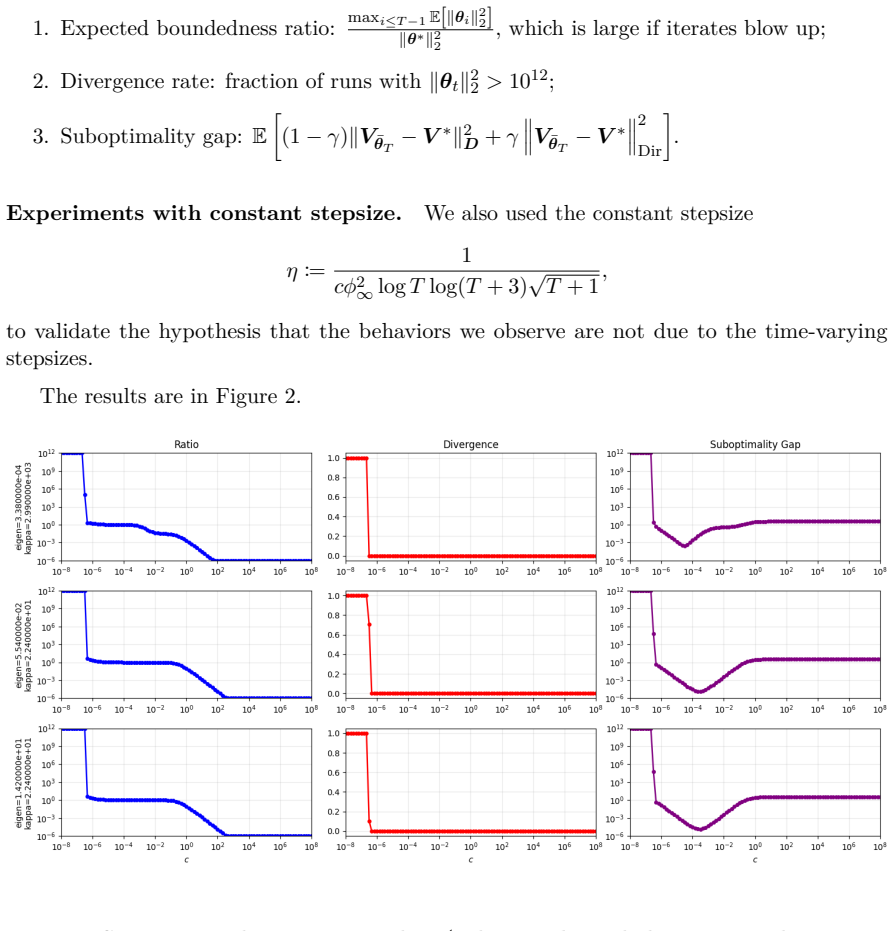
Summary. The paper analyzes unprojected TD(0) with linear function approximation under Markovian sampling and proves a robust O~(1/sqrt(T)) convergence rate in expectation for the Liu-Olshevsky potential, without any projection step and without lower-bounding the curvature of the potential. The proof strategy is a self-bounding induction: the authors show that the expected squared norm of the iterates remains bounded by a constant that depends on the step-size scale parameter c, and then use this to control the bias and gradient terms in the error recursion. The main theorems are Theorem 4.2 (informal) and Theorem D.1 (formal bounded-iterates statement), with the rate following from the potential identity of Lemma 4.1. The paper also includes experiments on a synthetic MDP that qualitatively support the predicted phase transition in the step-size parameter.
Significance. If correct, this result resolves an open problem raised by Bhandari et al. (COLT 2018), giving the first finite-time robust rate for projection-free TD(0) with Markovian noise. The proof is genuinely novel: it avoids the contraction-based arguments of prior work and instead establishes a self-bounding property of the iterates, reminiscent of parameter-free SGD analyses. The paper is careful about constants and includes explicit expressions for the radius rho_c. I specifically checked the early-segment bound in Lemma C.1 that was flagged as a possible circularity; the concern does not land because the proof bounds d_{k-s_k} ell_{k-s_k}, and for k <= u_t one has s_k = k, so the quantity is exactly d0 ell_0, requiring no iterate bound. The main technical gap I found is in the proof of Lemma B.5, where the conditional-expectation definition of Xi is replaced by the raw stochastic gradient; this is load-bearing for Lemma C.1 but appears readily repairable.
major comments (3)
- [Appendix B, Lemma B.5] The proof of Lemma B.5 is formally incorrect as written. The definition of Xi in Appendix A is Xi(theta_t, Z_t) = < E[g(theta_t, Z_t) | F_{t-1}] - gbar(theta_t), theta_t - theta* >, but the displayed first equality in the proof uses < g(theta_k, Z_k) - gbar(theta_k), theta_k - theta* >, omitting the conditional expectation. Since Lemma C.1 invokes Lemma B.5 to bound differences of Xi terms, this gap affects a load-bearing step. The statement itself is true and the fix is straightforward: one should apply the triangle inequality to the conditional-expectation version, use the almost-sure bound ||g(theta, o)|| <= ell_theta to control E[||g(theta, Z)|| | F], and use the fact that conditional expectation preserves the 2 phi_inf^2 Lipschitz property. Please rewrite the proof accordingly.
- [Appendix C, Lemma C.1] In the first bias term, the proof silently replaces the conditioning sigma-field F_{k-1} by F_{k-1-s_k}. This equality is true, but it is not immediate and should be justified: theta_{k-s_k} is F_{k-1-s_k}-measurable, and by the Markov property the conditional distribution of Z_k given F_{k-1} is the same as that given F_{k-1-s_k} (and s_{k-s_k}). The text also uses F_{-1} for the early segment without defining it; F_{-1} should be declared as the trivial sigma-field. Without these clarifications, the proof of Lemma C.1 has a logical gap at the point where Lemma B.4 is applied.
- [Appendix D, Theorem D.1] The induction hypothesis is stated as 'max_{i<=t} E[||theta_{i-1}||^2] <= rho_c^2 max{...}', which is ill-formed at the base case i=0 because theta_{-1} is not defined. It should be stated as 'max_{0 <= i <= t-1} E[||theta_i||^2] <= rho_c^2 max{...}'. Also, the proof only details the case r_infinity / phi_infinity <= d0 and says the other case is similar; this is acceptable, but the analogous beta_1, beta_2 definitions and the final fixed-point inequality for the alternative case should be given or at least clearly indicated to avoid an unverifiable 'similar' claim.
minor comments (4)
- [Appendix A] The line 'F_t in sigma{Z_0,...,Z_t}' should be 'F_t = sigma{Z_0,...,Z_t}'.
- [Section 4, proof of Theorem 4.2(b)] The lower bound on the sum of step sizes is written as >= 2 sqrt(T)/(c phi_inf^2 log^2(T+3)) in one place, but the preceding line gives the exact bound 2 sqrt(T) - 2 over the same denominator; the -2 term should be tracked or the inequality stated with the exact form.
- [Appendix D, heading] The sentence 'We can now give the formal statement and prove part (b) in Theorem 4.2: Theorem D.1' is misleading, because Theorem D.1 is the formal bounded-iterates statement (part (a)), not the rate statement (part (b)). Please rephrase.
- [Section 4, Theorem 4.2] The dependency on the mixing parameter alpha in the condition 'T sufficiently large' is stated only informally in Theorem 4.2; the precise condition in Theorem D.1 is log T >= (log(2 sqrt(T))/log(1/alpha) + 1)^{3/4}. Consider stating this condition (or a simplified sufficient condition) in the main theorem for clarity.
Circularity Check
No significant circularity: the convergence rate and bounded-iterates theorem are derived from explicit Markov-mixing and Lipschitz lemmas, not from the target statement.
full rationale
The derivation chain is self-contained against external benchmarks once Assumptions 1 and 2 are accepted. The robust rate in Theorem 4.2(b) is obtained by telescoping an explicit recurrence, using Lemma 4.1 (Liu and Olshevsky) to identify the potential decrement, Lemma 4.4-4.6 (Bhandari et al.) to bound gradients and Lipschitz constants, and Lemma C.1 to control the bias term under geometric mixing. The bounded-iterates property in Theorem D.1 is proved by a genuine induction: the induction hypothesis bounds E[||θ_i||^2] for i < t, Lemma D.2 controls cross terms, and the radius ρ_c is chosen to satisfy a fixed-point inequality rather than assumed from the conclusion. No parameter is fitted to the convergence quantity, and no target inequality is used as an input. The Liu-Olshevsky potential depends on θ* by definition, but that is the quantity being bounded, not a circular presupposition of the bound. The paper does cite work by co-author Orabona and Pál for an analogy in SGD and Cutkosky and Orabona in a future-work sentence, but these citations are not load-bearing evidence for the TD rate. The reviewer-flagged concern in Lemma C.1 about replacing d_k ℓ_k with d_0 ℓ_0 for early k is a potential correctness gap in the proof, not a circularity: it does not reduce the theorem to its own assumption, and under the task rules internal proof errors are outside the circularity verdict. Overall, no circular step can be exhibited from the paper's equations.
Assumptions & free parameters
free parameters (1)
- step-size scale c =
c ≥ 281, theoretical threshold (279+3√8837)/2
assumptions (4)
- domain assumption Assumption 1: the policy-induced Markov chain is irreducible and aperiodic, with geometric mixing in Theorem 3.1
- domain assumption Assumption 2: feature matrix Φ has full column rank and ||φ(s)||_2 ≤ φ∞; rewards are bounded by r∞
- domain assumption Lemma 4.1 from Liu and Olshevsky [2021, Theorem 1]: < -gbar(θ), θ-θ* > = f(θ) - f(θ*)
- standard math Lemmas 4.5 and 4.6 from Bhandari et al. [2018] bounding the mixing bias and giving Lipschitz continuity of g and gbar
Cite this review
Pith. "Pith review of A Robust $\widetilde{\mathcal{O}}(1/\sqrt{T})$ Rate for Unprojected TD Learning with Linear Function Approximation." pith.science (2026). https://pith.science/paper/XCEBT2SS
@misc{pith2026250601052,
  author       = {Pith},
  title        = {Pith review of: A Robust $\widetilde\mathcalO(1/\sqrtT)$ Rate for Unprojected TD Learning with Linear Function Approximation},
  year         = {2026},
  howpublished = {\url{https://pith.science/paper/XCEBT2SS}},
  note         = {Machine review of arXiv:2506.01052}
}
abstract
We investigate the finite-time convergence properties of Temporal Difference (TD) learning with linear function approximation, a cornerstone of reinforcement learning. We are interested in the so-called ``robust'' setting, where the convergence guarantee does not depend on the potential function's minimal curvature. While prior work has established convergence guarantees in this setting, these results typically rely on the artificial assumption that each iterate is projected onto a bounded set. Removing such a condition was left as an open problem by Bhandari et al. (COLT'18), hypothesizing the need for additional ``regularity conditions''. In this paper, we show that the simple unprojected TD(0) converges with a rate of $\widetilde{\mathcal{O}}\left(\frac{\|\theta^*\|^2_2}{\sqrt{T}}\right)$ in expectation, even in the presence of Markovian noise. We do not require an additional regularity condition, but only a minor polylog correction to the learning rate. Our analysis reveals a novel self-bounding property of the TD updates and exploits it to guarantee bounded iterates.
Figures

Forward citations
Cited by 2 Pith papers
-
Fast and Robust Convergence Rate for TD(0) with Linear Function Approximation, Universal Learning Steps and I.I.D. Samples
Establishes an O(1/k) MSE convergence rate for TD(0) with LFA that is independent of the smallest eigenvalue of the uncentered covariance matrix and robust to ill-conditioning.
-
A Diffusion Approximation for Temporal-Difference Learning with Linear Features under Markovian Noise
Presents an SDE diffusion approximation for linear TD(0) under Markovian noise that explains the constant-stepsize error floor via interaction of long-run covariance and projected Bellman operator geometry.
Reference graph
Works this paper leans on
-
[1]
A finite time analysis of temporal difference learning with linear function approximation
Jalaj Bhandari, Daniel Russo, and Raghav Singal. A finite time analysis of temporal difference learning with linear function approximation. In Conference on learning theory, pages 1691--1692. PMLR, 2018
work page 2018
-
[2]
Deepdriving: Learning affordance for direct perception in autonomous driving
Chenyi Chen, Ari Seff, Alain Kornhauser, and Jianxiong Xiao. Deepdriving: Learning affordance for direct perception in autonomous driving. In Proceedings of the IEEE international conference on computer vision, pages 2722--2730, 2015
work page 2015
-
[3]
Cutkosky and Francesco Orabona
Ashok. Cutkosky and Francesco Orabona. Black-box reductions for parameter-free online learning in Banach spaces. In Proc. of the Conference on Learning Theory (COLT), 2018
work page 2018
-
[4]
Gal Dalal, Gugan Thoppe, Bal \'a zs Sz \"o r \'e nyi, and Shie Mannor. Finite sample analysis of two-timescale stochastic approximation with applications to reinforcement learning. In Conference On Learning Theory, pages 1199--1233. PMLR, 2018
work page 2018
-
[5]
Logarithmic Sobolev inequalities for finite Markov chains
Persi Diaconis and Laurent Saloff-Coste. Logarithmic Sobolev inequalities for finite Markov chains. The Annals of Applied Probability, 6 0 (3): 0 695--750, 1996
work page 1996
-
[6]
Deep reinforcement learning for robotic manipulation with asynchronous off-policy updates
Shixiang Gu, Ethan Holly, Timothy Lillicrap, and Sergey Levine. Deep reinforcement learning for robotic manipulation with asynchronous off-policy updates. In 2017 IEEE international conference on robotics and automation (ICRA), pages 3389--3396. IEEE, 2017
work page 2017
-
[7]
DoG is SGD 's best friend: A parameter-free dynamic step size schedule
Maor Ivgi, Oliver Hinder, and Yair Carmon. DoG is SGD 's best friend: A parameter-free dynamic step size schedule. In International Conference on Machine Learning, pages 14465--14499. PMLR, 2023
work page 2023
-
[8]
Nathaniel Korda and Prashanth La. On TD (0) with function approximation: Concentration bounds and a centered variant with exponential convergence. In International conference on machine learning, pages 626--634. PMLR, 2015
work page 2015
Show all 21 references
-
[9]
Stochastic approximation: a survey
Harold Kushner. Stochastic approximation: a survey. Wiley Interdisciplinary Reviews: Computational Statistics, 2 0 (1): 0 87--96, 2010
2010
-
[10]
Linear stochastic approximation: How far does constant step-size and iterate averaging go? In International conference on artificial intelligence and statistics, pages 1347--1355
Chandrashekar Lakshminarayanan and Csaba Szepesvari. Linear stochastic approximation: How far does constant step-size and iterate averaging go? In International conference on artificial intelligence and statistics, pages 1347--1355. PMLR, 2018
2018
-
[11]
Markov chains and mixing times, volume 107
David A Levin and Yuval Peres. Markov chains and mixing times, volume 107. American Mathematical Soc., 2017
2017
-
[12]
Temporal difference learning as gradient splitting
Rui Liu and Alex Olshevsky. Temporal difference learning as gradient splitting. In International Conference on Machine Learning, pages 6905--6913. PMLR, 2021
2021
-
[13]
Reinforcement Learning: Foundations
Shie Mannor, Yishay Mansour, and Aviv Tamar. Reinforcement Learning: Foundations. -, 2022. URL https://sites.google.com/view/rlfoundations/home
2022
-
[14]
A simple finite-time analysis of TD learning with linear function approximation
Aritra Mitra. A simple finite-time analysis of TD learning with linear function approximation. IEEE Transactions on Automatic Control, 2024
2024
-
[15]
Approximate temporal difference learning is a gradient descent for reversible policies
Yann Ollivier. Approximate temporal difference learning is a gradient descent for reversible policies. arXiv preprint arXiv:1805.00869, 2018
2018 arXiv
-
[16]
Parameter-free stochastic optimization of variationally coherent functions
Francesco Orabona and David P\'al. Parameter-free stochastic optimization of variationally coherent functions. arXiv preprint arXiv:2102.00236, 2021
2021 arXiv
-
[17]
Mastering the game of go with deep neural networks and tree search
David Silver, Aja Huang, Chris J Maddison, Arthur Guez, Laurent Sifre, George Van Den Driessche, Julian Schrittwieser, Ioannis Antonoglou, Veda Panneershelvam, Marc Lanctot, Sander Dieleman, Dominik Grewe, John Nham, Nal Kalchbrenner, Ilya Sutskever, Timothy Lillicrap, Madelei...
2016
-
[18]
Finite-time error bounds for linear stochastic approximation and td learning
Rayadurgam Srikant and Lei Ying. Finite-time error bounds for linear stochastic approximation and td learning. In Conference on Learning Theory, pages 2803--2830. PMLR, 2019
2019
-
[19]
Learning to predict by the methods of temporal differences
Richard S Sutton. Learning to predict by the methods of temporal differences. Machine learning, 3: 0 9--44, 1988
1988
-
[20]
Analysis of temporal-diffference learning with function approximation
John Tsitsiklis and Benjamin Van Roy. Analysis of temporal-diffference learning with function approximation. Advances in neural information processing systems, 9, 1996
1996
-
[21]
L. Xiao. Dual averaging methods for regularized stochastic learning and online optimization. Journal of Machine Learning Research, 11: 0 2543--2596, 2010
2010
Reviewed August 7, 2026 · model on record in the stance chip above.
Discussion (0). Continue with ORCID to comment.