REVIEW 3 major objections 7 minor 56 references
Versatile Loco-Manipulation through Flexible Interlimb Coordination
T0 review · 3 major / 7 minor · reviewed 2026-08-07 · deepseek-v4-flash
Pith's one-line read A controller blending model-based manipulation with a learned gait policy lets a quadruped swap limb roles mid-task, hitting 78.9% across 12 real-world loco-manipulation tasks.
desk verdict ReLIC's dynamic limb role-switching is a real, useful result on a standard quadruped, but the force-blind architecture and thin evaluation metrics should be addressed before publication. read the letter →
The pith
A machine-rendered reading of the paper's core claim, the machinery that carries it, and where it could break.
The reading
What carries the argument
The load-bearing object is the mask-blended action identity $a = m \circ a_{\mathrm{MB}} + (1-m) \circ a_{\mathrm{RL}}$, in which the binary limb-role mask $m \in \{0,1\}^{|\Lambda|}$ selects, dimension by dimension, between a model-based manipulation action $a_{\mathrm{MB}}$ and an RL locomotion action $a_{\mathrm{RL}}$ of the same shape. The mask converts the discrete decision of which limbs manipulate and which support into a continuous joint-command signal, so one leg can be lifted for manipulation while the remaining three execute a learned three-legged bounce whose contact phases are shaped by a contact-time-based gait regularization term. Two supporting mechanisms complete the argument: the task-level representation of any task as a sequence of end-effector targets $\tau_t$ with masks $m_t$ (desired torso poses produced by whole-body inverse kinematics), and the sim-to-real pipeline in which the locomotion policy is trained with domain randomization and then adapted to hardware by fitting joint torque limits from real-robot rollouts.
What would settle it
Run a task that demands sustained force-regulated contact rather than pose tracking — for example, holding a spring-loaded door open with one foot under a measured load while the arm performs a separate reach — and record whether success falls as the spring force rises even when all target poses are correct; a collapse would show that the pose-plus-mask representation, not the blending controller, is the limiting assumption.
Extended reading notes
Core claim
ReLIC claims that versatile loco-manipulation is best achieved by decoupling the problem into a manipulation subproblem and a locomotion subproblem, joined by a learned limb-assignment mask rather than fixed heuristics. At each timestep, a binary mask $m \in \{0,1\}^{|\Lambda|}$ marks each limb as manipulator or supporter; a model-based inverse kinematics module produces the manipulation action $a_{\mathrm{MB}}$ for the assigned limbs, an RL policy $\pi(\cdot \mid s, m)$ produces the locomotion action $a_{\mathrm{RL}}$ for the supporting limbs, and the final command is $a = m \circ a_{\mathrm{MB}} + (1-m) \circ a_{\mathrm{RL}}$, with the same mask feeding the whole-body IK that sets the desired torso pose. The locomotion policy is trained entirely in simulation with contact-time-based gait regularization — a trot for four supporting legs and a cyclically staggered three-phase bounce for three — and is transferred to hardware through a motor-calibration step that fits joint torque limits to real-robot rollouts with an evolution-strategy optimizer. The paper reports that the controller switches between four-legged and three-legged gaits and reassigns the lifted limb mid-stride without pausing, tracks independent arm-and-leg target trajectories with low error while walking tripedally, and reaches a 78.9% average success rate on 12 real-world tasks, while end-to-end RL and MPC baselines fail on almost all of them.
Load-bearing premise
The load-bearing premise is that every task can be expressed as a sequence of end-effector target poses plus a binary limb-role mask, with torso targets computed by inverse kinematics; tasks whose essence is force-controlled or reactive contact fall outside what this pose-level interface can represent, a boundary the paper's limitations section itself acknowledges.
Editorial extensions
If this is right
- A single trained locomotion policy covers four-legged trotting, three-legged bouncing with any one leg lifted, and in-stride transitions between them without pause or a gait state machine when a limb changes role.
- Direct targets, clicked contact points, and language-derived targets all collapse into the same target-plus-mask representation and run on the same controller, so new tasks are added without retraining the low-level policy.
- Because manipulation and locomotion are decoupled, each subproblem can be improved independently; the paper's ablations show that both motor calibration and gait regularization are required for stable three-legged behavior.
- The failure analysis places most residual errors upstream of the blending controller — perception, extreme body configurations, and unintended contacts — so better state estimation and closed-loop contact reasoning would directly raise task success.
- Any limb can act as the manipulator under the same mechanism, which is why foot-assisted tasks, where a leg improves stability or efficiency, need no hardware or policy changes.
Reading between the lines
- If the pose-plus-mask representation is the true bottleneck, then force-controlled interlimb tasks — steadying a panel with one foot while the arm fastens it, say — would require extending the task interface with force or impedance targets, and the paper's reported failures on the yoga ball and trash bin mark where that boundary sits.
- The same mask-blending scheme could plausibly transfer to humanoid morphologies, to arms used as support limbs, or to gaits beyond trot and bounce, because the contact-time regularization encodes any periodic gait as target contact phases.
- A closed-loop variant of the language interface, in which the vision-language model re-selects contact points from refreshed point clouds after each stage, would directly attack the open-loop brittleness the paper acknowledges.
Editorial analysis
A structured set of objections, weighed in public.
Referee Report
Summary. The paper presents ReLIC, a hierarchical controller for an arm-mounted quadruped (Spot) that dynamically assigns limbs to manipulation or locomotion roles. A model-based inverse-kinematics module generates manipulation actions for masked limbs, while an RL policy trained in simulation generates locomotion actions for the remaining limbs; the final action is a mask-weighted blend. The task-level representation is a sequence of end-effector target poses and binary limb-role masks, which can be specified via direct targets, contact points, or language instructions. The method is evaluated on 12 real-world tasks spanning mobile interlimb coordination, stationary interlimb coordination, and foot-assisted manipulation, with 10 trials per task, reporting an average success rate of 78.9%. Ablations on motor calibration and gait regularization support the design choices, and code and videos are released.
Significance. If the reported results hold, ReLIC offers a practical and modular architecture for loco-manipulation that avoids monolithic end-to-end training and enables on-the-fly limb role switching without predefined gait state machines. The contribution is timely given the growing interest in whole-body control for legged robots. Strengths include the real-robot evaluation on a diverse 12-task suite, the two ablations that isolate the contributions of motor calibration and gait regularization, the contact-time gait regularization mechanism, and the released code and videos, which aid reproducibility. However, the evaluation lacks formal success criteria and statistical uncertainty quantification, and the baselines are insufficiently documented, so the quantitative strength of the claim is currently weaker than the narrative suggests.
major comments (3)
- [Section 4.2 / Figure 6] The paper reports an average success rate of 78.9% across 12 tasks with 10 trials each, but it never defines the success criteria for any of the tasks, and it reports no confidence intervals or statistical tests. With only 10 trials per task, the 95% confidence interval for an observed 8/10 success rate is roughly 0.44–0.96, so the headline claim of robustness is not quantitatively supported. I recommend adding per-task success criteria, raw trial counts, and confidence intervals or error bars.
- [Section 4.2, baselines] The E2E baseline is asserted to fail on all tasks, but no training details are provided (architecture, observations, reward, compute budget, number of seeds), so the comparison does not control for training parity with ReLIC's locomotion policy. The MPC baseline is described only as 'off-the-shelf' with no model equations or explanation of why it lacks support for interlimb manipulation and three-leg locomotion. Without this information, the claim that ReLIC's modular design is responsible for the improvement is not fully established. Please provide sufficient implementation detail for both baselines.
- [Sections 3.2, 6, and Table 2] The manipulation module is a standard inverse kinematics solver and the RL policy's observation space does not include interaction forces or torques at the end effectors, yet tasks such as Trash Bin, Tire Pump, Deck Box, and Chair require sustained or forceful contact. The paper's own failure analysis (Section 4.3) notes that 'the unpredictable external force from the pedal poses significant challenges for the policy to maintain balance,' which indicates that contact forces are only handled open-loop. The abstract's claim of 'versatile loco-manipulation' should therefore be scoped to quasi-static, position-driven interactions, or the paper should add force feedback and evaluate it. The Limitations section partially acknowledges this, but the main text and abstract should be consistent with that scope.
minor comments (7)
- [Section 3.3 / Reference [47]] Reference [47], cited for unmodeled motor parameter variations, points to a paper on clothing parametrization; please replace it with an appropriate actuator or motor modeling reference.
- [Section 4.2 / Figure 6] Section 4.2 says ReLIC-Contact and ReLIC-Language are evaluated on a subset of tasks, but Figure 6 appears to show bars for all tasks; please clarify which tasks each variant was run on and mark unavailable tasks in the figure.
- [Figure 5] Figure 5 reports end-effector tracking errors but the text does not provide the numerical values of the 'low mean Cartesian error'; please report the mean and standard deviation in the text or as a table.
- [Section 4.1] The statement that gait switches occur 'instantly' is qualitative; consider replacing it with a quantitative measure such as transition time or the contact-timing deviation during the switch.
- [Appendix D.1] The phrase 'A total of1.0×10 7 valid command samples' has a formatting issue (missing superscript and spacing); please correct.
- [Appendix C] The task descriptions in Appendix C do not list explicit success criteria; adding a per-task success criterion would also help address the missing quantitative definition in the main text.
- [Figure 6 caption] The caption statement 'Our three ReLIC variants consistently outperform the baselines' is too strong given that two variants are evaluated only on subsets; please qualify the caption accordingly.
Circularity Check
No significant circularity: ReLIC's central claim is empirical, its controller blend is an explicit design choice, and no fitted parameter is renamed as a prediction.
full rationale
ReLIC's load-bearing claim is the 78.9% average success across 12 real-world tasks (Section 4.2, Figure 6), which is an empirical outcome rather than a derived prediction. The core action formula a = m∘a_MB + (1−m)∘a_RL (Section 3.2) is presented as a design decision, not as a result derived from first principles, so there is no equation-level reduction of the claim to its inputs. The model-based module is a standard inverse kinematics solver, and the RL policy is trained with tracking and gait rewards (Section D), not with the task-success metric used in evaluation; task success is scored on physical task outcomes (e.g., can deposited, tire inflated, drawer closed) rather than on the controller's own target-tracking loss. The motor-calibration procedure (Section 3.3, Appendix E.2) fits torque limits from real-world rollouts and fine-tunes the simulation policy, but the final evaluation uses separate task trials and reports task completion, so the calibration fit is not renamed as a prediction. Citations to IsaacLab/Orbit [44], Mink [43], CMA-ES [48], GPT-4o [49], and SAM2 [54] are standard tool or method references; none is invoked as a uniqueness theorem or as the sole justification for a contested architectural choice. The paper's Limitations section (Section 6) concedes that the contact-point and language interfaces are open-loop and that the manipulation controller relies on inverse kinematics; this narrows the scope of the versatility claim (force-regulated contact is not demonstrated) but does not make the argument circular.
Assumptions & free parameters
free parameters (5)
- Knee torque-velocity limits =
Not reported numerically; shown as red lines in Fig. 11
- Gait cycle time T_gait =
0.4 s
- Reward weights =
Table 3: e.g., 7.0, 3.5, -120, -5, -0.1
- Observation noise and domain randomization ranges =
e.g., U(-0.1,0.1) velocity noise; friction and stiffness ranges not fully specified
- Target command sampling bounds =
linear velocity U(-1,1) m/s, angular U(-1,1) rad/s, roll/pitch U(-0.3,0.3), base height U(0.3,0.7)
assumptions (5)
- domain assumption Every task can be represented as a time sequence of end-effector target poses and a binary limb mask.
- domain assumption Whole-body IK can compute a feasible torso target from manipulation limb targets.
- domain assumption Trotting for four legs and three-phase bouncing for three legs are sufficient and beneficial for all evaluated tasks.
- domain assumption IsaacLab simulation with domain randomization and motor calibration is a faithful proxy for the real Spot.
- domain assumption GPT-4o and SAM2 can ground free-form language to reliable contact points.
Cite this review
Pith. "Pith review of Versatile Loco-Manipulation through Flexible Interlimb Coordination." pith.science (2026). https://pith.science/paper/2KQTNSYX
@misc{pith2026250607876,
  author       = {Pith},
  title        = {Pith review of: Versatile Loco-Manipulation through Flexible Interlimb Coordination},
  year         = {2026},
  howpublished = {\url{https://pith.science/paper/2KQTNSYX}},
  note         = {Machine review of arXiv:2506.07876}
}
read the original abstract
The ability to flexibly leverage limbs for loco-manipulation is essential for enabling autonomous robots to operate in unstructured environments. Yet, prior work on loco-manipulation is often constrained to specific tasks or predetermined limb configurations. In this work, we present Reinforcement Learning for Interlimb Coordination (ReLIC), an approach that enables versatile loco-manipulation through flexible interlimb coordination. The key to our approach is an adaptive controller that seamlessly bridges the execution of manipulation motions and the generation of stable gaits based on task demands. Through the interplay between two controller modules, ReLIC dynamically assigns each limb for manipulation or locomotion and robustly coordinates them to achieve the task success. Using efficient reinforcement learning in simulation, ReLIC learns to perform stable gaits in accordance with the manipulation goals in the real world. To solve diverse and complex tasks, we further propose to interface the learned controller with different types of task specifications, including target trajectories, contact points, and natural language instructions. Evaluated on 12 real-world tasks that require diverse and complex coordination patterns, ReLIC demonstrates its versatility and robustness by achieving a success rate of 78.9% on average. Videos and code can be found at https://relic-locoman.rai-inst.com.
Figures


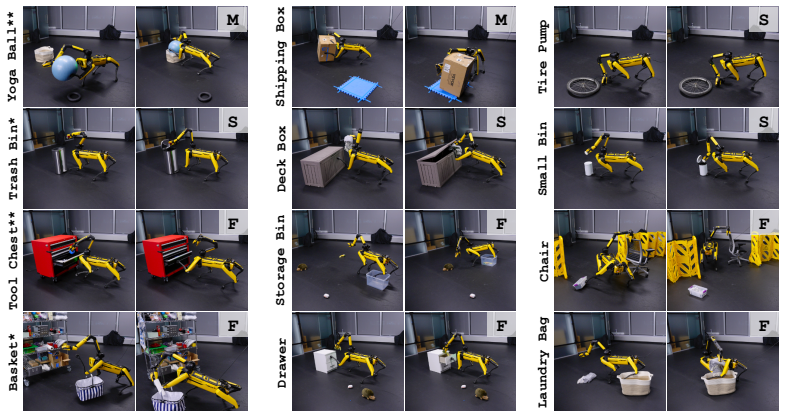
Figures from the paper (12 more)


Reference graph
Works this paper leans on
- [47]
-
[1]
B. U. Rehman, M. Focchi, J. Lee, H. Dallali, D. G. Caldwell, and C. Semini. Towards a multi-legged mobile manipulator. In2016 IEEE International Conference on Robotics and Automation (ICRA), pages 3618–3624, 2016. doi:10.1109/ICRA.2016.7487545
arXiv 2016
-
[2]
J.-P. Sleiman, F. Farshidian, and M. Hutter. Versatile multicontact planning and control for legged loco-manipulation.Science Robotics, 8(81):eadg5014, 2023
work page 2023
-
[3]
Z. Gu, J. Li, W. Shen, W. Yu, Z. Xie, S. McCrory, X. Cheng, A. Shamsah, R. Griffin, C. K. Liu, A. Kheddar, X. B. Peng, Y . Zhu, G. Shi, Q. Nguyen, G. Cheng, H. Gao, and Y . Zhao. Humanoid locomotion and manipulation: Current progress and challenges in control, planning, and learning, 2025. URLhttps://arxiv.org/abs/2501.02116
arXiv 2025
-
[4]
S. Zimmermann, R. Poranne, and S. Coros. Go fetch!-dynamic grasps using boston dynam- ics spot with external robotic arm. In2021 IEEE International Conference on Robotics and Automation (ICRA), pages 4488–4494. IEEE, 2021
work page 2021
- [5]
-
[6]
C. D. Bellicoso, K. Kr ¨amer, M. St ¨auble, D. Sako, F. Jenelten, M. Bjelonic, and M. Hutter. Alma-articulated locomotion and manipulation for a torque-controllable robot. In2019 Inter- national conference on robotics and automation (ICRA), pages 8477–8483. IEEE, 2019
work page 2019
-
[7]
Z. Fu, X. Cheng, and D. Pathak. Deep whole-body control: learning a unified policy for manipulation and locomotion. InConference on Robot Learning, pages 138–149. PMLR, 2023
2023
Show all 56 references
-
[8]
Zhang, T
Y . Zhang, T. Liang, Z. Chen, Y . Ze, and H. Xu. Catch it! learning to catch in flight with mobile dexterous hands.arXiv preprint arXiv:2409.10319, 2024
2024 arXiv
-
[9]
Bajracharya, J
M. Bajracharya, J. Borders, R. Cheng, D. Helmick, L. Kaul, D. Kruse, J. Leichty, J. Ma, C. Matl, F. Michel, et al. Demonstrating mobile manipulation in the wild: A metrics-driven approach.arXiv preprint arXiv:2401.01474, 2024
2024 arXiv
-
[10]
Z. Fu, T. Z. Zhao, and C. Finn. Mobile aloha: Learning bimanual mobile manipulation using low-cost whole-body teleoperation. InProceedings of The 8th Conference on Robot Learning, volume 270 ofProceedings of Machine Learning Research, pages 4066–4083. PMLR, 06–09 Nov 2025
2025
-
[11]
J. Hu, P. Stone, and R. Mart´ın-Mart´ın. Causal policy gradient for whole-body mobile manipu- lation. InProceedings of Robotics: Science and Systems, 2022
2022
-
[12]
Kindle, F
J. Kindle, F. Furrer, T. Novkovic, J. J. Chung, R. Siegwart, and J. Nieto. Whole-body control of a mobile manipulator using end-to-end reinforcement learning.arXiv preprint arXiv:2003.02637, 2020
2003 arXiv
-
[13]
T. Lew, S. Singh, M. Prats, J. Bingham, J. Weisz, B. Holson, X. Zhang, V . Sindhwani, Y . Lu, F. Xia, et al. Robotic table wiping via reinforcement learning and whole-body trajectory opti- mization. In2023 IEEE International Conference on Robotics and Automation (ICRA), pages ...
2023
-
[14]
C. Sun, J. Orbik, C. M. Devin, B. H. Yang, A. Gupta, G. Berseth, and S. Levine. Fully autonomous real-world reinforcement learning with applications to mobile manipulation. In Conference on Robot Learning, pages 308–319. PMLR, 2022. 10
2022
-
[15]
R. Yang, Y . Kim, R. Hendrix, A. Kembhavi, X. Wang, and K. Ehsani. Harmonic mobile manipulation. In2024 IEEE/RSJ International Conference on Intelligent Robots and Systems (IROS), pages 3658–3665. IEEE, 2024
2024
-
[16]
J. Wu, R. Antonova, A. Kan, M. Lepert, A. Zeng, S. Song, J. Bohg, S. Rusinkiewicz, and T. Funkhouser. Tidybot: Personalized robot assistance with large language models.Au- tonomous Robots, 47(8):1087–1102, 2023
2023
-
[17]
T. He, Z. Luo, X. He, W. Xiao, C. Zhang, W. Zhang, K. M. Kitani, C. Liu, and G. Shi. Om- nih2o: Universal and dexterous human-to-humanoid whole-body teleoperation and learning. InProceedings of The 8th Conference on Robot Learning, volume 270 ofProceedings of Ma- chine Learnin...
2025
-
[18]
Z. Fu, Q. Zhao, Q. Wu, G. Wetzstein, and C. Finn. Humanplus: Humanoid shadowing and imitation from humans. InProceedings of The 8th Conference on Robot Learning, volume 270 ofProceedings of Machine Learning Research, pages 2828–2844. PMLR, 06–09 Nov 2025
2025
-
[19]
Y . Ze, Z. Chen, W. Wang, T. Chen, X. He, Y . Yuan, X. B. Peng, and J. Wu. Generalizable humanoid manipulation with improved 3d diffusion policies.arXiv preprint arXiv:2410.10803, 2024
2024 arXiv
-
[20]
C. Lu, X. Cheng, J. Li, S. Yang, M. Ji, C. Yuan, G. Yang, S. Yi, and X. Wang. Mobile- television: Predictive motion priors for humanoid whole-body control.arXiv preprint arXiv:2412.07773, 2024
2024 arXiv
-
[21]
Y . Ma, F. Farshidian, T. Miki, J. Lee, and M. Hutter. Combining learning-based locomotion policy with model-based manipulation for legged mobile manipulators.IEEE Robotics and Automation Letters, 7(2):2377–2384, 2022
2022
-
[22]
Ewen, J.-P
P. Ewen, J.-P. Sleiman, Y . Chen, W.-C. Lu, M. Hutter, and R. Vasudevan. Generating con- tinuous motion and force plans in real-time for legged mobile manipulation. In2021 IEEE international conference on robotics and automation (ICRA), pages 4933–4939. IEEE, 2021
2021
-
[23]
Yokoyama, A
N. Yokoyama, A. Clegg, J. Truong, E. Undersander, T.-Y . Yang, S. Arnaud, S. Ha, D. Batra, and A. Rai. Asc: Adaptive skill coordination for robotic mobile manipulation.IEEE Robotics and Automation Letters, 9(1):779–786, 2023
2023
-
[24]
Ferrolho, V
H. Ferrolho, V . Ivan, W. Merkt, I. Havoutis, and S. Vijayakumar. Roloma: Robust loco- manipulation for quadruped robots with arms.Autonomous Robots, 47(8):1463–1481, 2023
2023
-
[25]
Arcari, M
E. Arcari, M. V . Minniti, A. Scampicchio, A. Carron, F. Farshidian, M. Hutter, and M. N. Zeilinger. Bayesian multi-task learning mpc for robotic mobile manipulation.IEEE Robotics and Automation Letters, 8(6):3222–3229, 2023
2023
-
[26]
Zhang, N
J. Zhang, N. Gireesh, J. Wang, X. Fang, C. Xu, W. Chen, L. Dai, and H. Wang. Gamma: Graspability-aware mobile manipulation policy learning based on online grasping pose fusion. In2024 IEEE International Conference on Robotics and Automation (ICRA), pages 1399–
-
[27]
S. Jeon, M. Jung, S. Choi, B. Kim, and J. Hwangbo. Learning whole-body manipulation for quadrupedal robot.IEEE Robotics and Automation Letters, 9(1):699–706, 2023
2023
-
[28]
H. Ha, Y . Gao, Z. Fu, J. Tan, and S. Song. UMI on legs: Making manipulation policies mobile with manipulation-centric whole-body controllers. InProceedings of the 2024 Conference on Robot Learning, 2024
2024
-
[29]
M. Liu, Z. Chen, X. Cheng, Y . Ji, R.-Z. Qiu, R. Yang, and X. Wang. Visual whole-body control for legged loco-manipulation. In8th Annual Conference on Robot Learning, 2024. 11
2024
-
[30]
Sleiman, M
J.-P. Sleiman, M. Mittal, and M. Hutter. Guided reinforcement learning for robust multi-contact loco-manipulation. In8th Annual Conference on Robot Learning (CoRL 2024), 2024
2024
-
[31]
G. Pan, Q. Ben, Z. Yuan, G. Jiang, Y . Ji, J. Pang, H. Liu, and H. Xu. Roboduet: A framework affording mobile-manipulation and crossembodiment.arXiv preprint arXiv:2403.17367, 6, 2024
2024 arXiv
-
[32]
Fuchs and J
A. Fuchs and J. Kelso. A theoretical note on models of interlimb coordination.Journal of Experimental Psychology: Human Perception and Performance, 20(5):1088, 1994
1994
-
[33]
Wannier, C
T. Wannier, C. Bastiaanse, G. Colombo, and V . Dietz. Arm to leg coordination in humans during walking, creeping and swimming activities.Experimental brain research, 141:375– 379, 2001
2001
-
[34]
S. F. Donker, P. J. Beek, R. Wagenaar, and T. Mulder. Coordination between arm and leg movements during locomotion.Journal of motor behavior, 33(1):86–102, 2001
2001
-
[35]
S. Aoi, P. Manoonpong, Y . Ambe, F. Matsuno, and F. W ¨org¨otter. Adaptive control strategies for interlimb coordination in legged robots: a review.Frontiers in neurorobotics, 11:39, 2017
2017
-
[36]
T. Tarn, A. Bejczy, and X. Yun. Coordinated control of two robot arms. InProceedings. 1986 IEEE International Conference on Robotics and Automation, volume 3, pages 1193–1202. IEEE, 1986
1986
-
[37]
Lin, Z.-H
T. Lin, Z.-H. Yin, H. Qi, P. Abbeel, and J. Malik. Twisting lids off with two hands. In8th Annual Conference on Robot Learning, 2024
2024
-
[38]
W. J. Wolfslag, C. McGreavy, G. Xin, C. Tiseo, S. Vijayakumar, and Z. Li. Optimisation of body-ground contact for augmenting the whole-body loco-manipulation of quadruped robots. In2020 IEEE/RSJ International Conference on Intelligent Robots and Systems (IROS), pages 3694–3701...
2020
-
[39]
C. Lin, X. Liu, Y . Yang, Y . Niu, W. Yu, T. Zhang, J. Tan, B. Boots, and D. Zhao. Locoman: Ad- vancing versatile quadrupedal dexterity with lightweight loco-manipulators. In2024 IEEE/RSJ International Conference on Intelligent Robots and Systems (IROS), pages 6877–6884. IEEE, 2024
2024
-
[40]
P. Arm, M. Mittal, H. Kolvenbach, and M. Hutter. Pedipulate: Enabling manipulation skills using a quadruped robot’s leg. In2024 IEEE International Conference on Robotics and Au- tomation (ICRA), pages 5717–5723. IEEE, 2024
2024
-
[41]
Z. He, K. Lei, Y . Ze, K. Sreenath, Z. Li, and H. Xu. Learning visual quadrupedal loco- manipulation from demonstrations. In2024 IEEE/RSJ International Conference on Intelligent Robots and Systems (IROS), pages 9102–9109. IEEE, 2024
2024
-
[42]
Cheng, A
X. Cheng, A. Kumar, and D. Pathak. Legs as manipulator: Pushing quadrupedal agility beyond locomotion. In2023 IEEE International Conference on Robotics and Automation (ICRA), pages 5106–5112. IEEE, 2023
2023
-
[43]
K. Zakka. Mink: Python inverse kinematics based on mujoco, July 2024. URLhttps: //github.com/kevinzakka/mink. License: Apache-2.0
2024
-
[44]
Mittal, C
M. Mittal, C. Yu, Q. Yu, J. Liu, N. Rudin, D. Hoeller, J. L. Yuan, R. Singh, Y . Guo, H. Mazhar, A. Mandlekar, B. Babich, G. State, M. Hutter, and A. Garg. Orbit: A unified simulation framework for interactive robot learning environments.IEEE Robotics and Automation Letters, 8...
2023
-
[45]
Miller, F
A. Miller, F. Yu, M. Brauckmann, and F. Farshidian. High-performance reinforcement learn- ing on spot: Optimizing simulation parameters with distributional measures.arXiv preprint arXiv:2403.16967, 2025. 12
2025 arXiv
-
[46]
Siekmann, Y
J. Siekmann, Y . Godse, A. Fern, and J. Hurst. Sim-to-real learning of all common bipedal gaits via periodic reward composition. In2021 IEEE International Conference on Robotics and Automation (ICRA), pages 7309–7315, 2021. doi:10.1109/ICRA48506.2021.9561814
2021
-
[48]
Nomura and M
M. Nomura and M. Shibata. cmaes : A simple yet practical python library for cma-es.arXiv preprint arXiv:2402.01373, 2024
2024
-
[49]
Gpt-4o system card, 2024
OpenAI. Gpt-4o system card, 2024. URLhttps://arxiv.org/abs/2410.21276
2024 arXiv
-
[50]
Spot.https://bostondynamics.com/products/spot/,
Boston Dynamics. Spot.https://bostondynamics.com/products/spot/,
-
[51]
Spot sdk.https://dev.bostondynamics.com/,
Boston Dynamics. Spot sdk.https://dev.bostondynamics.com/,
-
[52]
O. R. developers. Onnx runtime.https://onnxruntime.ai/, 2021
2021
-
[53]
Rudin, D
N. Rudin, D. Hoeller, P. Reist, and M. Hutter. Learning to walk in minutes using massively parallel deep reinforcement learning. InConference on Robot Learning, pages 91–100. PMLR, 2022
2022
-
[54]
Tool Chest Closing Task
N. Ravi, V . Gabeur, Y .-T. Hu, R. Hu, C. Ryali, T. Ma, H. Khedr, R. R ¨adle, C. Rolland, L. Gustafson, E. Mintun, J. Pan, K. V . Alwala, N. Carion, C.-Y . Wu, R. Girshick, P. Doll ´ar, and C. Feichtenhofer. Sam 2: Segment anything in images and videos.arXiv preprint arXiv:240...
2024 arXiv
-
[55]
One point where the ARM/GRIPPER should contact the object
-
[56]
Objects of interest: tool chest drawers
One point where the LEG should contact or interact with the object Task details: Using the arm and leg to close the opening tool chest drawers. Objects of interest: tool chest drawers. Robot capabilities: - Leg: end effector provide contact with objects - Arm: end effector pro...
Reviewed August 7, 2026 · model on record in the stance chip above.
Discussion (0). Sign in to comment.