REVIEW 3 major objections 5 minor 65 references
TrajFlow: Multi-modal Motion Prediction via Flow Matching
T0 review · 3 major / 5 minor · reviewed 2026-08-07 · deepseek-v4-flash
Pith's one-line read TrajFlow predicts all candidate future driving trajectories in a single flow-matching pass and, on the Waymo Open Motion Dataset, reports state-of-the-art scores on all five metrics.
desk verdict A solid flow-matching motion predictor whose real contribution is efficiency and the ranking loss; the test-set SOTA claim is not established because of protocol mismatch and tiny margins. read the letter →
The pith
A machine-rendered reading of the paper's core claim, the machinery that carries it, and where it could break.
The reading
What carries the argument
The load-bearing mechanism is the multi-shot trajectory-space flow matching decoder. Standard flow matching learns a velocity field $v_\theta(Y^t, C, t)$ and generates one trajectory per sampling run; TrajFlow instead predicts the denoised trajectory $\hat{Y}^1$ directly, and does so for $N_q=64$ query tokens simultaneously, so one Euler step produces all candidate trajectories together with classification logits and ranking scores. Noisy inputs are formed by linear interpolation $Y^t=(1-t)Y^0+tY^1$ between Gaussian noise and ground truth, and the trajectory-space regression loss replaces the standard velocity loss, letting the model pick the best-matching prediction for the ground truth. The ranking head assigns Plackett-Luce scores $r_k$, and the negative log-likelihood of the ground-truth ordering of displacement errors (Eq. 7) is added to the training loss with weight $\lambda=0.1$, which is what calibrates the confidence scores. Self-conditioning, used with 50% probability, takes the model's own $t=1$ prediction, mixes it with noise at a fresh time $t$, and feeds it back through the decoder, preventing the trivial copy-input solution and making multi-step ODE sampling stable.
What would settle it
Re-evaluating the strongest baselines (e.g., EDA and BeTop) under the exact current WOMD official evaluation protocol on the same test split would settle the state-of-the-art claim; if the small minADE and minFDE gaps (roughly 0.001–0.004) reverse or become statistically indistinguishable, the all-metrics claim fails, and the validation-split results, where TrajFlow trails on three of five metrics, suggest this is a live possibility.
Extended reading notes
Core claim
The paper's central claim is that a flow-matching decoder can generate the full set of candidate future trajectories in a single forward pass, and that this design is both more accurate and more efficient than repeated sampling. The decoder outputs $N_q$ denoised trajectories, classification logits, and ranking scores at once, conditioned on scene context tokens. The training objective combines a trajectory-space regression loss on the best-matching prediction, a classification loss that raises that prediction's score, and a Plackett-Luce ranking loss that trains all scores to order predictions by displacement error. Self-conditioning, applied with probability 0.5, rebuilds the noisy input from the model's own prediction instead of the ground truth, which the paper says prevents the decoder from copying its input when the noise level is low and stabilizes ODE sampling. The paper reports that on the WOMD marginal test set this single model outperforms all compared non-ensemble baselines on minADE, minFDE, Miss Rate, mAP, and Soft mAP, with faster per-agent inference than MTR.
Load-bearing premise
The test-set comparison assumes that the baseline numbers in Table I, taken from earlier papers and the Waymo leaderboard, were obtained under the same official evaluation protocol that TrajFlow used, even though the Waymo evaluation server and internal protocol have changed over time.
Editorial extensions
If this is right
- Single-pass generation makes the inference cost of a full multi-modal prediction roughly the cost of one forward pass plus NMS, removing the need for multiple sampling runs.
- If the Plackett-Luce ranking loss calibrates confidence scores correctly, planners and NMS-based trajectory selection receive better top-ranked candidates, which matters for downstream decision-making.
- With self-conditioning, the model remains stable as the number of ODE steps increases, so one-step speed can be traded for multi-step accuracy without the performance collapse observed without self-conditioning.
- On the WOMD marginal test set, the reported numbers imply that a single, non-ensemble model using no extra sensor data is currently ahead of all compared baselines on every official metric.
Reading between the lines
- If the single-pass design generalizes, the same multi-shot flow matching decoder could be applied to other multi-modal structured prediction tasks that currently rely on repeated sampling, such as human motion synthesis or multi-agent interaction forecasting.
- Because the Plackett-Luce loss acts only on the scores, it could be retrofitted to other trajectory predictors that already output confidence scores, potentially improving their mAP and Soft mAP without changing the trajectory generator.
- The self-conditioning scheme is described as training-only; iterating it during inference, by feeding the model's own prediction back into the next denoising step, is a natural experimental extension the paper does not report.
- The validation-split results, where the protocol is consistent, show TrajFlow ahead on mAP but behind on minADE, minFDE, and Miss Rate, so the test-set 'wins all metrics' claim is the part most sensitive to the protocol changes noted in Appendix B.
Editorial analysis
A structured set of objections, weighed in public.
Referee Report
Summary. The paper introduces TrajFlow, a flow-matching framework for multi-modal motion prediction on the Waymo Open Motion Dataset (WOMD). The method uses a multi-shot decoder that produces Nq trajectory proposals in a single ODE integration pass, a Plackett-Luce ranking loss for confidence calibration, and a self-conditioning training procedure that reuses the model's own predictions to construct noisy inputs. The authors report state-of-the-art results on the WOMD marginal test set, claiming superiority over all baselines across minADE, minFDE, Miss Rate, mAP, and Soft mAP, along with reduced inference cost compared to MTR.
Significance. If the state-of-the-art claim were established under a consistent evaluation protocol, the paper would make a useful contribution: it demonstrates that flow matching can serve as an efficient alternative to diffusion-based trajectory predictors, and it introduces a principled ranking objective for confidence calibration. The method is clearly described with pseudo-code, architecture details, ablations, and a promised code release. However, the empirical headline is not yet supported. The test-set comparison mixes protocols, as acknowledged in Appendix B; the reported margins over strong baselines are at the 0.0001 level with no error bars; and the same-protocol validation numbers in Table IV show TrajFlow trailing EDA on minADE, minFDE, and Miss Rate. The paper's current value lies in the method and its mAP improvements, not in an established all-metrics state of the art.
major comments (3)
- [IV-C, Table I, and Appendix B] The central claim that TrajFlow "outperforms all baselines across all metrics" on the WOMD test set is not supported by consistent-protocol evidence. The paper acknowledges in Appendix B that baseline numbers were obtained under older Waymo evaluation protocols, yet the reported margins over EDA and BeTop are on the order of 0.0001 (minADE 0.5714 vs 0.5718; minFDE 1.1667 vs 1.1668; Miss Rate 0.1162 vs 0.1169). No error bars or multiple-seed results are reported anywhere. On the Standard-Val split of Table IV, where all numbers come from the same protocol, TrajFlow trails EDA on minADE (0.5734 vs 0.5708), minFDE (1.1768 vs 1.1730), and Miss Rate (0.1187 vs 0.1178), while leading only on mAP and Soft mAP. The all-metrics test-set claim therefore cannot be taken as established; the authors should either provide a same-protocol test-set comparison (e.g., by submitting to the current leaderboard and re-evaluating baselines under the same protocol) or revise the claim to "competitive on error metrics and best on mAP."
- [III-B.3, Eq. (7)] The Plackett-Luce ranking loss defines the ground-truth ranking using the model's own predicted trajectories: d_k = ||Y_1_hat_k - Y_1||^2. Because the target ranking is a function of the current model output, the loss may be minimized by a model that learns to rank its own errors consistently without improving the absolute calibration of confidence scores relative to the ground-truth future. The paper should provide a direct evaluation of uncertainty calibration (e.g., reliability diagrams or expected calibration error) in addition to mAP, which primarily measures ranking quality. Without such evidence, the claim that the PL loss improves uncertainty estimation is only partially supported.
- [IV-C] The paper does not report the official Waymo composite meta-metric, which is the weighted combination of mAP, minADE, minFDE, and Miss Rate used for leaderboard ranking. Since TrajFlow's advantage on the Standard-Val split is concentrated in mAP/Soft mAP while it trails on the error metrics, the composite could place it below EDA or BeTop. Reporting the official composite is necessary to substantiate any claim of state-of-the-art performance on WOMD, and the statement that mAP and Soft mAP are "the most crucial indicators" should be justified with respect to the official evaluation protocol.
minor comments (5)
- [IV-A.3] The implementation details mention "a linear decay learning rate scheduler over 22/24/26/28 epochs, 40 total epochs," which is internally inconsistent; please clarify the exact learning-rate schedule and the number of training epochs.
- [Tables I and IV] The same baseline is referred to as "SceneTF" in Table I and "SceneTransformer" in Table IV; please use consistent naming throughout the paper and table captions.
- [II and Table V] The paper motivates TrajFlow against diffusion-based generative models, but the runtime comparison in Table V is only against MTR; adding a runtime (and if possible accuracy) comparison with a diffusion-based trajectory predictor would make the efficiency claim more convincing.
- [III-B.3] The GMM formulation of the regression loss is referenced to [19] but not defined; please provide the exact loss expression or a precise pointer to the equation in [19] so that the objective is self-contained.
- [IV-E] The ablation study in Table II uses 20% of the training set; please state whether the same 40-epoch budget and all other hyperparameters are used for the variants, and report the number of random seeds over which the results are averaged.
Circularity Check
No load-bearing circularity: the central SOTA claim is empirical and externally benchmarked; only a mild self-referential training target (PL ranking loss) is present.
-
self definitional
[Section III-B.3, Eq. (7) and preceding definition]
"We define the ground-truth ranking as σ = arg sort([d1, . . . , dNq ]), where dk = ∥ ˆY 1 k − Y 1∥2 2 is the displacement error."
The 'ground-truth ranking' used to supervise the ranking head is defined from the model's own predicted trajectories Ŷ1_k, not from an independent target. Therefore the Plackett-Luce loss in Eq. (7) trains the ranking scores to match a permutation that the model itself determines; the improvement in score-error alignment is partly by construction. This is a self-referential training objective rather than a derived prediction, and it is separately validated by external mAP/ablation results, so it is only a mild circular step and does not undermine the benchmark claims.
full rationale
The paper's central claims are the WOMD benchmark results and the architectural/loss contributions. These are empirical: the model is trained and evaluated against an external dataset with fixed metrics, and the reported SOTA numbers are compared to baselines from prior papers and the official leaderboard. That comparison, though subject to protocol-mismatch caveats noted in Appendix B, is not circular because the baselines are external and the metric values are not derived from the model's own definitions. The only self-referential elements are the PL ranking loss, whose 'ground-truth ranking' is computed from the model's own predicted trajectories, and the self-conditioning mechanism, which reuses model outputs to construct noisy training inputs. Both are training techniques validated by ablations on external metrics, not logical deductions that reduce to their inputs. No load-bearing self-citations or imported uniqueness theorems appear; the references to the authors' prior work are background or method-building blocks. The protocol-mismatch concern about test-set baselines is a correctness risk, not circularity. Overall, the derivation chain for the main contribution is self-contained and externally grounded, so the circularity score is low.
Assumptions & free parameters
free parameters (5)
- lambda (Lrank weight) =
0.1
- number of ODE steps T =
1
- self-conditioning probability =
0.5
- Nq (number of queries) =
64
- normalization offset/scale per coordinate =
from training set statistics
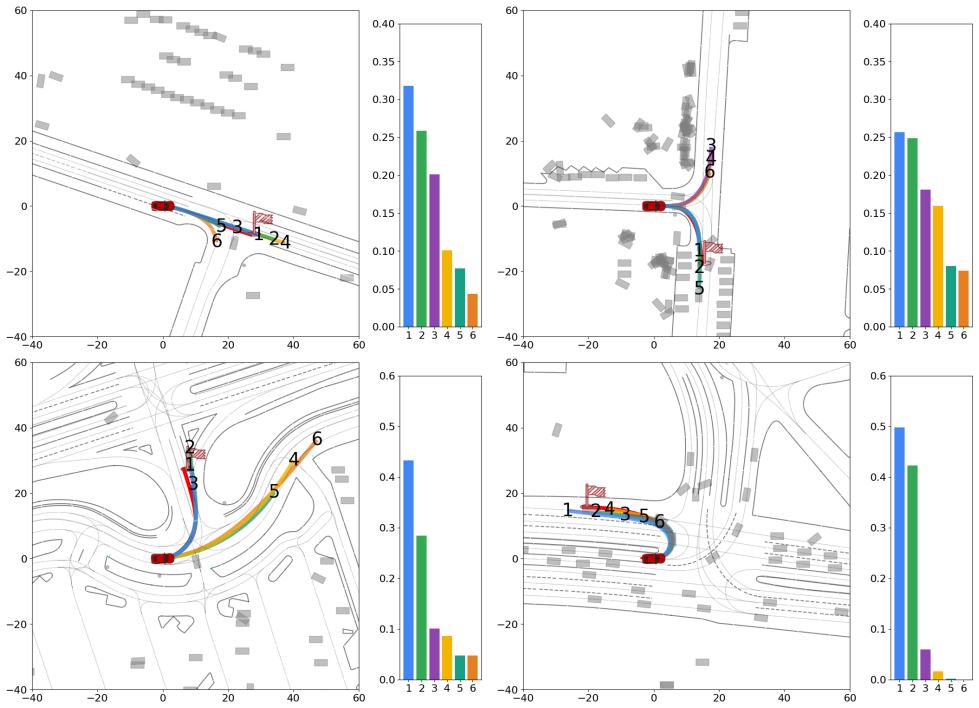
assumptions (4)
- standard math Linear interpolation flow (Eq. 1-2) defines a valid probability path for trajectory generation
- ad hoc to paper Plackett-Luce model (Eq. 6) is an appropriate likelihood for ranking predicted trajectories
- domain assumption The Waymo Open Motion Dataset ground truth is accurate and representative
- ad hoc to paper A single shared noise vector plus per-query embeddings can cover the multi-modal future distribution
Cite this review
Pith. "Pith review of TrajFlow: Multi-modal Motion Prediction via Flow Matching." pith.science (2026). https://pith.science/paper/WDHGJAWQ
@misc{pith2026250608541,
  author       = {Pith},
  title        = {Pith review of: TrajFlow: Multi-modal Motion Prediction via Flow Matching},
  year         = {2026},
  howpublished = {\url{https://pith.science/paper/WDHGJAWQ}},
  note         = {Machine review of arXiv:2506.08541}
}
read the original abstract
Efficient and accurate motion prediction is crucial for ensuring safety and informed decision-making in autonomous driving, particularly under dynamic real-world conditions that necessitate multi-modal forecasts. We introduce TrajFlow, a novel flow matching-based motion prediction framework that addresses the scalability and efficiency challenges of existing generative trajectory prediction methods. Unlike conventional generative approaches that employ i.i.d. sampling and require multiple inference passes to capture diverse outcomes, TrajFlow predicts multiple plausible future trajectories in a single pass, significantly reducing computational overhead while maintaining coherence across predictions. Moreover, we propose a ranking loss based on the Plackett-Luce distribution to improve uncertainty estimation of predicted trajectories. Additionally, we design a self-conditioning training technique that reuses the model's own predictions to construct noisy inputs during a second forward pass, thereby improving generalization and accelerating inference. Extensive experiments on the large-scale Waymo Open Motion Dataset (WOMD) demonstrate that TrajFlow achieves state-of-the-art performance across various key metrics, underscoring its effectiveness for safety-critical autonomous driving applications. The code and other details are available on the project website https://traj-flow.github.io/.
Figures


Figures from the paper (2 more)


Reference graph
Works this paper leans on
-
[1]
Learning lane graph representations for motion forecasting,
M. Liang, B. Yang, R. Hu, Y . Chen, R. Liao, S. Feng, and R. Urta- sun, “Learning lane graph representations for motion forecasting,” in ECCV, 2020
2020
-
[2]
Implicit latent variable model for scene-consistent motion forecasting,
S. Casas, C. Gulino, S. Suo, K. Luo, R. Liao, and R. Urtasun, “Implicit latent variable model for scene-consistent motion forecasting,” in ECCV, 2020
2020
-
[3]
Safety-oriented pedestrian occupancy forecasting,
K. Luo, S. Casas, R. Liao, X. Yan, Y . Xiong, W. Zeng, and R. Urtasun, “Safety-oriented pedestrian occupancy forecasting,” in IROS, 2021
work page 2021
-
[4]
Lanercnn: Distributed representations for graph-centric motion forecasting,
W. Zeng, M. Liang, R. Liao, and R. Urtasun, “Lanercnn: Distributed representations for graph-centric motion forecasting,” in IROS, 2021
work page 2021
-
[5]
MotionCNN: A Strong Baseline for Motion Prediction in Autonomous Driving
S. Konev, K. Brodt, and A. Sanakoyeu, “Motioncnn: a strong base- line for motion prediction in autonomous driving,” arXiv preprint arXiv:2206.02163, 2022
work page Pith review arXiv 2022
-
[6]
Social nce: Contrastive learning of socially-aware motion representations,
Y . Liu, Q. Yan, and A. Alahi, “Social nce: Contrastive learning of socially-aware motion representations,” in ICCV, 2021
work page 2021
-
[7]
Argoverse: 3d tracking and forecasting with rich maps,
M.-F. Chang, J. Lambert, P. Sangkloy, J. Singh, S. Bak, A. Hartnett, D. Wang, P. Carr, S. Lucey, D. Ramananet al., “Argoverse: 3d tracking and forecasting with rich maps,” in CVPR, 2019
work page 2019
-
[8]
Large scale interactive motion forecasting for autonomous driving: The waymo open motion dataset,
S. Ettinger, S. Cheng, B. Caine, C. Liu, H. Zhao, S. Pradhan, Y . Chai, B. Sapp, C. R. Qi, Y . Zhou et al. , “Large scale interactive motion forecasting for autonomous driving: The waymo open motion dataset,” in ICCV, 2021
work page 2021
Show all 65 references
-
[9]
Tnt: Target-driven trajectory prediction,
H. Zhao, J. Gao, T. Lan, C. Sun, B. Sapp, B. Varadarajan, Y . Shen, Y . Shen, Y . Chai, C. Schmid et al. , “Tnt: Target-driven trajectory prediction,” in CoRL, 2021
2021
-
[10]
Densetnt: End-to-end trajectory predic- tion from dense goal sets,
J. Gu, C. Sun, and H. Zhao, “Densetnt: End-to-end trajectory predic- tion from dense goal sets,” in ICCV, 2021
2021
-
[11]
Stochastic trajectory prediction via motion indeterminacy diffusion,
T. Gu, G. Chen, J. Li, C. Lin, Y . Rao, J. Zhou, and J. Lu, “Stochastic trajectory prediction via motion indeterminacy diffusion,” in CVPR, 2022
2022
-
[12]
Leapfrog diffusion model for stochastic trajectory prediction,
W. Mao, C. Xu, Q. Zhu, S. Chen, and Y . Wang, “Leapfrog diffusion model for stochastic trajectory prediction,” in CVPR, 2023
2023
-
[13]
Motiondiffuser: Controllable multi-agent motion prediction using diffusion,
C. Jiang, A. Cornman, C. Park, B. Sapp, Y . Zhou, D. Anguelov et al. , “Motiondiffuser: Controllable multi-agent motion prediction using diffusion,” in CVPR, 2023. 6
2023
-
[14]
Moflow: One-step flow matching for human trajectory forecasting via implicit maximum likelihood estimation based distillation,
Y . Fu, Q. Yan, L. Wang, K. Li, and R. Liao, “Moflow: One-step flow matching for human trajectory forecasting via implicit maximum likelihood estimation based distillation,” CVPR, 2025
2025
-
[15]
Motionlm: Multi-agent motion forecasting as language modeling,
A. Seff, B. Cera, D. Chen, M. Ng, A. Zhou, N. Nayakanti, K. S. Refaat, R. Al-Rfou, and B. Sapp, “Motionlm: Multi-agent motion forecasting as language modeling,” in ICCV, 2023
2023
-
[16]
Scene transformer: A unified architecture for predicting multiple agent tra- jectories,
J. Ngiam, B. Caine, V . Vasudevan, Z. Zhang, H.-T. L. Chiang, J. Ling, R. Roelofs, A. Bewley, C. Liu, A. Venugopal et al. , “Scene transformer: A unified architecture for predicting multiple agent tra- jectories,” arXiv preprint arXiv:2106.08417 , 2021
2021 arXiv
-
[17]
Wayformer: Motion forecasting via simple & efficient attention networks,
N. Nayakanti, R. Al-Rfou, A. Zhou, K. Goel, K. S. Refaat, and B. Sapp, “Wayformer: Motion forecasting via simple & efficient attention networks,” in ICRA, 2023
2023
-
[18]
Multipath++: Efficient information fusion and trajectory aggregation for behavior prediction,
B. Varadarajan, A. Hefny, A. Srivastava, K. S. Refaat, N. Nayakanti, A. Cornman, K. Chen, B. Douillard, C. P. Lam, D. Anguelov et al. , “Multipath++: Efficient information fusion and trajectory aggregation for behavior prediction,” in ICRA, 2022
2022
-
[19]
Motion transformer with global intention localization and local movement refinement,
S. Shi, L. Jiang, D. Dai, and B. Schiele, “Motion transformer with global intention localization and local movement refinement,” NeurIPS, 2022
2022
-
[20]
Mtr++: Multi-agent motion prediction with symmetric scene modeling and guided intention querying,
——, “Mtr++: Multi-agent motion prediction with symmetric scene modeling and guided intention querying,” IEEE TPAMI, 2024
2024
-
[21]
Query-centric trajectory prediction,
Z. Zhou, J. Wang, Y .-H. Li, and Y .-K. Huang, “Query-centric trajectory prediction,” in CVPR, 2023
2023
-
[22]
Hdgt: Heterogeneous driving graph transformer for multi-agent trajectory prediction via scene encoding,
X. Jia, P. Wu, L. Chen, Y . Liu, H. Li, and J. Yan, “Hdgt: Heterogeneous driving graph transformer for multi-agent trajectory prediction via scene encoding,” IEEE TPAMI, 2023
2023
-
[23]
Eda: Evolving and distinct anchors for multimodal motion prediction,
L. Lin, X. Lin, T. Lin, L. Huang, R. Xiong, and Y . Wang, “Eda: Evolving and distinct anchors for multimodal motion prediction,” in AAAI, 2024
2024
-
[24]
Reasoning multi-agent behavioral topology for interactive autonomous driving,
H. Liu, L. Chen, Y . Qiao, C. Lv, and H. Li, “Reasoning multi-agent behavioral topology for interactive autonomous driving,” NeurIPS, vol. 37, 2024
2024
-
[25]
Social gan: Socially acceptable trajectories with generative adversarial net- works,
A. Gupta, J. Johnson, L. Fei-Fei, S. Savarese, and A. Alahi, “Social gan: Socially acceptable trajectories with generative adversarial net- works,” in CVPR, 2018
2018
-
[26]
Mg-gan: A multi- generator model preventing out-of-distribution samples in pedestrian trajectory prediction,
P. Dendorfer, S. Elflein, and L. Leal-Taix ´e, “Mg-gan: A multi- generator model preventing out-of-distribution samples in pedestrian trajectory prediction,” in ICCV, 2021
2021
-
[27]
Groupnet: Multiscale hypergraph neural networks for trajectory prediction with relational reasoning,
C. Xu, M. Li, Z. Ni, Y . Zhang, and S. Chen, “Groupnet: Multiscale hypergraph neural networks for trajectory prediction with relational reasoning,” in CVPR, 2022
2022
-
[28]
Dynamic-group-aware networks for multi-agent trajectory prediction with relational reasoning,
C. Xu, Y . Wei, B. Tang, S. Yin, Y . Zhang, S. Chen, and Y . Wang, “Dynamic-group-aware networks for multi-agent trajectory prediction with relational reasoning,” Neural Networks, vol. 170, 2024
2024
-
[29]
Muse-vae: Multi-scale vae for environment-aware long term trajec- tory prediction,
M. Lee, S. S. Sohn, S. Moon, S. Yoon, M. Kapadia, and V . Pavlovic, “Muse-vae: Multi-scale vae for environment-aware long term trajec- tory prediction,” in CVPR, 2022
2022
-
[30]
Flow matching for generative modeling,
Y . Lipman, R. T. Chen, H. Ben-Hamu, M. Nickel, and M. Le, “Flow matching for generative modeling,” ICLR, 2023
2023
-
[31]
Attention is all you need,
A. Vaswani, N. Shazeer, N. Parmar, J. Uszkoreit, L. Jones, A. N. Gomez, Ł. Kaiser, and I. Polosukhin, “Attention is all you need,” NeurIPS, 2017
2017
-
[32]
Denoising diffusion probabilistic models,
J. Ho, A. Jain, and P. Abbeel, “Denoising diffusion probabilistic models,” NeurIPS, vol. 33, 2020
2020
-
[33]
Executing your commands via motion diffusion in latent space,
X. Chen, B. Jiang, W. Liu, Z. Huang, B. Fu, T. Chen, and G. Yu, “Executing your commands via motion diffusion in latent space,” in Proceedings of the IEEE/CVF conference on computer vision and pattern recognition, 2023, pp. 18 000–18 010
2023
-
[34]
Human motion diffusion model,
G. Tevet, S. Raab, B. Gordon, Y . Shafir, D. Cohen-Or, and A. H. Bermano, “Human motion diffusion model,” arXiv preprint arXiv:2209.14916, 2022
2022 arXiv
-
[35]
Motiondiffuse: Text-driven human motion generation with diffusion model,
M. Zhang, Z. Cai, L. Pan, F. Hong, X. Guo, L. Yang, and Z. Liu, “Motiondiffuse: Text-driven human motion generation with diffusion model,” IEEE transactions on pattern analysis and machine intelli- gence, vol. 46, no. 6, pp. 4115–4128, 2024
2024
-
[36]
Geneoh diffusion: Towards generalizable hand- object interaction denoising via denoising diffusion,
X. Liu and L. Yi, “Geneoh diffusion: Towards generalizable hand- object interaction denoising via denoising diffusion,” arXiv preprint arXiv:2402.14810, 2024
2024 arXiv
-
[37]
Interhandgen: Two-hand interaction generation via cascaded reverse diffusion,
J. Lee, S. Saito, G. Nam, M. Sung, and T.-K. Kim, “Interhandgen: Two-hand interaction generation via cascaded reverse diffusion,” in Proceedings of the IEEE/CVF Conference on Computer Vision and Pattern Recognition, 2024, pp. 527–537
2024
-
[38]
Latenthoi: On the generalizable hand object motion generation with latent hand diffusion
M. Li, S. Christen, C. Wan, Y . Cai, R. Liao, L. Sigal, and S. Ma, “Latenthoi: On the generalizable hand object motion generation with latent hand diffusion.” in Proceedings of the Computer Vision and Pattern Recognition Conference (CVPR) , June 2025, pp. 17 416– 17 425
2025
-
[39]
Pointnet: Deep learning on point sets for 3d classification and segmentation,
C. R. Qi, H. Su, K. Mo, and L. J. Guibas, “Pointnet: Deep learning on point sets for 3d classification and segmentation,” in CVPR, 2017
2017
-
[40]
The analysis of permutations,
R. L. Plackett, “The analysis of permutations,” Applied Statistics , vol. 24, no. 2, 1975
1975
-
[41]
R. D. Luce, Individual Choice Behavior . John Wiley, 1959
1959
-
[42]
Symmetricdiffusers: Learning discrete diffusion on finite symmetric groups,
Y . Zhang, D. Yang, and R. Liao, “Symmetricdiffusers: Learning discrete diffusion on finite symmetric groups,” ICLR, 2025
2025
-
[43]
Recoat: A deep learning-based framework for multi-modal motion prediction in autonomous driving application,
Z. Huang, X. Mo, and C. Lv, “Recoat: A deep learning-based framework for multi-modal motion prediction in autonomous driving application,” in IEEE 25th International Conference on Intelligent Transportation Systems (ITSC) , 2022
2022
-
[44]
Controlmtr: Control-guided motion transformer with scene-compliant intention points for feasible motion prediction,
J. Sun, C. Yuan, S. Sun, S. Wang, Y . Han, S. Ma, Z. Huang, A. Wong, K. P. Tee, and M. H. Ang Jr, “Controlmtr: Control-guided motion transformer with scene-compliant intention points for feasible motion prediction,” in IEEE 27th International Conference on Intelligent Transpor...
2024
-
[45]
Decoupled weight decay regularization,
I. Loshchilov and F. Hutter, “Decoupled weight decay regularization,” ICLR, 2019
2019
-
[46]
Pytorch: An imperative style, high-performance deep learning library,
A. Paszke, S. Gross, F. Massa, A. Lerer, J. Bradbury, G. Chanan, T. Killeen, Z. Lin, N. Gimelshein, L. Antiga et al. , “Pytorch: An imperative style, high-performance deep learning library,” NeurIPS, 2019
2019
-
[47]
Analog bits: Generating discrete data using diffusion models with self-conditioning,
T. Chen, R. Zhang, and G. Hinton, “Analog bits: Generating discrete data using diffusion models with self-conditioning,” arXiv preprint arXiv:2208.04202, 2022
2022 arXiv
-
[48]
Swingnn: Rethink- ing permutation invariance in diffusion models for graph generation,
Q. Yan, Z. Liang, Y . Song, R. Liao, and L. Wang, “Swingnn: Rethink- ing permutation invariance in diffusion models for graph generation,” arXiv preprint arXiv:2307.01646 , 2023
2023 arXiv
-
[49]
Joint generative modeling of scene graphs and images via diffusion models,
B. Xu, Q. Yan, R. Liao, L. Wang, and L. Sigal, “Joint generative modeling of scene graphs and images via diffusion models,” arXiv preprint arXiv:2401.01130, 2024
2024 arXiv
-
[50]
Uniedit-flow: Unleash- ing inversion and editing in the era of flow models,
G. Jiao, B. Huang, K.-C. Wang, and R. Liao, “Uniedit-flow: Unleash- ing inversion and editing in the era of flow models,” arXiv preprint arXiv:2504.13109, 2025
2025 arXiv
-
[51]
Qdm: Quadtree- based region-adaptive sparse diffusion models for efficient image super-resolution,
D. Yang, P. Vicol, X. Qi, R. Liao, and X. Zhang, “Qdm: Quadtree- based region-adaptive sparse diffusion models for efficient image super-resolution,” arXiv preprint arXiv:2503.12015 , 2025
2025
-
[52]
Score-based generative modeling through stochastic differential equations,
Y . Song, J. Sohl-Dickstein, D. P. Kingma, A. Kumar, S. Ermon, and B. Poole, “Score-based generative modeling through stochastic differential equations,” in ICLR, 2021. [Online]. Available: https: //openreview.net/forum?id=PxTIG12RRHS
2021
-
[53]
Elucidating the design space of diffusion-based generative models,
T. Karras, M. Aittala, T. Aila, and S. Laine, “Elucidating the design space of diffusion-based generative models,” in Proc. NeurIPS, 2022
2022
-
[54]
Video diffusion models: A survey,
A. Melnik, M. Ljubljanac, C. Lu, Q. Yan, W. Ren, and H. Ritter, “Video diffusion models: A survey,”arXiv preprint arXiv:2405.03150, 2024
2024 arXiv
-
[55]
Multi-modal interactive agent trajec- tory prediction using heterogeneous edge-enhanced graph attention network,
X. Mo, Z. Huang, and C. Lv, “Multi-modal interactive agent trajec- tory prediction using heterogeneous edge-enhanced graph attention network,” in Workshop on Autonomous Driving, CVPR , vol. 6, 2021, p. 7
2021
-
[56]
AIR 2 for interaction prediction,
D. Wu and Y . Wu, “AIR 2 for interaction prediction,” arXiv preprint arXiv:2111.08184, 2021
2021 arXiv
-
[57]
M2i: From factored marginal trajectory prediction to interactive prediction,
Q. Sun, X. Huang, J. Gu, B. C. Williams, and H. Zhao, “M2i: From factored marginal trajectory prediction to interactive prediction,” in Proceedings of the IEEE/CVF Conference on Computer Vision and Pattern Recognition, 2022, pp. 6543–6552
2022
-
[58]
Gameformer: Game-theoretic modeling and learning of transformer-based interactive prediction and planning for autonomous driving,
Z. Huang, H. Liu, and C. Lv, “Gameformer: Game-theoretic modeling and learning of transformer-based interactive prediction and planning for autonomous driving,” in Proceedings of the IEEE/CVF Interna- tional Conference on Computer Vision , 2023, pp. 3903–3913
2023
-
[59]
Amp: Autoregressive motion prediction revisited with next token prediction for autonomous driving,
X. Jia, S. Shi, Z. Chen, L. Jiang, W. Liao, T. He, and J. Yan, “Amp: Autoregressive motion prediction revisited with next token prediction for autonomous driving,” arXiv preprint arXiv:2403.13331 , 2024. 7 APPENDIX A. Implementation Details Algorithm 1 TrajFlow Training 1: Req...
2024 arXiv
-
[60]
Training and Inference Pipeline: The pseudo-code for the training and sampling procedures utilized in the Tra- jFlow framework is provided in Algorithms 1 and 2. During training, a composite objective is employed, integrating flow- matching denoising loss, classification loss,...
-
[61]
The context encoder has 6 layers, an embedding dimension of 256, and 8 attention heads
Model Configurations: As shown in Table III, Tra- jFlow primarily comprises a context encoder, flow matching decoder, and prediction heads. The context encoder has 6 layers, an embedding dimension of 256, and 8 attention heads. The flow matching decoder also has 6 layers but w...
1939
-
[62]
IV, covering both the standard val- idation and test splits, as well as the interactive validation and test sets
More Quantitative Results: We present additional quantitative results in Tab. IV, covering both the standard val- idation and test splits, as well as the interactive validation and test sets. The WOMD benchmark includes two tasks, each with its own evaluation metrics: (1) the ...
-
[63]
V, comparing MTR [19] and our method on the WOMD validation set, which consists of 44,097 agents, using the same hardware (NVIDIA A100 80GB)
Runtime Comparison: We present the inference run- time results in Tab. V, comparing MTR [19] and our method on the WOMD validation set, which consists of 44,097 agents, using the same hardware (NVIDIA A100 80GB). Thanks to the multi-shot prediction formulation and few- step sa...
-
[64]
4 and Fig
More Qualitative Results: Additional qualitative results are presented in Fig. 4 and Fig. 5, providing further examples of both successful and failed cases on the validation datasets. In Fig. 4, we showcase a diverse set of agents—including ve- hicles, pedestrians, and cyclist...
-
[65]
However, its reliability in edge cases—such as rare behaviors or complex interactions—remains an open question
Societal Impact: Our method supports motion predic- tion for agents in autonomous driving scenarios, contributing to safer navigation and improved decision-making. However, its reliability in edge cases—such as rare behaviors or complex interactions—remains an open question. F...
Reviewed August 7, 2026 · model on record in the stance chip above.
Discussion (0). Sign in to comment.