REVIEW 4 major objections 5 minor 1 cited by
Beyond Personalization: Federated Recommendation with Calibration via Low-rank Decomposition
T0 review · 4 major / 5 minor · reviewed 2026-08-07 · deepseek-v4-flash
Pith's one-line read Federated recommendation's shared item embeddings skew each client's local user model; a low-rank buffer matrix recalibrates it and personalizes items, beating all compared baselines on five datasets.
desk verdict A real phenomenon and a plausible fix, but the theory leans on an unjustified contraction assumption; empirically interesting enough to send to a serious referee. read the letter →
The pith
A machine-rendered reading of the paper's core claim, the machinery that carries it, and where it could break.
The reading
What carries the argument
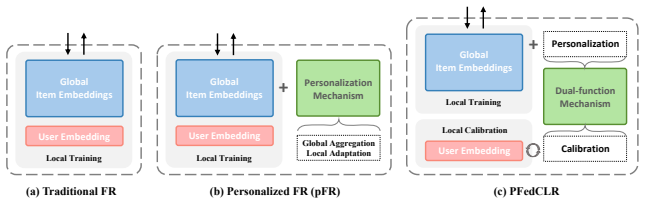
The load-bearing object is the buffer matrix $W_u \in \mathbb{R}^{m \times d}$, implemented in low-rank form $A_u B_u$ with $A_u \in \mathbb{R}^{m \times r}$ zero-initialized and $B_u \in \mathbb{R}^{r \times d}$ randomly initialized, $r \ll \min(m,d)$. It is injected into the frozen local item embeddings as $Q_u + A_u B_u$ and jointly serves two functions: its update produces the calibration terms $-\eta L_1 L_2 p_u^\top p_u \cdot q_i^{(u)}$ and $-\eta L_1^2 p_u$, which oppose the scaling and shift components of the user embedding skew, and its merged form personalizes the global item embeddings per client. The analysis decomposes the skew into these two gradient terms, and the protocol's ordering, train item embeddings with the user embedding frozen, upload, then calibrate, is what keeps the server from ever seeing the personalized model.
What would settle it
Run FedMF on a standard dataset and record $\|q_i^{(g,t)} - q_i^{(u,t)}\|$ per item per round; if the maximum ratio ever exceeds 1 or fails to trend below 1, the geometric contraction behind the skew bound is violated and the bound does not apply as stated.
Extended reading notes
Core claim
PFedCLR's central claim is that user embeddings in embedding-based federated recommender systems suffer from a skew: global aggregation introduces a gap $\delta_i^{(t)}$ between the server-level item embedding and the local one, and this gap injects a scaling term and a shift term into the user embedding's gradient that rotate and stretch its update direction. The theory bounds the accumulated skew over $T$ rounds under a geometric contraction assumption, concluding that the user embedding would converge to a suboptimal point and that the damage should be mitigated from the very first rounds. The proposed remedy is a zero-initialized buffer matrix, decomposed into low-rank factors $A_u B_u$, that is optimized while the item embedding is frozen; the buffer's update produces calibration terms that oppose the skew, and merging the buffer with the local item embeddings also yields client-specific item personalization. By uploading the model before running this personalization step, the server only receives the unpersonalized item embeddings, preserving privacy while the calibration stays on-device. Experiments report consistent gains, with HR@10 above 0.9 on four datasets and up to 39.8% relative improvement over the best baseline, plus negligible extra space and parallel client-server execution.
Load-bearing premise
The whole skew bound depends on the assumption that the gap between each global and local item embedding shrinks by a factor $\gamma < 1$ every round; if local training and global aggregation instead amplify the gap, the accumulated-skew bound and the 'calibrate from round one' argument lose their theoretical support.
Editorial extensions
If this is right
- Baselines that personalize before uploading leak user preference patterns in the uploaded item embeddings, whereas PFedCLR's upload-before-personalization ordering prevents that leakage.
- The low-rank buffer needs only about 10% extra client-side space at rank 2 and can be trained in parallel with server aggregation, keeping per-round efficiency close to plain FedMF.
- Calibration must start from round one: the accumulated skew bound is governed by the initial gap $\delta_i^{(0)}$, so injecting the buffer late cannot undo the distortion.
- PFedCLR stays stable under local differential privacy: with Laplace noise of strength $\lambda = 0.5$, performance degradation stays below 5% on all five datasets and still exceeds the state-of-the-art baselines.
- Because the buffer simultaneously personalizes item embeddings, PFedCLR closes much of the gap toward centralized recommenders, matching or beating them on most datasets tested.
Reading between the lines
- The same skew mechanism should appear in any federated method that aggregates shared item-side parameters while keeping user-side parameters local; a testable extension is to apply the calibration buffer to NCF-style or graph-based backbones instead of matrix factorization.
- The motivation plots show local-only training eventually outperforming aggregation on long horizons, which suggests that annealing the aggregation weight over rounds could improve late-stage accuracy, an implication the paper reports but does not pursue.
- The geometric contraction assumption ($\gamma < 1$) deserves a direct empirical check: logging the per-round gap between global and local item embeddings in a standard FedMF run would either confirm the bound or show that a different mechanism, such as gradient diversity, is what actually controls the skew.
- A low-rank calibration buffer placed before personalization could also serve as a privacy shield against membership inference in other embedding-based federated models, not just matrix-factorization recommenders.
Editorial analysis
A structured set of objections, weighed in public.
Referee Report
Summary. This paper studies federated recommendation (FR) and the phenomenon that globally aggregated item embeddings can distort the local user embedding updates, a problem the authors term "user embedding skew." The authors provide a theoretical analysis of this skew via a Taylor expansion (Lemmas 3.1-3.3) and propose PFedCLR, which uses a low-rank buffer matrix to simultaneously calibrate the user embedding and personalize item embeddings. The method is evaluated on five benchmark datasets against centralized and federated baselines, reporting large improvements in HR@10 and NDCG@10, along with efficiency comparisons and a local differential privacy extension. The code is publicly available.
Significance. The paper addresses a practical and under-explored issue in personalized federated recommendation, and the proposed mechanism is simple, lightweight, and privacy-aware. If the reported gains are reproducible and the theoretical motivation can be placed on firmer ground, PFedCLR could be a useful contribution to the FR literature. The paper also includes a thorough experimental section with five datasets, a cost analysis, and a privacy analysis, and it ships code. These strengths are tempered by gaps in the theoretical derivation and by the lack of statistical reporting in the main experiments.
major comments (4)
- [§B.3, Lemma B.3 (Eq. 19/23)] The bound on accumulated user embedding skew relies critically on the assumption ||δ_i^(t+1)|| ≤ γ||δ_i^(t)|| with γ∈(0,1), justified only by a generic reference to the convergence property of FedAvg [17,40]. FedAvg convergence results bound the global model's behavior, not the per-client gap between the global item embedding q_g^(t) and a client's locally trained item embedding q_u^(t). Under non-IID data, this gap can stay large, oscillate, or grow, especially since PFedCLR deliberately trains the uploaded model before personalization and uses a different effective item embedding for the user update. If γ≥1, the bound in Eq. (23) diverges, and the conclusion in Remark B.4 that accumulated skew is finite and that early calibration is sufficient collapses. As the theoretical analysis of the skew is a central claimed contribution, this unsupported contraction assumption needs to be either proved under explicit conditions or substantially weakened.
- [§5.2, Table 1; §C.3] Although the implementation details state that results are the average of 5 repeated experiments, no standard deviations, confidence intervals, or significance tests are reported for any of the main results. This makes it impossible to assess whether PFedCLR's improvements over the baselines are statistically reliable. Additionally, the reported HR@10=0.9989 on ML-100K is near saturation and is not explained; the evaluation protocol does not clearly specify how many negative candidates are used per positive item in the leave-one-out setting. The paper mentions sampling N=4 negative instances per positive sample for training, but the evaluation candidate set is not specified. This is essential for interpreting the scores, and the near-perfect values raise concerns about whether the evaluation setup is overly easy (e.g., a very small candidate set). Please report variances, use significance tests where appropriate, and specify the exact evaluation candidate construction.
- [§4.2, Lemma 4.1 (Eq. 7)] The calibration analysis shows that the low-rank buffer matrix introduces correction terms with the same algebraic structure as the skew terms in Lemma 3.2, but it does not establish that the residual skew is actually reduced or bounded. The proof in Lemma B.5 uses a first-order approximation and drops terms of order O(||δ_i + w_i||^2), and the correction terms involve p_u, not δ_i, so the cancellation is only structural and approximate. To support the claim that PFedCLR "effectively mitigates user embedding skew," the paper should provide either a quantitative bound on the remaining skew after calibration or a direct empirical measurement showing that the user embedding trajectories under PFedCLR are closer to the no-global-aggregation trajectories than those of the baselines.
- [§3, Lemmas 3.1-3.3 vs. §4, Step 1/2] The theoretical skew analysis in Lemma B.2 derives the skew term for a user embedding update that directly uses the globally aggregated item embeddings q^(g)_i. However, in PFedCLR, Step 1 freezes the user embedding and trains the local item embeddings Q_u from Q_g, and only in Step 2 is the user embedding updated using Q_u + A_u B_u, not Q_g. Thus, the analytical expression for the skew does not directly describe the actual user update in the proposed algorithm. This gap between the theory and the algorithmic procedure makes it unclear how the theoretical analysis justifies the specific design choices of PFedCLR. The authors should reconcile the theory with the actual update rule, or explicitly frame the theory as a motivating approximation for a different (simpler) FR setting and provide an empirical validation of the skew phenomenon in their own algorithm.
minor comments (5)
- [§1, footnote 2] The definitions of "global optimum" and "local optimum" in the footnote are unconventional; consider renaming them (e.g., "collaborative optimum" and "individual optimum") to avoid confusion with standard optimization terminology.
- [§2, Figure 2 and §5.3, Figure 5] The t-SNE trajectory subfigures are very small and the legend entries are nearly illegible; please enlarge the figures or provide separate panels with readable labels.
- [§5.5 and Appendix D.7] The statement that uploading the non-personalized local model "prevents the server from accessing sensitive information" is too strong in the absence of a formal privacy guarantee; the inherent privacy claim should be presented as an empirical property, with LDP being the formal mechanism, and the wording should be adjusted accordingly.
- [§4.1, Eq. (6) and §5.1] The learning rate β for the low-rank matrices is introduced in Section 4.2 but its interaction with the embedding learning rate η is not discussed until Appendix D.6; consider mentioning the default setting (β=η=0.01) in the main text.
- [Appendix D.1] The evaluation protocol for the motivation experiment should state the number of negative candidates used for computing HR@10 and NDCG@10, just as recommended for the main experiments, so that the near-saturated scores can be interpreted.
Circularity Check
No significant circularity: the skew and calibration terms are derived by self-contained Taylor expansions, and the weak contraction assumption in Lemma B.3 is a correctness gap rather than a circular reduction.
full rationale
The derivation chain is formally self-contained. Lemma 3.2 (Appendix B.2) computes the user-embedding skew by a first-order Taylor expansion of the BCE gradient about the local item embedding, i.e., the difference between the gradient evaluated at the global item embedding and the local one; this is a mathematical identity, not a fitted quantity. Lemma 4.1 (Appendix B.5) derives the calibration term by the same expansion after injecting a zero-initialized buffer matrix and taking one gradient step for the buffer; Eq. (7) is not set equal to Eq. (4) by construction, because the skew depends on the global-local item gap delta_i while the calibration depends on the user embedding p_u, and no constant is fitted to any target metric. The empirical claims are tested against held-out HR/NDCG and external baselines, so the central results do not reduce to the paper's own definitions. The main theoretical weakness is Lemma B.3's assumed contraction ||delta_i^(t+1)|| <= gamma ||delta_i^(t)|| with gamma < 1, justified only by a generic FedAvg convergence citation; if that contraction fails in non-IID personalized federated recommendation, the accumulated-skew bound diverges and the theory does not establish the mitigation claim. That is an unsupported premise and a correctness risk, but not a circular reduction. Self-citations in the paper (e.g., [31]) appear as context or framework references and are not load-bearing for the main derivations. Overall, there is no exhibited circular step, so the appropriate finding is a low score.
Assumptions & free parameters
free parameters (3)
- rank r of low-rank matrices =
2 (searched over {1,2,4,6,8,10,12})
- learning rate β of low-rank matrices =
0.01 (searched over {0.1,0.01,0.001,0.0001,0})
- Laplace noise strength λ for LDP experiments =
0.5 (main table), robustness up to 1.0
assumptions (3)
- domain assumption The difference δ_i between global and local item embeddings contracts geometrically: ||δ_i^(t+1)|| ≤ γ ||δ_i^(t)|| with γ in (0,1).
- standard math First-order Taylor expansion of the sigmoid with higher-order terms neglected.
- domain assumption The user embedding is frozen during Step 1 to avoid skew from Q_g; this decoupling is assumed to not break the joint optimization.
invented entities (1)
-
Dual-function buffer matrix W_u (low-rank AuBu)
independent evidence
Cite this review
Pith. "Pith review of Beyond Personalization: Federated Recommendation with Calibration via Low-rank Decomposition." pith.science (2026). https://pith.science/paper/VKSXG7CC
@misc{pith2026250609525,
  author       = {Pith},
  title        = {Pith review of: Beyond Personalization: Federated Recommendation with Calibration via Low-rank Decomposition},
  year         = {2026},
  howpublished = {\url{https://pith.science/paper/VKSXG7CC}},
  note         = {Machine review of arXiv:2506.09525}
}
read the original abstract
Federated recommendation (FR) is a promising paradigm to protect user privacy in recommender systems. Distinct from general federated scenarios, FR inherently needs to preserve client-specific parameters, i.e., user embeddings, for privacy and personalization. However, we empirically find that globally aggregated item embeddings can induce skew in user embeddings, resulting in suboptimal performance. To this end, we theoretically analyze the user embedding skew issue and propose Personalized Federated recommendation with Calibration via Low-Rank decomposition (PFedCLR). Specifically, PFedCLR introduces an integrated dual-function mechanism, implemented with a buffer matrix, to jointly calibrate local user embedding and personalize global item embeddings. To ensure efficiency, we employ a low-rank decomposition of the buffer matrix to reduce the model overhead. Furthermore, for privacy, we train and upload the local model before personalization, preventing the server from accessing sensitive information. Extensive experiments demonstrate that PFedCLR effectively mitigates user embedding skew and achieves a desirable trade-off among performance, efficiency, and privacy, outperforming state-of-the-art (SOTA) methods.
Figures


Figures from the paper (12 more)


Forward citations
Cited by 1 Pith paper
-
Breaking the Aggregation Bottleneck in Federated Recommendation: A Personalized Model Merging Approach
FedEM blends each client's local model with the federated global model to counter the claimed aggregation bottleneck in federated recommendation, where averaging harms personalization.
Reference graph
Works this paper leans on
-
[1]
A survey on federated recommendation systems
Zehua Sun, Yonghui Xu, Yong Liu, Wei He, Lanju Kong, Fangzhao Wu, Yali Jiang, and Lizhen Cui. A survey on federated recommendation systems. IEEE TNNLS, pages 6–20, 2024
work page 2024
-
[2]
On-device recommender systems: A comprehensive survey
Hongzhi Yin, Liang Qu, Tong Chen, Wei Yuan, Ruiqi Zheng, Jing Long, Xin Xia, Yuhui Shi, and Chengqi Zhang. On-device recommender systems: A comprehensive survey. arXiv preprint arXiv:2401.11441, 2024
arXiv 2024
-
[3]
Personalized Recommendation Models in Federated Settings: A Survey
Chunxu Zhang, Guodong Long, Zijian Zhang, Zhiwei Li, Honglei Zhang, Qiang Yang, and Bo Yang. Personalized recommendation models in federated settings: A survey. arXiv preprint arXiv:2504.07101, 2025
work page Pith review arXiv 2025
-
[4]
Federated collaborative filtering for privacy-preserving personalized recommendation system
Muhammad Ammad-Ud-Din, Elena Ivannikova, Suleiman A Khan, Were Oyomno, Qiang Fu, Kuan Eeik Tan, and Adrian Flanagan. Federated collaborative filtering for privacy-preserving personalized recommendation system. arXiv preprint arXiv:1901.09888, 2019
arXiv 1901
-
[5]
Secure federated matrix factorization
Di Chai, Leye Wang, Kai Chen, and Qiang Yang. Secure federated matrix factorization. IEEE Intelligent Systems, pages 11–20, 2020
work page 2020
-
[6]
Federated neural collaborative filtering
Vasileios Perifanis and Pavlos S Efraimidis. Federated neural collaborative filtering. Knowledge-Based Systems, page 108441, 2022
work page 2022
-
[7]
Lightfr: Lightweight federated recommendation with privacy-preserving matrix factorization
Honglei Zhang, Fangyuan Luo, Jun Wu, Xiangnan He, and Yidong Li. Lightfr: Lightweight federated recommendation with privacy-preserving matrix factorization. ACM TOIS, pages 1–28, 2023
work page 2023
-
[8]
Dual personalization on federated recommendation
Chunxu Zhang, Guodong Long, Tianyi Zhou, Peng Yan, Zijian Zhang, Chengqi Zhang, and Bo Yang. Dual personalization on federated recommendation. In IJCAI, pages 4558–4566, 2023
work page 2023
Show all 44 references
-
[9]
A tutorial of personalized federated recommender systems: Recent advances and future directions
Jing Jiang, Chunxu Zhang, Honglei Zhang, Zhiwei Li, Yidong Li, and Bo Yang. A tutorial of personalized federated recommender systems: Recent advances and future directions. In WWW, 2025
2025
-
[10]
Confree: Conflict-free client update aggregation for personalized federated learning
Hao Zheng, Zhigang Hu, Liu Yang, Meiguang Zheng, Aikun Xu, and Boyu Wang. Confree: Conflict-free client update aggregation for personalized federated learning. In AAAI, pages 22875–22883, 2025
2025
-
[11]
Personalized federated learning with inferred collaboration graphs
Rui Ye, Zhenyang Ni, Fangzhao Wu, Siheng Chen, and Yanfeng Wang. Personalized federated learning with inferred collaboration graphs. In ICML, pages 39801–39817, 2023
2023
-
[12]
Gpfedrec: Graph-guided personalization for federated recommendation
Chunxu Zhang, Guodong Long, Tianyi Zhou, Zijian Zhang, Peng Yan, and Bo Yang. Gpfedrec: Graph-guided personalization for federated recommendation. In KDD, pages 4131–4142, 2024
2024
-
[13]
Federated recommendation with additive person- alization
Zhiwei Li, Guodong Long, and Tianyi Zhou. Federated recommendation with additive person- alization. In ICLR, 2024
2024
-
[14]
Personalized federated learning with theoretical guarantees: A model-agnostic meta-learning approach
Alireza Fallah, Aryan Mokhtari, and Asuman Ozdaglar. Personalized federated learning with theoretical guarantees: A model-agnostic meta-learning approach. In NeurIPS, pages 3557– 3568, 2020
2020
-
[15]
Personalized federated learning with moreau envelopes
Canh T Dinh, Nguyen Tran, and Josh Nguyen. Personalized federated learning with moreau envelopes. In NeurIPS, pages 21394–21405, 2020
2020
-
[16]
Model-agnostic meta-learning for fast adapta- tion of deep networks
Chelsea Finn, Pieter Abbeel, and Sergey Levine. Model-agnostic meta-learning for fast adapta- tion of deep networks. In ICML, pages 1126–1135, 2017
2017
-
[17]
Communication-efficient learning of deep networks from decentralized data
Brendan McMahan, Eider Moore, Daniel Ramage, Seth Hampson, and Blaise Aguera y Arcas. Communication-efficient learning of deep networks from decentralized data. In AISTATS, pages 1273–1282, 2017
2017
-
[18]
Personalized federated learning using hypernetworks
Aviv Shamsian, Aviv Navon, Ethan Fetaya, and Gal Chechik. Personalized federated learning using hypernetworks. In ICML, pages 9489–9502, 2021. 10
2021
-
[19]
Fedmd: Heterogenous federated learning via model distillation
Daliang Li and Junpu Wang. Fedmd: Heterogenous federated learning via model distillation. In NeurIPS, 2019
2019
-
[20]
Ensemble distillation for robust model fusion in federated learning
Tao Lin, Lingjing Kong, Sebastian U Stich, and Martin Jaggi. Ensemble distillation for robust model fusion in federated learning. In NeurIPS, pages 2351–2363, 2020
2020
-
[21]
Practical one-shot federated learning for cross-silo setting
Qinbin Li, Bingsheng He, and Dawn Song. Practical one-shot federated learning for cross-silo setting. In IJCAI, pages 1484–1490, 2021
2021
-
[22]
Ditto: Fair and robust federated learning through personalization
Tian Li, Shengyuan Hu, Ahmad Beirami, and Virginia Smith. Ditto: Fair and robust federated learning through personalization. In ICML, pages 6357–6368, 2021
2021
-
[23]
Exploiting shared representations for personalized federated learning
Liam Collins, Hamed Hassani, Aryan Mokhtari, and Sanjay Shakkottai. Exploiting shared representations for personalized federated learning. In ICML, pages 2089–2099, 2021
2021
-
[24]
Fedala: Adaptive local aggregation for personalized federated learning
Jianqing Zhang, Yang Hua, Hao Wang, Tao Song, Zhengui Xue, Ruhui Ma, and Haibing Guan. Fedala: Adaptive local aggregation for personalized federated learning. In AAAI, pages 11237–11244, 2023
2023
-
[25]
Fedphp: Federated personalization with inherited private models
Xin-Chun Li, De-Chuan Zhan, Yunfeng Shao, Bingshuai Li, and Shaoming Song. Fedphp: Federated personalization with inherited private models. In ECML PKDD, pages 587–602, 2021
2021
-
[26]
Adaptive personalized federated learning
Yuyang Deng, Mohammad Mahdi Kamani, and Mehrdad Mahdavi. Adaptive personalized federated learning. arXiv preprint arXiv:2003.13461, 2020
2003 arXiv
-
[27]
Matrix factorization techniques for recom- mender systems
Yehuda Koren, Robert Bell, and Chris V olinsky. Matrix factorization techniques for recom- mender systems. Computer, pages 30–37, 2009
2009
-
[28]
Neural collaborative filtering
Xiangnan He, Lizi Liao, Hanwang Zhang, Liqiang Nie, Xia Hu, and Tat-Seng Chua. Neural collaborative filtering. In WWW, pages 173–182, 2017
2017
-
[29]
Lora: Low-rank adaptation of large language models
Edward J Hu, Yelong Shen, Phillip Wallis, Zeyuan Allen-Zhu, Yuanzhi Li, Shean Wang, Lu Wang, Weizhu Chen, et al. Lora: Low-rank adaptation of large language models. In ICLR, page 3, 2022
2022
-
[30]
Towards efficient communication and secure federated recommendation system via low-rank training
Ngoc-Hieu Nguyen, Tuan-Anh Nguyen, Tuan Nguyen, Vu Tien Hoang, Dung D Le, and Kok- Seng Wong. Towards efficient communication and secure federated recommendation system via low-rank training. In WWW, pages 3940–3951, 2024
2024
-
[31]
Beyond similarity: Personalized federated recommendation with composite aggregation
Honglei Zhang, Haoxuan Li, Jundong Chen, Sen Cui, Kunda Yan, Abudukelimu Wuerkaixi, Xin Zhou, Zhiqi Shen, and Yidong Li. Beyond similarity: Personalized federated recommendation with composite aggregation. arXiv preprint arXiv:2406.03933, 2024
2024 arXiv
-
[32]
Personalized federated collaborative filtering: A variational autoencoder approach
Zhiwei Li, Guodong Long, Tianyi Zhou, Jing Jiang, and Chengqi Zhang. Personalized federated collaborative filtering: A variational autoencoder approach. In AAAI, pages 18602–18610, 2025
2025
-
[33]
Fedloca: Low-rank coordinated adaptation with knowledge decoupling for federated recommendations
Yuchen Ding, Siqing Zhang, Boyu Fan, Wei Sun, Yong Liao, and Peng Yuan Zhou. Fedloca: Low-rank coordinated adaptation with knowledge decoupling for federated recommendations. In RecSys, pages 690–700, 2024
2024
-
[34]
A novel bayesian similarity measure for recommender systems
Guibing Guo, Jie Zhang, and Neil Yorke-Smith. A novel bayesian similarity measure for recommender systems. In IJCAI, pages 2619–2625, 2013
2013
-
[35]
The movielens datasets: History and context
F Maxwell Harper and Joseph A Konstan. The movielens datasets: History and context. ACM TIIS, pages 1–19, 2015
2015
-
[36]
Second workshop on information het- erogeneity and fusion in recommender systems (hetrec2011)
Iván Cantador, Peter Brusilovsky, and Tsvi Kuflik. Second workshop on information het- erogeneity and fusion in recommender systems (hetrec2011). In RecSys, pages 387–388, 2011
2011
-
[37]
A generic coordinate descent framework for learning from implicit feedback
Immanuel Bayer, Xiangnan He, Bhargav Kanagal, and Steffen Rendle. A generic coordinate descent framework for learning from implicit feedback. In WWW, pages 1341–1350, 2017. 11
2017
-
[38]
Trirank: Review-aware explainable recommendation by modeling aspects
Xiangnan He, Tao Chen, Min-Yen Kan, and Xiao Chen. Trirank: Review-aware explainable recommendation by modeling aspects. In CIKM, pages 1661–1670, 2015
2015
-
[39]
Lightgcn: Simplifying and powering graph convolution network for recommendation
Xiangnan He, Kuan Deng, Xiang Wang, Yan Li, Yongdong Zhang, and Meng Wang. Lightgcn: Simplifying and powering graph convolution network for recommendation. In SIGIR, pages 639–648, 2020
2020
-
[40]
On the convergence of fedavg on non-iid data
Xiang Li, Kaixuan Huang, Wenhao Yang, Shusen Wang, and Zhihua Zhang. On the convergence of fedavg on non-iid data. In ICLR, 2019
2019
-
[41]
A federated graph neural network framework for privacy-preserving personalization
Chuhan Wu, Fangzhao Wu, Lingjuan Lyu, Tao Qi, Yongfeng Huang, and Xing Xie. A federated graph neural network framework for privacy-preserving personalization. Nature Communications, page 3091, 2022
2022
-
[42]
Calibrating noise to sensitivity in private data analysis
Cynthia Dwork, Frank McSherry, Kobbi Nissim, and Adam Smith. Calibrating noise to sensitivity in private data analysis. In TCC, pages 265–284, 2006
2006
-
[43]
Guaranteeing local differential privacy on ultra-low-power systems
Woo-Seok Choi, Matthew Tomei, Jose Rodrigo Sanchez Vicarte, Pavan Kumar Hanumolu, and Rakesh Kumar. Guaranteeing local differential privacy on ultra-low-power systems. In ISCA, pages 561–574, 2018
2018
-
[44]
↑" denotes increased costs on FedMF, while
Kang Wei, Jun Li, Ming Ding, Chuan Ma, Howard H Yang, Farhad Farokhi, Shi Jin, Tony QS Quek, and H Vincent Poor. Federated learning with differential privacy: Algorithms and performance analysis. IEEE TIFS, pages 3454–3469, 2020. 12 Appendix To support the main content of the ...
2020
Reviewed August 7, 2026 · model on record in the stance chip above.
Discussion (0). Continue with ORCID to comment.