REVIEW 5 major objections 6 minor 55 references
Domain2Vec: Vectorizing Datasets to Find the Optimal Data Mixture without Training
T0 review · 5 major / 6 minor · reviewed 2026-08-07 · deepseek-v4-flash
Pith's one-line read Domain2Vec claims that the optimal pretraining data mixture can be found by aligning a dataset's 260-dimensional domain vector to the validation set, with no proxy model training.
desk verdict Novel dataset-vectorization idea for data-mixture search, but the training-free DA2 claim is under-validated; worth a serious referee. read the letter →
The pith
A machine-rendered reading of the paper's core claim, the machinery that carries it, and where it could break.
The reading
What carries the argument
The central object is the domain vector: a probability distribution over 260 meta-domains, where a meta-domain is a k-means cluster of document embeddings that acts like a basis direction in dataset space. The load-bearing algebraic step is that the mixed training set's vector is the linear combination $V_{\mathrm{train}} \cdot r$, making the objective $r^* = \arg\min_r \mathrm{Dist}(V_{\mathrm{train}} \cdot r, v_{\mathrm{valid}})$ cheap to evaluate with Huber loss. The paper's pilot study also shows that mixture rankings are nearly invariant across model sizes (Spearman 0.9743 and Pearson 0.9947 between 83M and 1.6B models), which supports transferring the no-training solution to larger LMs. When integrated with RegMix, the same vector space lets the paper fit per-meta-domain loss functions $f_i(V_{\mathrm{train}} \cdot r)$ and sum them weighted by the validation vector, avoiding refits when datasets change.
What would settle it
Train a 7B-parameter model on several C4/Knowledge-Pile mixtures (or Pile component mixtures) and compare actual validation-loss rankings to Domain2Vec's distance ranking; if the Spearman correlation falls well below the reported 0.97 from the 83M-to-1.6B pilot, or if the DA2-chosen mixture is outperformed by a random mixture, the central claim fails. A cheaper check on a fixed validation set is to test whether Dist($V_{\mathrm{train}} \cdot r$, $v_{\mathrm{valid}}$) predicts validation loss across mixtures when $r$ is varied in directions that do not change document-type composition but do change content quality.
Extended reading notes
Core claim
On the paper's own terms, optimal data-mixture discovery reduces to a distance-minimization problem in a fixed 260-dimensional semantic space. Meta-domains are built by embedding a 5.2 TB corpus of English, Chinese, and code, clustering it with k-means into 260 groups, and training a classifier (a fine-tuned Qwen2-1.5B, with 74.73% accuracy) that maps each document to a distribution over the groups. Any dataset becomes the average of its sampled documents' classifier outputs, so a mixture with ratios $r$ has domain vector $V_{\mathrm{train}} \cdot r$. Under the Distribution Alignment Assumption, validation loss decreases as that vector approaches $v_{\mathrm{valid}}$, so the paper sets $r^* = \arg\min_r \mathrm{Dist}(V_{\mathrm{train}} \cdot r, v_{\mathrm{valid}})$. It validates the rule by showing that mixture rankings on 20 validation sets are strongly correlated with actual rankings, and that selected mixtures need only 51.5% of baseline compute to match Pile-CC validation loss while improving average downstream accuracy by 2.83% under equal compute.
Load-bearing premise
The method assumes that aligning the document-type composition of the training mixture with the validation set's composition lowers validation loss, and that the best mixture found at small model sizes stays the best at production scale.
Editorial extensions
If this is right
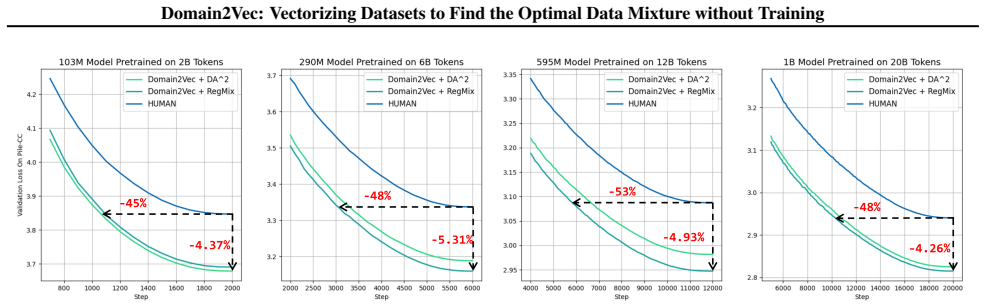
- Pretraining budgets shrink: on the Pile-CC validation target, the selected mixture matches the original Pile mixture's validation loss at 51.5% of training steps, or cuts validation loss by roughly 4% at the same budget.
- Downstream gains: under equal compute, the Domain2Vec+RegMix mixture improves average downstream accuracy by 2.83% over the Human Pile mixture, landing close to DoReMi and RegMix while using only 0.26% of their estimated FLOPs.
- Dataset changes become cheap: because each dataset is a fixed vector, adding or removing a source only requires vectorizing the new source and rerunning the minimization, not retraining proxy models or refitting mixture-loss functions.
- Prior methods become reusable: Domain2Vec+RegMix fits loss functions per meta-domain, so predictions transfer to unseen training and validation sets without collecting new fitting points.
- A mixture can be scored by a matrix-vector product plus a distance evaluation, so comparing thousands of candidate mixtures costs almost nothing compared with training a language model.
Reading between the lines
- The paper does not explore using the same geometry to choose the validation distribution itself; a deliberately broad $v_{\mathrm{valid}}$ would likely select a mixture optimized for general performance rather than one benchmark.
- DA2 is applied as a static one-shot optimization; an online version that periodically re-solves the distance minimization during pretraining would test whether alignment is the causal driver of the reported gains.
- The domain vector summarizes only document-type composition, not within-domain ordering or quality; combining Domain2Vec with a quality filter is a natural next experiment that might yield further savings.
- The 260 meta-domains were built for English, Chinese, and code; vectorizing multilingual or multimodal corpora would require rebuilding the vocabulary, so the paper's "any dataset" claim is untested in those regimes.
Editorial analysis
A structured set of objections, weighed in public.
Referee Report
Summary. Domain2Vec proposes representing text datasets as distributions over 260 k-means-clustered "meta-domains" using a fine-tuned Qwen2-1.5B classifier, and then selecting pretraining mixture ratios by minimizing a distance between the training mixture's domain vector and the validation set's domain vector (Eq. 5, DA2). The paper also integrates domain vectors into a RegMix-style regression (Eq. 7) to reduce the cost of fitting mixture-performance models. Experiments rank six C4/Knowledge-Pile mixtures (Table 2) and evaluate downstream performance of Pile-based mixtures (Table 3), reporting validation-loss savings at 51.5% of the compute of the Human mixture and downstream performance at 0.26% of DoReMi's estimated FLOPs.
Significance. The vectorization idea is clean and the integration with RegMix is a useful modular contribution that could reduce the cost of data-mixture search. The reported compute savings are substantial if the central assumption holds. However, the validity of the DA2 surrogate is not established by the supplied evidence: the pilot study tests a different property, and the direct correlation in Table 2 is moderate. The paper is honest in labeling DA2 as an assumption and in listing unresolved choices, but the current evidence does not support the "optimal data mixture" framing without qualification.
major comments (5)
- [3.3, Eq. (5), Appendix A] The central objective Eq. (5) is an assumption, not a consequence of maximum likelihood. Appendix A shows only that when Dtrain and Dvalid are identical distributions, MLE on Dtrain optimizes the validation loss; it does not show that proximity of the 260-dimensional meta-domain histograms implies proximity of the document-level distributions. Two corpora can have nearly identical domain vectors while differing in token-level difficulty, style, or intra-cluster topic composition, so minimizing Dist(Vtrain·r, vvalid) need not minimize LDvalid(r). The paper should either derive a quantitative bound connecting the two or provide direct counterfactual evidence, for example mixtures with equal domain-vector distance but different measured losses.
- [3.2] The pilot study is structurally separate from DA2. It establishes only that the ranking of six mixtures is similar for 83M and 1.6B models (Spearman 0.9743); it does not test whether domain-vector alignment ranks mixtures correctly. Consequently, the only direct support for Eq. (5) is Table 2, and the pilot study should not be presented as validating the DA2 approach.
- [4.1, Table 2] The direct evidence for Eq. (5) is moderate and statistically thin. Table 2 reports aggregate Spearman 0.6657 and Pearson 0.5833 across 20 validation sets, but with only two datasets and six prespecified ratios, and without per-validation-set correlations, confidence intervals, or significance tests. Random ranking already gives Spearman 0.0497 and the kNN baseline gives 0.3543. The experiments also rank discrete mixtures rather than solving Eq. (4)/(5) over the continuous simplex, so the claim of finding "the optimal data mixture" is stronger than the setup can verify.
- [4.2, Table 3] The downstream results do not clearly support the "comparable performance" wording. Table 3 shows Domain2Vec+DA2 averaging 0.432 and Domain2Vec+RegMix averaging 0.436, whereas DoReMi and RegMix average 0.439 and 0.441 respectively; the reported improvement is only relative to the Human mixture (0.424). No error bars or significance tests are given, so the comparison to strong baselines is not established. The paper should report variance across seeds, provide a direct statistical comparison, and qualify the abstract's claim about downstream improvement.
- [2, 4.2] The meta-domain vocabulary and classifier are constructed from a 5.2TB corpus that appears to overlap with the evaluation corpora (The Pile, RedPajama) in source composition. This creates a risk of leakage: domain vectors for evaluation datasets may be easy to estimate because the same kinds of sources were used to build the 260 meta-domains and to fine-tune the classifier. A disjointness analysis or a hold-out source experiment is needed before claiming generalization to new domains. Likewise, key hyperparameters (k=260, N=1000, Huber loss, top-100 averaging, Dirichlet prior) are chosen without sensitivity analysis; only distance functions are compared in Appendix E, and Figure 2's inertia curve is not a predictive-validity check.
minor comments (6)
- [Throughout] The naming is inconsistent: DOMAIN2VEC, Domain2Vec, D OMAIN2VEC, and Domain2vec appear in different places; please unify the notation.
- [4.2] There are typos such as "stardard practice" and "REG MIX" in Figure 5; the grammar in "The computational complexity of these methods will grow non-linearly" should be corrected.
- [Appendix B vs. 4.2] Algorithms 2 and 3 describe top-1 selection, while Section 4.2 and the text mention averaging the top-100 predicted mixtures; make the final selection rule explicit and consistent in both places.
- [Eqs. (6)-(7)] The notation fi and vtrain is ambiguous: please specify explicitly that vtrain = Vtrain·r and that each fi is fitted on the 260-dimensional domain-vector space.
- [3.1 vs. 4.2] Section 3.1 says Dvalid is often i.i.d. with Dtrain, but Section 4.2 uses Pile-CC as validation and deliberately optimizes the mixture for Pile-CC; please clarify what "i.i.d." means in this setting and how the one-epoch restriction interacts with the data-amount constraint.
- [Figure 2] The inertia-versus-k curve is monotonically decreasing and does not by itself justify k=260; report ranking or downstream performance for several values of k as a sensitivity check.
Circularity Check
No significant circularity: DA2 is an explicit assumption and all predictions are checked against measured losses.
full rationale
The derivation chain is not circular. Equation 5 defines the training-free selector as the minimizer of a distance in domain-vector space, but this is explicitly introduced as the Distribution Alignment Assumption rather than derived from the data; Appendix A only gives a special-case MLE justification for exact distribution equality, not a construction that makes the distance objective equal to validation loss. The central evaluation in Table 2 compares the DA2 ranking against actual validation losses of trained 83M and 1.6B models, so the objective is empirically tested rather than defined to match the reported outcome. The Domain2Vec+RegMix variant fits per-meta-domain surrogate models and validates ranking accuracy on held-out mixture ratios (Figure 4), so its predictions are not forced by construction either. The Pile-CC-only baseline is a sanity check whose stated purpose is to verify the Pile-CC-validation-loss/downstream correlation, not to prove DA2. Self-citations (Fei et al. 2024; Ye et al. 2024; Wang et al. 2025) appear for datasets and related work, and none is load-bearing for the distance-minimization claim or the fitted surrogate. Concerns about the classifier training corpus overlapping evaluation sources or about hyperparameter choices (Huber loss, N=1000, top-100 averaging) are potential leakage/tuning issues, not reductions of a prediction to its own input.
Assumptions & free parameters
free parameters (5)
- Number of meta-domains (k) =
260 (120 English, 120 Chinese, 20 Code)
- Sample size N for domain vector estimation =
1000 documents
- Distance function in DA2 =
Huber Loss
- Number of candidate mixtures K and top-k averaging =
100,000 candidates, top-100 averaged (Section 4.2); top-1 used in Section 4.1
- Dirichlet prior (atrain) for sampling mixtures =
token distribution of the training datasets
assumptions (5)
- domain assumption Distribution Alignment Assumption: lower validation loss when the training set's meta-domain distribution is better aligned with the validation set's distribution.
- domain assumption Meta-domains form a sufficient basis: any dataset's LM-relevant features are captured by its distribution over 260 k-means clusters.
- domain assumption Mixture-ratio rankings are invariant to model size.
- domain assumption The validation set is a good proxy for downstream performance.
- domain assumption The meta-domain classifier, trained on a 5.2TB corpus, generalizes to unseen datasets without leakage.
invented entities (1)
-
Meta-domain
Cite this review
Pith. "Pith review of Domain2Vec: Vectorizing Datasets to Find the Optimal Data Mixture without Training." pith.science (2026). https://pith.science/paper/Z4REOJCG
@misc{pith2026250610952,
  author       = {Pith},
  title        = {Pith review of: Domain2Vec: Vectorizing Datasets to Find the Optimal Data Mixture without Training},
  year         = {2026},
  howpublished = {\url{https://pith.science/paper/Z4REOJCG}},
  note         = {Machine review of arXiv:2506.10952}
}
abstract
We introduce~\textsc{Domain2Vec}, a novel approach that decomposes any dataset into a linear combination of several \emph{meta-domains}, a new concept designed to capture the key underlying features of datasets. \textsc{Domain2Vec} maintains a vocabulary of meta-domains and uses a classifier to decompose any given dataset into a domain vector that corresponds to a distribution over this vocabulary. These domain vectors enable the identification of the optimal data mixture for language model (LM) pretraining in a training-free manner under the \emph{\textbf{D}istribution \textbf{A}lignment \textbf{A}ssumption} (DA$^{2}$), which suggests that when the data distributions of the training set and the validation set are better aligned, a lower validation loss is achieved. Moreover, \textsc{Domain2vec} can be seamlessly integrated into previous works to model the relationship between domain vectors and LM performance, greatly enhancing the efficiency and scalability of previous methods. Extensive experiments demonstrate that \textsc{Domain2Vec} helps find the data mixture that enhances downstream task performance with minimal computational overhead. Specifically, \textsc{Domain2Vec} achieves the same validation loss on Pile-CC using only $51.5\%$ of the computation required when training on the original mixture of The Pile dataset. Under equivalent compute budget, \textsc{Domain2Vec} improves downstream performance by an average of $2.83\%$.
Figures


Figures from the paper (6 more)



Reference graph
Works this paper leans on
-
[1]
Ankner, Z., Blakeney, C., Sreenivasan, K., Marion, M., Leavitt, M. L., and Paul, M. Perplexed by perplexity: Perplexity-based data pruning with small reference models, 2024. URL https://arxiv.org/abs/2405.20541
arXiv 2024
-
[2]
Arthur, D. and Vassilvitskii, S. k-means++: The advantages of careful seeding. Technical report, Stanford, 2006
work page 2006
-
[3]
Bisk, Y., Zellers, R., Bras, R. L., Gao, J., and Choi, Y. Piqa: Reasoning about physical commonsense in natural language. In AAAI Conference on Artificial Intelligence, 2019. URL https://api.semanticscholar.org/CorpusID:208290939
work page 2019
-
[4]
Cross-Table Pretraining towards a Universal Function Space for Heterogeneous Tabular Data
Chen, J., Lin, Z., Chen, Q., and Sun, J. Cross-table pretraining towards a universal function space for heterogeneous tabular data. arXiv preprint arXiv:2406.00281, 2024
work page Pith review arXiv 2024
-
[5]
Think you have solved question answering? try arc, the ai2 reasoning challenge
Clark, P., Cowhey, I., Etzioni, O., Khot, T., Sabharwal, A., Schoenick, C., and Tafjord, O. Think you have solved question answering? try arc, the ai2 reasoning challenge. ArXiv, abs/1803.05457, 2018. URL https://api.semanticscholar.org/CorpusID:3922816
arXiv 2018
-
[6]
Deepseek-v2: A strong, economical, and efficient mixture-of-experts language model, 2024
DeepSeek-AI. Deepseek-v2: A strong, economical, and efficient mixture-of-experts language model, 2024
2024
-
[7]
DOGE : Domain reweighting with generalization estimation
Fan, S., Pagliardini, M., and Jaggi, M. DOGE : Domain reweighting with generalization estimation. In Second Agent Learning in Open-Endedness Workshop, 2023. URL https://openreview.net/forum?id=qiKqsqwYXm
work page 2023
-
[8]
Query of cc: Unearthing large scale domain-specific knowledge from public corpora, 2024
Fei, Z., Shao, Y., Li, L., Zeng, Z., He, C., Yan, H., Lin, D., and Qiu, X. Query of cc: Unearthing large scale domain-specific knowledge from public corpora, 2024. URL https://arxiv.org/abs/2401.14624
arXiv 2024
Show all 55 references
-
[9]
The pile: An 800gb dataset of diverse text for language modeling
Gao, L., Biderman, S., Black, S., Golding, L., Hoppe, T., Foster, C., Phang, J., He, H., Thite, A., Nabeshima, N., Presser, S., and Leahy, C. The pile: An 800gb dataset of diverse text for language modeling. CoRR, abs/2101.00027, 2021. URL https://arxiv.org/abs/2101.00027
2021 arXiv
-
[10]
A framework for few-shot language model evaluation, 07 2024
Gao, L., Tow, J., Abbasi, B., Biderman, S., Black, S., DiPofi, A., Foster, C., Golding, L., Hsu, J., Le Noac'h, A., Li, H., McDonell, K., Muennighoff, N., Ociepa, C., Phang, J., Reynolds, L., Schoelkopf, H., Skowron, A., Sutawika, L., Tang, E., Thite, A., Wang, B., Wang, K., a...
2024
-
[11]
Data mixing made efficient: A bivariate scaling law for language model pretraining, 2024
Ge, C., Ma, Z., Chen, D., Li, Y., and Ding, B. Data mixing made efficient: A bivariate scaling law for language model pretraining, 2024. URL https://arxiv.org/abs/2405.14908
2024 arXiv
-
[12]
S em E val-2012 task 7: Choice of plausible alternatives: An evaluation of commonsense causal reasoning
Gordon, A., Kozareva, Z., and Roemmele, M. S em E val-2012 task 7: Choice of plausible alternatives: An evaluation of commonsense causal reasoning. In Agirre, E., Bos, J., Diab, M., Manandhar, S., Marton, Y., and Yuret, D. (eds.), * SEM 2012: The First Joint Conference on Lexi...
2012
-
[13]
The llama 3 herd of models
Grattafiori, A., Dubey, A., Jauhri, A., Pandey, A., Kadian, A., Al-Dahle, A., Letman, A., Mathur, A., Schelten, A., Vaughan, A., et al. The llama 3 herd of models. arXiv preprint arXiv:2407.21783, 2024
2024 arXiv
-
[14]
CMR scaling law: Predicting critical mixture ratios for continual pre-training of language models
Gu, J., Yang, Z., Ding, C., Zhao, R., and Tan, F. CMR scaling law: Predicting critical mixture ratios for continual pre-training of language models. In Al-Onaizan, Y., Bansal, M., and Chen, Y.-N. (eds.), Proceedings of the 2024 Conference on Empirical Methods in Natural Langua...
2024 doi
-
[15]
Data selection via optimal control for language models
Gu, Y., Dong, L., Wang, H., Hao, Y., Dong, Q., Wei, F., and Huang, M. Data selection via optimal control for language models. arXiv preprint arXiv: 2410.07064, 2024 b
2024 arXiv
-
[16]
V., and Smith, K
Guo, S., Ren, Y., Albrecht, S. V., and Smith, K. Sample relationships through the lens of learning dynamics with label information. In First Workshop on Interpolation Regularizers and Beyond at NeurIPS 2022, 2022. URL https://openreview.net/forum?id=mIl1mMA7Uz
2022
-
[17]
H., and Friedman, J
Hastie, T., Tibshirani, R., Friedman, J. H., and Friedman, J. H. The elements of statistical learning: data mining, inference, and prediction, volume 2. Springer, 2009
2009
-
[18]
A., Welbl, J., Clark, A., Hennigan, T., Noland, E., Millican, K., van den Driessche, G., Damoc, B., Guy, A., Osindero, S., Simonyan, K., Elsen, E., Rae, J
Hoffmann, J., Borgeaud, S., Mensch, A., Buchatskaya, E., Cai, T., Rutherford, E., de Las Casas, D., Hendricks, L. A., Welbl, J., Clark, A., Hennigan, T., Noland, E., Millican, K., van den Driessche, G., Damoc, B., Guy, A., Osindero, S., Simonyan, K., Elsen, E., Rae, J. W., Vin...
2022 arXiv
-
[19]
A., Welbl, J., Clark, A., Hennigan, T., Noland, E., Millican, K., van den Driessche, G., Damoc, B., Guy, A., Osindero, S., Simonyan, K., Elsen, E., Vinyals, O., Rae, J
Hoffmann, J., Borgeaud, S., Mensch, A., Buchatskaya, E., Cai, T., Rutherford, E., de las Casas, D., Hendricks, L. A., Welbl, J., Clark, A., Hennigan, T., Noland, E., Millican, K., van den Driessche, G., Damoc, B., Guy, A., Osindero, S., Simonyan, K., Elsen, E., Vinyals, O., Ra...
2022
-
[20]
Huber, P. J. Robust Estimation of a Location Parameter . The Annals of Mathematical Statistics, 35 0 (1): 0 73 -- 101, 1964. doi:10.1214/aoms/1177703732. URL https://doi.org/10.1214/aoms/1177703732
1964
-
[21]
S., Schmidt-Thieme, L., and Grabocka, J
Jomaa, H. S., Schmidt-Thieme, L., and Grabocka, J. Dataset2vec: Learning dataset meta-features. Data Mining and Knowledge Discovery, 35 0 (3): 0 964--985, 2021
2021
-
[22]
B., Chess, B., Child, R., Gray, S., Radford, A., Wu, J., and Amodei, D
Kaplan, J., McCandlish, S., Henighan, T., Brown, T. B., Chess, B., Child, R., Gray, S., Radford, A., Wu, J., and Amodei, D. Scaling laws for neural language models, 2020. URL https://arxiv.org/abs/2001.08361
2020 arXiv
-
[23]
Lightgbm: A highly efficient gradient boosting decision tree
Ke, G., Meng, Q., Finley, T., Wang, T., Chen, W., Ma, W., Ye, Q., and Liu, T.-Y. Lightgbm: A highly efficient gradient boosting decision tree. Advances in neural information processing systems, 30, 2017
2017
-
[24]
Looking beyond the surface: A challenge set for reading comprehension over multiple sentences
Khashabi, D., Chaturvedi, S., Roth, M., Upadhyay, S., and Roth, D. Looking beyond the surface: A challenge set for reading comprehension over multiple sentences. In Walker, M., Ji, H., and Stent, A. (eds.), Proceedings of the 2018 Conference of the North A merican Chapter of t...
2018 doi
-
[25]
RACE : Large-scale R e A ding comprehension dataset from examinations
Lai, G., Xie, Q., Liu, H., Yang, Y., and Hovy, E. RACE : Large-scale R e A ding comprehension dataset from examinations. In Palmer, M., Hwa, R., and Riedel, S. (eds.), Proceedings of the 2017 Conference on Empirical Methods in Natural Language Processing, pp.\ 785--794, Copenh...
2017 doi
-
[26]
Not all tokens are what you need for pretraining
Lin, Z., Gou, Z., Gong, Y., Liu, X., Xu, R., Lin, C., Yang, Y., Jiao, J., Duan, N., Chen, W., et al. Not all tokens are what you need for pretraining. Advances in Neural Information Processing Systems, 37: 0 29029--29063, 2024
2024
-
[27]
Logiqa: a challenge dataset for machine reading comprehension with logical reasoning
Liu, J., Cui, L., Liu, H., Huang, D., Wang, Y., and Zhang, Y. Logiqa: a challenge dataset for machine reading comprehension with logical reasoning. In Proceedings of the Twenty-Ninth International Joint Conference on Artificial Intelligence, IJCAI'20, 2021. ISBN 9780999241165
2021
-
[28]
Regmix: Data mixture as regression for language model pre-training, 2024
Liu, Q., Zheng, X., Muennighoff, N., Zeng, G., Dou, L., Pang, T., Jiang, J., and Lin, M. Regmix: Data mixture as regression for language model pre-training, 2024. URL https://arxiv.org/abs/2407.01492
2024 arXiv
-
[29]
and Hutter, F
Loshchilov, I. and Hutter, F. Decoupled weight decay regularization. arXiv preprint arXiv:1711.05101, 2017
2017 arXiv
-
[30]
Some methods for classification and analysis of multivariate observations
Macqueen, J. Some methods for classification and analysis of multivariate observations. In Proceedings of 5-th Berkeley Symposium on Mathematical Statistics and Probability/University of California Press, 1967
1967
-
[31]
Can a suit of armor conduct electricity? a new dataset for open book question answering
Mihaylov, T., Clark, P., Khot, T., and Sabharwal, A. Can a suit of armor conduct electricity? a new dataset for open book question answering. In Conference on Empirical Methods in Natural Language Processing, 2018. URL https://api.semanticscholar.org/CorpusID:52183757
2018
-
[32]
Gpt-4 technical report, 2024
OpenAI. Gpt-4 technical report, 2024. URL https://arxiv.org/abs/2303.08774
2024 arXiv
-
[33]
Q., Bernardi, R., Pezzelle, S., Baroni, M., Boleda, G., and Fern \'a ndez, R
Paperno, D., Kruszewski, G., Lazaridou, A., Pham, N. Q., Bernardi, R., Pezzelle, S., Baroni, M., Boleda, G., and Fern \'a ndez, R. The LAMBADA dataset: Word prediction requiring a broad discourse context. In Erk, K. and Smith, N. A. (eds.), Proceedings of the 54th Annual Meeti...
2016 doi
-
[34]
B., Lozhkov, A., Mitchell, M., Raffel, C., Werra, L
Penedo, G., Kydl \' c ek, H., allal, L. B., Lozhkov, A., Mitchell, M., Raffel, C., Werra, L. V., and Wolf, T. The fineweb datasets: Decanting the web for the finest text data at scale. In The Thirty-eight Conference on Neural Information Processing Systems Datasets and Benchma...
2024
-
[35]
D-cpt law: Domain-specific continual pre-training scaling law for large language models
Que, H., Liu, J., Zhang, G., Zhang, C., Qu, X., Ma, Y., Duan, F., Bai, Z., Wang, J., Zhang, Y., et al. D-cpt law: Domain-specific continual pre-training scaling law for large language models. Advances in Neural Information Processing Systems, 37: 0 90318--90354, 2024
2024
-
[36]
Qwen2 technical report, 2024
Qwen Team . Qwen2 technical report, 2024. URL https://arxiv.org/abs/2407.10671
2024 arXiv
-
[37]
Improving language understanding by generative pre-training
Radford, A. Improving language understanding by generative pre-training. 2018
2018
-
[38]
Rae, J. W., Borgeaud, S., Cai, T., Millican, K., Hoffmann, J., Song, F., Aslanides, J., Henderson, S., Ring, R., Young, S., Rutherford, E., Hennigan, T., Menick, J., Cassirer, A., Powell, R., van den Driessche, G., Hendricks, L. A., Rauh, M., Huang, P.-S., Glaese, A., et al. S...
2022 arXiv
-
[39]
Raffel, C., Shazeer, N., Roberts, A., Lee, K., Narang, S., Matena, M., Zhou, Y., Li, W., and Liu, P. J. Exploring the limits of transfer learning with a unified text-to-text transformer. J. Mach. Learn. Res., 21 0 (1), jan 2020. ISSN 1532-4435
2020
-
[40]
W., Hashimoto, T
Sagawa*, S., Koh*, P. W., Hashimoto, T. B., and Liang, P. Distributionally robust neural networks. In International Conference on Learning Representations, 2020. URL https://openreview.net/forum?id=ryxGuJrFvS
2020
-
[41]
L., Bhagavatula, C., and Choi, Y
Sakaguchi, K., Bras, R. L., Bhagavatula, C., and Choi, Y. Winogrande: an adversarial winograd schema challenge at scale. Commun. ACM, 64 0 (9): 0 99–106, August 2021. ISSN 0001-0782. doi:10.1145/3474381. URL https://doi.org/10.1145/3474381
2021 doi
-
[42]
Social IQ a: Commonsense reasoning about social interactions
Sap, M., Rashkin, H., Chen, D., Le Bras, R., and Choi, Y. Social IQ a: Commonsense reasoning about social interactions. In Inui, K., Jiang, J., Ng, V., and Wan, X. (eds.), Proceedings of the 2019 Conference on Empirical Methods in Natural Language Processing and the 9th Intern...
2019 doi
-
[43]
Self-influence guided data reweighting for language model pre-training
Thakkar, M., Bolukbasi, T., Ganapathy, S., Vashishth, S., Chandar, S., and Talukdar, P. Self-influence guided data reweighting for language model pre-training. In The 2023 Conference on Empirical Methods in Natural Language Processing, 2023. URL https://openreview.net/forum?id...
2023
-
[44]
C., Chen, M., Cucurull, G., Esiobu, D., Fernandes, J., Fu, J., Fu, W., Fuller, B., et al
Touvron, H., Martin, L., Stone, K., Albert, P., Almahairi, A., Babaei, Y., Bashlykov, N., Batra, S., Bhargava, P., Bhosale, S., Bikel, D., Blecher, L., Ferrer, C. C., Chen, M., Cucurull, G., Esiobu, D., Fernandes, J., Fu, J., Fu, W., Fuller, B., et al. Llama 2: Open foundation...
2023 arXiv
-
[45]
and Hinton, G
Van der Maaten, L. and Hinton, G. Visualizing data using t-sne. Journal of machine learning research, 9 0 (11), 2008
2008
-
[46]
Wang, X., Tissue, H., Wang, L., Li, L., and Zeng, D. D. Learning dynamics in continual pre-training for large language models. arXiv preprint arXiv: 2505.07796, 2025
2025 arXiv
-
[47]
Redpajama: an open dataset for training large language models
Weber, M., Fu, D., Anthony, Q., Oren, Y., Adams, S., Alexandrov, A., Lyu, X., Nguyen, H., Yao, X., Adams, V., Athiwaratkun, B., Chalamala, R., Chen, K., Ryabinin, M., Dao, T., Liang, P., Ré, C., Rish, I., and Zhang, C. Redpajama: an open dataset for training large language mod...
2024 arXiv
-
[48]
F., and Gardner, M
Welbl, J., Liu, N. F., and Gardner, M. Crowdsourcing multiple choice science questions. In Derczynski, L., Xu, W., Ritter, A., and Baldwin, T. (eds.), Proceedings of the 3rd Workshop on Noisy User-generated Text, pp.\ 94--106, Copenhagen, Denmark, September 2017. Association f...
2017 doi
-
[49]
C-pack: Packaged resources to advance general chinese embedding, 2023
Xiao, S., Liu, Z., Zhang, P., and Muennighoff, N. C-pack: Packaged resources to advance general chinese embedding, 2023
2023
-
[50]
M., Pham, H., Dong, X., Du, N., Liu, H., Lu, Y., Liang, P., Le, Q
Xie, S. M., Pham, H., Dong, X., Du, N., Liu, H., Lu, Y., Liang, P., Le, Q. V., Ma, T., and Yu, A. W. Doremi: Optimizing data mixtures speeds up language model pretraining. In Thirty-seventh Conference on Neural Information Processing Systems, 2023 a . URL https://openreview.ne...
2023
-
[51]
M., Santurkar, S., Ma, T., and Liang, P
Xie, S. M., Santurkar, S., Ma, T., and Liang, P. S. Data selection for language models via importance resampling. Advances in Neural Information Processing Systems, 36: 0 34201--34227, 2023 b
2023
-
[52]
Data mixing laws: Optimizing data mixtures by predicting language modeling performance, 2024
Ye, J., Liu, P., Sun, T., Zhou, Y., Zhan, J., and Qiu, X. Data mixing laws: Optimizing data mixtures by predicting language modeling performance, 2024. URL https://arxiv.org/abs/2403.16952
2024 arXiv
-
[53]
Hellaswag: Can a machine really finish your sentence? In Annual Meeting of the Association for Computational Linguistics, 2019
Zellers, R., Holtzman, A., Bisk, Y., Farhadi, A., and Choi, Y. Hellaswag: Can a machine really finish your sentence? In Annual Meeting of the Association for Computational Linguistics, 2019. URL https://api.semanticscholar.org/CorpusID:159041722
2019
-
[54]
LIMA : Less is more for alignment
Zhou, C., Liu, P., Xu, P., Iyer, S., Sun, J., Mao, Y., Ma, X., Efrat, A., Yu, P., YU, L., Zhang, S., Ghosh, G., Lewis, M., Zettlemoyer, L., and Levy, O. LIMA : Less is more for alignment. In Thirty-seventh Conference on Neural Information Processing Systems, 2023. URL https://...
2023
-
[55]
write newline
" write newline "" before.all 'output.state := FUNCTION n.dashify 't := "" t empty not t #1 #1 substring "-" = t #1 #2 substring "--" = not "--" * t #2 global.max substring 't := t #1 #1 substring "-" = "-" * t #2 global.max substring 't := while if t #1 #1 substring * t #2 gl...
Reviewed August 7, 2026 · model on record in the stance chip above.
Discussion (0). Sign in to comment.