REVIEW 4 major objections 3 minor 3 cited by
SciSage: A Multi-Agent Framework for High-Quality Scientific Survey Generation
T0 review · 4 major / 3 minor · reviewed 2026-08-07 · deepseek-v4-flash
Pith's one-line read A six-agent pipeline that reflects while drafting beats current survey generators
desk verdict Useful system and benchmark, but the headline coherence claim likely measures outlines and the human-eval numbers contradict each other; worth refereeing after major revision. read the letter →
The pith
A machine-rendered reading of the paper's core claim, the machinery that carries it, and where it could break.
The reading
What carries the argument
The central mechanism is the hierarchical Reflector agent, a generate–reflect–regenerate loop that runs at three scopes: outline, section, and full document. At full-document scope it convenes a panel of LLM personas (editor, senior professor, peer reviewer) with majority-vote identification of weak sections and a structured revision plan. The Reflector does the work of converting an unreflective single-pass writer into a self-correcting one; ablation shows document coherence rising from 71.25 to 81.48 and critical-thinking scores from 69.70 to 77.93 when reflection is enabled.
What would settle it
Swap the judge: have a different model family (or blinded expert raters) score the same generated surveys on the 10-point rubric. If SciSage no longer separates from LLM×MapReduce-V2 on document coherence, or if the cognitive scores invert on topics where humans preferred the human-written survey, the claimed advantage is an artifact of self-judging.
Extended reading notes
Core claim
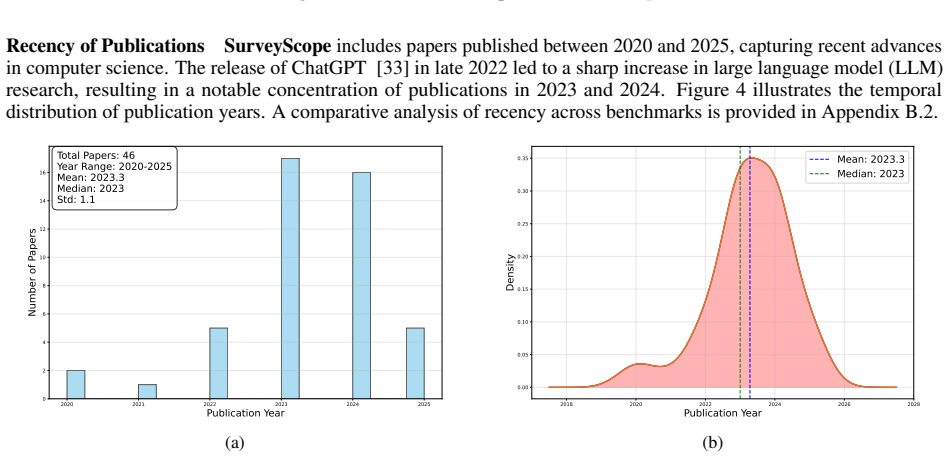
The paper claims that embedding a critic into the generation loop—rather than relying on a single-pass draft plus post-editing—is what makes automated surveys structurally coherent and citation-faithful. The Reflector audits the outline for completeness and logic, audits each section for accuracy and evidential support and can trigger new retrieval, and audits the full text through a panel of simulated expert personas whose majority vote feeds a revision plan back into retrieval and composition. On SurveyScope, a curated set of 46 high-impact computer-science surveys (2020–2025, average 322 citations), this yields document-level coherence 80.37, critical-thinking 77.58, and citation $F_1$ 0.46 with 1,510 of 3,844 human-cited references correctly matched—while the nearest baseline on citation $F_1$ matches 392. Human experts found the generated surveys broader and faster to produce, but preferred human-written surveys on 7 of 10 topics, mainly for depth, precise formulas, and style.
Load-bearing premise
The headline numbers assume that Qwen3-32B—the same model family that wrote the surveys—is an unbiased judge of coherence, critical thinking, and citation quality, and that the rescaled 10-point rubric preserves the ranking a 100-point scale would give.
Editorial extensions
If this is right
- If the reflect-when-you-write result holds, automated survey systems should embed critics at every drafting stage rather than bolting on a final edit.
- Citation quality becomes a measurable property of the pipeline: $F_1$ 0.46 with 1,510 exact overlaps shows retrieval-driven composition can align with human reference choices at an actionable scale.
- The 10-point scoring rubric rescaled to 0–100 is a methodological claim: the standard 100-point rubric saturates and cannot separate modern systems, so finer-grained evaluation is needed.
- SurveyScope's recency and citation controls give future survey-generation work a common, higher-impact testbed than the older 20-paper SURVEY EVAL_TEST and AutoSurvey sets.
- The mixed human results imply the practical payoff is breadth and drafting efficiency, not replacing expert authorship of analytic content.
Reading between the lines
- If the benchmark's retrieval sources overlap the manually curated SurveyScope papers, the citation-$F_1$ gains could partly measure retrieval access rather than reflection; a clean test is to hold out the benchmark papers from the retrieval corpus and re-measure.
- The same hierarchical-reflection pattern could transfer to other long-form, citation-heavy writing—technical reports, regulatory documents, textbooks—where structural coherence and source fidelity matter more than one-shot fluency.
- A stricter extension of the paper's own metric-saturation warning: future evaluation should shift from topical-relevance and section-coherence scores toward document-level argumentation and claim-support alignment, where the paper shows the largest discriminative gaps.
Editorial analysis
A structured set of objections, weighed in public.
Referee Report
Summary. The paper proposes SciSage, a multi-agent LLM framework for automated scientific survey generation built around a 'reflect-when-you-write' paradigm, in which a hierarchical Reflector agent critiques and refines generated content at outline, section, and document levels. The authors also introduce SurveyScope, a benchmark of 46 high-impact computer science survey papers (2020–2025) with recency and citation-based quality controls. Experiments compare SciSage against OpenScholar (w/ SciSage), AutoSurvey, and LLM×MapReduce-V2, reporting gains in document coherence (80.37 vs. 78.64) and citation F1 (0.46 vs. 0.14 for the strongest baseline), together with a human evaluation by domain experts. The paper claims that SciSage significantly outperforms state-of-the-art baselines, especially in structural coherence and reference accuracy.
Significance. If the reported results were fully supported, SciSage would be a useful contribution to automated survey generation, and the SurveyScope benchmark would provide a valuable community resource. The framework is described in sufficient detail to be reproducible, and the release of code and benchmark is a concrete strength. The reflect-when-you-write mechanism is a plausible and interesting design choice. However, the evaluation as currently presented contains load-bearing problems: the 'document coherence' metric appears to score outlines rather than full generated documents, the human evaluation numbers are internally contradictory, and the LLM judge is the same model family as the generator. These issues mean that the central claims of superiority over baselines are not currently established by the manuscript's evidence.
major comments (4)
- [§5.1.2, Appendix A.6] The 'Document-Level Structure' metric—which is the basis for the headline claim of +1.73/+2.8 points in document coherence (Table 4, §6.2.1) and for the ablation gains in Table 6—does not actually evaluate the full generated survey document. The prompt in Appendix A.6 is titled 'Prompt for Evaluation Document Outline', takes [Topic], [Skeleton], and [OUTLINE] as inputs, and defines its scoring criteria (structural coherence, conceptual depth, critical thinking) in terms of an outline's section organization and coverage. There is no input slot for the finished survey text. Consequently, the reported 'Document' scores measure outline quality, not the coherence of the final manuscript. This is a construct-validity failure that directly undermines the primary quantitative comparison. The authors must either re-run the document-level evaluation on full generated documents or substantially re-frame the claims.
- [Abstract, §1, §5.2, Table 7, §9] The human evaluation results are reported inconsistently in ways that cannot all be true. The Abstract states '3 wins vs. 7 losses against human-written surveys'; the Introduction states 'Human experts prefer SciSage's drafts on 7 out of 10 topics'; Table 7 lists only one topic where 'SciSage is better', two where 'Same', and seven where 'Human is better'; and the Conclusion states a '30% win rate'. These statements are mutually contradictory. The authors need to reconcile the counts and present a single, accurate summary of the human study. As it stands, the reader cannot tell whether the system won 1, 3, or 7 of the comparisons, and the Introduction's claim is contradicted by the paper's own Table 7.
- [§5.1, §6.2.1] The automatic evaluation framework uses Qwen3-32B as the judge for systems that are also built on Qwen3-32B, including SciSage itself. The paper further replaced the 100-point rubric from LLM×MapReduce-V2 with a 10-point rubric to increase score variance (Section 5.1.1), which suggests that the original rubric was not discriminative. This setup creates a risk of evaluator bias in favor of the proposed system, since the judge may prefer outputs that match its own stylistic tendencies. The authors should provide evidence that the Qwen3-32B judge is not biased, for example by reporting agreement with human judgments or by using an independent judge (e.g., a different model family or human preference judgments) for at least a subset of the evaluation.
- [Abstract, §1, Table 4] The reported effect sizes are inconsistent across the paper. The Abstract claims '+32% in citation F1 scores', which appears to be an absolute percentage-point difference (0.46 vs. 0.14 for AutoSurvey), not a relative improvement; relative to AutoSurvey the improvement is about 228%. The Introduction claims '+2.8 points in document coherence', but Table 4 shows a difference of 1.73 points (80.37 vs. 78.64) against LLM×MapReduce-V2, and larger differences against other baselines. The authors should state the comparison basis explicit for every reported gain and ensure the abstract, introduction, and results tables are consistent.
minor comments (3)
- [Table 5, §7.1] Table 5 is captioned 'Comparison of SCISAGE with and without Reflection', but the surrounding text in §7.1 describes an ablation of query understanding (w/ Q.U. vs. w/o Q.U.). This caption appears to be a copy-paste error and should be corrected.
- [Throughout] There are numerous spelling and formatting errors, including 'adajecent' in Table 3, 'retrievd' in §5.1.3, 'Pormpt' in Appendix A.4 and A.5, 'Comparsion' in Figure 12, 'scitific' in §2, 'understading' in §3.1, and 'trails' instead of 'trials' in Algorithm 1. The model name is inconsistently written as 'Qwen3-32B' and 'QWEN 3-32B', and the system name as 'SciSage' and 'SCISAGE'. These should be cleaned up.
- [§6.2.1] The statement that SciSage achieves 'perfect topical relevance (100)' is not a meaningful differentiator because LLM×MapReduce-V2 also achieves 100 and the metric is acknowledged as saturated in §8. The discussion should avoid highlighting a saturated metric as evidence of superiority.
Circularity Check
No significant circularity: the central claim is an empirical system comparison, not a derivation that reduces to its inputs; only minor evaluator overlap and an outline-vs-document construct concern appear.
full rationale
The paper's central claim—that SciSage's hierarchical reflect-when-you-write agents improve document coherence and citation F1—is an empirical result obtained by running SciSage and three external baselines on a new benchmark, SurveyScope. No fitted parameter is renamed as a prediction, no equation is defined in terms of the quantity it is said to predict, and no load-bearing claim rests on a self-citation or on a uniqueness theorem from the authors' prior work. The main result is supported by ablations (Table 6) that toggle the reflection mechanism and measure the effect, which is a causal comparison rather than a construction-level identity. The automatic evaluation does use Qwen3-32B both as generator and as judge, and the rubrics are authored by the same team, but this is an evaluator-overlap/validity risk, not a circular derivation: the scores are not obtained by plugging the system's own outputs back into the system's own parameters. There is also a construct-validity concern that the "Document" coherence score may actually be an outline score, since Appendix A.6 is titled "Prompt for Evaluation Document Outline" and its placeholders are [TOPIC], [Skeleton], and [OUTLINE]; however, this is a measurement-mismatch issue, not a case of the claimed result being equivalent to the input by construction. The paper's own Section 8 acknowledges metric saturation for Topical Relevance and Section Coherence, further indicating that the headline discriminative claims are limited to specific metrics rather than being forced by the framework's definition. Overall, the derivation chain is self-contained and empirically grounded; the identified concerns belong under correctness/validity risk, not circularity.
Assumptions & free parameters
free parameters (3)
- outline_max_reflections =
2
- section_reflection_max_turns =
2
- global_reflection_max_turns =
2
assumptions (4)
- domain assumption LLM-based evaluation with Qwen3-32B is a valid proxy for expert human assessment of survey quality.
- domain assumption Citation count and publication recency are appropriate proxies for paper quality in benchmark construction.
- domain assumption Human-written reference lists are the complete ground truth for citation F1.
- domain assumption Baselines run under official default configurations provide fair comparisons.
Cite this review
Pith. "Pith review of SciSage: A Multi-Agent Framework for High-Quality Scientific Survey Generation." pith.science (2026). https://pith.science/paper/OXSGETAX
@misc{pith2026250612689,
  author       = {Pith},
  title        = {Pith review of: SciSage: A Multi-Agent Framework for High-Quality Scientific Survey Generation},
  year         = {2026},
  howpublished = {\url{https://pith.science/paper/OXSGETAX}},
  note         = {Machine review of arXiv:2506.12689}
}
read the original abstract
The rapid growth of scientific literature demands robust tools for automated survey-generation. However, current large language model (LLM)-based methods often lack in-depth analysis, structural coherence, and reliable citations. To address these limitations, we introduce SciSage, a multi-agent framework employing a reflect-when-you-write paradigm. SciSage features a hierarchical Reflector agent that critically evaluates drafts at outline, section, and document levels, collaborating with specialized agents for query interpretation, content retrieval, and refinement. We also release SurveyScope, a rigorously curated benchmark of 46 high-impact papers (2020-2025) across 11 computer science domains, with strict recency and citation-based quality controls. Evaluations demonstrate that SciSage outperforms state-of-the-art baselines (LLM x MapReduce-V2, AutoSurvey), achieving +1.73 points in document coherence and +32% in citation F1 scores. Human evaluations reveal mixed outcomes (3 wins vs. 7 losses against human-written surveys), but highlight SciSage's strengths in topical breadth and retrieval efficiency. Overall, SciSage offers a promising foundation for research-assistive writing tools.
Figures


Figures from the paper (10 more)


Forward citations
Cited by 3 Pith papers
-
Externalizing Research Synthesis and Validation in AI Scientists through a Research Harness
Xcientist is a research harness that externalizes an AI scientist's literature grounding, idea evolution, experiments, and repairs into auditable artifacts, demonstrated on memory, traffic forecasting, and PDE-solving tasks.
-
SurveyLens: A Discipline-Aware Benchmark for Automatic Survey Generation
SurveyLens benchmarks AI survey generators on 1,000 human-written surveys from 10 disciplines, finding Deep Research agents most robust and reference quality weakest everywhere.
-
DeepSurvey-Bench: Evaluating Academic Value of Automatically Generated Scientific Surveys
A benchmark with human-annotated academic-value labels and seven LLM-judged metrics for evaluating whether automatically generated scientific surveys have real academic value.
Reference graph
Works this paper leans on
-
[1]
Lutz Bornmann, Robin Haunschild, and Rüdiger Mutz. Growth rates of modern science: a latent piecewise growth curve approach to model publication numbers from established and new literature databases. Humanities and Social Sciences Communications, 8(1):1–15, 2021
work page 2021
-
[2]
Autosurvey: Large language models can automatically write surveys
Yidong Wang, Qi Guo, Wenjin Yao, Hongbo Zhang, Xin Zhang, Zhen Wu, Meishan Zhang, Xinyu Dai, Qingsong Wen, Wei Ye, et al. Autosurvey: Large language models can automatically write surveys. Advances in Neural Information Processing Systems, 37:115119–115145, 2024
2024
-
[3]
Deep reinforcement learning: A survey
Xu Wang, Sen Wang, Xingxing Liang, Dawei Zhao, Jincai Huang, Xin Xu, Bin Dai, and Qiguang Miao. Deep reinforcement learning: A survey. IEEE Transactions on Neural Networks and Learning Systems, 35(4):5064– 5078, 2022
work page 2022
-
[4]
A survey on large language models: Applications, challenges, limitations, and practical usage
Muhammad Usman Hadi, Rizwan Qureshi, Abbas Shah, Muhammad Irfan, Anas Zafar, Muhammad Bilal Shaikh, Naveed Akhtar, Jia Wu, Seyedali Mirjalili, et al. A survey on large language models: Applications, challenges, limitations, and practical usage. Authorea Preprints, 2023
2023
-
[5]
A survey on large language model based autonomous agents
Lei Wang, Chen Ma, Xueyang Feng, Zeyu Zhang, Hao Yang, Jingsen Zhang, Zhiyuan Chen, Jiakai Tang, Xu Chen, Yankai Lin, et al. A survey on large language model based autonomous agents. Frontiers of Computer Science, 18(6):186345, 2024
2024
-
[6]
Aaron Hurst, Adam Lerer, Adam P Goucher, Adam Perelman, Aditya Ramesh, Aidan Clark, AJ Ostrow, Akila Welihinda, Alan Hayes, Alec Radford, et al. Gpt-4o system card. arXiv preprint arXiv:2410.21276, 2024
arXiv 2024
-
[7]
Gemini: a family of highly capable multimodal models
Gemini Team, Rohan Anil, Sebastian Borgeaud, Jean-Baptiste Alayrac, Jiahui Yu, Radu Soricut, Johan Schalkwyk, Andrew M Dai, Anja Hauth, Katie Millican, et al. Gemini: a family of highly capable multimodal models. arXiv preprint arXiv:2312.11805, 2023
arXiv 2023
-
[8]
Deepseek-r1: Incentivizing reasoning capability in llms via reinforcement learning
Daya Guo, Dejian Yang, Haowei Zhang, Junxiao Song, Ruoyu Zhang, Runxin Xu, Qihao Zhu, Shirong Ma, Peiyi Wang, Xiao Bi, et al. Deepseek-r1: Incentivizing reasoning capability in llms via reinforcement learning. arXiv preprint arXiv:2501.12948, 2025
arXiv 2025
Show all 56 references
-
[9]
Qwen3 technical report
An Yang, Anfeng Li, Baosong Yang, Beichen Zhang, Binyuan Hui, Bo Zheng, Bowen Yu, Chang Gao, Chengen Huang, Chenxu Lv, Chujie Zheng, Dayiheng Liu, Fan Zhou, Fei Huang, Feng Hu, Hao Ge, Haoran Wei, Huan Lin, Jialong Tang, Jian Yang, Jianhong Tu, Jianwei Zhang, Jianxin Yang, Jia...
2025 arXiv
-
[10]
Assisting in writing wikipedia-like articles from scratch with large language models
Yijia Shao, Yucheng Jiang, Theodore A Kanell, Peter Xu, Omar Khattab, and Monica S Lam. Assisting in writing wikipedia-like articles from scratch with large language models. arXiv preprint arXiv:2402.14207, 2024
2024 arXiv
-
[11]
Into the unknown unknowns: Engaged human learning through participation in language model agent conversations
Yucheng Jiang, Yijia Shao, Dekun Ma, Sina J Semnani, and Monica S Lam. Into the unknown unknowns: Engaged human learning through participation in language model agent conversations. arXiv preprint arXiv:2408.15232, 2024
2024 arXiv
-
[12]
Llm × mapreduce-v2: Entropy-driven convolutional test-time scaling for generating long-form articles from extremely long resources
Haoyu Wang, Yujia Fu, Zhu Zhang, Shuo Wang, Zirui Ren, Xiaorong Wang, Zhili Li, Chaoqun He, Bo An, Zhiyuan Liu, et al. Llm × mapreduce-v2: Entropy-driven convolutional test-time scaling for generating long-form articles from extremely long resources. arXiv preprint arXiv:2504....
2025 arXiv
-
[13]
Reflexion: Language agents with verbal reinforcement learning
Noah Shinn, Federico Cassano, Ashwin Gopinath, Karthik Narasimhan, and Shunyu Yao. Reflexion: Language agents with verbal reinforcement learning. Advances in Neural Information Processing Systems, 36:8634–8652, 2023
2023
-
[14]
Self-rag: Learning to retrieve, gener- ate, and critique through self-reflection
Akari Asai, Zeqiu Wu, Yizhong Wang, Avirup Sil, and Hannaneh Hajishirzi. Self-rag: Learning to retrieve, gener- ate, and critique through self-reflection. In The Twelfth International Conference on Learning Representations, 2023
2023
-
[15]
Self-reflection in llm agents: Effects on problem-solving performance
Matthew Renze and Erhan Guven. Self-reflection in llm agents: Effects on problem-solving performance. arXiv preprint arXiv:2405.06682, 2024
2024 arXiv
-
[16]
Openscholar: Synthesizing scientific literature with retrieval-augmented lms
Akari Asai, Jacqueline He, Rulin Shao, Weijia Shi, Amanpreet Singh, Joseph Chee Chang, Kyle Lo, Luca Soldaini, Sergey Feldman, Mike D’arcy, et al. Openscholar: Synthesizing scientific literature with retrieval-augmented lms. arXiv preprint arXiv:2411.14199, 2024
2024 arXiv
-
[17]
Surveyforge: On the outline heuristics, memory-driven generation, and multi-dimensional evaluation for automated survey writing
Xiangchao Yan, Shiyang Feng, Jiakang Yuan, Renqiu Xia, Bin Wang, Bo Zhang, and Lei Bai. Surveyforge: On the outline heuristics, memory-driven generation, and multi-dimensional evaluation for automated survey writing. arXiv preprint arXiv:2503.04629, 2025
2025 arXiv
-
[18]
Interactivesurvey: An llm-based personalized and interactive survey paper generation system
Zhiyuan Wen, Jiannong Cao, Zian Wang, Beichen Guo, Ruosong Yang, and Shuaiqi Liu. Interactivesurvey: An llm-based personalized and interactive survey paper generation system. arXiv preprint arXiv:2504.08762, 2025
2025 arXiv
-
[19]
Introducing deep research, 2024
OpenAI. Introducing deep research, 2024. Accessed: 2025-05-19
2024
-
[20]
Gemini deep research overview, 2024
Google DeepMind. Gemini deep research overview, 2024. Accessed: 2025-05-19
2024
-
[21]
A survey on llm-based multi-agent systems: workflow, infrastructure, and challenges
Xinyi Li, Sai Wang, Siqi Zeng, Yu Wu, and Yi Yang. A survey on llm-based multi-agent systems: workflow, infrastructure, and challenges. Vicinagearth, 1(1):9, 2024
2024
-
[22]
Large language model based multi-agents: A survey of progress and challenges
Taicheng Guo, Xiuying Chen, Yaqi Wang, Ruidi Chang, Shichao Pei, Nitesh V Chawla, Olaf Wiest, and Xiangliang Zhang. Large language model based multi-agents: A survey of progress and challenges. arXiv preprint arXiv:2402.01680, 2024
2024 arXiv
-
[23]
Metagpt: Meta programming for multi-agent collaborative framework
Sirui Hong, Xiawu Zheng, Jonathan Chen, Yuheng Cheng, Jinlin Wang, Ceyao Zhang, Zili Wang, Steven Ka Shing Yau, Zijuan Lin, Liyang Zhou, et al. Metagpt: Meta programming for multi-agent collaborative framework. arXiv preprint arXiv:2308.00352, 3(4):6, 2023
2023 arXiv
-
[24]
Autogen: Enabling next-gen llm applications via multi-agent conversation
Qingyun Wu, Gagan Bansal, Jieyu Zhang, Yiran Wu, Beibin Li, Erkang Zhu, Li Jiang, Xiaoyun Zhang, Shaokun Zhang, Jiale Liu, et al. Autogen: Enabling next-gen llm applications via multi-agent conversation. arXiv preprint arXiv:2308.08155, 2023
2023 arXiv
-
[25]
Unleashing the emergent cognitive synergy in large language models: A task-solving agent through multi-persona self-collaboration
Zhenhailong Wang, Shaoguang Mao, Wenshan Wu, Tao Ge, Furu Wei, and Heng Ji. Unleashing the emergent cognitive synergy in large language models: A task-solving agent through multi-persona self-collaboration. arXiv preprint arXiv:2307.05300, 2023
2023 arXiv
-
[26]
Generative agents: Interactive simulacra of human behavior
Joon Sung Park, Joseph O’Brien, Carrie Jun Cai, Meredith Ringel Morris, Percy Liang, and Michael S Bernstein. Generative agents: Interactive simulacra of human behavior. In Proceedings of the 36th annual acm symposium on user interface software and technology, pages 1–22, 2023
2023
-
[27]
Agentverse: Facilitating multi-agent collaboration and exploring emergent behaviors in agents
Weize Chen, Yusheng Su, Jingwei Zuo, Cheng Yang, Chenfei Yuan, Chen Qian, Chi-Min Chan, Yujia Qin, Yaxi Lu, Ruobing Xie, et al. Agentverse: Facilitating multi-agent collaboration and exploring emergent behaviors in agents. arXiv preprint arXiv:2308.10848, 2(4):6, 2023
2023 arXiv
-
[28]
Chatdev: Communicative agents for software development
Chen Qian, Wei Liu, Hongzhang Liu, Nuo Chen, Yufan Dang, Jiahao Li, Cheng Yang, Weize Chen, Yusheng Su, Xin Cong, et al. Chatdev: Communicative agents for software development. arXiv preprint arXiv:2307.07924, 2023
2023 arXiv
-
[29]
Dynamic llm-agent network: An llm-agent collaboration framework with agent team optimization
Zijun Liu, Yanzhe Zhang, Peng Li, Yang Liu, and Diyi Yang. Dynamic llm-agent network: An llm-agent collaboration framework with agent team optimization. arXiv preprint arXiv:2310.02170, 2023. 15 SciSage Technical Report
2023 arXiv
-
[30]
Encouraging divergent thinking in large language models through multi-agent debate
Tian Liang, Zhiwei He, Wenxiang Jiao, Xing Wang, Yan Wang, Rui Wang, Yujiu Yang, Shuming Shi, and Zhaopeng Tu. Encouraging divergent thinking in large language models through multi-agent debate. arXiv preprint arXiv:2305.19118, 2023
2023 arXiv
-
[31]
Improving factuality and reasoning in language models through multiagent debate
Yilun Du, Shuang Li, Antonio Torralba, Joshua B Tenenbaum, and Igor Mordatch. Improving factuality and reasoning in language models through multiagent debate. In Forty-first International Conference on Machine Learning, 2023
2023
-
[32]
Agentnet: Decentralized evolutionary coordination for llm-based multi-agent systems
Yingxuan Yang, Huacan Chai, Shuai Shao, Yuanyi Song, Siyuan Qi, Renting Rui, and Weinan Zhang. Agentnet: Decentralized evolutionary coordination for llm-based multi-agent systems. arXiv preprint arXiv:2504.00587, 2025
2025 arXiv
-
[33]
Chatgpt and open-ai models: A preliminary review
Konstantinos I Roumeliotis and Nikolaos D Tselikas. Chatgpt and open-ai models: A preliminary review. Future Internet, 15(6):192, 2023
2023
-
[34]
A probabilistic interpretation of precision, recall and f-score, with implication for evaluation
Cyril Goutte and Eric Gaussier. A probabilistic interpretation of precision, recall and f-score, with implication for evaluation. In European conference on information retrieval, pages 345–359. Springer, 2005. 16 SciSage Technical Report A Prompt Template A.1 Prompt for Query ...
2005
-
[35]
Machine Learning
Research Domain: Identify the broad academic field the query falls into. Examples: Computer Science, Medicine, Physics, Sociology, History, Linguistics. Be as specific as reasonably possible (e.g., "Machine Learning" if clearly indicated within Computer Science, otherwise "Com...
-
[36]
You MUST choose one of the following predefined types: survey, method, application, analysis, position, theory, benchmark, dataset, OTHER
Query Type: Determine the type of information or paper the user is likely seeking. You MUST choose one of the following predefined types: survey, method, application, analysis, position, theory, benchmark, dataset, OTHER . If none of the specific types fit well, use OTHER
-
[37]
latest advancements in using LLMs for code generation
Research Topic: Pinpoint the specific subject, concept, or entities at the core of the query. This should be a concise phrase representing the main focus. For example, if the query is "latest advancements in using LLMs for code generation", the topic could be "LLMs for code ge...
-
[38]
Semantic clarity issues
-
[39]
Contextual fit for search/research scenarios
-
[40]
Based on the following paper title, please complete the two tasks below:
Overly complex or verbose phrasing If rewriting is needed, create a revised version that: • Maintains the original semantic meaning • Is more precise and concise • Is better suited for search/research purposes A.2 Prompt for Benchmark Topic Classification You are an expert in ...
-
[41]
Extract the main research topic of the paper (expressed as a concise phrase, such as: Robustness in NLP Models, Multimodal Learning, LLM Safety, etc.)
-
[42]
Assign the extracted topic to one of the following high-level categories: Category List:
-
[43]
Medical / Biomedical 17 SciSage Technical Report
-
[44]
Finance / Domain-specific
-
[45]
Benchmarking / Evaluation
-
[46]
Now I want to gain a comprehensive overview of the current research hotspots across the field
Other Paper Title: {title} Please return the result in the following format: Research Topic: [your topic] Category: [your chosen category] A.3 Prompt for Benchmark Topic Completion You are an expert in computer science research. Now I want to gain a comprehensive overview of t...
-
[47]
Uses precise terminology consistently, avoids colloquial language entirely, and maintains a scholarly tone throughout
Academic Formality (10 points) Demonstrates flawless academic rigor. Uses precise terminology consistently, avoids colloquial language entirely, and maintains a scholarly tone throughout. Sentence structures are sophisticated and intentionally crafted to support analytical dep...
-
[48]
Sentences are logically structured with seamless transitions
Clarity & Readability (10 points) Writing is exceptionally clear, concise, and unambiguous. Sentences are logically structured with seamless transitions. The argument progresses smoothly with no unnecessary complexity. Any ambiguity or minor inefficiency reduces the score
-
[49]
Repetition is only acceptable for structural clarity, such as reinforcing terminology or aiding transitions
Redundancy (10 points) Uniqueness: Every sentence should contribute new value. Repetition is only acceptable for structural clarity, such as reinforcing terminology or aiding transitions. Efficiency: Arguments must be logically coherent and free from unnecessary repetition. Re...
-
[50]
Clearly identifies significant gaps, weaknesses, and areas for improvement
Critical Analysis (10 points) Offers a deep and incisive critique of methodologies, results, and underlying assumptions. Clearly identifies significant gaps, weaknesses, and areas for improvement. Challenges assumptions with well-supported arguments and proposes concrete alternatives
-
[51]
Demon- strates strong subject-matter understanding and contributes genuinely original perspectives
Original Insights (10 points) Proposes novel, well-supported interpretations or frameworks based on the reviewed literature. Demon- strates strong subject-matter understanding and contributes genuinely original perspectives. Insights are well-integrated with existing research,...
-
[52]
Suggestions are concrete, actionable, and closely tied to gaps identified in the literature
Future Directions (10 points) Clearly articulates promising research directions with strong justification. Suggestions are concrete, actionable, and closely tied to gaps identified in the literature. Demonstrates foresight by proposing innovative approaches or methodologies. [...
-
[53]
Sections and subsections are clearly organized, transitions are smooth, and the narrative progression is coherent
Structural Coherence & Narrative Logic (10 points) Ideal Standard: The outline presents a well-structured, logically flowing framework. Sections and subsections are clearly organized, transitions are smooth, and the narrative progression is coherent. Scoring Guidance: Deduct p...
-
[54]
There is a balance of breadth and depth, with core debates and historical development of the field clearly reflected
Conceptual Depth & Thematic Coverage (10 points) Ideal Standard: The outline captures key themes, concepts, and subfields comprehensively and insightfully. There is a balance of breadth and depth, with core debates and historical development of the field clearly reflected. Sco...
-
[55]
It synthesizes viewpoints into a coherent scholarly vision
Critical Thinking & Scholarly Synthesis (10 points) Ideal Standard: The outline integrates perspectives critically, addressing contradictions, methodologi- cal tensions, and open research questions. It synthesizes viewpoints into a coherent scholarly vision. Scoring Guidance: ...
-
[56]
SurveyScope exhibits broader and more balanced domain coverage
Medical / Biomedical Benchmarking / Evaluation Dialogue Systems Finance / Domain-specific LLMs (General) LLMs Efficiency LLMs Safety Medical / Biomedical Multimodal NLP Other Robotics 2 4 6 8 SurveyScope SurveyEval_T est AutoSurvey Figure 9: Radar chart illustrating topic dist...
2019
Reviewed August 7, 2026 · model on record in the stance chip above.
Discussion (0). Continue with ORCID to comment.