REVIEW 4 major objections 5 minor 50 references
Fair Bayesian Model-Based Clustering
T0 review · 4 major / 5 minor · reviewed 2026-08-07 · deepseek-v4-flash
Pith's one-line read Fair Bayesian clustering infers K and keeps sensitive groups balanced by encoding fairness through matching maps instead of hard constraints.
desk verdict FBC is a genuine step forward for Bayesian fair clustering, but its real-data claims rest on an unproven r>0 heuristic and single-draw experiments. read the letter →
The pith
A machine-rendered reading of the paper's core claim, the machinery that carries it, and where it could break.
The reading
What carries the argument
The load-bearing object is the matching map $T:[n_1]\to[n_0]$ with $|T^{-1}(i)|=\beta$, together with the masked subset $E$ of size $m$ and an arbitrary map $T_0$ for $E$. Conditional on $T$, each group-1 instance $j$ is assigned the cluster of its match, $Z_j^{(1)}=Z_{T(j)}^{(0)}$, and instances in $E$ receive independent labels via $T_0$. This construction guarantees that the support of the assignment distribution lies in $\mathcal{Z}^{\mathrm{Fair}}_{m/n_1}$ when $r=0$, and the set of all matching maps covers every perfectly fair assignment. An energy-based prior $e(T)=\exp\big(-\sum_j D(X_{T(j)}^{(0)},X_j^{(1)})/(n_1\tau)\big)$ favors matches between similar instances, and the MCMC algorithm alternately samples the matching structure $(T,T_0,E)$ and the mixture partition $C$ of $[n_0]$ using a modified Dirichlet-process-mixture sampler.
What would settle it
Run FBC with $m=0$ on synthetic data with $n_0=60$, $n_1=90$ ($\beta=1$, $r=30$) where the smaller group contains three well-separated clusters of 20 points each but the chosen subset $R$ contains 20 points from the first cluster and 5 from each of the other two. Because the sufficient condition $|C_k^{(0)}|/n_0=|C_k^{(0)}\cap R|/r$ fails, the posterior's matching assignments can make the group-1 proportion in the first cluster far exceed the group-0 proportion, so the reported $\Delta(Z)$ would be bounded well above zero; this would show the $r>0$ heuristic does not deliver the fairness guarantee that the $r=0$ theory provides.
Extended reading notes
Core claim
The paper's central claim is that group-fair clustering with an unknown number of clusters can be formulated as a Bayesian mixture model whose prior is supported on fair assignments. A cluster assignment $Z$ is perfectly fair ($\Delta(Z)=0$) exactly when one can find a matching map $T$ from the larger sensitive group to the smaller one such that every group-1 instance inherits the cluster label of its matched group-0 instance, provided $n_1=\beta n_0$ (Theorem 3.2). This equivalence turns fairness from a hard constraint into a reparameterization: the model draws cluster labels for group 0 from a categorical distribution and copies them along matching maps, so no constrained parameter space is needed. A masked set $E$ of $m$ group-1 instances, whose labels are drawn independently, relaxes perfect fairness to $\Delta(Z)\le m/n_1$ (Theorem A.3), giving a tunable fairness knob. On DIABETES, ADULT, and BANK, FBC reports the lowest $\Delta$ among compared methods at comparable cost, infers $K$ through its posterior, and improves fairness on binarized categorical data.
Load-bearing premise
When the two sensitive groups have sizes $n_1=\beta n_0+r$ with $r>0$, the paper replaces exact fairness with a heuristic: fix a subset $R$ of size $r$ and declare assignments fair if they arise from a matching map that pairs group-1 points to group-0 points in a balanced way, with the $r$ 'extra' pairs concentrated on $R$. The load-bearing premise is that a random (or cluster-centered) $R$ represents the smaller group's distribution well, because all real datasets in the experiments have $r>0$ while the proven fairness bound applies only to $r=0$.
Editorial extensions
If this is right
- FBC infers the number of clusters from data, removing the need to fix $K$ in advance.
- Because fairness is encoded in the prior, FBC applies to any data type with a defined likelihood, including categorical data modeled by Bernoulli mixtures.
- With $r=0$, setting the masked-set size $m$ controls the fairness level: the resulting assignment satisfies $\Delta(Z)\le m/n_1$.
- On real benchmark datasets, FBC achieves a utility-fairness trade-off comparable to (and often fairer than) SFC, VFC, and Fair MFM.
- The matching-map formulation extends to three or more sensitive groups, with a bound $\Delta(Z)\le (m_1/n_1+m_2/n_2)/2$.
Reading between the lines
- The reparameterization suggests that other constrained clustering tasks, such as diversity or capacity constraints, could be encoded by modifying the matching class instead of adding penalty terms.
- The paper leaves assignment of new data as future work; a natural extension is to learn a parametric approximation of the matching map and apply it to test points.
- The $r>0$ heuristic deserves a theoretical worst-case analysis: if $R$ is adversarially chosen, the fairness violation of assignments in $\mathcal{T}_R$ can be large, so a data-dependent criterion for choosing $R$ would strengthen the method.
- Since the prior over $T$ uses an energy based on a pre-specified distance, FBC inherits the need for a meaningful distance for the matching step even though the likelihood itself can be model-based; a fully distance-free variant could be explored.
Editorial analysis
A structured set of objections, weighed in public.
Referee Report
Summary. The paper proposes Fair Bayesian Clustering (FBC), a Bayesian mixture model with an unknown number of clusters that enforces group fairness through a matching-map prior. For balanced groups (n0 = n1 or n1 = beta n0), the support of the proposed prior is exactly the set of perfectly fair assignments (Theorems 3.1 and 3.2). For unequal groups with remainder r > 0, fairness is defined through a heuristic subset R, and an epsilon-fair version masks m instances and is claimed to achieve Delta <= m/n1. An MCMC algorithm is developed and experiments on toy and real datasets (DIABETES, ADULT, BANK) report competitive utility-fairness trade-offs, inferred numbers of clusters, and categorical-data performance.
Significance. If the r = 0 theory and the r > 0 heuristic were rigorously supported, FBC would be a useful contribution: it extends fair clustering beyond K-means to likelihood-based models with unknown K and categorical data, and the matching construction is elegant and computationally attractive. The exact-support results for r = 0 are clean and correctly proved. However, the headline claims go beyond the proven theory because all real-data experiments use r > 0 and are governed by an unproven approximation rather than by Theorem A.3. The manuscript also reports all experimental numbers from a single randomly selected posterior sample, without repeated runs or error bars.
major comments (4)
- [Section 3.3.2 and Theorem A.3] The fairness guarantee for the actual method is not established for any of the real datasets. For n1 = beta n0 + r with r > 0, the prior's support is {Z : Z_j^(1) = Z_T(j)^(0) for some T in T_R}; such Z need not lie in ZFair_0, and for a fixed T in T_R the fairness level equals Delta(Z) = r/(2 n1) * sum_k |p_k - q_k|, where p_k = |C_k^(0)|/n0 and q_k = |C_k^(0) intersect R|/r. This can be as large as r/n1 on the support of the prior (e.g., about 0.35 for BANK). The only rigorous bound, Theorem A.3, assumes r = 0, and with m = 0 it would give Delta = 0 only in that case. For DIABETES, ADULT, and BANK the remainders are r = 24, 82, and 212, so the reported Delta values (0.012, 0.006, 0.020) are not covered by any theorem; the abstract's statement that the prior 'puts its mass only on fair clusters' is therefore unsupported for the experimental setting. Please either prove a rigorous deterministic or high-probability bound on Delta for random R in the r > 0 case, or restrict the fairness claim to r = 0 and describe the r > 0 construction as a heuristic.
- [Section A, proof of Theorem A.1] The proof that a fair Z admits a map T in T is not valid as written. After defining k* = argmin_k |C_k^(0)|, the proof asserts a_l = |C_l^(0)| / |C_k^(0)| in N for all l; this is false for fair assignments, e.g., n0 = 15, n1 = 20 (beta = 1, r = 5) with |C_1^(0)| = 6 and |C_2^(0)| = 9 gives a_2 = 1.5, while the assignment is fair since |C_1^(1)| = 8 and |C_2^(1)| = 12. Thus the existence claim for r > 0 is unproven. Please repair the construction (e.g., define alpha_l = r |C_l^(0)| / n0 directly, which is an integer for fair Z) or state a corrected theorem.
- [Section 6.1 and Tables 1-3] All headline numbers are from one randomly chosen post-burn-in sample, with no repeated runs or measures of posterior variability. The utility-fairness trade-off comparisons and the ablation conclusions in Tables 1, 2, 3, 4, and 5 could therefore be driven by a single draw. Please report means and standard deviations over repeated MCMC runs or over multiple posterior samples, and state the selection protocol explicitly.
- [Section C, Theorem C.1] The multinary extension is stated without the balance assumptions needed by Theorem A.3. The proof of Theorem C.1 invokes Theorem A.3 pairwise, but that theorem requires r = 0 for each pair; the BANK experiment with three sensitive groups has sizes (586, 305, 109), so the bound Delta <= 1/2 (m1/n1 + m2/n2) is not proven for that experiment. Please add explicit hypotheses (e.g., exact divisibility for all pairs) or supply a proof for unequal group sizes.
minor comments (5)
- [Section 3.3.2] The set T of matching maps for the r > 0 case is defined similarly to the r = 0 case but with a different cardinality condition; please use distinct notation (e.g., T_r) to avoid confusion.
- [Throughout] Theorems 3.1 and 3.2 are called Propositions in the main text, and Theorems A.1, A.2, and A.3 are inconsistently labeled as Propositions in the appendix. Please unify the theorem/proposition numbering.
- [Section 4.2] The prior for E is described as uniform on [n1 : m], which is nonstandard notation; it should say the collection of all subsets of [n1] of cardinality m.
- [Section 4.2] Definition 4.1 is referred to as 'Theorem 4.1' in the text; please correct this cross-reference.
- [Section D.3.2] In the test-data evaluation, the optimal transport maps T_test and T* are used without specifying the cost function or the algorithm; please give the implementation details.
Circularity Check
FBC's fairness guarantee is a self-contained prior construction; only mild definitional circularity in the r>0 case, where 'fair' is redefined via T_R.
-
self definitional
[Section 3.3.2, Case of r>0; cf. Abstract and Theorem A.3]
"To resolve this difficulty, we propose a heuristic modification of the definition of 'fairness of Z'. Let R be a subset of [n0] with |R|=r, and let TR be a subset of T such that RT =R. Then, we say that Z is fair if there exists T∈ TR such that Z(1)j =Z(0)T(j). Note that a fair Z may not belong to ZFair0 but the violation of fairness would be small when |C(0)k|/n0 ≈ |C(0)k∩R|/r."
For r>0, the prior's support is fair only under the redefined notion (existence of T∈TR), not under the original ∆(Z) measure of Eq. (7) used in Tables 1-3 and in the abstract's claim that the prior 'puts its mass only on fair clusters'. The proved fairness bound (Theorem A.3) requires r=0, so for real datasets the claimed fairness guarantee reduces to a definitional convention plus an unproven approximation about the subset R. The fairness-control experiment then confirms this construction rather than an independent prediction.
full rationale
The central construction is not circular: the matching-map prior is explicitly designed so that its support equals ZFair0 when n1=βn0, and Propositions 3.1-3.2 prove that equivalence from the definition of ∆; Theorem A.3 derives the ε=m/n1 bound from the masked-set mechanism for r=0. These are self-contained mathematical proofs, and FBC is benchmarked against external SFC, VFC, and MFM baselines. The self-citations [10,11] are contextual acknowledgments of the matching idea, not load-bearing evidence for the theorems. The only mild definitional element is the r>0 case, where Section 3.3.2 explicitly redefines 'fair' via T_R and relies on a heuristic approximation instead of the original ∆; this is acknowledged and empirically checked, so it is a caveat or correctness risk rather than a forced equivalence. Hence a low circularity score of 2.
Assumptions & free parameters
free parameters (5)
- tau (temperature in energy prior) =
1.0 (default; ablation over 0.1, 1.0, 10.0)
- m (size of masked set E) =
0 for perfect fairness in main results
- gamma (Dirichlet concentration) =
1
- kappa (Geometric prior on K) =
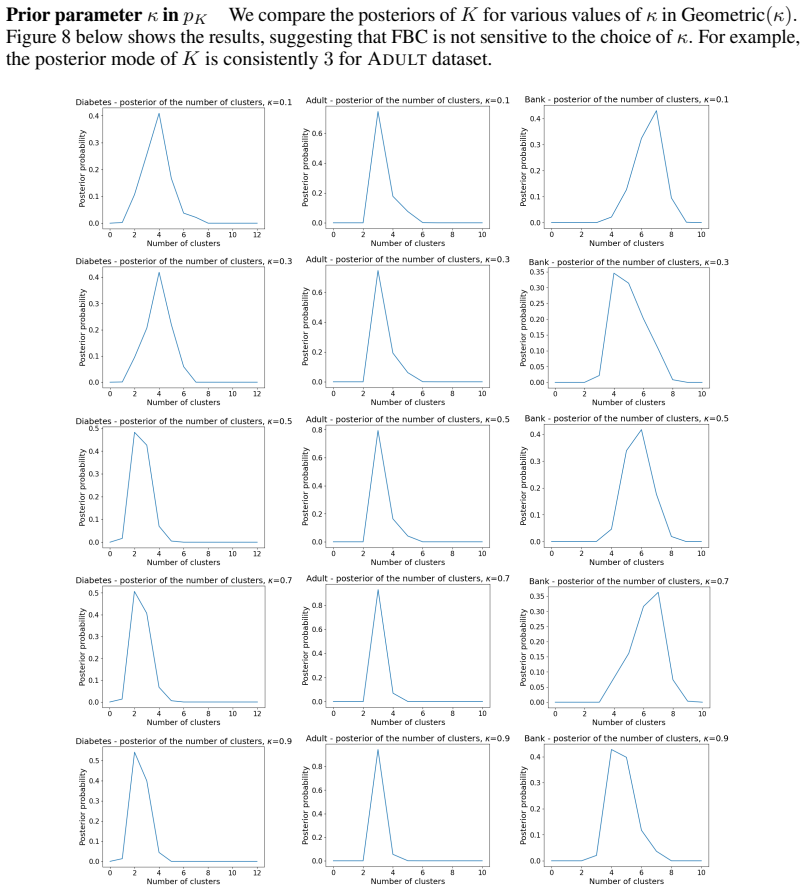
0.1
- a, b (NIW hyperparameters) =
a=b=1
assumptions (4)
- domain assumption The likelihood f is correctly specified for the data (Gaussian for continuous, product Bernoulli for categorical).
- domain assumption The sensitive attribute is known and binary, with a natural reference group 0.
- ad hoc to paper For r>0, a random subset R of [n0] of size r has an empirical distribution close to that of [n0], so the modified fairness definition is approximately exact.
- domain assumption The MCMC sampler converges to the posterior within the 1200 iterations used.
Cite this review
Pith. "Pith review of Fair Bayesian Model-Based Clustering." pith.science (2026). https://pith.science/paper/TKXUKIHG
@misc{pith2026250612839,
  author       = {Pith},
  title        = {Pith review of: Fair Bayesian Model-Based Clustering},
  year         = {2026},
  howpublished = {\url{https://pith.science/paper/TKXUKIHG}},
  note         = {Machine review of arXiv:2506.12839}
}
abstract
Fair clustering has become a socially significant task with the advancement of machine learning technologies and the growing demand for trustworthy AI. Group fairness ensures that the proportions of each sensitive group are similar in all clusters. Most existing group-fair clustering methods are based on the $K$-means clustering and thus require the distance between instances and the number of clusters to be given in advance. To resolve this limitation, we propose a fair Bayesian model-based clustering called Fair Bayesian Clustering (FBC). We develop a specially designed prior which puts its mass only on fair clusters, and implement an efficient MCMC algorithm. Advantages of FBC are that it can infer the number of clusters and can be applied to any data type as long as the likelihood is defined (e.g., categorical data). Experiments on real-world datasets show that FBC (i) reasonably infers the number of clusters, (ii) achieves a competitive utility-fairness trade-off compared to existing fair clustering methods, and (iii) performs well on categorical data.
Figures


Figures from the paper (7 more)




Reference graph
Works this paper leans on
-
[1]
Fair clustering through fairlets.Advances in neural information processing systems, 30, 2017
Flavio Chierichetti, Ravi Kumar, Silvio Lattanzi, and Sergei Vassilvitskii. Fair clustering through fairlets.Advances in neural information processing systems, 30, 2017
work page 2017
-
[2]
Sylvia Richardson and Peter J Green. On bayesian analysis of mixtures with an unknown number of components (with discussion).Journal of the Royal Statistical Society Series B: Statistical Methodology, 59(4):731–792, 1997
work page 1997
-
[3]
Agostino Nobile and Alastair T Fearnside. Bayesian finite mixtures with an unknown number of components: The allocation sampler.Statistics and Computing, 17:147–162, 2007
work page 2007
-
[4]
How many clusters?Bayesian Analysis, 3(1):101–120, 2008
Peter McCullagh and Jie Yang. How many clusters?Bayesian Analysis, 3(1):101–120, 2008
work page 2008
-
[5]
Jeffrey W Miller and Matthew T Harrison. Mixture models with a prior on the number of components.Journal of the American Statistical Association, 113(521):340–356, 2018
work page 2018
-
[6]
A bayesian analysis of some nonparametric problems.The annals of statistics, pages 209–230, 1973
Thomas S Ferguson. A bayesian analysis of some nonparametric problems.The annals of statistics, pages 209–230, 1973
work page 1973
-
[7]
Charles E Antoniak. Mixtures of dirichlet processes with applications to bayesian nonparametric problems.The annals of statistics, pages 1152–1174, 1974
work page 1974
-
[8]
Bayesian density estimation and inference using mixtures
Michael D Escobar and Mike West. Bayesian density estimation and inference using mixtures. Journal of the american statistical association, 90(430):577–588, 1995
work page 1995
Show all 50 references
-
[9]
Markov chain sampling methods for dirichlet process mixture models.Journal of computational and graphical statistics, 9(2):249–265, 2000
Radford M Neal. Markov chain sampling methods for dirichlet process mixture models.Journal of computational and graphical statistics, 9(2):249–265, 2000
2000
-
[10]
Fairness through matching.Transactions on Machine Learning Research, 2025
Kunwoong Kim, Insung Kong, Jongjin Lee, Minwoo Chae, Sangchul Park, and Yongdai Kim. Fairness through matching.Transactions on Machine Learning Research, 2025
2025
-
[11]
Fair clustering via alignment, 2025
Kunwoong Kim, Jihu Lee, Sangchul Park, and Yongdai Kim. Fair clustering via alignment, 2025
2025
-
[12]
Gaussian mixture clustering and imputation of microarray data.Bioinformatics, 20(6):917–923, 2004
Ming Ouyang, William J Welsh, and Panos Georgopoulos. Gaussian mixture clustering and imputation of microarray data.Bioinformatics, 20(6):917–923, 2004
2004
-
[13]
Gaussian mixture models.Encyclopedia of biometrics, 741(659-663), 2009
Douglas A Reynolds et al. Gaussian mixture models.Encyclopedia of biometrics, 741(659-663), 2009
2009
-
[14]
Variable selection for clustering with gaussian mixture models.Biometrics, 65(3):701–709, 2009
Cathy Maugis, Gilles Celeux, and Marie-Laure Martin-Magniette. Variable selection for clustering with gaussian mixture models.Biometrics, 65(3):701–709, 2009
2009
-
[15]
A robust em clustering algorithm for gaussian mixture models.Pattern Recognition, 45(11):3950–3961, 2012
Miin-Shen Yang, Chien-Yo Lai, and Chih-Ying Lin. A robust em clustering algorithm for gaussian mixture models.Pattern Recognition, 45(11):3950–3961, 2012
2012
-
[16]
Gaussian mixture model clustering with incomplete data
Yi Zhang, Miaomiao Li, Siwei Wang, Sisi Dai, Lei Luo, En Zhu, Huiying Xu, Xinzhong Zhu, Chaoyun Yao, and Haoran Zhou. Gaussian mixture model clustering with incomplete data. ACM Transactions on Multimedia Computing, Communications, and Applications (TOMM), 17(1s):1–14, 2021
2021
-
[17]
Robust mixture modelling using the t distribution
David Peel and Geoffrey J McLachlan. Robust mixture modelling using the t distribution. Statistics and computing, 10:339–348, 2000
2000
-
[18]
Finite mixture modelling using the skew normal distribution.Statistica Sinica, pages 909–927, 2007
Tsung I Lin, Jack C Lee, and Shu Y Yen. Finite mixture modelling using the skew normal distribution.Statistica Sinica, pages 909–927, 2007
2007
-
[19]
Bayesian inferences of latent class models with an unknown number of classes.Psychometrika, 79(4):621–646, 2014
Jia-Chiun Pan and Guan-Hua Huang. Bayesian inferences of latent class models with an unknown number of classes.Psychometrika, 79(4):621–646, 2014
2014
-
[20]
John Wiley & Sons, 2000
Geoffrey J McLachlan and David Peel.Finite mixture models. John Wiley & Sons, 2000
2000
-
[21]
A split-merge markov chain monte carlo procedure for the dirichlet process mixture model.Journal of computational and Graphical Statistics, 13(1):158– 182, 2004
Sonia Jain and Radford M Neal. A split-merge markov chain monte carlo procedure for the dirichlet process mixture model.Journal of computational and Graphical Statistics, 13(1):158– 182, 2004. 10
2004
-
[22]
Scalable fair clustering
Arturs Backurs, Piotr Indyk, Krzysztof Onak, Baruch Schieber, Ali Vakilian, and Tal Wagner. Scalable fair clustering. InInternational Conference on Machine Learning, pages 405–413. PMLR, 2019
2019
-
[23]
Guarantees for spectral clustering with fairness constraints
Matthäus Kleindessner, Samira Samadi, Pranjal Awasthi, and Jamie Morgenstern. Guarantees for spectral clustering with fairness constraints. InInternational conference on machine learning, pages 3458–3467. PMLR, 2019
2019
-
[24]
Variational fair clustering
Imtiaz Masud Ziko, Jing Yuan, Eric Granger, and Ismail Ben Ayed. Variational fair clustering. In Proceedings of the AAAI Conference on Artificial Intelligence, volume 35, pages 11202–11209, 2021
2021
-
[25]
Deep fair clustering for visual learning
Peizhao Li, Han Zhao, and Hongfu Liu. Deep fair clustering for visual learning. InProceedings of the IEEE/CVF Conference on Computer Vision and Pattern Recognition, pages 9070–9079, 2020
2020
-
[26]
Deep fair clustering via maximizing and minimizing mutual information: Theory, algorithm and metric
Pengxin Zeng, Yunfan Li, Peng Hu, Dezhong Peng, Jiancheng Lv, and Xi Peng. Deep fair clustering via maximizing and minimizing mutual information: Theory, algorithm and metric. InProceedings of the IEEE/CVF Conference on Computer Vision and Pattern Recognition, pages 23986–23995, 2023
2023
-
[27]
Fair algorithms for clustering.Advances in Neural Information Processing Systems, 32, 2019
Suman Bera, Deeparnab Chakrabarty, Nicolas Flores, and Maryam Negahbani. Fair algorithms for clustering.Advances in Neural Information Processing Systems, 32, 2019
2019
-
[28]
Kfc: A scalable approximation algorithm for kcenter fair clustering
Elfarouk Harb and Ho Shan Lam. Kfc: A scalable approximation algorithm for kcenter fair clustering. In H. Larochelle, M. Ranzato, R. Hadsell, M.F. Balcan, and H. Lin, editors,Advances in Neural Information Processing Systems, volume 33, pages 14509–14519. Curran Associates, Inc., 2020
2020
-
[29]
Efficient sampling for bipartite matching problems
Maksims V olkovs and Richard Zemel. Efficient sampling for bipartite matching problems. In F. Pereira, C.J. Burges, L. Bottou, and K.Q. Weinberger, editors,Advances in Neural Information Processing Systems, volume 25. Curran Associates, Inc., 2012
2012
-
[30]
Estimating mixture of dirichlet process models.Journal of Computational and Graphical Statistics, 7(2):223–238, 1998
Steven N MacEachern and Peter Müller. Estimating mixture of dirichlet process models.Journal of Computational and Graphical Statistics, 7(2):223–238, 1998
1998
-
[31]
Everhart, W
Jack Smith, J. Everhart, W. Dickson, W. Knowler, and Richard Johannes. Using the adap learning algorithm to forcast the onset of diabetes mellitus.Proceedings - Annual Symposium on Computer Applications in Medical Care, 10, 11 1988
1988
-
[32]
Barry Becker and Ronny Kohavi. Adult. UCI Machine Learning Repository, 1996. DOI: https://doi.org/10.24432/C5XW20
1996 doi
-
[33]
A data-driven approach to predict the success of bank telemarketing.Decision Support Systems, 62:22–31, 2014
Sérgio Moro, Paulo Cortez, and Paulo Rita. A data-driven approach to predict the success of bank telemarketing.Decision Support Systems, 62:22–31, 2014
2014
-
[34]
Fair clustering under a bounded cost.Advances in Neural Information Processing Systems, 34:14345–14357, 2021
Seyed Esmaeili, Brian Brubach, Aravind Srinivasan, and John Dickerson. Fair clustering under a bounded cost.Advances in Neural Information Processing Systems, 34:14345–14357, 2021
2021
-
[35]
Error detecting and error correcting codes.The Bell system technical journal, 29(2):147–160, 1950
Richard W Hamming. Error detecting and error correcting codes.The Bell system technical journal, 29(2):147–160, 1950
1950
-
[36]
Extensions to the k-means algorithm for clustering large data sets with categori- cal values.Data mining and knowledge discovery, 2(3):283–304, 1998
Zhexue Huang. Extensions to the k-means algorithm for clustering large data sets with categori- cal values.Data mining and knowledge discovery, 2(3):283–304, 1998
1998
-
[37]
Clustering categorical data based on distance vectors.Journal of the American Statistical Association, 101(473):355–367, 2006
Peng Zhang, Xiaogang Wang, and Peter X-K Song. Clustering categorical data based on distance vectors.Journal of the American Statistical Association, 101(473):355–367, 2006. 11 A Theoretical results for Section 3 Theorem 3.1Assume that n0 =n 1 = ¯n.Then, we have: Z∈ ZFair 0 ⇐ ...
2006
-
[38]
InitializeC={[n 0]}(i.e., a single cluster)
-
[39]
For i= 1,
Repeat the following steps N times, to obtain N samples. For i= 1, . . . , n0: Remove element i∈[n 0] and its matched elements in J({i};T,T 0, E) :={j∈E:T 0(j) = i} ∪ {j∈[n1]\E:T(j) =i}fromC. Then, place them • toc ′ ∈ C \iwith probability ∝(|c ′|+γ) m(X c′ ∪X {i}|T,T 0, E) m(...
-
[40]
InitializeC={[n 0]}(i.e., a single cluster) withϕ [n0] ∼H
-
[41]
For i= 1,
Repeat the following steps N times, to obtain N samples. For i= 1, . . . , n0: Remove element i∈[n 0] and its matched elements in J({i}) from C. Then, generate m independent auxiliary variablesϕ (1), . . . , ϕ(m) ∼H. Compute the assignment weights as: wc′ = (|c′|+γ) Y x∈X {i} ...
-
[42]
Toy dataset: We build a 2D toy dataset from a 6-component Gaussian mixture model with unit covariance matrix I2. For D(0), we draw 600 samples from each N([−5,−30],I 2)/3 + N([−5,0],I 2)/3 +N([−5,30],I 2)/3 and Similarly for D(1), we draw 600 samples from N([−5,−29.5],I 2)/3 +...
-
[43]
The sample size is 768 (sensitive group sizes: 396 and 372)
DIABETES: The diabetes dataset is a collection of data spanning five years, consisting of various physical indicators (e.g., glucose concentration, blood pressure, BMI, etc., totaling 7 features) of Pima Indian women*. The sample size is 768 (sensitive group sizes: 396 and 372...
-
[44]
It is extracted from 1994 U.S
ADULT: The adult income dataset is a collection of data consisting of several demographic features including employment features. It is extracted from 1994 U.S. Census database [32]. We subsample 1,000 data points (sensitive group sizes: 694 and 306) from the original dataset....
1994
-
[45]
We use 6 continuous features (age, call duration, 3-month Euribor rate, number of employees, con- sumer price index, and number of contacts during the campaign)
BANK: The bank marketing dataset is a collection of data from a Portuguese bank’s direct marketing campaigns, each corresponding to an individual client contacted [33]. We use 6 continuous features (age, call duration, 3-month Euribor rate, number of employees, con- sumer pric...
-
[46]
That is, |Dtest 0 |= |Dtest 1 |=n test
We prepare test dataset Dtest 0 and Dtest 1 , each containing ntest samples. That is, |Dtest 0 |= |Dtest 1 |=n test
-
[47]
, Z(0),test ntest , Z(1),test 1 ,
To construct fair assignments Ztest := (Z (0),test 1 , . . . , Z(0),test ntest , Z(1),test 1 , . . . , Z(1),test ntest ) on Dtest 0 ∪ Dtest 1 , we build a one-to-one matching map between Dtest 0 and Dtest 1 , using the optimal transport mapT test
-
[48]
We match instances inD test 0 to those inD 0 by using an optimal transportT ∗
-
[49]
We assignZ (0),test j =Z (0) T∗(j) andZ (1),test j =Z (0),test Ttest(j) forj∈[n test]
-
[50]
See Figure 6 for a simple visualization of this construction whenn test = 4
For each posterior sample obtained by FBC, we calculate the log-likelihood of test data conditional onZ test. See Figure 6 for a simple visualization of this construction whenn test = 4. Figure 6: A visualization of the construction of fair assignments Ztest for the test data ...
Reviewed August 7, 2026 · model on record in the stance chip above.
Discussion (0). Continue with ORCID to comment.