REVIEW 5 major objections 4 minor 4 cited by
Adaptive Guidance Accelerates Reinforcement Learning of Reasoning Models
T0 review · 5 major / 4 minor · reviewed 2026-08-07 · deepseek-v4-flash
Pith's one-line read The paper claims that RLVR progress on reasoning problems mostly re-weights answers the model already knows, and that injecting hints on failed attempts accelerates learning without needing hints at test time.
desk verdict Useful empirical decomposition and a plausible algorithm, but the theory is broken—Theorem 1 does not follow and should not be cited. read the letter →
The pith
A machine-rendered reading of the paper's core claim, the machinery that carries it, and where it could break.
The reading
What carries the argument
The load-bearing object is the importance-weighted guided objective (Eq. 6), which samples guided rollouts $\pi_{\theta_{\text{old}}}(\cdot \mid \tilde{x}_q)$ when all plain rollouts fail and reweights each token's probability ratio by $\pi_\theta(r_t \mid x_q, r_{<t}) / \pi_{\theta_{\text{old}}}(r_t \mid \tilde{x}_q, r_{<t})$. The theorem relies on Lemma 1, which asserts that the gradient of the guided log-likelihood is a positive scalar multiple of the plain gradient, so that the off-policy correction preserves the plain-prompt gradient direction. Also load-bearing is the selective guidance rule: hints only on the unsolved set $U$, justified by Lemma 2 that selective guidance dominates always-guidance.
What would settle it
Compute, for a fixed guided sample $y$, the gradient $\nabla_\theta \log \pi_\theta(y \mid x_q)$ and $\nabla_\theta \log \pi_\theta(y \mid \tilde{x}_q)$ at the same $\theta$; if the ratio of their components is not constant across parameter directions, Lemma 1 fails and the first-order improvement of Theorem 1 is not established. A more direct empirical falsifier: train Guide-GRPO with the importance weight removed, and with the correct off-policy weight, on a fixed set of unsolved prompts; if the corrected version does not outperform the uncorrected one, the off-policy correction is not the driver.
Extended reading notes
Core claim
Guide-GRPO is a training algorithm that, for each prompt whose all k rollouts fail, samples additional rollouts from the same policy but with a hint appended to the prompt, and optimizes the Guide objective (Eq. 6). The objective keeps standard GRPO's group-normalized advantages and clipping, but replaces the probability ratio denominator with the guided sampling distribution and adds an importance weight that projects the guided gradient onto the plain-prompt gradient. The paper's Theorem 1 states that if the expected guided advantage over unsolved prompts is positive, then to first order in the learning rate, Guide-GRPO's one-step expected improvement exceeds vanilla GRPO's by $\eta (1-p_q)^k \mathbb{E}[\tilde{A}_q] p_q$ summed over unsolved prompts. The empirical claim is that this converts unreachable solutions into reachable ones during training, so self-distillation can then compress them into pass@1, and the gains transfer to test time where no hints are present.
Load-bearing premise
The proof that guided updates improve on vanilla GRPO rests on the claim that the gradient of the guided-prompt log-likelihood is a positive scalar multiple of the plain-prompt gradient; this identity is generally false when the prompt text changes.
Editorial extensions
If this is right
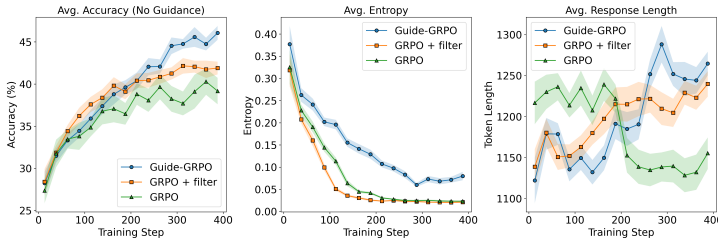
- Guide-GRPO raises macro-average pass@1 on math benchmarks by 1-4 percentage points over vanilla GRPO at 7B and 32B scale, with the largest gains on Olympiad-level and AIME problems.
- The gains transfer to test time without hints, because the importance weighting optimizes the unguided objective.
- Selective guidance (only when all rollouts fail) outperforms unconditional guidance; always-on hints harm learning.
- RLVR progress is mostly self-distillation at every scale studied, so methods that expand the pool of correct rollouts like Guide attack the bottleneck.
- Removing PPO clipping on guided ratios and computing importance weights relative to the guided distribution are necessary for stable training.
Reading between the lines
- If the gradient-identity assumption in Lemma 1 fails, the importance-weighted update may not align with the plain-prompt objective; one could test this numerically and, if it fails, the learning-efficiency theorem would need a different correction.
- The decomposition itself depends on the sampling budget $k$ used to define 'capability'; using larger $k$ would shrink the self-distillation share, so the 'primarily distillation' conclusion is budget-relative.
- The guidance quality is generated by a strong external teacher; a natural extension is to test whether weaker or model-generated hints still yield gains, which would lower the approach's dependency on a strong teacher.
- The method's logic generalizes to code and agent domains where verifiable rewards exist; the self-distillation-vs-capability decomposition is likely similar, but the guidance transfer may differ.
Editorial analysis
A structured set of objections, weighed in public.
Referee Report
Summary. The paper studies how RLVR improves reasoning models, decomposing progress into self-distillation (converting pass@k reachable solutions into pass@1) and genuine capability gain (solving problems unreachable even at k attempts). The authors report that self-distillation dominates across model scales from 0.5B to 72B on a large multi-domain dataset. They then propose Guide, a family of online RL algorithms that injects natural-language hints only when all plain rollouts fail, and applies an importance-weighting correction to keep guided updates aligned with the unguided objective. They specialize Guide to GRPO and PPO, report improved math benchmark performance over vanilla GRPO and filtering baselines, and state a theoretical result (Theorem 1) claiming that Guide-GRPO improves one-step expected learning efficiency over vanilla GRPO under a positive guided-advantage assumption.
Significance. The empirical decomposition of RLVR progress into self-distillation versus capability gain is a valuable and clearly presented observation, backed by experiments across five model scales and more than 500,000 problems. The proposed Guide method is simple and the ablations over guidance thresholds, importance-weight choices, and PPO clipping are informative. If the theoretical guarantee were valid, it would strengthen the case that guided failure-only rollouts accelerate learning. However, the central theorem and its supporting lemmas contain serious mathematical errors, so the theoretical contribution is not established. The empirical results alone provide partial support for Guide, but the paper's advertised claim of a provable efficiency gain currently rests on incorrect derivations.
major comments (5)
- [Appendix B.2, Eq. (16)] Lemma 1 is false. The claim that ∇θ log πθ(yq|x~q) = wq ∇θ log πθ(yq|xq) for a scalar wq cannot hold in general: changing the conditioning text from xq to x~q changes the full conditional distribution over token sequences, and the gradient of its log-likelihood is not a scalar multiple of the plain-prompt gradient across all parameter values. A simple counterexample is a two-token distribution where guidance changes the relative probabilities of tokens; no per-example scalar weight can align the two gradients. Since this lemma is the stated justification for the off-policy importance correction in Eq. (6) and for the gradient-alignment claim used in Theorem 1, the off-policy correction is not theoretically justified.
- [Appendix B.3, Eqs. (30)-(31)] The proof of Theorem 1 replaces an expectation with a single trajectory without justification. Eq. (30) correctly writes ∇θpq = E_y[I[f(y)=y*_q] ∇θ log πθ(y|xq)], but Eq. (31) then asserts pq(θ_{t+1}) = pq + η pq ⟨∇θ log πθ(y_q|x_q), g⟩ + O(η^2) for one sampled y_q. The correct first-order term is η E_y[I[f(y)=y*_q] ∇θ log πθ(y|x_q)]·g. The subsequent Eqs. (34)-(38) all inherit this error, so the claimed expressions for E[ΔR_Vanilla] and E[ΔR_Guide] are not derived.
- [Appendix B.3, Eqs. (25)-(26), (37)-(38)] Even apart from the missing expectation, the final comparison in Eq. (38) is not a valid consequence of the preceding equations. Eq. (37) has an outer sum over q of pq times a gradient norm, but the change in expected number of solved problems is a sum over prompts of the change in each prompt's success probability, which requires the expectation over y∼πθ(·|xq) inside each term. The proof's replacement of these expectations by single-trajectory norms makes the claimed superiority of Guide-GRPO unsupported.
- [Appendix B.2, Lemma 2 and Eq. (23)] Lemma 2's proof contains a sign error and an algebraic mistake. From Eqs. (21)-(22), the actual difference is Δ_sel − Δ_all = −η Σ_q [1−(1−p_q)^k] Ã^succ_q p_q, not −η Σ_q [1−(1−p_q)^k] (Ã^fail_q − Ã^succ_q) p_q. The printed Eq. (23) substitutes Ã^fail_q − Ã^succ_q for Ã^succ_q, which is not equivalent. Moreover, if Ã^fail_q ≥ Ã^succ_q as claimed, the sign of the correct expression is negative whenever Ã^succ_q > 0, giving Δ_sel < Δ_all, the opposite of the lemma's conclusion. Thus the claim that selective guidance outperforms or matches always-guidance is not established.
- [Section 3.2.2, Tables 1-2] The text states that Guide-GRPO 'consistently outperforms all baselines' and that its improvements are 'consistent' when scaling, but the tables show several per-benchmark regressions. In Table 1, Guide-GRPO is worse than vanilla GRPO on MINERVA pass@1 (32.35 vs 32.72) and on AIME24 pass@16 (56.67 vs 60.00). In Table 2, Guide-7B-8K is worse than GRPO-7B-8K on MINERVA pass@1, AIME24 pass@1, and AIME25 pass@1. The macro-average improvements are positive, but the 'consistent' claim is not supported by the reported numbers.
minor comments (4)
- [Abstract] The phrase 'Based of these insights' should be 'Based on these insights.'
- [Appendix I.1] 'comparsion' should be 'comparison'; 'indepedent' in Table 4's caption should be 'independent.'
- [Appendix E and Eq. (6)] The main text says importance ratios are re-weighted with an adaptive policy-reshaping described in Appendix E, but neither Eq. (6) nor Algorithm 1 includes the f(w_i) factor. The relationship between the reshaping and the off-policy correction should be made explicit.
- [Tables 4-5] Several pass@1 confidence intervals are reported as ±0.00 (e.g., GRPO MATH500 pass@1 and AIME25 pass@1 for all methods). This is surprising for quantities averaged over five independent runs and deserves a brief explanation or a different reporting method.
Circularity Check
Theorem 1's claimed Guide-GRPO guarantee is an algebraic restatement of its 'guided advantage is positive' assumption; the empirical comparisons are independent and prevent a higher circularity score.
-
self definitional
[Appendix B.3, Theorem 1 (Eqs. 24–26 and 39); main text Section 2.2]
"Suppose that, in expectation over unsolved prompts and the group Gq of guided and unguided trajectories, the guided advantage is positive: Eq∈U[ Ey∼πθ(·|˜xq)[ ˜Aq(y;Gq) ] ] > 0. Then ... E[∆RGuide] > E[∆RVanilla]. ... E[∆RGuide] = η Σq∈U [ Aq p²q + (1−pq)^k Ey∼πθ(·|˜xq)[ ˜Aq(y)] pq ] + O(η²). ... As long as Eq∈U[ Ey∼πθ(·|˜xq)[ ˜Aq(y;Gq) ] ] > 0, the guide update yields a greater gain."
The claimed advantage of Guide over vanilla is precisely the extra term ηΣq∈U(1−pq)^k E[˜Aq] pq appearing in Eq. 26. This term is positive if and only if the assumed positivity of the expected guided advantage holds (for pq>0, (1−pq)^k≥0), and the vanilla terms Aq p²q cancel in the comparison. All of the Taylor-expansion and gradient machinery in the proof is superfluous to the inequality: the theorem restates its input assumption as its output inequality. It therefore does not derive Guide's benefit; it packages 'guidance has positive expected advantage' as 'Guide improves learning efficiency'.
-
other
[Appendix B.2, Lemma 2 (Eqs. 18–23), Proof 1]
"Moreover, since ˜Aq(y;Gq) is computed relative to the full set of guided and unguided rollouts, and the group mean reward is lower when all plain rollouts fail, we have ˜Afail q ≥ ˜Asucc q by construction."
The lemma's conclusion that selective guidance dominates always-guidance is made to rest on declaring the required ordering of conditional guided advantages to hold 'by construction'. The proof then subtracts the two first-order expressions and obtains Δsel − Δall = −η Σ [1−(1−pq)^k] (˜Afail − ˜Asucc) pq, which is ≤ 0 under the asserted ordering—the opposite of the claimed Δsel ≥ Δall. Thus the key comparison is not derived; it is inserted as a by-construction premise rather than proven, and the algebraic consequence is misread.
full rationale
The paper's empirical core is not circular: Guide-GRPO is compared against vanilla GRPO, Filter-GRPO, SFT, and the base model on held-out math benchmarks (Tables 1–2), and the pass@k guidance effect is measured directly (Figure 2). No load-bearing self-citations or imported uniqueness theorems were found. The circularity is confined to the theoretical claim. Theorem 1's inequality reduces by construction to its assumption that the expected guided advantage is positive; since that assumption is essentially 'guidance helps on unsolved prompts', the theorem does not independently establish Guide's learning-efficiency gain. The additional proof defects—Eq. 31 dropping the expectation over y in the log-derivative identity, and Lemma 1 (Eq. 16) asserting a false scalar-multiple relationship between guided and plain gradients—are mathematical errors rather than definitional circularity, but they compound the fact that the advertised theoretical guarantee is not established. Lemma 2's 'by construction' ordering and subsequent sign error further show that the selective-vs-always comparison is asserted rather than derived. Overall, the empirical results could stand alone, but the theory as presented is substantially circular and should not be cited as an independent proof of Guide's benefit.
Assumptions & free parameters
free parameters (7)
- rollout count k =
8 per prompt
- guidance threshold =
apply guidance only when all k rollouts fail
- P90 percentile for policy reshaping =
90th percentile of importance ratios within each rollout
- capability-gain labeling k =
k=16 for labeling, k=8 for training rollouts
- PPO clip handling =
clipping removed for guided trajectories
- GPT-4o guidance temperature and hint count =
temperature 0; 3-5 hints per problem
- GRPO and SFT hyperparameters =
RL lr 1e-6, SFT lr 1e-5, batch 1024, minibatch 512, kl coeff 0, entropy coeff 0, generation max 3072
assumptions (7)
- domain assumption Rewards from the verifier are correct and binary on final answers.
- domain assumption Group-relative advantage normalization over guided and unguided rollouts is well-defined and yields the claimed signal.
- ad hoc to paper The expected guided advantage over unsolved prompts is positive.
- ad hoc to paper Importance-weight gradient identity in Lemma 1 (Eq. 16) holds.
- domain assumption GPT-4o-generated hints from reference solutions improve pass@k without leaking the solution chain.
- domain assumption OpenR1-Math-220k training problems do not contaminate the evaluation benchmarks.
- domain assumption Pass@1 at temperature 0 and pass@16 at temperature 1 correctly represent the initial policy's ability.
Cite this review
Pith. "Pith review of Adaptive Guidance Accelerates Reinforcement Learning of Reasoning Models." pith.science (2026). https://pith.science/paper/QFOVJHUN
@misc{pith2026250613923,
  author       = {Pith},
  title        = {Pith review of: Adaptive Guidance Accelerates Reinforcement Learning of Reasoning Models},
  year         = {2026},
  howpublished = {\url{https://pith.science/paper/QFOVJHUN}},
  note         = {Machine review of arXiv:2506.13923}
}
abstract
We study the process through which reasoning models trained with reinforcement learning on verifiable rewards (RLVR) can learn to solve new problems. We find that RLVR drives performance in two main ways: (1) by compressing pass@$k$ into pass@1 and (2) via "capability gain" in which models learn to solve new problems that they previously could not solve even at high $k$. We find that while capability gain exists across model scales, learning to solve new problems is primarily driven through self-distillation. We demonstrate these findings across model scales ranging from 0.5B to 72B parameters on >500,000 reasoning problems with prompts and verifiable final answers across math, science, and code domains. We further show that we can significantly improve pass@$k$ rates by leveraging natural language guidance for the model to consider within context while still requiring the model to derive a solution chain from scratch. Based of these insights, we derive $\text{Guide}$ -- a new class of online training algorithms. $\text{Guide}$ adaptively incorporates hints into the model's context on problems for which all rollouts were initially incorrect and adjusts the importance sampling ratio for the "off-policy" trajectories in order to optimize the policy for contexts in which the hints are no longer present. We describe variants of $\text{Guide}$ for GRPO and PPO and empirically show that Guide-GRPO on 7B and 32B parameter models improves generalization over its vanilla counterpart with up to 4$\%$ macro-average improvement across math benchmarks. We include careful ablations to analyze $\text{Guide}$'s components and theoretically analyze Guide's learning efficiency.
Figures


Figures from the paper (1 more)

Forward citations
Cited by 4 Pith papers
-
Beacon: Knowing When and How to Perform Agentic Visual Reasoning
Beacon improves agentic visual reasoning by teaching models when tools are necessary and how to use them for net gains, via necessity-aware rewards and hint-guided RL.
-
LoRA Scaffolded Policy Optimization (LSPO): A Sampling-Time Low-Rank Scaffold for Recovering Reinforcement-Learning Gradient on Zero-Reward Cliff Prompts
A training method that recovers reinforcement-learning gradient on all-fail math prompts by fitting a temporary LoRA adapter, re-rolling, and splicing successful answers into the RL batch.
-
It Takes 8 Tokens: Weak-to-Strong Off-Policy RL via Auxiliary Branches
W2SPO trains a reasoning LLM by inserting short 8-token branches proposed by a weaker model into its own rollouts and updating only those branch tokens, improving Pass@1 over vanilla GRPO (64.2% vs 62.3%) with a 3.55x...
-
TaoSR-AGRL: Adaptive Guided Reinforcement Learning Framework for E-commerce Search Relevance
TaoSR-AGRL improves e-commerce search relevance by combining dense rule-aware reward shaping with adaptive ground-truth-guided replay in GRPO, reporting gains on Taobao's private offline and online evaluations.
Reference graph
Works this paper leans on
-
[1]
OpenAI, Aaron Jaech, Adam Kalai, Adam Lerer, and Adam et al. Richardson. Openai o1 system card.arXiv preprint arXiv:2412.16720, 2024
arXiv 2024
-
[2]
Daya Guo, Dejian Yang, Haowei Zhang, Junxiao Song, and Ruoyu et al. Zhang. Deepseek- r1: Incentivizing reasoning capability in llms via reinforcement learning.arXiv preprint arXiv:2501.12948, 2025
arXiv 2025
-
[3]
Nathan Lambert, Jacob Morrison, Valentina Pyatkin, Shengyi Huang, and Hamish et al. Ivison. Tülu 3: Pushing frontiers in open language model post-training.arXiv preprint arXiv:2411.15124, 2024
arXiv 2024
-
[4]
Teaching large language models to reason with reinforcement learning
Alexander Havrilla, Yuqing Du, Sharath Chandra Raparthy, Christoforos Nalmpantis, Jane Dwivedi-Yu, Eric Hambro, Sainbayar Sukhbaatar, and Roberta Raileanu. Teaching large language models to reason with reinforcement learning. InAI for Math Workshop @ ICML 2024, 2024
2024
-
[5]
Yang Yue, Zhiqi Chen, Rui Lu, Andrew Zhao, Zhaokai Wang, Shiji Song, and Gao Huang. Does reinforcement learning really incentivize reasoning capacity in llms beyond the base model? arXiv preprint arXiv:2504.13837, 2025
arXiv 2025
-
[6]
Eric Zelikman, Yuhuai Wu, Jesse Mu, and Noah D. Goodman. Star: Bootstrapping reasoning with reasoning. InAdvances in Neural Information Processing Systems (NeurIPS), 2022
work page 2022
-
[7]
Reinforced self-training (rest) for language modeling.arXiv preprint arXiv:2308.08998, 2023
Caglar Gulcehre, Tom Le Paine, Srivatsan Srinivasan, Ksenia Konyushkova, Lotte Weerts, Abhishek Sharma, Aditya Siddhant, Alex Ahern, Miaosen Wang, Chenjie Gu, Wolfgang Macherey, Arnaud Doucet, Orhan Firat, and Nando de Freitas. Reinforced self-training (rest) for language modeling.arXiv preprint arXiv:2308.08998, 2023
arXiv 2023
-
[8]
Openai’s reinforcement fine-tuning research program, 2024
OpenAI. Openai’s reinforcement fine-tuning research program, 2024
work page 2024
Show all 58 references
-
[9]
Be- yond human data: Scaling self-training for problem-solving with language models.Transactions on Machine Learning Research, 2024
Avi Singh, John D Co-Reyes, Rishabh Agarwal, Ankesh Anand, Piyush Patil, Xavier Garcia, Peter J Liu, James Harrison, Jaehoon Lee, Kelvin Xu, Aaron T Parisi, Abhishek Kumar, Alexan- der A Alemi, Alex Rizkowsky, Azade Nova, Ben Adlam, Bernd Bohnet, Gamaleldin Fathy Elsayed, Hani...
2024
-
[10]
V-star: Training verifiers for self-taught reasoners
Arian Hosseini, Xingdi Yuan, Nikolay Malkin, Aaron Courville, Alessandro Sordoni, and Rishabh Agarwal. V-star: Training verifiers for self-taught reasoners. InProceedings of the 2024 Conference on Language Modeling (COLM), 2024
2024
-
[11]
ReST- MCTS*: LLM self-training via process reward guided tree search
Dan Zhang, Sining Zhoubian, Ziniu Hu, Yisong Yue, Yuxiao Dong, and Jie Tang. ReST- MCTS*: LLM self-training via process reward guided tree search. InThe Thirty-eighth Annual Conference on Neural Information Processing Systems, 2024
2024
-
[12]
Continuous control with deep reinforcement learning.arXiv preprint arXiv:1509.02971, 2015
Timothy P Lillicrap, Jonathan J Hunt, Alexander Pritzel, Nicolas Heess, Tom Erez, Yuval Tassa, David Silver, and Daan Wierstra. Continuous control with deep reinforcement learning.arXiv preprint arXiv:1509.02971, 2015
2015 arXiv
-
[13]
An Yang, Baosong Yang, Beichen Zhang, Binyuan Hui, Bo Zheng, Bowen Yu, Chengyuan Li, Dayiheng Liu, Fei Huang, Haoran Wei, et al. Qwen2. 5 technical report.arXiv preprint arXiv:2412.15115, 2024. 11
2024 arXiv
-
[15]
Measuring mathematical problem solving with the math dataset
Dan Hendrycks, Collin Burns, Saurav Kadavath, Akul Arora, Steven Basart, Eric Tang, Dawn Song, and Jacob Steinhardt. Measuring mathematical problem solving with the math dataset. arXiv preprint arXiv:2103.03874, 2021
2021 arXiv
-
[16]
Aime 2024
American Mathematics Competitions. Aime 2024. 2024. Problems from the American Invitational Mathematics Examination
2024
-
[17]
Aime 2025
American Mathematics Competitions. Aime 2025. 2025. Problems from the American Invitational Mathematics Examination
2025
-
[18]
Amc 2023
American Mathematics Competitions. Amc 2023. 2023. American Mathematics Competitions 10/12
2023
-
[19]
Gpqa: A graduate-level google-proof q&a benchmark
David Rein, Betty Li Hou, Asa Cooper Stickland, Jackson Petty, Richard Yuanzhe Pang, Julien Dirani, Julian Michael, and Samuel R Bowman. Gpqa: A graduate-level google-proof q&a benchmark. InFirst Conference on Language Modeling, 2024
2024
-
[20]
Olympiadbench: A challenging benchmark for promoting agi with olympiad-level bilingual multimodal scientific problems.arXiv preprint arXiv:2402.14008, 2024
Chaoqun He, Renjie Luo, Yuzhuo Bai, Shengding Hu, Zhen Leng Thai, Junhao Shen, Jinyi Hu, Xu Han, Yujie Huang, Yuxiang Zhang, et al. Olympiadbench: A challenging benchmark for promoting agi with olympiad-level bilingual multimodal scientific problems.arXiv preprint arXiv:2402.1...
2024 arXiv
-
[21]
Deepseek-coder: When the large language model meets programming–the rise of code intelligence.arXiv preprint arXiv:2401.14196, 2024
Daya Guo, Qihao Zhu, Dejian Yang, Zhenda Xie, Kai Dong, Wentao Zhang, Guanting Chen, Xiao Bi, Yu Wu, YK Li, et al. Deepseek-coder: When the large language model meets programming–the rise of code intelligence.arXiv preprint arXiv:2401.14196, 2024
2024 arXiv
-
[22]
Livecodebench: Holistic and contamination free evaluation of large language models for code.arXiv preprint, 2024
Naman Jain, King Han, Alex Gu, Wen-Ding Li, Fanjia Yan, Tianjun Zhang, Sida Wang, Ar- mando Solar-Lezama, Koushik Sen, and Ion Stoica. Livecodebench: Holistic and contamination free evaluation of large language models for code.arXiv preprint, 2024
2024
-
[23]
Evaluating large language models trained on code.arXiv preprint arXiv:2107.03374, 2021
Mark Chen, Jerry Tworek, Heewoo Jun, Qiming Yuan, Henrique Ponde De Oliveira Pinto, Jared Kaplan, Harri Edwards, Yuri Burda, Nicholas Joseph, Greg Brockman, et al. Evaluating large language models trained on code.arXiv preprint arXiv:2107.03374, 2021
2021 arXiv
-
[24]
Open r1: A fully open reproduction of deepseek-r1, January 2025
Hugging Face. Open r1: A fully open reproduction of deepseek-r1, January 2025
2025
-
[25]
Dapo: An open-source llm reinforcement learning system at scale, 2025
Qiying Yu, Zheng Zhang, Ruofei Zhu, Yufeng Yuan, Xiaochen Zuo, Yu Yue, Tiantian Fan, Gaohong Liu, Lingjun Liu, Xin Liu, Haibin Lin, Zhiqi Lin, Bole Ma, Guangming Sheng, Yuxuan Tong, Chi Zhang, Mofan Zhang, Wang Zhang, Hang Zhu, Jinhua Zhu, Jiaze Chen, Jiangjie Chen, Chengyi Wa...
2025
-
[26]
Ziegler, Nisan Stiennon, Jeffrey Wu, Tom B
Daniel M. Ziegler, Nisan Stiennon, Jeffrey Wu, Tom B. Brown, Alec Radford, Dario Amodei, Paul Christiano, and Geoffrey Irving. Fine-tuning language models from human preferences. arXiv preprint arXiv:1909.08593, 2019
1909 arXiv
-
[27]
Long Ouyang, Jeffrey Wu, Xu Jiang, Diogo Almeida, Carroll L. Wainwright, Pamela Mishkin, Chong Zhang, Sandhini Agarwal, Katarina Slama, Alex Ray, John Schulman, Jacob Hilton, Fraser Kelton, Luke Miller, Maddie Simens, Amanda Askell, Peter Welinder, Paul F. Christiano, Jan Leik...
2022
-
[28]
Lmrl gym: Benchmarks for multi-turn reinforcement learning with language models.arXiv preprint arXiv:2311.18232, 2023
Marwa Abdulhai, Isadora White, Charlie Snell, Charles Sun, Joey Hong, Yuexiang Zhai, Kelvin Xu, and Sergey Levine. Lmrl gym: Benchmarks for multi-turn reinforcement learning with language models.arXiv preprint arXiv:2311.18232, 2023. 12
2023 arXiv
-
[29]
Archer: Training language model agents via hierarchical multi-turn rl
Yifei Zhou, Andrea Zanette, Jiayi Pan, Sergey Levine, and Aviral Kumar. Archer: Training language model agents via hierarchical multi-turn rl. In Ruslan Salakhutdinov, Zico Kolter, Katherine Heller, Adrian Weller, Nuria Oliver, Jonathan Scarlett, and Felix Berkenkamp, editors,...
2024
-
[30]
Aligning large multimodal models with factually augmented rlhf
Zhiqing Sun, Sheng Shen, Shengcao Cao, Haotian Liu, Chunyuan Li, Yikang Shen, Chuang Gan, Liang-Yan Gui, Yu-Xiong Wang, Yiming Yang, Kurt Keutzer, and Trevor Darrell. Aligning large multimodal models with factually augmented rlhf. InFindings of the Association for Computationa...
2024
-
[31]
Angang Du, Bofei Gao, Bowei Xing, Changjiu Jiang, and Cheng et al. Chen. Kimi k1.5: Scaling reinforcement learning with llms.arXiv preprint arXiv:2501.12599, 2025
2025 arXiv
-
[32]
Training verifiers to solve math word problems.arXiv preprint arXiv:2110.14168, 2021
Karl Cobbe, Vineet Kosaraju, Mohammad Bavarian, Mark Chen, Heewoo Jun, Lukasz Kaiser, Matthias Plappert, Jerry Tworek, Jacob Hilton, Reiichiro Nakano, Christopher Hesse, and John Schulman. Training verifiers to solve math word problems.arXiv preprint arXiv:2110.14168, 2021
-
[33]
Program synthesis with large language models.arXiv preprint arXiv:2108.07732, 2021
Jacob Austin, Augustus Odena, Maxwell Nye, Maarten Bosma, Henryk Michalewski, David Dohan, Ellen Jiang, Carrie Cai, Michael Terry, Quoc Le, and Charles Sutton. Program synthesis with large language models.arXiv preprint arXiv:2108.07732, 2021
2021 arXiv
-
[34]
Rlef: Grounding code llms in execution feedback with reinforcement learning.arXiv preprint arXiv:2410.02089, 2024
Jonas Gehring, Kunhao Zheng, Jade Copet, Vegard Mella, Taco Cohen, and Gabriel Synnaeve. Rlef: Grounding code llms in execution feedback with reinforcement learning.arXiv preprint arXiv:2410.02089, 2024
2024 arXiv
-
[35]
Le, Sergey Levine, and Yi Ma
Tianzhe Chu, Yuexiang Zhai, Jihan Yang, Shengbang Tong, Saining Xie, Dale Schuurmans, Quoc V . Le, Sergey Levine, and Yi Ma. Sft memorizes, rl generalizes: A comparative study of foundation model post-training.arXiv preprint arXiv:2501.17161, 2025
2025 arXiv
-
[36]
Scaling LLM test-time com- pute optimally can be more effective than scaling parameters for reasoning
Charlie Victor Snell, Jaehoon Lee, Kelvin Xu, and Aviral Kumar. Scaling LLM test-time com- pute optimally can be more effective than scaling parameters for reasoning. InThe Thirteenth International Conference on Learning Representations, 2025
2025
-
[37]
Echo chamber: Rl post-training amplifies behaviors learned in pretraining.arXiv preprint arXiv:2504.07912, 2025
Rosie Zhao, Alexandru Meterez, Sham Kakade, Cengiz Pehlevan, Samy Jelassi, and Eran Malach. Echo chamber: Rl post-training amplifies behaviors learned in pretraining.arXiv preprint arXiv:2504.07912, 2025
2025 arXiv
-
[38]
Assessing diversity collapse in reasoning
Xingyu Dang, Christina Baek, J Zico Kolter, and Aditi Raghunathan. Assessing diversity collapse in reasoning. InScaling Self-Improving Foundation Models without Human Supervision, 2025
2025
-
[39]
Direct preference optimization: Your language model is secretly a reward model
Rafael Rafailov, Archit Sharma, Eric Mitchell, Christopher D Manning, Stefano Ermon, and Chelsea Finn. Direct preference optimization: Your language model is secretly a reward model. InThirty-seventh Conference on Neural Information Processing Systems, 2023
2023
-
[40]
Bellemare, Jonathan Lebensold, Arnaud Bergeron, Joshua Greaves, Alex Fréchette, Carolyne Pelletier, Eric Thibodeau-Laufer, Sándor Toth, and Samantha Work
Nicolas Le Roux, Marc G. Bellemare, Jonathan Lebensold, Arnaud Bergeron, Joshua Greaves, Alex Fréchette, Carolyne Pelletier, Eric Thibodeau-Laufer, Sándor Toth, and Samantha Work. Tapered off-policy reinforce: Stable and efficient reinforcement learning for llms.arXiv preprint...
2025 arXiv
-
[41]
Learning to reason under off-policy guidance.arXiv preprint arXiv:2504.14945, 2025
Jianhao Yan, Yafu Li, Zican Hu, Zhi Wang, Ganqu Cui, Xiaoye Qu, Yu Cheng, and Yue Zhang. Learning to reason under off-policy guidance.arXiv preprint arXiv:2504.14945, 2025
2025 arXiv
-
[42]
Hybridflow: A flexible and efficient rlhf framework.arXiv preprint arXiv: 2409.19256, 2024
Guangming Sheng, Chi Zhang, Zilingfeng Ye, Xibin Wu, Wang Zhang, Ru Zhang, Yanghua Peng, Haibin Lin, and Chuan Wu. Hybridflow: A flexible and efficient rlhf framework.arXiv preprint arXiv: 2409.19256, 2024. 13 A Guide Algorithms The Guide algorithm is a general method for adap...
2024 arXiv
-
[43]
[Conceptual hint focusing on relevant mathematical principles]
-
[44]
[Strategic hint about approach without revealing steps]
-
[45]
[Hint addressing common misconception or roadblock]
-
[46]
[More direct hint if needed]
-
[47]
A hint to the problem is provided below: [HINT_START]
[Final hint that guides toward the solution method without providing it] ''' The following are some examples on the guidance generated using the prompt above: 19 Example A: (Algebra) User: Find $\\frac{a^{12}-4096}{64 a^{6}}$, if $\\frac{a^{2}}{4}-\\frac{4}{a^{2}}=3$. A hint t...
-
[48]
Think about how the identity (a²/4) - (4/a²) might be used as a building block for factoring the larger expression
Notice that the given condition and the expression both involve terms of the form a²and its reciprocal. Think about how the identity (a²/4) - (4/a²) might be used as a building block for factoring the larger expression. ,→ ,→
-
[49]
Ask yourself if a difference of powers or a recognizable factorization pattern might help connect the two parts of the expression
Consider rewriting the numerator in a way that reveals a common factor with the given condition. Ask yourself if a difference of powers or a recognizable factorization pattern might help connect the two parts of the expression. ,→ ,→
-
[50]
How can this substitution simplify the structure of the problem? ,→ ,→
It might be useful to make a substitution, such as letting x = a²/4, to help simplify both the given equation and the overall expression. How can this substitution simplify the structure of the problem? ,→ ,→
-
[51]
Once you have expressed the terms in a unified form using your substitution, think about how to factor or combine terms so that the given condition naturally appears in the algebraic manipulation. ,→ ,→
-
[52]
Use these observations to guide your step-by-step approach toward the final simplified result
Finally, reflect on any familiar algebraic identities or factorizations you know that involve higher powers; these might help you write the expression in a form that can be directly evaluated using the given value. Use these observations to guide your step-by-step approach tow...
-
[53]
Think about what it means for a shape to be a square, and how its area relates to the length of one of its sides.,→
-
[54]
Consider how you might determine the side length from the given area without directly calculating it—what operation relates area and side length for a square?,→
-
[55]
What does that imply about multiplying the side length? ,→ ,→
Once you have an idea for finding the side length, think about how you would compute the total length of fence needed for three sides of a square playground. What does that imply about multiplying the side length? ,→ ,→
-
[56]
Ensure each step follows from the properties of a square.,→
Be cautious about mixing up the operations needed to go from area to side length and then to the fence perimeter. Ensure each step follows from the properties of a square.,→
-
[57]
using the hint
Finally, try to translate the relationships into a step-by-step approach that first finds the side of the square and then uses that to calculate the overall fence length for three of its sides.,→ [HINT_END] Table 6: Two sample hint blocks produced by our pipeline. 20 Example C...
-
[58]
This example shows how a concise, domain-specific hint can redirect the model’s reasoning and correct a systematic geometric error
After the area- invariance hint is provided, the model abandons this similarity shortcut, equates the original area 1 2 ·3·4 = 6 with the area of the translated right triangle 1 2 ·1·x , and correctly derives x=B 1C1 = 12. This example shows how a concise, domain-specific hint...
-
[59]
<think>\n {thoughts} </think>\n\
train subset and use the Qwen-2.5-Math-7B trained by [41] for running inference. For these prompts we generate guidance using reference solution by using the prompt described in Appendix G. Capability Gain and DistillationWe compute the capability gain (C) and distillation set...
Reviewed August 7, 2026 · model on record in the stance chip above.
Discussion (0). Sign in to comment.