REVIEW 3 major objections 6 minor 52 references
A Hierarchical Test Platform for Vision Language Model (VLM)-Integrated Real-World Autonomous Driving
T0 review · 3 major / 6 minor · reviewed 2026-08-15 · deepseek-v4-flash
Pith's one-line read A hierarchical real-world test platform evaluates VLM-equipped vehicles in repeatable closed-track scenarios before road deployment.
desk verdict A genuinely useful real-world testbed description for VLM-integrated driving, but the accuracy metric never scores the VLM, so the central validation claim does not land. read the letter →
The pith
A machine-rendered reading of the paper's core claim, the machinery that carries it, and where it could break.
The reading
What carries the argument
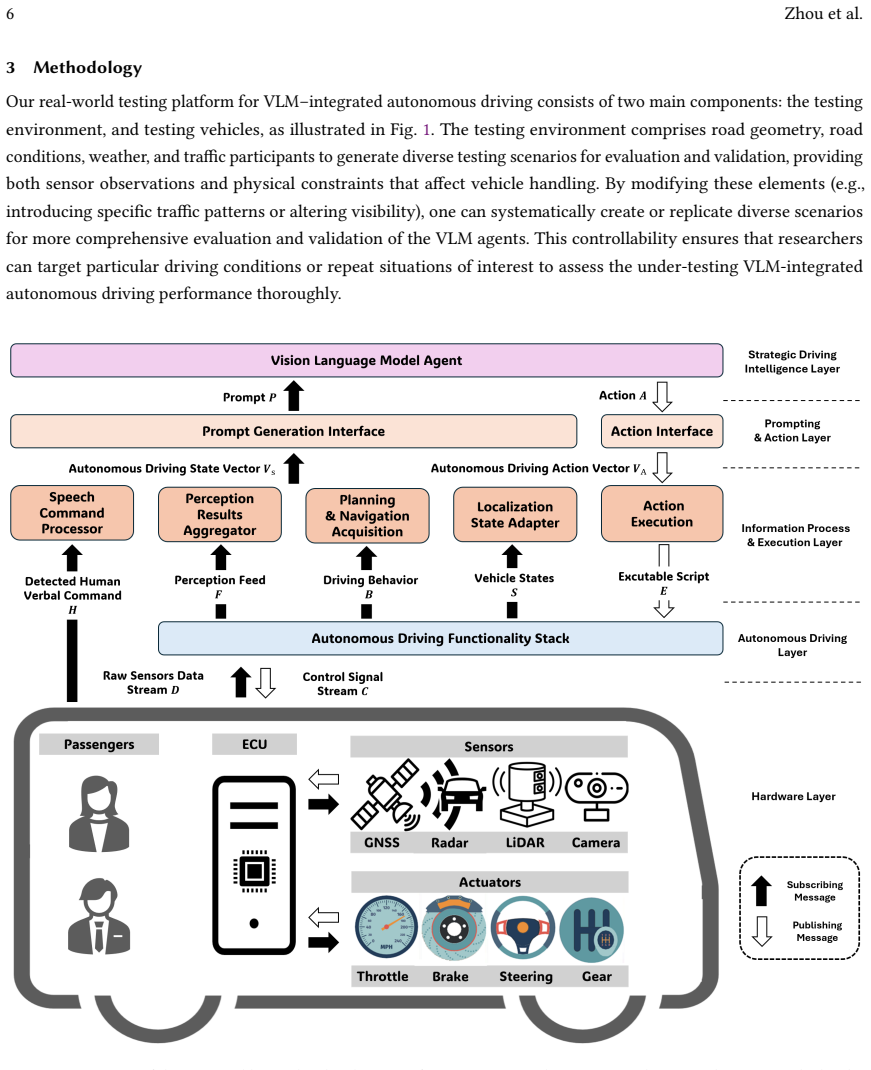
The load-bearing object is the hierarchical vehicle architecture, whose layers separate strategic intelligence (the VLM) from prompting, information processing, autonomy, and hardware. The mechanism that carries the argument is the structured driving-state vector $V_s$ and action vector $V_a$: the middleware summarizes perception feed, vehicle state, planned behaviors, and passenger commands into a prompt, the VLM returns a high-level action, and the execution layer validates it against safety constraints before adjusting control parameters and executing scripts. The second half of the machinery is the scenario suite, where road geometry, road conditions, weather, and traffic participants are varied on a closed track, which is the paper's answer to repeatability and experimental control.
What would settle it
Run the recorded scenario videos past independent human expert drivers and ask them to label the correct maneuver at each decision point; if the VLM's selected behavior agrees with the experts in materially fewer than the reported near-universal cases, the validation would be measuring self-consistency, not driving competence.
Extended reading notes
Core claim
The paper claims that VLM-integrated autonomous driving can be tested as a whole, in the physical world, before deployment: its platform replaces the usual choice between closed-loop simulation and open-road testing with a closed track where road geometry, road conditions, weather, and traffic participants are configurable. The vehicle side is organized into stacked layers, from the VLM as strategic intelligence through a prompting/action interface, an information-processing/execution layer that builds a driving-state vector and turns VLM actions into executable scripts, a modular autonomy layer, and the hardware layer, so the VLM's decisions close the loop through real sensors and actuators. A case study with a by-wire SUV, a cloud-hosted VLM, and an open-source autonomy stack runs the vehicle through highway, intersection, and parking-lot scenarios under varied conditions, reporting sub-20 ms message latencies and near-universal module-level correctness.
Load-bearing premise
The headline accuracy results assume that each module's expected output is the correct answer; for behavior selection and prompt/action formatting the expected output is the same structured data the system itself encoded, so near-perfect correctness mostly reflects self-consistency rather than whether the VLM made the right driving decision.
Editorial extensions
If this is right
- Different VLMs can be swapped into the strategic intelligence layer and compared under identical, repeatable real-world conditions.
- The separated perception-planning-control interfaces let one component be replaced while the rest of the stack is held fixed, isolating where an error enters the system.
- Because scenarios are configurable, staged near-crash and low-visibility conditions can be repeated many times to check decision consistency.
- The reported low latencies indicate that a cloud-hosted VLM can close the decision loop in a physical vehicle without breaking real-time constraints.
- The platform supports controlled study of domain shift by varying weather, road condition, and traffic density on the same closed track.
Reading between the lines
- A direct extension would run the same scenario suite across several VLMs and report inter-model decision agreement; the paper tests only a single VLM.
- The self-referential accuracy metric means that the high-correctness claim should be read as a wiring and formatting check; an independent human-annotated ground truth for scene understanding would be needed to support driving-competence claims.
- The same harness could probe causal grounding, for example by removing the camera image from the prompt and observing whether the selected behavior changes; the platform already exposes the prompt-construction point where such ablations are easy.
- Closed-track repeatability makes it feasible to measure response distributions rather than single runs, giving statistical confidence for rare-case behaviors.
Signed reviews
Editorial analysis
A structured set of objections, weighed in public.
Referee Report
Summary. This paper proposes a hierarchical real-world test platform for VLM-integrated autonomous driving, comprising a modular low-latency on-vehicle middleware, a clearly separated perception-planning-control architecture that can host VLM-based and conventional modules, and a configurable closed-track scenario suite. The authors describe a case study on a by-wire modified Lexus using Autoware as the backbone and GPT-4 as the VLM, and they report latency, accuracy, and computational-resource measurements across highway, intersection, and parking-lot scenarios. The central claim is that the platform can test and validate VLM-based driving systems in controlled, authentic, and reproducible real-world conditions prior to road deployment.
Significance. If substantiated, the platform would fill a genuine gap: simulation-based and logged-data benchmarks cannot provide controllable closed-loop real-world evaluation of VLM-integrated driving. The paper's strengths are its real-vehicle deployment details, the concrete hardware and middleware descriptions, and the independently measured latency and resource-utilization figures, which are credible and useful to the community. However, the validation of VLM decision correctness is currently missing, and the accuracy metric used is largely circular. Because the central claim is about testing and validating VLM-based driving systems, the current evidence supports only the claim that classical pipeline modules run with low latency and small footprint, not that the VLM's decisions or scene understanding are correct. The platform concept is valuable, but the paper's validation falls short of its stated goal.
major comments (3)
- [Section 5.1, Section 5.2, Section 6] The accuracy metric is defined as 'comparing the generated outputs with the expected outputs based on the input messages.' For the Prompt Generation Interface, Action Interface, Driving Behavior Selection, and Motion Control Refinement, the expected output is essentially a deterministic reformatting or relay of the same structured input data, so near-100% accuracy is largely tautological and does not indicate whether the VLM selected a safe or correct behavior. Table 2 does not score the VLM itself, and the only accuracy result with an independent ground truth is the Speech Command Processor (91.78%, against the transcribed command). Consequently, the conclusion in Section 6 that the framework 'maintains high accuracy' and can 'validate VLM-integrated autonomous driving' is not established. Please provide an independent correctness signal for VLM decisions and scene understanding, such as expert annotations, an established benchmark, or a quantitative comparison against a rule-based or classical baseline.
- [Section 4.2, Section 5.2] Each scenario is demonstrated with only two trips (e.g., highway: 'traffic too slow' vs. 'drive safely'; intersection: 'catch a flight' vs. 'keep safe'), and no repeated runs are reported. The manuscript claims 'reproducible' testing and 'robust experimentation under diverse conditions,' but with two trials per scenario and no variance or error analysis, these claims are not supported. Please report multiple repetitions per scenario and condition, with per-trial results and summary statistics, and state the total number of runs in the validation results.
- [Section 5.2] The reported latency and resource-utilization numbers are absolute and lack any comparison baseline. To demonstrate that the platform enables meaningful evaluation of VLM-integrated systems, the case study should compare the VLM-enabled pipeline against a comparable conventional autonomy stack (e.g., the same Autoware setup without the VLM, or a simple rule-based decision maker). Without such a baseline, one cannot determine whether the VLM improves, degrades, or leaves unchanged the driving performance, and the claim that the framework can 'validate' VLM-based driving systems remains unsupported.
minor comments (6)
- [Section 3.1] The heading 'Tesing Vehicle Architecture' contains a typo and should read 'Testing Vehicle Architecture.'
- [Section 5.2, Table 2] Section 5.2 reports accuracy numbers (mostly 100%, and 91.78% for the Speech Command Processor) in the text, but Table 2 shows only latency and resource utilization; add an accuracy column with per-module values and explicitly describe how each accuracy value was computed.
- [Section 5.1] The subsection heading 'Time Effeciency' should be 'Time Efficiency.'
- [Section 4.2.3, Section 5.2] The latency for the Speech Command Processor is reported inconsistently: Table 2 lists 0.24 ms, the text mentions 167.95 ms for the full end-to-end speech recognition process, and Section 4.2 states command processing times from 0.5 s to 1.9 s; please clarify which quantity is being reported in each place.
- [Title page] The ACM Reference Format and copyright notice cite 2018 and ACM Transactions on Internet Things, which does not match the current arXiv submission date or venue; update these fields.
- [Section 4.2.1, Section 4.2.2] The driving behavior set B is reported as [overtake, yield, following] for the highway scenario and later for the intersection scenario has only [yield, following]; make the scenario definitions consistent across the case study.
Circularity Check
The reported high-accuracy validation reduces to a self-consistency check: expected outputs are derived from the same inputs the modules format, and the VLM under test is not scored.
-
self definitional
[Section 5.1, Accuracy paragraph (Evaluation Metrics), with Table 2]
"Accuracy evaluates the correctness of the outputs generated by each module. We measure accuracy by comparing the generated outputs with the expected outputs based on the input messages."
For every module in Table 2 except the Speech Command Processor, the 'expected output' is the structured representation that the module itself was designed to produce from the same input message. Table 1 lists, for example, Prompt Generation Interface output 'Formatted Prompt Text' from 'Current Vehicle State, Recognized Text Command', and Action Interface output 'Final Trajectories' from the VLM's selected behavior and parameters; the aggregators and adapters repackage perception, localization, and planning data already generated by the classical stack. Comparing these deterministic reformatting outputs with expected outputs derived from the same inputs measures format consistency, not decision correctness, so 100% accuracy is forced by construction.
full rationale
The platform architecture, the real-world closed-loop demonstration, and the latency and resource-utilization measurements are independent contributions and are not circular. The circularity is confined to the accuracy component of the validation. Section 5.1 defines accuracy as agreement with expected outputs based on input messages, and Section 5.2 then reports near-100% correctness for eight deterministic middleware modules. For those modules the expected output is the structured data the module was designed to produce from the same input, so the near-perfect scores are tautological. Only the Speech Command Processor is scored against an independently meaningful target, the transcribed voice command, at 91.78%. Moreover, the VLM itself, which is the system under test, does not appear in Table 2, so the paper's conclusion that the framework 'maintains high accuracy' for VLM-based driving validation is not established by the correctness metric. Because the centerpiece accuracy result reduces by construction, the circularity score is 6 rather than 0-2.
Assumptions & free parameters
free parameters (3)
- Longitudinal PID gains Kp, Ki, Kd =
Example: 1.1, 0.02, 0.01 (Eq. 6)
- MPC lateral-control weights (Q, R, P) =
Not reported numerically
- VLM request interval =
3 seconds
assumptions (4)
- domain assumption Representativeness: staged scenarios on a closed track with weather, road, and traffic variations approximate real-world domain shift
- domain assumption Safety sufficiency of a 3-second cloud VLM loop when combined with the classical stack
- ad hoc to paper Accuracy can be assessed by comparing each module's outputs to expected outputs based on input messages
- standard math Standard components (PID, MPC, NDT, YOLO, Autoware) perform as documented
Cite this review
Pith. "Pith review of A Hierarchical Test Platform for Vision Language Model (VLM)-Integrated Real-World Autonomous Driving." pith.science (2026). https://pith.science/paper/BDCKZTS4
@misc{pith2026250614100,
  author       = {Pith},
  title        = {Pith review of: A Hierarchical Test Platform for Vision Language Model (VLM)-Integrated Real-World Autonomous Driving},
  year         = {2026},
  howpublished = {\url{https://pith.science/paper/BDCKZTS4}},
  note         = {Machine review of arXiv:2506.14100}
}
read the original abstract
Vision-Language Models (VLMs) have demonstrated notable promise in autonomous driving by offering the potential for multimodal reasoning through pretraining on extensive image-text pairs. However, adapting these models from broad web-scale data to the safety-critical context of driving presents a significant challenge, commonly referred to as domain shift. Existing simulation-based and dataset-driven evaluation methods, although valuable, often fail to capture the full complexity of real-world scenarios and cannot easily accommodate repeatable closed-loop testing with flexible scenario manipulation. In this paper, we introduce a hierarchical real-world test platform specifically designed to evaluate VLM-integrated autonomous driving systems. Our approach includes a modular, low-latency on-vehicle middleware that allows seamless incorporation of various VLMs, a clearly separated perception-planning-control architecture that can accommodate both VLM-based and conventional modules, and a configurable suite of real-world testing scenarios on a closed track that facilitates controlled yet authentic evaluations. We demonstrate the effectiveness of the proposed platform`s testing and evaluation ability with a case study involving a VLM-enabled autonomous vehicle, highlighting how our test framework supports robust experimentation under diverse conditions.
Figures


Figures from the paper (5 more)


Reference graph
Works this paper leans on
-
[1]
Alnaser, Arman Sargolzaei, and Mustafa Ilhan Akbaş
Ala’ J. Alnaser, Arman Sargolzaei, and Mustafa Ilhan Akbaş. 2021. Autonomous Vehicles Scenario Testing Framework and Model of Computation: On Generation and Coverage.IEEE Access9 (2021), 60617–60628. doi:10.1109/ACCESS.2021.3074062
arXiv 2021
-
[2]
AutonomouStuff. 2024. Autoware.AI Drivers - as/master Branch. https://gitlab.com/astuff/autoware.ai/drivers/-/tree/as/master/as?ref_type=heads. Accessed: 2024-08-19
work page 2024
-
[3]
AutonomouStuff. n.d.. AutonomouStuff: Autonomy Solutions. https://autonomoustuff.com/. Accessed: 2025-02-09
work page 2025
-
[4]
Autoware Foundation. n.d.. Autoware Foundation. https://autoware.org/. Accessed: 2025-02-09
work page 2025
-
[5]
P. Biber and W. Strasser. 2003. The normal distributions transform: a new approach to laser scan matching. InProceedings 2003 IEEE/RSJ International Conference on Intelligent Robots and Systems (IROS 2003) (Cat. No.03CH37453), Vol. 3. IEEE, Las Vegas, Nevada, USA, 2743–2748 vol.3. doi:10.1109/IROS.2003.1249285
arXiv 2003
-
[6]
Holger Caesar, Juraj Kabzan, Kok Seang Tan, Whye Kit Fong, Eric Wolff, Alex Lang, Luke Fletcher, Oscar Beijbom, and Sammy Omari. 2022. NuPlan: A closed-loop ML-based planning benchmark for autonomous vehicles. arXiv:2106.11810 [cs.CV] https://arxiv.org/abs/2106.11810
arXiv 2022
-
[7]
Ming-Fang Chang, John Lambert, Patsorn Sangkloy, Jagjeet Singh, Slawomir Bak, Andrew Hartnett, De Wang, Peter Carr, Simon Lucey, Deva Ramanan, and James Hays. 2019. Argoverse: 3D Tracking and Forecasting with Rich Maps. arXiv:1911.02620 [cs.CV] https://arxiv.org/abs/1911.02620
arXiv 2019
-
[8]
Li Chen, Penghao Wu, Kashyap Chitta, Bernhard Jaeger, Andreas Geiger, and Hongyang Li. 2024. End-to-End Autonomous Driving: Challenges and Frontiers.IEEE Transactions on Pattern Analysis and Machine Intelligence46, 12 (2024), 10164–10183. doi:10.1109/TPAMI.2024.3435937
arXiv 2024
Show all 52 references
-
[10]
Wenhao Cheng, Junbo Yin, Wei Li, Ruigang Yang, and Jianbing Shen. 2023. Language-Guided 3D Object Detection in Point Cloud for Autonomous Driving. arXiv:2305.15765 [cs.CV] https://arxiv.org/abs/2305.15765
2023 arXiv
-
[11]
Chidhambararajan, Aman Rangapur, S
R. Chidhambararajan, Aman Rangapur, S. Sibi Chakkaravarthy, Aswani Kumar Cherukuri, Meenalosini Vimal Cruz, and S. Sudhakar Ilango. 2022. EfficientWord-Net: An Open Source Hotword Detection Engine Based on Few-Shot Learning.Journal of Information & Knowledge Management21, 04 (...
2022 doi
-
[12]
Comma.ai. 2024. Openpilot: An Open-source Driving Agent. https://www.comma.ai/openpilot. Accessed: 2024-08-22
2024
-
[14]
Can Cui, Zichong Yang, Yupeng Zhou, Yunsheng Ma, Juanwu Lu, Lingxi Li, Yaobin Chen, Jitesh Panchal, and Ziran Wang. 2023. Personalized Autonomous Driving with Large Language Models: Field Experiments. arXiv preprint arXiv:2312.09397, 10 pages. arXiv:2312.09397 [cs.AI] https://...
2023 arXiv
-
[15]
Can Cui, Zichong Yang, Yupeng Zhou, Juntong Peng, Sung-Yeon Park, Cong Zhang, Yunsheng Ma, Xu Cao, Wenqian Ye, Yiheng Feng, Jitesh Panchal, Lingxi Li, Yaobin Chen, and Ziran Wang. 2024. On-Board Vision-Language Models for Personalized Autonomous Vehicle Motion Control: System ...
2024 arXiv
-
[16]
Alexey Dosovitskiy, German Ros, Felipe Codevilla, Antonio Lopez, and Vladlen Koltun. 2017. CARLA: An Open Urban Driving Simulator. arXiv:1711.03938 [cs.LG] https://arxiv.org/abs/1711.03938
2017 arXiv
-
[17]
Minjian Feng and Hui Zhang. 2022. Application of Baidu Apollo Open Platform in a Course of Control Simulation Experiments.Computer Applications in Engineering Education30, 3 (2022), 892–906
2022
-
[18]
Hossam A Gabbar, Jing Ren, and Patrick CK Hung. 2022. Modeling and simulation for connected and automated vehicle (CAV) deployment and performance evaluation. InSmart Cities Policies and Financing. Elsevier, Cambridge, MA, USA, 481–510
2022
-
[19]
Felix Gruber and Matthias Althoff. 2018. Anytime Safety Verification of Autonomous Vehicles. In2018 21st International Conference on Intelligent Transportation Systems (ITSC). IEEE, Maui, HI, USA, 1708–1714. doi:10.1109/ITSC.2018.8569950
2018
-
[20]
Jinwei Han, Zhiwen Lin, Zhongyisun Sun, Yingguo Gao, Ke Yan, Shouhong Ding, Yuan Gao, and Gui-Song Xia. 2024. Anchor-based Robust Finetuning of Vision-Language Models. arXiv:2404.06244 [cs.CV] https://arxiv.org/abs/2404.06244
2024 arXiv
-
[21]
WuLing Huang, Kunfeng Wang, Yisheng Lv, and FengHua Zhu. 2016. Autonomous Vehicles Testing Methods Review. In2016 IEEE 19th International Conference on Intelligent Transportation Systems (ITSC). IEEE, Rio de Janeiro, Brazil, 163–168. doi:10.1109/ITSC.2016.7795548
2016
-
[22]
Madhava Krishna, and Vineet Gandhi
Kanishk Jain, Varun Chhangani, Amogh Tiwari, K. Madhava Krishna, and Vineet Gandhi. 2023. Ground then Navigate: Language-guided Navigation in Dynamic Scenes. In2023 IEEE International Conference on Robotics and Automation (ICRA). IEEE, London, United Kingdom, 4113–4120. doi:10...
2023
-
[23]
Phillip Karle, Tobias Betz, Marcin Bosk, Felix Fent, Nils Gehrke, Maximilian Geisslinger, Luis Gressenbuch, Philipp Hafemann, Sebastian Huber, Maximilian Hübner, Sebastian Huch, Gemb Kaljavesi, Tobias Kerbl, Dominik Kulmer, Tobias Mascetta, Sebastian Maierhofer, Florian Pfab, ...
2024 arXiv
-
[24]
Napat Karnchanachari, Dimitris Geromichalos, Kok Seang Tan, Nanxiang Li, Christopher Eriksen, Shakiba Yaghoubi, Noushin Mehdipour, Gianmarco Bernasconi, Whye Kit Fong, Yiluan Guo, and Holger Caesar. 2024. Towards learning-based planning:The nuPlan benchmark for real-world auto...
2024 arXiv
-
[25]
Shinpei Kato, Shota Tokunaga, Yuya Maruyama, Seiya Maeda, Manato Hirabayashi, Yuki Kitsukawa, Abraham Monrroy, Tomohito Ando, Yusuke Fujii, and Takuya Azumi. 2018. Autoware on Board: Enabling Autonomous Vehicles with Embedded Systems. In2018 ACM/IEEE 9th International Conferen...
2018
-
[27]
Alex Krizhevsky, Ilya Sutskever, and Geoffrey E Hinton. 2012. ImageNet Classification with Deep Convolutional Neural Networks. InAdvances in Neural Information Processing Systems, F. Pereira, C.J. Burges, L. Bottou, and K.Q. Weinberger (Eds.), Vol. 25. Curran Associates, Inc.,...
2012
-
[28]
Tian, and Panos D
Zhenning Li, Qiong Wu, Hao Yu, Cong Chen, Guohui Zhang, Zong Z. Tian, and Panos D. Prevedouros. 2019. Temporal-spatial dimension extension- based intersection control formulation for connected and autonomous vehicle systems.Transportation Research Part C: Emerging Technologies...
2019 doi
-
[29]
Mengyin Liu, Jie Jiang, Chao Zhu, and Xu-Cheng Yin. 2023. VLPD: Context-Aware Pedestrian Detection via Vision-Language Semantic Self- Supervision . In2023 IEEE/CVF Conference on Computer Vision and Pattern Recognition (CVPR). IEEE Computer Society, Los Alamitos, CA, USA, 6662–...
2023
-
[30]
Mengyin Liu, Chao Zhu, Shiqi Ren, and Xu-Cheng Yin. 2024. Unsupervised Multi-view Pedestrian Detection. InProceedings of the 32nd ACM International Conference on Multimedia(Melbourne VIC, Australia)(MM ’24). Association for Computing Machinery, New York, NY, USA, 1034–1042. do...
2024
-
[31]
Manuel Mar, Vishnu Chellapandi, Liangqi Yuan, Ziran Wang, and Eric Dietz. 2024. A Review of Full-Sized Autonomous Racing Vehicle Sensor Architecture. arXiv preprint arXiv:2402.02603, 13 pages. arXiv:2402.02603 [cs.RO] https://arxiv.org/abs/2402.02603
2024 arXiv
-
[32]
Till Menzel, Gerrit Bagschik, and Markus Maurer. 2018. Scenarios for Development, Test and Validation of Automated Vehicles. In2018 IEEE Intelligent Vehicles Symposium (IV). IEEE, Changshu, Suzhou, China, 1821–1827. doi:10.1109/IVS.2018.8500406
2018
-
[33]
Matthew O’Kelly, Houssam Abbas, Sicun Gao, Shin’ichi Shiraishi, Shinpei Kato, and Rahul Mangharam. 2016. APEX: Autonomous Vehicle Plan Verification and Execution. InSAE World Congress 2016. SAE International, Detroit, MI, USA, 1–13
2016
-
[34]
Matthew O’Kelly, Hongrui Zheng, Dhruv Karthik, and Rahul Mangharam. 2020. F1TENTH: An Open-source Evaluation Environment for Continuous Control and Reinforcement Learning.Proceedings of Machine Learning Research123 (2020), 77–90. https://par.nsf.gov/biblio/10221872
2020
-
[35]
Mohammad Omama, Pranav Inani, Pranjal Paul, Sarat Chandra Yellapragada, Krishna Murthy Jatavallabhula, Sandeep Chinchali, and Madhava Krishna. 2023. ALT-Pilot: Autonomous navigation with Language augmented Topometric maps. arXiv:2310.02324 [cs.RO] https://arxiv.org/abs/ 2310.02324
2023 arXiv
-
[36]
OpenAI. 2025. ChatGPT: GPT-4 Model. Accessed March 15, 2025. Available at https://chat.openai.com
2025
-
[37]
Chenbin Pan, Burhaneddin Yaman, Tommaso Nesti, Abhirup Mallik, Alessandro G Allievi, Senem Velipasalar, and Liu Ren. 2024. VLP: Vision Language Planning for Autonomous Driving . In2024 IEEE/CVF Conference on Computer Vision and Pattern Recognition (CVPR). IEEE Computer Society...
2024
-
[38]
Masayoshi Tomizuka Pan Song and Changfu Zong. 2015. A novel integrated chassis controller for full drive-by-wire vehicles.Vehicle System Dynamics53, 2 (2015), 215–236. doi:10.1080/00423114.2014.991331 arXiv:https://doi.org/10.1080/00423114.2014.991331
2015
-
[39]
SungYeon Park, MinJae Lee, JiHyuk Kang, Hahyeon Choi, Yoonah Park, Juhwan Cho, Adam Lee, and DongKyu Kim. 2024. VLAAD: Vision and Language Assistant for Autonomous Driving . In2024 IEEE/CVF Winter Conference on Applications of Computer Vision Workshops (W ACVW). IEEE Computer ...
2024
-
[40]
Tianwen Qian, Jingjing Chen, Linhai Zhuo, Yang Jiao, and Yu-Gang Jiang. 2024. NuScenes-QA: A Multi-Modal Visual Question Answering Benchmark for Autonomous Driving Scenario.Proceedings of the AAAI Conference on Artificial Intelligence38, 5 (Mar. 2024), 4542–4550. doi:10.1609/ ...
2024
-
[41]
Ng, et al
Morgan Quigley, Ken Conley, Brian Gerkey, Josh Faust, Tully Foote, Jeremy Leibs, Rob Wheeler, Andrew Y. Ng, et al. 2009. ROS: an open-source Robot Operating System. InICRA Workshop on Open Source Software, Vol. 3. IEEE, Kobe, Japan, 5
2009
-
[42]
Alec Radford, Jong Wook Kim, Chris Hallacy, Aditya Ramesh, Gabriel Goh, Sandhini Agarwal, Girish Sastry, Amanda Askell, Pamela Mishkin, Jack Clark, Gretchen Krueger, and Ilya Sutskever. 2021. Learning Transferable Visual Models From Natural Language Supervision. arXiv:2103.000...
2021 arXiv
-
[43]
Guodong Rong, Byung Hyun Shin, Hadi Tabatabaee, Qiang Lu, Steve Lemke, M¯artin, š Možeiko, Eric Boise, Geehoon Uhm, Mark Gerow, Shalin Mehta, Eugene Agafonov, Tae Hyung Kim, Eric Sterner, Keunhae Ushiroda, Michael Reyes, Dmitry Zelenkovsky, and Seonman Kim. 2020. LGSVL Simulat...
2020
-
[44]
Hao Sha, Yao Mu, Yuxuan Jiang, Li Chen, Chenfeng Xu, Ping Luo, Shengbo Eben Li, Masayoshi Tomizuka, Wei Zhan, and Mingyu Ding. 2023. LanguageMPC: Large Language Models as Decision Makers for Autonomous Driving. arXiv:2310.03026 [cs.RO] https://arxiv.org/abs/2310.03026 Manuscri...
2023 arXiv
-
[45]
2018.AirSim: High-Fidelity Visual and Physical Simulation for Autonomous Vehicles
Shital Shah, Debadeepta Dey, Chris Lovett, and Ashish Kapoor. 2018.AirSim: High-Fidelity Visual and Physical Simulation for Autonomous Vehicles. Springer, Cham, Cham, Switzerland, 621–635. doi:10.1007/978-3-319-67361-5_40
2018 doi
-
[46]
Pei Sun, Henrik Kretzschmar, Xerxes Dotiwalla, Aurelien Chouard, Vijaysai Patnaik, Paul Tsui, James Guo, Yin Zhou, Yuning Chai, Benjamin Caine, Vijay Vasudevan, Wei Han, Jiquan Ngiam, Hang Zhao, Aleksei Timofeev, Scott Ettinger, Maxim Krivokon, Amy Gao, Aditya Joshi, Yu Zhang,...
2020
-
[47]
Ardi Tampuu, Tambet Matiisen, Maksym Semikin, Dmytro Fishman, and Naveed Muhammad. 2022. A Survey of End-to-End Driving: Architectures and Training Methods.IEEE Transactions on Neural Networks and Learning Systems33, 4 (2022), 1364–1384. doi:10.1109/TNNLS.2020.3043505
2022
-
[48]
Xiaoyu Tian, Junru Gu, Bailin Li, Yicheng Liu, Yang Wang, Zhiyong Zhao, Kun Zhan, Peng Jia, Xianpeng Lang, and Hang Zhao. 2024. DriveVLM: The Convergence of Autonomous Driving and Large Vision-Language Models. arXiv:2402.12289 [cs.CV] https://arxiv.org/abs/2402.12289
2024 arXiv
-
[49]
Wenhai Wang, Jiangwei Xie, ChuanYang Hu, Haoming Zou, Jianan Fan, Wenwen Tong, Yang Wen, Silei Wu, Hanming Deng, Zhiqi Li, Hao Tian, Lewei Lu, Xizhou Zhu, Xiaogang Wang, Yu Qiao, and Jifeng Dai. 2023. DriveMLM: Aligning Multi-Modal Large Language Models with Behavioral Plannin...
2023
-
[50]
Dongming Wu, Wencheng Han, Tiancai Wang, Yingfei Liu, Xiangyu Zhang, and Jianbing Shen. 2023. Language Prompt for Autonomous Driving. arXiv:2309.04379 [cs.CV] https://arxiv.org/abs/2309.04379
2023 arXiv
-
[51]
Meyer, Siva Karthik Mustikovela, Siddhartha Srinivasa, Eric M
Yi Xu, Yuxin Hu, Zaiwei Zhang, Gregory P. Meyer, Siva Karthik Mustikovela, Siddhartha Srinivasa, Eric M. Wolff, and Xin Huang. 2024. VLM-AD: End-to-End Autonomous Driving through Vision-Language Model Supervision. arXiv:2412.14446 [cs.CV] https://arxiv.org/abs/2412.14446
2024 arXiv
-
[52]
Wong, Zhenguo Li, and Hengshuang Zhao
Zhenhua Xu, Yujia Zhang, Enze Xie, Zhen Zhao, Yong Guo, Kwan-Yee K. Wong, Zhenguo Li, and Hengshuang Zhao. 2024. DriveGPT4: Interpretable End-to-End Autonomous Driving Via Large Language Model.IEEE Robotics and Automation Letters9, 10 (2024), 8186–8193. doi:10.1109/LRA.2024. 3440097
2024 doi
-
[53]
Yu Zhang, Zhongyin Guo, Jianqing Wu, Yuan Tian, Haotian Tang, and Xinming Guo. 2022. Real-Time Vehicle Detection Based on Improved YOLO v5.Sustainability14, 19, Article 12274 (Sept. 2022), 14 pages. doi:10.3390/su141912274
2022 doi
-
[54]
Xingcheng Zhou, Mingyu Liu, Ekim Yurtsever, Bare Luka Zagar, Walter Zimmer, Hu Cao, and Alois C. Knoll. 2024. Vision Language Models in Autonomous Driving: A Survey and Outlook.IEEE Transactions on Intelligent Vehicles1 (2024), 1–20. doi:10.1109/TIV.2024.3402136
2024
-
[55]
Poskitt, Yang Liu, and Zijiang Yang
Yuan Zhou, Yang Sun, Yun Tang, Yuqi Chen, Jun Sun, Christopher M. Poskitt, Yang Liu, and Zijiang Yang. 2023. Specification-Based Autonomous Driving System Testing.IEEE Transactions on Software Engineering49, 6 (2023), 3391–3410. doi:10.1109/TSE.2023.3254142 Manuscript submitted to ACM
2023
Reviewed August 15, 2026 · model on record in the stance chip above.
Discussion (0). Continue with ORCID to comment.