REVIEW 4 major objections 5 minor 1 cited by
Demystifying the Visual Quality Paradox in Multimodal Large Language Models
T0 review · 4 major / 5 minor · reviewed 2026-08-06 · deepseek-v4-flash
Pith's one-line read For multimodal LLMs, degraded images can beat clean ones.
desk verdict A real phenomenon buried under inconsistent baselines and missing statistics; the paradox deserves a serious look, but the VQ-TTT results as reported don't yet support the headline. read the letter →
The pith
A machine-rendered reading of the paper's core claim, the machinery that carries it, and where it could break.
The reading
What carries the argument
The mechanism is a two-part test-time tuning module called VQ-TTT. First, a learnable kernel layer modulates the input image as $v' = (1+b)v - b\,(v * K_\sigma)$, where $b$ is a learnable blending coefficient and $K_\sigma$ a separable Gaussian kernel with learnable standard deviation; positive $b$ sharpens and negative $b$ blurs using only two parameters. Second, LoRA adapters inserted into the first two layers of the frozen CLIP vision encoder let the model adapt to the modulated input distribution. Both parts are tuned once per test image by minimizing the prediction entropy $L_{entropy} = -\sum_{y\in Y} p_\theta(y|v',t)\log p_\theta(y|v',t)$, which pushes the model toward confident answers. The same two components carry the whole argument: the kernel searches image space, the LoRA keeps the representation aligned, and the entropy loss selects the modulation without any labels.
What would settle it
Split a benchmark into a tuning half and a held-out half. Run VQ-TTT by minimizing entropy on the tuning half, then apply the learned per-image modulation to the held-out half and compare accuracy against no tuning; if the gains vanish or reverse while entropy still drops on the tuned half, the entropy proxy was overfitting the tuned inputs rather than improving correctness. A second check is to compare VQ-TTT against a version tuned with true answer labels on a small subsample; if label-tuned modulation yields different image filters and larger accuracy gains, entropy minimization is not finding the real model preference.
Extended reading notes
Core claim
The central claim is the visual-quality paradox: for many MLLMs, answers on vision-language questions can become more accurate when the input image deviates from human-perceived fidelity, depending on the model, the task, and even the individual instance. The paper demonstrates this with controlled Gaussian noise, motion and defocus blur, snow, and fog applied across MathVista, MMMU, ScienceQA, TextVQA, and MME, showing that reasoning-heavy tasks sometimes improve under degradation while recognition-heavy tasks drop. It then shows that standard restoration pipelines fail to recover the lost performance and can make it worse, because they optimize for perceptual metrics rather than the features the model actually uses. The positive proposal, VQ-TTT, inserts a learnable low-rank frequency-modulating kernel before the frozen vision encoder and fine-tunes shallow encoder layers with LoRA, minimizing prediction entropy on the test input itself; the paper reports that this lifts average accuracy across all evaluated models and datasets without external models, cached features, or extra training data.
Load-bearing premise
The load-bearing premise is that minimizing the model's prediction entropy on a test image is a valid proxy for getting the answer right, because the reported accuracy gains are measured on the very same inputs whose entropy was minimized.
Editorial extensions
If this is right
- Off-the-shelf restoration pipelines, including strong transformer- and diffusion-based models, do not recover MLLM performance on degraded inputs and can actively hurt it, implying human perceptual quality metrics are misaligned with what MLLMs use.
- VQ-TTT improves average accuracy across the evaluated MLLMs and all datasets, with under 1% of original model parameters, no external models, no cached features, and no extra training data.
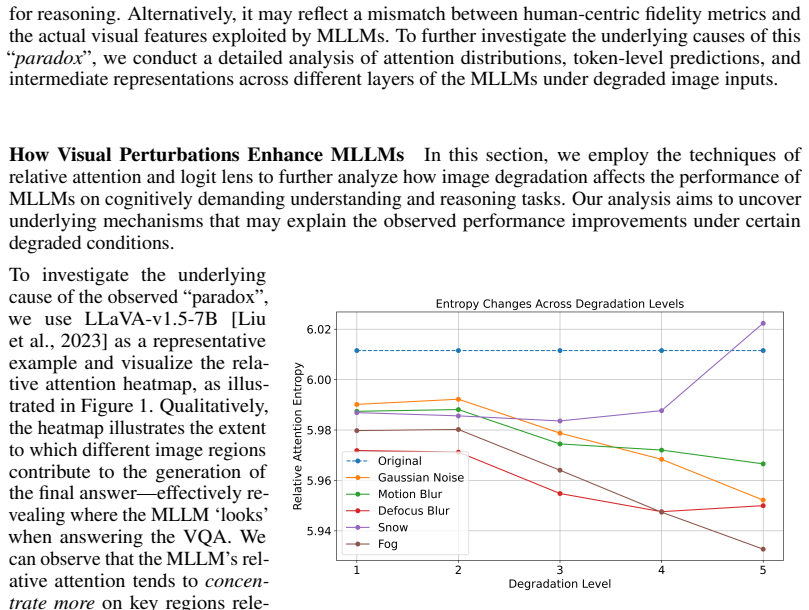
- Degradation can sharpen the model's relative attention on question-relevant image regions and improve semantic coherence on cognitively demanding tasks like MathVista and ScienceQA.
- Each model and task has its own preferred visual input quality, so there is no universally 'clean' image optimum; input preparation should be adaptive.
Reading between the lines
- If the paradox holds generally, image compression and delivery pipelines could be re-engineered to maximize downstream MLLM accuracy rather than human-rated fidelity, for example by preserving model-preferred frequency content and discarding what the model ignores.
- A natural stress test is to apply VQ-TTT to open-ended generation tasks with no single correct answer, where confidence is not calibrated; the entropy proxy may fail there even if it works on multiple-choice VQA.
- The per-instance nature of the paradox suggests that robustness benchmarks should report not only average degradation curves but also the distribution of instances where degradation helps, which could change how model robustness is scored.
- The frequency-modulation idea is modality-agnostic in principle; a testable extension is to translate the learnable kernel to video frames or audio spectrograms for multimodal models.
Editorial analysis
A structured set of objections, weighed in public.
Referee Report
Summary. The paper studies how input image quality affects the performance of multimodal large language models (MLLMs). Through systematic degradation experiments across several MLLMs and vision-language benchmarks, it claims a "visual-quality paradox": models sometimes perform better on images that humans perceive as degraded. It then proposes Visual-Quality Test-Time Tuning (VQ-TTT), a lightweight module that inserts a learnable low-rank kernel before the frozen vision encoder and applies shallow-layer LoRA, tuned by entropy minimization on the test input. The paper reports accuracy gains from VQ-TTT and argues that restoration pipelines are insufficient because they optimize human-perceptual quality rather than model-preferred representations.
Significance. If the empirical claims were fully supported, the paper would be a valuable challenge to the common assumption that cleaner, higher-fidelity images always benefit MLLMs. The paper has notable strengths: it evaluates several models and many datasets, attempts mechanistic analysis via relative attention and logit lens, and proposes a parameter-efficient adaptation method that could be practically useful. However, the central evidence is currently undermined by an internal baseline inconsistency, a transductive evaluation protocol whose validity is not demonstrated, and the absence of variance or significance reporting. These issues must be resolved before the paradox or the VQ-TTT gains can be assessed reliably.
major comments (4)
- [Table 1 / Table 2] The 'original' baseline for LLaVA-v1.5-7B is not stable across the paper. Table 1 (and Table 7) report MME Perception 1510.28 and MME Cognition 357.85 for the original condition, while Table 2 reports MME Perception 1500.13 and MME Cognition 316.43 for the same model and condition. The 41.42-point discrepancy in MME Cognition is much larger than the claimed VQ-TTT delta on that metric (-8.6), and the 10.15-point discrepancy in MME Perception is comparable to the reported +12.0 gain. As a result, the reported improvement pattern is not uniquely determined by the data as presented. Please provide a single reproducible evaluation setting, including the exact checkpoint, decoding parameters, and metric implementation, and use it consistently for all baseline and VQ-TTT rows.
- [§4.1, Eq. (2)] VQ-TTT minimizes prediction entropy on the very test inputs on which accuracy is later reported. This transductive protocol can inflate apparent gains by making the model more confident without making it more correct. The paper does not show that lower entropy correlates with correct answers on these benchmarks, nor does it report accuracy under entropy-minimized modulation on a held-out set. Please evaluate on a separate split, or at least report the accuracy-entropy correlation and the accuracy of entropy-minimized predictions on a validation set, to rule out overconfident wrong predictions as the source of the reported gains.
- [§3.2 and Table 2] The headline claims of 'significant' gains and 'consistent improvements' are not backed by any variance information. No seeds, standard deviations, or significance tests are reported, and many deltas are small (e.g., +0.3, +0.2, +0.1 in Table 2). Please report multiple runs or bootstrap confidence intervals and apply a paired test across examples. Without this, the visual-quality paradox itself, which rests on average improvements of about one point on MathVista and smaller effects elsewhere, is not statistically distinguishable from noise.
- [Table 7] Table 7 contains unexplained rows and entries that prevent independent audit. 'VLM-R1' appears without any introduction in Section 3 or in the list of evaluated models, and Qwen-2.5-VL-3B-instruct's ScienceQAI accuracy collapses to 0.00 after every restoration pipeline while remaining nonzero under direct degradation; neither phenomenon is discussed. These entries need to be explained or removed, and the table should be reconciled with Table 1.
minor comments (5)
- [§3.2] The text says the results are presented in Table 7, but the main-text table is Table 1; please unify the cross-references.
- [Throughout] There are repeated formatting issues, including 'LLaV A' spacing, 'Visualizaion' in the Figure 1 caption, and 'traiditonal' in Section 5.3; a careful proofread is needed.
- [Table 1/Table 2] The column labels 'ScienceQA T' and 'ScienceQAI' are not defined; please clarify whether these are different subsets or a typo.
- [Abstract and §4.2] The claimed gain magnitude is inconsistent: the Abstract and Introduction state gains of up to 8.6%, while Section 4.2 reports gains of up to 4.5%; please reconcile these numbers.
- [Figures 2 and 3] The attention-entropy and logit-lens analyses are presented qualitatively or for single examples; please add quantitative summaries across samples to support the mechanistic claims.
Circularity Check
No significant circularity: the paradox is an empirical measurement and VQ-TTT accuracy gains are evaluated with labels after label-free entropy tuning.
full rationale
I walked the paper's derivation chain and found no circular step that reduces a claimed prediction to its own inputs by construction. The visual-quality paradox is an empirical observation: the paper systematically degrades images and reports measured accuracy changes, so it is not derived from an assumption that already contains the conclusion. VQ-TTT's learning objective, Eq. (2), minimizes prediction entropy over the test input without using ground-truth answers; the reported accuracy in Table 2 is then computed with labels as an external evaluation. There is no equation or construction in the paper that forces low entropy to equal high accuracy, so the accuracy gain is not a fitted parameter renamed as a prediction. This is a standard transductive test-time adaptation evaluation: the test input is used for adaptation, but the measured outcome is independent of the tuning signal in the sense that the labels are never used during optimization. The paper's self-citations appear in related work and application listings, not as load-bearing evidence for the central claim, and no uniqueness theorem or ansatz is smuggled in through self-citation. I also checked the internal Table 1/Table 2 inconsistency: the LLaVA-v1.5-7B baseline differs between tables for MME Perception (1510.28 vs 1500.13) and MME Cognition (357.85 vs 316.43), and Table 7 contains an unexplained VLM-R1 row and some ScienceQA-I entries collapsed to 0.00. Those are reproducibility and correctness concerns, not circularity, because they do not exhibit a derivation that is equivalent to its input by definition. The paper's own Limitations section acknowledges the narrow evaluation scope and the compact method's limited capacity, which further supports treating the empirical claims as honestly scoped rather than circular. Overall, no step in the claimed derivation chain is self-definitional, no fitted input is relabeled as a prediction, and the central empirical findings stand as independent measurements.
Assumptions & free parameters
free parameters (3)
- b (blending coefficient in Eq. 1) =
not reported
- sigma (Gaussian kernel standard deviation) =
not reported
- LoRA configuration (rank, alpha, layers) =
approx 0.1M parameters
assumptions (3)
- domain assumption Entropy minimization is a valid proxy for prediction accuracy.
- ad hoc to paper A learnable kernel with two scalar parameters plus shallow-layer LoRA can capture task-specific visual quality preferences.
- domain assumption Synthetic degradations from the imagecorruptions library are representative of real-world visual quality variation.
Cite this review
Pith. "Pith review of Demystifying the Visual Quality Paradox in Multimodal Large Language Models." pith.science (2026). https://pith.science/paper/USO6E7V2
@misc{pith2026250615645,
  author       = {Pith},
  title        = {Pith review of: Demystifying the Visual Quality Paradox in Multimodal Large Language Models},
  year         = {2026},
  howpublished = {\url{https://pith.science/paper/USO6E7V2}},
  note         = {Machine review of arXiv:2506.15645}
}
read the original abstract
Recent Multimodal Large Language Models (MLLMs) excel on benchmark vision-language tasks, yet little is known about how input visual quality shapes their responses. Does higher perceptual quality of images already translate to better MLLM understanding? We conduct the first systematic study spanning leading MLLMs and a suite of vision-language benchmarks, applying controlled degradations and stylistic shifts to each image. Surprisingly, we uncover a visual-quality paradox: model, task, and even individual-instance performance can improve when images deviate from human-perceived fidelity. Off-the-shelf restoration pipelines fail to reconcile these idiosyncratic preferences. To close the gap, we introduce Visual-Quality Test-Time Tuning (VQ-TTT)-a lightweight adaptation module that: (1) inserts a learnable, low-rank kernel before the frozen vision encoder to modulate frequency content; and (2) fine-tunes only shallow vision-encoder layers via LoRA. VQ-TTT dynamically adjusts each input image in a single forward pass, aligning it with task-specific model preferences. Across the evaluated MLLMs and all datasets, VQ-TTT lifts significant average accuracy, with no external models, cached features, or extra training data. These findings redefine ``better'' visual inputs for MLLMs and highlight the need for adaptive, rather than universally ``clean'', imagery, in the new era of AI being the main data customer.
Figures


Figures from the paper (2 more)


Forward citations
Cited by 1 Pith paper
-
Diagnosing Corruption-Induced Reliability Failures in Vision-Language Models
Mild visual corruption can boost a vision-language model's top-1 accuracy while its confidence–correctness alignment (measured by the new RAS score) degrades.
Reference graph
Works this paper leans on
-
[1]
A. Abdelhamed, S. Lin, and M. S. Brown. A high-quality denoising dataset for smartphone cameras. In Proceedings of the IEEE conference on computer vision and pattern recognition, pages 1692--1700, 2018
work page 2018
- [2]
-
[3]
A. Abouelenin, A. Ashfaq, A. Atkinson, H. Awadalla, N. Bach, J. Bao, A. Benhaim, M. Cai, V. Chaudhary, C. Chen, et al. Phi-4-mini technical report: Compact yet powerful multimodal language models via mixture-of-loras. arXiv preprint arXiv:2503.01743, 2025
arXiv 2025
-
[4]
H. Agrawal, K. Desai, Y. Wang, X. Chen, R. Jain, M. Johnson, D. Batra, D. Parikh, S. Lee, and P. Anderson. Nocaps: Novel object captioning at scale. In Proceedings of the IEEE/CVF international conference on computer vision, pages 8948--8957, 2019
work page 2019
-
[5]
J. Bai, S. Bai, S. Yang, S. Wang, S. Tan, P. Wang, J. Lin, C. Zhou, and J. Zhou. Qwen-vl: A versatile vision-language model for understanding, localization, text reading, and beyond. arXiv preprint arXiv:2308.12966, 2023 a
arXiv 2023
-
[6]
S. Bai, K. Chen, X. Liu, J. Wang, W. Ge, S. Song, K. Dang, P. Wang, S. Wang, J. Tang, et al. Qwen2. 5-vl technical report. arXiv preprint arXiv:2502.13923, 2025
arXiv 2025
-
[7]
Y. Bai, X. Zhang, Y. Wang, Y. Fu, L. Yuan, and J. Gao. Align before generate: Vision-language pretraining with contrastive learning and knowledge distillation. arXiv preprint arXiv:2302.14045, 2023 b
arXiv 2023
- [8]
Show all 80 references
-
[9]
Brown, B
T. Brown, B. Mann, N. Ryder, M. Subbiah, J. D. Kaplan, P. Dhariwal, A. Neelakantan, P. Shyam, G. Sastry, A. Askell, et al. Language models are few-shot learners. Advances in neural information processing systems, 33: 0 1877--1901, 2020
1901
-
[10]
K. Chen, S. Xie, Z. Ma, and K. Goldberg. Robo2vlm: Visual question answering from large-scale in-the-wild robot manipulation datasets. arXiv preprint arXiv:2505.15517, 2025
2025 arXiv
-
[11]
L. Chen, X. Chu, X. Zhang, and J. Sun. Simple baselines for image restoration. In European conference on computer vision, pages 17--33. Springer, 2022
2022
-
[12]
X. Chen, H. Fang, T.-Y. Lin, R. Vedantam, S. Gupta, P. Doll \'a r, and C. L. Zitnick. Microsoft coco captions: Data collection and evaluation server. arXiv preprint arXiv:1504.00325, 2015
2015 arXiv
-
[13]
Devlin, M.-W
J. Devlin, M.-W. Chang, K. Lee, and K. Toutanova. Bert: Pre-training of deep bidirectional transformers for language understanding. arXiv preprint arXiv:1810.04805, 2018
2018 arXiv
-
[14]
C. Dong, C. C. Loy, K. He, and X. Tang. Image super-resolution using deep convolutional networks. In IEEE Transactions on Pattern Analysis and Machine Intelligence, volume 38, pages 295--307. IEEE, 2016
2016
- [15]
-
[16]
Gurari, Q
D. Gurari, Q. Li, A. J. Stangl, A. Guo, C. Lin, K. Grauman, J. Luo, and J. P. Bigham. Vizwiz grand challenge: Answering visual questions from blind people. In Proceedings of the IEEE conference on computer vision and pattern recognition, pages 3608--3617, 2018
2018
-
[17]
C.-W. Hu, Y. Wang, S. Xing, C.-J. Chen, and Z. Tu. mrag: Elucidating the design space of multi-modal retrieval-augmented generation. arXiv preprint arXiv:2505.24073, 2025
2025 arXiv
-
[18]
D. A. Hudson and C. D. Manning. Gqa: A new dataset for real-world visual reasoning and compositional question answering. In Proceedings of the IEEE/CVF conference on computer vision and pattern recognition, pages 6700--6709, 2019
2019
-
[19]
M. J. Kim, K. Pertsch, S. Karamcheti, T. Xiao, A. Balakrishna, S. Nair, R. Rafailov, E. Foster, G. Lam, P. Sanketi, et al. Openvla: An open-source vision-language-action model. arXiv preprint arXiv:2406.09246, 2024
2024 arXiv
-
[20]
Ledig, L
C. Ledig, L. Theis, F. Husz \'a r, J. Caballero, A. Cunningham, A. Acosta, A. Aitken, A. Tejani, J. Totz, Z. Wang, and W. Shi. Photo-realistic single image super-resolution using a generative adversarial network. CVPR, 2017
2017
-
[21]
C. Li, C. Wong, S. Zhang, N. Usuyama, H. Liu, J. Yang, T. Naumann, H. Poon, and J. Gao. Llava-med: Training a large language-and-vision assistant for biomedicine in one day. Advances in Neural Information Processing Systems, 36, 2024 a
2024
-
[22]
F. Li, Y. Wang, Q. Sun, L. Van Gool, and R. Timofte. Joint image restoration and recognition using a single model. In CVPR, 2023 a
2023
-
[23]
F. Li, R. Zhang, H. Zhang, Y. Zhang, B. Li, W. Li, Z. Ma, and C. Li. Llava-next-interleave: Tackling multi-image, video, and 3d in large multimodal models. arXiv preprint arXiv:2407.07895, 2024 b
2024 arXiv
-
[24]
H. Li, Z. Zhang, J. Liu, X. Wang, J. Wu, and Y. Wang. Visual prompt tuning for adapting vision-language models. In Proceedings of the IEEE/CVF Conference on Computer Vision and Pattern Recognition (CVPR), 2024 c
2024
-
[25]
J. Li, D. Li, C. Xiong, and S. Hoi. Blip: Bootstrapping language-image pre-training for unified vision-language understanding and generation. In International conference on machine learning, pages 12888--12900. PMLR, 2022
2022
-
[26]
J. Li, D. Li, S. Savarese, and S. Hoi. Blip-2: Bootstrapping language-image pre-training with frozen image encoders and large language models. In International conference on machine learning, pages 19730--19742. PMLR, 2023 b
2023
-
[27]
P. Li, X. Zou, Z. Wu, R. Li, S. Xing, H. Zheng, Z. Hu, Y. Wang, H. Li, Q. Yuan, et al. Safeflow: A principled protocol for trustworthy and transactional autonomous agent systems. arXiv preprint arXiv:2506.07564, 2025
2025 arXiv
-
[28]
X. Lin, J. He, Z. Chen, Z. Lyu, B. Dai, F. Yu, Y. Qiao, W. Ouyang, and C. Dong. Diffbir: Toward blind image restoration with generative diffusion prior. In European Conference on Computer Vision, pages 430--448. Springer, 2024
2024
-
[29]
H. Liu, C. Li, Q. Wu, and Y. J. Lee. Visual instruction tuning. arXiv preprint arXiv:2304.08485, 2023. URL https://arxiv.org/abs/2304.08485
2023 arXiv
-
[30]
H. Liu, C. Li, Q. Wu, and Y. J. Lee. Visual instruction tuning. Advances in neural information processing systems, 36, 2024
2024
-
[31]
H. Lu, W. Liu, B. Zhang, B. Wang, K. Dong, B. Liu, J. Sun, T. Ren, Z. Li, H. Yang, et al. Deepseek-vl: towards real-world vision-language understanding. arXiv preprint arXiv:2403.05525, 2024 a
2024 arXiv
-
[32]
P. Lu, S. Mishra, T. Xia, L. Qiu, K.-W. Chang, S.-C. Zhu, O. Tafjord, P. Clark, and A. Kalyan. Learn to explain: Multimodal reasoning via thought chains for science question answering. In The 36th Conference on Neural Information Processing Systems (NeurIPS), 2022
2022
-
[33]
P. Lu, H. Bansal, T. Xia, J. Liu, C. Li, H. Hajishirzi, H. Cheng, K.-W. Chang, M. Galley, and J. Gao. Mathvista: Evaluating mathematical reasoning of foundation models in visual contexts. In International Conference on Learning Representations (ICLR), 2024 b
2024
-
[34]
X. Luo, F. Yang, F. Ding, X. Gao, S. Xing, Y. Zhou, Z. Tu, and C. Liu. V2x-unipool: Unifying multimodal perception and knowledge reasoning for autonomous driving. arXiv preprint arXiv:2506.02580, 2025
2025
-
[35]
o lund, and T. B. Sch \
Z. Luo, F. K. Gustafsson, Z. Zhao, J. Sj \"o lund, and T. B. Sch \"o n. Controlling vision-language models for multi-task image restoration. arXiv preprint arXiv:2310.01018, 2023 a
2023 arXiv
-
[36]
o lund, and T. B. Sch \
Z. Luo, F. K. Gustafsson, Z. Zhao, J. Sj \"o lund, and T. B. Sch \"o n. Image restoration with mean-reverting stochastic differential equations. arXiv preprint arXiv:2301.11699, 2023 b
2023 arXiv
-
[37]
Y. Ma, W. Ye, C. Cui, H. Zhang, S. Xing, F. Ke, J. Wang, C. Miao, J. Chen, H. Rezatofighi, et al. Position: Prospective of autonomous driving-multimodal llms world models embodied intelligence ai alignment and mamba. In Proceedings of the Winter Conference on Applications of C...
2025
-
[38]
Llama 3.2: Revolutionizing edge ai and vision with open, customizable models
Meta. Llama 3.2: Revolutionizing edge ai and vision with open, customizable models. 2024. URL https://ai.meta.com/blog/llama-3-2-connect-2024-vision-edge-mobile-devices/
2024
-
[39]
Michaelis, B
C. Michaelis, B. Mitzkus, R. Geirhos, E. Rusak, O. Bringmann, A. S. Ecker, M. Bethge, and W. Brendel. Benchmarking robustness in object detection: Autonomous driving when winter is coming. arXiv preprint arXiv:1907.07484, 2019
1907 arXiv
-
[40]
M. Moor, Q. Huang, S. Wu, M. Yasunaga, Y. Dalmia, J. Leskovec, C. Zakka, E. P. Reis, and P. Rajpurkar. Med-flamingo: a multimodal medical few-shot learner. In Machine Learning for Health (ML4H), pages 353--367. PMLR, 2023
2023
-
[41]
S. Nah, T. Hyun Kim, and K. Mu Lee. Deep multi-scale convolutional neural network for dynamic scene deblurring. In Proceedings of the IEEE conference on computer vision and pattern recognition, pages 3883--3891, 2017
2017
-
[42]
interpreting gpt: the logit lens
nostalgebraist. interpreting gpt: the logit lens. 2020. URL https://www.lesswrong.com/posts/AcKRB8wDpdaN6v6ru/interpreting-gpt-the-logit-lens
2020
-
[43]
Radford, J
A. Radford, J. Wu, R. Child, D. Luan, D. Amodei, I. Sutskever, et al. Language models are unsupervised multitask learners. OpenAI blog, 1 0 (8): 0 9, 2019
2019
-
[44]
Radford, J
A. Radford, J. W. Kim, C. Hallacy, A. Ramesh, G. Goh, S. Agarwal, G. Sastry, A. Askell, P. Mishkin, J. Clark, et al. Learning transferable visual models from natural language supervision. In International conference on machine learning, pages 8748--8763. PMLR, 2021
2021
-
[45]
Raffel, N
C. Raffel, N. Shazeer, A. Roberts, K. Lee, S. Narang, M. Matena, Y. Zhou, W. Li, and P. J. Liu. Exploring the limits of transfer learning with a unified text-to-text transformer. Journal of machine learning research, 21 0 (140): 0 1--67, 2020
2020
-
[46]
K. Rana, J. Haviland, S. Garg, J. Abou-Chakra, I. Reid, and N. Suenderhauf. Sayplan: Grounding large language models using 3d scene graphs for scalable robot task planning. In 7th Annual Conference on Robot Learning, 2023
2023
-
[47]
Roziere, J
B. Roziere, J. Gehring, F. Gloeckle, S. Sootla, I. Gat, X. E. Tan, Y. Adi, J. Liu, T. Remez, J. Rapin, et al. Code llama: Open foundation models for code. arXiv preprint arXiv:2308.12950, 2023
2023 arXiv
-
[48]
S. Saha, A. Sinha, and S. Bandyopadhyay. Image restoration using very deep convolutional encoder-decoder networks with symmetric skip connections. In Pattern Recognition Letters, volume 138, pages 185--191. Elsevier, 2021
2021
-
[49]
H. Shao, Y. Hu, L. Wang, G. Song, S. L. Waslander, Y. Liu, and H. Li. Lmdrive: Closed-loop end-to-end driving with large language models. In Proceedings of the IEEE/CVF Conference on Computer Vision and Pattern Recognition, pages 15120--15130, 2024
2024
-
[50]
C. Sima, K. Renz, K. Chitta, L. Chen, H. Zhang, C. Xie, P. Luo, A. Geiger, and H. Li. Drivelm: Driving with graph visual question answering. arXiv preprint arXiv:2312.14150, 2023
2023 arXiv
-
[51]
Singh, V
A. Singh, V. Natarajan, M. Shah, Y. Jiang, X. Chen, D. Batra, D. Parikh, and M. Rohrbach. Towards vqa models that can read. In Proceedings of the IEEE/CVF conference on computer vision and pattern recognition, pages 8317--8326, 2019 a
2019
-
[52]
Singh, V
A. Singh, V. Natarajan, M. Shah, Y. Jiang, X. Chen, D. Batra, D. Parikh, and M. Rohrbach. Towards vqa models that can read. In Proceedings of the IEEE/CVF conference on computer vision and pattern recognition, pages 8317--8326, 2019 b
2019
-
[53]
Q. Sun, A. Tzamarias, and B. Schiele. Test-time training with self-supervision for generalization under distribution shifts. In International Conference on Machine Learning (ICML), pages 9229--9248, 2020
2020
-
[54]
G. Team, R. Anil, S. Borgeaud, Y. Wu, J.-B. Alayrac, J. Yu, R. Soricut, J. Schalkwyk, A. M. Dai, A. Hauth, et al. Gemini: a family of highly capable multimodal models. arXiv preprint arXiv:2312.11805, 2023
2023 arXiv
-
[55]
Q. Team. Qwen2.5: A party of foundation models, September 2024. URL https://qwenlm.github.io/blog/qwen2.5/
2024
-
[56]
X. Tian, J. Gu, B. Li, Y. Liu, C. Hu, Y. Wang, K. Zhan, P. Jia, X. Lang, and H. Zhao. Drivevlm: The convergence of autonomous driving and large vision-language models. arXiv preprint arXiv:2402.12289, 2024
2024 arXiv
-
[57]
Touvron, T
H. Touvron, T. Lavril, G. Izacard, X. Martinet, M.-A. Lachaux, T. Lacroix, B. Rozi \`e re, N. Goyal, E. Hambro, F. Azhar, et al. Llama: Open and efficient foundation language models. arXiv preprint arXiv:2302.13971, 2023 a
2023 arXiv
-
[58]
Touvron, L
H. Touvron, L. Martin, K. Stone, P. Albert, A. Almahairi, Y. Babaei, N. Bashlykov, S. Batra, P. Bhargava, S. Bhosale, et al. Llama 2: Open foundation and fine-tuned chat models. arXiv preprint arXiv:2307.09288, 2023 b
2023 arXiv
-
[59]
Ulyanov, A
D. Ulyanov, A. Vedaldi, and V. Lempitsky. Deep image prior. CVPR, 2018
2018
-
[60]
D. Wang, J. Bao, X. Dong, J.-Y. Zhu, and J. E. Gonzalez. Tent: Fully test-time adaptation by entropy minimization. In International Conference on Learning Representations (ICLR), 2021
2021
-
[61]
P. Wang, S. Bai, S. Tan, S. Wang, Z. Fan, J. Bai, K. Chen, X. Liu, J. Wang, W. Ge, Y. Fan, K. Dang, M. Du, X. Ren, R. Men, D. Liu, C. Zhou, J. Zhou, and J. Lin. Qwen2-vl: Enhancing vision-language model's perception of the world at any resolution. arXiv preprint arXiv:2409.12191, 2024
2024 arXiv
-
[62]
Y. Wang, S. Xing, C. Can, R. Li, H. Hua, K. Tian, Z. Mo, X. Gao, K. Wu, S. Zhou, et al. Generative ai for autonomous driving: Frontiers and opportunities. arXiv preprint arXiv:2505.08854, 2025
2025 arXiv
-
[63]
Z. Wu, X. Chen, Z. Pan, X. Liu, W. Liu, D. Dai, H. Gao, Y. Ma, C. Wu, B. Wang, et al. Deepseek-vl2: Mixture-of-experts vision-language models for advanced multimodal understanding. arXiv preprint arXiv:2412.10302, 2024
2024 arXiv
-
[64]
S. Xing, H. Hua, X. Gao, S. Zhu, R. Li, K. Tian, X. Li, H. Huang, T. Yang, Z. Wang, Y. Zhou, H. Yao, and Z. Tu. AutoTrust: Benchmarking Trustworthiness in Large Vision Language Models for Autonomous Driving . arXiv, Dec. 2024 a . doi:10.48550/arXiv.2412.15206
2024 doi
- [65]
-
[66]
S. Xing, Z. Sun, S. Xie, K. Chen, Y. Huang, Y. Wang, J. Li, D. Song, and Z. Tu. Can large vision language models read maps like a human? arXiv preprint arXiv:2503.14607, 2025 a
2025 arXiv
-
[67]
S. Xing, Y. Wang, P. Li, R. Bai, Y. Wang, C. Qian, H. Yao, and Z. Tu. Re-align: Aligning vision language models via retrieval-augmented direct preference optimization. arXiv preprint arXiv:2502.13146, 2025 b
2025
-
[68]
A. Yang, B. Yang, B. Hui, B. Zheng, B. Yu, C. Zhou, C. Li, C. Li, D. Liu, F. Huang, G. Dong, H. Wei, H. Lin, J. Tang, J. Wang, J. Yang, J. Tu, J. Zhang, J. Ma, J. Xu, J. Zhou, J. Bai, J. He, J. Lin, K. Dang, K. Lu, K. Chen, K. Yang, M. Li, M. Xue, N. Ni, P. Zhang, P. Wang, R. ...
2024 arXiv
-
[69]
C. Yang, Q. Li, M. Luo, F. Wu, and C. Xu. Multi-task learning for image super-resolution with auxiliary tasks. In ECCV, 2020
2020
-
[70]
Z. Yang, W. Ping, Z. Liu, V. Korthikanti, W. Nie, D.-A. Huang, L. Fan, Z. Yu, S. Lan, B. Li, et al. Re-vilm: Retrieval-augmented visual language model for zero and few-shot image captioning. arXiv preprint arXiv:2302.04858, 2023
2023 arXiv
-
[71]
Yasunaga, A
M. Yasunaga, A. Aghajanyan, W. Shi, R. James, J. Leskovec, P. Liang, M. Lewis, L. Zettlemoyer, and W.-t. Yih. Retrieval-augmented multimodal language modeling. arXiv preprint arXiv:2211.12561, 2022
2022 arXiv
-
[72]
F. Yu, J. Gu, Z. Li, J. Hu, X. Kong, X. Wang, J. He, Y. Qiao, and C. Dong. Scaling up to excellence: Practicing model scaling for photo-realistic image restoration in the wild. In Proceedings of the IEEE/CVF Conference on Computer Vision and Pattern Recognition, pages 25669--2...
2024
-
[73]
X. Yue, Y. Ni, K. Zhang, T. Zheng, R. Liu, G. Zhang, S. Stevens, D. Jiang, W. Ren, Y. Sun, C. Wei, B. Yu, R. Yuan, R. Sun, M. Yin, B. Zheng, Z. Yang, Y. Liu, W. Huang, H. Sun, Y. Su, and W. Chen. Mmmu: A massive multi-discipline multimodal understanding and reasoning benchmark...
2024
-
[74]
S. W. Zamir, A. Arora, S. H. Khan, M. Hayat, F. Khan, M. Yang, and L. Shao. Restormer: Efficient transformer for high-resolution image restoration. In CVPR, 2021
2021
-
[75]
Zhang, Y
H. Zhang, Y. Liu, M. Tan, Q. Le, and A. A. Yu. Test-time adaptation for large language models via entropy minimization and alignment tuning. arXiv preprint arXiv:2305.07026, 2023 a
2023 arXiv
-
[76]
Zhang, M
J. Zhang, M. Khayatkhoei, P. Chhikara, and F. Ilievski. Mllms know where to look: Training-free perception of small visual details with multimodal llms. arXiv preprint arXiv:2502.17422, 2025
2025 arXiv
-
[77]
Zhang, W
K. Zhang, W. Zuo, Y. Chen, D. Meng, and L. Zhang. Beyond a gaussian denoiser: Residual learning of deep cnn for image denoising. IEEE Transactions on Image Processing, 26 0 (7): 0 3142--3155, 2017
2017
-
[78]
Zhang, P
Y. Zhang, P. Sun, Y. Jiang, D. Yu, C. Weng, Z. Yuan, P. Luo, and T. Kong. Bytetrack: Multi-object tracking by associating every detection box. In ECCV, 2022
2022
-
[79]
Zhang, Q
Y. Zhang, Q. Wang, P. Xie, J. Lin, and X. E. Wang. Test-time adaptation of vision-language models with cross-modal consistency. arXiv preprint arXiv:2310.10039, 2023 b
2023 arXiv
-
[80]
R. Zhu, Z. Tu, J. Liu, A. C. Bovik, and Y. Fan. Mwformer: Multi-weather image restoration using degradation-aware transformers. IEEE Transactions on Image Processing, 2024
2024
Reviewed August 6, 2026 · model on record in the stance chip above.
Discussion (0). Sign in to comment.