REVIEW 3 major objections 5 minor 15 references
From Multimodal Perception to Strategic Reasoning: A Survey on AI-Generated Game Commentary
T0 review · 3 major / 5 minor · reviewed 2026-08-07 · deepseek-v4-flash
Pith's one-line read This survey argues that AI-generated game commentary research can be organized under one unified framework built from three commentator capabilities and three commentary types.
desk verdict Useful organizing survey with a clean taxonomy; one real citation error and no search protocol undercut the 'systematic' label, but it deserves refereeing. read the letter →
The pith
A machine-rendered reading of the paper's core claim, the machinery that carries it, and where it could break.
The reading
What carries the argument
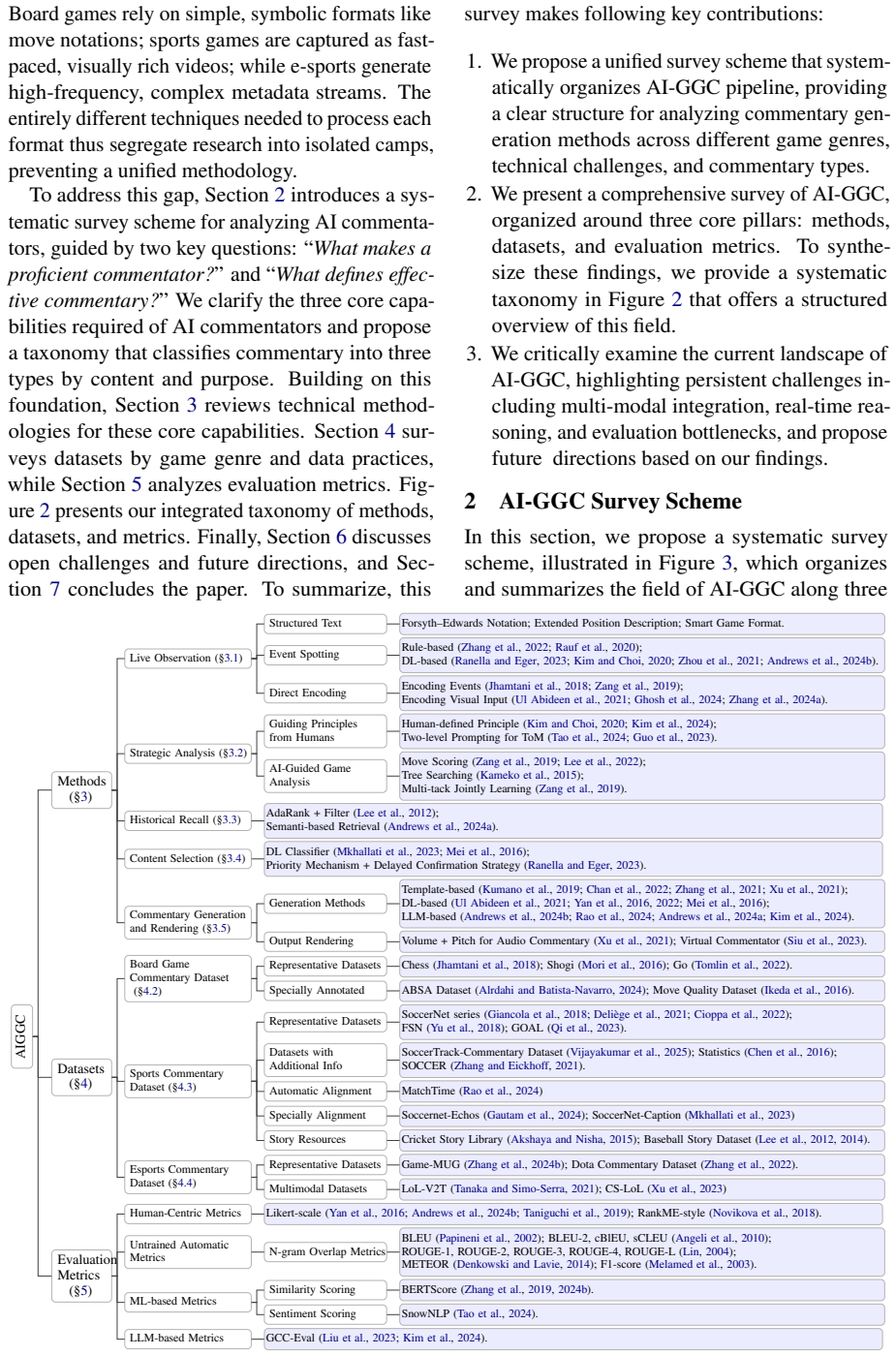
The organizing device is the three-capability / three-commentary-type taxonomy, summarized in Figures 2 and 3 of the survey. Live Observation is realized technically by event spotting and direct encoding of game states; Strategic Analysis by human-derived guiding principles and AI-engine move scoring; Historical Recall by retrieval over story libraries and player databases. The taxonomy does the work of a map: it assigns each surveyed method, dataset, and metric to a capability or commentary type, turning a list of isolated papers into a structured landscape.
What would settle it
A systematic search for published AI-GGC systems beyond the venues surveyed would falsify the taxonomy's completeness if a substantial share (say, more than ten percent) of systems cannot be assigned one of the three capabilities, one of the three commentary types, or one of the three genres without overlap. Concretely, a racing-game commentary system built purely on audio cues, or a system whose output mixes analytic and background content in a way the taxonomy cannot separate, would test the scheme's boundaries.
Extended reading notes
Core claim
The central claim is that the fragmented landscape of AI-generated game commentary can be unified by a taxonomy built from the question 'what makes a proficient commentator?' The answer has three parts: a commentator must perceive the live game state (Live Observation), reason about strategy and intent (Strategic Analysis), and draw on historical and contextual knowledge (Historical Recall). These capabilities map onto three commentary types—Descriptive Commentary ('what is happening'), Analytical Commentary ('why did that happen, what next'), and Background Commentary ('what is the significance')—and together they cover the methods, datasets, and metrics reviewed in the paper. The paper further claims that this structure reveals shared challenges across genres, such as real-time latency, incomplete multimodal input use, and weak evaluation metrics, and that future work should pursue tighter integration of the modules.
Load-bearing premise
The framework's completeness is the load-bearing premise: that the three capabilities, three commentary types, and three game genres chosen by the authors cover essentially all existing AI-GGC work without overlap or omission, a limitation the authors themselves concede with respect to less popular games.
Editorial extensions
If this is right
- Researchers gain a shared pipeline—observe, select, analyze, recall, generate—so a chess-commentary system and a soccer-commentary system can be described and compared in the same terms.
- The taxonomy turns dataset diversity into a structured comparison: board games align moves to commentary naturally, while sports and esports rely on event spotting, automatic alignment, or manual annotation, and each choice carries different information-loss trade-offs.
- It exposes the least-developed modules—historical recall and content selection—as concrete research targets rather than scattered observations.
- It argues that n-gram overlap metrics such as BLEU and ROUGE are poorly matched to open-ended commentary and points toward state-grounded, reference-free, and LLM-based evaluation.
- It recommends end-to-end multimodal large models that chain game understanding and commentary generation in a single architecture to reduce latency and integration overhead.
Reading between the lines
- A consequence the authors leave implicit is that the framework could serve as a specification for a shared benchmark: new datasets and systems could declare which capability they exercise and which commentary type they target, making cross-genre comparison feasible.
- The three-genre division may be a byproduct of dataset availability rather than a deep boundary; the same capabilities likely apply to racing games, fighting games, or amateur streams, an extension the survey's own limitation about less popular games gestures toward.
- If the mapping from capabilities to commentary types is correct, then systems that explicitly implement strategic analysis and historical recall should produce measurably more analytical and background commentary than systems trained end-to-end on observation-to-text pairs; the survey does not test this prediction.
Editorial analysis
A structured set of objections, weighed in public.
Referee Report
Summary. This survey paper proposes a unified framework for AI-generated game commentary (AI-GGC), organized around three commentator capabilities (Live Observation, Strategic Analysis, Historical Recall) and three corresponding commentary types (Descriptive, Analytical, Background). It reviews methods, datasets, and evaluation metrics across board games, sports, and esports, and closes with challenges and future directions. The paper's central claim is that it provides the first systematic, unified survey of this fragmented field.
Significance. If the framework is accepted, it gives the community a shared structure for comparing methods, datasets, and metrics, which is genuinely useful given the spread of work across chess, soccer, MOBA games, and other domains. The survey compiles a substantial body of recent literature and identifies plausible gaps such as the neglect of historical recall and the lack of standardized dataset schemas. The paper does not present new empirical results or machine-checked proofs; its contribution is organizational and taxonomical. The practical value of the taxonomy depends on the reliability of the underlying literature representation and on whether the categories are convincing as an organizing scheme, so issues in those areas directly affect the paper's contribution.
major comments (3)
- [Appendix A.3 and Section 4.4] The citation of Liang et al. (2009) is clearly wrong. The reference list identifies Liang, Jordan, and Klein (2009) as 'Learning semantic correspondences with less supervision', an ACL 2009 paper that does not describe a RoboCup commentary database or any game commentary system. Appendix A.3 states that 'Liang et al. (2009) employed a first attempt. They constructed a large candidate commentary database...' and Section 4.4 uses the same citation to place RoboCup in the esports dataset landscape. This misattribution is not a peripheral typo: it is part of the survey's historical narrative for a specific dataset family. The authors need to correct the citation (likely to Chen et al., 2001, or another appropriate source) or remove the claim.
- [Section 1 (Introduction) and Conclusions] The paper repeatedly calls itself a 'systematic survey' and 'comprehensive', but it does not describe the literature search protocol, the databases queried, the inclusion or exclusion criteria, or the cutoff date for the search. Without this information, a reader cannot independently verify that the coverage is systematic rather than a selection of papers the authors were already aware of. I recommend adding a short 'search methodology' paragraph to the introduction or an appendix; if no such protocol exists, the wording should be softened to 'structured survey' rather than 'systematic'.
- [Sections 2.2, 2.3, and Figure 2] The three-by-three taxonomy is the paper's main novel claim, but it is asserted rather than validated. The authors do not report any inter-annotator agreement, a quantitative check of category overlap, or a demonstration that every surveyed paper falls into exactly one cell of the framework. The Limitations section only concedes that less popular games may be overlooked; it does not consider whether the three capabilities or the three commentary types overlap or omit important work within the covered genres. Given that the taxonomy is used to classify the literature, this is a load-bearing gap. The authors should either provide evidence of taxonomic reliability (even a small annotation study) or explicitly present the categories as an interpretive framework rather than an empirically grounded classification.
minor comments (5)
- [Section 2.2 (2)] The second capability is named 'Strategic Thinking' in Section 2.2(2), but the abstract, Figure 2, Figure 3, and Section 3.2 all use 'Strategic Analysis'. Please unify the terminology throughout the paper.
- [Appendix A.3] The sentence 'Liang et al. (2009) employed a first attempt.' is ungrammatical and reads as an incomplete thought. It should be revised to a full sentence, for example 'Liang et al. (2009) made a first attempt by constructing a large candidate commentary database...'
- [Section 4.4] RoboCup is classified as an esports dataset, but RoboCup is a robotic soccer simulation rather than a competitive video game in the usual esports sense. The genre placement is not self-evident and should be justified, or the dataset should be placed in a separate category such as 'simulated sports'.
- [Figure 2] The abbreviations 'cBlEU' and 'sCLEU' appear with unusual capitalization; these are likely BLEU variants from the cited paper (Angeli et al., 2010), and the rendering should be checked and made consistent with the standard notation.
- [Ethics Statement] The Ethics Statement says 'All cited works are appropriately acknowledged', which is incompatible with the misattributed Liang et al. (2009) reference in Appendix A.3. After correcting the citation, the statement should be reviewed for accuracy.
Circularity Check
No circular derivation: the survey's taxonomy is an organizational proposal, not a claim deduced from its own categories.
full rationale
This paper is a survey and makes no equation-level derivation; its central artifact is the proposed three-capability/three-commentary-type taxonomy in Sections 2.1–2.3 and Figure 2. The taxonomy is stipulated as an organizing scheme ('we introduce a unified framework that systematically organizes the AI-GGC landscape'), not derived from the surveyed papers, so there is no fitted parameter renamed as a prediction and no principle defined in terms of the conclusion. The authors do not rely on their own prior work: none of the cited references are authored by Zheng, Wang, Cheng, Lu, Ali, Li, or Wenxin Li, so no self-citation chain bears the load. The reader's concern that the definitions in Section 2 are then used to classify the same literature is an ordinary property of any survey taxonomy; it limits falsifiability but is not circular because the paper does not claim to test or derive the taxonomy. One factual issue was noted during reading: Sections 4.4 and A.3 attribute a RoboCup commentary dataset to 'Liang et al. (2009)', but the cited ACL 2009 paper by Liang, Jordan, and Klein is about learning semantic correspondences and contains no RoboCup commentary system. That is a correctness and reproducibility problem for the survey's coverage claim, not a circularity problem, and it is therefore not scored here under the circularity rubric.
Assumptions & free parameters
assumptions (4)
- domain assumption Three core commentator capabilities (Live Observation, Strategic Analysis, Historical Recall) form a complete decomposition of AI-GGC.
- domain assumption Commentary types (Descriptive, Analytical, Background) map one-to-one onto the three capabilities.
- domain assumption Board games, esports, and sports are representative and separable genres covering the AI-GGC field.
- domain assumption Cited papers are accurately represented under the assigned taxonomy categories.
invented entities (2)
-
Live Observation / Strategic Analysis / Historical Recall capability triad
-
Descriptive / Analytical / Background commentary types
Cite this review
Pith. "Pith review of From Multimodal Perception to Strategic Reasoning: A Survey on AI-Generated Game Commentary." pith.science (2026). https://pith.science/paper/2DITCNZS
@misc{pith2026250617294,
  author       = {Pith},
  title        = {Pith review of: From Multimodal Perception to Strategic Reasoning: A Survey on AI-Generated Game Commentary},
  year         = {2026},
  howpublished = {\url{https://pith.science/paper/2DITCNZS}},
  note         = {Machine review of arXiv:2506.17294}
}
read the original abstract
The advent of artificial intelligence has propelled AI-Generated Game Commentary (AI-GGC) into a rapidly expanding research area, offering advantages such as scalable availability and personalized narration. However, existing studies remain fragmented, and a systematic survey that unifies prior efforts is still lacking. To bridge this gap, our survey introduces a unified framework that systematically organizes the AI-GGC landscape. We present a novel taxonomy focused on three core commentator capabilities: Live Observation, Strategic Analysis, and Historical Recall, and further categorize commentary into three corresponding types: Descriptive Commentary, Analytical Commentary, and Background Commentary. Building on this structure, we provide an in-depth review of methods, datasets, and evaluation metrics, analyzing their strengths and limitations. Finally, we highlight key challenges and point out promising directions for future research in AI-GGC.
Figures


Reference graph
Works this paper leans on
-
[6]
Improving Chess Commentaries by Combining Language Models with Symbolic Reasoning Engines
Improving chess commentaries by combining language models with symbolic reasoning engines. ArXiv, abs/2212.08195. Greg Lee, Vadim Bulitko, and Elliot Ludvig. 2012. Sports commentary recommendation system (scores): machine learning for automated narrative. InPro- ceedings of the Eighth AAAI Conference on Artificial Intelligence and Interactive Digital Ente...
work page Pith review arXiv 2012
-
[10]
Simple LLM prompting is state-of-the-art for robust and multilingual dialogue evaluation. InPro- ceedings of the Eleventh Dialog System Technology Challenge, pages 133–143, Prague, Czech Republic. Association for Computational Linguistics. Hassan Mkhallati, Anthony Cioppa, Silvio Giancola, Bernard Ghanem, and Marc Van Droogenbroeck
-
[11]
Soccernet-caption: Dense video captioning for soccer broadcasts commentaries.2023 IEEE/CVF Conference on Computer Vision and Pattern Recog- nition Workshops (CVPRW), pages 5074–5085. Shinsuke Mori, John Richardson, Atsushi Ushiku, Tet- suro Sasada, Hirotaka Kameko, and Yoshimasa Tsu- ruoka. 2016. A Japanese chess commentary corpus. InProceedings of the Te...
work page 2023
-
[13]
In2020 IEEE 23rd International Multitopic Confer- ence (INMIC), pages 1–6
Extraction of strong and weak regions of cricket batsman through text-commentary analysis. In2020 IEEE 23rd International Multitopic Confer- ence (INMIC), pages 1–6. Ehud Reiter and Anja Belz. 2009. An investigation into the validity of some metrics for automatically evalu- ating natural language generation systems.Computa- tional Linguistics, 35(4):529–5...
arXiv 2009
-
[14]
Chien-Yao Wang, Alexey Bochkovskiy, and Hong- Yuan Mark Liao
Player tracking-integrated soccer game com- mentary generation.IJSAT-International Journal on Science and Technology, 16(2). Chien-Yao Wang, Alexey Bochkovskiy, and Hong- Yuan Mark Liao. 2022. Yolov7: Trainable bag-of- freebies sets new state-of-the-art for real-time object detectors.2023 IEEE/CVF Conference on Computer Vision and Pattern Recognition (CVP...
work page 2022
-
[15]
MOBA-E2C: Generating MOBA game com- mentaries via capturing highlight events from the meta-data. InFindings of the Association for Com- putational Linguistics: EMNLP 2022, pages 4545– 4556, Abu Dhabi, United Arab Emirates. Association for Computational Linguistics. Ruochen Zhang and Carsten Eickhoff. 2021. SOCCER: An information-sparse discourse state tra...
arXiv 2018
-
[2003]
InCompanion Volume of the Proceedings of HLT- NAACL 2003 - Short Papers, pages 61–63
Precision and recall of machine translation. InCompanion Volume of the Proceedings of HLT- NAACL 2003 - Short Papers, pages 61–63. John Mendonça, Patrícia Pereira, Helena Moniz, Joao Paulo Carvalho, Alon Lavie, and Isabel Trancoso
work page 2003
-
[2014]
Training a multilingual sportscaster: Using perceptual context to learn language.J. Artif. Intell. Res., 37:397–435. David L. Chen and Raymond J. Mooney. 2008. Learn- ing to sportscast: a test of grounded language ac- quisition. InInternational Conference on Machine Learning. Mao Chen, Klaus Dorer, Ehsan Foroughi, Fredrik Heintz, ZhanXiang Huang, Spiros K...
work page 2008
Show all 15 references
-
[2016]
What to talk about and how? selective gen- eration using LSTMs with coarse-to-fine alignment. InProceedings of the 2016 Conference of the North American Chapter of the Association for Computa- tional Linguistics: Human Language Technologies, pages 720–730, San Diego, Californi...
2016
-
[2018]
RankME: Reliable human ratings for natural language generation. InProceedings of the 2018 Conference of the North American Chapter of the Association for Computational Linguistics: Human Language Technologies, Volume 2 (Short Papers), pages 72–78, New Orleans, Louisiana. Assoc...
2018
-
[2020]
ArXiv, abs/2006.14799
Evaluation of text generation: A survey. ArXiv, abs/2006.14799. Cheuk-Yiu Chan, Chun-Chuen Hui, Wan-Chi Siu, Sin- wai Chan, and H. Anthony Chan. 2022. To start automatic commentary of soccer game with mixed spatial and temporal attention. InTENCON 2022 - 2022 IEEE Region 10 Co...
2006 arXiv
-
[2022]
Adrien Deliège, Anthony Cioppa, Silvio Giancola, Meisam J
Scaling up soccernet with multi-view spatial localization and re-identification.Scientific Data, 9. Adrien Deliège, Anthony Cioppa, Silvio Giancola, Meisam J. Seikavandi, Jacob V . Dueholm, Kamal Nasrollahi, Bernard Ghanem, Thomas B. Moeslund, and Marc Van Droogenbroeck. 2021....
2021 arXiv
-
[2023]
InProceedings of the 16th International Natural Language Generation Conference: System Demonstrations, pages 9–10, Prague, Czechia
Audio commentary system for real-time racing game play. InProceedings of the 16th International Natural Language Generation Conference: System Demonstrations, pages 9–10, Prague, Czechia. Asso- ciation for Computational Linguistics. Tatsuya Ishigaki, Goran Topic, Yumi Hamazono...
2021 arXiv
-
[2024]
Silvio Giancola, Mohieddine Amine, Tarek Dghaily, and Bernard Ghanem
Automated cricket commentary generation using deep learning.INTERNATIONAL CONFER- ENCE ON INTELLIGENT AND SMART COMPUTA- TION (ICIASC-2023). Silvio Giancola, Mohieddine Amine, Tarek Dghaily, and Bernard Ghanem. 2018. Soccernet: A scal- able dataset for action spotting in socce...
2023 arXiv
-
[2025]
Percy Liang, Michael Jordan, and Dan Klein
Exploring the reliability of large language models as customized evaluators for diverse nlp tasks. Percy Liang, Michael Jordan, and Dan Klein. 2009. Learning semantic correspondences with less super- vision. InProceedings of the Joint Conference of the 47th Annual Meeting of t...
2009
Reviewed August 7, 2026 · model on record in the stance chip above.
Discussion (0). Sign in to comment.