REVIEW 3 major objections 5 minor 16 references
Distributionally robust minimization in meta-learning for system identification
T0 review · 3 major / 5 minor · reviewed 2026-08-06 · deepseek-v4-flash
Pith's one-line read This paper argues that training in-context system identification models on the worst-case tail of the task-loss distribution, rather than the average, lowers both worst-case and average prediction error.
desk verdict Solid empirical recipe for CVaR-trained in-context SYSID; the convergence theory is conditional on an unverified bound, but the main result stands. read the letter →
The pith
A machine-rendered reading of the paper's core claim, the machinery that carries it, and where it could break.
The reading
What carries the argument
The machinery is a quantile-estimation scheme around the conditional value-at-risk (CVaR) of the task-loss distribution. The loss of a task is the KL divergence between the true query-output density and the Gaussian density predicted by the Transformer meta-model, written as $-\log q$; for a fixed $\phi$, the map from datasets to losses defines a random variable whose tail, above the $\alpha$-value-at-risk, is what CVaR averages. Algorithm 1 approximates this tail expectation by drawing $b$ tasks, selecting the $\lfloor(1-\alpha)b\rfloor$ with the highest loss, and backpropagating only through those tasks. The accompanying convergence analysis adapts a lemma from the distributionally robust meta-learning literature and verifies its assumptions for a Lipschitz Transformer with bounded inputs and positive predicted variances.
What would settle it
Log the difference between the sampled and true value-at-risk at level $\alpha$ during Algorithm 1 on the Wiener-Hammerstein distribution; if it exceeds the bound of Assumption (III) at any iteration, or if the robust objective increases after an update, the convergence claim is contradicted.
Extended reading notes
Core claim
The central claim is that replacing the standard expected KL risk $J(\phi)$ with the robust objective $J_\alpha(\phi)$---the expectation of the KL risk over the worst $(1-\alpha)$ fraction of tasks, i.e. the conditional value-at-risk---produces an in-context meta-model for system identification with better worst-case and average predictions. Algorithm 1 implements this by sampling a batch of tasks, ranking them by their current KL risk, keeping the $\lfloor(1-\alpha)b\rfloor$ tasks with the highest risk, and updating the Transformer parameters only on those tasks. The paper states a convergence guarantee (Lemma 3.1 from the robust meta-learning literature, adapted in Proposition 3.2) that Algorithm 1 reaches a local optimum of $J_\alpha(\phi)$ under Lipschitz, boundedness, and value-at-risk estimation error assumptions. Empirically, the robust model improves in-distribution tail RMSE by about 25% and average RMSE by about 20%, and it remains better under out-of-distribution inputs (a random binary signal and a random-phase multisine) and on the Silverbox benchmark; training-time and dataset-budget comparisons show the robust model also avoids the meta-overfitting that standard training displays under RBS excitation. The authors further argue that the uncertainty-aware KL risk, rather than plain RMSE, is what makes the robust training effective.
Load-bearing premise
The proof that the robust update makes the tail objective no worse depends on an unproven bound on how close the sampled value-at-risk is to the true value-at-risk at every training iteration; if that bound is ever violated, the guarantee collapses.
Editorial extensions
If this is right
- In-distribution tail RMSE drops from 0.173 to 0.129 (about 25%) and average RMSE from 0.088 to 0.070 (about 20%) when training on the worst 40% of tasks instead of all tasks.
- Out-of-distribution gains persist: with RBS (random binary signal) input, tail RMSE drops from 0.604 to 0.547 and test RMSE from 0.232 to 0.223; with multisine, tail RMSE drops from 0.292 to 0.240 and test RMSE from 0.151 to 0.130.
- Under matched training time (29 hours) or matched dataset budget, robust training still wins on the hardest OOD scenario (RBS), where extended standard training exhibits meta-overfitting with an RMSE increase of nearly 50%.
- The choice of risk function matters: robust training with the KL risk outperforms the same procedure with RMSE risk on every scenario, indicating that predicted uncertainty is a useful training signal.
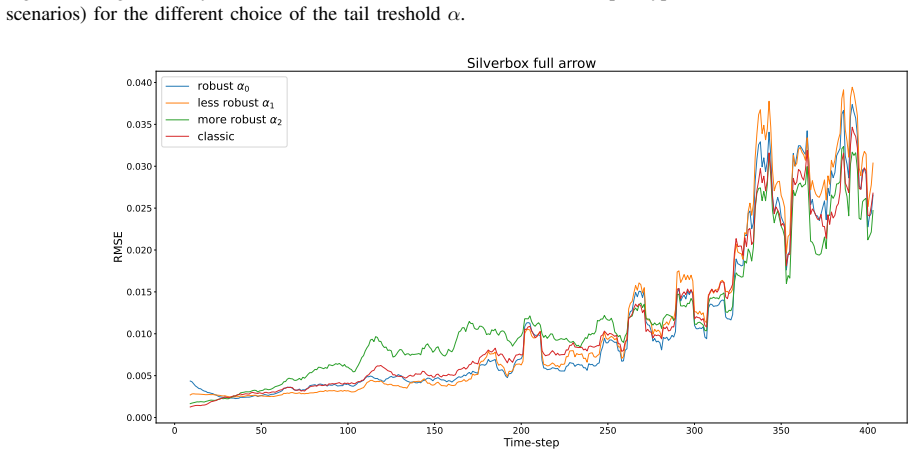
- The tail threshold $\alpha$ trades average performance for extrapolation ability; a tighter tail (smaller $\alpha$) improves predictions in the extrapolation region of the Silverbox full-arrow test at the expense of average and tail RMSE elsewhere.
Reading between the lines
- The same tail-selection recipe could be carried over to other in-context regression problems, such as time-series forecasting or control, by swapping the KL risk for a suitable predictive loss and re-checking the convergence assumptions for the new architecture.
- Because Assumption (III) is stated but not proved, a practitioner who wants the guarantee should monitor the sampled value-at-risk against a large held-out batch and adapt batch size or $\alpha$ if the error bound is violated.
- The meta-overfitting of standard training under RBS suggests robust tail training acts as an implicit regularizer against distribution shift; a direct test would vary training length and measure the divergence between the training task distribution and the RBS task losses.
Editorial analysis
A structured set of objections, weighed in public.
Referee Report
Summary. The paper studies meta-learning for in-context system identification with a Transformer meta-model, and replaces the standard expected KL-loss training with a distributionally robust objective: minimizing the conditional value-at-risk (CVaR) of the KL risk over the task distribution. The proposed Algorithm 1 samples a batch of tasks, keeps the fraction of tasks with the highest risk, and performs a gradient step on that tail subset. The authors adapt a convergence lemma from [7], specialize its assumptions to Transformer meta-models in Proposition 3.2, and evaluate the method on synthetic Wiener-Hammerstein systems, with in-distribution and out-of-distribution tests, a real Silverbox benchmark, equal-time and equal-budget comparisons, an RMSE-risk ablation, and a tuning study over the tail probability alpha. The central empirical claim is that robust training reduces tail and, in most settings, average RMSE relative to standard expected-loss training.
Significance. If the empirical claim holds, the paper offers a practical and useful recipe for improving worst-case task performance in meta-learning for system identification, with the welcome strengths of open-source code, validation on a real benchmark, and careful equal-time/equal-budget comparisons. The theoretical contribution is modest: Lemma 3.1 is adapted from [7], and Proposition 3.2 mainly restates assumptions in the language of Transformer layers. The consistent improvements across ID, OOD, and Silverbox scenarios are the main value of the paper, but the absence of error bars weakens the empirical support, and the convergence theorem is conditional on a per-iteration Monte Carlo VaR bound that is neither proved nor verified.
major comments (3)
- [Section III, Lemma 3.1 and Proposition 3.2] The convergence guarantee for Algorithm 1 rests on Assumption (III), the deterministic bound |Vtilde[L_phi] - VaR_alpha[L_phi]| <= eta/(beta_l (1-alpha)^2) at every iteration. The paper gives no proof and no empirical verification of this bound for the Transformer meta-model, and the text itself labels it 'the most restrictive.' Since the descent guarantee J_alpha(phi^(j+1)) <= J_alpha(phi^(j)) collapses if the bound fails, Proposition 3.2 does not currently establish convergence for the algorithm as actually run. The authors should either verify the bound empirically (for example, by monitoring the Monte Carlo VaR error on a validation batch during training) or explicitly restate the convergence result as conditional on Assumption (III).
- [Section III, proof of Proposition 3.2] The proof that Assumption (V) holds uses the claims that 'the true output tilde y is bounded' and that 'all inputs are bounded,' but neither is listed among assumptions (1)-(5) nor justified from the task-generation procedure in Section IV.A. With Gaussian white-noise inputs and Gaussian measurement noise, inputs and noisy outputs are not uniformly bounded over the task distribution; moreover, even with a Lipschitz Transformer, boundedness of mu_phi(X) and sigma_phi(X) over the support does not follow from Lipschitz continuity alone. The authors should either add the missing boundedness assumptions explicitly or revise the proof, since Assumption (V) is load-bearing for the lemma's conclusion.
- [Tables I-V and Section IV.B] The paper states that all experiments were repeated across different random initializations and dataset realizations, but the tables report only single point estimates, with no standard deviations, confidence intervals, or seed information. This matters because the central claim is a comparison of RMSE and tail RMSE values (for example, 0.173 versus 0.129 in Table I); without run-to-run variability, the reader cannot assess whether these differences are larger than the noise in the training procedure. The authors should report mean and variance over the repeated runs, at least for the main ID and OOD tables.
minor comments (5)
- [Section IV.C, text before Table I] The phrase 'Robust training improves tail performance, sthe direct training objective' contains a typo ('sthe') and should read 'the direct training objective.'
- [Table IV] The column labeled 'Epochs' reports values such as 1.75M and 0.7M, which appear to be numbers of training iterations rather than epochs; please relabel the column accordingly.
- [Table IV] There are typos in the table: 'mutlisine' should be 'multisine', and the SilverBox entry '0,01079' uses a comma instead of a decimal point.
- [Section IV.G and Figure 7] The text says 'an tuning study' and the caption says 'treshold'; both should be corrected to 'a tuning study' and 'threshold.'
- [Section IV.G] The tuning study compares alpha values 0.4, 0.6, and 0.2, but alpha_1 is implemented as 'worst 36 out of 60 tasks,' which corresponds to a tail fraction of 0.6, and alpha_2 as 'worst 32 out of 160 tasks,' corresponding to 0.2; the text should state this correspondence explicitly to avoid confusion.
Circularity Check
No circular reduction found: the robust tail objective is evaluated on held-out RMSE tails and external benchmarks, and the convergence theorem is conditional on explicit assumptions rather than on its own conclusion.
full rationale
Walking the derivation chain, I find no step in which a prediction is equivalent by construction to its inputs. The robust objective (9) minimizes a CVaR of KL risk over tasks sampled from p(D), while the reported improvements in Tables I-III are RMSE tails computed on held-out tasks (top 40% by RMSE). Since the training loss is KL-based with the predicted variance in the denominator and the test metric is plain RMSE, the empirical tail improvement is not forced by the optimized objective; the metric mismatch gives the result independent empirical content. The self-citations [4] and [11] supply the probabilistic in-context framework and the Transformer architecture, but they are used as the baseline and backbone, not as evidence that robust training improves tails; the robust method is also compared against classical NLSQ and the public Silverbox benchmark, so the central empirical claim is not reduced to a self-citation. The theoretical chain Lemma 3.1/Proposition 3.2 is attributed to independent work [7] and restated with explicit assumptions. The paper itself flags Assumption (III) as 'the most restrictive' and states it as a bound on the Monte Carlo VaR approximation error, and the proof of Proposition 3.2 silently uses boundedness of the true output even though that is not listed among the proposition's assumptions. These are genuine correctness gaps or omitted proofs, not circular steps: the theorem is conditional on stated premises and does not assume its own conclusion. I therefore exhibit no circular step; the score of 2 reflects only the presence of non-load-bearing self-citations, not a circular derivation.
Assumptions & free parameters
free parameters (3)
- tail probability alpha =
0.4
- two-stage switch point =
100,000 iterations
- robust batch sizes =
80 sampled, 32 kept
assumptions (5)
- domain assumption The dataset distribution p(D) is well-behaved: sup_D p(D) <= M and the measure of each loss level set {D | loss(D;phi)=L} is bounded for all L.
- ad hoc to paper The Monte Carlo VaR approximation error is bounded at every iteration by eta/(beta_l (1-alpha)^2) (Assumption III of Lemma 3.1).
- domain assumption The true query outputs ytilde are bounded.
- standard math The transformer meta-model is Lipschitz continuous with respect to its inputs, with bounded parameters norm(phi) <= C < infinity.
- domain assumption Predicted standard deviation sigma_phi(X) is nonzero and layer normalization inputs have nonzero standard deviation.
Cite this review
Pith. "Pith review of Distributionally robust minimization in meta-learning for system identification." pith.science (2026). https://pith.science/paper/AKGS4VM5
@misc{pith2026250618074,
  author       = {Pith},
  title        = {Pith review of: Distributionally robust minimization in meta-learning for system identification},
  year         = {2026},
  howpublished = {\url{https://pith.science/paper/AKGS4VM5}},
  note         = {Machine review of arXiv:2506.18074}
}
read the original abstract
Meta learning aims at learning how to solve tasks, and thus it allows to estimate models that can be quickly adapted to new scenarios. This work explores distributionally robust minimization in meta learning for system identification. Standard meta learning approaches optimize the expected loss, overlooking task variability. We use an alternative approach, adopting a distributionally robust optimization paradigm that prioritizes high-loss tasks, enhancing performance in worst-case scenarios. Evaluated on a meta model trained on a class of synthetic dynamical systems and tested in both in-distribution and out-of-distribution settings, the proposed approach allows to reduce failures in safety-critical applications.
Figures


Figures from the paper (4 more)


Reference graph
Works this paper leans on
-
[7]
A simple yet effective strategy to robustify the meta learning paradigm,
C. Wang, Y . Lv, Y . Feng, Z. Xie, and J. Huang, “A simple yet effective strategy to robustify the meta learning paradigm,” in Advances in Neural Information Processing Systems , vol. 36, 2023
work page 2023
-
[1]
J. Schmidhuber, “Evolutionary principles in self-referential learning, or on learning how to learn: the meta-meta-... hook,” Ph.D. dissertation, Technische Universität München, 1987
work page 1987
-
[2]
Meta- learning in neural networks: A survey,
T. Hospedales, A. Antoniou, P. Micaelli, and A. Storkey, “Meta- learning in neural networks: A survey,” IEEE transactions on pattern analysis and machine intelligence, vol. 44, no. 9, pp. 5149–5169, 2021
work page 2021
-
[3]
Meta-learning of neural state-space models using data from similar systems,
A. Chakrabarty, G. Wichern, and C. R. Laughman, “Meta-learning of neural state-space models using data from similar systems,” in World Congress of the International Federation of Automatic Control (IFAC), Jul. 2023
work page 2023
-
[4]
From system models to class models: An in-context learning paradigm,
M. Forgione, F. Pura, and D. Piga, “From system models to class models: An in-context learning paradigm,” IEEE Control Systems Letters, vol. 7, pp. 3513–3518, 2023
work page 2023
-
[5]
Adversarially robust few-shot learn- ing: A meta-learning approach,
G. Micah, F. Liam, and G. Tom, “Adversarially robust few-shot learn- ing: A meta-learning approach,” in Advances in Neural Information Processing Systems, vol. 33, 2020
work page 2020
-
[6]
Task-robust model- agnostic meta-learning,
L. Collins, A. Mokhtari, and S. Shakkottai, “Task-robust model- agnostic meta-learning,” in Advances in Neural Information Process- ing Systems, vol. 33, 2020
work page 2020
-
[8]
Optimization of conditional value- at-risk,
R. T. Rockafellar and S. Uryasev, “Optimization of conditional value- at-risk,” Journal of risk, 2, 21-42 , 2000
work page 2000
Show all 16 references
-
[9]
Active learning for regression by inverse distance weighting,
A. Bemporad, “Active learning for regression by inverse distance weighting,” Information Sciences, vol. 626, pp. 275–292, 2023
2023
-
[10]
Frameworks and results in distribution- ally robust optimization,
H. Rahimian and S. Mehrotra, “Frameworks and results in distribution- ally robust optimization,” Open Journal of Mathematical Optimization, vol. 3, 2022
2022
-
[11]
Enhanced transformer architecture for in-context learning of dynamical systems,
M. Rufolo, D. Piga, G. Maroni, and M. Forgione, “Enhanced transformer architecture for in-context learning of dynamical systems,” Accepted for the 2025 European Control Conference (ECC). [Online]. Available: https://arxiv.org/abs/2410.03291
2025 arXiv
-
[12]
GPT-4 technical report,
J. Achiam, S. Adler, S. Agarwal, L. Ahmad, I. Akkaya, F. L. Aleman, D. Almeida, J. Altenschmidt, S. Altman, S. Anadkat et al. , “GPT-4 technical report,” arXiv preprint arXiv:2303.08774 , 2023
2023 arXiv
-
[13]
LipsFormer: Introducing Lipschitz Continuity to Vision Transformers,
X. Qi, J. Wang, Y . Chen, Y . Shi, and L. Zhang, “LipsFormer: Introducing Lipschitz Continuity to Vision Transformers,” in The Eleventh International Conference on Learning Representations, 2023
2023
-
[14]
How smooth is attention?
V . Castin, P. Ablin, and G. Peyré, “How smooth is attention?” in Forty-first International Conference on Machine Learning , 2024
2024
-
[15]
Three free data sets for development and benchmarking in nonlinear system identification,
T. Wigren and J. Schoukens, “Three free data sets for development and benchmarking in nonlinear system identification,” in 2013 European Control Conference (ECC), 2013
2013
-
[16]
General- purpose in-context learning by meta-learning transformers,
L. Kirsch, J. Harrison, J. Sohl-Dickstein, and L. Metz, “General- purpose in-context learning by meta-learning transformers,” arXiv preprint arXiv:2212.04458, 2022
2022 arXiv
Reviewed August 6, 2026 · model on record in the stance chip above.
Discussion (0). Sign in to comment.