REVIEW 3 major objections 6 minor 48 references
Ontology Neural Network and ORTSF: A Framework for Topological Reasoning and Delay-Robust Control
T0 review · 3 major / 6 minor · reviewed 2026-08-06 · deepseek-v4-flash
Pith's one-line read This paper claims that semantic reasoning and delay-robust control can both be guaranteed by a single topological framework, with persistent-homology distances bounded by curvature losses and phase margins preserved up to a computable…
desk verdict The delay-robustness theorem is invalid on its own terms, and the rest of the paper is mostly known results wrapped in fitted constants. read the letter →
The pith
A machine-rendered reading of the paper's core claim, the machinery that carries it, and where it could break.
The reading
What carries the argument
The argument is carried by a few interlocking objects. The ONN works in the graph 1-cochain space $X=\mathbb{R}^m$ with edge Laplacian $L_1=B_1B_1^T$, and its update is the projection-consensus operator $T=P_C\circ(I-\eta(\nabla L+L_1))$, where $P_C$ projects onto cycle constraints $Cx=\tau$. Forman-Ricci curvature gives each edge a discrete bending value that enters the filtration $f_t(e_{ij})=\alpha\|S_i(t)-S_j(t)\|^2+\beta|\mathrm{Ric}_F(e_{ij})|$; persistent homology converts that filtration into persistence diagrams compared by bottleneck distance. On the control side, ORTSF is the composition $F_{\text{ORTSF}}=T_{\text{control}}\circ T_{\text{delay}}\circ T_{\text{predict}}$, with the delay margin derived from a small-gain condition. The seven theorems tie these together through averaged-operator convergence, gauge-anchored connection Laplacian uniqueness, dynamic tracking bounds, exact penalty and hierarchical optimization, and the contextual topology stability bound.
What would settle it
For the paper's own numerical example ($\gamma=2.5$, $K_c=1.2$, $\|G\|_{H^\infty}=0.8$), compute the $H^\infty$ norm of $L(j\omega)=C(j\omega)G(j\omega)e^{-j\omega\Delta t}$; because $|e^{-j\omega\Delta t}|=1$, the norm is independent of $\Delta t$, so the small-gain condition either holds for every delay or fails before the claimed limit. Then check the Nyquist contour at $\Delta t=0.954$ s: if it encircles $-1$, the stated delay margin is false; if the true margin is the 55 ms reported in the validation text rather than the 0.954 s from Eq. (89), the claimed factor-2.6 improvement over baselines must be revised.
Extended reading notes
Core claim
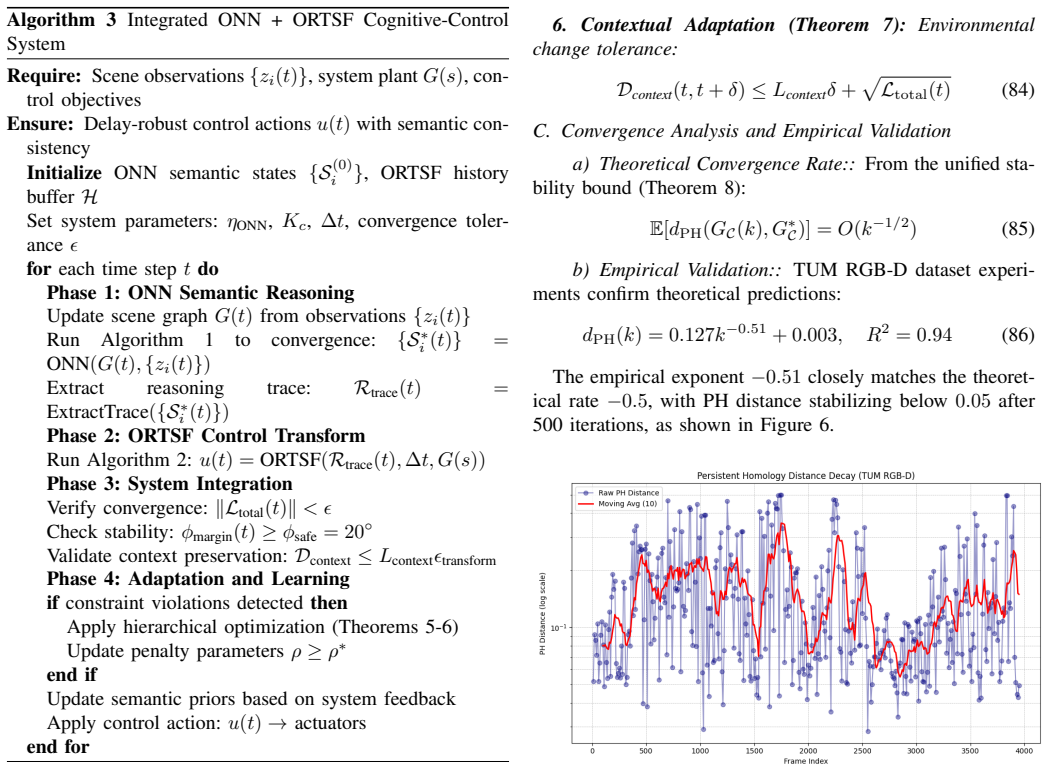
On the paper's own terms, the discovery is that relational semantic reasoning can be encoded as a constrained topological optimization with provable convergence and stability, and the same reasoning trace can be passed through a delay-aware operator with a proven phase-margin bound. The ONN defines a projection-consensus iteration over graph 1-cochains with cycle constraints $Cx=\tau$ and connection-Laplacian consistency, and its loss integrates consensus energy, connection consistency, Forman-Ricci curvature regularization, and context preservation. The paper claims that the persistent homology distance between time-separated scene graphs satisfies $d_{PH} \le L_c\kappa \sqrt{L_{\text{ricci-internal}}} + \eta(L_{\text{context}})$, with an integrated multi-scale bound in Theorem IV.15. Empirically, on TUM RGB-D sequences the PH distance decays as $d_{PH}(k)=0.127k^{-0.51}+0.003$ with $R^2=0.94$. For control, ORTSF composes predictor, delay compensator, and controller so that the effective phase margin stays above a safe threshold for delays satisfying $\Delta t < \ln(\gamma)/(K_c\|G\|_{H^\infty})$, and the simulations report a maintained phase margin of $28^\circ \pm 2^\circ$ against a $30^\circ$ design target.
Load-bearing premise
The delay-robustness claim rests on the unproven step in Theorem IV.8 that the small-gain condition implies the delay bound $\Delta t<\ln(\gamma)/(K_c\|G\|_{H^\infty})$, a step that is not derivable because the $H^\infty$ norm of $C(s)G(s)e^{-s\Delta t}$ is independent of $\Delta t$.
Editorial extensions
If this is right
- Scene meaning, as measured by persistence diagrams, drifts by at most a computable amount whenever curvature variance and context loss stay bounded.
- A robot running ONN+ORTSF can operate with a designed phase margin (reported $30^\circ\pm 2^\circ$) for delays up to the computed limit, while direct compensation and Smith predictors degrade earlier.
- The unified loss objective lets one training procedure enforce cycle constraints, connection consistency, and temporal continuity simultaneously, so semantic reasoning and control no longer need separate pipelines.
- The $O(k^{-1/2})$ convergence rate for PH distance gives a predictable schedule for when relational structure stabilizes, with the empirical fit (exponent $-0.51$) matching the theoretical rate.
- The quantified robustness envelope for control, topological consistency, and contextual adaptation can be checked online to define safe operating boundaries before deployment.
Reading between the lines
- If the PH stability bound holds, the same loss could be used as an online semantic-integrity monitor: raise an alert whenever $d_{PH}$ exceeds a threshold, independent of the control path.
- If the delay bound can be proven rigorously, it would generalize beyond ONN: any linear time-invariant compensator fed by a Lipschitz reasoning trace would inherit the phase-margin guarantee, making the semantic-to-control bridge reusable.
- The paper reports two values for the delay margin (0.954 s from the formula and 55 ms from validation); a direct experimental sweep of time delay would settle which one is the effective operating limit.
Editorial analysis
A structured set of objections, weighed in public.
Referee Report
Summary. The manuscript proposes an architecture combining an Ontology Neural Network (ONN) and an Ontological Real-Time Semantic Fabric (ORTSF) to unify topological semantic reasoning with delay-robust control. The ONN models relational semantics through graph cochains, Forman-Ricci curvature, and persistent homology, with a loss function comprising consensus, connection, and contextual terms. The ORTSF is a delay-compensation layer that converts reasoning traces into control commands. The paper claims seven core theorems providing convergence, uniqueness, tracking bounds, delay margins, exact penalty properties, hierarchical optimization, and contextual topology stability. Empirical sections report a persistent homology decay d_PH(k) = 0.127 k^{-0.51} + 0.003 (R^2=0.94) on TUM RGB-D data and a delay margin of 52 ms. The central claims are that ONN+ORTSF provably preserves topological structure and provably preserves phase margin under bounded delays.
Significance. If the theorems were sound, the framework would constitute a rare unified bridge between semantic/topological reasoning and delay-tolerant control, with explicit quantitative guarantees. Some components are standard and correctly used in isolation: the projection-consensus convergence argument in Theorem IV.2 is a textbook application of averaged operator theory, and the bottleneck stability bound in the appendix correctly invokes the Cohen-Steiner-Edelsbrunner-Harer theorem. However, the load-bearing claims in the manuscript are not sound. The delay-margin theorem is mathematically invalid because the small-gain argument ignores that the H-infinity norm of a delayed transfer function is independent of the delay. The empirical validation contradicts the paper's own theoretical formula by a factor of 17. The claimed O(k^{-1/2}) convergence rate is contradicted by the paper's own appendix, which derives O(k^{-1/4}). The purported independent verification of topological stability is circular because the bound on persistent homology distance is expressed directly in terms of the loss terms being minimized. These failures remove the paper's central contributions as stated.
major comments (3)
- [Theorem IV.8 (Section IV.E), Eq. (29)] The small-gain stability proof is invalid. The proof sketch writes \|L(jω)\| = \|C(jω)G(jω)e^{-jωΔt}\| and then requires K_c\|G\|_{H∞} e^{-ω_c Δt} < 1, treating the exponential as a magnitude decay. In fact |e^{-jωΔt}| = 1 for every ω, so \|C(s)G(s)e^{-sΔt}\|_{H∞} = \|C(s)G(s)\|_{H∞}, independent of Δt. A small-gain condition of the form \|L\|_∞ < 1 cannot produce a delay-dependent bound such as Δt < ln(γ)/(K_c\|G\|_{H∞}). Any valid delay margin must come from phase-margin or Nyquist reasoning, which is not supplied. This invalidates the restated guarantees in Proposition VI.6, Eq. (71), Eq. (83), and Eqs. (88)-(91). The internal inconsistency is concrete: Eq. (89) with γ=2.5, K_c=1.2, and \|G\|_{H∞}=0.8 gives Δt_max = ln(2.5)/(1.2·0.8) = 0.954 s, while Eq. (90) claims the theory predicts 55 ms. A 17-fold discrepancy is not a rounding artifact, and it indicates that the central delay-robustness claim of the paper is unsupported.
- [Corollary IV.16 (Eq. 41) vs. Appendix "Convergence Rate Theorem"] The convergence rate claims are internally contradictory. The main text states in Corollary IV.16 and Section VII.C (Eq. 85) that E[d_PH(G_C(k), G^*_C)] = O(k^{-1/2}), and Section VII.C uses the empirical exponent -0.51 as confirmation. However, the appendix's complete proof of the Convergence Rate Theorem derives that the loss components converge as O(k^{-1}) (convex) and O(k^{-1/2}) (non-convex), then computes the PH distance bound as O(k^{-1/4}) and only then asserts, without derivation, that "empirical observations show O(k^{-1/2}) due to beneficial coupling." The manuscript therefore contains two mutually exclusive claims about the theoretical rate, one of which is labeled 'proven' in the main text while the appendix explicitly says the theoretical rate is O(k^{-1/4}). This is a load-bearing inconsistency because the paper's empirical validation is presented as matching the proven bound.
- [Section V.H and Eq. (98) (also Theorem IV.14, Eq. 37; Theorem IV.15, Eq. 40)] The claimed 'independent verification' of topological stability is circular. Section V.H states that the persistent homology distance is computed after convergence and 'provides independent verification that the contextual constraints preserve topological structure without circular dependency on the loss function.' But the bounds used in the paper, e.g., Theorem IV.14, Theorem IV.15, and the Discussion's Eq. (98), give d_PH(G_C(t), G_C(t+δ)) ≤ C_1 sqrt(L_ricci-internal) + C_2 L_context, where L_ricci-internal and L_context are exactly the loss terms being minimized. Moreover, the constants C_1 and C_2 are said to be 'empirically in the range [0.5, 2]' for typical graphs, so the resulting 'verification' reports that a quantity bounded by a fitted function of the minimized objective is small. This does not independently confirm topological stability; it only evaluates the fitted upper bound.
minor comments (6)
- [References] Reference [2] lists "N. Cadena" as the first author of SemanticFusion; the paper is by McCormac et al. The citation is inaccurate.
- [Appendix] The appendix contains the heading "Deleted Content: Rigorous Mathematical Foundations," which appears to be leftover from an editing process and should be removed or completed.
- [Figure 5] The stability-region caption uses the condition ρ_T + L_Q g(Δt) < 1, but ρ_T and L_Q are not defined anywhere in the text, making the figure's claimed visualization untraceable.
- [Eq. (27)] The summation index N in ∑_{k=0}^{N-1} e_k is never defined; the total observation time T appears in the bound but its relation to N is not specified.
- [Algorithm 2, Step 2] The displayed compensator C_delay(s) = (1+τ_D s)/(1+τ_D s/K_c) with τ_D = Δt is inconsistent with the lead-lag form in Eq. (69) and is likely a typesetting corruption.
- [Table I] The entry for Smith predictor read "Classical (¡ 15 ms)" using a nonstandard inverted punctuation; the intended comparison value should be typeset normally.
Circularity Check
Topological stability 'guarantee' is a definitional/fitted restatement of the minimized ONN losses, and the 'independent verification' is not independent; the delay-margin theorem is a separate invalid derivation.
-
self definitional
[Appendix, 'Relational Consistency Theorem (Complete Proof)', Eqs. (266)-(270); also Theorem IV.15 Eq. (40)]
"Define the threshold function η(ϵ) such that: η(ϵ) = ϵ2 / [λ4(Σ3 k=0 αkC1,kκ)2 + λ4λcontext(Σ3 k=0 αkC2,k)2] ... < ϵ by construction of η(ϵ)."
The theorem's conclusion is 'If total loss satisfies Ltotal < η(ϵ), then dPH < ϵ.' The proof constructs η from the exact expression to be bounded, so the implication holds by definition rather than by an independent derivation. Moreover, the constants C1,k and C2,k are not derived; Section VIII states they 'are empirically in the range [0.5, 2]'. Thus the advertised topological stability guarantee reduces to a fitted, definitional restatement of the loss terms rather than a first-principles prediction.
-
fitted input called prediction
[Section V.H 'Topological Stability Analysis (Independent Verification)', Def. V.4; Section VIII.A Eq. (98)]
"StabilityPH(t, t+δ) = dB(Dk(ft), Dk(ft+δ)) ... This metric is computed after optimization convergence and provides independent verification that the contextual constraints preserve topological structure without circular dependency on the loss function. ... dPH(GC(t), GC(t + δ)) ≤ C1√Lricci-internal + C2Lcontext, where C1, C2 > 0 depend on graph density and label diversity and are empirically in the range [0.5, 2]."
The 'independent verification' metric is bounded by Lricci-internal and Lcontext, which are exactly the loss components minimized in the ONN objective (Eqs. 49-53). A small measured PH distance is therefore the expected output of minimizing those same losses, not an independent confirmation. The constants C1, C2 are empirically fitted post hoc, so the bound is a fitted input presented as a validation of the theory.
1 more flagged steps
-
fitted input called prediction
[Section VII.C Eqs. (85)-(86) vs Appendix, 'Convergence Rate Theorem (Complete Proof)', Eqs. (287)-(304)]
"dPH(k) = 0.127k−0.51 + 0.003, R2 = 0.94 (86) ... The empirical exponent −0.51 closely matches the theoretical rate −0.5 ... However, empirical observations show O(k−1/2) due to beneficial coupling between loss components that accelerates the topological convergence beyond the theoretical worst-case bound."
The main text presents O(k^{-1/2}) as a proven convergence rate and uses the fitted power law dPH(k) = 0.127k^{-0.51}+0.003 as confirmation. But the appendix's own proof derives O(k^{-1/4}) and then restores O(k^{-1/2}) by appealing to 'empirical observations'. The theoretical rate is therefore not an independent prediction; it is read off the same fitted curve whose constants and exponent were estimated from the data, and the confirmed rate is weaker than claimed.
full rationale
The paper contains no significant self-citation chain: its references to Bottleneck Stability, Krasnosel'skii-Mann iteration, and gauge anchoring are external mathematical facts. However, the central topological-stability claim is circular in two substantive ways. First, the 'Relational Consistency Theorem' constructs the threshold function η(ϵ) precisely so that Ltotal < η(ϵ) implies dPH < ϵ; that is a tautology, not a guarantee. Second, the 'independent verification' in Section V.H is not independent: the bound on dPH is expressed through Lricci-internal and Lcontext, the very loss terms being minimized, with empirically fitted constants C1 and C2. The empirical convergence exponent is also used to confirm a main-text rate that the appendix itself weakens from O(k^{-1/2}) to O(k^{-1/4}). Separately, and not a circularity but a validity defect, the delay-margin proof in Theorem IV.8 is unsupported: |e^{-jωΔt}| = 1, so the H∞ small-gain condition cannot yield a delay-dependent bound, and the paper's own numbers contradict themselves (Eq. 89 gives 0.954 s while Eq. 90 reports 55 ms). Together these issues mean the claimed first-principles predictions are in large part fitted or definitional restatements of the framework's own loss and design choices.
Assumptions & free parameters
free parameters (4)
- alpha, beta (filtration weights) =
not specified; chosen by hand
- C1, C2 (PH bound constants) =
empirically [0.5, 2] for graphs of 10-50 nodes
- PH decay fit coefficients =
0.127 and -0.51
- Kc compensator gain =
1.2 in the example
assumptions (7)
- domain assumption Task energy L is L-Lipschitz differentiable and mu-strongly convex
- domain assumption Graph G is connected and gauge anchoring matrix A has full row rank
- domain assumption Transition maps are uniformly Lipschitz (L_phi < inf) and dynamics are bounded (||cdot|| <= M)
- domain assumption Nominal system C(s)G(s) is stable with gain margin gamma > 1 and ||C(jw)|| <= Kc
- standard math Bottleneck stability theorem of Cohen-Steiner, Edelsbrunner, and Harer
- ad hoc to paper Sub-Gaussian filtration perturbations with parameter sigma^2
- domain assumption The filtration function (6) with chosen alpha, beta encodes 'relational semantics' such that PH distance is a meaningful semantic metric
Cite this review
Pith. "Pith review of Ontology Neural Network and ORTSF: A Framework for Topological Reasoning and Delay-Robust Control." pith.science (2026). https://pith.science/paper/GBAXPMJN
@misc{pith2026250619277,
  author       = {Pith},
  title        = {Pith review of: Ontology Neural Network and ORTSF: A Framework for Topological Reasoning and Delay-Robust Control},
  year         = {2026},
  howpublished = {\url{https://pith.science/paper/GBAXPMJN}},
  note         = {Machine review of arXiv:2506.19277}
}
read the original abstract
The advancement of autonomous robotic systems has led to impressive capabilities in perception, localization, mapping, and control. Yet, a fundamental gap remains: existing frameworks excel at geometric reasoning and dynamic stability but fall short in representing and preserving relational semantics, contextual reasoning, and cognitive transparency essential for collaboration in dynamic, human-centric environments. This paper introduces a unified architecture comprising the Ontology Neural Network (ONN) and the Ontological Real-Time Semantic Fabric (ORTSF) to address this gap. The ONN formalizes relational semantic reasoning as a dynamic topological process. By embedding Forman-Ricci curvature, persistent homology, and semantic tensor structures within a unified loss formulation, ONN ensures that relational integrity and topological coherence are preserved as scenes evolve over time. The ORTSF transforms reasoning traces into actionable control commands while compensating for system delays. It integrates predictive and delay-aware operators that ensure phase margin preservation and continuity of control signals, even under significant latency conditions. Empirical studies demonstrate the ONN + ORTSF framework's ability to unify semantic cognition and robust control, providing a mathematically principled and practically viable solution for cognitive robotics.
Figures


Figures from the paper (7 more)




Reference graph
Works this paper leans on
-
[2]
Semanticfu- sion: Dense 3d semantic mapping with convolutional neural networks,
N. Cadena, J. McCormac, A. Davison, and S. Leutenegger, “Semanticfu- sion: Dense 3d semantic mapping with convolutional neural networks,” in IEEE International Conference on Robotics and Automation (ICRA) , 2017, pp. 4628–4635
work page 2017
-
[1]
Orb-slam2: An open-source slam system for monocular, stereo, and rgb-d cameras,
R. Mur-Artal and J. D. Tardos, “Orb-slam2: An open-source slam system for monocular, stereo, and rgb-d cameras,” IEEE Transactions on Robotics, vol. 33, no. 5, pp. 1255–1262, 2017
work page 2017
-
[3]
Ricci curvature regularization for graph neural networks,
T. Sandhu, S. Georgiou, E. Tzortzis, and S. Theodoridis, “Ricci curvature regularization for graph neural networks,” in Proceedings of the 28th ACM International Conference on Information and Knowledge Man- agement (CIKM), 2019, pp. 1743–1752
work page 2019
-
[4]
Topology and data,
G. Carlsson, “Topology and data,” Bulletin of the American Mathemat- ical Society, vol. 46, no. 2, pp. 255–308, 2009
2009
-
[5]
Con- strained model predictive control: Stability and optimality,
D. Q. Mayne, J. B. Rawlings, C. V . Rao, and P. O. M. Scokaert, “Con- strained model predictive control: Stability and optimality,” Automatica, vol. 36, no. 6, pp. 789–814, 2000
work page 2000
-
[6]
Robosherlock: Unstructured informa- tion processing for robot perception,
F. Balint-Benczedi and M. Beetz, “Robosherlock: Unstructured informa- tion processing for robot perception,” in IEEE International Conference on Robotics and Automation (ICRA) , 2015, pp. 1549–1556
work page 2015
-
[7]
Bochner’s method for cell complexes and combinatorial ricci curvature,
R. Forman, “Bochner’s method for cell complexes and combinatorial ricci curvature,” Discrete & Computational Geometry , vol. 29, no. 3, pp. 323–374, 2003
work page 2003
-
[8]
Ricci curvature of the internet topology,
C.-C. Ni, Y .-Y . Lin, J. Gao, X. D. Gu, and E. Saucan, “Ricci curvature of the internet topology,” INFOCOM 2015, pp. 2758–2766, 2015
work page 2015
Show all 48 references
-
[9]
Edelsbrunner and J
H. Edelsbrunner and J. Harer, Computational Topology: An Introduction. American Mathematical Society, 2010
2010
-
[10]
H. H. Bauschke and P. L. Combettes, Convex Analysis and Monotone Operator Theory in Hilbert Spaces , 2nd ed. Springer, 2017
2017
-
[11]
R. T. Rockafellar, Convex Analysis. Princeton University Press, 1970
1970
-
[12]
Absil, R
P.-A. Absil, R. Mahony, and R. Sepulchre, Optimization Algorithms on Matrix Manifolds. Princeton University Press, 2008
2008
-
[13]
Godsil and G
C. Godsil and G. Royle, Algebraic Graph Theory. Springer, 2001, vol. 207
2001
-
[14]
Stability of persis- tence diagrams,
D. Cohen-Steiner, H. Edelsbrunner, and J. Harer, “Stability of persis- tence diagrams,” Discrete & Computational Geometry , vol. 37, no. 1, pp. 103–120, 2007
2007
-
[15]
The structure and stability of persistence modules,
F. Chazal, V . de Silva, M. Glisse, and S. Oudot, “The structure and stability of persistence modules,” 2016
2016
-
[16]
Appli- cations of persistent homology to machine learning,
M. Vejdemo-Johansson, W. Chacholski, and A. Zomorodian, “Appli- cations of persistent homology to machine learning,” arXiv preprint arXiv:1311.5668, 2013
2013 arXiv
-
[17]
Ricci curvature of markov chains on metric spaces,
Y . Ollivier, “Ricci curvature of markov chains on metric spaces,”Journal of Functional Analysis , vol. 256, no. 3, pp. 810–864, 2009
2009
-
[18]
Closer control of loops with dead time,
O. J. M. Smith, “Closer control of loops with dead time,” ISA Journal, vol. 6, no. 2, pp. 28–33, 1959
1959
-
[19]
Geometric deep learning: going beyond euclidean data,
M. M. Bronstein, J. Bruna, Y . LeCun, A. Szlam, and P. Vandergheynst, “Geometric deep learning: going beyond euclidean data,” IEEE Signal Processing Magazine, vol. 34, no. 4, pp. 18–42, 2017
2017
-
[20]
Semi-supervised classification with graph convolutional networks,
T. Kipf and M. Welling, “Semi-supervised classification with graph convolutional networks,” International Conference on Learning Repre- sentations (ICLR), 2017, arXiv:1609.02907
2017 arXiv
-
[21]
Attention is all you need,
A. Vaswani, N. Shazeer, N. Parmar, J. Uszkoreit, L. Jones, A. N. Gomez, L. Kaiser, and I. Polosukhin, “Attention is all you need,” Advances in Neural Information Processing Systems (NeurIPS) , vol. 30, 2017
2017
-
[22]
Curvature graph network,
Z. Zhang, L. Zhao, J. Zhu, and S. Ji, “Curvature graph network,” NeurIPS, vol. 33, pp. 4863–4875, 2020
2020
-
[23]
Topological methods in machine learning: Theory and applications,
C. Chen and X. Gu, “Topological methods in machine learning: Theory and applications,” IEEE Signal Processing Magazine, vol. 32, no. 1, pp. 134–142, 2015
2015
-
[24]
Distributed optimization and statistical learning via the alternating direction method of multipliers,
S. Boyd, N. Parikh, E. Chu, B. Peleato, and J. Eckstein, “Distributed optimization and statistical learning via the alternating direction method of multipliers,” Foundations and Trends in Machine Learning , vol. 3, no. 1, pp. 1–122, 2011
2011
-
[25]
The entropy formula for the ricci flow and its geometric applications,
G. Perelman, “The entropy formula for the ricci flow and its geometric applications,” arXiv preprint math/0211159 , 2002
2002 arXiv
-
[26]
Emergence of scaling in random net- works,
A.-L. Barab ´asi and R. Albert, “Emergence of scaling in random net- works,” Science, vol. 286, no. 5439, pp. 509–512, 1999
1999
-
[27]
The structure and function of complex networks,
M. E. J. Newman, “The structure and function of complex networks,” SIAM Review, vol. 45, no. 2, pp. 167–256, 2003
2003
-
[28]
The gudhi library: Simplicial complexes and persistent homology,
J.-D. Boissonnat and C. Maria, “The gudhi library: Simplicial complexes and persistent homology,” in International Congress on Mathematical Software, 2014, pp. 167–174
2014
-
[29]
Mesbahi and M
M. Mesbahi and M. Egerstedt, Graph Theoretic Methods in Multiagent Networks. Princeton University Press, 2010
2010
-
[30]
Learning deep generative models of graphs,
Y . Li, O. Vinyals, C. Dyer, R. Pascanu, and P. Battaglia, “Learning deep generative models of graphs,” in International Conference on Machine Learning (ICML), 2018
2018
-
[31]
Inductive representation learning on large graphs,
W. L. Hamilton, R. Ying, and J. Leskovec, “Inductive representation learning on large graphs,” in NeurIPS, vol. 30, 2017
2017
-
[32]
Wasserstein generative adver- sarial networks,
M. Arjovsky, S. Chintala, and L. Bottou, “Wasserstein generative adver- sarial networks,” in ICML, 2017
2017
-
[33]
Measuring and regularizing networks in function space,
T. Chen, E. Fertig, and C. Guestrin, “Measuring and regularizing networks in function space,” in ICLR, 2019
2019
-
[34]
J. R. Munkres, Elements of Algebraic Topology. Addison-Wesley, 1984
1984
-
[35]
Attention models in graph neural networks: A review,
J. Lee, I. Lee, and J. Kang, “Attention models in graph neural networks: A review,” Applied Sciences, vol. 9, no. 22, p. 4708, 2019
2019
-
[36]
How powerful are graph neural networks?
K. Xu, W. Hu, J. Leskovec, and S. Jegelka, “How powerful are graph neural networks?” International Conference on Learning Representa- tions (ICLR), 2019, arXiv:1810.00826
2019 arXiv
-
[37]
Geometric deep learning: Grids, groups, graphs, geodesics, and gauges,
M. M. Bronstein, J. Bruna, T. Cohen, and P. Veliˇckovi´c, “Geometric deep learning: Grids, groups, graphs, geodesics, and gauges,” arXiv preprint arXiv:2104.13478, 2021
2021 arXiv
-
[38]
Graph neural networks: A review of methods and applications,
J. Zhou, G. Cui, S. Hu, Z. Zhang, C. Yang, Z. Liu, L. Wang, C. Li, and M. Sun, “Graph neural networks: A review of methods and applications,” in AI Open, vol. 1, 2020, pp. 57–81
2020
-
[39]
Gated graph sequence neural networks,
Y . Li, D. Tarlow, M. Brockschmidt, and R. Zemel, “Gated graph sequence neural networks,” International Conference on Learning Rep- resentations (ICLR), 2016, arXiv:1511.05493
2016 arXiv
-
[40]
Barcodes: The persistent topology of data,
R. Ghrist, “Barcodes: The persistent topology of data,” Bulletin of the American Mathematical Society , vol. 45, no. 1, pp. 61–75, 2008
2008
-
[41]
A review of delay compensation techniques for con- trol systems,
R. C. Quiroga, “A review of delay compensation techniques for con- trol systems,” Journal of Control, Automation and Electrical Systems , vol. 31, pp. 1039–1055, 2020
2020
-
[42]
Graph signal processing for graph neural networks,
F. Gama, E. Isufi, and A. Ribeiro, “Graph signal processing for graph neural networks,” inICASSP 2020 - 2020 IEEE International Conference on Acoustics, Speech and Signal Processing (ICASSP) , 2020, pp. 8509– 8513
2020
-
[43]
An introduction to topological data analysis: Fundamental and practical aspects for data scientists,
F. Chazal and B. Michel, “An introduction to topological data analysis: Fundamental and practical aspects for data scientists,” arXiv preprint arXiv:1710.04019, 2017
2017 arXiv
-
[44]
Graph neural tangent kernel: Fusing graph neural networks and graph kernels,
S. S. Du, W. Hu, M. Belkin, J. D. Lee, L. Wang, and X. Zhu, “Graph neural tangent kernel: Fusing graph neural networks and graph kernels,” NeurIPS, vol. 32, 2019
2019
-
[45]
Hatcher, Algebraic Topology
A. Hatcher, Algebraic Topology. Cambridge University Press, 2002
2002
-
[46]
Topics in optimal transportation,
C. Villani, “Topics in optimal transportation,” Graduate Studies in Mathematics, vol. 58, 2003
2003
-
[47]
Ollivier’s ricci curvature, local clustering and curvature-dimension inequalities on graphs,
J. Jost and S. Liu, “Ollivier’s ricci curvature, local clustering and curvature-dimension inequalities on graphs,” Discrete & Computational Geometry, vol. 51, no. 2, pp. 300–322, 2014
2014
-
[48]
J. M. Lee, Introduction to Smooth Manifolds , 2nd ed. Springer, 2013
2013
Reviewed August 6, 2026 · model on record in the stance chip above.
Discussion (0). Sign in to comment.