REVIEW 4 major objections 4 minor 3 cited by
Skywork-SWE: Unveiling Data Scaling Laws for Software Engineering in LLMs
T0 review · 4 major / 4 minor · reviewed 2026-08-06 · deepseek-v4-flash
Pith's one-line read The paper claims that LLM agents' software-engineering skill follows a data scaling law, with pass@1 on SWE-bench Verified reaching 38.0% at 8,209 validated trajectories and still not saturating.
desk verdict A useful dataset-scale SWE model result and a plausible but under-supported scaling-law claim; the dataset deserves release and the curve needs a controlled rerun before 'no saturation' is credible. read the letter →
The pith
A machine-rendered reading of the paper's core claim, the machinery that carries it, and where it could break.
The reading
What carries the argument
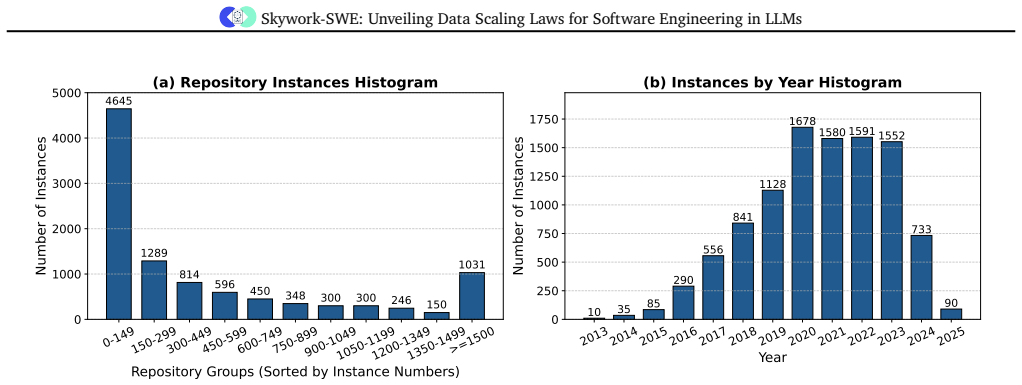
The load-bearing object is the Skywork-SWE dataset: 10,169 real-world Python issue-fix instances from 2,531 GitHub repositories, each with a natural-language task description, a gold patch, a test patch, and a container runtime image built for automated unit-test execution, plus 8,209 runtime-validated agent trajectories. The machinery that produces it is a three-stage pipeline: repository and pull-request pre-filtering, execution-based validation that keeps only instances with a non-empty FAIL_TO_PASS test set, and agent trajectory generation by proprietary LLMs with final-patch validation. What carries the scaling argument is the trajectory-count versus resolve-rate curve, a log-linear fit over nine training sizes that continues upward and gives the paper its empirical data-scaling-law claim.
What would settle it
Train the same 32B model on random subsets of the 8,209 trajectories that are matched for repository mix, issue difficulty, and unit-test counts, and plot resolve rate against subset size; if the curve flattens or loses monotonicity, the claimed scaling law is an artifact of chronological curation. A simpler observable is whether the last-added trajectories are systematically different in difficulty or repository coverage from the first ones.
Extended reading notes
Core claim
The central claim, stated in the paper's own terms, is that a log-linear data scaling law holds for software engineering: as the number of training trajectories $N_{\mathrm{traj}}$ increases from 125 to 8,209, the resolve rate on SWE-bench Verified rises monotonically from 6.4% to 38.0%, with no signs of saturation. The paper attributes the trend to the quality and diversity of the curated trajectories, each ending in a patch that passes all unit tests within a per-instance runtime image. It further claims that the same model, given Best-of-8 test-time scaling, reaches 47.0%, surpassing prior state-of-the-art results for sub-32-billion-parameter models. The supporting comparison shows the model outperforming three published 32B agents at the 2,000, 6,000, and 8,000 trajectory marks, which the paper reads as evidence that scaling validated data can match or exceed gains from more complex agent designs.
Load-bearing premise
The scaling curve assumes that the chronological batches of trajectories are comparable samples of one stable distribution of software tasks, even though the paper acknowledges that later subsets may differ in composition, so the steady gains could reflect dataset evolution rather than a general law that adding data alone improves performance.
Editorial extensions
If this is right
- At a fixed 32B model size, performance rises with each addition of validated trajectories; the paper reports the model overtaking SWE-Dev-32B at 2,000 trajectories, OpenHands-LM-32B-v0.1 at 6,000, and SWE-Agent-LM-32B at 8,000.
- The dataset doubles as an evaluation resource because every instance brings an executable runtime and validated tests, so organizations can generate and check new training trajectories without manual environment setup.
- Test-time scaling compounds the data gain: raising independent rollouts from 1 to 8 lifts resolve rate from 38.0% to 47.0%, and extending the maximum interaction rounds from 10 to 100 lifts it from 28.2% to 38.0%.
- The absence of saturation implies that enlarging the dataset further, rather than enlarging the model or redesigning the agent scaffold, is a viable route to better open-source software-engineering agents.
Reading between the lines
- My inference, not the paper's: the monotone curve may partly reflect the dataset's chronological construction; Table 4 notes that some trajectories came from earlier subsets, so later additions could be easier or closer to the evaluation distribution, and volume alone may not produce the same gains.
- A direct test would be to train on random difficulty- and repository-matched subsets of the 8,209 trajectories; if the log-linear curve persists, the scaling law is about data volume, and if it flattens, it is about curation order.
- The pipeline's yields, roughly 16% of instances install successfully and under 7% pass execution validation, suggest the practical cost of scaling is high; a cost-aware accounting of validated instances per unit of compute and storage would be the next useful quantity.
- The paper evaluates only Python on one benchmark, so an open question is whether the scaling law transfers to other languages or to closed-source repositories.
Editorial analysis
A structured set of objections, weighed in public.
Referee Report
Summary. This paper presents Skywork-SWE, an automated pipeline for building a 10,169-instance, 2,531-repository Python software-engineering dataset with runtime-validated unit tests, and uses 8,209 validated agent trajectories to fine-tune Qwen-2.5-Coder-32B-Instruct, reporting 38.0% pass@1 on SWE-bench Verified without verifiers or multiple rollouts and 47.0% with test-time scaling. The headline contribution is an empirical 'data scaling law' for SWE: a log-linear improvement on SWE-bench Verified with increasing trajectory count, with 'no signs of saturation' at 8,209 trajectories. The paper also releases the model checkpoint and discusses pragmatic data-curation lessons.
Significance. If the scaling-law claim held, it would be a valuable result: it would provide evidence that execution-grounded, test-validated trajectory data behaves like standard pretraining data for SWE agents, and it would justify large data-curation investments. The dataset itself is a useful community resource, the explicit exclusion of SWE-bench Verified repositories from collection is commendable, and the evaluation is external and execution-validated, so there is no training/evaluation circularity. However, the scaling-law claim is currently an uncontrolled observational fit rather than a demonstrated law, so the paper's significance is conditional on the additional controlled experiments described below.
major comments (4)
- [§4.2, Fig. 1 (top)] The central scaling claim rests on eight single-run data points with no seeds, no variance estimates, and no error bars. On the 500-instance SWE-bench Verified set, the binomial standard error at 38% pass@1 is about 2.2 percentage points, which is comparable to several adjacent increments in the curve (e.g., 18.4 to 20.8 or 25.2 to 28.8). Without repeated runs or confidence intervals, the 'clear log-linear trend' and the monotonic improvement are not statistically established.
- [§4.3, Table 4] The scaling curve confounds data quantity with dataset composition. The authors note that 'the dataset was constructed chronologically, some trajectories were collected from earlier subsets,' and Table 4 shows large variation in teacher-model resolve rates (from 3.63% for Gemini-2.0-Flash at temperature 1.0 to 20.23% for Gemini-2.5-Pro). Later prefixes therefore differ not only in N but also in repository mix, task difficulty, and teacher quality. Controlled random-subset retraining from the final 8,209-trajectory corpus at matched N, ideally with multiple seeds, is needed before the gains can be attributed to data quantity alone.
- [Abstract, §4.2, Fig. 1 caption] The claim of 'no signs of saturation' extrapolates beyond the observed data. The largest training size is 8,209 trajectories, the fit is an unconstrained log-linear curve, and no saturation model or confidence band is provided. The defensible claim is 'no saturation observed up to 8,209 trajectories'; the current wording overstates what the experiment can support.
- [§4.2, Table 3, Fig. 1] The comparative claims contain internal inconsistencies that need correction. SWE-Dev-32B is listed as 36.6 in Table 3 but plotted as 25.2 in Fig. 1, and the text says Skywork-SWE 'outperforms SWE-Dev-32B at N_traj=2000' when both plotted values at that point are 25.2. Similarly, the text states that Skywork-SWE 'exceeds SWE-smith-LM-32B by absolute 6.8% points,' yet Table 3 lists SWE-smith-LM-32B at 40.2, which is higher than the reported 38.0. These discrepancies must be resolved and a consistent evaluation protocol stated before the SOTA comparisons can be audited.
minor comments (4)
- [Table 4] The table header contains a typo ('up tp') and the Temperature column entries are inconsistent: reasoning models such as Doubao-1.5-Thinking-Pro and o3-mini are marked '–' but the footnote does not specify the temperature used for the other proprietary models that do support it.
- [References] Several reference entries are malformed, including the Hoffmann et al. 2022a entry, which contains a garbled author list ('Lei Chinchilla'), and the Haosheng Zou et al. entry, which begins with 'Shousheng Jia Haosheng Zou, Xiaowei Lv'. These should be cleaned up before publication.
- [Fig. 1] The top panel includes baselines such as OpenHands-LM-32B-v0.1 and SWE-Agent-LM-32B that are not defined in Table 3 or in the experimental setup; please add a pointer to their source and state their evaluation protocol so readers can compare them with the reported numbers.
- [Fig. 6] The word-cloud figure is hard to read in grayscale and the font sizes are not quantified; a simple bar chart of the top repositories would be more informative.
Circularity Check
No significant circularity: evaluation is external, dataset excludes the eval benchmark, and the scaling-law claim is an empirical fit, not a prediction forced by construction.
full rationale
The paper's central derivation chain is: build a new SWE dataset via an automated pipeline, validate trajectories by executing unit tests, fine-tune Qwen2.5-Coder-32B-Instruct, and evaluate on the external SWE-bench Verified benchmark. The evaluation is genuinely held out: the paper states it excludes repositories already in SWE-bench Verified to avoid leakage, and the benchmark is an independent, externally maintained test set. The 38.0% pass@1 result is therefore not circular with respect to the training data. The 'data scaling law' claim is an empirical observation over nine training-set sizes, presented as a fit line; it is not derived from the training data by construction, nor is any fitted parameter renamed as a prediction. The noted chronological composition of the dataset (Table 4: 'the dataset was constructed chronologically, some trajectories were collected from earlier subsets') is a validity or attribution concern about confounding data quantity with data evolution, not a circularity: it does not make the performance curve equal to its inputs by definition. No load-bearing self-citation is used to force the central claim; citations to Kaplan, Hoffmann, SWE-Gym, SWE-Dev, OpenHands, and the OpenHands critic are external references, and no uniqueness theorem from the authors is invoked. Thus the paper is self-contained against an external benchmark, and the appropriate finding is no significant circularity.
Assumptions & free parameters
free parameters (1)
- slope of log-linear scaling fit =
not reported
assumptions (3)
- domain assumption SWE-bench Verified is a valid external measure of software engineering capability
- domain assumption Passing unit tests (FAIL_TO_PASS and PASS_TO_PASS) is sufficient validation of a patch's correctness
- domain assumption Trajectories generated by proprietary LLMs are high-quality and representative of good SWE problem-solving
Cite this review
Pith. "Pith review of Skywork-SWE: Unveiling Data Scaling Laws for Software Engineering in LLMs." pith.science (2026). https://pith.science/paper/CHWUPHRD
@misc{pith2026250619290,
  author       = {Pith},
  title        = {Pith review of: Skywork-SWE: Unveiling Data Scaling Laws for Software Engineering in LLMs},
  year         = {2026},
  howpublished = {\url{https://pith.science/paper/CHWUPHRD}},
  note         = {Machine review of arXiv:2506.19290}
}
read the original abstract
Software engineering (SWE) has recently emerged as a crucial testbed for next-generation LLM agents, demanding inherent capabilities in two critical dimensions: sustained iterative problem-solving (e.g., >50 interaction rounds) and long-context dependency resolution (e.g., >32k tokens). However, the data curation process in SWE remains notoriously time-consuming, as it heavily relies on manual annotation for code file filtering and the setup of dedicated runtime environments to execute and validate unit tests. Consequently, most existing datasets are limited to only a few thousand GitHub-sourced instances. To this end, we propose an incremental, automated data-curation pipeline that systematically scales both the volume and diversity of SWE datasets. Our dataset comprises 10,169 real-world Python task instances from 2,531 distinct GitHub repositories, each accompanied by a task specified in natural language and a dedicated runtime-environment image for automated unit-test validation. We have carefully curated over 8,000 successfully runtime-validated training trajectories from our proposed SWE dataset. When fine-tuning the Skywork-SWE model on these trajectories, we uncover a striking data scaling phenomenon: the trained model's performance for software engineering capabilities in LLMs continues to improve as the data size increases, showing no signs of saturation. Notably, our Skywork-SWE model achieves 38.0% pass@1 accuracy on the SWE-bench Verified benchmark without using verifiers or multiple rollouts, establishing a new state-of-the-art (SOTA) among the Qwen2.5-Coder-32B-based LLMs built on the OpenHands agent framework. Furthermore, with the incorporation of test-time scaling techniques, the performance further improves to 47.0% accuracy, surpassing the previous SOTA results for sub-32B parameter models. We release the Skywork-SWE-32B model checkpoint to accelerate future research.
Figures


Figures from the paper (6 more)




Forward citations
Cited by 3 Pith papers
-
DCAS: Decoupling CLI Agent Scaffolding to Internalize Planning across Scaffolds
Fine-tuning a 30B coding agent on 576 planning-aware trajectories collected under Claude Code improves its SWE-bench score on unseen harnesses (OpenCode +3.4, mini-swe-agent +7.0 with self-plans).
-
Function-Aware Fill-in-the-Middle as Mid-Training for Coding Agent Foundation Models
Mid-training on function-aware fill-in-the-middle data improves SWE-Bench by 2.8-5.4 points and reduces post-training capability loss.
-
SERA: Soft-Verified Efficient Repository Agents
SERA trains competitive coding agents via supervised finetuning on synthetic trajectories verified only by patch-overlap recall, cutting data-generation cost by roughly two orders of magnitude.
Reference graph
Works this paper leans on
-
[1]
Claude 3.5 sonnet announcement.https://www.anthropic.com/news/claude-3-5-sonnet, 2024a
Anthropic. Claude 3.5 sonnet announcement.https://www.anthropic.com/news/claude-3-5-sonnet, 2024a. Accessed: 2025-06-04. Anthropic. Claude haiku 3.5.https://www.anthropic.com/claude/haiku, 2024b. Accessed: 2025-06-
work page 2025
-
[4]
Accessed: 2025-06-04. Shiyi Cao, Sumanth Hegde, Dacheng Li, Tyler Griggs, Shu Liu, Eric Tang, Jiayi Pan, Xingyao Wang, Akshay Malik, Graham Neubig, Kourosh Hakhamaneshi, Richard Liaw, Philipp Moritz, Matei Zaharia, Joseph E. Gonzalez, and Ion Stoica. Skyrl-v0: Train real-world long-horizon agents via reinforcement learning,
work page 2025
-
[5]
Chi In Chang, Wan Chong Choi, and Iek Chong Choi. A systematic literature review of the opportunities and advantages for aigc (openai chatgpt, copilot, codex) in programming course. InProceedings of the 2024 7th International Conference on Big Data and Education, pages 29–35,
work page 2024
-
[6]
Evaluating large language models trained on code.arXiv preprint arXiv:2107.03374,
Mark Chen, Jerry Tworek, Heewoo Jun, Qiming Yuan, Henrique Ponde De Oliveira Pinto, Jared Kaplan, Harri Edwards, Yuri Burda, Nicholas Joseph, Greg Brockman, et al. Evaluating large language models trained on code.arXiv preprint arXiv:2107.03374,
- [7]
-
[8]
URLhttps://arxiv.org/abs/2412.19437. Google DeepMind. Gemini 2.0 flash.https://deepmind.google/technologies/gemini,
-
[9]
Accessed: 2025-06-04. Google DeepMind. Gemini 2.5 pro.https://deepmind.google/models/gemini/pro/,
work page 2025
-
[10]
Accessed: 2025-06-04. 20 Skywork-SWE: Unveiling Data Scaling Laws for Software Engineering in LLMs Daya Guo, Dejian Yang, Haowei Zhang, Junxiao Song, Ruoyu Zhang, Runxin Xu, Qihao Zhu, Shirong Ma, Peiyi Wang, Xiao Bi, et al. Deepseek-r1: Incentivizing reasoning capability in llms via reinforcement learning.arXiv preprint arXiv:2501.12948,
arXiv 2025
Show all 34 references
-
[11]
Jordan Hoffmann, Sebastian Biette, Jacopo de Aiken, James Lei, Zi Lin Chen, Jeff Clune, Li Zhang, Jose Suarez, FrankM.Hutter, GregBrockman, JackW.Rae, LeiChinchilla, etal
URLhttps: //github.com/Qihoo360/360-LLaMA-Factory. Jordan Hoffmann, Sebastian Biette, Jacopo de Aiken, James Lei, Zi Lin Chen, Jeff Clune, Li Zhang, Jose Suarez, FrankM.Hutter, GregBrockman, JackW.Rae, LeiChinchilla, etal. Trainingcompute-optimallarge language models.arXiv pre...
-
[12]
Openai o1 system card.arXiv preprint arXiv:2412.16720,
Aaron Jaech, Adam Kalai, Adam Lerer, Adam Richardson, Ahmed El-Kishky, Aiden Low, Alec Helyar, Alek- sander Madry, Alex Beutel, Alex Carney, et al. Openai o1 system card.arXiv preprint arXiv:2412.16720,
-
[13]
Livecodebench: Holistic and contamination free evaluation of large language models for code.arXiv preprint arXiv:2403.07974,
Naman Jain, King Han, Alex Gu, Wen-Ding Li, Fanjia Yan, Tianjun Zhang, Sida Wang, Armando Solar-Lezama, Koushik Sen, and Ion Stoica. Livecodebench: Holistic and contamination free evaluation of large language models for code.arXiv preprint arXiv:2403.07974,
-
[14]
A survey on large language models for code generation.arXiv preprint arXiv:2406.00515,
Juyong Jiang, Fan Wang, Jiasi Shen, Sungju Kim, and Sunghun Kim. A survey on large language models for code generation.arXiv preprint arXiv:2406.00515,
-
[15]
Jared Kaplan, Sam McCandlish, Tom Henighan, Tom B Brown, Benjamin Chess, Rewon Child, Scott Gray, Alec Radford, Jeffrey Wu, and Dario Amodei
URLhttps://openreview.net/forum?id=VTF8yNQM66. Jared Kaplan, Sam McCandlish, Tom Henighan, Tom B Brown, Benjamin Chess, Rewon Child, Scott Gray, Alec Radford, Jeffrey Wu, and Dario Amodei. Scaling laws for neural language models.arXiv preprint arXiv:2001.08361, 2020a. Jared Ka...
2001 arXiv
-
[17]
Sequence parallelism: Long sequence training from system perspective.arXiv preprint arXiv:2105.13120,
Shenggui Li, Fuzhao Xue, Chaitanya Baranwal, Yongbin Li, and Yang You. Sequence parallelism: Long sequence training from system perspective.arXiv preprint arXiv:2105.13120,
-
[19]
Thinking longer, not larger: Enhancing software engineering agents via scaling test-time compute.arXiv preprint arXiv:2503.23803,
Yingwei Ma, Yongbin Li, Yihong Dong, Xue Jiang, Rongyu Cao, Jue Chen, Fei Huang, and Binhua Li. Thinking longer, not larger: Enhancing software engineering agents via scaling test-time compute.arXiv preprint arXiv:2503.23803,
-
[20]
Accessed: 2025-06-03. OpenAI. Introducing gpt-4.1 in the api.https://openai.com/index/gpt-4-1/,
2025
-
[21]
Accessed: 2025- 06-04. OpenAI. Hello gpt-4o, 2024a. URLhttps://openai.com/index/hello-gpt-4o/. Accessed: 2025-05-30. OpenAI. Introducing openai o1, 2024b. URLhttps://openai.com/o1/. Accessed: 2025-05-30. OpenAI. Introducing openai o1 preview, 2024c. URL https://openai.com/inde...
2025
-
[22]
Accessed: 2025-06-04. OpenAI. Openai o3 and o4-mini system card. https://cdn.openai.com/pdf/ 2221c875-02dc-4789-800b-e7758f3722c1/o3-and-o4-mini-system-card.pdf , April
2025
-
[23]
Arvid Orwall
Accessed: 2025-05-13. Arvid Orwall. Moatless tools: Practical large-codebase editing with language models.https://github. com/aorwall/moatless-tools,
2025
-
[24]
Training software engineering agents and verifiers with swe-gym.arXiv preprint arXiv:2412.21139,
Jiayi Pan, Xingyao Wang, Graham Neubig, Navdeep Jaitly, Heng Ji, Alane Suhr, and Yizhe Zhang. Training software engineering agents and verifiers with swe-gym.arXiv preprint arXiv:2412.21139,
-
[25]
URLhttps://pypi.org/. Qwen. Qwen2.5-coder series: Powerful, diverse, practical. https://qwenlm.github.io/blog/qwen2. 5-max/, 2024a. Accessed: 2025-06-04. Qwen. Qwen2.5-max: Maximizing reasoning and tool use abilities.https://qwenlm.github.io/blog/ qwen2.5-max/, 2024b. Accessed...
2025 arXiv
-
[26]
Hybridflow: A flexible and efficient rlhf framework.arXiv preprint arXiv: 2409.19256,
22 Skywork-SWE: Unveiling Data Scaling Laws for Software Engineering in LLMs Guangming Sheng, Chi Zhang, Zilingfeng Ye, Xibin Wu, Wang Zhang, Ru Zhang, Yanghua Peng, Haibin Lin, and Chuan Wu. Hybridflow: A flexible and efficient rlhf framework.arXiv preprint arXiv: 2409.19256,
-
[27]
Gemini: a family of highly capable multimodal models.arXiv preprint arXiv:2312.11805,
Gemini Team, Rohan Anil, Sebastian Borgeaud, Jean-Baptiste Alayrac, Jiahui Yu, Radu Soricut, Johan Schalkwyk, Andrew M Dai, Anja Hauth, Katie Millican, et al. Gemini: a family of highly capable multimodal models.arXiv preprint arXiv:2312.11805,
-
[28]
Kimi Team, Angang Du, Bofei Gao, Bowei Xing, Changjiu Jiang, Cheng Chen, Cheng Li, Chenjun Xiao, Chenzhuang Du, Chonghua Liao, et al. Kimi k1. 5: Scaling reinforcement learning with llms.arXiv preprint arXiv:2501.12599,
-
[29]
Xingyao Wang
Accessed: 2025-05-13. Xingyao Wang. Sota on swe-bench verified with inference-time scal- ing and critic model,
2025
-
[30]
github.io/posts/2023-06-23-agent/
URLhttps://lilianweng. github.io/posts/2023-06-23-agent/. Chunqiu Steven Xia, Yinlin Deng, Soren Dunn, and Lingming Zhang. Agentless: Demystifying llm-based software engineering agents.arXiv preprint arXiv:2407.01489,
2023 arXiv
-
[31]
Swe-fixer: Training open-source llms for effective and efficient github issue resolution.arXiv preprint arXiv:2501.05040,
Chengxing Xie, Bowen Li, Chang Gao, He Du, Wai Lam, Difan Zou, and Kai Chen. Swe-fixer: Training open-source llms for effective and efficient github issue resolution.arXiv preprint arXiv:2501.05040,
-
[32]
Swe-smith: Scaling data for software engineering agents
John Yang, Kilian Leret, Carlos E Jimenez, Alexander Wettig, Kabir Khandpur, Yanzhe Zhang, Binyuan Hui, Ofir Press, Ludwig Schmidt, and Diyi Yang. Swe-smith: Scaling data for software engineering agents. arXiv preprint arXiv:2504.21798,
-
[33]
Yuntong Zhang, Haifeng Ruan, Zhiyu Fan, and Abhik Roychoudhury
URL https://arxiv.org/abs/2504.02605. Yuntong Zhang, Haifeng Ruan, Zhiyu Fan, and Abhik Roychoudhury. Autocoderover: Autonomous program improvement. InProceedings of the 33rd ACM SIGSOFT International Symposium on Software Testing and Analysis, ISSTA 2024, page 1592–1604, New ...
2024 arXiv
-
[34]
ISBN 9798400706127
Association for Computing Machinery. ISBN 9798400706127. doi: 10.1145/3650212.3680384. URLhttps://doi.org/10.1145/3650212. 3680384. Terry Yue Zhuo, Minh Chien Vu, Jenny Chim, Han Hu, Wenhao Yu, Ratnadira Widyasari, Imam Nur Bani Yusuf, Haolan Zhan, Junda He, Indraneil Paul, et...
-
[2021]
Wizardcoder: Empowering code large language models with evol-instruct.arXiv preprint arXiv:2306.08568,
21 Skywork-SWE: Unveiling Data Scaling Laws for Software Engineering in LLMs Ziyang Luo, Can Xu, Pu Zhao, Qingfeng Sun, Xiubo Geng, Wenxiang Hu, Chongyang Tao, Jing Ma, Qingwei Lin, and Daxin Jiang. Wizardcoder: Empowering code large language models with evol-instruct.arXiv pr...
-
[2023]
Raymond Li, Loubna Ben Allal, Yangtian Zi, Niklas Muennighoff, Denis Kocetkov, Chenghao Mou, Marc Marone, Christopher Akiki, Jia Li, Jenny Chim, et al
Accessed: 2025-01-14. Raymond Li, Loubna Ben Allal, Yangtian Zi, Niklas Muennighoff, Denis Kocetkov, Chenghao Mou, Marc Marone, Christopher Akiki, Jia Li, Jenny Chim, et al. Starcoder: may the source be with you!arXiv preprint arXiv:2305.06161,
2025 arXiv
-
[2024]
Large language monkeys: Scaling inference compute with repeated sampling.arXiv preprint arXiv:2407.21787,
Bradley Brown, Jordan Juravsky, Ryan Ehrlich, Ronald Clark, Quoc V Le, Christopher Ré, and Azalia Mirhoseini. Large language monkeys: Scaling inference compute with repeated sampling.arXiv preprint arXiv:2407.21787,
-
[2025]
Jacob Austin, Augustus Odena, Maxwell Nye, Maarten Bosma, Henryk Michalewski, David Dohan, Ellen Jiang, Carrie Cai, Michael Terry, Quoc Le, et al
Accessed: 2025-06-04. Jacob Austin, Augustus Odena, Maxwell Nye, Maarten Bosma, Henryk Michalewski, David Dohan, Ellen Jiang, Carrie Cai, Michael Terry, Quoc Le, et al. Program synthesis with large language models.arXiv preprint arXiv:2108.07732,
2025 arXiv
Reviewed August 6, 2026 · model on record in the stance chip above.
Discussion (0). Sign in to comment.