REVIEW 4 major objections 6 minor 31 references
Tailored Conversations beyond LLMs: A RL-Based Dialogue Manager
T0 review · 4 major / 6 minor · reviewed 2026-08-15 · deepseek-v4-flash
Pith's one-line read A phase-aware RL manager steering an LLM beats the plain-LLM baseline on motivational-interviewing reward.
desk verdict A well-engineered HRL+LLM dialogue manager for motivational interviewing with a genuinely novel meta-learned master policy, but the evaluation is a single-run reward comparison against an unoptimized baseline on the authors' own simulator, so the clinical 'potential benefit' claim outruns the evidence. read the letter →
The pith
A machine-rendered reading of the paper's core claim, the machinery that carries it, and where it could break.
The reading
What carries the argument
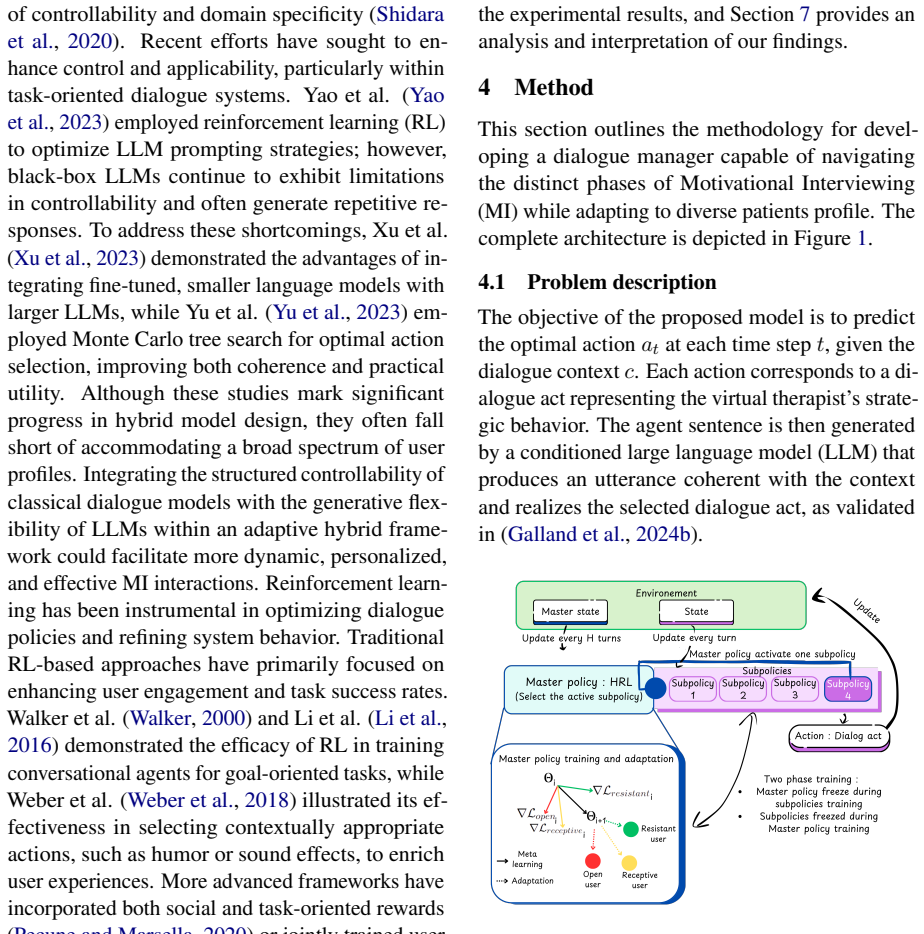
The load-bearing mechanism is the two-level hierarchical policy. A master policy θ re-reads the dialogue every H=3 turns and picks which of N=6 phase sub-policies ψ0,…,ψN runs for the next interval; the chosen sub-policy then selects one of 13 dialogue acts at each turn. The master state is built from counts of user dialogue acts that approximate context knowledge, engagement, and evocation, while the sub-policy state adds the latest user and agent acts, the timestamp, and an encoding of the last three utterances. The master policy is meta-trained with MAML so that a few interactions with a new user profile suffice to personalize it; the sub-policies are trained with Soft Actor-Critic. The reward function is the other load-bearing piece: it assigns +5 to change talk, −5 to sustain talk, and escalating bonuses (+50 to +200) for phase-appropriate acts once emotion, information, and motivation milestones are reached.
What would settle it
Run the full model and the same Nemo Instruct baseline in sessions with human participants (or with recorded real patient behavior) and compare client change-talk, post-session readiness to change, and ratings by MI-competent coders; if the trained manager does not beat the prompted baseline on these measures, the simulator-reward advantage does not establish the paper's claim.
Extended reading notes
Core claim
On the paper's own terms, the discovery claim is that conditioning an LLM with a structured RL dialogue manager yields better motivational-interviewing dialogues than asking the same kind of LLM to conduct the interview freely. The manager divides the dialogue into MI phases through a master policy that selects a phase-specific sub-policy every three turns; each sub-policy emits one of thirteen dialogue acts, and a prompted LLM generates the utterance realizing that act. The reward is built from patient responses that clinical meta-analyses link to outcomes: change talk is rewarded, sustain talk penalized, and phase-appropriate acts earn increasing bonuses as engagement and evocation milestones are met. The paper further shows that removing the hierarchical structure collapses the policy toward a single 'give solution' act, and removing meta-learning collapses the master policy toward one dominant phase, while the full model keeps phase diversity and shows sensible phase timing across patient profiles.
Load-bearing premise
The result is measured against a simulated patient—a prompted LLM—so the load-bearing premise is that optimizing reward against this simulator, with this reward function, transfers to real patients and to genuinely better motivational interviewing; the authors acknowledge in Section 9 that generalizability to humans is not yet established.
Editorial extensions
If this is right
- An LLM can be steered toward a clinical structure without retraining it, by pairing it with a small RL manager that picks dialogue acts.
- Phase structure matters for MI fidelity: without hierarchical control the trained policy degenerates to a single action, 'give solution', which the paper identifies as MI-incompliant.
- Meta-learning adds adaptability across user types; without MAML the master policy collapses to one dominant phase rather than differentiating patient profiles.
- The learned policy produces plausible phase timing—engagement early, focusing and planning later, and a shorter engagement for open-to-change patients—consistent with MI practice.
- The superiority over the baseline suggests that reward-conditioning an LLM can improve the proportion of desirable dialogue acts in open-ended goal-directed dialogue.
Reading between the lines
- If the simulated-patient result survives human evaluation, the same master/sub-policy split is a template for other staged behavior-change protocols, such as cognitive-behavioral therapy sessions or health-coaching consultations, by changing the phase definitions and rewards; the paper itself does not make this extension.
- Part of the gap over the baseline may be an artifact of reward shaping: the baseline is asked to follow MI strategies but is never rewarded for phase milestones, so the comparison measures objective alignment as much as dialogue quality; an independent MI-competence rating would separate these.
- A concrete robustness check is reward gaming: a simulator could reward 'give solution' with change talk even when the act is clinically premature, so logging action frequencies and having MI annotators judge the same dialogues would test whether the higher reward means better therapy.
Signed reviews
Editorial analysis
A structured set of objections, weighed in public.
Referee Report
Summary. The paper proposes a hierarchical reinforcement learning (HRL) dialogue manager for Motivational Interviewing (MI). A master policy selects a dialogue phase every H turns, sub-policies choose among 13 dialogue acts, and a Mistral-Nemo LLM generates the surface utterance conditioned on the selected act. The master policy is trained with SAC and meta-learned with MAML to adapt to three simulated patient profiles. Evaluation is conducted entirely through an author-built simulated patient, and the paper reports that the full model achieves mean reward 394 ± 132 versus 235 ± 106 for a prompted Nemo Instruct baseline, with the difference marked as p<.1. Ablations without MAML and without HRL are also reported, together with qualitative analyses of phase distributions and profile-dependent behavior.
Significance. If the result were supported by evidence that the reward proxy reflects MI effectiveness, the paper would make a useful contribution: combining hierarchical structure, meta-learning, and LLM generation is a plausible route to controllable yet flexible goal-directed dialogue, and the algorithmic exposition is reasonably clear. The paper also ships an ablation design that isolates the contributions of MAML and HRL, and the phase-distribution analysis is a thoughtful way to inspect learned policy structure. However, the central quantitative claim rests on a hand-designed reward function that is not validated against any external measure of MI quality or clinical outcome, and the evaluation uses a single training run, a small number of final evaluation dialogues, high variance, and a weak significance threshold. The strengths of the framework and the clarity of the method are real, but the evidence for the headline claim is currently thin and needs substantial strengthening.
major comments (4)
- [§5.2.5 and Table 1] The reward function in §5.2.5 is a hand-weighted sum of user dialogue acts (+50 for feelings, +100 for information, +150 for evoking, +200 for planning) with no validation against expert MI fidelity ratings, behavioral outcomes, or any external criterion. Because the full model is trained to maximize this reward while the baseline is only prompted with MI strategies, the reported advantage of 394 ± 132 versus 235 ± 106 may simply reflect the agent learning to exploit the reward signal, as the no-HRL ablation in §7 already demonstrates by collapsing to a single 'Give solution' action. To support the claim that the dialogue manager has 'potential benefit', the reward should be validated as a proxy for MI effectiveness, or the comparison should include human evaluation or expert annotation. As written, the result establishes reward optimization on an unvalidated proxy, not improved dialogue quality.
- [§6 and Table 1] The statistical evidence for the central comparison is thin. The final evaluation appears to consist of 15 dialogues (5 per user profile), with high standard deviations (132 and 106), and the reported difference is significant only at p<.1. There is also no indication of multiple training seeds. This does not support the statement in §6 that 'the RL model consistently outperforms the baseline'; with this level of variance and one run, the result could be the product of noise. The authors should report multiple seeds, confidence intervals or effect sizes, per-profile results, and either a larger evaluation set or an explicit justification of the sample size.
- [§5.1 and §6] The baseline is not trained or optimized for the evaluation reward; it is a prompted LLM. Comparing a reward-optimized agent against a reward-agnostic prompt baseline conflates 'better dialogue' with 'better reward optimization'. This is especially important because the reward is not independently validated. To make the comparison informative, the baseline would need to be optimized for the same objective (or evaluated on human judgments), or the paper should explicitly restrict its claim to reward on the simulated user and acknowledge that this does not transfer automatically to real MI effectiveness.
- [§5.2.1 and §9] The evaluation environment is self-referential to a degree that limits the external validity of the central claim. The simulated user, the dialogue-act taxonomy, and the reward all originate from the authors' own prior work, and §5.2.1 admits that differences between user profiles 'have not been tested' in the simulator. The paper's own Limitations section acknowledges the absence of human evaluation and that the phase analysis relies on 'predefined heuristics, making it inherently subjective.' These are significant caveats, and they should be reflected not only in the Limitations section but also in the abstract and conclusion. The current wording presents the result as a demonstration of practical benefit, which the evidence does not support; a more measured claim about performance on the simulated environment would be appropriate.
minor comments (6)
- [References] The manuscript contains 'anonymous' citations (e.g., §2.1 and §7) that must be resolved before publication; anonymous references are not appropriate in a submitted archival paper.
- [§2.1 and §6] The profile names are inconsistent: §2.1 introduces 'Open-to-Change', 'Resistant-to-Change', and 'Receptive', while §6 and Figure 4 use 'Open to Change', 'Resistant to Change', and 'Hesitant'. The terminology should be unified.
- [Algorithm 2] In Algorithm 2, the notation 'B_{At=i}' for sampling batches per sub-policy is unclear; please define it precisely, for instance by specifying how transitions are filtered by the active master action.
- [Figures 3 and 4] Figures 3 and 4 lack complete axis labels and legend information; the claim that color intensity is proportional to usage should be stated in the captions, and the mapping from master actions to MI phases should be defined explicitly.
- [General] There are several typos and grammatical errors throughout, including 'transit fluidly' in the abstract, 'patients profile' in §4, and 'as they do human therapist' in §7. A careful proofreading pass is needed.
- [References] One bibliography entry is truncated: 'Simulating patient oral dialogues: A study on naturalness and' appears incomplete and should be corrected.
Circularity Check
Evaluation metric is the trained reward: reward superiority over an unoptimized LLM baseline is by construction a measure of reward optimization, so the 'potential benefit' claim is not independently evidenced.
-
fitted input called prediction
[Section 4.4.2 (Algorithm 2), Section 5.2.5 (Reward Function), Section 6 (Table 1), Section 7]
"The reward function is designed to predict therapy outcomes by assigning specific values to different user dialogue acts. ... Our model's reward performance surpasses that of the baseline, demonstrating that conditioning an LLM with our dialogue manager enhances the proportion of desirable dialogue acts."
Algorithm 2 trains the sub-policies and the cloned master policy with SAC to maximize the same hand-designed reward R that Section 6 uses as the sole evaluation metric in Table 1. The baseline LLM is prompted with MI strategies but is not optimized for R, so the reported gap (394±132 vs 235±106) is, in expectation, a measure of how well the policy optimized its own objective rather than an independent measure of MI dialogue quality.
full rationale
The paper's algorithmic contribution—HRL with MAML for phase-structured dialogue—has independent, non-circular content, and the ablations (without MAML, without HRL) are meaningful comparisons of design choices. Reliance on the authors' own prior simulator and taxonomy is a real generalizability limitation but not itself a derivation-level circularity, since those prior works are separate and may include their own validation. The principal circular feature is that the evaluation reward is identical to the training objective, and the headline result is a comparison against a baseline that does not optimize that reward. Section 7's admission that a degenerate policy can earn immediate rewards while violating MI principles confirms that high reward does not automatically imply MI fidelity. Section 9 further concedes that phase analysis relies on 'predefined heuristics, making it inherently subjective' and that no human evaluation is reported. Thus the reward-based superiority claim is partially self-referential: it demonstrates reward optimization, and the leap from reward to 'potential benefit' is not independently established. Because the architecture itself is evaluated through additional non-reward analyses and the reward has some external literature grounding, the circularity is partial rather than total, supporting a score of 5 rather than 6 or higher.
Assumptions & free parameters
free parameters (3)
- Reward function weights =
+5, -5, +50, +100, +150, +200
- Master policy decision interval H =
3 turns
- Number of sub-policies =
6
assumptions (4)
- domain assumption The simulated user's dialogue act counts, such as change talk and sustain talk, are reliable proxies for therapy progress.
- domain assumption The Mistral Nemo-based user simulator faithfully reproduces the three patient profiles: Open-to-Change, Resistant-to-Change, and Receptive.
- domain assumption The dialogue act taxonomy, with 13 therapist acts and 9 user acts, and the patient profile taxonomy are valid for MI research.
- domain assumption The Steenstra et al. 2024 prompted LLM is an appropriate state-of-the-art baseline for MI dialogue.
Cite this review
Pith. "Pith review of Tailored Conversations beyond LLMs: A RL-Based Dialogue Manager." pith.science (2026). https://pith.science/paper/LVSB5LSL
@misc{pith2026250619652,
  author       = {Pith},
  title        = {Pith review of: Tailored Conversations beyond LLMs: A RL-Based Dialogue Manager},
  year         = {2026},
  howpublished = {\url{https://pith.science/paper/LVSB5LSL}},
  note         = {Machine review of arXiv:2506.19652}
}
read the original abstract
In this work, we propose a novel framework that integrates large language models (LLMs) with an RL-based dialogue manager for open-ended dialogue with a specific goal. By leveraging hierarchical reinforcement learning to model the structured phases of dialogue and employ meta-learning to enhance adaptability across diverse user profiles, our approach enhances adaptability and efficiency, enabling the system to learn from limited data, transition fluidly between dialogue phases, and personalize responses to heterogeneous patient needs. We apply our framework to Motivational Interviews, aiming to foster behavior change, and demonstrate that the proposed dialogue manager outperforms a state-of-the-art LLM baseline in terms of reward, showing a potential benefit of conditioning LLMs to create open-ended dialogue systems with specific goals.
Figures


Reference graph
Works this paper leans on
-
[1]
Hasan Abu-Rasheed, Mohamad Hussam Abdulsalam, Christian Weber, and Madjid Fathi. 2024. Supporting student decisions on learning recommendations: An llm-based chatbot with knowledge graph contextualization for conversational explainability and mentoring. arXiv preprint arXiv:2401.08517
arXiv 2024
-
[2]
anonymous. 2024. anonymous
work page 2024
-
[3]
Jawid Ahmad Baktash and Mursal Dawodi. 2023. Gpt-4: A review on advancements and opportunities in natural language processing. arXiv preprint arXiv:2305.03195
arXiv 2023
-
[4]
Gillian Cameron, David Cameron, Gavin Megaw, Raymond Bond, Maurice Mulvenna, Siobhan O’Neill, Cherie Armour, and Michael McTear. 2017. Towards a chatbot for digital counselling. In Proceedings of the 31st International BCS Human Computer Interaction Conference (HCI 2017) 31, pages 1--7
work page 2017
-
[5]
Kerstin Denecke, Sayan Vaaheesan, and Aaganya Arulnathan. 2020. A mental health chatbot for regulating emotions (sermo)-concept and usability test. IEEE Transactions on Emerging Topics in Computing, 9(3):1170--1182
work page 2020
-
[6]
Chelsea Finn, Pieter Abbeel, and Sergey Levine. 2017. Model-agnostic meta-learning for fast adaptation of deep networks. In International conference on machine learning, pages 1126--1135. PMLR
2017
-
[7]
Amelia Fiske, Peter Henningsen, and Alena Buyx. 2019. Your robot therapist will see you now: ethical implications of embodied artificial intelligence in psychiatry, psychology, and psychotherapy. Journal of medical Internet research, 21(5):e13216
work page 2019
-
[8]
Lucie Galland, Catherine Pelachaud, and Florian Pecune. 2024 a . Generating unexpected yet relevant user dialog acts. In Proceedings of the 25th Annual Meeting of the Special Interest Group on Discourse and Dialogue, pages 192--203
work page 2024
Show all 31 references
-
[9]
Lucie Galland, Catherine Pelachaud, and Florian Pecune. 2024 b . Simulating patient oral dialogues: A study on naturalness and In Proceedings of the ACM International Conference on Intelligent Virtual Agents, pages 1--4
2024
-
[10]
Tuomas Haarnoja, Aurick Zhou, Pieter Abbeel, and Sergey Levine. 2018. Soft actor-critic: Off-policy maximum entropy deep reinforcement learning with a stochastic actor. In International conference on machine learning, pages 1861--1870. PMLR
2018
-
[11]
Muhammad Usman Hadi, Qasem Al Tashi, Abbas Shah, Rizwan Qureshi, Amgad Muneer, Muhammad Irfan, Anas Zafar, Muhammad Bilal Shaikh, Naveed Akhtar, Jia Wu, et al. 2024. Large language models: a comprehensive survey of its applications, challenges, limitations, and future prospect...
2024
-
[12]
Tao He, Lizi Liao, Yixin Cao, Yuanxing Liu, Ming Liu, Zerui Chen, and Bing Qin. 2024. Planning like human: A dual-process framework for dialogue planning. arXiv preprint arXiv:2406.05374
2024 arXiv
-
[13]
Toshikazu Kanaoka and Bilge Mutlu. 2015. Designing a motivational agent for behavior change in physical activity. In Proceedings of the 33rd Annual ACM Conference Extended Abstracts on Human Factors in Computing Systems, pages 1445--1450
2015
-
[14]
Jiwei Li, Will Monroe, Alan Ritter, Michel Galley, Jianfeng Gao, and Dan Jurafsky. 2016. Deep reinforcement learning for dialogue generation. arXiv preprint arXiv:1606.01541
2016 arXiv
-
[15]
Molly Magill, Timothy R Apodaca, Brian Borsari, Jacques Gaume, Ariel Hoadley, Rebecca EF Gordon, J Scott Tonigan, and Theresa Moyers. 2018. A meta-analysis of motivational interviewing process: Technical, relational, and conditional process models of change. Journal of consult...
2018
-
[16]
Molly Magill, Jacques Gaume, Timothy R Apodaca, Justin Walthers, Nadine R Mastroleo, Brian Borsari, and Richard Longabaugh. 2014. The technical hypothesis of motivational interviewing: A meta-analysis of mi’s key causal model. Journal of consulting and clinical psychology, 82(6):973
2014
-
[17]
William R Miller and Stephen Rollnick. 2012. Motivational interviewing: Helping people change. Guilford press
2012
-
[18]
Stefan Olafsson, Byron C Wallace, and Timothy W Bickmore. 2020. Towards a computational framework for automating substance use counseling with virtual agents. In AAMAS, volume 19, pages 9--13. Auckland
2020
-
[19]
Florian Pecune and Stacy Marsella. 2020. A framework to co-optimize task and social dialogue policies using reinforcement learning. In Proceedings of the 20th ACM International Conference on Intelligent Virtual Agents, pages 1--8
2020
-
[20]
Judith J Prochaska, Erin A Vogel, Amy Chieng, Matthew Kendra, Michael Baiocchi, Sarah Pajarito, and Athena Robinson. 2021. A therapeutic relational agent for reducing problematic substance use (woebot): development and usability study. Journal of medical Internet research, 23(...
2021
-
[21]
Kazuhiro Shidara, Hiroki Tanaka, Hiroyoshi Adachi, Daisuke Kanayama, Yukako Sakagami, Takashi Kudo, and Satoshi Nakamura. 2020. Analysis of mood changes and facial expressions during cognitive behavior therapy through a virtual agent. In Companion Publication of the 2020 Inter...
2020
-
[22]
Ian Steenstra, Farnaz Nouraei, Mehdi Arjmand, and Timothy Bickmore. 2024. Virtual agents for alcohol use counseling: Exploring llm-powered motivational interviewing. In Proceedings of the 24th ACM International Conference on Intelligent Virtual Agents, pages 1--10
2024
-
[23]
Ryuichi Takanobu, Runze Liang, and Minlie Huang. 2020. Multi-agent task-oriented dialog policy learning with role-aware reward decomposition. arXiv preprint arXiv:2004.03809
2020 arXiv
-
[24]
Marilyn A Walker. 2000. An application of reinforcement learning to dialogue strategy selection in a spoken dialogue system for email. Journal of Artificial Intelligence Research, 12:387--416
2000
-
[25]
Klaus Weber, Hannes Ritschel, Ilhan Aslan, Florian Lingenfelser, and Elisabeth Andr \'e . 2018. How to shape the humor of a robot-social behavior adaptation based on reinforcement learning. In Proceedings of the 20th ACM international conference on multimodal interaction, page...
2018
-
[26]
Canwen Xu, Yichong Xu, Shuohang Wang, Yang Liu, Chenguang Zhu, and Julian McAuley. 2023. Small models are valuable plug-ins for large language models. arXiv preprint arXiv:2305.08848
2023 arXiv
-
[27]
Weiran Yao, Shelby Heinecke, Juan Carlos Niebles, Zhiwei Liu, Yihao Feng, Le Xue, Rithesh Murthy, Zeyuan Chen, Jianguo Zhang, Devansh Arpit, et al. 2023. Retroformer: Retrospective large language agents with policy gradient optimization. arXiv preprint arXiv:2308.02151
2023 arXiv
-
[28]
Xiao Yu, Maximillian Chen, and Zhou Yu. 2023. Prompt-based monte-carlo tree search for goal-oriented dialogue policy planning. arXiv preprint arXiv:2305.13660
2023 arXiv
-
[29]
Zheng Zhang, Lizi Liao, Xiaoyan Zhu, Tat-Seng Chua, Zitao Liu, Yan Huang, and Minlie Huang. 2020. Learning goal-oriented dialogue policy with opposite agent awareness. arXiv preprint arXiv:2004.09731
2020 arXiv
-
[30]
online" 'onlinestring :=
ENTRY address archivePrefix author booktitle chapter edition editor eid eprint eprinttype howpublished institution journal key month note number organization pages publisher school series title type volume year doi pubmed url lastchecked label extra.label sort.label short.list...
-
[31]
write newline
" write newline "" before.all 'output.state := FUNCTION n.dashify 't := "" t empty not t #1 #1 substring "-" = t #1 #2 substring "--" = not "--" * t #2 global.max substring 't := t #1 #1 substring "-" = "-" * t #2 global.max substring 't := while if t #1 #1 substring * t #2 gl...
Reviewed August 15, 2026 · model on record in the stance chip above.
Discussion (0). Continue with ORCID to comment.