REVIEW 2 major objections 6 minor 1 cited by
Shaping Galactic Habitability: the impact of stellar migration and gas giants
T0 review · 2 major / 6 minor · reviewed 2026-08-15 · deepseek-v4-flash
Pith's one-line read Stellar migration multiplies outer-Milky-Way habitable-planet hosts by about five.
desk verdict A useful first GHZ map with radial migration, but the factor-of-five claim is bolted to an extreme migration strength that the paper's own comparison does not support. read the letter →
The pith
A machine-rendered reading of the paper's core claim, the machinery that carries it, and where it could break.
The reading
What carries the argument
The central object is the migration-weighted habitable-star count, $N_{\star,\rm mHC}(R_f,t)=\sum_{R_i} P_{\rm GHZ}(R_i\rightarrow R_f,t)\, N_\star(R_i\rightarrow R_f,t)$ (Eq. 10). The migration kernel is the Gaussian of Eq. (3), $\ln p(R_f|R_i,\tau)=\ln c_3 - (R_f-R_i)^2/(2\sigma_{\rm RM}\,\tau/10\,{\rm Gyr})$, where $\sigma_{\rm RM}$ is the diffusion strength in kpc; it redistributes each birth-radius population according to stellar age. The habitability probability $P_{\rm GHZ}(R_i\rightarrow R_f,t)$ combines the star formation history at the birth radius, a metallicity-dependent Earth-formation probability $P_E$ evaluated at the birth $[\rm Fe/H]$, and a supernova survival probability $P_{\rm SN}$ evaluated at the final radius. This separation, birth metallicity setting planet-forming capability and current position setting sterilizing environment, is what converts a migration prescription into a habitability map. The two gas-giant scenarios are encoded through $P_E([\rm Fe/H])=0.4\,(1\mp\langle P_{\rm GGP}(M_\star,[\rm Fe/H])\rangle_{\rm IMF})$, where the minus sign is the hazard scenario and the plus sign the catalyst scenario.
What would settle it
A survey of outer-disk (beyond 14 kpc) planet-host stars that measures birth locations through chemical tagging would settle it: the strong-migration models predict roughly a four-to-fivefold excess of metal-rich migrators at 18 kpc compared with in-situ stars, whereas finding a nearly in-situ, metal-poor population would rule out the enhancement. Alternatively, fitting the same diffusion prescription to age-metallicity data beyond 14 kpc and recovering $\sigma_{\rm RM}\approx1$ kpc, as the paper's own Model Weak does for local data, would collapse the factor to near unity.
Extended reading notes
Core claim
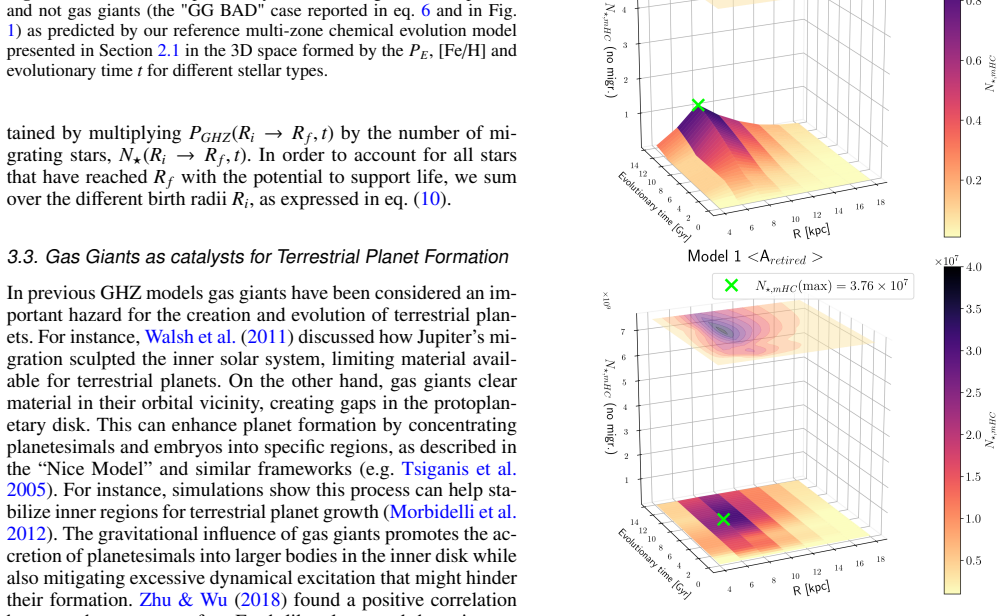
On the paper's own terms, the central discovery is that two neglected processes reshape the Galactic Habitable Zone in opposite radial directions. Radial stellar migration, modeled as diffusion with strength $\sigma_{\rm RM}$, transports stars born in metal-rich inner regions outward; because those stars keep their birth metallicity but are exposed to lower supernova rates at larger radii, the outer disk gains habitable planets. In the extreme $\sigma_{\rm RM}=6$ kpc model, the number of FGK stars with minimum habitability conditions at 18 kpc is about 4.9 times the no-migration prediction around $t=6.1$ Gyr, and the outer boundary of the habitable zone widens. In the inner disk, the assumption that gas giants catalyze terrestrial planet formation raises planet-host numbers at the 4 kpc ring to about 1.4 times the gas-giant-hazard case for FGK stars (1.5 without migration), and about 2.8 times for retired A stars (3.3 without migration). Migration dilutes this inner enhancement by redistributing the affected stars outward. At the solar circle the total number of habitable FGK stars is nearly unchanged, but its birth-radius mix changes substantially.
Load-bearing premise
The outward boost assumes the Gaussian migration diffusion of Eq. (3), calibrated on observed star populations at 5 to 14 kpc, can be extrapolated to 3 to 19 kpc with strength $\sigma_{\rm RM}=3.5$ to 6 kpc; the paper's own metallicity comparison hints the true strength may be closer to $\sigma_{\rm RM}=1$ kpc, in which case the outer enhancement mostly disappears.
Editorial extensions
If this is right
- The outer Milky Way, previously counted out of the habitable zone because it forms few stars and is metal-poor, becomes a candidate repository of habitable planets if migration is strong; organic molecules detected in outer-disk star-forming regions line up with this picture.
- At the solar circle, surveys of planet hosts should see a mixed birth-radius population: a substantial share of FGK hosts currently at 8 kpc would have been born at 4, 6, or 10 kpc, so age and metallicity tagging can test the migration hypothesis.
- If gas giants catalyze terrestrial planet formation, the inner 4 kpc ring is where the signature is strongest; future transit or microlensing surveys of inner-disk fields can look for the predicted excess of Earth-sized planets there.
- The peak of habitability shifts from 8 kpc to 10 kpc when the supernova sterilization threshold is lowered, so GHZ maps remain strongly sensitive to how destructive supernovae actually are.
- The paper's own comparison to observed local, inner, and outer planet-host metallicity distributions suggests that reproducing the data may require $\sigma_{\rm RM}\approx1$ kpc; under that calibration the outer-disk factor of five shrinks toward unity, making observational calibration of migration strength the key next step.
Reading between the lines
- If radial migration is genuinely strong, then planet-host stars in the outer disk should be systematically older and more metal-rich than the local interstellar medium there; this fossil record is testable with future spectroscopic surveys of outer-disk exoplanet hosts.
- The catalyst-versus-hazard contrast implies an observational discriminator: terrestrial-planet occurrence among stars with and without cold giant companions should differ more strongly in the inner disk than at the solar circle, because super-solar metallicities dominate there, and migration weakens but does not erase the contrast.
- The maps are likely sensitive to the assumed $[\rm Fe/H]=-1$ threshold for planet formation; if the true threshold is lower, the outer-disk enhancement would shrink because more in-situ metal-poor stars would already count as habitable.
- A testable extension would compare the predicted spatial gradients in potentially habitable planet abundance with transit and microlensing demographics once surveys cover enough sky at different Galactocentric radii.
Signed reviews
Editorial analysis
A structured set of objections, weighed in public.
Referee Report
Summary. This paper presents updated maps of the Milky Way's Galactic Habitable Zone (GHZ) using a two-infall, multi-zone chemical evolution model, with two extensions over previous work: stellar radial migration is implemented via the Frankel et al. (2018) diffusion kernel with sigma_RM = 3.5 and 6 kpc, and the probability of terrestrial-planet formation is modified to account for gas giants as either hazards ('GG BAD', PE = 0.4 x (1 - <P_GGP>)) or catalysts ('GG GOOD', PE = 0.4 x (1 + <P_GGP>)). The main claims are that migration increases the number of FGK stars with minimum habitability conditions in the outer disc by up to a factor of about 5 at 18 kpc (for sigma_RM = 6), and that the GG GOOD scenario raises this number at 4 kpc by factors of about 1.4 (FGK) and 2.8 (retired A) compared to GG BAD, with slightly larger ratios when migration is absent. The paper also compares predicted metallicity distribution functions with an observed sample of low-mass planet hosts and tests sensitivity to the tmax delay.
Significance. If accepted with appropriate caveats, the migration part of this paper would be a useful first step in quantifying how radial migration reshapes the GHZ in a detailed chemical evolution framework. The implementation is transparent, the equations for migration are internally consistent, the tmax sensitivity test is a positive feature, and the CMDF comparison engages with observational data. However, the two headline quantitative claims need substantial qualification: the factor-of-five outer-Galaxy enhancement comes from an extreme, uncalibrated migration strength, and the gas-giant GOOD/BAD ratios are essentially a re-expression of the adopted PE parametrization rather than an independent test of the catalyst hypothesis. The paper is nevertheless likely to be of interest to the astrobiology and Galactic archaeology communities if reframed accordingly.
major comments (2)
- [Section 3.3, Eqs. (6) and (12), Fig. 10, Abstract] The abstract and conclusions highlight the factor of approximately 4.9 increase in N_mHC at 18 kpc, but this value comes exclusively from Model 4, which adopts sigma_RM = 6 kpc. The authors themselves describe this as an 'extreme case' and it is not independently calibrated in Section 2.2. The only calibration test presented in the paper, the CMDF comparison in Fig. 7, shows that sigma_RM = 1 kpc reproduces the observed local/inner/outer planet-host CMDFs nearly perfectly, while even Model 3 (sigma_RM = 3.5 kpc) overpredicts the migrating populations. The paper correctly notes that the observational sample constrains only blurring, not churning, so this comparison is not a complete measurement of sigma_RM; nevertheless, it does not support sigma_RM = 6, and the text itself states that 'a lower migration rate is needed to reproduce the data.' The factor-of-five headline should be presented as an upper-limit scenario, with the ratios for the reference and low-migration cases (e.g., Model 3 and the 'Model Weak' sigma_RM = 1 case) also reported in the abstract and conclusions. As written, the central quantitative claim is not supported by the manuscript's own calibration.
- [Section 3.3, Eqs. (6) and (12), Fig. 10, Abstract] The GG GOOD/GG BAD ratios in Fig. 10 are mathematically forced by the definitions of PE. The two scenarios differ only by the sign in front of <P_GGP>, and all other ingredients in Eq. (10) (SFR, PSN, migration) are identical when computed with the same sigma_RM. Consequently, the ratio of N_mHC at any given (R,t) is fully determined by the adopted Ghezzi et al. (2018) gas-giant occurrence relation and the model's predicted metallicity distribution; it does not add information beyond the assumed functional form of PE. The headline ratios quoted in the abstract (1.4, 2.8, 1.5, 3.3) are therefore a direct consequence of the ansatz in Eqs. (6) and (12). The authors should present these results explicitly as a sensitivity study of the PE parametrization, not as a new prediction that bears on whether gas giants actually catalyze terrestrial-planet formation. As it stands, the gas-giant section risks overinterpreting a tautology.
minor comments (6)
- [Abstract] The phrase 'relative to a baseline value of unity at 6 kpc' is unclear; the factor is taken relative to the no-migration model at the same radius and time, and the meaning of the 'baseline value of unity at 6 kpc' should be specified.
- [Section 4.2, footnote 5] The sentence 'This predicted ratio is approximately 4.9 for also both M stars and retired A stars' is awkward; please rephrase, for example as 'This predicted ratio is approximately 4.9 for M stars and retired A stars as well.'
- [Section 2.2] Please clarify whether the same age cut as in Frankel et al. (2018) is adopted here: the text says migration is not considered for an 'old disc' with age > 8 Gyr in their case, but the present model enables migration only after the second infall at tmax = 3.25 Gyr; the relation between these two time cuts should be stated explicitly.
- [Fig. 7] In the legend of the right panel, the 'Model Weak' curve should be labeled with its parameter value (sigma_RM = 1 kpc) so that the reader does not have to infer it from the caption text.
- [Fig. 7 caption and Appendix C] The acronym 'A&S' in the Fig. 7 caption is not defined in the caption; please expand it on first use (e.g., Ariel Stellar Catalogue and SWEET-Cat sample) to match the definition in Appendix C.
- [Eq. (4)] The asymmetric uncertainties of the Ghezzi et al. (2018) fitting coefficients are not propagated to the predicted GG GOOD/GG BAD ratios; a short discussion of the resulting uncertainty range would help the reader judge the robustness of the quoted factors.
Circularity Check
The GG GOOD/GG BAD ratios are built into the definitions of PE; the migration results are independent and not circular.
-
self definitional
[Section 3.1, Eq. (6); Section 3.3, Eq. (12); Section 4.3, Fig. 10]
"Hence, the probability of forming an Earth-like planet, PE, as a function of the host star [Fe/H] abundance, assuming no formation of gas giants, is: PE([Fe/H]) = 0.4 × (1 − <PGGP(M⋆,[Fe/H])>IMF) ... which can be expressed as follows: PE([Fe/H]) = 0.4 × (1 + <PGGP(M⋆,[Fe/H])>IMF)."
By construction, the two 'scenarios' differ only by the sign of the same IMF-weighted Ghezzi et al. (2018) gas-giant occurrence function <PGGP>. At fixed (R,t), the GG GOOD/GG BAD ratio of N⋆,mHC is therefore (1+x)/(1−x) with x=<PGGP>([Fe/H](R,t)), where the chemical evolution model supplies [Fe/H]. The paper's own statement that 'the two PE probabilities exhibit significant differences only at super-solar metallicities. Consequently, we expect disparities primarily in the innermost regions' shows that the reported spatial pattern is already contained in the assumed metallicity dependence of <PGGP>. The quoted ratios (1.4, 1.5, 2.8, 3.3) are analytic consequences of Eqs.
full rationale
The central migration claim is not circular: Eq. (3) is a Gaussian diffusion kernel taken from Frankel et al. (2018), and the adopted σRM=3.5 and σRM=6 kpc are external parameter choices, not fitted to the paper's own target quantities. The CMDF comparison in Fig. 7 is a genuine external check; the fact that Model 3 overpredicts migrators and 'Model Weak' (σRM=1) does better is a calibration concern about the reference/strong migration cases, not a definitional circularity. The authors' self-citations (Spitoni et al. 2014, 2017; Palla et al. 2022) supply the PE=0.4 baseline and the migration implementation, but these are traceable to external work (Lineweaver et al. 2004; Frankel et al. 2018) and are not used to define the claimed new result. The genuine circularity is confined to the GG GOOD/GG BAD comparison. Because Eq. (6) and Eq. (12) are affine functions of the same <PGGP> relation, the entire spatial and spectral pattern of the ratios in Fig. 10 — largest at 4 kpc, largest for retired A stars, negligible at the solar circle — is the input relation re-expressed through the model metallicity. Calling this a 'finding' or a 'prediction' of the model is therefore a constructed result, not an empirical discovery. This affects one of the two headline claims, but the migration factor-of-five statement does not reduce by construction, so the paper is only partially circular.
Assumptions & free parameters
free parameters (6)
- sigma_RM (radial migration strength) =
3.5 kpc reference; 6 kpc extreme; 1 kpc weak
- tmax (delay between disc infall episodes) =
3.25 Gyr (also 1 and 5 Gyr)
- PE baseline (Earth-like planet occurrence) =
0.4
- SN survival threshold multiplier =
2x solar-vicinity average for headline models (Case 2); 1x for Model 2
- P_GGP gas-giant occurrence coefficients =
normalization 0.085, mass exponent 1.05, metallicity exponent 1.05
- inside-out infall timescale tau_2(R) =
1.033 R - 1.267 Gyr
assumptions (6)
- domain assumption The Frankel et al. (2018) migration kernel, fitted to APOGEE stars at 5 to 14 kpc, remains valid when extrapolated to 3 to 19 kpc.
- domain assumption Supernova sterilization is a step function of the total SN rate relative to the solar-vicinity average.
- domain assumption Terrestrial planet formation requires [Fe/H] > -1 and has a constant probability of 0.4 above that threshold for all stellar types.
- domain assumption Stellar metallicity is inherited from the ISM at the birth radius and birth time, while SN damage is evaluated at the final radius.
- domain assumption Stellar migration is a passive tracer and does not change the ISM chemical evolution.
- ad hoc to paper Gas giants can be treated as catalysts for terrestrial planet formation with PE = 0.4 times (1 + <P_GGP>).
Cite this review
Pith. "Pith review of Shaping Galactic Habitability: the impact of stellar migration and gas giants." pith.science (2026). https://pith.science/paper/EYJNGBFI
@misc{pith2026250619981,
  author       = {Pith},
  title        = {Pith review of: Shaping Galactic Habitability: the impact of stellar migration and gas giants},
  year         = {2026},
  howpublished = {\url{https://pith.science/paper/EYJNGBFI}},
  note         = {Machine review of arXiv:2506.19981}
}
read the original abstract
In exoplanet research, the focus is increasingly on identifying Earth analogs, planets similar in density and habitability potential. As the number of rocky exoplanets grows, parallel discussions have emerged on system architectures and Galactic environments that may support life, drawing comparisons to our own Earth. This has brought renewed attention to the concept of the Galactic Habitable Zone (GHZ) as a broader context for interpreting the diversity of planetary environments. This study is the first to use detailed chemical evolution models to investigate the impact of stellar migration, modeled through a parametric approach, on the GHZ. Our findings reveal that stellar migration significantly enhances the number of stars capable of hosting habitable planets in the outer Galactic regions, with an increase of up to a factor of five at 18 kpc relative to a baseline value of unity at 6 kpc. Furthermore, we explore a novel scenario where the presence of gas giant planets increases the probability for the formation of terrestrial ones. We find that this increased probability is higher in the inner Galactic disc, but is also mitigated by stellar migration. In particular, at the present time, the number of FGK stars hosting terrestrial planets with minimum habitability conditions in the ring centered at 4 kpc is approximately 1.4 times higher than in scenarios where gas giants are assumed to hinder the formation and evolution of Earth-like planets. Without stellar migration, this factor increases to 1.5. Even larger ratios are predicted for terrestrial planets orbiting retired A stars, reaching 2.8 in models with stellar migration and 3.3 in models without it.
Figures


Figures from the paper (6 more)


Forward citations
Cited by 1 Pith paper
-
Probing the origins. III. Exoplanet demographics across Galactic birth radii
Giant-planet hosts preferentially formed in the metal-rich inner Galaxy and later migrated, while rocky-only systems are less centrally concentrated and show smaller radial excursions.
Reference graph
Works this paper leans on
-
[1]
, " * write output.state after.block = add.period write newline
ENTRY address archiveprefix author booktitle chapter edition editor howpublished institution eprint journal key month note number organization pages publisher school series title type volume year label extra.label sort.label short.list INTEGERS output.state before.all mid.sentence after.sentence after.block FUNCTION init.state.consts #0 'before.all := #1 ...
-
[2]
write newline
" write newline "" before.all 'output.state := FUNCTION n.dashify 't := "" t empty not t #1 #1 substring "-" = t #1 #2 substring "--" = not "--" * t #2 global.max substring 't := t #1 #1 substring "-" = "-" * t #2 global.max substring 't := while if t #1 #1 substring * t #2 global.max substring 't := if while FUNCTION word.in bbl.in " " * FUNCTION format....
-
[3]
S., Aguilar , G., et al
Abolfathi , B., Aguado , D. S., Aguilar , G., et al. 2018, , 235, 42
2018
-
[4]
2019, Geosciences, 9, 105
Adibekyan , V. 2019, Geosciences, 9, 105
2019
-
[5]
D., Allende Prieto , C., et al
Alam , S., Albareti , F. D., Allende Prieto , C., et al. 2015, , 219, 12
2015
-
[6]
2022, , 512, 505
Ambrifi , A., Balbi , A., Lingam , M., Tombesi , F., & Perlman , E. 2022, , 512, 505
2022
-
[7]
Armitage , P. J. 2003, , 582, L47
2003
-
[8]
Baba , J., Tsujimoto , T., & Saitoh , T. R. 2024, , 976, L29
2024
Show all 107 references
-
[9]
2020, Life, 10, 132
Balbi , A., Hami , M., & Kova c evi \'c , A. 2020, Life, 10, 132
2020
-
[10]
J., Pascucci , I., Mulders , G
Bergsten , G. J., Pascucci , I., Mulders , G. D., Fernandes , R. B., & Koskinen , T. T. 2022, , 164, 190
2022
-
[11]
J., Sephus , C
Bernal , J. J., Sephus , C. D., & Ziurys , L. M. 2021, , 922, 106
2021
-
[12]
2015, , 216, 29
Bovy , J. 2015, , 216, 29
2015
-
[13]
2022, Experimental Astronomy, 53, 511
Brucalassi , A., Tsantaki , M., Magrini , L., et al. 2022, Experimental Astronomy, 53, 511
2022
-
[14]
A., Bitsch , B., Johansen , A., et al
Buchhave , L. A., Bitsch , B., Johansen , A., et al. 2018, , 856, 37
2018
-
[15]
A., Latham , D
Buchhave , L. A., Latham , D. W., Johansen , A., et al. 2012, , 486, 375
2012
-
[16]
2013, , 49, 253
Carigi , L., Garc \' a-Rojas , J., & Meneses-Goytia , S. 2013, , 49, 253
2013
-
[17]
1997, , 477, 765
Chiappini , C., Matteucci , F., & Gratton , R. 1997, , 477, 765
1997
-
[18]
2001, , 554, 1044
Chiappini , C., Matteucci , F., & Romano , D. 2001, , 554, 1044
2001
-
[19]
2022, Experimental Astronomy, 53, 473
Danielski , C., Brucalassi , A., Benatti , S., et al. 2022, Experimental Astronomy, 53, 473
2022
-
[20]
C., et al
de Laverny , P., Recio-Blanco , A., Worley , C. C., et al. 2013, The Messenger, 153, 18
2013
-
[21]
& Schramm , D
Ellis , J. & Schramm , D. N. 1995, Proceedings of the National Academy of Science, 92, 235
1995
-
[22]
Fischer , D. A. & Valenti , J. 2005, , 622, 1102
2005
-
[23]
2022, , 664, A154
Fontani , F., Schmiedeke , A., S \'a nchez-Monge , A., et al. 2022, , 664, A154
2022
-
[24]
2024, , 691, A180
Fontani , F., Vermari \"e n , G., Viti , S., et al. 2024, , 691, A180
2024
-
[25]
2017, International Journal of Astrobiology, 16, 60
Forgan , D., Dayal , P., Cockell , C., & Libeskind , N. 2017, International Journal of Astrobiology, 16, 60
2017
-
[26]
Frankel , N., Rix , H.-W., Ting , Y.-S., Ness , M., & Hogg , D. W. 2018, , 865, 96
2018
-
[27]
2020, , 896, 15
Frankel , N., Sanders , J., Ting , Y.-S., & Rix , H.-W. 2020, , 896, 15
2020
-
[28]
M., Jackman , C
Gehrels , N., Laird , C. M., Jackman , C. H., et al. 2003, , 585, 1169
2003
-
[29]
T., & Johnson , J
Ghezzi , L., Montet , B. T., & Johnson , J. A. 2018, , 860, 109
2018
-
[30]
& Hong , S
Gobat , R. & Hong , S. E. 2016, , 592, A96
2016
-
[31]
2001, , 152, 185
Gonzalez , G., Brownlee , D., & Ward , P. 2001, , 152, 185
2001
-
[32]
2018, , 481, 2570
Grisoni , V., Spitoni , E., & Matteucci , F. 2018, , 481, 2570
2018
-
[33]
He , M. Y. & Weiss , L. M. 2023, , 166, 36
2023
-
[34]
1999, , 125, 439
Iwamoto , K., Brachwitz , F., Nomoto , K., et al. 1999, , 125, 439
1999
-
[35]
Johnson , J. L. & Li , H. 2012, , 751, 81
2012
-
[36]
Kennicutt , Jr., R. C. 1998, , 498, 541
1998
-
[37]
2011, , 476, 429
Kirkby , J., Curtius , J., Almeida , J., et al. 2011, , 476, 429
2011
-
[38]
A., & Gilmore , G
Kroupa , P., Tout , C. A., & Gilmore , G. 1993, , 262, 545
1993
-
[39]
Krug, A. Z. & Jablonski, D. 2012, Geology, 40, 731
2012
-
[40]
2013, , 436, 1479
Kubryk , M., Prantzos , N., & Athanassoula , E. 2013, , 436, 1479
2013
-
[41]
2015, , 580, A126
Kubryk , M., Prantzos , N., & Athanassoula , E. 2015, , 580, A126
2015
-
[42]
& Chieffi , A
Limongi , M. & Chieffi , A. 2018, , 237, 13
2018
-
[43]
H., Fenner , Y., & Gibson , B
Lineweaver , C. H., Fenner , Y., & Gibson , B. K. 2004, Science, 303, 59
2004
-
[44]
Lodders , K., Palme , H., & Gail , H. P. 2009, Landolt B \"o rnstein, 4B, 712
2009
-
[45]
& Kalnajs , A
Lynden-Bell , D. & Kalnajs , A. J. 1972, , 157, 1
1972
-
[46]
W., Reinhard , C
Lyons , T. W., Reinhard , C. T., & Planavsky , N. J. 2014, , 506, 307
2014
-
[47]
T., Bovy , J., Schiavon , R
Mackereth , J. T., Bovy , J., Schiavon , R. P., et al. 2017, , 471, 3057
2017
-
[48]
2022, , 663, A161
Magrini , L., Danielski , C., Bossini , D., et al. 2022, , 663, A161
2022
-
[49]
2013, , 767, 129
Matsumura , S., Ida , S., & Nagasawa , M. 2013, , 767, 129
2013
-
[50]
2021, , 29, 5
Matteucci , F. 2021, , 29, 5
2021
-
[51]
& Francois , P
Matteucci , F. & Francois , P. 1989, , 239, 885
1989
-
[52]
& Recchi , S
Matteucci , F. & Recchi , S. 2001, , 558, 351
2001
-
[53]
F., Parravano , A., & Hollenbach , D
McKee , C. F., Parravano , A., & Hollenbach , D. J. 2015, , 814, 13
2015
-
[54]
2013, , 558, A9
Minchev , I., Chiappini , C., & Martig , M. 2013, , 558, A9
2013
-
[55]
2015, , 804, L9
Minchev , I., Martig , M., Streich , D., et al. 2015, , 804, L9
2015
-
[56]
& Quillen , A
Minchev , I. & Quillen , A. C. 2006, , 368, 623
2006
-
[57]
2023, , 523, 2974
Molero , M., Magrini , L., Matteucci , F., et al. 2023, , 523, 2974
2023
-
[58]
2025, , 694, A274
Molero , M., Magrini , L., Palla , M., et al. 2025, , 694, A274
2025
-
[59]
Molero , M., Matteucci , F., Spitoni , E., Rojas-Arriagada , A., & Rich , R. M. 2024, , 687, A268
2024
-
[60]
I., O'Brien , D
Morbidelli , A., Lunine , J. I., O'Brien , D. P., Raymond , S. N., & Walsh , K. J. 2012, Annual Review of Earth and Planetary Sciences, 40, 251
2012
-
[61]
E., Christensen-Dalsgaard , J., Mosumgaard , J
Nissen , P. E., Christensen-Dalsgaard , J., Mosumgaard , J. R., et al. 2020, , 640, A81
2020
-
[62]
P., Izidoro , A., Jacobson , S
O'Brien , D. P., Izidoro , A., Jacobson , S. A., Raymond , S. N., & Rubie , D. C. 2018, , 214, 47
2018
-
[63]
Pagel, B. E. J. 2006, Nucleosynthesis and Chemical Evolution of Galaxies, 2nd edn. (Cambridge University Press)
2006
-
[64]
2024, , 690, A334
Palla , M., Magrini , L., Spitoni , E., et al. 2024, , 690, A334
2024
-
[65]
2020, , 498, 1710
Palla , M., Matteucci , F., Spitoni , E., Vincenzo , F., & Grisoni , V. 2020, , 498, 1710
2020
-
[66]
2022, , 663, A125
Palla , M., Santos-Peral , P., Recio-Blanco , A., & Matteucci , F. 2022, , 663, A125
2022
-
[67]
A., Marcy , G
Petigura , E. A., Marcy , G. W., Winn , J. N., et al. 2018, , 155, 89
2018
-
[68]
2008, , 135, 313
Prantzos , N. 2008, , 135, 313
2008
-
[69]
2018, , 476, 3432
Prantzos , N., Abia , C., Limongi , M., Chieffi , A., & Cristallo , S. 2018, , 476, 3432
2018
-
[70]
P., Ottiger , M., Fontanet , E., et al
Quanz , S. P., Ottiger , M., Fontanet , E., et al. 2022, , 664, A21
2022
-
[71]
2023, , 525, 2208
Ratcliffe , B., Minchev , I., Anders , F., et al. 2023, , 525, 2208
2023
-
[72]
2024, , 528, 3464
Ratcliffe , B., Minchev , I., Cescutti , G., et al. 2024, , 528, 3464
2024
-
[73]
2024, arXiv e-prints, arXiv:2406.05447
Rauer , H., Aerts , C., Cabrera , J., et al. 2024, arXiv e-prints, arXiv:2406.05447
2024 arXiv
-
[74]
2019, , 489, 5244
Rizzuti , F., Cescutti , G., Matteucci , F., et al. 2019, , 489, 5244
2019
-
[75]
I., Tosi , M., & Matteucci , F
Romano , D., Karakas , A. I., Tosi , M., & Matteucci , F. 2010, , 522, A32
2010
-
[76]
J., & Ventura , P
Romano , D., Matteucci , F., Zhang , Z.-Y., Ivison , R. J., & Ventura , P. 2019, , 490, 2838
2019
-
[77]
P., Stinson , G
Ro s kar , R., Debattista , V. P., Stinson , G. S., et al. 2008, , 675, L65
2008
-
[78]
C., Sousa , S
Santos , N. C., Sousa , S. G., Mortier , A., et al. 2013, , 556, A150
2013
-
[79]
2020, , 639, A140
Santos-Peral , P., Recio-Blanco , A., de Laverny , P., Fern \'a ndez-Alvar , E., & Ordenovic , C. 2020, , 639, A140
2020
-
[80]
2021, , 653, A85
Santos-Peral , P., Recio-Blanco , A., Kordopatis , G., Fern \'a ndez-Alvar , E., & de Laverny , P. 2021, , 653, A85
2021
-
[81]
Scalo , J. M. 1986, , 11, 1
1986
-
[82]
2024, Astrobiology, 24, e916
Scherf , M., Lammer , H., & Spross , L. 2024, Astrobiology, 24, e916
2024
-
[83]
Sellwood , J. A. & Carlberg , R. G. 2014, , 785, 137
2014
-
[84]
2017, Scientific Reports, 7, 5419
Sloan , D., Alves Batista , R., & Loeb , A. 2017, Scientific Reports, 7, 5419
2017
-
[85]
A., & Sch \"o nrich , R
Solway , M., Sellwood , J. A., & Sch \"o nrich , R. 2012, , 422, 1363
2012
-
[86]
G., Adibekyan , V., Delgado-Mena , E., et al
Sousa , S. G., Adibekyan , V., Delgado-Mena , E., et al. 2021, , 656, A53
2021
-
[87]
2021, , 647, A41
Spinelli , R., Ghirlanda , G., Haardt , F., Ghisellini , G., & Scuderi , G. 2021, , 647, A41
2021
-
[88]
2022, , 663, A174
Spitoni , E., Aguirre B rsen-Koch , V., Verma , K., & Stokholm , A. 2022, , 663, A174
2022
-
[89]
2017, , 605, A38
Spitoni , E., Gioannini , L., & Matteucci , F. 2017, , 605, A38
2017
-
[90]
2024, , 690, A208
Spitoni , E., Matteucci , F., Gratton , R., et al. 2024, , 690, A208
2024
-
[91]
2009, , 504, 87
Spitoni , E., Matteucci , F., Recchi , S., Cescutti , G., & Pipino , A. 2009, , 504, 87
2009
-
[92]
2014, , 440, 2588
Spitoni , E., Matteucci , F., & Sozzetti , A. 2014, , 440, 2588
2014
-
[93]
2019, , 623, A60
Spitoni , E., Silva Aguirre , V., Matteucci , F., Calura , F., & Grisoni , V. 2019, , 623, A60
2019
-
[94]
2020, , 635, A58
Spitoni , E., Verma , K., Silva Aguirre , V., & Calura , F. 2020, , 635, A58
2020
-
[95]
2022, , 49, e96376
Svensmark , H. 2022, , 49, e96376
2022
-
[96]
2023, Journal of Geophysical Research (Atmospheres), 128, e2022JD037766
Svensmark , J. 2023, Journal of Geophysical Research (Atmospheres), 128, e2022JD037766
2023
-
[97]
2018, Experimental Astronomy, 46, 135
Tinetti , G., Drossart , P., Eccleston , P., et al. 2018, Experimental Astronomy, 46, 135
2018
-
[98]
2022, in European Planetary Science Congress, EPSC2022--1114
Tinetti , G., Eccleston , P., Lueftinger , T., et al. 2022, in European Planetary Science Congress, EPSC2022--1114
2022
-
[99]
1996, Publications of the Astronomical Society of the Pacific, 108, 1073
Trimble, V. 1996, Publications of the Astronomical Society of the Pacific, 108, 1073
1996
-
[100]
2025, , 697, A102
Tsantaki , M., Magrini , L., Danielski , C., et al. 2025, , 697, A102
2025
-
[101]
Tsiganis , K., Gomes , R., Morbidelli , A., & Levison , H. F. 2005, , 435, 459
2005
-
[102]
2013, , 431, 3642
Ventura , P., Di Criscienzo , M., Carini , R., & D'Antona , F. 2013, , 431, 3642
2013
-
[103]
2016, , 459, 3512
Vukoti \'c , B., Steinhauser , D., Martinez-Aviles , G., et al. 2016, , 459, 3512
2016
-
[104]
J., Morbidelli , A., Raymond , S
Walsh , K. J., Morbidelli , A., Raymond , S. N., O'Brien , D. P., & Mandell , A. M. 2011, , 475, 206
2011
-
[105]
2016, , 833, 214
Zackrisson , E., Calissendorff , P., Gonz \'a lez , J., et al. 2016, , 833, 214
2016
-
[106]
& Wu , Y
Zhu , W. & Wu , Y. 2018, , 156, 92
2018
-
[107]
K., Hardegree-Ullman , K
Zink , J. K., Hardegree-Ullman , K. K., Christiansen , J. L., et al. 2023, , 165, 262
2023
Reviewed August 15, 2026 · model on record in the stance chip above.
Discussion (0). Continue with ORCID to comment.