REVIEW 4 major objections 6 minor 3 cited by
A Sibling of AR Scorpii: SDSS J230641.47$+$244055.8 and the Observational Blueprint of White Dwarf Pulsars
T0 review · 4 major / 6 minor · reviewed 2026-08-06 · deepseek-v4-flash
Pith's one-line read SDSS J230641.47+244055.8 is the third known white dwarf pulsar, a non-accreting binary whose 92.28-second spin period drives pulsed emission from an M-dwarf companion.
desk verdict Genuine candidate third WD pulsar with a coherent 92-s signal, but the spin interpretation and the 'third member' claim need radio/polarization confirmation before they are locked in. read the letter →
The pith
A machine-rendered reading of the paper's core claim, the machinery that carries it, and where it could break.
The reading
What carries the argument
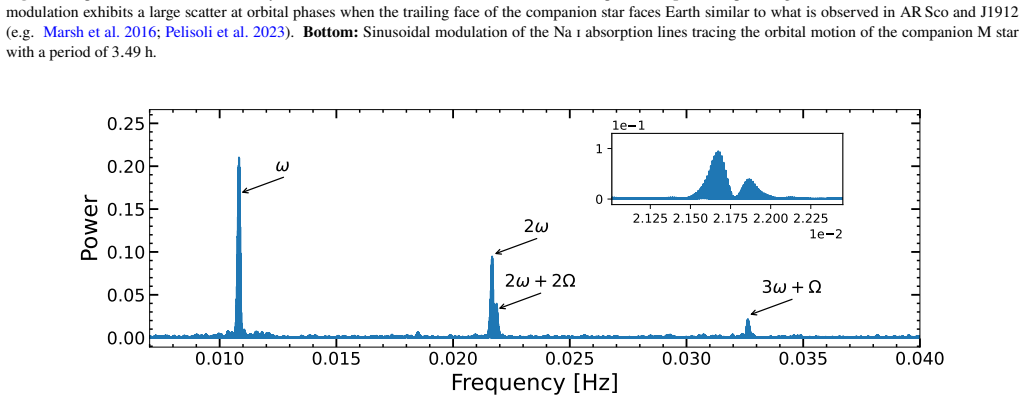
The load-bearing object is the coherent 92.28-second photometric signal detected in four ULTRASPEC high-speed photometry visits, together with its harmonics and the 2ω+2Ω sideband, which the paper interprets as the spin period of the white dwarf primary. This periodic clock is what separates WD pulsars from accreting magnetic binaries: after removing the orbital modulation, the highly coherent pulse train signals the absence of stochastic accretion flickering. The same rotating magnetosphere mechanism proposed for AR Scorpii accounts for the double-pulse morphology, the orbital modulation of pulse amplitude, and the energetic emission line flashes seen in H-alpha.
What would settle it
Take independent high-cadence photometry of SDSSJ2306 at a later epoch with a different telescope and filter, and check whether the 92.28-second oscillation reappears at the same period and phase, and whether its pulse shape and amplitude vary with orbital phase as in AR Scorpii. If the signal is absent, incoherent, or behaves like stochastic flickering, the spin-period interpretation, and with it the 'third WD pulsar' claim, would collapse. Alternatively, optical polarimetry that fails to detect pulsed linear polarization in the 92-second component would falsify the magnetospheric interaction origin shared with AR Scorpii.
Extended reading notes
Core claim
SDSSJ2306 is a spectroscopic binary with an M4.0±0.5 dwarf (effective temperature roughly 3300 K) and a compact primary whose 92.28-second coherent pulsations, accompanied by harmonics and a beat with the orbital period, mark the white dwarf's rotation. The Na I absorption doublet traces the companion's center of mass and yields a mass function f(M)=0.21±0.01 solar masses; Roche geometry, the absence of eclipses, and the mass-radius relation constrain the inclination to roughly 45–50 degrees, the secondary mass to 0.19–0.28 solar masses, and the distance to about 1.25 kpc. The double-pulse shape of the 92-second light curve, the narrow emission lines from the irradiated companion face, a low-amplitude broad H-alpha component, the orbital-phase-dependent pulse amplitude, and the low X-ray upper limit all match the behavior seen in AR Scorpii. On this basis the authors classify the system as the third member of the white dwarf pulsar class and provide a summary table of defining observational properties.
Load-bearing premise
The 92.28-second periodic signal seen in four high-speed photometry runs is the spin period of the white dwarf and not a detrending artifact, an alias of the orbital period, or a transient brightness fluctuation.
Editorial extensions
If this is right
- SDSSJ2306 becomes the third confirmed white dwarf pulsar, giving the class a statistically usable sample for testing evolutionary models.
- Its spin period of 92.28 seconds is slightly shorter than AR Scorpii's roughly 117 seconds, providing an independent system against which magnetospheric interaction models can be compared.
- The compiled blueprint of common properties, such as a heated M-dwarf companion, lack of steady accretion, pulsed non-thermal emission, and a high spin-to-orbital period ratio, gives observers a concrete checklist for identifying future candidates in survey data.
- If the preliminary VLA radio detection mentioned in the paper is confirmed as pulsed, it would extend the radio pulsar behavior to a third system and strengthen the case that WD pulsars emit across the entire electromagnetic spectrum.
- The position of all three WD pulsars in the same Gaia colour-magnitude region suggests that their formation requires a fairly narrow band of progenitor stellar and orbital properties, sharpening predictions for where to find more members.
Reading between the lines
- If this classification holds, SDSSJ2306's shorter spin period than AR Sco implies that WD pulsars need not share a single spin-up history; a testable extension would be to search for a correlation between spin period and orbital period across a larger sample.
- The paper's argument against a propeller-like formation channel predicts that ultraviolet spectroscopy of SDSSJ2306 should show no CNO abundance anomalies from a stripped companion envelope; a UV observation would test this directly.
- Because the 92-second signal is the crux of the classification, an independent high-cadence observation at a later epoch that fails to reproduce the coherent pulse train would call the spin interpretation into question, even though the orbital parameters would remain secure.
- The blueprint suggests a population-level search strategy: look for M-dwarf-dominated spectra with narrow emission lines and large orbital-phase-dependent photometric scatter in time-domain surveys, then follow up with high-speed photometry and polarimetry to confirm the pulsed mechanism.
Editorial analysis
A structured set of objections, weighed in public.
Referee Report
Summary. The paper reports the discovery of SDSS J230641.47+244055.8 as a candidate third white-dwarf pulsar, using ZTF photometry to measure an orbital period P_orb = 3.4939558(3) h, ULTRASPEC high-speed photometry to detect a 92.28(3) s coherent signal interpreted as the WD spin period, and GMOS time-resolved spectroscopy to measure radial velocities, a binary mass function f(M) = 0.21 ± 0.01 M_sun, and the companion properties (M4.0 ± 0.5, T_eff ≈ 3300 K). The paper also derives a distance of ≈1.25 kpc, a secondary mass range 0.19–0.28 M_sun, and an inclination of ≈45–50°, and compiles the properties of the three known WD pulsars into a comparative table. The central classification of the system as a WD pulsar rests on the identification of the 92.28 s photometric signal as the WD spin period and on the pulsed-emission interpretation.
Significance. If the classification holds, this would be only the third known WD pulsar and would strengthen the empirical basis for the proposed evolutionary connection between intermediate polars, WD pulsars, and polars. The paper's strengths are the precise orbital period, the coherent high-cadence photometric signal with candidate harmonics and beat frequencies, the clear spectroscopic binary solution with an M-dwarf companion, and the systematic compilation of the observational properties of the class. The main weakness is that the load-bearing spin-period identification is not yet independently confirmed: no spectroscopic or polarimetric confirmation exists, the VLA detection is preliminary and unpulsed, and the paper's own Table 4 marks pulsed emission and optical polarization for J2306 as unconfirmed. The central claim is therefore defensible as a candidate discovery but is not yet established at the level claimed in the title and abstract.
major comments (4)
- [Sec. 3.1.2, Table 4, Sec. 4.1] The identification of the 92.28 s signal as the WD spin period is load-bearing for the 'third WD pulsar' claim, but the evidence is not yet conclusive. The signal is a single photometric periodicity seen in four ULTRASPEC visits; the GMOS exposure time (553 s) was deliberately chosen to smear this signal, so no spectroscopic confirmation exists; the VLA detection is described as preliminary and not yet shown to be pulsed; and no photopolarimetric observations are available. The paper's own Table 4 marks pulsed emission, optical polarization, and radio pulsed emission for J2306 as '?'. Furthermore, the spectral window is not presented, and the candidate beat peaks 2ω+2Ω and 3ω+Ω in Table 2 have offsets from ω and 2ω that are close to the frequency scales set by the ~3.5 h visit lengths, so they do not, by themselves, rule out window-function aliases. I request that the authors present the Lomb-Scargle false-alarm levels against a red-noise model, the spectral window, and a phase-connected solution, and either obtain independent confirmation (e.g., pulsed radio, optical polarimetry, or high-cadence spectroscopy) or revise the central claim throughout to 'strong WD pulsar candidate' rather than 'the third system of the class.'
- [Sec. 3.2.2] The adopted spectral type and effective temperature are selected with partial circularity relative to the paper's central classification. The GMOS template fitting yields M2.5, but M4.0 is adopted because it is said to be 'a more natural match for SDSSJ2306's orbital period' and because all three WD pulsars are 'clustered in the same region of the colour magnitude diagram'; similarly, Teff = 3600 K is replaced by Teff = 3300 K because the latter is 'a more natural match to the spectral class'. Since the paper is using the CMD clustering and the WD pulsar class to justify the very parameters that place the system in that class, the inference is circular. Please report the template-fitting χ² values for the full grid, include the systematic uncertainty from template choice, and use selection criteria that do not presuppose class membership.
- [Sec. 3.2.2, Eq. (2), Sec. 3.3] The mass function quoted as f(M) = 0.21 ± 0.01 M_sun is treated as a single measured value even though the text states that the Na I semi-amplitude is 'effectively an upper limit' to K2 because the line forms across an irradiated hemisphere with a temperature gradient. Since f(M) ∝ K^3, an upper limit on K translates directly into an upper limit on f(M), and the constraints on M1, M2, and inclination in Sec. 3.3 and Fig. 8 inherit this systematic direction. The numerical value of K_NaI is not stated anywhere in the text or tables, which makes it impossible to evaluate the propagation. Please report K_NaI explicitly and either compute the mass function with a proper model of the line-formation region or clearly present the inferred masses as upper/lower limits consistent with the K-correction.
- [Sec. 3.4] The adopted distance d = 1.25(2) kpc is derived by assuming that SDSSJ2306 has the same average G-band luminosity as AR Sco. This is an ad-hoc assumption that is not independently verified, and it is then used to derive the secondary mass range (0.19–0.28 M_sun) and the WD mass/inclination constraints (Fig. 8). The Bailer-Jones geometric distance quoted in the same section has large uncertainty (≈1.5(+1.5,−0.5) kpc) and is consistent with a range spanning 1.0–3.0 kpc. The equal-luminosity assumption should be clearly flagged as model-dependent, and the derived masses and inclinations should be recomputed for a conservative distance range rather than adopting a single value.
minor comments (6)
- [Sec. 2.3] The sentence 'we have used the fast photometry gathered with ULTRASPEC to determine the short-term properties' and the phrase 'designed to minimize the impact of flexures' are slightly awkward; consider rewording for clarity.
- [Affiliations] Affiliation 6 (School of Physics, University College Cork) is listed twice with the same address; please remove the duplicate.
- [Sec. 3.3] The text contains repeated misspellings of 'Chandrasekhar' as 'Chandrasekar', and 'constrains' should be 'constraints' throughout; these should be corrected in a language edit.
- [Fig. 3] The inset panel labeled '1e 2' and '1e 1' lacks axis labels with units; adding frequency and power units would improve readability.
- [Sec. 2.2] The phrase 'with only 15 ms dead time between each exposure' is clear, but the reader may benefit from a brief statement of the effective Nyquist frequency for the 7.8 s and 15.8 s exposure sequences.
- [Sec. 4.1] In the sentence 'In general, the pulsed emission on WD pulsars is thought to arise predominately from synchrotron radiation, which dominates across the electromagnetic spectrum..', there is a doubled period and 'predominately' should be 'predominantly'.
Circularity Check
Mild, local circularity in the spectral-type and distance choices that place J2306 in the WD-pulsar CMD cluster; the central spin/orbital periods and mass function are independently derived.
-
self definitional
[Sec. 3.2.2 (Companion Star & Mass Function), spectral-type and Teff selection]
"Using this data, the best match is obtained for the M4 with similar values for M3 and M5 the spectral template matching with the. These values are a more natural match for SDSSJ2306's orbital period and are consistent with fact that all three WD pulsars are clustered in the same region of the colour magnitude diagram (see Sec.4.1). Therefore, we conclude that the most likely spectral type of SDSSJ2306 is M4.0±0.5."
The GMOS data are best matched by an M2.5 template, while the SDSS data give comparable fits for M3, M4, and M5. The paper breaks this degeneracy by requiring consistency with the WD-pulsar class ('a more natural match for SDSSJ2306's orbital period' and 'clustered' with the two known WD pulsars), adopts M4.0±0.5 and Teff=3300 K, and then in Sec. 4.1 cites the resulting CMD clustering as evidence that the systems share the same physical process. Class consistency is thus an input to the choice of spectral parameters, not an independent confirmation; the inferred spectral type and CMD position partly recycle the classification being asserted.
-
self definitional
[Sec. 3.4 (Distance to SDSSJ2306) and Sec. 4.1 (HR-diagram clustering)]
"Given the similarities of the observational properties of SDSSJ2306 with ARSco (Sec.4.1) we can assume both sources have the same luminosity and make a direct comparison using the average Gaia magnitude to obtain an estimate of the distance... the position of WD pulsars on the HR diagram seems to be clustered around absolute magnitudes M_G ≃ 10 mag in the Gaia G-band and G_BP−G_RP≃1.25 (see Sec. 3.4 for a discussion on the distance)."
The distance used to place J2306 on the Gaia CMD is derived by assuming that, because of 'the similarities of the observational properties of SDSSJ2306 with AR Sco', the two systems have the same luminosity. That similarity includes the very WD-pulsar classification and CMD location under discussion; the distance obtained from this assumption then yields M_G ≃ 10 and G_BP−G_RP ≃ 1.25, and this co-location is subsequently cited in Sec. 4.1 as evidence that the same physical process operates in all three systems. The conclusion (J2306 belongs to the WD-pulsar CMD cluster) is therefore conditioned on the assumption (J2306 is similar to AR Sco) rather than derived from an independent distance measurement.
full rationale
The core discovery claims—the 3.4939558 h orbital period from ZTF photometry, the 92.28 s coherent signal from ULTRASPEC, the radial-velocity solution from Na I absorption, and the resulting mass function f(M)=0.21±0.01 M_sun—are derived directly from the data and do not reduce to the paper's conclusion. In particular, the mass function is obtained from the Na I semi-amplitude via the standard formula, without reference to WD-pulsar class membership, and the orbital period is an independent Lomb-Scargle detection. The identification of the 92.28 s signal as the WD spin period is an interpretation, not a fitted consequence: the text explicitly says 'which we interpret to be the spin period of the WD primary' (Sec. 3.1.2) and later acknowledges that the beat period would be only ~10 per cent different; this is a robustness concern rather than a circular reduction. Similarly, the unverified entries in Table 4 for J2306's optical polarization and radio pulsed emission are acknowledged limitations, not circular reasoning. The only genuine (though local) circularity is in the secondary-parameter loop: the spectral type and effective temperature are chosen in part because they place J2306 near the other WD pulsars in the CMD, and the distance assumed for that placement itself assumes AR Sco-like luminosity; the resulting CMD clustering is then presented as evidence of commonality. This loop does not damage the spin/orbital/mass-function derivation, but it weakens the independent evidentiary value of the CMD-clustering and spectral-class consistency arguments. Overall score 3 reflects a partial, non-central circularity; the central classification rests on the directly measured periods and mass function.
Assumptions & free parameters
free parameters (9)
- Orbital period P_orb =
3.4939558(3) h
- Spin period P_spin =
92.28(3) s
- NaI radial-velocity semi-amplitude K_NaI =
not quoted directly; f(M)=0.21±0.01 Msun
- Spectral type =
M4.0±0.5
- Companion effective temperature T_eff,2 =
3300(100) K
- Distance d =
1.25(2) kpc
- Inclination i =
45 to 50 degrees
- Extinction E(g-r) =
0.23±0.02
- Veiling power-law component =
per-exposure fitted
assumptions (7)
- standard math Binary mass function formula (Eq. 2) relates K, P_orb, masses, and inclination.
- domain assumption Companion star fills its Roche lobe and emission lines originate near the inner Lagrangian point.
- domain assumption NaI absorption lines approximately trace the center of mass of the secondary star.
- domain assumption Brown et al. (2022) semi-empirical mass-radius relation applies to the irradiated M-dwarf companion.
- ad hoc to paper SDSSJ2306 has the same average G-band luminosity as AR Sco.
- domain assumption The compact object is a white dwarf rather than a neutron star.
- domain assumption The system is non-accreting, with no steady mass transfer onto the WD.
Cite this review
Pith. "Pith review of A Sibling of AR Scorpii: SDSS J230641.47$+$244055.8 and the Observational Blueprint of White Dwarf Pulsars." pith.science (2026). https://pith.science/paper/PH3DX263
@misc{pith2026250620455,
  author       = {Pith},
  title        = {Pith review of: A Sibling of AR Scorpii: SDSS J230641.47$+$244055.8 and the Observational Blueprint of White Dwarf Pulsars},
  year         = {2026},
  howpublished = {\url{https://pith.science/paper/PH3DX263}},
  note         = {Machine review of arXiv:2506.20455}
}
abstract
Radio pulsating white dwarf (WD) systems, known as WD pulsars, are non-accreting binary systems where the rapidly spinning WD interacts with a low-mass companion producing pulsed non-thermal emission that can be observed across the entire electromagnetic spectrum. Only two such systems are known: AR Sco and eRASSU J191213.9$-$441044. Here we present the discovery of a third WD pulsar, SDSS J230641.47$+$244055.8. The optical spectrum is dominated by molecular bands from an M-dwarf companion, with additional narrow emission lines from the Balmer series and He I. The long-term optical light-curve folded on its orbital period ($P_\mathrm{orb} = 3.49$ h) exhibits large scatter (roughly 10 per cent). High-cadence photometry reveals a short period signal, which we interpret to be the spin period of the WD primary ($P_\mathrm{spin} \simeq 92$ s). The WD spin period is slightly shorter than that of AR Sco ($\rm \sim 117$ s), the WD pulsar prototype. Time-resolved spectroscopy reveals emission from the irradiated companion and Na I absorption lines approximately tracing its centre of mass, which yields a binary mass function of $f(M) \simeq 0.2 {\rm M_\odot}$. The H$\alpha$ emission includes a low-amplitude broad component, resembling the energetic emission line flashes seen in AR Sco. Using spectral templates, we classify the companion to be most likely a $\rm M4.0\pm 0.5$ star with $T_\mathrm{\rm eff} \approx 3300$ K. Modelling the stellar contribution constrains the secondary mass ($0.19\,{\rm M_\odot}\lesssim M_2\lesssim 0.28\,{\rm M_\odot}$), system distance ($\simeq1.25\,{\rm kpc}$), and inclination ($i \simeq 45-50^\circ$). We discuss the proposed evolutionary scenarios and summarize the observational properties of all three known WD pulsars, establishing a benchmark for identifying and classifying future members of this emerging class.
Figures


Figures from the paper (7 more)


Forward citations
Cited by 3 Pith papers
-
phoptic -- a Python package for reducing astronomical images
phoptic provides a single open-source Python pipeline that reduces images from OPTICAM, ULTRACAM, HiPERCAM, and MEXMAN into photometric light curves.
-
A new long period radio transient: Discovery of pulses repeating every 1.16 hours from ASKAP J175534.9-252749.1
ASKAP J175534.9-252749.1 is confirmed as a long period radio transient with a period of 4186.3285 seconds (about 1.16 hours), based on new multi-telescope detections and a timing solution.
-
Low-frequency observations of low-mass binary systems with neutron star candidates
A 111 MHz archival search finds no periodic radio emission from five compact-object binaries and one ambiguous 13 Jy, 0.13 s burst toward J1527+3536.
Reference graph
Works this paper leans on
-
[1]
write newline
" write newline "" before.all 'output.state := FUNCTION fin.entry write newline FUNCTION new.block output.state before.all = 'skip after.block 'output.state := if FUNCTION new.sentence output.state after.block = 'skip output.state before.all = 'skip after.sentence 'output.state := if if FUNCTION not #0 #1 if FUNCTION and 'skip pop #0 if FUNCTION or pop #1...
-
[2]
Abrahams E. S., Bloom J. S., Szkody P., Rix H.-W., Mowlavi N., 2022, @doi [ ] 10.3847/1538-4357/ac87ab , https://ui.adsabs.harvard.edu/abs/2022ApJ...938...46A 938, 46
-
[3]
Allard F., Hauschildt P. H., Alexander D. R., Starrfield S., 1997, @doi [ ] 10.1146/annurev.astro.35.1.137 , https://ui.adsabs.harvard.edu/abs/1997ARA&A..35..137A 35, 137
-
[4]
Althaus L. G., C \'o rsico A. H., Isern J., Garc \' a-Berro E., 2010, @doi [ ] 10.1007/s00159-010-0033-1 , https://ui.adsabs.harvard.edu/abs/2010A&ARv..18..471A 18, 471
-
[5]
Astropy Collaboration et al., 2018, @doi [ ] 10.3847/1538-3881/aabc4f , https://ui.adsabs.harvard.edu/abs/2018AJ....156..123A 156, 123
-
[6]
Bagnulo S., Landstreet J. D., 2022, @doi [ ] 10.3847/2041-8213/ac84d3 , https://ui.adsabs.harvard.edu/abs/2022ApJ...935L..12B 935, L12
-
[7]
Bailer-Jones C. A. L., Rybizki J., Fouesneau M., Demleitner M., Andrae R., 2021, @doi [ ] 10.3847/1538-3881/abd806 , https://ui.adsabs.harvard.edu/abs/2021AJ....161..147B 161, 147
-
[8]
Barrett P. E., Gurwell M. A., 2025, @doi [arXiv e-prints] 10.48550/arXiv.2505.06468 , https://ui.adsabs.harvard.edu/abs/2025arXiv250506468B p. arXiv:2505.06468
Show all 88 references
-
[9]
C., et al., 2019a, @doi [ ] 10.1088/1538-3873/aaecbe , https://ui.adsabs.harvard.edu/abs/2019PASP..131a8002B 131, 018002
Bellm E. C., et al., 2019a, @doi [ ] 10.1088/1538-3873/aaecbe , https://ui.adsabs.harvard.edu/abs/2019PASP..131a8002B 131, 018002
-
[10]
C., et al., 2019b, @doi [ ] 10.1088/1538-3873/ab0c2a , https://ui.adsabs.harvard.edu/abs/2019PASP..131f8003B 131, 068003
Bellm E. C., et al., 2019b, @doi [ ] 10.1088/1538-3873/ab0c2a , https://ui.adsabs.harvard.edu/abs/2019PASP..131f8003B 131, 068003
-
[11]
Beniamini P., Hotokezaka K., van der Horst A., Kouveliotou C., 2019, @doi [ ] 10.1093/mnras/stz1391 , https://ui.adsabs.harvard.edu/abs/2019MNRAS.487.1426B 487, 1426
2019 doi
-
[12]
R., et al., 2017, @doi [ ] 10.3847/1538-3881/aa7567 , https://ui.adsabs.harvard.edu/abs/2017AJ....154...28B 154, 28
Blanton M. R., et al., 2017, @doi [ ] 10.3847/1538-3881/aa7567 , https://ui.adsabs.harvard.edu/abs/2017AJ....154...28B 154, 28
2017 doi
-
[13]
S., Marsh T
Brinkworth C. S., Marsh T. R., Dhillon V. S., Knigge C., 2006, @doi [ ] 10.1111/j.1365-2966.2005.09718.x , https://ui.adsabs.harvard.edu/abs/2006MNRAS.365..287B 365, 287
2006
-
[14]
J., et al., 2022, @doi [ ] 10.1093/mnras/stac1047 , https://ui.adsabs.harvard.edu/abs/2022MNRAS.513.3050B 513, 3050
Brown A. J., et al., 2022, @doi [ ] 10.1093/mnras/stac1047 , https://ui.adsabs.harvard.edu/abs/2022MNRAS.513.3050B 513, 3050
2022 doi
-
[15]
Buckley D. A. H., Meintjes P. J., Potter S. B., Marsh T. R., G \"a nsicke B. T., 2017, @doi [Nature Astronomy] 10.1038/s41550-016-0029 , https://ui.adsabs.harvard.edu/abs/2017NatAs...1E..29B 1, 0029
2017 doi
-
[16]
R., Schreiber M
Camisassa M., Fuentes J. R., Schreiber M. R., Rebassa-Mansergas A., Torres S., Raddi R., Dominguez I., 2024, @doi [ ] 10.1051/0004-6361/202452539 , https://ui.adsabs.harvard.edu/abs/2024A&A...691L..21C 691, L21
2024 doi
-
[17]
Castro Segura N., et al., 2023, @doi [ ] 10.1093/mnras/stad3109 , https://ui.adsabs.harvard.edu/abs/2023MNRAS.tmp.2995C
2023 doi
-
[18]
Castro-Tapia M., Zhang S., Cumming A., 2024, @doi [ ] 10.3847/1538-4357/ad7a6a , https://ui.adsabs.harvard.edu/abs/2024ApJ...975...63C 975, 63
2024 doi
-
[19]
Chen X., Wang S., Deng L., de Grijs R., Yang M., Tian H., 2020, @doi [ ] 10.3847/1538-4365/ab9cae , https://ui.adsabs.harvard.edu/abs/2020ApJS..249...18C 249, 18
2020 doi
-
[20]
Dekany R., et al., 2020, @doi [ ] 10.1088/1538-3873/ab4ca2 , https://ui.adsabs.harvard.edu/abs/2020PASP..132c8001D 132, 038001
2020 doi
-
[21]
S., et al., 2014, @doi [ ] 10.1093/mnras/stu1660 , https://ui.adsabs.harvard.edu/abs/2014MNRAS.444.4009D 444, 4009
Dhillon V. S., et al., 2014, @doi [ ] 10.1093/mnras/stu1660 , https://ui.adsabs.harvard.edu/abs/2014MNRAS.444.4009D 444, 4009
2014 doi
-
[22]
S., et al., 2021, @doi [ ] 10.1093/mnras/stab2130 , https://ui.adsabs.harvard.edu/abs/2021MNRAS.507..350D 507, 350
Dhillon V. S., et al., 2021, @doi [ ] 10.1093/mnras/stab2130 , https://ui.adsabs.harvard.edu/abs/2021MNRAS.507..350D 507, 350
2021 doi
-
[23]
P., 1983, @doi [ ] 10.1086/160960 , https://ui.adsabs.harvard.edu/abs/1983ApJ...268..368E 268, 368
Eggleton P. P., 1983, @doi [ ] 10.1086/160960 , https://ui.adsabs.harvard.edu/abs/1983ApJ...268..368E 268, 368
1983 doi
-
[24]
L., 1999, @doi [ ] 10.1086/316293 , https://ui.adsabs.harvard.edu/abs/1999PASP..111...63F 111, 63
Fitzpatrick E. L., 1999, @doi [ ] 10.1086/316293 , https://ui.adsabs.harvard.edu/abs/1999PASP..111...63F 111, 63
1999 doi
-
[25]
W., Lang D., Goodman J., 2013, @doi [ ] 10.1086/670067 , https://ui.adsabs.harvard.edu/abs/2013PASP..125..306F 125, 306
Foreman-Mackey D., Hogg D. W., Lang D., Goodman J., 2013, @doi [ ] 10.1086/670067 , https://ui.adsabs.harvard.edu/abs/2013PASP..125..306F 125, 306
2013 doi
-
[26]
T., Martin J
Friend M. T., Martin J. S., Smith R. C., Jones D. H. P., 1990, , https://ui.adsabs.harvard.edu/abs/1990MNRAS.246..654F 246, 654
1990
-
[27]
Gaia Collaboration et al., 2023, @doi [ ] 10.1051/0004-6361/202243940 , https://ui.adsabs.harvard.edu/abs/2023A&A...674A...1G 674, A1
2023 doi
-
[28]
T., et al., 2003, @doi [ ] 10.1086/376902 , https://ui.adsabs.harvard.edu/abs/2003ApJ...594..443G 594, 443
G \"a nsicke B. T., et al., 2003, @doi [ ] 10.1086/376902 , https://ui.adsabs.harvard.edu/abs/2003ApJ...594..443G 594, 443
2003 doi
-
[29]
S., Lyutikov M., 2019, @doi [ ] 10.3847/1538-4357/aafb2c , https://ui.adsabs.harvard.edu/abs/2019ApJ...872...67G 872, 67
Garnavich P., Littlefield C., Kafka S., Kennedy M., Callanan P., Balsara D. S., Lyutikov M., 2019, @doi [ ] 10.3847/1538-4357/aafb2c , https://ui.adsabs.harvard.edu/abs/2019ApJ...872...67G 872, 67
2019 doi
-
[30]
Garnavich P., Littlefield C., Lyutikov M., Barkov M., 2021, @doi [ ] 10.3847/1538-4357/abd4db , https://ui.adsabs.harvard.edu/abs/2021ApJ...908..195G 908, 195
2021 doi
-
[31]
Geng J.-J., Zhang B., Huang Y.-F., 2016, @doi [ ] 10.3847/2041-8205/831/1/L10 , https://ui.adsabs.harvard.edu/abs/2016ApJ...831L..10G 831, L10
2016 doi
-
[32]
J., et al., 2019, @doi [ ] 10.1088/1538-3873/ab006c , https://ui.adsabs.harvard.edu/abs/2019PASP..131g8001G 131, 078001
Graham M. J., et al., 2019, @doi [ ] 10.1088/1538-3873/ab006c , https://ui.adsabs.harvard.edu/abs/2019PASP..131g8001G 131, 078001
2019 doi
-
[33]
M., Schlafly E., Zucker C., Speagle J
Green G. M., Schlafly E., Zucker C., Speagle J. S., Finkbeiner D., 2019, @doi [ ] 10.3847/1538-4357/ab5362 , https://ui.adsabs.harvard.edu/abs/2019ApJ...887...93G 887, 93
2019 doi
-
[35]
Haefner R., Fiedler A., Butler K., Barwig H., 2004, @doi [ ] 10.1051/0004-6361:20041397 , https://ui.adsabs.harvard.edu/abs/2004A&A...428..181H 428, 181
2004 doi
-
[36]
K., et al., 2017, @doi [ ] 10.1093/mnras/stw3051 , https://ui.adsabs.harvard.edu/abs/2017MNRAS.465.4968H 465, 4968
Hardy L. K., et al., 2017, @doi [ ] 10.1093/mnras/stw3051 , https://ui.adsabs.harvard.edu/abs/2017MNRAS.465.4968H 465, 4968
2017 doi
-
[38]
M., J rgensen I., Allington-Smith J
Hook I. M., J rgensen I., Allington-Smith J. R., Davies R. L., Metcalfe N., Murowinski R. G., Crampton D., 2004, @doi [ ] 10.1086/383624 , https://ui.adsabs.harvard.edu/abs/2004PASP..116..425H 116, 425
2004 doi
-
[39]
Hurley-Walker N., et al., 2024, @doi [ ] 10.3847/2041-8213/ad890e , https://ui.adsabs.harvard.edu/abs/2024ApJ...976L..21H 976, L21
2024 doi
-
[40]
Inight K., et al., 2023, @doi [ ] 10.1093/mnras/stad2018 , https://ui.adsabs.harvard.edu/abs/2023MNRAS.524.4867I 524, 4867
2023 doi
-
[41]
Isern J., Garc \' a-Berro E., K \"u lebi B., Lor \'e n-Aguilar P., 2017, @doi [ ] 10.3847/2041-8213/aa5eae , https://ui.adsabs.harvard.edu/abs/2017ApJ...836L..28I 836, L28
2017 doi
-
[42]
J., VanderPlas J
Ivezi \'c Z ., Connolly A. J., VanderPlas J. T., Gray A., 2014, Statistics, Data Mining, and Machine Learning in Astronomy: A Practical Python Guide for the Analysis of Survey Data , @doi 10.1515/9781400848911
2014 doi
-
[43]
Joshi A., 2025, @doi [ ] 10.3847/1538-3881/adc815 , https://ui.adsabs.harvard.edu/abs/2025AJ....169..269J 169, 269
2025 doi
-
[44]
I., 2017, @doi [ ] 10.3847/1538-4357/835/2/150 , https://ui.adsabs.harvard.edu/abs/2017ApJ...835..150K 835, 150
Katz J. I., 2017, @doi [ ] 10.3847/1538-4357/835/2/150 , https://ui.adsabs.harvard.edu/abs/2017ApJ...835..150K 835, 150
2017 doi
-
[45]
Knigge C., Baraffe I., Patterson J., 2011, @doi [ ] 10.1088/0067-0049/194/2/28 , https://ui.adsabs.harvard.edu/abs/2011ApJS..194...28K 194, 28
2011 doi
-
[46]
R., 1976, @doi [ ] 10.1007/BF00648343 , https://ui.adsabs.harvard.edu/abs/1976Ap&SS..39..447L 39, 447
Lomb N. R., 1976, @doi [ ] 10.1007/BF00648343 , https://ui.adsabs.harvard.edu/abs/1976Ap&SS..39..447L 39, 447
1976 doi
- [47]
-
[48]
R., et al., 2016, @doi [ ] 10.1038/nature18620 , https://ui.adsabs.harvard.edu/abs/2016Natur.537..374M 537, 374
Marsh T. R., et al., 2016, @doi [ ] 10.1038/nature18620 , https://ui.adsabs.harvard.edu/abs/2016Natur.537..374M 537, 374
2016 doi
-
[49]
W., Lee Y
Mauche C. W., Lee Y. P., Kallman T. R., 1997, @doi [ ] 10.1086/303717 , https://ui.adsabs.harvard.edu/abs/1997ApJ...477..832M 477, 832
1997 doi
-
[50]
G., 2005, @doi [ ] 10.1086/497420 , https://ui.adsabs.harvard.edu/abs/2005ApJ...635..502M 635, 502
Mu \ n oz-Darias T., Casares J., Mart \' nez-Pais I. G., 2005, @doi [ ] 10.1086/497420 , https://ui.adsabs.harvard.edu/abs/2005ApJ...635..502M 635, 502
2005 doi
-
[51]
Mukai K., 2017, @doi [ ] 10.1088/1538-3873/aa6736 , https://ui.adsabs.harvard.edu/abs/2017PASP..129f2001M 129, 062001
2017 doi
-
[52]
A., Mead R., 1965, The Computer Journal, 7, 308
Nelder J. A., Mead R., 1965, The Computer Journal, 7, 308
1965
-
[53]
13, Mass Loss from Stars
Paczynski B., Zi \'o lkowski J., Zytkow A., 1969, in Hack M., ed., Astrophysics and Space Science Library Vol. 13, Mass Loss from Stars. p. 237, @doi 10.1007/978-94-010-3405-0\_30
1969 doi
-
[54]
F., et al., 2017, @doi [ ] 10.1093/mnras/stw3293 , https://ui.adsabs.harvard.edu/abs/2017MNRAS.466.2855P 466, 2855
Pala A. F., et al., 2017, @doi [ ] 10.1093/mnras/stw3293 , https://ui.adsabs.harvard.edu/abs/2017MNRAS.466.2855P 466, 2855
2017 doi
-
[55]
F., et al., 2020, @doi [ ] 10.1093/mnras/staa764 , https://ui.adsabs.harvard.edu/abs/2020MNRAS.494.3799P 494, 3799
Pala A. F., et al., 2020, @doi [ ] 10.1093/mnras/staa764 , https://ui.adsabs.harvard.edu/abs/2020MNRAS.494.3799P 494, 3799
2020 doi
-
[56]
G., Marsh T
Parsons S. G., Marsh T. R., Copperwheat C. M., Dhillon V. S., Littlefair S. P., G \"a nsicke B. T., Hickman R., 2010, @doi [ ] 10.1111/j.1365-2966.2009.16072.x , https://ui.adsabs.harvard.edu/abs/2010MNRAS.402.2591P 402, 2591
2010
-
[57]
G., et al., 2018, @doi [ ] 10.1093/mnras/sty2345 , https://ui.adsabs.harvard.edu/abs/2018MNRAS.481.1083P 481, 1083
Parsons S. G., et al., 2018, @doi [ ] 10.1093/mnras/sty2345 , https://ui.adsabs.harvard.edu/abs/2018MNRAS.481.1083P 481, 1083
2018 doi
-
[58]
Pelisoli I., et al., 2022a, @doi [ ] 10.1093/mnrasl/slab116 , https://ui.adsabs.harvard.edu/abs/2022MNRAS.509L..31P 509, L31
-
[59]
Pelisoli I., et al., 2022b, @doi [ ] 10.1093/mnras/stac2391 , https://ui.adsabs.harvard.edu/abs/2022MNRAS.516.5052P 516, 5052
-
[60]
Pelisoli I., et al., 2023, @doi [Nature Astronomy] 10.1038/s41550-023-01995-x , https://ui.adsabs.harvard.edu/abs/2023NatAs...7..931P 7, 931
2023 doi
-
[61]
Pelisoli I., et al., 2024, @doi [ ] 10.1093/mnras/stad3442 , https://ui.adsabs.harvard.edu/abs/2024MNRAS.527.3826P 527, 3826
2024 doi
-
[62]
Pelisoli I., et al., 2025, @doi [ ] 10.1093/mnras/staf761 , https://ui.adsabs.harvard.edu/abs/2025MNRAS.tmp..722P
2025 doi
-
[63]
B., Buckley D
Potter S. B., Buckley D. A. H., 2018, @doi [ ] 10.1093/mnras/sty2407 , https://ui.adsabs.harvard.edu/abs/2018MNRAS.481.2384P 481, 2384
2018 doi
-
[64]
L., Knigge C., 2012, @doi [ ] 10.1111/j.1365-2966.2011.19801.x , https://ui.adsabs.harvard.edu/abs/2012MNRAS.419.1442P 419, 1442
Pretorius M. L., Knigge C., 2012, @doi [ ] 10.1111/j.1365-2966.2011.19801.x , https://ui.adsabs.harvard.edu/abs/2012MNRAS.419.1442P 419, 1442
2012
-
[65]
L., Mukai K., 2014, @doi [ ] 10.1093/mnras/stu990 , https://ui.adsabs.harvard.edu/abs/2014MNRAS.442.2580P 442, 2580
Pretorius M. L., Mukai K., 2014, @doi [ ] 10.1093/mnras/stu990 , https://ui.adsabs.harvard.edu/abs/2014MNRAS.442.2580P 442, 2580
2014 doi
-
[66]
Rea N., et al., 2024, @doi [ ] 10.3847/1538-4357/ad165d , https://ui.adsabs.harvard.edu/abs/2024ApJ...961..214R 961, 214
2024 doi
-
[67]
C., 2025, @doi [ ] 10.1051/0004-6361/202553684 , https://ui.adsabs.harvard.edu/abs/2025A&A...695L...8R 695, L8
Rodriguez A. C., 2025, @doi [ ] 10.1051/0004-6361/202553684 , https://ui.adsabs.harvard.edu/abs/2025A&A...695L...8R 695, L8
2025 doi
-
[68]
C., et al., 2025, @doi [ ] 10.1088/1538-3873/ada185 , https://ui.adsabs.harvard.edu/abs/2025PASP..137a4201R 137, 014201
Rodriguez A. C., et al., 2025, @doi [ ] 10.1088/1538-3873/ada185 , https://ui.adsabs.harvard.edu/abs/2025PASP..137a4201R 137, 014201
2025 doi
-
[69]
D., Mathis J
Savage B. D., Mathis J. S., 1979, @doi [ ] 10.1146/annurev.aa.17.090179.000445 , https://ui.adsabs.harvard.edu/abs/1979ARA&A..17...73S 17, 73
1979
-
[70]
D., 1982, @doi [ ] 10.1086/160554 , https://ui.adsabs.harvard.edu/abs/1982ApJ...263..835S 263, 835
Scargle J. D., 1982, @doi [ ] 10.1086/160554 , https://ui.adsabs.harvard.edu/abs/1982ApJ...263..835S 263, 835
1982 doi
-
[71]
Scaringi S., et al., 2015, @doi [Science Advances] 10.1126/sciadv.1500686 , https://ui.adsabs.harvard.edu/abs/2015SciA....1E0686S 1, e1500686
2015 doi
-
[72]
N., Pelisoli I., Geier S., Kupfer T., 2023, @doi [ ] 10.1051/0004-6361/202244697 , https://ui.adsabs.harvard.edu/abs/2023A&A...673A..90S 673, A90
Schaffenroth V., Barlow B. N., Pelisoli I., Geier S., Kupfer T., 2023, @doi [ ] 10.1051/0004-6361/202244697 , https://ui.adsabs.harvard.edu/abs/2023A&A...673A..90S 673, A90
2023 doi
-
[73]
R., 2002, in G \"a nsicke B
Schenker K., King A. R., 2002, in G \"a nsicke B. T., Beuermann K., Reinsch K., eds, Astronomical Society of the Pacific Conference Series Vol. 261, The Physics of Cataclysmic Variables and Related Objects. p. 242 ( @eprint arXiv astro-ph/0110187 )
2002 arXiv
-
[74]
R., Kolb U., Wynn G
Schenker K., King A. R., Kolb U., Wynn G. A., Zhang Z., 2002, @doi [ ] 10.1046/j.1365-8711.2002.05999.x , https://ui.adsabs.harvard.edu/abs/2002MNRAS.337.1105S 337, 1105
2002
-
[75]
F., Finkbeiner D
Schlafly E. F., Finkbeiner D. P., 2011, @doi [ ] 10.1088/0004-637X/737/2/103 , https://ui.adsabs.harvard.edu/abs/2011ApJ...737..103S 737, 103
2011 doi
-
[76]
R., Belloni D., G \"a nsicke B
Schreiber M. R., Belloni D., G \"a nsicke B. T., Parsons S. G., Zorotovic M., 2021, @doi [Nature Astronomy] 10.1038/s41550-021-01346-8 , https://ui.adsabs.harvard.edu/abs/2021NatAs...5..648S 5, 648
2021 doi
-
[77]
D., 2018, @doi [ ] 10.1051/0004-6361/201833723 , https://ui.adsabs.harvard.edu/abs/2018A&A...619A..62S 619, A62
Schwope A. D., 2018, @doi [ ] 10.1051/0004-6361/201833723 , https://ui.adsabs.harvard.edu/abs/2018A&A...619A..62S 619, A62
2018 doi
-
[78]
Schwope A., Marsh T. R., Standke A., Pelisoli I., Potter S., Buckley D., Munday J., Dhillon V., 2023, @doi [ ] 10.1051/0004-6361/202346589 , https://ui.adsabs.harvard.edu/abs/2023A&A...674L...9S 674, L9
2023 doi
-
[79]
R., Marsh T
Stanway E. R., Marsh T. R., Chote P., G \"a nsicke B. T., Steeghs D., Wheatley P. J., 2018, @doi [ ] 10.1051/0004-6361/201732380 , https://ui.adsabs.harvard.edu/abs/2018A&A...611A..66S 611, A66
2018 doi
-
[80]
P., Lin L
Takata J., Hu C. P., Lin L. C. C., Tam P. H. T., Pal P. S., Hui C. Y., Kong A. K. H., Cheng K. S., 2018, @doi [ ] 10.3847/1538-4357/aaa23d , https://ui.adsabs.harvard.edu/abs/2018ApJ...853..106T 853, 106
2018 doi
-
[81]
M., Bildsten L., 2004, @doi [ ] 10.1086/379647 , https://ui.adsabs.harvard.edu/abs/2004ApJ...600..390T 600, 390
Townsley D. M., Bildsten L., 2004, @doi [ ] 10.1086/379647 , https://ui.adsabs.harvard.edu/abs/2004ApJ...600..390T 600, 390
2004 doi
-
[82]
T., 2018, @doi [ ] 10.3847/1538-4365/aab766 , https://ui.adsabs.harvard.edu/abs/2018ApJS..236...16V 236, 16
VanderPlas J. T., 2018, @doi [ ] 10.3847/1538-4365/aab766 , https://ui.adsabs.harvard.edu/abs/2018ApJS..236...16V 236, 16
2018 doi
-
[83]
T., Ivezi \'c Z ., 2015, @doi [ ] 10.1088/0004-637X/812/1/18 , https://ui.adsabs.harvard.edu/abs/2015ApJ...812...18V 812, 18
VanderPlas J. T., Ivezi \'c Z ., 2015, @doi [ ] 10.1088/0004-637X/812/1/18 , https://ui.adsabs.harvard.edu/abs/2015ApJ...812...18V 812, 18
2015 doi
- [84]
-
[85]
F., 1987, Soviet Astronomy Letters, https://ui.adsabs.harvard.edu/abs/1987SvAL...13..250V 13, 250
Voikhanskaya N. F., 1987, Soviet Astronomy Letters, https://ui.adsabs.harvard.edu/abs/1987SvAL...13..250V 13, 250
1987
-
[86]
Warner B., 1995, Cataclysmic variable stars . Vol. 28
1995
-
[87]
H., 1996, in Griffiths D
Wright M. H., 1996, in Griffiths D. F., Watson G. A., eds, Numerical Analysis 1995: Proceedings of the 1995 Dundee Biennial Conference in Numerical Analysis. Addison Wesley Longman, Harlow, UK, pp 191--208
1996
-
[88]
R., G \"a nsicke B
Zorotovic M., Schreiber M. R., G \"a nsicke B. T., 2011, @doi [ ] 10.1051/0004-6361/201116626 , https://ui.adsabs.harvard.edu/abs/2011A&A...536A..42Z 536, A42
2011 doi
-
[89]
de Ruiter I., et al., 2025, @doi [Nature Astronomy] 10.1038/s41550-025-02491-0 , https://ui.adsabs.harvard.edu/abs/2025NatAs.tmp...78D
2025 doi
-
[90]
K., Buckley D
du Plessis L., Venter C., Wadiasingh Z., Harding A. K., Buckley D. A. H., Potter S. B., Meintjes P. J., 2022, @doi [ ] 10.1093/mnras/stab3595 , https://ui.adsabs.harvard.edu/abs/2022MNRAS.510.2998D 510, 2998
2022 doi
Reviewed August 6, 2026 · model on record in the stance chip above.
Discussion (0). Continue with ORCID to comment.