REVIEW 3 major objections 4 minor 1 cited by
When Life Gives You Samples: The Benefits of Scaling up Inference Compute for Multilingual LLMs
T0 review · 3 major / 4 minor · reviewed 2026-08-06 · deepseek-v4-flash
Pith's one-line read This paper shows that generating five candidate outputs and selecting among them with multilingual-aware sampling and judging outperforms single-sample decoding across languages, adding up to 17.3 win-rate points for an 8B model.
desk verdict A genuinely multi-task, seven-language study of sampling and selection for inference-time scaling, with practical methods and honest limitations, but the headline win-rate results would be stronger with per-language judge agreement checks and error bars. read the letter →
The pith
A machine-rendered reading of the paper's core claim, the machinery that carries it, and where it could break.
The reading
What carries the argument
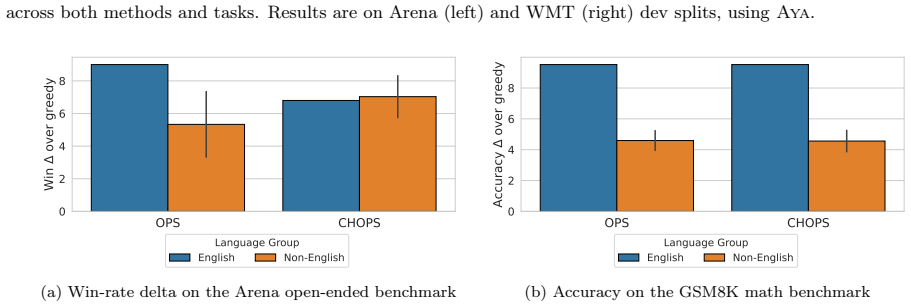
The machinery is a two-stage pipeline for parallel inference-time scaling. Sampling creates a pool of $N=5$ candidates. The paper's hedged sampling mixes stochastic samples at temperature $\tau \in [0.7, 0.9]$ with one deterministic greedy ($\tau=0$) output, because non-English languages show higher 'risk'—the worst sample's quality drops faster at high temperature—so the greedy sample acts as a safety net. Selection then picks one candidate. The paper compares Best-of-N with a reward model (scoring each sample independently), Minimum Bayes Risk (MBR) with pairwise LLM-judge comparisons, and two new methods: CHOPS, which asks an LLM judge to first write a prompt-specific evaluation checklist and then select the best candidate in a single pass ($O(1)$ judge calls); and X-MBR, which extends the MBR evidence set with $M=3$ extra samples written in a dominant language (Chinese for English prompts, English otherwise), leveraging cross-lingual generation to sharpen selection.
What would settle it
Run the same hedged sampling with CHOPS and X-MBR on m-ArenaHard in the seven test languages, then have human annotators rate the selected outputs and compare win rates per language against GPT-4o's ratings. If the methods' advantage shrinks or reverses for some languages when ground truth is human preference rather than the automated judge, the central claim would be shown to be judge-dependent.
Extended reading notes
Core claim
The paper's central claim is that parallel inference-time scaling—sample multiple outputs, then select one—generalizes to multilingual, multi-task settings only if both stages are language-aware. Existing selection methods that work in English (likelihood, similarity-based MBR) fail or underperform cross-lingually, while Best-of-N with a specialized reward model is a strong but not optimal baseline. The paper introduces hedged sampling (mixing high-temperature stochastic samples with the deterministic greedy output), CHOPS (one-pass checklist-based judge selection), and X-MBR (cross-lingual evidence for MBR). On test sets spanning open-ended generation (m-ArenaHard-v2.0), math reasoning (MGSM) and machine translation (WMT24++), across seven languages and two 8B models, the best combinations beat single-sample greedy decoding on every task and language, and also improve the outputs of the much larger Command-A model when it judges its own samples.
Load-bearing premise
The reported gains depend on the judges used for selection (Command A) and for evaluation (GPT-4o) agreeing with human preferences in every language; the paper acknowledges this reliance but does not measure whether judge preferences are biased toward certain languages, styles, or output lengths.
Editorial extensions
If this is right
- Five well-chosen samples can replace a much larger and more expensive model for many multilingual generation tasks.
- Existing English-tuned reward models are not the ceiling: generalist multilingual LLM judges can outperform a specialized RM for Best-of-N in open-ended multilingual generation.
- The same recipe transfers to a 111B model selecting its own outputs, so the gains do not depend on a size gap between generator and judge.
- The recipe is cheap: CHOPS costs $O(1)$ judge calls, and X-MBR requires only $N+M=8$ total samples and $O(N(N+M))$ pairwise comparisons.
- Scaling curves are steep at $N=5$; beyond $N=10$ gains become less predictable, so small budgets are a sensible operating point.
Reading between the lines
- The cross-lingual evidence idea suggests a testable extension: for languages with no strong auxiliary language, evidence drawn from several languages or from machine-translated prompts may give a similar boost.
- The checklist mechanism in CHOPS may be doing the real calibration work: asking the judge to operationalize quality criteria before reading candidates could reduce the length or style biases that plague LLM judges; this could be tested by comparing CHOPS against judges primed with fixed rubrics.
- Because the gains appear in open-ended generation and translation, synthetic-data pipelines that produce multilingual training data could adopt the same selection step to filter higher-quality samples at negligible extra cost.
- The paper only tests high-resource languages; if the pattern holds, the risk-hedging motivation is even stronger for lower-resource languages, where sample variance is larger.
Editorial analysis
A structured set of objections, weighed in public.
Referee Report
Summary. This paper studies parallel inference-time scaling (sampling N=5 outputs and selecting one) for multilingual, multi-task generation. The authors evaluate Aya-Expanse-8B, Qwen3-8B, and Command-A (111B) across seven languages on m-ArenaHard open-ended tasks, MGSM math reasoning, and WMT24++ translation. They introduce hedged sampling (mixing greedy with stochastic samples), CHOPS (one-pass checklist-based judge selection), and X-MBR (MBR with cross-lingual evidence in English/Chinese), reporting consistent win-rate, accuracy, and XComet gains over greedy decoding, with headline improvements such as +17.3 win-rate points for Aya on m-ArenaHard and +9.0 for Command-A. The paper argues that English-centric inference-time scaling strategies do not transfer across languages and tasks.
Significance. The contribution is practically relevant and empirically broad: the authors compare against strong reward-model BoN baselines, use separate dev, devtest, and test splits, and report results on open-ended generation, math, and MT across seven languages. If the judge-based gains are real, the proposed methods are low-cost and useful for production multilingual systems. However, the central quantitative claims rest entirely on LLM-judge win rates, and the paper explicitly acknowledges in its Limitations that judge alignment is not addressed; the absence of any cross-lingual validation of the judges is a significant gap that must be closed before the headline deltas can be taken at face value.
major comments (3)
- [Limitations; §3.3.2; Eq. (8)] The manuscript's central win-rate claims are evaluated with GPT-4o (m-ArenaHard) while CHOPS and X-MBR select using Command A. The Limitations section ('Reliance on judge alignment') concedes that the methods 'do not directly address' the issue, and no per-language agreement analysis between either judge and human preferences is provided. This matters because X-MBR (Eq. 8) scores target-language candidates against English/Chinese pseudo-references, so selection can favor outputs that match the judge's stylistic or length preferences in those evidence languages rather than genuine quality. M-RewardBench (Table 5) measures preference accuracy on a different task, not agreement on open-ended win rates. Please add a cross-lingual judge-bias check: either per-language human agreement for GPT-4o and Command A on a sample of m-ArenaHard, or a judge-substitution experiment (e.g., re-running the final evaluation with a different judge model) to demonstrate that the reported deltas are not artifacts.
- [§3.3.2; Tables 3 and 4] All quantitative results, including the headline '+17.3', '+9.0', and '+6.8', are point estimates without confidence intervals or significance tests. In Table 3, many deltas are small (e.g., +0.20 XComet for Aya WMT), and Table 8 shows negative per-language X-MBR deltas on WMT; a paired bootstrap over the 250/498 prompts could establish which gains are stable. Without such intervals, the claim of 'consistent gains across languages' is not supported at the reported level of precision. Please add uncertainty estimates for the main tables.
- [§3.3.2 vs Appendix F, Table 8] The text in §3.3.2 states 'We find improvements over the greedy baseline in all tasks, languages, and methods,' but Appendix F Table 8 reports negative X-MBR deltas for most WMT language pairs (e.g., Aya: Chinese -1.05, Japanese -3.62, Russian -2.73; Qwen: Chinese -0.23, Japanese -0.60, Russian -1.26). Even the averaged test result in Table 3 is only +0.20 for Aya WMT, and X-MBR underperforms RM-BoN and CHOPS on translation in both tables. The blanket claim and the recipe's recommendation of X-MBR for 'language disparities' therefore need to be qualified, for example restricted to open-ended generation.
minor comments (4)
- [Abstract; §3.3.2, Table 4] Please clarify in the abstract that the +6.8 average against Gemini is the X-MBR result specifically; CHOPS gives +5.0 and BoN +6.4 in Table 4, so the current wording ('our combined sampling and selection methods') overstates the consistency across methods.
- [§1; §3.1] Section 1 contains a typo ('and and how well'), and §3.1 defines X-MBR without stating explicitly that the M=3 evidence samples are an additional inference budget beyond the N=5 candidates; please state this in the method description.
- [Figure 4a] The x-axis labels ('Single Temperature Hedged Single Hedged Random Random Temperature') are hard to parse; consider a cleaner legend that distinguishes single vs multi-temperature and hedged vs non-hedged.
- [Table 5] M-RewardBench is a preference-accuracy benchmark; the text should clarify that it does not directly measure agreement with human open-ended quality judgments, which is precisely the gap noted in the Limitations.
Circularity Check
No circularity: headline gains are held-out empirical evaluations against external metrics; selection judges and hyperparameters are inputs, not derived predictions.
full rationale
The paper's derivation chain is empirical rather than formal, and I found no load-bearing step that reduces to its own inputs. The central claims (+17.3, +9.0, +6.8 win-rate points) are measured on held-out test splits (m-ArenaHard-v2.0, MGSM, WMT24++) with external evaluation metrics (GPT-4o win rate, exact match, XComet-XL). Sampling and selection hyperparameters (temperature 0.7, min-p 0.2, hedged greedy inclusion, and the X-MBR evidence-language rule) were chosen on dev splits and applied to the test set only once, which is standard practice and not a fitted-input-called-prediction loop. CHOPS and X-MBR use Command A as a selection judge, but the evaluation judge is GPT-4o; a selection model is an input to the pipeline, not a quantity derived from the evaluation. The self-improvement experiment uses Command A for both generation and selection, but the resulting win rates are judged by GPT-4o against greedy single-sample outputs, so the claim is not forced by construction. Some references are to the authors' own models and benchmarks (Aya Expanse, m-ArenaHard, M-RewardBench, Command A), but these support the experimental setup rather than supply an unverified theorem, uniqueness claim, or ansatz that the results depend on. The Limitations section explicitly acknowledges that judge-alignment is not addressed; that is a validity risk for the multilingual win-rate claims, not a circularity in the derivation. Because final results are evaluated against external or held-out metrics and no parameter is fitted to the test distribution, the appropriate finding is no significant circularity.
Assumptions & free parameters
free parameters (4)
- sampling temperature tau =
0.7
- min-p threshold p =
0.2
- cross-lingual evidence size M =
3
- X-MBR evidence language mapping =
Chinese for English prompts, English otherwise
assumptions (4)
- domain assumption GPT-4o is a reliable and unbiased judge of answer quality across the 7 test languages
- domain assumption The LLM judges (Command A) select outputs in a way that transfers to the GPT-4o-judged win-rate metric
- domain assumption The 7 high-resource languages are representative of multilingual settings
- domain assumption Exact-match accuracy on MGSM and XComet-XL on WMT are appropriate metrics for the respective tasks
Cite this review
Pith. "Pith review of When Life Gives You Samples: The Benefits of Scaling up Inference Compute for Multilingual LLMs." pith.science (2026). https://pith.science/paper/SZWQ72VG
@misc{pith2026250620544,
  author       = {Pith},
  title        = {Pith review of: When Life Gives You Samples: The Benefits of Scaling up Inference Compute for Multilingual LLMs},
  year         = {2026},
  howpublished = {\url{https://pith.science/paper/SZWQ72VG}},
  note         = {Machine review of arXiv:2506.20544}
}
read the original abstract
Recent advancements in large language models (LLMs) have shifted focus toward scaling inference-time compute, improving performance without retraining the model. A common approach is to sample multiple outputs in parallel, and select one of these as the final output. However, work to date has focused on English and a handful of domains such as math and code. In contrast, we are most interested in techniques that generalize across open-ended tasks, formally verifiable tasks, and across languages. In this work, we study how to robustly scale inference-time compute for open-ended generative tasks in a multilingual, multi-task setting. Our findings show that both sampling strategy based on temperature variation and selection strategy must be adapted to account for diverse domains and varied language settings. We evaluate existing selection methods, revealing that strategies effective in English often fail to generalize across languages. We propose novel sampling and selection strategies specifically adapted for multilingual and multi-task inference scenarios, and show they yield notable gains across languages and tasks. In particular, our combined sampling and selection methods lead to an average +6.8 jump in win-rates for our 8B models on m-ArenaHard-v2.0 prompts, against proprietary models such as Gemini. At larger scale, Command-A (111B model) equipped with our methods, shows +9.0 improvement in win-rates on the same benchmark with just five samples against single-sample decoding, a substantial increase at minimal cost. Our results underscore the need for language- and task-aware approaches to inference-time compute, aiming to democratize performance improvements in underrepresented languages.
Figures


Figures from the paper (10 more)




Forward citations
Cited by 1 Pith paper
-
CodeChemist: Test-Time Scaling for Low-Resource Code Generation via Functional Knowledge Transfer
Using Python-generated test oracles and multi-temperature sampling, CodeChemist selects low-resource-language code by execution pass rate and improves Pass@1 up to 69.5% over vanilla sampling.
Reference graph
Works this paper leans on
-
[1]
The multilingual alignment prism: Aligning global and local preferences to reduce harm
Arash Ahmadian Aakanksha, Beyza Ermis, Seraphina Goldfarb-Tarrant, Julia Kreutzer, Marzieh Fadaee, Sara Hooker, et al. The multilingual alignment prism: Aligning global and local preferences to reduce harm. InProceedings of the 2024 Conference on Empirical Methods in Natural Language Processing, pp. 12027–12049,
work page 2024
-
[6]
Training verifiers to solve math word problems.arXiv preprint arXiv:2110.14168,
Karl Cobbe, Vineet Kosaraju, Mohammad Bavarian, Mark Chen, Heewoo Jun, Lukasz Kaiser, Matthias Plappert, Jerry Tworek, Jacob Hilton, Reiichiro Nakano, et al. Training verifiers to solve math word problems.arXiv preprint arXiv:2110.14168,
-
[8]
Jonathan Cook, Tim Rocktäschel, Jakob Foerster, Dennis Aumiller, and Alex Wang. Ticking all the boxes: Generated checklists improve llm evaluation and generation.arXiv preprint arXiv:2410.03608,
-
[9]
RLHF can speak many languages: Unlocking multilingual preference optimization for LLMs
John Dang, Arash Ahmadian, Kelly Marchisio, Julia Kreutzer, Ahmet Üstün, and Sara Hooker. RLHF can speak many languages: Unlocking multilingual preference optimization for LLMs. In Yaser Al-Onaizan, Mohit Bansal, and Yun-Nung Chen (eds.),Proceedings of the 2024 Conference on Empirical Methods in Natural Language Processing, pp. 13134–13156, Miami, Florida...
arXiv 2024
-
[10]
URL https://arxiv.org/abs/2505.08751. Daniel Deutsch, Eleftheria Briakou, Isaac Caswell, Mara Finkelstein, Rebecca Galor, Juraj Juraska, Geza Kovacs, Alison Lui, Ricardo Rei, Jason Riesa, et al. Wmt24++: Expanding the language coverage of wmt24 to 55 languages & dialects.arXiv preprint arXiv:2502.12404,
-
[11]
18 Weihua Du, Yiming Yang, and Sean Welleck. Optimizing temperature for language models with multi-sample inference.arXiv preprint arXiv:2502.05234,
-
[14]
doi:10.18653/v1/2022.sumeval-1.4
Association for Computational Linguistics. doi:10.18653/v1/2022.sumeval-1.4. URLhttps://aclanthology.org/2022.sumeval-1.4/. Patrick Fernandes, António Farinhas, Ricardo Rei, José G. C. de Souza, Perez Ogayo, Graham Neubig, and Andre Martins. Quality-aware decoding for neural machine translation. In Marine Carpuat, Marie-Catherine de Marneffe, and Ivan Vla...
-
[15]
doi:10.18653/v1/2022.naacl-main.100
Association for Computational Linguistics. doi:10.18653/v1/2022.naacl-main.100. URL https://aclanthology .org/2022.naacl-main.100/. Markus Freitag, Behrooz Ghorbani, and Patrick Fernandes. Epsilon sampling rocks: Inves- tigating sampling strategies for minimum Bayes risk decoding for machine translation. In Houda Bouamor, Juan Pino, and Kalika Bali (eds.)...
Show all 45 references
-
[16]
doi:10.18653/v1/2023.findings-emnlp.617
Associa- tion for Computational Linguistics. doi:10.18653/v1/2023.findings-emnlp.617. URL https://aclanthology.org/2023.findings-emnlp.617/. Ashim Gupta and Vivek Srikumar. Test-time scaling with repeated sampling improves multilingual text generation,
2023 doi
-
[17]
Srishti Gureja, Lester James V Miranda, Shayekh Bin Islam, Rishabh Maheshwary, Drishti Sharma, Gusti Winata, Nathan Lambert, Sebastian Ruder, Sara Hooker, and Marzieh Fadaee
URLhttps://arxiv.org/abs/2505.21941. Srishti Gureja, Lester James V Miranda, Shayekh Bin Islam, Rishabh Maheshwary, Drishti Sharma, Gusti Winata, Nathan Lambert, Sebastian Ruder, Sara Hooker, and Marzieh Fadaee. M- rewardbench: Evaluating reward models in multilingual settings...
-
[18]
Truncation sampling as language model desmoothing
John Hewitt, Christopher Manning, and Percy Liang. Truncation sampling as language model desmoothing. In Yoav Goldberg, Zornitsa Kozareva, and Yue Zhang (eds.),Findings of the Association for Computational Linguistics: EMNLP 2022, pp. 3414–3427, Abu Dhabi, United Arab Emirates...
2022
-
[19]
doi:10.18653/v1/2022 .findings-emnlp.249
Association for Computational Linguistics. doi:10.18653/v1/2022 .findings-emnlp.249. URLhttps://aclanthology.org/2022.findings-emnlp.249/. Ari Holtzman, Jan Buys, Li Du, Maxwell Forbes, and Yejin Choi. The curious case of neural text degeneration. InInternational Conference on...
2022 doi
-
[20]
Audrey Huang, Adam Block, Qinghua Liu, Nan Jiang, Dylan J Foster, and Akshay Krishnamurthy
URL https://arxiv.org/abs/2407.05694. Audrey Huang, Adam Block, Qinghua Liu, Nan Jiang, Dylan J Foster, and Akshay Krishnamurthy. Is best-of-n the best of them? coverage, scaling, and optimality in inference-time alignment.arXiv preprint arXiv:2503.21878,
-
[22]
doi:10.18653/v1/2024.emnlp-main.248
Association for Computational Linguistics. doi:10.18653/v1/2024.emnlp-main.248. URL https://aclanthology .org/2024.emnlp-main.248/. Tom Kocmi, Eleftherios Avramidis, Rachel Bawden, Ondřej Bojar, Anton Dvorkovich, Christian Federmann, Mark Fishel, Markus Freitag, Thamme Gowda, ...
2024 doi
-
[23]
doi:10.18653/v1/2024.wmt-1.109
Association for Computational Linguistics. doi:10.18653/v1/2024.wmt-1.109. URL https://aclanthology.org/2024.wmt-1.109/. Julia Kreutzer, Eleftheria Briakou, Sweta Agrawal, Marzieh Fadaee, and Kocmi Tom. D\’ej\a vu: Multilingual llm evaluation through the lens of machine transl...
2024 arXiv
-
[25]
From crowdsourced data to high-quality benchmarks: Arena-hard and benchbuilder pipeline.arXiv preprint arXiv:2406.11939,
Tianle Li, Wei-Lin Chiang, Evan Frick, Lisa Dunlap, Tianhao Wu, Banghua Zhu, Joseph E Gonzalez, and Ion Stoica. From crowdsourced data to high-quality benchmarks: Arena-hard and benchbuilder pipeline.arXiv preprint arXiv:2406.11939,
-
[26]
Chris Yuhao Liu, Liang Zeng, Jiacai Liu, Rui Yan, Jujie He, Chaojie Wang, Shuicheng Yan, Yang Liu, and Yahui Zhou
URLhttps://openreview.net/f orum?id=v8L0pN6EOi. Chris Yuhao Liu, Liang Zeng, Jiacai Liu, Rui Yan, Jujie He, Chaojie Wang, Shuicheng Yan, Yang Liu, and Yahui Zhou. Skywork-reward: Bag of tricks for reward modeling in llms.arXiv preprint arXiv:2410.18451,
-
[27]
Ayomide Odumakinde, Daniel D’souza, Pat Verga, Beyza Ermis, and Sara Hooker
URLhttps: //openreview.net/forum?id=FBkpCyujtS. Ayomide Odumakinde, Daniel D’souza, Pat Verga, Beyza Ermis, and Sara Hooker. Multilingual arbi- trage: Optimizing data pools to accelerate multilingual progress.arXiv preprint arXiv:2408.14960,
-
[28]
José Pombal, Dongkeun Yoon, Patrick Fernandes, Ian Wu, Seungone Kim, Ricardo Rei, Graham Neubig, and André FT Martins
URLhttps://kar.kent.ac.uk/105743/. José Pombal, Dongkeun Yoon, Patrick Fernandes, Ian Wu, Seungone Kim, Ricardo Rei, Graham Neubig, and André FT Martins. M-prometheus: A suite of open multilingual llm judges.arXiv preprint arXiv:2504.04953,
-
[29]
The effect of sampling temperature on problem solving in large language models
Matthew Renze. The effect of sampling temperature on problem solving in large language models. In Yaser Al-Onaizan, Mohit Bansal, and Yun-Nung Chen (eds.),Findings of the Association for Computational Linguistics: EMNLP 2024, pp. 7346–7356, Miami, Florida, USA, November
2024
-
[30]
doi:10.18653/v1/2024.findings-emnlp.432
Association for Computational Linguistics. doi:10.18653/v1/2024.findings-emnlp.432. URL https://aclanthology.org/2024.findings-emnlp.432/. 21 Chufan Shi, Haoran Yang, Deng Cai, Zhisong Zhang, Yifan Wang, Yujiu Yang, and Wai Lam. A thorough examination of decoding methods in th...
2024 doi
-
[31]
doi:10.18653/v1/2024.emnlp-main.489
Association for Computational Linguistics. doi:10.18653/v1/2024.emnlp-main.489. URL https://aclantholo gy.org/2024.emnlp-main.489/. Freda Shi, Mirac Suzgun, Markus Freitag, Xuezhi Wang, Suraj Srivats, Soroush Vosoughi, Hyung Won Chung, Yi Tay, Sebastian Ruder, Denny Zhou, et a...
2024 arXiv
-
[32]
Guijin Son, Jiwoo Hong, Hyunwoo Ko, and James Thorne
URLhttps://openreview.net/forum?i d=4FWAwZtd2n. Guijin Son, Jiwoo Hong, Hyunwoo Ko, and James Thorne. Linguistic generalizability of test-time scaling in mathematical reasoning.arXiv preprint arXiv:2502.17407,
-
[33]
The good, the bad, and the greedy: Evaluation of LLMs should not ignore non-determinism
Yifan Song, Guoyin Wang, Sujian Li, and Bill Yuchen Lin. The good, the bad, and the greedy: Evaluation of LLMs should not ignore non-determinism. In Luis Chiruzzo, Alan Ritter, and Lu Wang (eds.),Proceedings of the 2025 Conference of the Nations of the Americas Chapter of the ...
2025
-
[34]
ISBN 979-8-89176-189-6
Association for Computational Linguistics. ISBN 979-8-89176-189-6. doi:10.18653/v1/2025.naacl-long.211. URL https: //aclanthology.org/2025.naacl-long.211/. Miloš Stanojević, Amir Kamran, Philipp Koehn, and Ondřej Bojar. Results of the wmt15 metrics shared task. InProceedings o...
2025 doi
-
[36]
Nandan Thakur, Jianmo Ni, Gustavo Hernandez Abrego, John Wieting, Jimmy Lin, and Daniel Cer
URL https://openreview.net/forum?id=348hfcprUs. Nandan Thakur, Jianmo Ni, Gustavo Hernandez Abrego, John Wieting, Jimmy Lin, and Daniel Cer. Leveraging LLMs for synthesizing training data across many languages in multilingual dense retrieval. In Kevin Duh, Helena Gomez, and St...
2024
-
[37]
doi:10.18653/v1/2024.naacl-long.426
Association for Computational Linguistics. doi:10.18653/v1/2024.naacl-long.426. URL https://aclanthology.org/2024.naacl-long.426/. Hugo Touvron, Thibaut Lavril, Gautier Izacard, Xavier Martinet, Marie-Anne Lachaux, Timothée Lacroix, Baptiste Rozière, Naman Goyal, Eric Hambro, ...
2024 arXiv
-
[38]
Aya model: An instruction finetuned open-access multilingual language model.arXiv preprint arXiv:2402.07827,
Ahmet Üstün, Viraat Aryabumi, Zheng-Xin Yong, Wei-Yin Ko, Daniel D’souza, Gbemileke Onilude, Neel Bhandari, Shivalika Singh, Hui-Lee Ooi, Amr Kayid, et al. Aya model: An instruction finetuned open-access multilingual language model.arXiv preprint arXiv:2402.07827,
-
[39]
Zhilin Wang, Yi Dong, Olivier Delalleau, Jiaqi Zeng, Gerald Shen, Daniel Egert, Jimmy J Zhang, Makesh Narsimhan Sreedhar, and Oleksii Kuchaiev
URL https://openreview.net/forum?id=1PL1NIMMrw. Zhilin Wang, Yi Dong, Olivier Delalleau, Jiaqi Zeng, Gerald Shen, Daniel Egert, Jimmy J Zhang, Makesh Narsimhan Sreedhar, and Oleksii Kuchaiev. Helpsteer2: Open-source dataset for training top-performing reward models.arXiv prepr...
-
[40]
Yangzhen Wu, Zhiqing Sun, Shanda Li, Sean Welleck, and Yiming Yang
URLhttps://openreview.net/forum?id=7xCS K9BLPy. Yangzhen Wu, Zhiqing Sun, Shanda Li, Sean Welleck, and Yiming Yang. Scaling inference computa- tion: Compute-optimal inference for problem-solving with language models. InThe 4th Workshop on Mathematical Reasoning and AI at NeurI...
2024 arXiv
-
[41]
doi:10.18653/v1/2024.acl-long.405
Association for Computational Linguistics. doi:10.18653/v1/2024.acl-long.405. URL https://aclanthology.org/2024.acl-long.405/. Lunjun Zhang, Arian Hosseini, Hritik Bansal, Mehran Kazemi, Aviral Kumar, and Rishabh Agarwal. Generative verifiers: Reward modeling as next-token pre...
2024 arXiv
-
[42]
non-thinking
Association for Computational Linguistics. doi: 10.18653/v1/2024.findings-acl.498. URLhttps://aclanthology.org/2024.findings-acl.498/. 24 A Detailed Experimental Setup Models and Language CoverageFor the multilingual generative model, we consider two 8B models from different f...
2024 doi
-
[43]
For the larger models (Command A and Gemini 2.0 Flash), we use their dedicated hosted APIs
Model Serving:We use vLLM [Kwon et al., 2023] to generate outputs from our 8B models (Aya andQwen), loading them with FP8 quantization and a maximum sequence length of 8,192 tokens. For the larger models (Command A and Gemini 2.0 Flash), we use their dedicated hosted APIs. For...
2023
-
[44]
where its agreement with pairwise human preferences from Chatbot Arena battles in multiple languages is close to GPT-4o’s, with particular strengths in Chinese, Vietnamese, French, Turkish and Dutch. On the English RewardBench benchmark [Lambert et al., 2024], classifier RMs a...
2024
-
[45]
"" Listing 1: Prompt Used for Checklisted One Pass Selection (CHOPS) 30
and Stroebl et al. [2024]. The results in Figure 13 illustrates this issue: Win rate improvements over greedy are not developing smoothly across languages, sometimes even dropping below zero, so that it is not always the case that sampling more will result in a larger improvem...
2024
-
[1985]
doi:https://doi.org/10.1016/S0 364-0213(85)80012-4
ISSN 0364-0213. doi:https://doi.org/10.1016/S0 364-0213(85)80012-4. URL https://www.sciencedirect.com/science/article/pii/S0364021 385800124. Arash Ahmadian, Seraphina Goldfarb-Tarrant, Beyza Ermis, Marzieh Fadaee, Sara Hooker, et al. Mix data or merge models? optimizing for d...
-
[2002]
doi: 10.3115/1118693.1118712
Association for Computational Linguistics. doi: 10.3115/1118693.1118712. URLhttps://doi.org/10.3115/1118693.1118712. 20 Shankar Kumar and William Byrne. Minimum Bayes-risk decoding for statistical machine translation. InProceedings of the Human Language Technology Conference o...
-
[2015]
Inference scaling{F} laws: The limits of llm resampling with imperfect verifiers.arXiv preprint arXiv:2411.17501,
Benedikt Stroebl, Sayash Kapoor, and Arvind Narayanan. Inference scaling{F} laws: The limits of llm resampling with imperfect verifiers.arXiv preprint arXiv:2411.17501,
-
[2019]
doi:10.18653/v1/P19-1365
Association for Computational Linguistics. doi:10.18653/v1/P19-1365. URLhttps://aclanthology.org/P19-1365/. Seungone Kim, Juyoung Suk, Shayne Longpre, Bill Yuchen Lin, Jamin Shin, Sean Welleck, Graham Neubig, Moontae Lee, Kyungjae Lee, and Minjoon Seo. Prometheus 2: An open so...
-
[2020]
doi: 10.18653/v1/2020.coling-main.398
International Committee on Computational Linguistics. doi: 10.18653/v1/2020.coling-main.398. URLhttps://aclanthology.org/2020.coling-main.398/. Bryan Eikema and Wilker Aziz. Sampling-based approximations to minimum Bayes risk decoding for neural machine translation. In Yoav Go...
2020 doi
-
[2021]
Command a: An enterprise-ready large language model.arXiv preprint arXiv:2504.00698,
Team Cohere, Arash Ahmadian, Marwan Ahmed, Jay Alammar, Yazeed Alnumay, Sophia Althammer, Arkady Arkhangorodsky, Viraat Aryabumi, Dennis Aumiller, Raphaël Avalos, et al. Command a: An enterprise-ready large language model.arXiv preprint arXiv:2504.00698,
-
[2022]
doi:10.18653/v1/2022.emnlp-main.754
Association for Computational Linguistics. doi:10.18653/v1/2022.emnlp-main.754. URL https://aclanthology.org/2022.em nlp-main.754/. Christian Federmann, Tom Kocmi, and Ying Xin. NTREX-128 – news test references for MT evaluation of 128 languages. In Kabir Ahuja, Antonios Anast...
2022 doi
-
[2023]
doi:10.18653/v1/2023.bigpicture-1.9
Association for Computational Linguistics. doi:10.18653/v1/2023.bigpicture-1.9. URL https://aclanthology.org/2023.bigpicture-1.9/. Bradley Brown, Jordan Juravsky, Ryan Ehrlich, Ronald Clark, Quoc V Le, Christopher Ré, and Azalia Mirhoseini. Large language monkeys: Scaling infe...
2023 arXiv
-
[2024]
Do we truly need so many samples? multi-llm repeated sampling efficiently scale test-time compute.arXiv preprint arXiv:2504.00762,
Jianhao Chen, Zishuo Xun, Bocheng Zhou, Han Qi, Qiaosheng Zhang, Yang Chen, Wei Hu, Yuzhong Qu, Wanli Ouyang, and Shuyue Hu. Do we truly need so many samples? multi-llm repeated sampling efficiently scale test-time compute.arXiv preprint arXiv:2504.00762,
-
[2025]
Breaking language barriers in multilingual mathematical reasoning: Insights and observations.arXiv preprint arXiv:2310.20246,
Nuo Chen, Zinan Zheng, Ning Wu, Ming Gong, Dongmei Zhang, and Jia Li. Breaking language barriers in multilingual mathematical reasoning: Insights and observations.arXiv preprint arXiv:2310.20246,
Reviewed August 6, 2026 · model on record in the stance chip above.
Discussion (0). Sign in to comment.