REVIEW 3 major objections 5 minor 30 references
GenEscape: Hierarchical Multi-Agent Generation of Escape Room Puzzles
T0 review · 3 major / 5 minor · reviewed 2026-08-06 · deepseek-v4-flash
Pith's one-line read A four-agent team—designer, player, examiner, builder—makes escape-room puzzle images that people judge more solvable, raising the solvability preference from 3.3% to 53.3%.
desk verdict Novel task and sensible multi-agent pipeline, but solvability is measured by image preference, not by whether anyone can actually solve the puzzle. read the letter →
The pith
A machine-rendered reading of the paper's core claim, the machinery that carries it, and where it could break.
The reading
What carries the argument
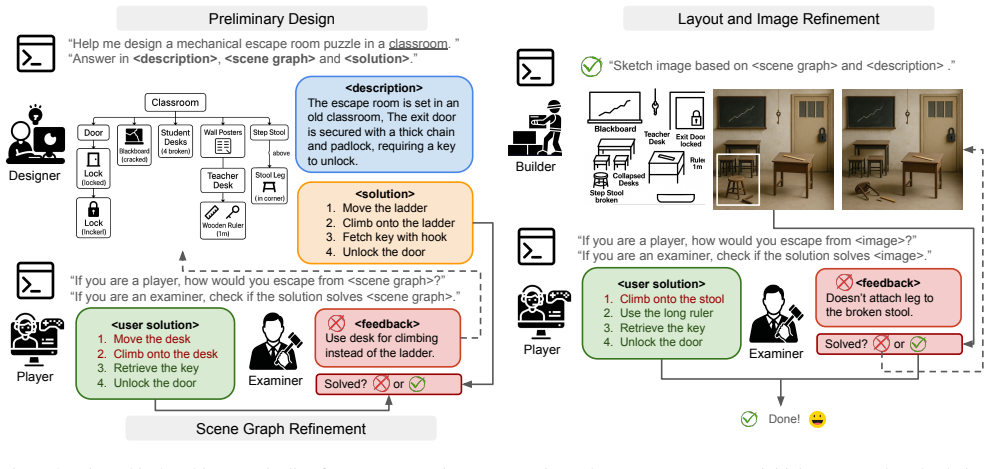
The load-bearing mechanism is the Player–Examiner loop, in which one agent (the Player) tries to escape from the current representation—first the textual scene graph, then the 2D layout, then the photorealistic image—while a second agent (the Examiner) compares the attempted solution with the intended one and issues bullet-point feedback on discrepancies, such as shortcuts. This loop is applied hierarchically at three abstraction levels, so logical flaws are caught cheaply in symbols before expensive image generation, and only the residual visual-affordance errors are fixed by local image editing at the pixel level. The Designer supplies the initial puzzle description, scene graph, and intended solution; the Builder turns the verified graph into a layout and then an image.
What would settle it
Have independent participants actually try to solve each generated puzzle image, with no ground-truth solution available, and record whether they follow the intended action sequence; if the full pipeline's images are not solved more often than the baselines' images, the reported solvability preference does not reflect real solvability.
Extended reading notes
Core claim
The central discovery is that iterated, role-specialized critique—rather than a single prompt or a chain of prompts—is what makes a generated scene logically usable. The paper demonstrates this through a hierarchy of four stages: an initial text design, a symbolic scene graph, a 2D layout, and a final photorealistic image; at every stage a Player agent proposes a solution and an Examiner agent compares it to the intended one, so that shortcuts are closed and affordances clarified before the next stage begins. The final stage adds local image editing guided by which visual cue the Player misread. Quantitatively, the complete pipeline raises the proportion of cases where annotators rank its output as the best for solvability from 3.3% (vanilla GPT-4o) to 53.3%, for shortcut avoidance from 0% to 46.6%, and achieves 36.7% for spatial alignment, while using fewer image generations than the partial pipelines.
Load-bearing premise
The results assume that when annotators look at two images and pick which one they could solve, that choice predicts whether a person would actually find and execute the intended multi-step solution in the real image.
Editorial extensions
If this is right
- Human assessors, not just automatic metrics, discriminate between the full pipeline and its ablations, chiefly on whether the intended multi-step solution can be read off the image.
- The refinement loop closes shortcuts: the Examiner specifically catches Player attempts that bypass the intended tool, such as using a desk instead of a ladder to reach a key.
- Because all agents are instances of the same black-box vision-language model, the pipeline can be re-hosted on a different text-to-image service without retraining.
- The hierarchical order matters for cost: symbolic and layout-level iteration happens before images are rendered, which is why the full pipeline uses fewer image generations per puzzle than variants that skip the layout stage.
Reading between the lines
- A direct test would be to let real players attempt the generated puzzles in a controlled setting and measure whether they actually execute the intended solution; the paper only measures annotators' preference for which image looks most solvable. If the two diverge, the reported solvability gain is a preference effect, not a problem-solving effect.
- The Player–Examiner loop is essentially a generic consistency oracle: the same hierarchy could be applied to any generation task with a checkable specification, such as safety instructions, assembly diagrams, or board-game layouts, wherever shortcuts and affordances can be verbalized.
- The eight-step and eight-object ceiling the authors report suggests the bottleneck is the model's spatial working memory; a natural extension is to externalize object states, such as a simulated inventory, so the scene graph is re-verified after each action without requiring the image itself to update.
- Including a hidden-object mechanic, which the paper lists as unsupported, would require moving from a single static image to a conditional image sequence; the current hierarchy already has the machinery to steer such sequences if the base model could do multi-frame edits.
Editorial analysis
A structured set of objections, weighed in public.
Referee Report
Summary. The paper introduces GenEscape, a hierarchical multi-agent framework for generating 2D escape-room puzzle images. The system decomposes generation into four stages: a Designer creates a scene description, a symbolic scene graph, and an intended solution; Player and Examiner agents iteratively refine the graph for logical solvability; a Builder produces a 2D layout and then a photorealistic image; finally, the Player/Examiner loop is re-applied to the image to verify visual affordances and suppress shortcuts. Experiments compare the full pipeline against vanilla GPT-4o and ablations that omit individual stages, using human preference judgments (best-image selection by 10 annotators per scene on 15 scenes) and a Long-CLIP score. The paper reports that the full pipeline achieves 53.3% solvability, 46.6% shortcut avoidance, and 36.7% spatial alignment, versus 3.3%, 0%, and N/A for vanilla GPT-4o, and concludes that agent collaboration improves output quality while maintaining visual quality. A human-AI interaction interface is also presented as a proof of playability.
Significance. If the central claim is established, the paper makes a useful contribution: it defines a novel generation task, proposes a concrete multi-agent decomposition with symbolic intermediate representations, and demonstrates qualitative improvements in spatial coherence and affordance clarity. The hierarchical refinement ideas—separating functional design, scene-graph reasoning, layout synthesis, and local editing—are reasonable and could transfer to other structured visual-generation tasks. The paper is clearly written, the framework is reproducible in principle, and the appendix provides full intended solutions for several example scenes, which aids transparency. However, the central claim about solvability rests entirely on a preference-selection proxy rather than on evidence that a person can actually infer the intended solution. The evaluation also lacks variance estimates and significance tests, and the ablation numbers in Table 1 show substantial swings that are not discussed. These issues are fixable within the scope of the manuscript, but they are load-bearing for the paper's main conclusion.
major comments (3)
- [§4.1, Table 1] The operational definition of Solvability in Section 4.1 is "whether a player can infer the intended multi-step solution purely from visual cues," but the reported protocol only asks 10 annotators per scene to "select the best image" among outputs while showing the scene description and object names. Annotators are not asked to propose an action sequence, are not told the intended solution (so they cannot verify it is inferable), and may prefer images that merely contain the listed objects or appear more puzzle-like. The 53.3% versus 3.3% gap is therefore a difference in relative preferences, not a measured difference in solvability. To support the abstract's central claim, the authors should either run a genuine solving study (e.g., asking annotators to produce action sequences and scoring them against the intended solution, with an option to indicate that no solution is visible) or provide evidence that the best-image selection metric correlates with actual solvability.
- [§4.2, Table 1] No error bars, confidence intervals, or significance tests are reported, and the sample is only 15 scenes with 10 annotators each. The ablation numbers swing substantially across rows—for example, spatial alignment drops from 26.7% for +D+S.G. to 13.3% for +D+S.G.+L, then rises to 23.3% for +D+S.G.+I before reaching 36.7% for the full pipeline—yet the text interprets every change as a monotonic benefit of the added module. The overall 53.3% versus 3.3% difference may be meaningful, but the individual ablation claims are not supported without variance estimates and an appropriate significance test (or at least bootstrap confidence intervals). Please report per-scene agreement and statistical uncertainty.
- [§3.3 and Algorithm 1] The Player and Examiner agents are instances of the same GPT-4o family that generated the scene graph and the intended solution, so the internal refinement loop measures self-consistency of the generator rather than independent verification that a human can solve the puzzle. The human evaluation in Section 4.1 is external, but as noted in the first major comment, it does not test solving. The paper should explicitly discuss this circularity concern and add an external check—either a human solving task or a different model as an independent verifier—to support the claim that the iterative loop improves human solvability rather than merely converging to the model's own preferences.
minor comments (5)
- [Appendix (Solutions to Figure 3)] The appendix provides solutions for 8 of the 15 test scenes, but the evaluation was conducted on 15 scenes. Please list all 15 scene settings and their intended solutions, or explain why only a subset is shown.
- [Table 1] The Long-CLIP score column is not accompanied by any description of the exact prompt used for scoring or the number of samples; please specify how the score is computed and report the standard deviation or a confidence interval.
- [Algorithm 1] The input is called "ground-truth solution S," but S is generated by the Designer, not independently verified ground truth. Consider renaming it "intended solution" throughout the pseudocode and the text to avoid confusion.
- [§5] The human interface demo in Figure 4 shows the AI providing increasingly direct guidance until the player converges on the intended path. The paper should clarify whether this interface is intended as a playability demo or as an evaluation tool; as presented, it appears to be the former, which is fine but should be stated.
- [§4.1] The metric names Solvability, Shortcut Avoidance, and Spatial Alignment are defined only in prose; a brief annotation-instruction excerpt would help readers understand what annotators were actually shown and asked to do.
Circularity Check
GenEscape's solvability claim rests on a GPT-4o self-consistency loop: the same model writes the ground-truth solution and then verifies that it can reproduce it.
-
self definitional
[Section 3.1, Section 3.3, Algorithm 1]
"At each stage, the Player proposes a solution, and the Examiner verifies solvability. ... We repeat until the Examiner confirms the solution matches the official one. ... The Player agent attempts to solve the puzzle by generating a sequence of actions based solely on the scene graph structure. This proposed solution is then evaluated by the Examiner agent, who compares it against the intended solution."
Algorithm 1 takes the Designer-generated 'ground-truth solution' S as input and loops until examiner.check(S, S*) = ∅, i.e., until the Player's solution equals S. The Player and Examiner are independent instances of the same GPT-4o model that wrote S. The convergence condition therefore encodes self-consistency: the system declares the puzzle solvable when the generating model can reproduce its own intended solution. No external solver or human verifier enters this loop. The paper's further claim that this symbolic verification 'ensures ... a functionally valid and solvable puzzle' (Section 3.3) equates solvability with generator self-agreement by construction.
full rationale
GenEscape does not rely on self-citation or imported uniqueness theorems; its references are external, and the Builder, layout synthesis, local editing, Long-CLIP scoring, and human annotators provide some independent content. However, the central solvability claim is only partially grounded. The internal Player-Examiner refinement is a self-consistency loop: the ground-truth solution S is generated by the Designer, and the Examiner checks whether the Player (both instances of GPT-4o) reproduces S. Thus the assertion that the refined scene graph 'ensures' a solvable puzzle reduces by construction to the model agreeing with itself. The external human study does not repair this gap: Section 4.1 asks annotators to 'select the best image' for solvability while showing the scene description and object names, rather than asking them to infer or attempt the intended multi-step solution, so the reported 53.3% solvability in Table 1 is a best-image preference rate, not a demonstrated solve rate. The guided Human Interface (Section 5) also supplies the ground-truth solution to the AI that evaluates the human, so it does not independently establish inferability. Section 7's limitations are candid about short solution chains, spatial mistakes, and slow convergence, but they do not address this circular validation. Overall, the derivation chain is partially circular: the internal verification is self-referential, and the external metric does not measure the construct it names.
Assumptions & free parameters
assumptions (3)
- domain assumption The Examiner agent's VLM judgments reliably detect visual affordance errors in generated images.
- domain assumption The local image editing operation can modify images to add or remove affordances as specified.
- ad hoc to paper Human annotators' preference selections for 'solvability' are a valid proxy for true puzzle solvability.
Cite this review
Pith. "Pith review of GenEscape: Hierarchical Multi-Agent Generation of Escape Room Puzzles." pith.science (2026). https://pith.science/paper/R7EYKQQB
@misc{pith2026250621839,
  author       = {Pith},
  title        = {Pith review of: GenEscape: Hierarchical Multi-Agent Generation of Escape Room Puzzles},
  year         = {2026},
  howpublished = {\url{https://pith.science/paper/R7EYKQQB}},
  note         = {Machine review of arXiv:2506.21839}
}
read the original abstract
We challenge text-to-image models with generating escape room puzzle images that are visually appealing, logically solid, and intellectually stimulating. While base image models struggle with spatial relationships and affordance reasoning, we propose a hierarchical multi-agent framework that decomposes this task into structured stages: functional design, symbolic scene graph reasoning, layout synthesis, and local image editing. Specialized agents collaborate through iterative feedback to ensure the scene is visually coherent and functionally solvable. Experiments show that agent collaboration improves output quality in terms of solvability, shortcut avoidance, and affordance clarity, while maintaining visual quality.
Figures


Figures from the paper (1 more)

Reference graph
Works this paper leans on
-
[1]
Yew Ken Chia, Vernon Toh, Deepanway Ghosal, Lidong Bing, and Soujanya Poria. Puzzlevqa: Diagnosing mul- timodal reasoning challenges of language models with ab- stract visual patterns. InFindings of the Association for Com- putational Linguistics: ACL 2024 , 2024. 2
work page 2024
-
[2]
Gemini 1.5 technical report, 2024
Google DeepMind. Gemini 1.5 technical report, 2024. Ac- cessed: 2025-05-08. 1
work page 2024
-
[3]
Black- box prompt optimization with meta reinforcement learning
Qi Diao, Zhengxiao Xu, Tong Zhang, and Hang Li. Black- box prompt optimization with meta reinforcement learning. In International Conference on Learning Representations (ICLR), 2023. arXiv:2201.08531. 1
arXiv 2023
-
[4]
Puzzles: A benchmark for neural algorithmic reasoning
Benjamin Estermann, Luca Lanzend ¨orfer, Yannick Nieder- mayr, and Roger Wattenhofer. Puzzles: A benchmark for neural algorithmic reasoning. In Advances in Neural Infor- mation Processing Systems (NeurIPS), 2024. 2
work page 2024
-
[5]
Large language models empowered agent-based modeling and simulation: A survey and perspectives
Chen Gao, Xiaochong Lan, Nian Li, Yuan Yuan, Jingtao Ding, Zhilun Zhou, Fengli Xu, and Yong Li. Large language models empowered agent-based modeling and simulation: A survey and perspectives. Humanities and Social Sciences Communications, 11(1):1259, 2024. 2
work page 2024
-
[6]
Chain-of-agents: Large language mod- els collaborating on long context tasks
Google Research. Chain-of-agents: Large language mod- els collaborating on long context tasks. https : / / research . google / blog / chain - of - agents - large- language- models- collaborating- on- long-context-tasks/, 2024. 2
work page 2024
-
[7]
Optimizing prompts for text-to-image generation
Yaru Hao, Zewen Chi, Li Dong, and Furu Wei. Optimizing prompts for text-to-image generation. In Advances in Neural Information Processing Systems, 2023. 1
work page 2023
-
[8]
Prompt-to-prompt image editing with cross-attention control
Amir Hertz, Ron Mokady, Rinon Gal, Amit H Bermano, and Daniel Cohen-Or. Prompt-to-prompt image editing with cross-attention control. In International Conference on Learning Representations (ICLR), 2023. 1
work page 2023
Show all 30 references
-
[9]
Scalable perception-action-communication loops with convolutional and graph neural networks
Ting-Kuei Hu, Fernando Gama, Tianlong Chen, Wenqing Zheng, Zhangyang Wang, Alejandro Ribeiro, and Brian M Sadler. Scalable perception-action-communication loops with convolutional and graph neural networks. arXiv preprint arXiv:2106.13358, 2021. 2
2021 arXiv
-
[10]
The power of scale for parameter-efficient prompt tuning
Brian Lester, Rami Al-Rfou, and Noah Constant. The power of scale for parameter-efficient prompt tuning. In Pro- ceedings of the 2021 Conference on Empirical Methods in Natural Language Processing (EMNLP) , pages 3045–3059,
2021
-
[11]
Mccd: Multi-agent collaboration-based compositional diffusion for complex text-to-image genera- tion
Mingcheng Li, Xiaolu Hou, Ziyang Liu, Dingkang Yang, Ziyun Qian, Jiawei Chen, Jinjie Wei, Yue Jiang, Qingyao Xu, and Lihua Zhang. Mccd: Multi-agent collaboration-based compositional diffusion for complex text-to-image genera- tion. In Proceedings of the IEEE/CVF Conference on ...
2025
-
[12]
Hunyuan-dit: A powerful multi-resolution diffusion trans- former with fine-grained chinese understanding, 2024
Zhimin Li, Jianwei Zhang, Qin Lin, Jiangfeng Xiong, Yanxin Long, Xinchi Deng, Yingfang Zhang, Xingchao Liu, Minbin Huang, Zedong Xiao, Dayou Chen, Jiajun He, Jiahao Li, Wenyue Li, Chen Zhang, Rongwei Quan, Jianxiang Lu, Jiabin Huang, Xiaoyan Yuan, Xiaoxiao Zheng, Yixuan Li, Ji...
2024
-
[13]
Compositional visual generation with composable diffusion models
Shuang Liu, Song Li, Yilun Du, Antonio Torralba, and Joshua B Tenenbaum. Compositional visual generation with composable diffusion models. In European Conference on Computer Vision (ECCV), 2022. 1
2022
-
[14]
Dynamic prompt optimizing for text- to-image generation
Wenyi Mo, Tianyu Zhang, Yalong Bai, Bing Su, Ji-Rong Wen, and Qing Yang. Dynamic prompt optimizing for text- to-image generation. In Proceedings of the IEEE/CVF Con- ference on Computer Vision and Pattern Recognition , 2024. 1
2024
-
[15]
Gpt-4o technical report, 2024
OpenAI. Gpt-4o technical report, 2024. Accessed: 2025-05-
2024
-
[16]
Training language models to follow instructions with human feed- back
Long Ouyang, Jeff Wu, Xu Jiang, and et al. Training language models to follow instructions with human feed- back. In Advances in Neural Information Processing Systems (NeurIPS), 2022. 1
2022
-
[17]
Generative agents: Interactive simulacra of human behavior
Joon Sung Park, Joseph C O’Brien, Carrie J Cai, Mered- ith Ringel Morris, Percy Liang, and Michael S Bernstein. Generative agents: Interactive simulacra of human behavior. arXiv preprint arXiv:2304.03442, 2023. 1
2023 arXiv
-
[18]
Solving puzzles with an ensemble of chain-of-thought prompts
Md Nishat Raihan, Dhiman Goswami, Al Nahian Bin Em- ran, Sadiya Sayara Chowdhury Puspo, Amrita Ganguly, and Marcos Zampieri. Solving puzzles with an ensemble of chain-of-thought prompts. In Proceedings of the 18th In- ternational Workshop on Semantic Evaluation (SemEval) ,
-
[19]
Autoprompt: Eliciting knowl- edge from language models with automatically generated prompts
Taylor Shin, Yasaman Razeghi, Robert L Logan IV , Eric Wallace, and Suchin Singh. Autoprompt: Eliciting knowl- edge from language models with automatically generated prompts. In Proceedings of the 2020 Conference on Em- pirical Methods in Natural Language Processing (EMNLP) , ...
2020
-
[20]
Cogvlm: Visual expert for pretrained language models
Can Wang, Zhikang Zhang, Zhanming Tang, et al. Cogvlm: Visual expert for pretrained language models. arXiv preprint arXiv:2403.07584, 2024. 1
2024 arXiv
-
[21]
Multi- modal llm as an agent for unified image generation and edit- ing
Zhenyu Wang, Aoxue Li, Zhenguo Li, and Xihui Liu. Multi- modal llm as an agent for unified image generation and edit- ing. In Advances in Neural Information Processing Systems (NeurIPS), 2024. 1
2024
-
[22]
How do mul- timodal large language models handle complex multimodal reasoning? placing them in an extensible escape game, 2025
Ziyue Wang, Yurui Dong, Fuwen Luo, Minyuan Ruan, Zhili Cheng, Chi Chen, Peng Li, and Yang Liu. How do mul- timodal large language models handle complex multimodal reasoning? placing them in an extensible escape game, 2025. 2
2025
-
[23]
Universal prompt optimizer for safe text- to-image generation
Zongyu Wu, Hongcheng Gao, Yueze Wang, Xiang Zhang, and Suhang Wang. Universal prompt optimizer for safe text- to-image generation. In Proceedings of the 2024 Confer- ence of the North American Chapter of the Association for Computational Linguistics: Human Language Technologie...
2024
-
[24]
Planning with multi-constraints via collaborative language agents
Yujie Xiong, Yuan Cheng, Yinghui Xu, et al. Planning with multi-constraints via collaborative language agents. In Pro- ceedings of the 2025 Conference on Computational Linguis- tics (COLING), 2025. 2
2025
-
[25]
Mm- storyagent: Immersive narrated storybook video generation with a multi-agent paradigm across text, image and audio
Xuenan Xu, Jiahao Mei, Chenliang Li, Yuning Wu, Ming Yan, Shaopeng Lai, Ji Zhang, and Mengyue Wu. Mm- storyagent: Immersive narrated storybook video generation with a multi-agent paradigm across text, image and audio. arXiv preprint arXiv:2503.05242, 2024. 2
2024 arXiv
-
[26]
Long-clip: Unlocking the long-text capability of clip
Beichen Zhang, Pan Zhang, Xiaoyi Dong, Yuhang Zang, and Jiaqi Wang. Long-clip: Unlocking the long-text capability of clip. arXiv preprint arXiv:2403.15378, 2024. 3
2024 arXiv
-
[27]
Reflective multi- agent collaboration based on large language models
Zeyu Zhang, Xuefeng Bai, Zhiwei Jia, et al. Reflective multi- agent collaboration based on large language models. In Ad- vances in Neural Information Processing Systems (NeurIPS),
-
[28]
Lightva: Lightweight visual analytics with llm agent-based task planning and execution
Yuheng Zhao, Junjie Wang, Linbin Xiang, Xiaowen Zhang, Zifei Guo, Cagatay Turkay, Yu Zhang, and Sim- ing Chen. Lightva: Lightweight visual analytics with llm agent-based task planning and execution. arXiv preprint arXiv:2411.05651, 2024. 2
2024 arXiv
-
[29]
Migc: Multi-instance generation controller for text-to-image synthesis
Dewei Zhou, You Li, Fan Ma, Xiaoting Zhang, and Yi Yang. Migc: Multi-instance generation controller for text-to-image synthesis. In Proceedings of the IEEE/CVF Conference on Computer Vision and Pattern Recognition (CVPR), 2024. 1
2024
-
[30]
Large language model guided evolutionary optimization for black-box prompt tun- ing
Zihan Zhou and Graham Neubig. Large language model guided evolutionary optimization for black-box prompt tun- ing. arXiv preprint arXiv:2305.14216, 2023. 1
2023 arXiv
Reviewed August 6, 2026 · model on record in the stance chip above.
Discussion (0). Continue with ORCID to comment.