REVIEW 3 major objections 5 minor 59 references
Residual Reward Models for Preference-based Reinforcement Learning
T0 review · 3 major / 5 minor · reviewed 2026-08-06 · deepseek-v4-flash
Pith's one-line read This paper claims that a Residual Reward Model—a fixed prior reward plus a learned residual fit to preference data—substantially improves the success rate and feedback efficiency of preference-based reinforcement learning on simulated and…
desk verdict Useful empirical study, but the residual architecture's benefit is not isolated from the prior-reward injection; needs a PEBBLE+prior baseline. read the letter →
The pith
A machine-rendered reading of the paper's core claim, the machinery that carries it, and where it could break.
The reading
What carries the argument
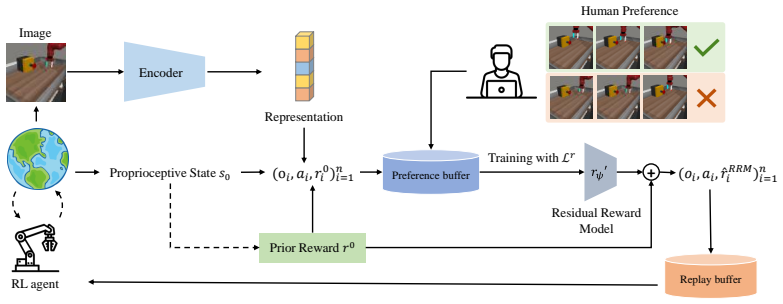
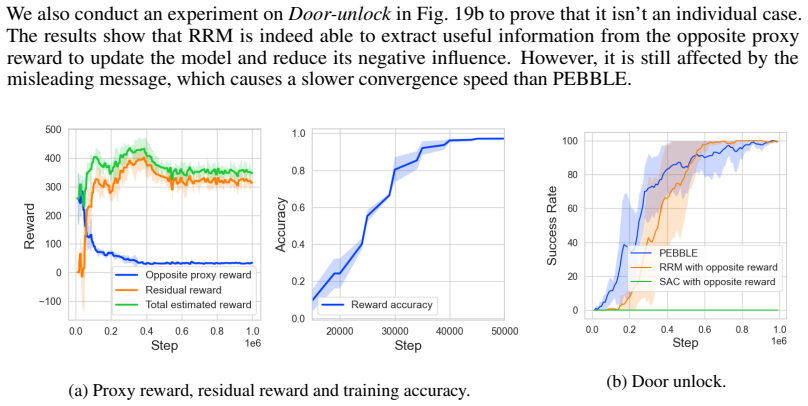
The central object is the decomposition $\hat{r}^{\mathrm{RRM}}_\psi = r_0 + r'_\psi$, where $r_0$ can be a hand-designed proxy reward, an IRL-learned reward, or even a negated version of such a reward, and $r'_\psi$ is a neural-network residual whose output is bounded by $\tanh$ so that it stays small relative to the prior. The paper motivates this structure as maximum a posteriori reward estimation with a Gaussian prior concentrated at $r_0$. The prior term gives the agent an immediate shaping signal, making early preference queries informative, while the residual term is fit by the Bradley-Terry cross-entropy loss and can grow to dominate where the prior is wrong; the paper shows it actively inverting an opposite-signed prior within roughly the first 50,000 steps.
What would settle it
Train RRM on the same Meta-World tasks using a shuffled prior reward—the identical values of the proxy reward randomly reassigned to state-action pairs—under the same feedback budget as the main experiments; if RRM still outperforms PEBBLE the improvement is not explained by the prior's task-relevant structure, whereas if it does not, the paper's prior-guided residual correction mechanism is upheld.
Extended reading notes
Core claim
The paper’s central claim is that the true reward can be modeled as $\hat{r}^{\mathrm{RRM}}_\psi(s,a) = r_0(s,a) + r'_\psi(s,a, r_0(s,a))$, where $r_0$ is a prior reward fixed before training and $r'_\psi$ is a residual learned from preference data. Keeping the prior frozen and learning only the residual avoids the optimization instability the authors observe when a neural reward is pretrained and then fine-tuned with a different loss. Empirically, RRM raises the average IQM success rate of the PEBBLE baseline on Meta-World from 64.4% to 77.8% with a complete proxy prior, keeps high success rates when feedback is reduced tenfold, and on a real Franka Panda Pick-and-Reach task reaches 85% success at 600k steps where the baseline reaches 0%. The paper further shows that a prior rewarding the first subtask of a sequential manipulation is the most useful type of prior.
Load-bearing premise
The gains reported for RRM presuppose that the task is supplied with a nonzero prior reward before training, because the paper's own ablation shows RRM with a zero prior performs no better than its PEBBLE baseline; if no such prior can be obtained, the method offers no advantage.
Editorial extensions
If this is right
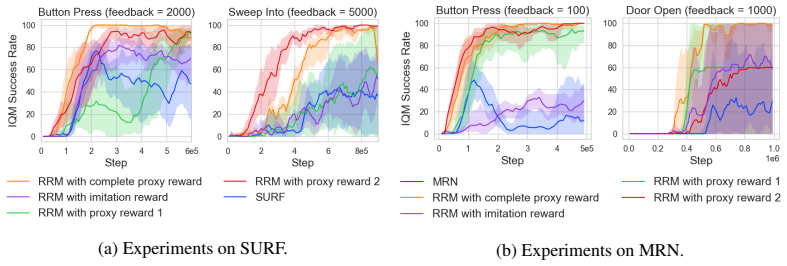
- Built on PEBBLE, RRM lifts the average IQM success rate from 64.4% to 77.8% across five Meta-World tasks, and the same construction improves the SURF and MRN algorithms.
- With a good prior, RRM holds roughly 90% or higher success on Button-press even when the preference batch size drops to 10 or feedback arrives only every 20,000 steps, while PEBBLE falls below 60% under the same cuts.
- A prior rewarding the first subgoal of the task is the most effective; a negated prior is still workable because the residual learns to correct it, but a zero prior yields no advantage over the baseline.
- Under stochastic (inconsistent) preference feedback RRM performs well, and it slightly improves on PEBBLE under mistaken (10% flipped) feedback, while the paper notes that fully resolving incorrect feedback remains an open limitation.
- On a real Franka Panda, RRM reaches 85% success on Pick-and-Reach at 600k steps while PEBBLE achieves 0%, indicating faster policy acquisition under sim-to-real transfer.
Reading between the lines
- The prior-plus-residual split should transfer wherever a coarse reward estimate already exists, for instance using a rule-based reward or a small demonstration set as the fixed prior in language-model alignment, so that preference data only corrects deviations rather than specifying the whole objective.
- The paper's conclusion that first-step priors work best suggests an automated recipe: decompose a task into its first subgoal and use the distance to that subgoal as the prior, which could be constructed from a task sketch or a few demonstrations and would directly address the paper's stated open problem of obtaining high-quality priors.
- RRM with a zero prior performing no better than PEBBLE sets a clear boundary on the method: its value is conditional on prior availability, so future comparisons on new tasks should report the quality of the prior used.
Editorial analysis
A structured set of objections, weighed in public.
Referee Report
Summary. The paper introduces Residual Reward Models (RRMs) for preference-based RL, parameterizing the reward as a fixed prior reward r0 plus a learned residual r'_psi trained on pairwise preferences. It instantiates RRM on top of PEBBLE (and SURF/MRN), evaluates state-based and image-based Meta-World tasks, ablates the prior and residual components, studies reduced/noisy feedback, and reports sim-to-real Franka experiments. The central empirical claim is that adding a fixed prior reward and learning only the residual substantially improves the convergence speed and final success of PEBBLE across tasks.
Significance. If the empirical comparison is unbiased, the residual reward structure is a simple and potentially valuable plug-in for existing PbRL algorithms, and the results span multiple tasks, backbones, feedback regimes, and a real robot. The paper also provides code pointers and reports IQM with confidence intervals, which is a strength. However, the headline comparison is currently confounded by simultaneously removing PEBBLE's unsupervised pretraining and injecting a task-specific prior, so the central attribution of the gains to residual preference learning is not yet established.
major comments (3)
- [§4.1–4.2, Table 1, Algorithm 1] The main comparison in Table 1 varies two factors at once: RRM removes PEBBLE's unsupervised pretraining (Algorithm 1, line 2: 'Unsupervised pretaining (do not perform)') and injects a task-specific prior reward r0 into both the stored transitions and the relabeled reward. The paper never reports the natural control of adding the same prior reward to PEBBLE's reward signal while keeping its warmup. The ablation in Fig. 4b shows that RRM with a zero prior is 'slightly lower than PEBBLE,' which the authors attribute to the missing warmup; this makes the attribution of the Table 1 gains to the residual preference model unsupported. Please add PEBBLE+prior with and without unsupervised pretraining, and report these controls alongside Table 1.
- [§A, Eq. (6); §F.2] The MAP derivation in Appendix A concludes with an explicit L2 penalty on the residual r'_psi, but the implemented residual network uses a tanh output bound instead, and the paper states that tanh is used 'instead of the squared penalty term.' The claimed connection to MAP estimation is therefore not realized by the implemented objective. Please either implement the L2 penalty or explicitly frame the tanh bound as a heuristic alternative, and report whether the output scale of the residual affects the results.
- [§D.10, Fig. 22] In the human-in-the-loop preference study, the interface displays the cumulative reward of each trajectory segment at the top of the animation for the labeler to reference. This exposes the labeler to the reward signal that PbRL is designed to elicit, and it is unclear how the displayed reward influences the stated preferences. The claim that RRM improves PEBBLE with real human feedback should be supported either by hiding the cumulative reward or by analyzing the relationship between displayed reward and labelling choices.
minor comments (5)
- [Table 1 (right)] The RRM-ID row reads '74.9±6,92.6'; this appears to be a formatting error where the success-rate confidence interval and return value are merged, and should be corrected to separate columns.
- [Algorithms 1 and 2] The comment on line 2 of both algorithms contains a typo: 'Unsupervised pretaining' should be 'Unsupervised pretraining.'
- [Figure 2 vs. §4.1] The selection rule for the evaluation step is described differently in the caption of Fig. 2 ('the first step when a non-oracle method's 4/5 runs reach 100% success') and in §4.1 ('the first step at which the mean success rate over the top 75% of runs reaches its maximum'); these definitions should be aligned.
- [§4.1] The constants k1, k2, k3, k4 are called normalization hyperparameters but are always set to 1, so the proxy rewards are simply unscaled negative distances; consider reporting the actual scale or removing the word 'normalized.'
- [§4.7] The 'first step' prior-selection rule is derived post hoc from the five Meta-World tasks and is not validated on held-out tasks or environments; the text should make clear that this is an explanatory principle rather than a tested design rule.
Circularity Check
No circularity: the residual reward is learned from preference data against a fixed prior reward, and no central prediction in the paper reduces by construction to its fitted inputs.
full rationale
The paper's central mechanism is Eq. (3), which defines the residual reward model as r0(s,a) + r'_psi(s,a,r0(s,a)), where r0 is a fixed input available before training and r'_psi is trained by minimizing the preference cross-entropy loss in Eq. (2). No parameter of the model is fitted to the evaluation metric (success rate or true return) and then reported as a prediction; the preference labels are generated from the environment's true reward by a scripted teacher or collected from humans, and the same preference loss is used for all variants. The prior reward is an external input, not a relabeled version of the learned output, and the paper explicitly reports that removing the prior (zero proxy reward) leaves performance slightly below PEBBLE, confirming that the prior is an independent ingredient rather than a disguised result of the preference fit. The 'first-step' prior-selection rule in Sec. 4.7 is derived after the experiments as an explanatory principle, and the paper itself flags that obtaining high-quality priors remains an open problem; it is not a fitted constant inserted into the model. There are no load-bearing self-citations, no imported uniqueness theorem, and no ansatz smuggled in via citation. The main experimental comparison does lack a PEBBLE-plus-prior control, which is a real confound for attributing gains to the residual structure, but that is a question of experimental design and causal attribution, not circularity of the derivation. Under the stated criteria, no step in the derivation chain is equivalent to its inputs by construction.
Assumptions & free parameters
free parameters (2)
- Proxy reward normalization constants k1, k2, k3, k4
- Residual output bound (tanh scale)
assumptions (3)
- ad hoc to paper The true reward can be decomposed as the sum of a prior reward and a learned residual.
- standard math Preferences follow the Bradley-Terry model.
- domain assumption The residual reward network is universal enough to capture the correction to the prior.
Cite this review
Pith. "Pith review of Residual Reward Models for Preference-based Reinforcement Learning." pith.science (2026). https://pith.science/paper/WZ2SSDSH
@misc{pith2026250700611,
  author       = {Pith},
  title        = {Pith review of: Residual Reward Models for Preference-based Reinforcement Learning},
  year         = {2026},
  howpublished = {\url{https://pith.science/paper/WZ2SSDSH}},
  note         = {Machine review of arXiv:2507.00611}
}
read the original abstract
Preference-based Reinforcement Learning (PbRL) provides a way to learn high-performance policies in environments where the reward signal is hard to specify, avoiding heuristic and time-consuming reward design. However, PbRL can suffer from slow convergence speed since it requires training in a reward model. Prior work has proposed learning a reward model from demonstrations and fine-tuning it using preferences. However, when the model is a neural network, using different loss functions for pre-training and fine-tuning can pose challenges to reliable optimization. In this paper, we propose a method to effectively leverage prior knowledge with a Residual Reward Model (RRM). An RRM assumes that the true reward of the environment can be split into a sum of two parts: a prior reward and a learned reward. The prior reward is a term available before training, for example, a user's ``best guess'' reward function, or a reward function learned from inverse reinforcement learning (IRL), and the learned reward is trained with preferences. We introduce state-based and image-based versions of RRM and evaluate them on several tasks in the Meta-World environment suite. Experimental results show that our method substantially improves the performance of a common PbRL method. Our method achieves performance improvements for a variety of different types of prior rewards, including proxy rewards, a reward obtained from IRL, and even a negated version of the proxy reward. We also conduct experiments with a Franka Panda to show that our method leads to superior performance on a real robot. It significantly accelerates policy learning for different tasks, achieving success in fewer steps than the baseline. The videos are presented at https://sunlighted.github.io/RRM-web/.
Figures


Figures from the paper (20 more)






Reference graph
Works this paper leans on
-
[1]
T. Silver, K. Allen, J. Tenenbaum, and L. Kaelbling, “Residual policy learning,” 2019. [Online]. Available: https://arxiv.org/abs/1812.06298
arXiv 2019
-
[2]
Magnetic control of tokamak plasmas through deep reinforcement learning,
J. Degrave, F. Felici, J. Buchli, M. Neunert, B. Tracey, F. Carpanese, T. Ewalds, R. Hafner, A. Abdolmaleki, D. de Las Casas et al., “Magnetic control of tokamak plasmas through deep reinforcement learning,” Nature, vol. 602, no. 7897, pp. 414–419, 2022
work page 2022
-
[3]
Designing Rewards for Fast Learning
H. Sowerby, Z. Zhou, and M. L. Littman, “Designing rewards for fast learning,”arXiv preprint arXiv:2205.15400, 2022
work page Pith review arXiv 2022
-
[4]
S. Singh, R. L. Lewis, and A. G. Barto, “Where do rewards come from,” in Proceedings of the annual conference of the cognitive science society. Cognitive Science Society, 2009, pp. 2601–2606
work page 2009
-
[5]
On the expressivity of markov reward,
D. Abel, W. Dabney, A. Harutyunyan, M. K. Ho, M. Littman, D. Precup, and S. Singh, “On the expressivity of markov reward,”Advances in Neural Information Processing Systems, vol. 34, pp. 7799–7812, 2021
work page 2021
-
[6]
Reward (mis)design for autonomous driving,
W. B. Knox, A. Allievi, H. Banzhaf, F. Schmitt, and P. Stone, “Reward (mis)design for autonomous driving,” 2022. [Online]. Available: https://arxiv.org/abs/2104.13906
arXiv 2022
-
[7]
D. Hadfield-Menell, S. Milli, P. Abbeel, S. Russell, and A. Dragan, “Inverse reward design,”
-
[8]
Avoiding side effects in complex environments,
A. M. Turner, N. Ratzlaff, and P. Tadepalli, “Avoiding side effects in complex environments,”
Show all 59 references
-
[9]
Challenges of real-world reinforcement learning: definitions, benchmarks and analysis,
G. Dulac-Arnold, N. Levine, D. J. Mankowitz, J. Li, C. Paduraru, S. Gowal, and T. Hester, “Challenges of real-world reinforcement learning: definitions, benchmarks and analysis,” Machine Learning, vol. 110, no. 9, pp. 2419–2468, Sep 2021. [Online]. Available: https://doi.org/1...
2021 doi
-
[10]
Available: https://arxiv.org/abs/2006.06547
[Online]. Available: https://arxiv.org/abs/2006.06547
2006 arXiv
-
[11]
The ingredients of real-world robotic reinforcement learning,
H. Zhu, J. Yu, A. Gupta, D. Shah, K. Hartikainen, A. Singh, V . Kumar, and S. Levine, “The ingredients of real-world robotic reinforcement learning,” 2020. [Online]. Available: https://arxiv.org/abs/2004.12570
2020 arXiv
-
[12]
Defining and characterizing reward hacking,
J. Skalse, N. H. R. Howe, D. Krasheninnikov, and D. Krueger, “Defining and characterizing reward hacking,” 2022. [Online]. Available: https://arxiv.org/abs/2209.13085
2022 arXiv
-
[13]
Deep reinforcement learning from human preferences,
P. F. Christiano, J. Leike, T. Brown, M. Martic, S. Legg, and D. Amodei, “Deep reinforcement learning from human preferences,” Advances in neural information processing systems, vol. 30, 2017
2017
-
[14]
B-pref: Benchmarking preference-based rein- forcement learning,
K. Lee, L. Smith, A. Dragan, and P. Abbeel, “B-pref: Benchmarking preference-based rein- forcement learning,” arXiv preprint arXiv:2111.03026, 2021
2021 arXiv
-
[15]
Surf: Semi-supervised reward learning with data augmentation for feedback-efficient preference-based reinforcement learning,
J. Park, Y . Seo, J. Shin, H. Lee, P. Abbeel, and K. Lee, “Surf: Semi-supervised reward learning with data augmentation for feedback-efficient preference-based reinforcement learning,” arXiv preprint arXiv:2203.10050, 2022
2022 arXiv
-
[16]
Pebble: Feedback-efficient interactive reinforcement learning via relabeling experience and unsupervised pre-training,
K. Lee, L. Smith, and P. Abbeel, “Pebble: Feedback-efficient interactive reinforcement learning via relabeling experience and unsupervised pre-training,” 2021. [Online]. Available: https://arxiv.org/abs/2106.05091
2021 arXiv
-
[17]
A bayesian approach for policy learning from trajectory preference queries,
A. Wilson, A. Fern, and P. Tadepalli, “A bayesian approach for policy learning from trajectory preference queries,” Advances in neural information processing systems, vol. 25, 2012
2012
-
[18]
Reward uncertainty for exploration in preference- based reinforcement learning,
X. Liang, K. Shu, K. Lee, and P. Abbeel, “Reward uncertainty for exploration in preference- based reinforcement learning,” arXiv preprint arXiv:2205.12401, 2022
2022 arXiv
-
[19]
Keyframe-based learning from demonstration,
B. Akgün, M. Cakmak, K. Jiang, and A. L. Thomaz, “Keyframe-based learning from demonstration,” International Journal of Social Robotics, vol. 4, pp. 343 – 355, 2012. [Online]. Available: https://api.semanticscholar.org/CorpusID:10004846
2012
-
[20]
Apprenticeship learning via inverse reinforcement learning,
P. Abbeel and A. Y . Ng, “Apprenticeship learning via inverse reinforcement learning,” in Proceedings of the twenty-first international conference on Machine learning, 2004, p. 1. 10
2004
-
[21]
Learning human objectives from sequences of physical corrections,
M. Li, A. Canberk, D. P. Losey, and D. Sadigh, “Learning human objectives from sequences of physical corrections,” 2021. [Online]. Available: https://arxiv.org/abs/2104.00078
2021 arXiv
-
[22]
Learning complicated manipulation skills via deterministic policy with limited demonstrations,
L. Haofeng, C. Yiwen, T. Jiayi, and M. H. Ang, “Learning complicated manipulation skills via deterministic policy with limited demonstrations,” 2023. [Online]. Available: https://arxiv.org/abs/2303.16469
2023 arXiv
-
[23]
Land: Learning to navigate from disengagements,
G. Kahn, P. Abbeel, and S. Levine, “Land: Learning to navigate from disengagements,” 2020. [Online]. Available: https://arxiv.org/abs/2010.04689
2020 arXiv
-
[24]
Guiding policies with language via meta-learning,
J. D. Co-Reyes, A. Gupta, S. Sanjeev, N. Altieri, J. Andreas, J. DeNero, P. Abbeel, and S. Levine, “Guiding policies with language via meta-learning,” 2019. [Online]. Available: https://arxiv.org/abs/1811.07882
2019 arXiv
-
[26]
Mile: Model-based intervention learning,
Y . Korkmaz and E. Bıyık, “Mile: Model-based intervention learning,” 2025. [Online]. Available: https://arxiv.org/abs/2502.13519
2025 arXiv
-
[27]
State regularized policy optimization on data with dynamics shift,
Z. Xue, Q. Cai, S. Liu, D. Zheng, P. Jiang, K. Gai, and B. An, “State regularized policy optimization on data with dynamics shift,” Advances in neural information processing systems, vol. 36, pp. 32 926–32 937, 2023
2023
-
[28]
Learning reward functions from diverse sources of human feedback: Optimally integrating demonstrations and preferences,
E. Bıyık, D. P. Losey, M. Palan, N. C. Landolfi, G. Shevchuk, and D. Sadigh, “Learning reward functions from diverse sources of human feedback: Optimally integrating demonstrations and preferences,” The International Journal of Robotics Research, vol. 41, no. 1, pp. 45–67, 2022
2022
-
[29]
The vanishing gradient problem during learning recurrent neural nets and problem solutions,
S. Hochreiter, “The vanishing gradient problem during learning recurrent neural nets and problem solutions,” International Journal of Uncertainty, Fuzziness and Knowledge-Based Systems, vol. 6, no. 02, pp. 107–116, 1998
1998
-
[30]
Learning from random demonstrations: Offline reinforcement learning with importance-sampled diffusion models,
Z. Fang and T. Lan, “Learning from random demonstrations: Offline reinforcement learning with importance-sampled diffusion models,” arXiv preprint arXiv:2405.19878, 2024
2024 arXiv
-
[31]
Identity mappings in deep residual networks,
K. He, X. Zhang, S. Ren, and J. Sun, “Identity mappings in deep residual networks,” inComputer Vision–ECCV 2016: 14th European Conference, Amsterdam, The Netherlands, October 11–14, 2016, Proceedings, Part IV 14. Springer, 2016, pp. 630–645
2016
-
[32]
Loss jump during loss switch in solving pdes with neural networks,
Z. Wang, L. Zhang, Z. Zhang, and Z.-Q. J. Xu, “Loss jump during loss switch in solving pdes with neural networks,” arXiv preprint arXiv:2405.03095, 2024
2024 arXiv
-
[33]
Meta-world: A benchmark and evaluation for multi-task and meta reinforcement learning,
T. Yu, D. Quillen, Z. He, R. Julian, K. Hausman, C. Finn, and S. Levine, “Meta-world: A benchmark and evaluation for multi-task and meta reinforcement learning,” inConference on robot learning. PMLR, 2020, pp. 1094–1100
2020
-
[34]
Residual reinforcement learning for robot control,
T. Johannink, S. Bahl, A. Nair, J. Luo, A. Kumar, M. Loskyll, J. A. Ojea, E. Solowjow, and S. Levine, “Residual reinforcement learning for robot control,” in2019 international conference on robotics and automation (ICRA). IEEE, 2019, pp. 6023–6029
2019
-
[35]
Few-shot preference learning for human-in-the-loop rl,
J. Hejna and D. Sadigh, “Few-shot preference learning for human-in-the-loop rl,” 2022. [Online]. Available: https://arxiv.org/abs/2212.03363
2022 arXiv
-
[36]
Meta-reward-net: Implicitly differentiable reward learning for preference-based reinforcement learning,
R. Liu, F. Bai, Y . Du, and Y . Yang, “Meta-reward-net: Implicitly differentiable reward learning for preference-based reinforcement learning,” Advances in Neural Information Processing Systems, vol. 35, pp. 22 270–22 284, 2022
2022
-
[37]
Query-policy misalignment in preference- based reinforcement learning,
X. Hu, J. Li, X. Zhan, Q.-S. Jia, and Y .-Q. Zhang, “Query-policy misalignment in preference- based reinforcement learning,” arXiv preprint arXiv:2305.17400, 2023
2023 arXiv
-
[38]
Benchmarks and algorithms for offline preference- based reward learning,
D. Shin, A. D. Dragan, and D. S. Brown, “Benchmarks and algorithms for offline preference- based reward learning,” arXiv preprint arXiv:2301.01392, 2023. 11
2023 arXiv
-
[39]
Active preference-based gaussian process regression for reward learning,
E. Bıyık, N. Huynh, M. J. Kochenderfer, and D. Sadigh, “Active preference-based gaussian process regression for reward learning,” arXiv preprint arXiv:2005.02575, 2020
2005 arXiv
-
[40]
Batch active preference-based learning of reward functions,
E. Biyik and D. Sadigh, “Batch active preference-based learning of reward functions,” in Conference on robot learning. PMLR, 2018, pp. 519–528
2018
-
[41]
Learning reward functions by integrating human demonstrations and preferences,
M. Palan, N. C. Landolfi, G. Shevchuk, and D. Sadigh, “Learning reward functions by integrating human demonstrations and preferences,” 2019. [Online]. Available: https://arxiv.org/abs/1906.08928
2019 arXiv
-
[42]
Autonomous robotic reinforcement learning with asynchronous human feedback,
M. B. I. Pamies, M. T. Villasevil, Z. Wang, S. Desai, P. Agrawal, and A. Gupta, “Autonomous robotic reinforcement learning with asynchronous human feedback,” in 7th Annual Conference on Robot Learning, 2023
2023
-
[43]
Discor: Corrective feedback in reinforcement learning via distribution correction,
A. Kumar, A. Gupta, and S. Levine, “Discor: Corrective feedback in reinforcement learning via distribution correction,” Advances in neural information processing systems, vol. 33, pp. 18 560–18 572, 2020
2020
-
[44]
Reinforcement learning from imperfect corrective actions and proxy rewards,
Z. Jiang, X. Feng, P. Weng, Y . Zhu, Y . Song, T. Zhou, Y . Hu, T. Lv, and C. Fan, “Reinforcement learning from imperfect corrective actions and proxy rewards,”arXiv preprint arXiv:2410.05782, 2024
2024 arXiv
-
[45]
Residual reinforcement learning from demonstrations,
M. Alakuijala, G. Dulac-Arnold, J. Mairal, J. Ponce, and C. Schmid, “Residual reinforcement learning from demonstrations,” 2021. [Online]. Available: https://arxiv.org/abs/2106.08050
2021 arXiv
-
[46]
Reward-rational (implicit) choice: A unifying formalism for reward learning,
H. J. Jeon, S. Milli, and A. Dragan, “Reward-rational (implicit) choice: A unifying formalism for reward learning,” in Advances in Neural Information Processing Systems, H. Larochelle, M. Ranzato, R. Hadsell, M. Balcan, and H. Lin, Eds., vol. 33. Curran Associates, Inc., 2020,...
2020
-
[47]
From imitation to refinement– residual rl for precise assembly,
L. Ankile, A. Simeonov, I. Shenfeld, M. Torne, and P. Agrawal, “From imitation to refinement– residual rl for precise assembly,”arXiv preprint arXiv:2407.16677, 2024
2024 arXiv
-
[48]
Teach a robot to fish: Versatile imitation from one minute of demonstrations,
S. Haldar, J. Pari, A. Rai, and L. Pinto, “Teach a robot to fish: Versatile imitation from one minute of demonstrations,” arXiv preprint arXiv:2303.01497, 2023
2023 arXiv
-
[49]
Advances in preference-based reinforcement learning: A review,
Y . Abdelkareem, S. Shehata, and F. Karray, “Advances in preference-based reinforcement learning: A review,” in2022 IEEE international conference on systems, man, and cybernetics (SMC). IEEE, 2022, pp. 2527–2532
2022
-
[50]
Data-informed residual reinforcement learning for high-dimensional robotic tracking control,
C. Li, F. Liu, Y . Wang, and M. Buss, “Data-informed residual reinforcement learning for high-dimensional robotic tracking control,” IEEE/ASME Transactions on Mechatronics, 2024
2024
-
[51]
Deep reinforcement learning at the edge of the statistical precipice,
R. Agarwal, M. Schwarzer, P. S. Castro, A. C. Courville, and M. Bellemare, “Deep reinforcement learning at the edge of the statistical precipice,” Advances in neural information processing systems, vol. 34, pp. 29 304–29 320, 2021
2021
-
[52]
Rank analysis of incomplete block designs: I. the method of paired comparisons,
R. A. Bradley and M. E. Terry, “Rank analysis of incomplete block designs: I. the method of paired comparisons,” Biometrika, vol. 39, no. 3/4, pp. 324–345, 1952
1952
-
[53]
Learning robust rewards with adversarial inverse reinforcement learning,
J. Fu, K. Luo, and S. Levine, “Learning robust rewards with adversarial inverse reinforcement learning,” arXiv preprint arXiv:1710.11248, 2017
2017 arXiv
-
[54]
Soft actor-critic: Off-policy maximum entropy deep reinforcement learning with a stochastic actor,
T. Haarnoja, A. Zhou, P. Abbeel, and S. Levine, “Soft actor-critic: Off-policy maximum entropy deep reinforcement learning with a stochastic actor,” inInternational conference on machine learning. Pmlr, 2018, pp. 1861–1870
2018
-
[55]
Drm: Mastering visual reinforcement learning through dormant ratio minimization,
G. Xu, R. Zheng, Y . Liang, X. Wang, Z. Yuan, T. Ji, Y . Luo, X. Liu, J. Yuan, P. Huaet al., “Drm: Mastering visual reinforcement learning through dormant ratio minimization,” arXiv preprint arXiv:2310.19668, 2023
2023 arXiv
-
[56]
Mastering visual continuous control: Improved data-augmented reinforcement learning,
D. Yarats, R. Fergus, A. Lazaric, and L. Pinto, “Mastering visual continuous control: Improved data-augmented reinforcement learning,” arXiv preprint arXiv:2107.09645, 2021. 12
2021 arXiv
-
[58]
Pybullet, a python module for physics simulation for games, robotics and machine learning,
E. Coumans and Y . Bai, “Pybullet, a python module for physics simulation for games, robotics and machine learning,” http://pybullet.org, 2016–2021. 13 Appendix A Motivating RRMs with MAP Estimation Our goal is to estimate a reward function from data using a reward prior: p(r|...
2016
-
[59]
+y(1) · log Pψ(σi 1 ≻ σi 0) − 1 2σ2 (r′ ψ)2 = argmaxr 1 N NX i=1 y(0) · log Pψ(σi 0 ≻ σi
-
[60]
The car needs to drive around obstacles and reach the goal location
+y(1) · log Pψ(σi 1 ≻ σi 0) − 1 2σ2 (r′ ψ)2 ≈ argminrLr + 1 2σ2 (r′ ψ)2, (6) where the approximation results from a finite-sample estimate of the expectation in Lr. In practice, we use tanh to enforce small values of r′ ψ (see Appx. F.2), instead of the squared penalty term. T...
2000
-
[2020]
Available: https://arxiv.org/abs/1711.02827
[Online]. Available: https://arxiv.org/abs/1711.02827
Reviewed August 6, 2026 · model on record in the stance chip above.
Discussion (0). Sign in to comment.