Revealing emergent many-body phenomena by analyzing large-scale space-time records of monitored quantum systems
Pith reviewed 2026-05-19 06:37 UTC · model grok-4.3
The pith
Free-energy analysis of quantum trajectories reveals hydrophobic-like features in a dissipative spin model.
A machine-rendered reading of the paper's core claim, the machinery that carries it, and where it could break.
Core claim
In the paradigmatic dissipative spin model, the trajectories of individual experimental runs reveal surprisingly complex statistical phenomena. Free-energy functionals for trajectory ensembles are used to identify dynamical features reminiscent of hydrophobic behavior observed near the liquid-vapor transition in the presence of solutes in water. These phenomena are observable in experiments, and the impact of common imperfections such as readout errors and disordered interactions is discussed.
What carries the argument
Free-energy functionals for trajectory ensembles, which quantify and classify statistical structures in the space-time records of monitored quantum trajectories.
If this is right
- Large-scale space-time structures in quantum trajectories become accessible for direct experimental study without requiring full state tomography.
- Individual experimental runs can suffice to reveal complex statistical phenomena previously hidden in ensemble averages.
- The method provides a concrete route to observe measurement-induced emergent behaviors in current quantum simulator platforms.
- Hydrophobic-like features serve as a diagnostic signature for certain classes of monitored many-body dynamics.
Where Pith is reading between the lines
- The same free-energy approach could be tested on other monitored systems such as trapped ions or superconducting circuits to check generality beyond spin models.
- Connections to classical phase transitions suggest that varying measurement strength might tune the system across an effective analog of a liquid-vapor line.
- Disorder in interactions could be deliberately engineered to map how robustness of the hydrophobic-like features depends on spatial inhomogeneity.
Load-bearing premise
The paradigmatic dissipative spin model and its trajectory statistics remain representative of experimental Rydberg systems even after accounting for readout errors and disordered interactions.
What would settle it
Apply the free-energy functional analysis to trajectory data collected from a real Rydberg quantum simulator and check whether the predicted hydrophobic-like dynamical features appear or are washed out by realistic readout errors and interaction disorder.
Figures


read the original abstract
Recent advances in quantum simulators permit unitary evolution interspersed with locally resolved mid-circuit measurements. This paves the way for the observation of large-scale space-time structures in quantum trajectories and opens a window for the \emph{in situ} analysis of complex dynamical processes. We demonstrate this idea using a paradigmatic dissipative spin model, which can be implemented, e.g., on Rydberg quantum simulators. Here, already the trajectories of individual experimental runs reveal surprisingly complex statistical phenomena. In particular, we exploit free-energy functionals for trajectory ensembles to identify dynamical features reminiscent of hydrophobic behavior observed near the liquid-vapor transition in the presence of solutes in water. We show that these phenomena are observable in experiments and discuss the impact of common imperfections, such as readout errors and disordered interactions.
Editorial analysis
A structured set of objections, weighed in public.
Referee Report
Summary. The manuscript demonstrates the use of free-energy functionals applied to ensembles of quantum trajectories generated by a monitored dissipative spin model (implementable on Rydberg arrays) to extract emergent many-body features analogous to hydrophobic behavior near a liquid-vapor transition. The authors argue that individual experimental runs already display complex statistical structure and that the reported phenomena remain observable once common imperfections are taken into account.
Significance. If the free-energy signatures prove robust, the approach would supply a concrete statistical-mechanics tool for interpreting large-scale space-time records from monitored quantum simulators, potentially revealing dynamical phases or transitions that are invisible to conventional order parameters.
major comments (1)
- [Abstract] Abstract: The claim that the hydrophobic-like trajectory features are observable in experiments rests on the assertion that readout errors and disordered interactions leave the relevant free-energy minima qualitatively intact. No explicit recomputation of the functionals (or equivalent large-deviation rate functions) under perturbed dynamics with 1-5% readout errors or 10-20% interaction disorder is presented, rendering the mapping from ideal-model trajectories to realistic Rydberg records an unverified assumption.
minor comments (1)
- The definition and normalization of the trajectory free-energy functional should be stated explicitly in the main text rather than only in supplementary material, to allow readers to reproduce the reported minima without ambiguity.
Simulated Author's Rebuttal
We thank the referee for the careful reading of our manuscript and for the positive overall assessment. We address the single major comment below and will revise the manuscript to incorporate additional explicit calculations.
read point-by-point responses
-
Referee: [Abstract] Abstract: The claim that the hydrophobic-like trajectory features are observable in experiments rests on the assertion that readout errors and disordered interactions leave the relevant free-energy minima qualitatively intact. No explicit recomputation of the functionals (or equivalent large-deviation rate functions) under perturbed dynamics with 1-5% readout errors or 10-20% interaction disorder is presented, rendering the mapping from ideal-model trajectories to realistic Rydberg records an unverified assumption.
Authors: We agree that the current manuscript relies on a qualitative discussion of robustness rather than explicit recomputation of the free-energy functionals under the specific perturbation strengths mentioned. The existing text argues that the relevant minima remain intact on the basis of the stability of the underlying trajectory statistics and perturbative considerations, but does not present new numerical evaluations of the rate functions for 1-5% readout errors or 10-20% interaction disorder. To strengthen the claim, we will add these explicit recomputations in the revised version, most likely as an additional figure or appendix section that directly compares the ideal and perturbed free-energy landscapes. revision: yes
Circularity Check
No circularity in derivation chain
full rationale
The paper applies established free-energy functionals from statistical mechanics to trajectory ensembles generated by a dissipative spin model. The identification of hydrophobic-like dynamical features follows directly from computing these functionals on the model's space-time records, without any step that reduces a reported prediction or first-principles result to a fitted parameter, self-defined quantity, or load-bearing self-citation. Imperfections such as readout errors are discussed separately as an experimental consideration rather than being folded into the core derivation. The analysis therefore remains self-contained and independent of its own inputs.
Axiom & Free-Parameter Ledger
free parameters (1)
- dissipation and interaction rates in the spin model
axioms (1)
- domain assumption The dissipative spin model can be implemented on Rydberg quantum simulators.
Lean theorems connected to this paper
-
IndisputableMonolith/Cost/FunctionalEquation.leanwashburn_uniqueness_aczel echoes?
echoesECHOES: this paper passage has the same mathematical shape or conceptual pattern as the Recognition theorem, but is not a direct formal dependency.
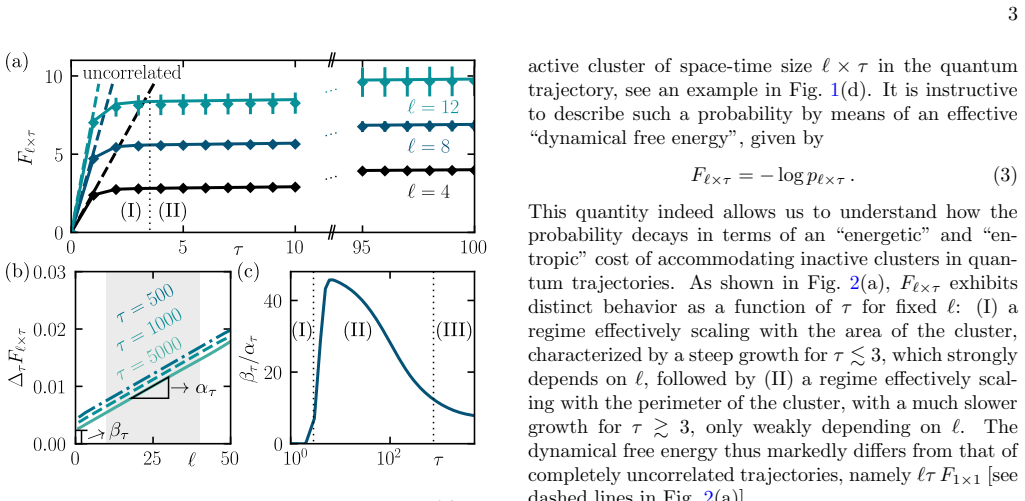
we exploit free-energy functionals for trajectory ensembles to identify dynamical features reminiscent of hydrophobic behavior... Fℓ×τ = −log pℓ×τ... Δτ Fℓ×τ = ατ ℓ + βτ
What do these tags mean?
- matches
- The paper's claim is directly supported by a theorem in the formal canon.
- supports
- The theorem supports part of the paper's argument, but the paper may add assumptions or extra steps.
- extends
- The paper goes beyond the formal theorem; the theorem is a base layer rather than the whole result.
- uses
- The paper appears to rely on the theorem as machinery.
- contradicts
- The paper's claim conflicts with a theorem or certificate in the canon.
- unclear
- Pith found a possible connection, but the passage is too broad, indirect, or ambiguous to say the theorem truly supports the claim.
Forward citations
Cited by 2 Pith papers
-
Exact large deviations and emergent long-range correlations in sequential quantum East circuits
Conditioning on rare boundary measurement outcomes in a quantum East circuit generates states with finite two-point correlations at arbitrary distances and an underlying Sierpiński-triangle fractal structure.
-
Quantum to classical relaxation dynamics of the dissipative Rydberg gas
Using the truncated Wigner approximation on large 1D and 2D systems, the authors find a pronounced slowdown in magnetization relaxation and transient signatures of quantum kinetically constrained dynamics starting fro...
Reference graph
Works this paper leans on
-
[1]
H.-J. Shao, Y.-X. Wang, D.-Z. Zhu, Y.-S. Zhu, H.-N. Sun, S.-Y. Chen, C. Zhang, Z.-J. Fan, Y. Deng, X.-C. Yao, et al., Antiferromagnetic phase transition in a 3D fermionic Hubbard model, Nature 632, 267 (2024)
work page 2024
-
[2]
A. Impertro, S. Huh, S. Karch, J. F. Wienand, I. Bloch, and M. Aidelsburger, Strongly interacting Meissner phases in large bosonic flux ladders, Nat. Phys. 21, 895 (2025)
work page 2025
-
[3]
A. Schuckert, O. Katz, L. Feng, E. Crane, A. De, M. Hafezi, A. V. Gorshkov, and C. Monroe, Observation of a finite-energy phase transition in a one-dimensional quantum simulator, Nat. Phys. 21, 374 (2025)
work page 2025
-
[4]
R. Haghshenas, E. Chertkov, M. DeCross, T. M. Gat- terman, J. A. Gerber, K. Gilmore, D. Gresh, N. Hewitt, C. V. Horst, M. Matheny, et al., Probing Critical States of Matter on a Digital Quantum Computer, Phys. Rev. Lett. 133, 266502 (2024)
work page 2024
-
[5]
C. Gross and I. Bloch, Quantum simulations with ultra- cold atoms in optical lattices, Science 357, 995 (2017)
work page 2017
-
[6]
B. Fauseweh, Quantum many-body simulations on dig- ital quantum computers: State-of-the-art and future challenges, Nat. Commun. 15, 2123 (2024)
work page 2024
-
[7]
N. Darkwah Oppong, G. Pasqualetti, O. Bettermann, P. Zechmann, M. Knap, I. Bloch, and S. F¨ olling, Probing Transport and Slow Relaxation in the Mass- Imbalanced Fermi-Hubbard Model, Phys. Rev. X 12, 031026 (2022)
work page 2022
-
[8]
Y. Kim, A. Eddins, S. Anand, K. X. Wei, E. van den Berg, S. Rosenblatt, H. Nayfeh, Y. Wu, M. Zaletel, K. Temme, and A. Kandala, Evidence for the utility of quantum computing before fault tolerance, Nature 618, 500 (2023)
work page 2023
- [9]
- [10]
-
[11]
A. M. Kaufman, M. E. Tai, A. Lukin, M. Rispoli, R. Schittko, P. M. Preiss, and M. Greiner, Quan- tum thermalization through entanglement in an isolated many-body system, Science 353, 794 (2016)
work page 2016
-
[12]
Z.-Y. Zhou, G.-X. Su, J. C. Halimeh, R. Ott, H. Sun, P. Hauke, B. Yang, Z.-S. Yuan, J. Berges, and J.-W. Pan, Thermalization dynamics of a gauge theory on a quantum simulator, Science 377, 311 (2022)
work page 2022
-
[13]
T. I. Andersen, N. Astrakhantsev, A. H. Karamlou, J. Berndtsson, J. Motruk, A. Szasz, J. A. Gross, A. Schuckert, T. Westerhout, Y. Zhang,et al., Thermal- ization and criticality on an analogue–digital quantum simulator, Nature 638, 79 (2025)
work page 2025
-
[14]
M. Schreiber, S. S. Hodgman, P. Bordia, H. P. L¨ uschen, M. H. Fischer, R. Vosk, E. Altman, U. Schneider, and I. Bloch, Observation of many-body localization of inter- acting fermions in a quasirandom optical lattice, Science 349, 842 (2015)
work page 2015
-
[15]
J.-y. Choi, S. Hild, J. Zeiher, P. Schauß, A. Rubio- Abadal, T. Yefsah, V. Khemani, D. A. Huse, I. Bloch, and C. Gross, Exploring the many-body localization transition in two dimensions, Science 352, 1547 (2016)
work page 2016
- [16]
-
[17]
Q. Guo, C. Cheng, Z.-H. Sun, Z. Song, H. Li, Z. Wang, W. Ren, H. Dong, D. Zheng, Y.-R. Zhang, et al., Obser- vation of energy-resolved many-body localization, Nat. Phys. 17, 234 (2021)
work page 2021
- [18]
- [19]
- [20]
- [21]
-
[22]
L. Zhao, P. R. Datla, W. Tian, M. M. Aliyu, and H. Loh, Observation of Quantum Thermalization Restricted to Hilbert Space Fragments and Z2k Scars, Phys. Rev. X 15, 011035 (2025)
work page 2025
- [23]
-
[24]
H. Bernien, S. Schwartz, A. Keesling, H. Levine, A. Om- ran, H. Pichler, S. Choi, A. S. Zibrov, M. Endres, M. Greiner, et al. , Probing many-body dynamics on a 51-atom quantum simulator, Nature 551, 579 (2017)
work page 2017
-
[25]
G.-X. Su, H. Sun, A. Hudomal, J.-Y. Desaules, Z.-Y. Zhou, B. Yang, J. C. Halimeh, Z.-S. Yuan, Z. Papi´ c, and J.-W. Pan, Observation of many-body scarring in a Bose-Hubbard quantum simulator, Phys. Rev. Research 5, 023010 (2023)
work page 2023
-
[26]
Z. Bao, S. Xu, Z. Song, K. Wang, L. Xiang, Z. Zhu, J. Chen, F. Jin, X. Zhu, Y. Gao, et al. , Creating and controlling global Greenberger-Horne-Zeilinger en- tanglement on quantum processors, Nat. Commun. 15, 8823 (2024)
work page 2024
-
[27]
A. D. C´ orcoles, M. Takita, K. Inoue, S. Lekuch, Z. K. Minev, J. M. Chow, and J. M. Gambetta, Exploiting Dynamic Quantum Circuits in a Quantum Algorithm with Superconducting Qubits, Phys. Rev. Lett. 127, 100501 (2021)
work page 2021
-
[28]
J. M. Pino, J. M. Dreiling, C. Figgatt, J. P. Gaebler, S. A. Moses, M. S. Allman, C. H. Baldwin, M. Foss- Feig, D. Hayes, K. Mayer, et al., Demonstration of the trapped-ion quantum CCD computer architecture, Na- ture 592, 209 (2021)
work page 2021
-
[29]
E. Deist, Y.-H. Lu, J. Ho, M. K. Pasha, J. Zeiher, Z. Yan, and D. M. Stamper-Kurn, Mid-Circuit Cavity Measurement in a Neutral Atom Array, Phys. Rev. Lett. 129, 203602 (2022)
work page 2022
-
[30]
T. M. Graham, L. Phuttitarn, R. Chinnarasu, Y. Song, C. Poole, K. Jooya, J. Scott, A. Scott, P. Eichler, and M. Saffman, Midcircuit Measurements on a Single- Species Neutral Alkali Atom Quantum Processor, Phys. Rev. X 13, 041051 (2023)
work page 2023
- [31]
-
[32]
P. M. Harrington, E. J. Mueller, and K. W. Murch, Engineered dissipation for quantum information science, Nat. Rev. Phys. 4, 660 (2022)
work page 2022
- [33]
-
[34]
F. Verstraete, M. M. Wolf, and J. Ignacio Cirac, Quan- tum computation and quantum-state engineering driven by dissipation, Nat. Phys. 5, 633 (2009)
work page 2009
-
[35]
Z.-P. Cian, G. Zhu, S.-K. Chu, A. Seif, W. DeGottardi, L. Jiang, and M. Hafezi, Photon Pair Condensation by Engineered Dissipation, Phys. Rev. Lett. 123, 063602 (2019)
work page 2019
-
[36]
A. Paviglianiti and A. Silva, Enhancing revivals via projective measurements in a quantum scarred system, arXiv:2503.2261 (2025)
-
[37]
E. Chertkov, Z. Cheng, A. C. Potter, S. Gopalakr- ishnan, T. M. Gatterman, J. A. Gerber, K. Gilmore, D. Gresh, A. Hall, A. Hankin, et al. , Characterizing a non-equilibrium phase transition on a quantum com- puter, Nat. Phys. 19, 1 (2023)
work page 2023
-
[38]
X. Mi, A. A. Michailidis, S. Shabani, K. C. Miao, P. V. Klimov, J. Lloyd, E. Rosenberg, R. Acharya, I. Aleiner, T. I. Andersen, et al. , Stable quantum- correlated many-body states through engineered dissi- pation, Science 383, 1332 (2024)
work page 2024
-
[39]
K. Sun, M. Kang, H. Nuomin, G. Schwartz, D. N. Be- ratan, K. R. Brown, and J. Kim, Quantum simulation of spin-boson models with structured bath, Nat. Commun. 16, 4042 (2025)
work page 2025
-
[40]
L. Li, T. Liu, X.-Y. Guo, H. Zhang, S. Zhao, Z.-A. Wang, Z. Xiang, X. Song, Y.-X. Zhang, K. Xu, et al. , Observation of multiple steady states with engineered dissipation, npj Quantum Inf. 11, 1 (2025)
work page 2025
-
[41]
C. Chen, K. Tang, Y. Zhou, K. Yi, X. Zhang, X. Zhang, H. Guo, S. Liu, Y. Chen, T. Yan, and D. Yu, Hardware- efficient stabilization of entanglement via engineered dissipation in superconducting circuits, Phys. Rev. Re- search 7, L022018 (2025)
work page 2025
-
[42]
L. Steffen, Y. Salathe, M. Oppliger, P. Kurpiers, M. Baur, C. Lang, C. Eichler, G. Puebla-Hellmann, A. Fedorov, and A. Wallraff, Deterministic quantum teleportation with feed-forward in a solid state system, Nature 500, 319 (2013)
work page 2013
-
[43]
Z. K. Minev, S. O. Mundhada, S. Shankar, P. Reinhold, R. Guti´ errez-J´ auregui, R. J. Schoelkopf, M. Mirrahimi, H. J. Carmichael, and M. H. Devoret, To catch and reverse a quantum jump mid-flight, Nature 570, 200 (2019)
work page 2019
- [44]
- [45]
-
[46]
S. Krinner, N. Lacroix, A. Remm, A. Di Paolo, E. Genois, C. Leroux, C. Hellings, S. Lazar, F. Swiadek, J. Herrmann, et al. , Realizing repeated quantum error correction in a distance-three surface code, Nature 605, 669 (2022)
work page 2022
- [47]
-
[48]
L. Postler, F. Butt, I. Pogorelov, C. D. Marciniak, S. Heußen, R. Blatt, P. Schindler, M. Rispler, M. M¨ uller, and T. Monz, Demonstration of Fault-Tolerant Steane Quantum Error Correction, PRX Quantum 5, 030326 (2024)
work page 2024
-
[49]
D. Bluvstein, S. J. Evered, A. A. Geim, S. H. Li, H. Zhou, T. Manovitz, S. Ebadi, M. Cain, M. Kali- nowski, D. Hangleiter, et al. , Logical quantum proces- sor based on reconfigurable atom arrays, Nature 626, 58 (2024)
work page 2024
-
[50]
R. Acharya, D. A. Abanin, L. Aghababaie-Beni, I. Aleiner, T. I. Andersen, M. Ansmann, F. Arute, K. Arya, A. Asfaw, N. Astrakhantsev, et al., Quantum error correction below the surface code threshold, Na- ture 638, 920 (2024)
work page 2024
-
[51]
K. Macieszczak, M. Gut ¸˘ a, I. Lesanovsky, and J. P. Gar- rahan, Dynamical phase transitions as a resource for quantum enhanced metrology, Phys. Rev. A 93, 022103 (2016)
work page 2016
- [52]
- [53]
- [54]
-
[55]
S. Midha and S. Gopalakrishnan, Metrology of open quantum systems from emitted radiation, arXiv:2504.13815 (2025)
- [56]
- [57]
-
[58]
Ilias, Biasing quantum trajectories for enhanced sens- ing, Phys
T. Ilias, Biasing quantum trajectories for enhanced sens- ing, Phys. Rev. A 111, 042432 (2025)
work page 2025
-
[59]
P. Wang, C. Chen, X. Peng, J. Wrachtrup, and R.-B. Liu, Characterization of Arbitrary-Order Correlations in Quantum Baths by Weak Measurement, Phys. Rev. Lett. 123, 050603 (2019)
work page 2019
-
[60]
Z. Wu, P. Wang, T. Wang, Y. Li, R. Liu, Y. Chen, X. Peng, and R.-B. Liu, Selective Detection of Dynamics-Complete Set of Correlations via Quantum Channels, Phys. Rev. Lett. 132, 200802 (2024)
work page 2024
-
[61]
Touchette, The large deviation approach to statisti- cal mechanics, Phys
H. Touchette, The large deviation approach to statisti- cal mechanics, Phys. Rep. 478, 1 (2009)
work page 2009
-
[62]
J. P. Garrahan and I. Lesanovsky, Thermodynamics of Quantum Jump Trajectories, Phys. Rev. Lett. 104, 160601 (2010)
work page 2010
-
[63]
R. Chetrite and H. Touchette, Nonequilibrium Micro- canonical and Canonical Ensembles and Their Equiva- lence, Phys. Rev. Lett. 111, 120601 (2013)
work page 2013
-
[64]
M. Cech, I. Lesanovsky, and F. Carollo, Thermodynam- ics of Quantum Trajectories on a Quantum Computer, Phys. Rev. Lett. 131, 120401 (2023)
work page 2023
-
[65]
R. L. Jack and P. Sollich, Large Deviations and Ensem- bles of Trajectories in Stochastic Models, Prog. Theor. Phys. Suppl. 184, 304 (2010)
work page 2010
-
[66]
D. Chandler and J. P. Garrahan, Dynamics on the Way to Forming Glass: Bubbles in Space-Time, Annu. Rev. Phys. Chem. 61, 191 (2010)
work page 2010
-
[67]
T. Bodineau, V. Lecomte, and C. Toninelli, Finite Size Scaling of the Dynamical Free-Energy in a Kinetically Constrained Model, J. Stat. Phys. 147, 1 (2012)
work page 2012
-
[68]
R. L. Jack and P. Sollich, Large deviations of the dynam- ical activity in the East model: analysing structure in biased trajectories, J. Phys. A: Math. Theor.47, 015003 (2013)
work page 2013
-
[69]
R. L. Jack and P. Sollich, Effective interactions and large deviations in stochastic processes, Eur. Phys. J.: Spec. Top. 224, 2351 (2015)
work page 2015
-
[70]
R. Guti´ errez and J. P. Garrahan, Front propagation ver- sus bulk relaxation in the annealing dynamics of a kinet- ically constrained model of ultrastable glasses, J. Stat. Mech: Theory Exp. 2016, 074005 (2016)
work page 2016
-
[71]
J. P. Garrahan, Aspects of non-equilibrium in classical and quantum systems: Slow relaxation and glasses, dy- namical large deviations, quantum non-ergodicity, and open quantum dynamics, Physica A 504, 130 (2018)
work page 2018
- [72]
-
[73]
M. C. Ba˜ nuls and J. P. Garrahan, Using Matrix Prod- uct States to Study the Dynamical Large Deviations of Kinetically Constrained Models, Phys. Rev. Lett. 123, 200601 (2019)
work page 2019
- [74]
- [75]
- [76]
- [77]
- [78]
-
[79]
K. Sfairopoulos, L. Causer, and J. P. Garrahan, Mul- ticriticality in stochastic dynamics protected by self- duality, arXiv:2504.01258 (2025)
-
[80]
I. Lesanovsky and J. P. Garrahan, Kinetic Constraints, Hierarchical Relaxation, and Onset of Glassiness in Strongly Interacting and Dissipative Rydberg Gases, Phys. Rev. Lett. 111, 215305 (2013)
work page 2013
discussion (0)
Sign in with ORCID, Apple, or X to comment. Anyone can read and Pith papers without signing in.