Exact large deviations and emergent long-range correlations in sequential quantum East circuits
Pith reviewed 2026-05-18 17:22 UTC · model grok-4.3
The pith
Conditioning on rare measurement outcomes generates long-range correlated states in quantum East circuits.
A machine-rendered reading of the paper's core claim, the machinery that carries it, and where it could break.
Core claim
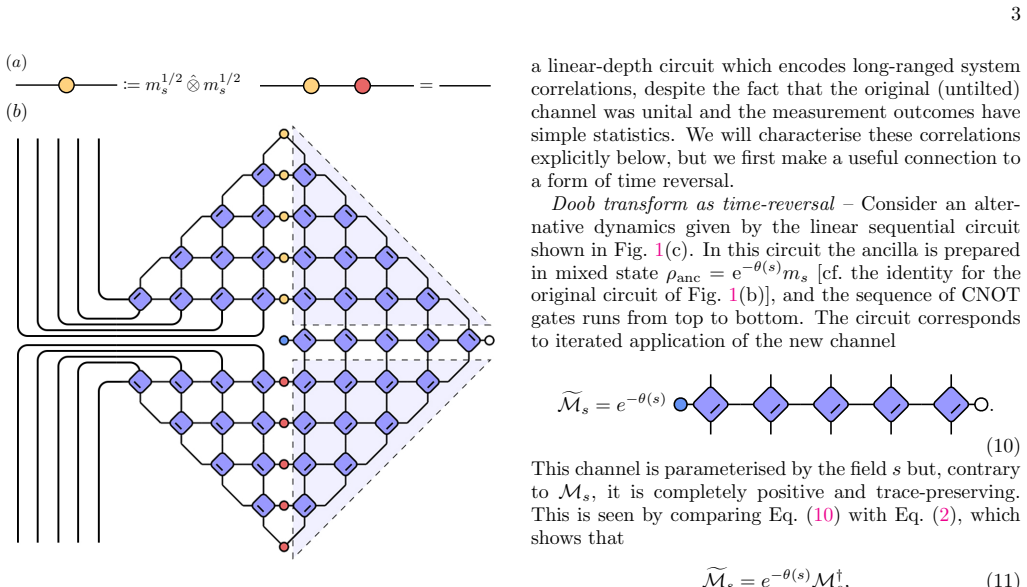
Conditioning on measurement outcomes in the deterministic quantum East circuit with boundary measurements generates a long-range correlated state. The channel optimally realizing the rare measurement trajectories is derived and connected to the Petz recovery map. One- and two-point correlation functions in the conditioned state reveal finite two-body correlations at arbitrarily large separations and an underlying fractal structure related to the Sierpiński triangle.
What carries the argument
The optimal rare-event channel connected to the Petz recovery map, which generates the conditioned long-range correlated state from the large deviation principle.
If this is right
- Finite two-body correlations persist at arbitrarily large separations in the conditioned state.
- An underlying fractal structure related to the Sierpiński triangle appears in the correlations.
- Boundary measurements can be used to control bulk properties of the quantum system.
- The typical trajectories are trivial but rare ones produce long-range order.
Where Pith is reading between the lines
- Similar conditioning techniques might apply to other quantum circuits to engineer specific entangled states.
- The fractal nature could connect to self-similar patterns in other quantum many-body systems.
- This exact solvability via large deviations may inspire analytical approaches in related measurement-driven dynamics.
Load-bearing premise
Large deviation theory applies exactly to the deterministic quantum East circuit with boundary measurements, yielding a well-defined effective channel for the conditioned state.
What would settle it
Numerical computation of the two-point correlation function in the conditioned state for large system sizes showing exponential decay to zero at large distances would falsify the long-range correlation claim.
Figures

read the original abstract
Exploiting quantum measurements is a promising route for preparation of correlated quantum states. We use methods from large deviation theory to solve this problem exactly for a specific system: the deterministic quantum East circuit with boundary measurements. We show that conditioning on measurement outcomes generates a long-range correlated state, despite typical trajectories being trivial. We derive the channel that optimally realizes the rare measurement trajectories, and establish a formal connection with the Petz recovery (time-reversal) map. We compute one- and two-point correlation functions in the conditioned state, revealing finite two-body correlations at arbitrarily large separations, and an underlying fractal structure, related to the Sierpi\'nski triangle. These results demonstrate explicitly how boundary measurements can be used to control bulk properties of a quantum system.
Editorial analysis
A structured set of objections, weighed in public.
Referee Report
Summary. The manuscript claims an exact solution via large deviation theory for the deterministic quantum East circuit subject to boundary measurements. Conditioning on rare measurement outcomes is shown to produce a long-range correlated bulk state with finite two-point correlations persisting at arbitrary distances and an underlying fractal structure resembling the Sierpiński triangle. An optimal channel realizing these rare trajectories is derived and formally connected to the Petz recovery map.
Significance. If the central derivations hold, the work is significant as a rare exactly solvable example linking large-deviation conditioning to emergent long-range order and fractal correlations in a quantum circuit. The explicit Petz-map connection and correlation-function results provide a concrete benchmark for measurement-induced phenomena and could inform protocols for preparing correlated states via post-selection.
major comments (3)
- [§3] §3 (Large-deviation setup): The claim that large deviation theory yields an exact optimal channel for the discrete projective-measurement trajectories rests on the existence of a convex rate function I(·) whose minimum reproduces the conditioned dynamics. The manuscript does not appear to compute or verify this rate function explicitly for the East-circuit overlaps; without that step the exactness of all downstream correlation functions is not demonstrated.
- [§4.2] §4.2 (Optimal channel and Petz map): The formal identification of the rare-event channel with the Petz recovery map is stated, yet the proof that this channel exactly implements the conditioned state (rather than an asymptotic or approximate version) is not supplied. A direct calculation showing that the channel action on the initial state reproduces the post-selected ensemble without additional scaling assumptions is required.
- [§5] §5 (Correlation functions): The reported finite two-point correlations at arbitrarily large separations and the Sierpiński-triangle fractal structure are derived from iterated application of the optimal channel. The manuscript should clarify how the self-similar structure emerges from the East-model update rules and provide an explicit recurrence or generating-function argument rather than relying on numerical illustration alone.
minor comments (2)
- [Abstract] The abstract asserts an 'exact' solution; a brief statement of the precise limit (e.g., infinite system size or specific scaling) in which exactness holds would improve clarity.
- Notation for the measurement outcomes and the trajectory probability measure should be introduced once and used consistently; occasional re-definition of symbols in later sections hinders readability.
Simulated Author's Rebuttal
We thank the referee for their thorough review and valuable comments on our manuscript. We address each of the major comments below, providing clarifications and indicating the revisions we plan to implement.
read point-by-point responses
-
Referee: [§3] §3 (Large-deviation setup): The claim that large deviation theory yields an exact optimal channel for the discrete projective-measurement trajectories rests on the existence of a convex rate function I(·) whose minimum reproduces the conditioned dynamics. The manuscript does not appear to compute or verify this rate function explicitly for the East-circuit overlaps; without that step the exactness of all downstream correlation functions is not demonstrated.
Authors: We agree that an explicit verification of the rate function would enhance the rigor of our claims. In the manuscript, we rely on the general framework of large deviation theory for the probability of rare trajectories, but we will add a new subsection in §3 deriving the rate function I(·) explicitly for the overlaps in the quantum East circuit. This will involve computing the log-probability of the measurement sequences and showing that its minimum indeed selects the optimal channel used for the conditioned state. revision: yes
-
Referee: [§4.2] §4.2 (Optimal channel and Petz map): The formal identification of the rare-event channel with the Petz recovery map is stated, yet the proof that this channel exactly implements the conditioned state (rather than an asymptotic or approximate version) is not supplied. A direct calculation showing that the channel action on the initial state reproduces the post-selected ensemble without additional scaling assumptions is required.
Authors: The identification with the Petz recovery map follows from the time-reversal symmetry in the conditioned ensemble. To provide the requested direct calculation, we will include in §4.2 an explicit computation demonstrating that the action of the optimal channel on the initial state exactly yields the post-selected ensemble. This calculation uses the specific form of the boundary measurements and the deterministic updates in the East circuit, without relying on asymptotic approximations. revision: yes
-
Referee: [§5] §5 (Correlation functions): The reported finite two-point correlations at arbitrarily large separations and the Sierpiński-triangle fractal structure are derived from iterated application of the optimal channel. The manuscript should clarify how the self-similar structure emerges from the East-model update rules and provide an explicit recurrence or generating-function argument rather than relying on numerical illustration alone.
Authors: We thank the referee for this suggestion. The self-similar structure originates from the hierarchical propagation of excitations under the East-model rules when conditioned on the rare boundary outcomes. We will revise §5 to include an explicit recurrence relation for the two-point correlation functions based on the circuit's update rules and a generating function that analytically captures the Sierpiński-triangle fractal. This will complement the numerical results and provide a rigorous derivation of the long-range correlations. revision: yes
Circularity Check
No circularity: derivation applies external large-deviation methods to model without self-referential reduction
full rationale
The paper invokes standard large deviation theory to obtain an effective channel for rare trajectories in the deterministic quantum East circuit and connects it formally to the Petz recovery map before computing correlations. No step reduces the claimed long-range correlations or fractal structure to a fitted parameter, a self-defined quantity, or a load-bearing self-citation whose content is itself unverified; the rate function and channel are treated as outputs of the external framework applied to the circuit dynamics. The derivation therefore remains self-contained against independent benchmarks such as conventional LDP applications and Petz-map properties.
Axiom & Free-Parameter Ledger
axioms (1)
- domain assumption Large deviation principle holds for the measurement trajectories in the deterministic quantum East circuit
Lean theorems connected to this paper
-
IndisputableMonolith/Foundation/AbsoluteFloorClosure.leanreality_from_one_distinction unclear?
unclearRelation between the paper passage and the cited Recognition theorem.
We compute one- and two-point correlation functions in the conditioned state, revealing finite two-body correlations at arbitrarily large separations, and an underlying fractal structure, related to the Sierpiński triangle.
-
IndisputableMonolith/Cost/FunctionalEquation.leanwashburn_uniqueness_aczel unclear?
unclearRelation between the paper passage and the cited Recognition theorem.
the Doob channel MDs := e−θ(s) Vs ◦ Ms ◦ V−1s ... MDs = fMPs (Petz recovery map)
What do these tags mean?
- matches
- The paper's claim is directly supported by a theorem in the formal canon.
- supports
- The theorem supports part of the paper's argument, but the paper may add assumptions or extra steps.
- extends
- The paper goes beyond the formal theorem; the theorem is a base layer rather than the whole result.
- uses
- The paper appears to rely on the theorem as machinery.
- contradicts
- The paper's claim conflicts with a theorem or certificate in the canon.
- unclear
- Pith found a possible connection, but the passage is too broad, indirect, or ambiguous to say the theorem truly supports the claim.
Reference graph
Works this paper leans on
-
[1]
q(s) iX k=0 βi,k # ,(19) ⟨ZiZj⟩s = exp ( q(s)
(b)C s(i, j) as a function ofj > ifor fixedi= 2 (top) andi= 8 (bottom). The gray dashed and dotted horizontal lines indicate the values ofC s(2m,2 n) andC s(2m,2 n + 2m). The red circles are the averages [C s(i,·)] 2n+1 2n . The blue tri- angles are [C s(i,·)] 2(n/8)+1 2(n/8) . of applications of fMs (or alternativelyM D s ), specifically int=Ltime steps....
work page 2024
-
[2]
A. C. Potter and R. Vasseur, Entanglement Dynamics in Hybrid Quantum Circuits, inEntanglement in Spin Chains: From Theory to Quantum Technology Applica- tions, edited by A. Bayat, S. Bose, and H. Johannesson (Cham, 2022) pp. 211–249
work page 2022
-
[3]
M. P. Fisher, V. Khemani, A. Nahum, and S. Vijay, Random quantum circuits, Annu. Rev. Condens. Matter Phys.14, 335 (2023)
work page 2023
-
[4]
Exactly solvable many-body dynamics from space-time duality
B. Bertini, P. W. Claeys, and T. Prosen, Exactly solvable many-body dynamics from space-time duality, arXiv:2505.11489 (2025)
work page internal anchor Pith review Pith/arXiv arXiv 2025
-
[5]
H.-R. Wang, X.-Y. Yang, and Z. Wang, Exact hidden markovian dynamics in quantum circuits, Phys. Rev. Lett.133, 170402 (2024)
work page 2024
-
[6]
Wang, Hopf algebras and solvable unitary circuits, Phys
Z. Wang, Hopf algebras and solvable unitary circuits, Phys. Rev. B111, 104315 (2025)
work page 2025
-
[7]
X.-H. Yu, Z. Wang, and P. Kos, Hierarchical generaliza- tion of dual unitarity, Quantum8, 1260 (2024)
work page 2024
-
[8]
S. J. Evered, D. Bluvstein, M. Kalinowski, S. Ebadi, T. Manovitz, H. Zhou, S. H. Li, A. A. Geim, T. T. Wang, N. Maskara,et al., High-fidelity parallel entangling gates on a neutral-atom quantum computer, Nature622, 268 (2023)
work page 2023
-
[9]
J.-S. Chen, E. Nielsen, M. Ebert, V. Inlek, K. Wright, V. Chaplin, A. Maksymov, E. P´ aez, A. Poudel, P. Maunz, and J. Gamble, Benchmarking a trapped-ion quantum computer with 30 qubits, Quantum8, 1516 (2024)
work page 2024
-
[10]
C. M. L¨ oschnauer, J. M. Toba, A. C. Hughes, S. A. King, M. A. Weber, R. Srinivas, R. Matt, R. Nour- shargh, D. T. C. Allcock, C. J. Ballance, C. Matthiesen, M. Malinowski, and T. P. Harty, Scalable, high- fidelity all-electronic control of trapped-ion qubits, arXiv:2407.07694 (2024)
-
[11]
L. E. Fischer, M. Leahy, A. Eddins, N. Keenan, D. Fer- racin, M. A. C. Rossi, Y. Kim, A. He, F. Pietracap- rina, B. Sokolov, S. Dooley, Z. Zimbor´ as, F. Tacchino, S. Maniscalco, J. Goold, G. Garc´ ıa-P´ erez, I. Tavernelli, A. Kandala, and S. N. Filippov, Dynamical simulations of many-body quantum chaos on a quantum computer, arXiv:2411.00765 (2024)
-
[12]
R. Acharya, D. A. Abanin, L. Aghababaie-Beni, I. Aleiner, T. I. Andersen,et al., Quantum error correc- tion below the surface code threshold, Nature638, 920 (2025). 6
work page 2025
-
[13]
F. Baccari, P. Kos, and G. Styliaris, Average- computation benchmarking for local expectation values in digital quantum devices, arXiv:2507.18708 (2025)
-
[14]
B. Skinner, J. Ruhman, and A. Nahum, Measurement- Induced Phase Transitions in the Dynamics of Entangle- ment, Phys. Rev. X9, 031009 (2019)
work page 2019
-
[15]
Y. Li, X. Chen, and M. P. A. Fisher, Measurement- driven entanglement transition in hybrid quantum cir- cuits, Phys. Rev. B100, 134306 (2019)
work page 2019
-
[16]
J. C. Hoke, M. Ippoliti, E. Rosenberg, D. Abanin,et al., Measurement-induced entanglement and teleportation on a noisy quantum processor, Nature622, 481 (2023)
work page 2023
- [17]
-
[18]
G.-Y. Zhu, N. Tantivasadakarn, A. Vishwanath, S. Trebst, and R. Verresen, Nishimori’s Cat: Stable Long-Range Entanglement from Finite-Depth Unitaries and Weak Measurements, Phys. Rev. Lett.131, 200201 (2023)
work page 2023
- [19]
- [20]
-
[21]
S. Gopalakrishnan, Push-down automata as sequential generators of highly entangled states, arXiv:2305.04951 (2023)
- [22]
-
[23]
J. Lloyd and D. A. Abanin, Quantum thermal state preparation for near-term quantum processors, arXiv:2506.21318 (2025)
-
[24]
Z. Ding, C.-F. Chen, and L. Lin, Single-ancilla ground state preparation via lindbladians, Phys. Rev. Res.6, 033147 (2024)
work page 2024
-
[25]
F. Ciccarello, S. Lorenzo, V. Giovannetti, and G. M. Palma, Quantum collision models: Open system dynam- ics from repeated interactions, Phys. Rep.954, 1 (2022)
work page 2022
-
[26]
D. Cilluffo, G. Buonaiuto, I. Lesanovsky, A. Carollo, S. Lorenzo, G. M. Palma, F. Ciccarello, and F. Carollo, Microscopic biasing of discrete-time quantum trajecto- ries, Quantum Sci. Technol.6, 045011 (2021)
work page 2021
-
[27]
M. Cech, I. Lesanovsky, and F. Carollo, Thermodynamics of Quantum Trajectories on a Quantum Computer, Phys. Rev. Lett.131, 120401 (2023)
work page 2023
-
[28]
M. Cech, M. Cea, M. C. Ba˜ nuls, I. Lesanovsky, and F. Carollo, Space-Time Correlations in Monitored Ki- netically Constrained Discrete-Time Quantum Dynam- ics, Phys. Rev. Lett.134, 230403 (2025)
work page 2025
-
[29]
M. Cech, C. D. Fazio, M. Cea, M. C. Ba˜ nuls, I. Lesanovsky, and F. Carollo, Revealing emergent many- body phenomena by analyzing large-scale space-time records of monitored quantum systems, arXiv:2507.00944 (2025)
work page internal anchor Pith review Pith/arXiv arXiv 2025
-
[30]
J. I. Cirac, D. P´ erez-Garc´ ıa, N. Schuch, and F. Ver- straete, Matrix product states and projected entangled pair states: Concepts, symmetries, theorems, Rev. Mod. Phys.93, 045003 (2021)
work page 2021
-
[31]
C. Sch¨ on, E. Solano, F. Verstraete, J. I. Cirac, and M. M. Wolf, Sequential Generation of Entangled Mul- tiqubit States, Phys. Rev. Lett.95, 110503 (2005)
work page 2005
-
[32]
C. Sch¨ on, K. Hammerer, M. M. Wolf, J. I. Cirac, and E. Solano, Sequential generation of matrix-product states in cavity QED, Phys. Rev. A75, 032311 (2007)
work page 2007
-
[33]
M. C. Ba˜ nuls, D. P´ erez-Garc´ ıa, M. M. Wolf, F. Ver- straete, and J. I. Cirac, Sequentially generated states for the study of two-dimensional systems, Phys. Rev. A77, 052306 (2008)
work page 2008
-
[34]
Z.-Y. Wei, D. Malz, and J. I. Cirac, Sequential Genera- tion of Projected Entangled-Pair States, Phys. Rev. Lett. 128, 010607 (2022)
work page 2022
-
[35]
Belavkin, A stochastic posterior Schr¨ odinger equation for counting nondemolition measurement, Lett
V. Belavkin, A stochastic posterior Schr¨ odinger equation for counting nondemolition measurement, Lett. Math. Phys.20, 85 (1990)
work page 1990
-
[36]
Carmichael,An open systems approach to quantum optics(1993)
H. Carmichael,An open systems approach to quantum optics(1993)
work page 1993
- [37]
-
[38]
M. B. Plenio and P. L. Knight, The quantum-jump ap- proach to dissipative dynamics in quantum optics, Rev. Mod. Phys.70, 101 (1998)
work page 1998
-
[39]
H. P. Breuer and F. Petruccione,The theory of open quantum systems(Great Clarendon Street, 2002)
work page 2002
-
[40]
J. P. Garrahan and I. Lesanovsky, Thermodynamics of Quantum Jump Trajectories, Phys. Rev. Lett.104, 160601 (2010)
work page 2010
-
[41]
M. Esposito, U. Harbola, and S. Mukamel, Nonequilib- rium fluctuations, fluctuation theorems, and counting statistics in quantum systems, Rev. Mod. Phys.81, 1665 (2009)
work page 2009
-
[42]
J. P. Garrahan, Aspects of non-equilibrium in classical and quantum systems: Slow relaxation and glasses, dy- namical large deviations, quantum non-ergodicity, and open quantum dynamics, Physica A504, 130 (2018)
work page 2018
-
[43]
F. Carollo, J. P. Garrahan, I. Lesanovsky, and C. P´ erez- Espigares, Making rare events typical in Markovian open quantum systems, Phys. Rev. A98, 010103 (2018)
work page 2018
-
[44]
D. Berenstein and J. Zhao, Exotic equilibration dynamics on a 1-D quantum CNOT gate lattice, arXiv:2102.05745 (2021)
- [45]
-
[46]
B. Bertini, P. Kos, and T. Prosen, Localized Dynamics in the Floquet Quantum East Model, Phys. Rev. Lett. 132, 080401 (2024)
work page 2024
-
[47]
B. Bertini, C. De Fazio, J. P. Garrahan, and K. Klobas, Exact quench dynamics of the Floquet quantum East model at the deterministic point, Phys. Rev. Lett.132, 120402 (2024)
work page 2024
-
[48]
J. Iaconis, S. Vijay, and R. Nandkishore, Anomalous sub- diffusion from subsystem symmetries, Phys. Rev. B100, 214301 (2019)
work page 2019
-
[49]
J. Iaconis, Quantum state complexity in computation- ally tractable quantum circuits, PRX Quantum2, 010329 (2021)
work page 2021
- [50]
-
[51]
X. Feng and M. Ippoliti, Dynamics of pseudoentangle- ment, J. High Energy Phys.2025(2), 128. 7
work page 2025
-
[52]
B. Bertini, K. Klobas, P. Kos, and D. Malz, Quantum and classical dynamics with random permutation cir- cuits, Phys. Rev. X15, 011015 (2025)
work page 2025
-
[53]
D. Sz´ asz-Schagrin, M. Mazzoni, B. Bertini, K. Klobas, and L. Piroli, Entanglement dynamics and page curves in random permutation circuits, arXiv:2505.06158 (2025)
- [54]
-
[55]
B. Bertini, K. Klobas, P. Kos, and D. Malz, Random per- mutation circuits are quantum chaotic, arXiv:2508.10890 (2025)
-
[56]
F. Carollo, R. L. Jack, and J. P. Garrahan, Unraveling the Large Deviation Statistics of Markovian Open Quan- tum Systems, Phys. Rev. Lett.122, 130605 (2019)
work page 2019
-
[57]
J. Li, R. L. Jack, B. Bertini, and J. P. Garrahan, Ef- ficient post-selection in light cone correlations of moni- tored quantum circuits, Phys. Rev. B111, 024309 (2025)
work page 2025
-
[58]
See Supplemental Material at [URL] for more details
-
[59]
Petz, Sufficient subalgebras and the relative entropy of states of a von Neumann algebra, Comm
D. Petz, Sufficient subalgebras and the relative entropy of states of a von Neumann algebra, Comm. Math. Phys. 105, 123 (1986)
work page 1986
-
[60]
H. Kwon, R. Mukherjee, and M. S. Kim, Reversing Lind- blad Dynamics via Continuous Petz Recovery Map, Phys. Rev. Lett.128, 020403 (2022)
work page 2022
- [61]
-
[62]
K. Rudinger, G. J. Ribeill, L. C. G. Govia, M. Ware, E. Nielsen, K. Young, T. A. Ohki, R. Blume-Kohout, and T. Proctor, Characterizing mid-circuit measurements on a superconducting qubit using gate set tomography, arXiv:2103.03008 (2021)
-
[63]
L. Piroli and J. I. Cirac, Quantum Cellular Automata, Tensor Networks, and Area Laws, Phys. Rev. Lett.125, 190402 (2020)
work page 2020
-
[64]
M. A. Nielsen and I. L. Chuang,Quantum computation and quantum information(Shaftesbury Road, 2010)
work page 2010
-
[65]
Touchette, Introduction to dynamical large deviations of Markov processes, Physica A504, 5 (2018)
H. Touchette, Introduction to dynamical large deviations of Markov processes, Physica A504, 5 (2018)
work page 2018
-
[66]
R. L. Jack, Ergodicity and large deviations in physical systems with stochastic dynamics, Eur. Phys. J. B93, 74 (2020)
work page 2020
-
[67]
S. Gopalakrishnan and A. Lamacraft, Unitary circuits of finite depth and infinite width from quantum channels, Phys. Rev. B100, 064309 (2019)
work page 2019
-
[68]
G. Giudice, G. Giudici, M. Sonner, J. Thoenniss, A. Lerose, D. A. Abanin, and L. Piroli, Temporal en- tanglement, quasiparticles and the role of interactions, Phys. Rev. Lett.128, 220401 (2022)
work page 2022
- [69]
-
[70]
R. L. Jack, I. R. Thompson, and P. Sollich, Hyperuni- formity and Phase Separation in Biased Ensembles of Trajectories for Diffusive Systems, Phys. Rev. Lett.114, 060601 (2015)
work page 2015
-
[71]
B. Buˇ ca, J. P. Garrahan, T. Prosen, and M. Vanicat, Ex- act large deviation statistics and trajectory phase transi- tion of a deterministic boundary driven cellular automa- ton, Phys. Rev. E100, 020103 (2019). 8 Supplemental Material: Exact large deviations and emergent long-range correlations in sequential quantum East circuits In this supplemental mat...
work page 2019
-
[72]
One-point function Defineq(s) = ln tanh(s) as in the main text, we considers >0 soq <0. We have ⟨Zi⟩s = exp[q(s)Vi] (sm-87) 23 (Fors <0 thene q is real and negative, andqis complex.) Now we compute the one-point correlation function averaged over the window from 0 to 2 m as [⟨Z⟩ s]2m 0 = ∞X k=0 qk k! [V k]2m 0 = ∞X k=0 qk k! 1 + 2k 2 m = 1 2m mX j=0 m j e...
-
[73]
Two-point function The two-point function can be treated in a similar way. We consider the illustrative casei= 2 m ≤jfor which ⟨ZiZj⟩s =⟨Z j⟩s exp[−2qβj,i] (sm-93) where we used thatβ j,0 = 1. It is also useful to note that Lucas’s theorem implies βj,2m =j m,(sm-94) wherej m is them-th coefficient of the expansion ofjin base 2. This means that we can writ...
discussion (0)
Sign in with ORCID, Apple, or X to comment. Anyone can read and Pith papers without signing in.