REVIEW 3 major objections 5 minor 2 cited by
ShapeEmbed: a self-supervised learning framework for 2D contour quantification
T0 review · 3 major / 5 minor · reviewed 2026-08-06 · deepseek-v4-flash
Pith's one-line read This paper claims that a self-supervised variational autoencoder trained on Euclidean distance matrices of 2D contours produces shape descriptors that are invariant to translation, scaling, rotation, reflection, and contour point…
desk verdict ShapeEmbed is a solid, well-evaluated method for learning shape descriptors from distance matrices, but the paper's central guarantee of point-indexation invariance is overstated and needs a direct test before I'd trust it. read the letter →
The pith
A machine-rendered reading of the paper's core claim, the machinery that carries it, and where it could break.
The reading
What carries the argument
The load-bearing object is the Euclidean distance matrix of the contour points: an N by N array of pairwise point distances that is translation- and rotation-invariant by construction and scale-invariant after division by its Frobenius norm. The argument is carried by three components: circular padding in every convolution and pooling layer of a ResNet-18 encoder to make it shift-equivariant under diagonal re-indexing; summing the encoder outputs of the matrix and its horizontal and vertical mirror to add reflection invariance; and a reconstruction loss that takes the minimum over all 2N equivalent indexations so the decoder is never forced to commit to one indexing.
What would settle it
Take a single contour, compute its distance matrix, generate all 2N re-indexed versions (N starting points times two travel directions), push each through the trained encoder, and measure the maximum pairwise distance between the resulting latent codes. If any two re-indexings yield codes that differ by more than the typical within-class spread of the latent space, the guaranteed-invariance claim is false, and the paper reports no such direct test.
Extended reading notes
Core claim
The central claim is that encoding the Euclidean distance matrix of a contour, rather than the segmentation mask, with a VAE whose encoder uses circular padding and whose decoder is trained with a min-over-reindexations loss yields latent vectors that are invariant to similarity transformations and to contour re-indexing. The paper argues that distance matrices are inherently invariant to translation and rotation, become scale-invariant after Frobenius normalization, and that the remaining indexation ambiguity, the 2N equivalent matrices from choice of origin and travel direction, is removed by the encoder design and loss, so the same latent code is produced for every equivalent indexing. It further reports that this descriptor outperforms the tested baselines in shape classification on natural image benchmarks and biological imaging datasets, and that adding object size back as an optional feature improves results on biology tasks.
Load-bearing premise
The whole invariance story depends on the claim that replacing padding with circular padding makes the ResNet-18 encoder shift-equivariant enough that all 2N re-indexed distance matrices of a contour map to the same latent code, even though the paper admits that stride and pooling break true shift equivariance.
Editorial extensions
If this is right
- Shape descriptors can be extracted without alignment, centering, or size normalization of input objects, removing a preprocessing step that classical shape pipelines require.
- The same trained model can reconstruct outlines from latent codes via multidimensional scaling, enabling visualization and generative sampling of shapes directly from the descriptor space.
- Reintroducing object size as an extra feature alongside the invariant code improves classification on biological datasets, so size can be treated as an optional, task-dependent channel.
- The method applies to simply connected 2D contours and would need new machinery for contours with holes or for genuine 3D surfaces.
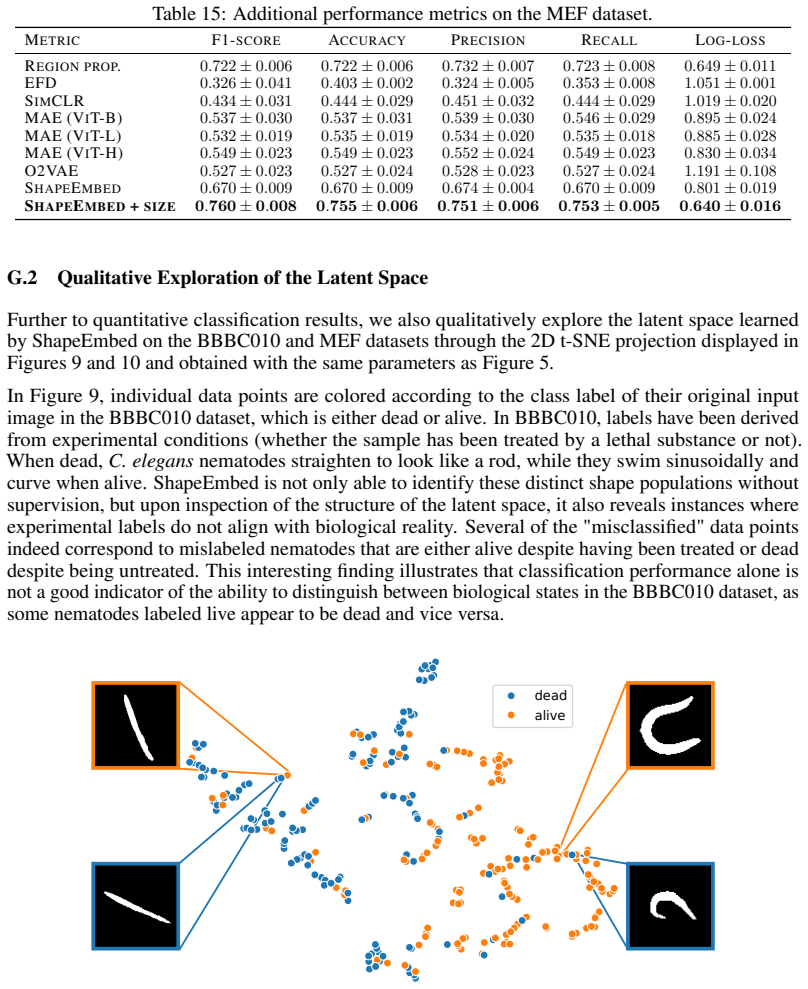
- In biological imaging, the unsupervised latent structure can reveal mismatches between experimental labels and actual phenotypes, as demonstrated on the C. elegans dataset.
Reading between the lines
- If the invariance claim holds exactly, ShapeEmbed could act as a drop-in shape encoder for unsupervised phenotype discovery, where structure in the latent space is inspected directly rather than through a trained classifier.
- The min-over-reindexations loss may let the decoder absorb residual encoder non-invariance rather than enforcing exact latent equality, so an explicit equality test would be needed to separate the two effects.
- The consistent gains from adding size back suggest the most useful practical descriptor is a two-part code: one scale-invariant shape vector plus one scalar scale channel, rather than a single invariant vector.
- The same distance-matrix-plus-indexation-invariance recipe could transfer to other self-supervised architectures than VAEs, provided their encoders can be made shift-equivariant under the 2N re-indexing group.
Editorial analysis
A structured set of objections, weighed in public.
Referee Report
Summary. The paper introduces ShapeEmbed, a self-supervised variational autoencoder that encodes ordered 2D contour points through normalized Euclidean distance matrices into a latent shape descriptor. The authors claim invariance to translation, scaling, rotation, reflection, and contour point re-indexing. The encoder is a ResNet-18 modified with circular padding, and the decoder is trained with a reconstruction loss that minimizes over all 2N equivalent re-indexings of the input distance matrix. The method is evaluated on MNIST, MPEG-7, BBBC010, and MEF datasets against classical descriptors, SimCLR, MAE variants, and O2VAE, with additional ablations and a robustness study on degraded segmentations.
Significance. If the invariance claims hold, ShapeEmbed would be a practically valuable contribution: it would provide the first VAE-based shape descriptor that is fully invariant to similarity transformations and to contour re-indexing, with demonstrated strengths in downstream classification and in generative exploration of bioimaging shape spaces. The empirical work is extensive and carefully reported: multiple baselines, multiple metrics with 5-fold cross-validation, separate ablations for rotation/translation and for regularization terms, a segmentation-noise robustness study, and qualitative latent-space analyses. The central limitation is that the paper's strongest advertised property, exact indexation invariance, is asserted but not directly verified, and the architecture's own text acknowledges that exact shift equivariance is lost in strided and pooling layers.
major comments (3)
- [Section 3.2] The sentence 'our VAE is thus guaranteed to map all possible equivalent indexings of successive outline points to the same latent vector' is stronger than what the architecture supports. The authors themselves state that, because ResNet-18 uses stride and pooling, 'the result is no longer truly shift equivariant or invariant' even with circular padding. Circular padding in convolutional layers does not restore exact equivariance through strided convolutions and pooling. No experiment in Section 4 measures latent vectors for the 2N re-indexed distance matrices of a single contour. This is a load-bearing assertion for contribution 1, so the manuscript should either provide a direct invariance test (for example, maximum pairwise latent distance or cosine similarity across D^{k,o} for held-out contours) or explicitly weaken the claim to approximate/practical invariance.
- [Equation (2)] The min-over-reindexations reconstruction loss supervises only the decoder: it selects the version of the ground-truth matrix closest to the decoder output. This loss is minimized even if the encoder preserves indexation information, because the decoder can align to whichever indexation was preserved. Nothing in the objective directly enforces equality of latent codes across the 2N equivalent matrices. The claim in Section 3.2 that the encoder 'is unable to distinguish' between re-indexings is therefore not implied by the loss alone. The authors should add an explicit invariance term or, at minimum, an empirical measurement showing that encoder outputs for D and D^{k,o} coincide.
- [Table 2] The 'No index. inv.' ablation removes circular padding and the custom indexation-invariant loss simultaneously, replacing both with constant padding and standard MSE reconstruction. Consequently, any observed drop in F1-score cannot be attributed to either component individually. Because this is the only experiment directly tied to indexation invariance, the ablation should separate the two changes. Moreover, downstream logistic-regression accuracy is a coarse proxy that tolerates residual intra-class latent variation; a direct latent-equality metric is needed to support the invariance claim.
minor comments (5)
- [Table 5] The rows for MEF and BBBC010 appear to be swapped relative to Section 4.1: Section 4.1 reports 1,407 objects for BBBC010 and 26,198 objects for MEF, while Table 5 assigns 1,407 to MEF and 26,198 to BBBC010. The maximum/minimum outline sizes appear swapped as well.
- [Section 4 / Supplementary B] The code repository is given as 'https://github.com/link_to_be_added_in_camera-ready_version', which is a placeholder. Since reproducibility is a stated goal, a working repository link or an explicit statement of availability is needed.
- [Section 4.5] The 'ShapeEmbed+Sz' variant is used in Table 4 but not defined in the main text. Please specify whether the saved distance-matrix norm is concatenated to the latent vector before the logistic regression classifier and how that feature is normalized.
- [Supplementary Section G.3] The sentence 'ShapeEmbed performs well (F1-score≤ 0.7)' appears to be a typo: the reported values and Figure 12 indicate that the intended statement is F1-score ≥ 0.7.
- [Throughout] There are small typographical and citation issues, including 'not to to the same solution' in Section 3.4 and the spelling 'Lorense' for the marching-squares reference, which should be 'Lorensen'.
Circularity Check
No circularity: ShapeEmbed's invariance construction and benchmark evaluations are self-contained; the untested indexation-invariance guarantee is a soundness concern, not circular reasoning.
full rationale
The paper's claimed derivation chain is self-contained rather than circular. Translation and rotation invariance follow from the Euclidean distance matrix definition with explicit algebra in Supplementary Section A. Scale invariance follows from the Frobenius-norm scaling identity (Eqs. 4-6). Re-indexed matrices are defined by Eq. 1, and the encoder modifications (circular padding and summed mirrored passes) are architectural constructions. The custom reconstruction loss (Eq. 2) is a training objective that minimizes over re-indexed versions of the input; it is not a fitted parameter renamed as a prediction, and the downstream classification evaluations use external labels on MNIST, MPEG-7, BBBC010, and MEF. The only self-citation in the introduction (Zinchenko et al.) is motivational and not load-bearing. The paper itself admits that with stride and pooling 'the result is no longer truly shift equivariant or invariant' (Section 3.2), so the assertion that the VAE is 'guaranteed to map all possible equivalent indexings of successive outline points to the same latent vector' is stronger than what the architecture provably delivers, and no experiment directly measures latent-code equality. This is an unverified assumption and a correctness risk, not circularity, because the claim does not reduce to its inputs by definition and the method's empirical value is assessed against independent baselines.
Assumptions & free parameters
free parameters (4)
- N (contour point count) =
64
- beta (KL weight) =
1e-10
- gamma, delta, epsilon (regularization weights) =
1e-5 each
- Latent dimension =
128
assumptions (4)
- domain assumption Contours are simply connected and can be represented by an ordered sequence of points
- domain assumption The distance matrix, after normalization, uniquely describes the contour shape up to isometry and indexation
- ad hoc to paper Circular padding makes the modified ResNet-18 sufficiently shift equivariant for exact indexation invariance
- ad hoc to paper The min-over-reindexations reconstruction loss (Eq. 2) does not allow the encoder to retain indexation information
Cite this review
Pith. "Pith review of ShapeEmbed: a self-supervised learning framework for 2D contour quantification." pith.science (2026). https://pith.science/paper/LIEQO6QS
@misc{pith2026250701009,
  author       = {Pith},
  title        = {Pith review of: ShapeEmbed: a self-supervised learning framework for 2D contour quantification},
  year         = {2026},
  howpublished = {\url{https://pith.science/paper/LIEQO6QS}},
  note         = {Machine review of arXiv:2507.01009}
}
read the original abstract
The shape of objects is an important source of visual information in a wide range of applications. One of the core challenges of shape quantification is to ensure that the extracted measurements remain invariant to transformations that preserve an object's intrinsic geometry, such as changing its size, orientation, and position in the image. In this work, we introduce ShapeEmbed, a self-supervised representation learning framework designed to encode the contour of objects in 2D images, represented as a Euclidean distance matrix, into a shape descriptor that is invariant to translation, scaling, rotation, reflection, and point indexing. Our approach overcomes the limitations of traditional shape descriptors while improving upon existing state-of-the-art autoencoder-based approaches. We demonstrate that the descriptors learned by our framework outperform their competitors in shape classification tasks on natural and biological images. We envision our approach to be of particular relevance to biological imaging applications.
Figures


Figures from the paper (11 more)




Forward citations
Cited by 2 Pith papers
-
The Push-Forward Transform for Continuous and Robust Comparison of Dynamic Shapes
Mapping signed distance functions through a diffeomorphism to a common reference domain yields a spectral shape descriptor (PF-SDM) that is invariant to rigid motions and scaling, and is competitive with deep learning...
-
Attention Mechanism in Randomized Time Warping
The abstract claims RTW's learned weights are interpretable as self-attention with a 5% benchmark gain, but the submitted full text is an unrelated contour-learning paper, so the claims are unsupported.
Reference graph
Works this paper leans on
-
[1]
Identification of everyday objects on the basis of silhouette and outline versions
Johan Wagemans, Joeri De Winter, Hans Op de Beeck, Annemie Ploeger, Tom Beckers, and Peter Vanroose. Identification of everyday objects on the basis of silhouette and outline versions. Perception, 37 0 (2): 0 207--244, 2008
work page 2008
-
[2]
Statistical shape analysis: with applications in R, volume 995
Ian L Dryden and Kanti V Mardia. Statistical shape analysis: with applications in R, volume 995. John Wiley & Sons, 2016
work page 2016
-
[3]
Biology and physics of cell shape changes in development
Ewa Paluch and Carl-Philipp Heisenberg. Biology and physics of cell shape changes in development. Current Biology, 19 0 (17): 0 R790--R799, 2009
work page 2009
-
[4]
Decoding information in cell shape
Padmini Rangamani, Azi Lipshtat, Evren U Azeloglu, Rhodora Cristina Calizo, Mufeng Hu, Saba Ghassemi, James Hone, Suzanne Scarlata, Susana R Neves, and Ravi Iyengar. Decoding information in cell shape. Cell, 154 0 (6): 0 1356--1369, 2013
work page 2013
-
[5]
Cell and nucleus shape as an indicator of tissue fluidity in carcinoma
Steffen Grosser, J \"u rgen Lippoldt, Linda Oswald, Matthias Merkel, Daniel M Sussman, Fr \'e d \'e ric Renner, Pablo Gottheil, Erik W Morawetz, Thomas Fuhs, Xiaofan Xie, et al. Cell and nucleus shape as an indicator of tissue fluidity in carcinoma. Physical Review X, 11 0 (1): 0 011033, 2021
work page 2021
-
[6]
Valentyna Zinchenko, Johannes Hugger, Virginie Uhlmann, Detlev Arendt, and Anna Kreshuk. Morphofeatures for unsupervised exploration of cell types, tissues, and organs in volume electron microscopy. Elife, 12: 0 e80918, 2023
work page 2023
-
[7]
Image-based multivariate profiling of drug responses from single cells
Lit-Hsin Loo, Lani F Wu, and Steven J Altschuler. Image-based multivariate profiling of drug responses from single cells. Nature methods, 4 0 (5): 0 445--453, 2007
work page 2007
-
[8]
Visualizing cellular imaging data using phenoplot
Heba Z Sailem, Julia E Sero, and Chris Bakal. Visualizing cellular imaging data using phenoplot. Nature communications, 6 0 (1): 0 5825, 2015
work page 2015
Show all 62 references
-
[9]
Comparison of quantitative methods for cell-shape analysis
Zachary Pincus and JA Theriot. Comparison of quantitative methods for cell-shape analysis. Journal of microscopy, 227 0 (2): 0 140--156, 2007
2007
-
[10]
Reducing the dimensionality of data with neural networks
Geoffrey E Hinton and Ruslan R Salakhutdinov. Reducing the dimensionality of data with neural networks. science, 313 0 (5786): 0 504--507, 2006
2006
-
[11]
Kingma and Max Welling
Diederik P. Kingma and Max Welling. Auto-encoding variational bayes. In Proceedings of the 2nd International Conference on Learning Representations (ICLR), Banff, AB, Canada, 2014. URL https://arxiv.org/abs/1312.6114
2014 arXiv
-
[12]
Quantitative comparison of principal component analysis and unsupervised deep learning using variational autoencoders for shape analysis of motile cells
Caleb K Chan, Amalia Hadjitheodorou, Tony Y-C Tsai, and Julie A Theriot. Quantitative comparison of principal component analysis and unsupervised deep learning using variational autoencoders for shape analysis of motile cells. bioRxiv, pages 2020--06, 2020
2020
-
[13]
Evaluation of methods for generative modeling of cell and nuclear shape
Xiongtao Ruan and Robert F Murphy. Evaluation of methods for generative modeling of cell and nuclear shape. Bioinformatics, 35 0 (14): 0 2475--2485, 2019
2019
-
[14]
Kendall shape-vae: Learning shapes in a generative framework
Sharvaree Vadgama, Jakub Mikolaj Tomczak, and Erik J Bekkers. Kendall shape-vae: Learning shapes in a generative framework. In NeurIPS 2022 Workshop on Symmetry and Geometry in Neural Representations, New Orleans, LA, USA, 2022
2022
-
[15]
Continuous kendall shape variational autoencoders
Sharvaree Vadgama, Jakub M Tomczak, and Erik Bekkers. Continuous kendall shape variational autoencoders. In International Conference on Geometric Science of Information, pages 73--81, Saint-Malo, France, 2023. Springer
2023
-
[16]
Euclidean distance matrices: essential theory, algorithms, and applications
Ivan Dokmanic, Reza Parhizkar, Juri Ranieri, and Martin Vetterli. Euclidean distance matrices: essential theory, algorithms, and applications. IEEE Signal Processing Magazine, 32 0 (6): 0 12--30, 2015
2015
-
[17]
Multidimensional scaling
Trevor F Cox and Michael AA Cox. Multidimensional scaling. CRC press, 2000
2000
-
[18]
Multiscale distance matrix for fast plant leaf recognition
Rongxiang Hu, Wei Jia, Haibin Ling, and Deshuang Huang. Multiscale distance matrix for fast plant leaf recognition. IEEE transactions on image processing, 21 0 (11): 0 4667--4672, 2012
2012
-
[19]
Wesd--weighted spectral distance for measuring shape dissimilarity
Ender Konukoglu, Ben Glocker, Antonio Criminisi, and Kilian M Pohl. Wesd--weighted spectral distance for measuring shape dissimilarity. IEEE transactions on pattern analysis and machine intelligence, 35 0 (9): 0 2284--2297, 2012
2012
-
[20]
Cajal enables analysis and integration of single-cell morphological data using metric geometry
Kiya W Govek, Patrick Nicodemus, Yuxuan Lin, Jake Crawford, Artur B Saturnino, Hannah Cui, Kristi Zoga, Michael P Hart, and Pablo G Camara. Cajal enables analysis and integration of single-cell morphological data using metric geometry. Nature Communications, 14 0 (1): 0 3672, 2023
2023
-
[21]
Highly accurate protein structure prediction with alphafold
John Jumper, Richard Evans, Alexander Pritzel, Tim Green, Michael Figurnov, Olaf Ronneberger, Kathryn Tunyasuvunakool, Russ Bates, Augustin Z \' dek, Anna Potapenko, et al. Highly accurate protein structure prediction with alphafold. nature, 596 0 (7873): 0 583--589, 2021
2021
-
[22]
S ch\"onberger, J uan Nunez-Iglesias , F ran c ois B oulogne, J oshua D
S t\'efan van der Walt, J ohannes L . S ch\"onberger, J uan Nunez-Iglesias , F ran c ois B oulogne, J oshua D . W arner, N eil Y ager, E mmanuelle G ouillart, T ony Y u, and the scikit-image contributors. scikit-image: image processing in P ython. PeerJ, 2: 0 e453, 6 2014. doi...
2014 doi
-
[23]
Quantitative morphological signatures define local signaling networks regulating cell morphology
Chris Bakal, John Aach, George Church, and Norbert Perrimon. Quantitative morphological signatures define local signaling networks regulating cell morphology. science, 316 0 (5832): 0 1753--1756, 2007
2007
-
[24]
Identification of phenotype-specific networks from paired gene expression--cell shape imaging data
Charlie George Barker, Eirini Petsalaki, Girolamo Giudice, Julia Sero, Emmanuel Nsa Ekpenyong, Chris Bakal, and Evangelia Petsalaki. Identification of phenotype-specific networks from paired gene expression--cell shape imaging data. Genome Research, 32 0 (4): 0 750--765, 2022
2022
-
[25]
Shape discrimination using fourier descriptors
Eric Persoon and King-Sun Fu. Shape discrimination using fourier descriptors. IEEE Transactions on systems, man, and cybernetics, 7 0 (3): 0 170--179, 1977
1977
-
[26]
Elliptic fourier features of a closed contour
Frank P Kuhl and Charles R Giardina. Elliptic fourier features of a closed contour. Computer Graphics and Image Processing, 18 0 (3): 0 236--258, 1982. doi:https://doi.org/10.1016/0146-664X(82)90034-X
1982 doi
-
[27]
A simple framework for contrastive learning of visual representations
Ting Chen, Simon Kornblith, Mohammad Norouzi, and Geoffrey Hinton. A simple framework for contrastive learning of visual representations. In International conference on machine learning, pages 1597--1607. PmLR, 2020
2020
-
[28]
Momentum contrast for unsupervised visual representation learning
Kaiming He, Haoqi Fan, Yuxin Wu, Saining Xie, and Ross Girshick. Momentum contrast for unsupervised visual representation learning. In Proceedings of the IEEE/CVF conference on computer vision and pattern recognition, pages 9729--9738, 2020
2020
-
[29]
Emerging properties in self-supervised vision transformers
Mathilde Caron, Hugo Touvron, Ishan Misra, Herv \'e J \'e gou, Julien Mairal, Piotr Bojanowski, and Armand Joulin. Emerging properties in self-supervised vision transformers. In Proceedings of the IEEE/CVF international conference on computer vision, pages 9650--9660, 2021
2021
-
[30]
Masked autoencoders are scalable vision learners
Kaiming He, Xinlei Chen, Saining Xie, Yanghao Li, Piotr Doll \'a r, and Ross Girshick. Masked autoencoders are scalable vision learners. In Proceedings of the IEEE/CVF conference on computer vision and pattern recognition, pages 16000--16009, 2022
2022
-
[31]
Jamieson, Erik S
Assaf Zaritsky, Andrew R. Jamieson, Erik S. Welf, Andres Nevarez, Justin Cillay, Ugur Eskiocak, Brandi L. Cantarel, and Gaudenz Danuser. Interpretable deep learning uncovers cellular properties in label-free live cell images that are predictive of highly metastatic melanoma. C...
2021
-
[32]
Orientation-invariant autoencoders learn robust representations for shape profiling of cells and organelles
James Burgess, Jeffrey J Nirschl, Maria-Clara Zanellati, Alejandro Lozano, Sarah Cohen, and Serena Yeung-Levy. Orientation-invariant autoencoders learn robust representations for shape profiling of cells and organelles. Nature Communications, 15 0 (1): 0 1022, 2024. doi:10.103...
2024 doi
-
[33]
Invariant shape representation learning for image classification
Tonmoy Hossain, Jing Ma, Jundong Li, and Miaomiao Zhang. Invariant shape representation learning for image classification. arXiv preprint arXiv:2411.12201, 2024
2024 arXiv
-
[34]
A rotation-invariant framework for deep point cloud analysis
Xianzhi Li, Ruihui Li, Guangyong Chen, Chi-Wing Fu, Daniel Cohen-Or, and Pheng-Ann Heng. A rotation-invariant framework for deep point cloud analysis. IEEE transactions on visualization and computer graphics, 28 0 (12): 0 4503--4514, 2021 a
2021
-
[35]
Riconv++: Effective rotation invariant convolutions for 3d point clouds deep learning
Zhiyuan Zhang, Binh-Son Hua, and Sai-Kit Yeung. Riconv++: Effective rotation invariant convolutions for 3d point clouds deep learning. International Journal of Computer Vision, 130 0 (5): 0 1228--1243, 2022
2022
-
[36]
A closer look at rotation-invariant deep point cloud analysis
Feiran Li, Kent Fujiwara, Fumio Okura, and Yasuyuki Matsushita. A closer look at rotation-invariant deep point cloud analysis. In Proceedings of the IEEE/CVF International Conference on Computer Vision, pages 16218--16227, 2021 b
2021
-
[37]
Ri-mae: Rotation-invariant masked autoencoders for self-supervised point cloud representation learning
Kunming Su, Qiuxia Wu, Panpan Cai, Xiaogang Zhu, Xuequan Lu, Zhiyong Wang, and Kun Hu. Ri-mae: Rotation-invariant masked autoencoders for self-supervised point cloud representation learning. In Proceedings of the AAAI Conference on Artificial Intelligence, volume 39, pages 701...
2025
-
[38]
Self-supervised learning of rotation-invariant 3d point set features using transformer and its self-distillation
Takahiko Furuya, Zhoujie Chen, Ryutarou Ohbuchi, and Zhenzhong Kuang. Self-supervised learning of rotation-invariant 3d point set features using transformer and its self-distillation. Computer Vision and Image Understanding, 244: 0 104025, 2024
2024
-
[39]
General e(2) -equivariant steerable cnns
Maurice Weiler and Gabriele Cesa. General e(2) -equivariant steerable cnns. In Advances in Neural Information Processing Systems (NeurIPS), volume 32, pages 5214--5224, Vancouver, BC, Canada, 2019. URL https://arxiv.org/abs/1911.08251
2019 arXiv
-
[40]
A high resolution 3d surface construction algorithm
WE Lorense. A high resolution 3d surface construction algorithm. Proc. Siggraph 87, 1987
1987
-
[41]
Representation learning: A review and new perspectives
Yoshua Bengio, Aaron Courville, and Pascal Vincent. Representation learning: A review and new perspectives. IEEE transactions on pattern analysis and machine intelligence, 35 0 (8): 0 1798--1828, 2013
2013
-
[42]
Deep residual learning for image recognition
Kaiming He, Xiangyu Zhang, Shaoqing Ren, and Jian Sun. Deep residual learning for image recognition. In Proceedings of the IEEE conference on computer vision and pattern recognition, pages 770--778, Las Vegas, NV, USA, 2016
2016
-
[43]
How shift equivariance impacts metric learning for instance segmentation
Josef Lorenz Rumberger, Xiaoyan Yu, Peter Hirsch, Melanie Dohmen, Vanessa Emanuela Guarino, Ashkan Mokarian, Lisa Mais, Jan Funke, and Dagmar Kainmueller. How shift equivariance impacts metric learning for instance segmentation. In Proceedings of the IEEE/CVF International Con...
2021
-
[44]
beta-vae: Learning basic visual concepts with a constrained variational framework
Irina Higgins, Loic Matthey, Arka Pal, Christopher P Burgess, Xavier Glorot, Matthew M Botvinick, Shakir Mohamed, and Alexander Lerchner. beta-vae: Learning basic visual concepts with a constrained variational framework. ICLR (Poster), 3, 2017
2017
-
[45]
The mnist database of handwritten digit images for machine learning research
Li Deng. The mnist database of handwritten digit images for machine learning research. IEEE Signal Processing Magazine, 29 0 (6): 0 141--142, 2012
2012
-
[46]
B enchmarking image database for shape recognition techniques
MPEG -7 C ore E xperiment CE - S hape-1. B enchmarking image database for shape recognition techniques. https://www.ehu.eus/ccwintco/index.php/MPEG-7_Core_Experiment_CE-Shape-1_Test_Set._Benchmarking_image_database_for_shape_recognition_techniques, 2009. Accessed: 2025-01-30
2009
-
[47]
Annotated high-throughput microscopy image sets for validation
Vebjorn Ljosa, Katherine L Sokolnicki, and Anne E Carpenter. Annotated high-throughput microscopy image sets for validation. Nature Methods, 9 0 (7): 0 637--637, July 2012. ISSN 1548-7091, 1548-7105. doi:10.1038/nmeth.2083. URL http://www.nature.com/articles/nmeth.2083
2012 doi
-
[48]
Phillip, Kyu-Sang Han, Wei-Chiang Chen, Denis Wirtz, and Pei-Hsun Wu
Jude M. Phillip, Kyu-Sang Han, Wei-Chiang Chen, Denis Wirtz, and Pei-Hsun Wu. A robust unsupervised machine-learning method to quantify the morphological heterogeneity of cells and nuclei. Nature Protocols, 16 0 (2): 0 754--774, 2 2021. ISSN 1750-2799. doi:10.1038/s41596-020-00432-x
2021 doi
-
[49]
Logistic Regression, pages 243--250
Ekaba Bisong. Logistic Regression, pages 243--250. Apress, Berkeley, CA, 2019. ISBN 978-1-4842-4470-8. doi:10.1007/978-1-4842-4470-8_20. URL https://doi.org/10.1007/978-1-4842-4470-8_20
2019 doi
-
[50]
Chai, Wee Sun Lee, and Hai Leong Chieu
Nan Ye, Kian Ming A. Chai, Wee Sun Lee, and Hai Leong Chieu. Optimizing f-measures: a tale of two approaches. In Proceedings of the 29th International Conference on International Conference on Machine Learning, ICML'12, page 1555–1562, Edinburgh, Scotland, 2012
2012
-
[51]
Shape distributions
Robert Osada, Thomas Funkhouser, Bernard Chazelle, and David Dobkin. Shape distributions. ACM Transactions on Graphics (TOG), 21 0 (4): 0 807--832, 2002
2002
-
[52]
Pytorch: An imperative style, high-performance deep learning library
Adam Paszke, Sam Gross, Francisco Massa, Adam Lerer, James Bradbury, Gregory Chanan, Trevor Killeen, Zeming Lin, Natalia Gimelshein, Luca Antiga, Alban Desmaison, Andreas Kopf, Edward Yang, Zachary DeVito, Martin Raison, Alykhan Tejani, Sasank Chilamkurthy, Benoit Steiner, Lu ...
2019
-
[53]
Kingma and Jimmy Ba
Diederik P. Kingma and Jimmy Ba. Adam: A method for stochastic optimization. In Proceedings of the 3rd International Conference on Learning Representations (ICLR), San Diego, CA, USA, 2015. URL https://arxiv.org/abs/1412.6980
2015 arXiv
-
[54]
Mart\' i n Abadi, Ashish Agarwal, Paul Barham, Eugene Brevdo, Zhifeng Chen, Craig Citro, Greg S. Corrado, Andy Davis, Jeffrey Dean, Matthieu Devin, Sanjay Ghemawat, Ian Goodfellow, Andrew Harp, Geoffrey Irving, Michael Isard, Yangqing Jia, Rafal Jozefowicz, Lukasz Kaiser, Manj...
2015
-
[55]
Model assisted survey sampling
Carl-Erik S \"a rndal, Bengt Swensson, and Jan Wretman. Model assisted survey sampling. Springer Science & Business Media, 2003
2003
-
[56]
Christopher M. Bishop. Pattern Recognition and Machine Learning. Springer, New York, NY, 2006. ISBN 9780387310732. URL https://www.springer.com/gp/book/9780387310732
2006
-
[57]
Visualizing data using t-SNE
Laurens van der Maaten and Geoffrey Hinton. Visualizing data using t-SNE . Journal of Machine Learning Research, 9: 0 2579--2605, 2008
2008
-
[58]
An image analysis toolbox for high-throughput c
Carolina W \"a hlby, Lee Kamentsky, Zihan H Liu, Tammy Riklin-Raviv, Annie L Conery, Eyleen J O'rourke, Katherine L Sokolnicki, Orane Visvikis, Vebjorn Ljosa, Javier E Irazoqui, et al. An image analysis toolbox for high-throughput c. elegans assays. Nature methods, 9 0 (7): 0 ...
2012
-
[59]
Smrt analysis of mtoc and nuclear positioning reveals the role of eb1 and lic1 in single-cell polarization
Christopher M Hale, Wei-Chiang Chen, Shyam B Khatau, Brian R Daniels, Jerry SH Lee, and Denis Wirtz. Smrt analysis of mtoc and nuclear positioning reveals the role of eb1 and lic1 in single-cell polarization. Journal of cell science, 124 0 (24): 0 4267--4285, 2011
2011
-
[60]
Open-source deep-learning software for bioimage segmentation
Alice M Lucas, Pearl V Ryder, Bin Li, Beth A Cimini, Kevin W Eliceiri, and Anne E Carpenter. Open-source deep-learning software for bioimage segmentation. Molecular Biology of the Cell, 32 0 (9): 0 823--829, 2021
2021
-
[61]
Cellpose: a generalist algorithm for cellular segmentation
Carsen Stringer, Tim Wang, Michalis Michaelos, and Marius Pachitariu. Cellpose: a generalist algorithm for cellular segmentation. Nature methods, 18 0 (1): 0 100--106, 2021
2021
-
[62]
Oliphant, Matt Haberland, Tyler Reddy, David Cournapeau, Evgeni Burovski, Pearu Peterson, Warren Weckesser, Jonathan Bright, St \'e fan J
Pauli Virtanen, Ralf Gommers, Travis E. Oliphant, Matt Haberland, Tyler Reddy, David Cournapeau, Evgeni Burovski, Pearu Peterson, Warren Weckesser, Jonathan Bright, St \'e fan J. van der Walt , Matthew Brett, Joshua Wilson, K. Jarrod Millman, Nikolay Mayorov, Andrew R. J. Nels...
2020
Reviewed August 6, 2026 · model on record in the stance chip above.
Discussion (0). Continue with ORCID to comment.