A Gaussian process framework for testing general relativity with gravitational waves
Pith reviewed 2026-05-19 07:06 UTC · model grok-4.3
The pith
A Gaussian process framework tests general relativity in gravitational waves from black hole mergers and finds no deviations.
A machine-rendered reading of the paper's core claim, the machinery that carries it, and where it could break.
Core claim
We introduce a Gaussian process framework to search for deviations from general relativity in gravitational-wave signals from binary black hole mergers with minimal assumptions. We employ a kernel that enforces our prior beliefs that if gravitational waveforms deviate from the predictions of general relativity the deviation is likely to be localised in time near the merger with some characteristic frequency. We demonstrate this formalism with simulated data and apply it to events from Gravitational-Wave Transient Catalog 3. We find no evidence for a deviation from general relativity. We limit the fractional deviation in gravitational-wave strain to as low as 7% (90% credibility) of thestrain
What carries the argument
Gaussian process regression equipped with a kernel that restricts potential deviations to a localized window in time near merger and a characteristic frequency band.
If this is right
- The framework supplies quantitative upper limits on fractional waveform deviations for each event analyzed.
- Current data from binary black hole mergers remain compatible with general relativity at the level of a few percent in strain amplitude.
- The same kernel and inference procedure can be applied to additional events as detector sensitivity improves.
- The method complements existing parametrized tests by remaining agnostic to the functional form of any new physics.
Where Pith is reading between the lines
- Extending the kernel to allow separate localization in the inspiral versus ringdown phases could isolate where any new effects appear.
- Application to neutron-star merger signals would test gravity in the presence of matter, a regime not covered by the current black-hole sample.
- If future detections exceed the reported limits, the framework itself would indicate the need for kernels with broader temporal support.
Load-bearing premise
Any deviation from general relativity must appear as a time-localized feature near the merger with some characteristic frequency.
What would settle it
A gravitational-wave signal whose residuals from the general-relativity template require a kernel with support spread far from the merger time or lacking a single characteristic frequency scale.
Figures


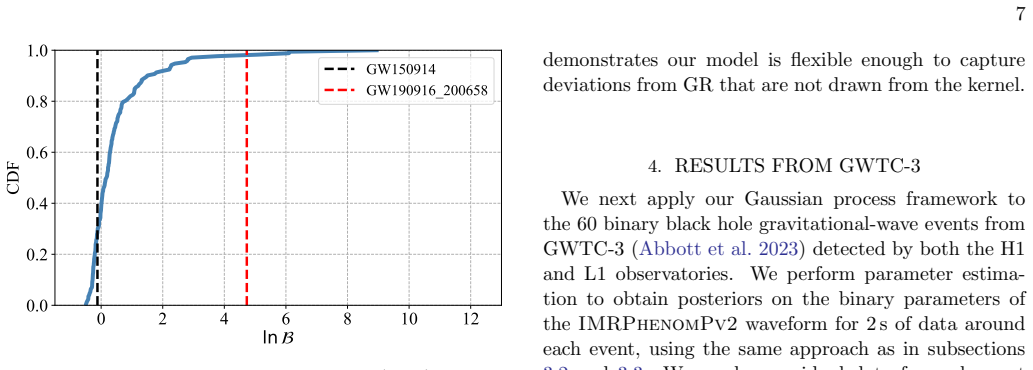


read the original abstract
Gravitational-wave astronomy provides a promising avenue for the discovery of new physics beyond general relativity as it probes extreme curvature and ultra-relativistic dynamics. However, in the absence of a compelling alternative to general relativity, it is difficult to carry out an analysis that allows for a wide range of deviations. To that end, we introduce a Gaussian process framework to search for deviations from general relativity in gravitational-wave signals from binary black hole mergers with minimal assumptions. We employ a kernel that enforces our prior beliefs that - if gravitational waveforms deviate from the predictions of general relativity - the deviation is likely to be localised in time near the merger with some characteristic frequency. We demonstrate this formalism with simulated data and apply it to events from Gravitational-Wave Transient Catalog 3. We find no evidence for a deviation from general relativity. We limit the fractional deviation in gravitational-wave strain to as low as 7% (90% credibility) of the strain of GW190701_203306.
Editorial analysis
A structured set of objections, weighed in public.
Referee Report
Summary. The paper introduces a Gaussian process framework to search for deviations from general relativity in gravitational-wave signals from binary black hole mergers. A kernel is employed that encodes the prior belief that any deviations are localised in time near the merger with some characteristic frequency. The method is demonstrated on simulated data and applied to selected events from the GWTC-3 catalog, yielding no evidence for deviations from GR and an upper limit on the fractional deviation in gravitational-wave strain of 7% (90% credibility) for the event GW190701_203306.
Significance. If the result holds, the work provides a flexible, data-driven approach to testing GR in the strong-field regime without specifying a particular alternative theory. Credit is given for the direct application to real GWTC-3 events and the derivation of quantitative credibility limits on strain deviations. The Gaussian-process construction is a strength for allowing a broad but still tractable search space.
major comments (2)
- [Abstract] Abstract: the phrasing 'with minimal assumptions' is not supported by the kernel choice, which explicitly enforces that deviations (if present) are localised near merger and possess a characteristic frequency. This prior restricts the class of detectable deviations, so the reported 7% (90% credibility) limit on fractional strain deviation for GW190701_203306 applies only within that morphology and is not a model-independent bound.
- [Method] Method (kernel and hyperparameter treatment): the central claim that the posterior on the fractional deviation is robust rests on the kernel hyperparameters, yet no quantitative validation metrics, error budgets, or explicit marginalisation procedure over length-scale and amplitude are supplied. This leaves the credibility of the 'no evidence' conclusion and the 7% limit only weakly supported.
minor comments (2)
- [Simulations section] Clarify in the text how the simulated injections were constructed and whether they include deviations outside the kernel support to test the method's sensitivity.
- Figure captions should explicitly state the kernel form and the prior ranges used for the hyperparameters.
Simulated Author's Rebuttal
We thank the referee for the careful review and constructive feedback. We address the major comments point by point below, indicating where revisions will be made to improve clarity and support for our claims.
read point-by-point responses
-
Referee: [Abstract] Abstract: the phrasing 'with minimal assumptions' is not supported by the kernel choice, which explicitly enforces that deviations (if present) are localised near merger and possess a characteristic frequency. This prior restricts the class of detectable deviations, so the reported 7% (90% credibility) limit on fractional strain deviation for GW190701_203306 applies only within that morphology and is not a model-independent bound.
Authors: We agree that the kernel choice incorporates specific prior beliefs regarding the localization and frequency content of deviations, which restricts the class of signals to which the method is sensitive. The phrase 'minimal assumptions' was intended to contrast the approach with tests that assume a particular alternative theory, but we recognize that it may overstate the generality. We will revise the abstract to remove this phrasing and instead describe the framework as incorporating physically motivated priors on the time localization and characteristic frequency of deviations. The reported credibility limits will be explicitly qualified as applying within this class of deviations. revision: yes
-
Referee: [Method] Method (kernel and hyperparameter treatment): the central claim that the posterior on the fractional deviation is robust rests on the kernel hyperparameters, yet no quantitative validation metrics, error budgets, or explicit marginalisation procedure over length-scale and amplitude are supplied. This leaves the credibility of the 'no evidence' conclusion and the 7% limit only weakly supported.
Authors: The manuscript does describe the choice of kernel hyperparameters based on the expected duration and frequency scale of the merger, with the posterior obtained after integrating over the Gaussian process coefficients. However, we acknowledge that more explicit documentation of the marginalization and robustness checks would strengthen the presentation. We will add a dedicated subsection that details the priors on the length-scale and amplitude hyperparameters, the numerical marginalization procedure, and quantitative validation results from a suite of injection-recovery tests. These will include sensitivity analyses showing how the recovered fractional deviation posteriors respond to variations in the hyperparameters, along with associated error budgets. revision: yes
Circularity Check
No significant circularity; framework applied to external data with explicit kernel choice
full rationale
The paper presents a Gaussian process model whose kernel is introduced as an explicit modeling choice that encodes prior beliefs about the time-frequency support of any GR deviation. This choice is stated directly rather than derived from the target events or fitted to them. The analysis is then applied to simulated injections and to external events drawn from the GWTC-3 catalog; the reported upper limits and 'no evidence' conclusion are posterior results conditioned on the observed data under that kernel. No equation or step reduces the final claim to a tautological restatement of the kernel or to a self-citation chain. The derivation therefore remains self-contained against external benchmarks and does not meet the criteria for any of the enumerated circularity patterns.
Axiom & Free-Parameter Ledger
free parameters (1)
- kernel length-scale and amplitude hyperparameters
axioms (1)
- domain assumption If gravitational waveforms deviate from the predictions of general relativity, the deviation is likely to be localised in time near the merger with some characteristic frequency.
Lean theorems connected to this paper
-
IndisputableMonolith/Foundation/RealityFromDistinction.leanreality_from_one_distinction unclear?
unclearRelation between the paper passage and the cited Recognition theorem.
The kernel is composed of several commonly used kernel functions... Gaussian kernel... cosine kernel... radial basis function kernel
What do these tags mean?
- matches
- The paper's claim is directly supported by a theorem in the formal canon.
- supports
- The theorem supports part of the paper's argument, but the paper may add assumptions or extra steps.
- extends
- The paper goes beyond the formal theorem; the theorem is a base layer rather than the whole result.
- uses
- The paper appears to rely on the theorem as machinery.
- contradicts
- The paper's claim conflicts with a theorem or certificate in the canon.
- unclear
- Pith found a possible connection, but the passage is too broad, indirect, or ambiguous to say the theorem truly supports the claim.
Reference graph
Works this paper leans on
-
[1]
Aasi et al., J. 2015, Class. Quantum Grav., 32, 074001, 10.1088/0264-9381/32/7/074001
-
[2]
Abbott, B. P., et al. 2016 a , Phys. Rev. Lett., 116, 221101, 10.1103/PhysRevLett.116.221101
- [3]
-
[4]
---. 2019, Phys. Rev. D, 100, 104036, 10.1103/PhysRevD.100.104036
-
[5]
Abbott, R., et al. 2021 a , Phys. Rev. D, 103, 122002, 10.1103/PhysRevD.103.122002
-
[6]
Tests of General Relativity with GWTC-3
---. 2021 b , Tests of General Relativity with GWTC -3, arXiv, 10.48550/arXiv.2112.06861
work page internal anchor Pith review Pith/arXiv arXiv doi:10.48550/arxiv.2112.06861 2021
- [7]
-
[8]
2023, ApJS, 267, 29, 10.3847/1538-4365/acdc9f
---. 2023, ApJS, 267, 29, 10.3847/1538-4365/acdc9f
-
[9]
Abbott et al., R. 2023, Phys. Rev. X, 13, 041039, 10.1103/PhysRevX.13.041039
-
[10]
Accadia et al., T. 2010, Class. Quantum Grav., 27, 194011, 10.1088/0264-9381/27/19/194011
-
[11]
Acernese, F., Agathos, M., Agatsuma, K., et al. 2015, Class. Quantum Grav., 32, 024001, 10.1088/0264-9381/32/2/024001
-
[12]
2019, Nat Astron, 3, 35, 10.1038/s41550-018-0658-y
Akutsu, T., Ando, M., Arai, K., et al. 2019, Nat Astron, 3, 35, 10.1038/s41550-018-0658-y
-
[13]
2023, Monthly Notices of the Royal Astronomical Society, 520, 2983, 10.1093/mnras/stad341
Ashton, G. 2023, Monthly Notices of the Royal Astronomical Society, 520, 2983, 10.1093/mnras/stad341
-
[14]
Ashton, G., Hübner, M., Lasky, P. D., et al. 2019, ApJS, 241, 27, 10.3847/1538-4365/ab06fc
-
[15]
2024, Bilby TGR , Zenodo, 10.5281/zenodo.10940210
Ashton, G., Talbot, C., Roy, S., et al. 2024, Bilby TGR , Zenodo, 10.5281/zenodo.10940210
-
[16]
Belgacem, E., Foffa, S., Maggiore, M., & Yang, T. 2020, Phys. Rev. D, 101, 063505, 10.1103/PhysRevD.101.063505
-
[17]
2021, ApJ, 918, 20, 10.3847/1538-4357/ac09e3
Cañas-Herrera, G., Contigiani, O., & Vardanyan, V. 2021, ApJ, 918, 20, 10.3847/1538-4357/ac09e3
- [18]
-
[19]
Cheung, S. Y., Lasky, P. D., & Thrane, E. 2024, Class. Quantum Grav., 41, 115010
work page 2024
-
[20]
Cornish, N. J., & Littenberg, T. B. 2015, Class. Quantum Grav., 32, 135012, 10.1088/0264-9381/32/13/135012
-
[21]
2021, Monthly Notices of the Royal Astronomical Society, 508, 2090, 10.1093/mnras/stab2623
D’Emilio, V., Green, R., & Raymond, V. 2021, Monthly Notices of the Royal Astronomical Society, 508, 2090, 10.1093/mnras/stab2623
-
[22]
Edelman, B., Rivera-Paleo, F., Merritt, J., et al. 2021, Phys. Rev. D, 103, 042004, 10.1103/PhysRevD.103.042004
-
[23]
2017, AJ, 154, 220, 10.3847/1538-3881/aa9332
Foreman-Mackey, D., Agol, E., Ambikasaran, S., & Angus, R. 2017, AJ, 154, 220, 10.3847/1538-3881/aa9332
-
[24]
Ghosh, A., Johnson-McDaniel, N. K., Ghosh, A., et al. 2017, Class. Quantum Grav., 35, 014002, 10.1088/1361-6382/aa972e
-
[25]
Glanzer, J., et al. 2023, Class. Quant. Grav., 40, 065004, 10.1088/1361-6382/acb633
-
[26]
Gupta, A., Arun, K. G., Barausse, E., et al. 2024, Possible Causes of False General Relativity Violations in Gravitational Wave Observations , arXiv, 10.48550/arXiv.2405.02197
-
[27]
Hughes, S. A., & Menou, K. 2005, ApJ, 623, 689, 10.1086/428826
-
[28]
Liu, M., Li, X.-D., & Chua, A. J. 2023, Phys. Rev. D, 108, 103027, 10.1103/PhysRevD.108.103027
-
[29]
Nishizawa, A., Taruya, A., Hayama, K., Kawamura, S., & Sakagami, M. 2009, Phys. Rev. D, 79, 082002
work page 2009
- [30]
-
[31]
M., Talbot, C., Biscoveanu, S., et al
Romero-Shaw, I. M., Talbot, C., Biscoveanu, S., et al. 2020, Mon. Not. R. Ast. Soc., 499, 3295
work page 2020
-
[32]
Romero-Shaw, I. M., Thrane, E., & Lasky, P. D. 2022, Pub. Astron. Soc. Aust., 39, E025
work page 2022
-
[33]
Schmidt, P., Hannam, M., & Husa, S. 2012, Phys. Rev. D, 86, 104063, 10.1103/PhysRevD.86.104063
-
[34]
Soni et al., S. 2020, Class. Quantum Grav., 38, 025016, 10.1088/1361-6382/abc906
-
[35]
Speagle, J. S. 2020, Monthly Notices of the Royal Astronomical Society, 493, 3132, 10.1093/mnras/staa278
- [36]
-
[37]
---. 2019 b , Publ. Astron. Soc. Austral., 36, e010, 10.1017/pasa.2019.2
-
[38]
Tolley, A. E., Davies, G. S. C., Harry, I. W., & Lundgren, A. P. 2023, Class. Quantum Grav., 40, 165005, 10.1088/1361-6382/ace22f
-
[39]
Veitch, J., Raymond, V., Farr, B., et al. 2015, Phys. Rev. D, 91, 042003, 10.1103/PhysRevD.91.042003
-
[40]
Zevin, M., Coughlin, S., Bahaadini, S., et al. 2017, Class. Quantum Grav., 34, 064003, 10.1088/1361-6382/aa5cea
discussion (0)
Sign in with ORCID, Apple, or X to comment. Anyone can read and Pith papers without signing in.