REVIEW 4 major objections 5 minor 23 references
A Data-Driven Prescribed-Time Control Framework via Koopman Operator and Adaptive Backstepping
T0 review · 4 major / 5 minor · reviewed 2026-08-06 · deepseek-v4-flash
Pith's one-line read This paper claims that an adaptive backstepping controller designed on a Koopman model learned from data achieves practical prescribed-time stability for parametric strict-feedback nonlinear systems, with the tracking error entering a…
desk verdict A fresh integration of Koopman learning and prescribed-time backstepping, but the controller is not fully defined and the proof is a sketch—reject with a clear path to revision. read the letter →
The pith
A machine-rendered reading of the paper's core claim, the machinery that carries it, and where it could break.
The reading
What carries the argument
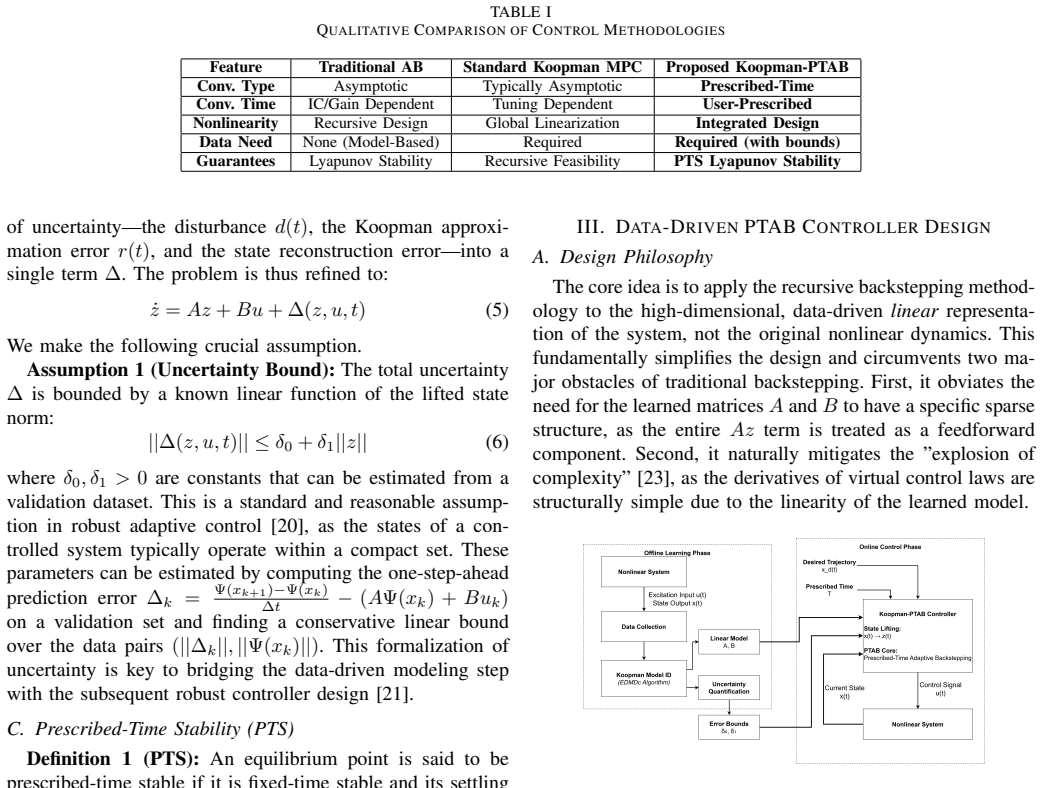
The load-bearing objects are the EDMDc-learned linear model $\dot{z} = Az + Bu + \Delta$ with error bound $\|\Delta\| \le \delta_0 + \delta_1\|z\|$, and the time-varying scaling function $\rho(t)=2/(T-t)$, equivalently $\mu(t)=T^2/(T-t)^2$. The scaling function is what turns ordinary Lyapunov convergence into prescribed-time convergence: its divergence near $t=T$ makes the gain dominate any fixed term, so convergence cannot be postponed beyond the user's deadline. The uncertainty bound is what keeps the data-driven step honest: it lumps the Koopman approximation error, state reconstruction error, and external disturbance into one term that the backstepping design absorbs with Young's inequality, leaving a residual set whose size depends on $\delta_0$ and $\delta_1$. The recursive construction of virtual controls $\alpha_i$ in the lifted coordinates is what avoids differentiating the original nonlinearities and hence avoids the explosion of complexity.
What would settle it
Write the closed loop down literally: because the virtual controls in (9) and (11) each contain $(Bu)_i$, the control $u$ appears on both sides of its own definition, and the function $\Phi_N(z)$ in (12a)-(12b) is never defined; a concrete test is to attempt the substitution and see whether an explicit expression for $u$ exists at all.
Extended reading notes
Core claim
On its own terms, the paper's central discovery is that prescribed-time adaptive backstepping can be carried out entirely in the Koopman-lifted coordinate system $z = \Psi(x)$, using only a linear model $Az + Bu$ plus a bounded residual $\Delta$. Under Assumption 1, the recursive design yields the Lyapunov inequality $\dot{V} \le -2\rho(t)c_{\min}V_e - k_v V + D_0$, where $\rho(t)=2/(T-t)$ grows without bound as $t$ approaches $T$. The unbounded gain forces the error norm into a residual set before $T$, and the $-k_v V + D_0$ term keeps it bounded afterwards, giving practical prescribed-time stability in the sense of Definition 2. The author treats the structure of the learned linear model as a design asset: because $A$ and $B$ are dense, every $Az$ term is handled as feedforward, so no special sparsity is needed and the derivatives of virtual controls stay simple. That is the mechanism by which data-driven model identification and a Lyapunov-based performance guarantee are claimed to coexist.
Load-bearing premise
The proof depends on knowing before the controller runs that all error left by the learned linear model, namely the Koopman approximation, the state reconstruction, and the external disturbance, never exceeds a known straight-line bound in the size of the lifted state; if that bound is wrong or unavailable, the convergence argument stops.
Editorial extensions
If this is right
- If the practical prescribed-time stability proof is correct, a control engineer can fix the settling time $T$ during design, with that time independent of initial conditions and of the adaptation gain.
- The same controller would apply to any strict-feedback system for which EDMDc returns a bounded-uncertainty linear model, not just the simulated Van der Pol oscillator.
- The final residual set shrinks as the model-error bounds $\delta_0$ and $\delta_1$ shrink, so richer dictionaries and more data directly buy tighter steady-state accuracy.
- Boundedness of all closed-loop signals would extend to the control input, making the scheme a candidate for safety-critical nonlinear systems despite the data-driven identification step.
- By replacing repeated differentiation of virtual controls with simple derivatives in the lifted linear space, the approach lowers the computational burden of backstepping in high-dimensional lifted spaces.
Reading between the lines
- A natural extension not developed in the paper is to make the dictionary adaptive online, so the uncertainty bounds could be updated as new data arrive and the residual set tightened during operation.
- Because the prescribed-time gain diverges as $t$ approaches $T$, any real actuator with finite authority will saturate near the deadline; the guarantee should be read as holding for ideal actuation unless input constraints are added.
- The framework's credibility rests on a validation-set estimate of $\delta_0$ and $\delta_1$; a testable extension is to compare the achieved residual set against the bound $D_0$ from the Lyapunov inequality across independent experiments.
- Making the algorithm reproducible requires specifying the undefined vector function $\Phi_N(z)$ and resolving the implicit appearance of the control $u$ inside the virtual control laws, which the manuscript leaves open.
Editorial analysis
A structured set of objections, weighed in public.
Referee Report
Summary. The paper proposes a data-driven prescribed-time control framework that combines EDMDc-based Koopman modeling with adaptive backstepping. The authors learn a high-dimensional linear model z = Az + Bu + Δ with a bounded uncertainty assumption, then apply recursive backstepping in the lifted space to design a Prescribed-Time Adaptive Backstepping (PTAB) controller. They claim practical prescribed-time stability (PPTS) for a class of parametric strict-feedback nonlinear systems, with tracking errors converging to a small residual set within a user-prescribed time T, and support the claim with a Lyapunov analysis and a Van der Pol oscillator simulation.
Significance. If the claimed guarantees were valid, the paper would present a useful integration of Koopman-based data-driven modeling with prescribed-time control, addressing the gap between black-box data-driven methods and Lyapunov-based model-based control. The attempt to quantify model uncertainty and incorporate it into a Lyapunov design is a worthwhile direction, and the simulation vignette is illustrative. However, the central controller is not well-defined, the stability proof contains substantial gaps, and the connection between the original nonlinear system and the lifted design is not established. As written, the paper does not provide a valid or implementable control framework, and the advertised PPTS guarantee is not proven.
major comments (4)
- [Section III-B, Eqs. (9), (11), (12a)] The virtual control laws contain the actual control input: in Eq. (9), α1 includes −(Bu)1, and in Eq. (11), αi includes −(Bu)i. For a generically learned B, (Bu)i involves the final control u, so every virtual control depends on u. The final control law (12a) then contains α_{N-1} and its derivative, making (12a) an implicit differential/algebraic equation rather than an explicit state-feedback law. No sparsity or structural assumption on B is stated; in fact, Section III-A explicitly claims the design 'obviates the need for the learned matrices A and B to have a specific sparse structure,' but this generality is exactly what makes the recursion circular. The controller is therefore not well-defined for the EDMDc-learned dense models the paper targets, and the subsequent Lyapunov analysis does not apply to a concrete closed-loop system.
- [Section III-B, Eqs. (12a)-(12b)] The vector function Φ_N(z) appears in the final control law (12a) and the adaptive law (12b) but is never defined anywhere in the manuscript. The adaptive term is therefore unspecified, and the controller cannot be implemented from the paper. Moreover, the stability analysis of Section IV implicitly assumes that Φ_N(z) satisfies properties that are never stated, so even the intended adaptive design has no definite object to prove stability for.
- [Section IV, Eqs. (14)-(15) and Appendix A] The derivation from Eq. (14) to Eq. (15) is not demonstrated; the text states 'after some algebraic manipulation' without presenting the calculation. More importantly, Eq. (15) of the form V̇ ≤ −2ρ(t)c_min V_e − k_v V + D_0 is claimed to guarantee PPTS, but no comparison argument is given that shows the error enters a residual set by time T independent of initial conditions. The standard UUB conclusion from V̇ ≤ −k_vV + D_0 does not by itself yield a prescribed settling time, and the role of the time-varying term −2ρ(t)c_minV_e in forcing convergence by T is not quantified. Appendix A, which is supposed to provide the needed bound on ||z||, is equally handwavy: its inductive step asserts that α_i, which depends on u implicitly through (Bu)_i, can be bounded by functions of ||e|| and ||θ̃||, but this is exactly what needs proof and is circular given the implicit definition of the controller.
- [Section II-B / III] The paper never establishes the relationship between the original parametric strict-feedback system (1) and the lifted model (5). The unknown parameter θ in (1) does not appear in (5), where all uncertainties are lumped into Δ; consequently, the adaptive law (12b) has no identifiable quantity to estimate. Additionally, the control objective is stated for the original state x, but the backstepping design is carried out in the lifted variable z = Ψ(x), with reconstruction x ≈ Cz used without a rigorous error bound. Without these connections, the framework does not actually solve the stated problem for the class of systems in (1), and the simulation results on the Van der Pol oscillator do not bridge this gap.
minor comments (5)
- [Section I, footnote] The footnote 'This work was supported by... (Please insert your funding information here)' is a template placeholder that should be removed or completed before submission.
- [Section II-C, Eq. (7)] The gain function μ(t) is defined in Eq. (7) but is never used later; the design instead uses ρ(t) = 2/(T-t), and the connection between the two is not explained.
- [Section III-B, Eq. (12a)] The notation (Bu)'_N is introduced only in a parenthetical without a formal definition, which makes the final control law difficult to parse.
- [Section II-D] The residual set Ω_e is referred to in the control objective but is never explicitly characterized in terms of the design parameters or uncertainty bounds δ0, δ1.
- [Section II-B] The conversion from the discrete-time EDMDc model to the continuous-time model in Eq. (4) is asserted without any details or assumptions on the sampling interval, which is important because Assumption 1 uses the continuous-time residual Δ.
Circularity Check
The PTAB controller is self-referential: every virtual control contains the actual input through (Bu)_i, so Eq. (12a) defines u only implicitly and the PPTS proof substitutes a control that is not explicitly defined.
-
self definitional
[Section III-B, Eqs. (9), (11), (12a); Section III-A (dense-B claim)]
"α1 = −c1ρ(t)e1 − (Az)1 − (Bu)1 + ˙zd,1 ... αi = −ciρ(t)ei − ei−1 − (Az)i − (Bu)i + ˙αi−1 ... u = 1/BN,1 ( − cN ρ(t)eN − eN−1 − (Az)N − (Bu)′N + ˙αN−1 − ˆθT ΦN (z) )"
In Eqs. (9) and (11), each virtual control αi is defined with the term −(Bu)i, and the paper explicitly rejects sparsity assumptions: 'it obviates the need for the learned matrices A and B to have a specific sparse structure.' For the dense B produced by EDMDc, (Bu)i contains Bi,1u, so αi depends on the actual control u. Consequently, the final law (12a) contains αN−1 and its derivative, and u appears on both sides of (12a), with ˙αN−1 involving ˙u. The recursive derivation therefore never yields an explicit state-feedback control; instead, (12a) is an implicit algebraic/differential equation. Section IV's step 'substituting the control and adaptive laws' has no well-defined closed-loop vector field to substitute, since the object being substituted still contains the unknown u.
full rationale
The central PPTS claim is a Lyapunov theorem for a controller synthesized from a learned Koopman model, not a benchmark prediction. Standard backstepping proofs are not circular because the controller is constructed explicitly and then verified. Here, however, the construction itself is self-referential: because each virtual control contains −(Bu)i, and B is deliberately allowed to be dense, the actual control u appears in αi and hence in αN−1 and ˙αN−1 inside Eq. (12a). The paper's own claim that no sparse structure is needed is exactly what makes the recursion circular. I do not count the validation-set estimates of δ0 and δ1 as circular: they size a residual set and are standard fitted uncertainty bounds, not a manufactured prediction of the convergence time or of the tracking error. There is no load-bearing self-citation, no imported uniqueness theorem, and no renamed empirical pattern. The undefined ΦN(z) in Eqs. (12a)–(12b) is a separate correctness/completeness gap, not itself a circular reduction. The score of 6 reflects that the central control-design derivation reduces to a self-referential equation, while the EDMDc data fit and the prescribed-time gain mechanism retain independent content.
Assumptions & free parameters
free parameters (5)
- delta_0, delta_1 =
estimated from validation data
- Design gains c_i =
not specified
- Adaptation gain matrix Gamma =
not specified
- Prescribed time T =
T=5s in simulation
- Dictionary and dimension N =
10 RBFs in simulation
assumptions (4)
- domain assumption Assumption 1: The total uncertainty Delta is bounded by delta_0 + delta_1 ||z||
- domain assumption The lifted linear model (5) with bounded Delta faithfully represents the original nonlinear system (1)
- ad hoc to paper The functions Phi_N(z) used in the control law exist and are known
- domain assumption B_{N,1} is nonzero
Cite this review
Pith. "Pith review of A Data-Driven Prescribed-Time Control Framework via Koopman Operator and Adaptive Backstepping." pith.science (2026). https://pith.science/paper/SQTASJTP
@misc{pith2026250702549,
  author       = {Pith},
  title        = {Pith review of: A Data-Driven Prescribed-Time Control Framework via Koopman Operator and Adaptive Backstepping},
  year         = {2026},
  howpublished = {\url{https://pith.science/paper/SQTASJTP}},
  note         = {Machine review of arXiv:2507.02549}
}
read the original abstract
Achieving rapid and time-deterministic stabilization for complex systems characterized by strong nonlinearities and parametric uncertainties presents a significant challenge. Traditional model-based control relies on precise system models, whereas purely data-driven methods often lack formal stability guarantees, limiting their applicability in safety-critical systems. This paper proposes a novel control framework that synergistically integrates data-driven modeling with model-based control. The framework first employs the Extended Dynamic Mode Decomposition with Control (EDMDc) to identify a high-dimensional Koopman linear model and quantify its bounded uncertainty from data. Subsequently, a novel Prescribed-Time Adaptive Backstepping (PTAB) controller is synthesized based on this data-driven model. The design leverages the structural advantages of Koopman linearization to systematically handle model errors and circumvent the "explosion of complexity" issue inherent in traditional backstepping. The proposed controller is validated through simulations on the classic Van der Pol oscillator. The results demonstrate that the controller can precisely stabilize the system states to a small neighborhood of the origin within a user-prescribed time, regardless of the initial conditions, while ensuring the boundedness of all closed-loop signals. This research successfully combines the flexibility of data-driven approaches with the rigor of Lyapunov-based analysis. It provides a high-performance control strategy with quantifiable performance and pre-assignable settling time for nonlinear systems, showcasing its great potential for controlling complex dynamics.
Figures


Reference graph
Works this paper leans on
-
[1]
Adaptive prescribed-time control for a class of uncertain nonlinear systems,
C. Hua, P. Ning, and K. Li, “Adaptive prescribed-time control for a class of uncertain nonlinear systems,” IEEE Trans. Autom. Control , vol. 67, no. 11, pp. 6159–6166, Nov. 2022
work page 2022
-
[2]
Data-driven control with prescribed-time convergence for discrete-time nonlinear systems,
Y . Li, X. Ou, P. Chen, X. He, and Q. Jiang, “Data-driven control with prescribed-time convergence for discrete-time nonlinear systems,” IEEE Trans. Autom. Sci. Eng. , vol. 22, pp. 4961-4971, 2025
work page 2025
-
[3]
W. Yan, T. Zhao, and E. Q. Wu, “Prescribed-time fuzzy control for MIMO coupled systems with unknown structure and control direction: Application to robotic arm,” IEEE Trans. Autom. Sci. Eng. , vol. 22, pp. 9013-9028, 2025
work page 2025
-
[4]
A review on data-driven model-free sliding mode control,
D. Castellanos-Cardenas et al., “A review on data-driven model-free sliding mode control,” Algorithms, vol. 17, no. 12, p. 543, 2024
work page 2024
-
[5]
Prescribed-time optimal control for a class of switched nonlinear systems,
Y . Zhang and Z. Xiang, “Prescribed-time optimal control for a class of switched nonlinear systems,” IEEE Trans. Autom. Sci. Eng. , vol. 22, pp. 3033-3043, 2025
work page 2025
-
[6]
Toward data-driven optimal control: A systematic review of the landscape,
K. Prag, M. Woolway, and T. Celik, “Toward data-driven optimal control: A systematic review of the landscape,” IEEE Access , vol. 10, pp. 32190–32212, 2022
work page 2022
-
[7]
Physics- informed machine learning modeling for predictive control using noisy data,
M. S. Alhajeri, F. Abdullah, Z. Wu, and P. D. Christofides, “Physics- informed machine learning modeling for predictive control using noisy data,” Chem. Eng. Res. Des. , vol. 186, pp. 34–45, 2022
work page 2022
-
[8]
Learning-based prescribed-time safety for control of unknown systems with control barrier functions,
T.-Y . Huang et al., “Learning-based prescribed-time safety for control of unknown systems with control barrier functions,” IEEE Control Syst. Lett., vol. 8, pp. 1817–1822, 2024
work page 2024
Show all 23 references
-
[9]
Robust input output linearizing control augmented with only one hidden layer neural network for induction motors,
H. Ait Abbas, “Robust input output linearizing control augmented with only one hidden layer neural network for induction motors,” in Proc. 9th Int. Conf. Control, Decis. Inf. Technol. (CoDIT) , Jul. 2023, pp. 1755–1760
2023
-
[10]
Kernel EDMD for data-driven nonlinear Koopman MPC with stability guarantees,
L. Bold, M. Schaller, I. Schimperna, and K. Worthmann, “Kernel EDMD for data-driven nonlinear Koopman MPC with stability guarantees,” arXiv preprint arXiv:2501.08709 , 2025
2025 arXiv
-
[11]
Koopman Lyapunov-based model predictive control of nonlinear chemical process systems,
A. Narasingam and J. S. Kwon, “Koopman Lyapunov-based model predictive control of nonlinear chemical process systems,” AIChE J. , vol. 65, no. 11, p. e16743, Nov. 2019
2019
-
[12]
Adaptive predefined- time prescribed performance control for trajectory tracking of tailless aircraft with backstepping method,
J. Cong, J. Hu, Y . Wang, L. Sun, and P. Zhang, “Adaptive predefined- time prescribed performance control for trajectory tracking of tailless aircraft with backstepping method,” SSRN, 2023. [Online]. Available: http://dx.doi.org/10.2139/ssrn.4677641
2023 doi
-
[13]
Prescribed-time adaptive backstepping control of an uncertain nonlinear 2-DOF helicopter,
V . K. Singh and S. Kamal, “Prescribed-time adaptive backstepping control of an uncertain nonlinear 2-DOF helicopter,” IEEE Trans. Circuits Syst. II, Exp. Briefs , vol. 70, no. 11, pp. 4138–4142, Nov. 2023
2023
-
[14]
Robust backstepping super- twisting sliding mode control for autonomous vehicle path following,
D. Ao, W. Huang, P. K. Wong, and J. Li, “Robust backstepping super- twisting sliding mode control for autonomous vehicle path following,” IEEE Access , vol. 9, pp. 123165–123177, 2021
2021
-
[15]
Adaptive fixed-time fault-tolerant tracking control for nonlinear systems with unmodeled dynamics,
Z. Ai, R. Zhang, and H. Wang, “Adaptive fixed-time fault-tolerant tracking control for nonlinear systems with unmodeled dynamics,” in Proc. Int. Annu. Conf. Complex Syst. Intell. Sci. (CSIS-IAC) , Oct. 2023, pp. 214–219
2023
-
[16]
Back- stepping prescribed-time sliding mode control of a quadrotor UA V ,
R. Badiei, M. B. Sajjadi, M. Ayati, and A. H. Davaie-Markazi, “Back- stepping prescribed-time sliding mode control of a quadrotor UA V ,” in Proc. 12th RSI Int. Conf. Robot. Mechatron. (ICRoM) , 2024, pp. 338–343
2024
-
[17]
Strong prescribed- time stabilization of uncertain nonlinear systems by periodic delayed feedback,
Y . Ding, B. Zhou, K.-K. Zhang, and W. Michiels, “Strong prescribed- time stabilization of uncertain nonlinear systems by periodic delayed feedback,” IEEE Trans. Autom. Control , vol. 69, no. 6, pp. 4072–4079, Jun. 2024
2024
-
[18]
Koopman operator dynamical models: Learning, analysis and control,
P. Bevanda, S. Sosnowski, and S. Hirche, “Koopman operator dynamical models: Learning, analysis and control,” Annu. Rev. Control, vol. 52, pp. 197–212, 2021
2021
-
[19]
Towards reliable data-based optimal and predictive control using extended DMD,
M. Schaller, K. Worthmann, F. Philipp, S. Peitz, and F. N ¨uske, “Towards reliable data-based optimal and predictive control using extended DMD,” IF AC-Pap., vol. 56, no. 1, pp. 169–174, 2023
2023
-
[20]
Model predictive control with model error compensation by Koopman approach,
M. Kanai and M. Yamakita, “Model predictive control with model error compensation by Koopman approach,” in Proc. 48th Annu. Conf. IEEE Ind. Electron. Soc. (IECON) , Oct. 2022, pp. 1–6
2022
-
[21]
Robust adaptive model predictive control with persistent excitation conditions,
X. Lu and M. Cannon, “Robust adaptive model predictive control with persistent excitation conditions,” Automatica, vol. 152, p. 110959, Jun. 2023
2023
-
[22]
Prescribed-time control with linear decay for nonlinear systems,
A. Shakouri and N. Assadian, “Prescribed-time control with linear decay for nonlinear systems,” IEEE Control Syst. Lett. , vol. 6, pp. 313–318, 2022
2022
-
[23]
Adaptive back- stepping control design for ATMD systems in nonlinear structures with nonlinear disturbance and parametric uncertainties,
R. C. Umutlu, B. Bidikli, H. Ozturk, and A. Pavic, “Adaptive back- stepping control design for ATMD systems in nonlinear structures with nonlinear disturbance and parametric uncertainties,” J. Vib. Control, vol. 30, no. 7–8, pp. 1635–1646, 2024
2024
Reviewed August 6, 2026 · model on record in the stance chip above.
Discussion (0). Continue with ORCID to comment.