A Note on Chaos in Hayward Black Holes with String Fluids
Pith reviewed 2026-05-19 06:10 UTC · model grok-4.3
The pith
Charge is required for chaos under temporal perturbations in the thermodynamics of Hayward black holes with string fluids, but spatial perturbations produce chaos with or without charge.
A machine-rendered reading of the paper's core claim, the machinery that carries it, and where it could break.
Core claim
From the equation of state of the black hole, a general condition is established indicating that under temporal perturbations, the existence of charge is an essential prerequisite for chaos. However, regardless of the presence of charge, spatial perturbations result in chaotic behavior. The string fluid density and the Hayward regularization parameter have a considerable effect on the amplitude of the Lyapunov exponent.
What carries the argument
Melnikov's integral evaluated on the perturbed Hamiltonian dynamics of the thermodynamic phase space, which detects the breaking of homoclinic orbits that signals the onset of chaos.
If this is right
- Chaos in the thermodynamic description appears only when charge supplies the necessary homoclinic structure for temporal driving.
- Spatial driving destabilizes the system even in uncharged Hayward black holes with string fluids.
- The magnitude of the Lyapunov exponent can be tuned by adjusting the string fluid density or the regularization parameter.
- Regular geometry corrections and matter sources together control the threshold and strength of thermodynamic instability.
Where Pith is reading between the lines
- The distinction between temporal and spatial perturbations may correspond to different physical processes such as sudden temperature changes versus spatial inhomogeneities in accretion flows.
- If the charge dependence survives in more realistic models, it could link thermodynamic chaos to the presence of electromagnetic fields near black holes.
- The control of Lyapunov amplitude by the Hayward parameter suggests that singularity resolution can suppress or enhance chaotic mixing in the phase space.
Load-bearing premise
The unperturbed thermodynamic system must possess a homoclinic orbit so that Melnikov's integral can be used to detect chaos under small perturbations.
What would settle it
Numerical integration of the perturbed equations of state showing that the Lyapunov exponent remains zero below a charge-dependent critical amplitude for temporal perturbations but becomes positive for any amplitude in the spatial case.
Figures

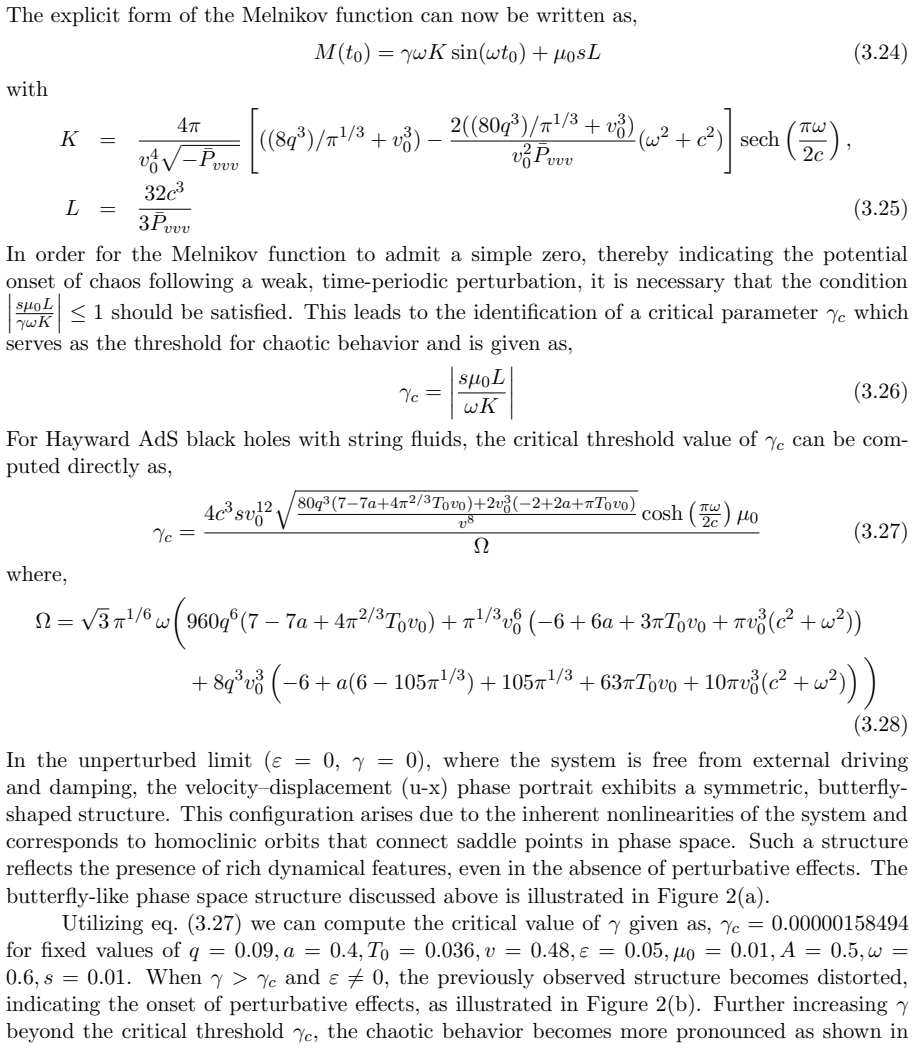
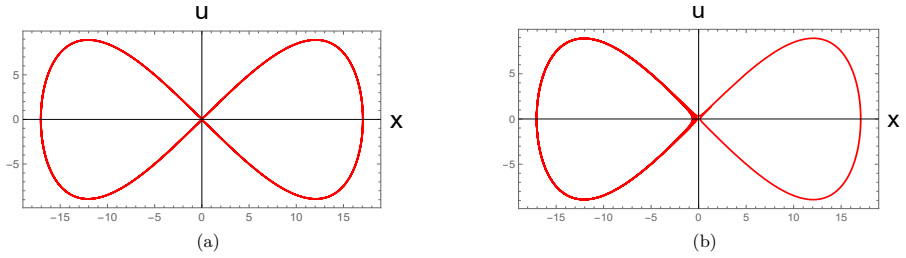
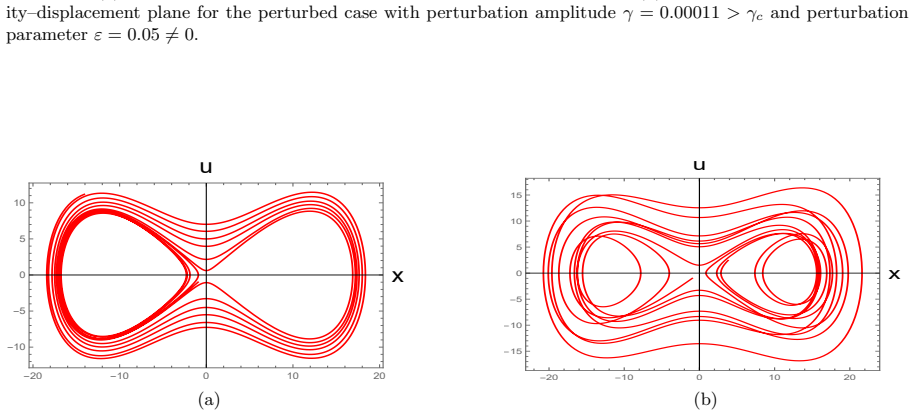


read the original abstract
In this work, we first examine the onset of thermodynamic chaos in Hayward AdS black holes with string fluids, emphasizing the effects of temporal and spatially periodic perturbations. We apply Melnikov's approach to examine the perturbed Hamiltonian dynamics and detect the onset of chaotic behavior. In the case of temporal perturbations induced by thermal quenches, chaos occurs for perturbation amplitude $\gamma$ exceeding a critical threshold, determined by charge $q$ and the string fluid parameter. From the equation of state of the black hole, a general condition is established indicating that under temporal perturbations, the existence of charge is an essential prerequisite for chaos. However, regardless of the presence of charge, spatial perturbations result in chaotic behavior. Further next, we compute the Lyapunov exponent associated with the thermodynamic system to further quantify chaotic behavior beyond the threshold condition. We demonstrate that the string fluid density and the Hayward regularization parameter have a considerable effect on the amplitude of the Lyapunov exponent, showing the control of thermal instability by regular geometry corrections and matter sources. These results highlight the rich nonlinear dynamics arising from the interplay of geometric regularization, matter content, and phase-space instability.
Editorial analysis
A structured set of objections, weighed in public.
Referee Report
Summary. The manuscript applies Melnikov's method to the perturbed thermodynamic Hamiltonian of Hayward AdS black holes with string fluids. It claims that temporal perturbations induce chaos only when charge q is present and the perturbation amplitude gamma exceeds a threshold set by q and the string-fluid parameter; spatial perturbations produce chaos irrespective of charge. Lyapunov exponents are then computed to quantify the chaotic regime, with explicit dependence on string-fluid density and the Hayward regularization parameter.
Significance. If the central technical steps are placed on a firm footing, the work would illustrate how geometric regularization and matter sources modulate nonlinear instability in black-hole thermodynamics, providing a concrete example of charge-dependent versus charge-independent routes to chaos under different perturbation classes.
major comments (1)
- The Melnikov analysis presupposes the existence of a homoclinic orbit in the unperturbed (P,V) phase space. The manuscript states that the method is applied directly to the equation of state but supplies neither an explicit phase-portrait analysis nor an analytic demonstration that such an orbit exists for the Hayward–string-fluid model. This omission renders the subsequent Melnikov integral and the derived threshold conditions on q and the string parameter formally undefined.
minor comments (2)
- Clarify in the text whether the string-fluid parameter and perturbation amplitude gamma are treated as independent inputs or are determined post-hoc from the equation of state; the present wording leaves open the possibility of circularity in the chaos condition.
- The abstract asserts that 'a general condition is established' from the equation of state; an explicit statement of this condition (perhaps as an inequality involving q) would strengthen the presentation.
Simulated Author's Rebuttal
We thank the referee for the careful reading of our manuscript on thermodynamic chaos in Hayward AdS black holes with string fluids. The major comment identifies a key technical prerequisite for the Melnikov analysis that was not explicitly addressed in the original submission. We respond to this point below and outline the revisions we will make.
read point-by-point responses
-
Referee: The Melnikov analysis presupposes the existence of a homoclinic orbit in the unperturbed (P,V) phase space. The manuscript states that the method is applied directly to the equation of state but supplies neither an explicit phase-portrait analysis nor an analytic demonstration that such an orbit exists for the Hayward–string-fluid model. This omission renders the subsequent Melnikov integral and the derived threshold conditions on q and the string parameter formally undefined.
Authors: We agree that the existence of a homoclinic orbit in the unperturbed system is essential for the validity of Melnikov's method and that our original manuscript did not supply an explicit phase-portrait analysis or analytic demonstration for the Hayward–string-fluid equation of state. In the revised version we will add a dedicated subsection that (i) presents the phase portrait of the unperturbed Hamiltonian in the (P,V) plane, (ii) identifies the saddle point at the critical volume, and (iii) analytically integrates the unperturbed equations of motion to exhibit the homoclinic orbit connecting the saddle to itself. This addition will place the subsequent Melnikov integrals and the derived threshold conditions on charge q and the string-fluid parameter on a rigorous footing. revision: yes
Circularity Check
No significant circularity; derivation applies standard Melnikov analysis to given EOS without self-referential reduction.
full rationale
The paper derives a chaos threshold condition for temporal perturbations directly from the Melnikov integral evaluated on the thermodynamic Hamiltonian constructed from the Hayward-string-fluid equation of state. Charge q and the string parameter appear as explicit model inputs in that EOS and thus in the integral; the resulting inequality on perturbation amplitude gamma is a direct consequence rather than a tautological re-expression or fitted output renamed as prediction. The assumption of an unperturbed homoclinic orbit is stated as a prerequisite for applying Melnikov's method but is not derived from or equivalent to the target chaos condition itself. No self-citation chain, ansatz smuggling, or renaming of known results is used to justify the central claim. The Lyapunov exponent computation is an independent numerical quantification performed after the threshold analysis. The derivation chain remains self-contained against the external Melnikov framework and the supplied EOS.
Axiom & Free-Parameter Ledger
free parameters (2)
- perturbation amplitude gamma
- string fluid parameter
axioms (1)
- domain assumption Melnikov's approach can be applied to the perturbed Hamiltonian dynamics of the black hole thermodynamic system.
Lean theorems connected to this paper
-
IndisputableMonolith/Cost/FunctionalEquation.leanwashburn_uniqueness_aczel unclear?
unclearRelation between the paper passage and the cited Recognition theorem.
We apply Melnikov’s approach to examine the perturbed Hamiltonian dynamics and detect the onset of chaotic behavior within the spinodal regime of the (P−v) plot.
-
IndisputableMonolith/Foundation/RealityFromDistinction.leanreality_from_one_distinction unclear?
unclearRelation between the paper passage and the cited Recognition theorem.
From the equation of state of the black hole, a general condition is established indicating that under temporal perturbations, the existence of charge is an essential prerequisite for chaos.
What do these tags mean?
- matches
- The paper's claim is directly supported by a theorem in the formal canon.
- supports
- The theorem supports part of the paper's argument, but the paper may add assumptions or extra steps.
- extends
- The paper goes beyond the formal theorem; the theorem is a base layer rather than the whole result.
- uses
- The paper appears to rely on the theorem as machinery.
- contradicts
- The paper's claim conflicts with a theorem or certificate in the canon.
- unclear
- Pith found a possible connection, but the passage is too broad, indirect, or ambiguous to say the theorem truly supports the claim.
Reference graph
Works this paper leans on
-
[1]
Jacob D. Bekenstein. “Black holes and entropy,” Phys. Rev. D , 7:2333–2346, Apr 1973
work page 1973
-
[2]
Generalized second law of thermodynamics in black hole physics,
Jacob D. Bekenstein. “Generalized second law of thermodynamics in black hole physics,” Phys. Rev. D , 9:3292–3300, Jun 1974
work page 1974
-
[3]
Black Holes and Thermodynamics,
S. W. Hawking, “Black Holes and Thermodynamics,” Phys. Rev. D 13, 191 (1976)
work page 1976
-
[4]
Thermodynamics of Black Holes in anti-De Sitter Space,
S. W. Hawking and D. N. Page, “Thermodynamics of Black Holes in anti-De Sitter Space,” Commun. Math. Phys. 87, 577 (1983)
work page 1983
-
[5]
The Large N limit of superconformal field theories and supergrav- ity,
J. M. Maldacena, “The Large N limit of superconformal field theories and supergrav- ity,” Int. J. Theor. Phys. 38, 1113 (1999) [Adv. Theor. Math. Phys. 2, 231 (1998)] [hep- th/9711200]
-
[6]
Anti De Sitter Space And Holography
E. Witten, “Anti-de Sitter space and holography,” Adv. Theor. Math. Phys. 2, 253 (1998) [hep-th/9802150]
work page internal anchor Pith review Pith/arXiv arXiv 1998
-
[7]
Enthalpy and the Mechanics of AdS Black Holes
D. Kastor, S. Ray, and J. Traschen, “Enthalpy and the Mechanics of AdS Black Holes,” Class.Quant.Grav. 26 (2009) 195011, [ arXiv:0904.2765 [hep-th]]
work page internal anchor Pith review Pith/arXiv arXiv 2009
-
[8]
Thermodynamics of de Sitter Black Holes: Thermal Cosmological Constant
Y. Sekiwa, “Thermodynamics of de Sitter black holes: Thermal cosmological constant,” Phys.Rev. D73 (2006) 084009, [arXiv:hep-th/0602269 [hep-th]]
work page internal anchor Pith review Pith/arXiv arXiv 2006
-
[9]
E. A. Larranaga Rubio, “Stringy Generalization of the First Law of Thermodynam- ics for Rotating BTZ Black Hole with a Cosmological Constant as State Parameter,” [ arXiv:0711.0012 [gr-qc]]
work page internal anchor Pith review Pith/arXiv arXiv
-
[10]
The cosmological constant and the black hole equation of state
B. P. Dolan, “The cosmological constant and the black hole equation of state,” Class.Quant.Grav.28 (2011) 125020, [ arXiv:1008.5023 [gr-qc]]
work page internal anchor Pith review Pith/arXiv arXiv 2011
-
[11]
Black Hole Enthalpy and an Entropy Inequality for the Thermodynamic Volume
M. Cvetic, G. Gibbons, D. Kubiznak, and C. Pope, “Black Hole Enthalpy and an Entropy Inequality for the Thermodynamic Volume,” Phys.Rev. D84 (2011) 024037, [arXiv:1012.2888 [hep-th]]
work page internal anchor Pith review Pith/arXiv arXiv 2011
-
[12]
Pressure and volume in the first law of black hole thermodynamics
B. P. Dolan, “Pressure and volume in the first law of black hole thermodynamics,” Class.Quant.Grav. 28 (2011) 235017, [arXiv:1106.6260 [gr-qc]]
work page internal anchor Pith review Pith/arXiv arXiv 2011
-
[13]
The Cosmological Constant as a Canonical Variable,
M. Henneaux and C. Teitelboim, “The Cosmological Constant as a Canonical Variable,” Phys.Lett. B143 (1984) 415–420. 19
work page 1984
-
[14]
The Cosmological Constant as a Thermodynamic Black Hole Parameter,
C. Teitelboim, “The Cosmological Constant as a Thermodynamic Black Hole Parameter,” Phys.Lett. B158 (1985) 293–297
work page 1985
-
[15]
The Cosmological Constant and General Covariance,
M. Henneaux and C. Teitelboim, “The Cosmological Constant and General Covariance,” Phys.Lett. B222 (1989) 195–199
work page 1989
-
[16]
Charged AdS Black Holes and Catastrophic Holography
A. Chamblin, R. Emparan, C. V. Johnson and R. C. Myers, “Charged AdS black holes and catastrophic holography,” Phys. Rev. D 60 (1999), 064018 doi:10.1103/PhysRevD.60.064018 [arXiv:hep-th/9902170 [hep-th]]
work page internal anchor Pith review Pith/arXiv arXiv doi:10.1103/physrevd.60.064018 1999
-
[17]
P-V criticality of charged AdS black holes
D. Kubiznak and R. B. Mann, “P-V criticality of charged AdS black holes,” JHEP 07 (2012), 033 doi:10.1007/JHEP07(2012)033 [arXiv:1205.0559 [hep-th]]
work page internal anchor Pith review Pith/arXiv arXiv doi:10.1007/jhep07(2012)033 2012
-
[18]
Black hole chemistry: thermodynamics with Lambda
D. Kubiznak, R. B. Mann and M. Teo, “Black hole chemistry: thermodynamics with Lambda,” Class. Quant. Grav. 34, no. 6, 063001 (2017) [arXiv:1608.06147 [hep-th]]
work page internal anchor Pith review Pith/arXiv arXiv 2017
-
[19]
S. Gunasekaran, R. B. Mann and D. Kubiznak, “Extended phase space thermodynamics for charged and rotating black holes and Born-Infeld vacuum polarization,” JHEP 1211, 110 (2012) [arXiv:1208.6251 [hep-th]]
work page internal anchor Pith review Pith/arXiv arXiv 2012
-
[20]
Thermodynamic curvature of AdS black holes with dark energy,
A. Singh, A. Ghosh and C. Bhamidipati, “Thermodynamic curvature of AdS black holes with dark energy,” Front. in Phys. 9 (2021), 65 doi:10.3389/fphy.2021.631471 [arXiv:2002.08787 [gr-qc]]
-
[21]
Thermodynamic curvature of charged black holes with AdS2 horizons,
A. Singh, P. Mukherjee and C. Bhamidipati, “Thermodynamic curvature of charged black holes with AdS2 horizons,” Phys. Rev. D 108 (2023) no.10, 106011 doi:10.1103/PhysRevD.108.106011 [arXiv:2307.11641 [hep-th]]
-
[22]
Thermodynamic geometry of dyonic black holes in AdS in extended phase space,
A. Singh, “Thermodynamic geometry of dyonic black holes in AdS in extended phase space,” Mod. Phys. Lett. A 38 (2023) no.40, 2350173 doi:10.1142/S0217732323501730
-
[23]
Criticality of charged AdS black holes with string clouds in boundary conformal field theory,
A. Singh and S. Mahish, “Criticality of charged AdS black holes with string clouds in boundary conformal field theory,” [arXiv:2504.20486 [hep-th]]
-
[24]
Thermodynamic curvature and topological insights of Hayward black holes with string fluids,
A. Anand, S. Noori Gashti and A. Singh, “Thermodynamic curvature and topological insights of Hayward black holes with string fluids,” Phys. Dark Univ. 49 (2025), 101994 doi:10.1016/j.dark.2025.101994 [arXiv:2506.23736 [gr-qc]]
-
[25]
Black Holes in Lorentz-Violating Gravity: Thermodynamics, Geometry, and Particle Dynamics,
A. Anand, A. Singh, A. Mishra, S. Noori Gashti, T. Tangphati and P. Channuie, “Black Holes in Lorentz-Violating Gravity: Thermodynamics, Geometry, and Particle Dynamics,” [arXiv:2507.00455 [gr-qc]]
-
[26]
L. Bombellitf and E. Calzetta, “Chaos around a black hole,” Class. Quant. Grav. 9 (1992) 2573
work page 1992
-
[27]
Chaos in black holes surrounded by gravitational waves,
P. S. Letelier and W. M. Vieira, “Chaos in black holes surrounded by gravitational waves,” Class. Quant. Grav. 14 (1997) 1249
work page 1997
-
[28]
Chaos in black holes surrounded by electromagnetic fields,
M. Santoprete and G. Cicogna, “Chaos in black holes surrounded by electromagnetic fields,” Gen. Rel. Grav. 34 (2002) 1107
work page 2002
-
[29]
Melnikov’s method in String Theory,
Y. Asano, H. Kyono and K. Yoshida, “Melnikov’s method in String Theory,” JHEP 1609, 103 (2016). 20
work page 2016
-
[30]
Chaos in preinflationary Friedmann- Robertson-Walker universes,
G. A. Monerat, H. P. de Oliveira and I. D. Soares, “Chaos in preinflationary Friedmann- Robertson-Walker universes,” Phys. Rev. D 58 (1998) 063504
work page 1998
-
[31]
Chaotic dynamics around astro- physical objects with nonisotropic stresses,
F. L. Dubeibe, L. A. Pachon and J. D. Sanabria-Gomez, “Chaotic dynamics around astro- physical objects with nonisotropic stresses,” Phys. Rev. D 75 (2007) 023008
work page 2007
-
[32]
Observable Properties of Orbits in Exact Bumpy Space- times,
J. R. Gair, C. Li and I. Mandel, “Observable Properties of Orbits in Exact Bumpy Space- times,” Phys. Rev. D 77 (2008) 024035
work page 2008
-
[33]
Chaotic motion of particles in the accelerating and rotating black holes spacetime,
S. Chen, M. Wang and J. Jing, “Chaotic motion of particles in the accelerating and rotating black holes spacetime,” JHEP 1609 (2016) 082
work page 2016
-
[34]
Geodesic stability, Lyapunov exponents and quasinormal modes
V. Cardoso, A. S. Miranda, E. Berti, H. Witek and V. T. Zanchin, “Geodesic sta- bility, Lyapunov exponents and quasinormal modes,” Phys. Rev. D 79, 064016 (2009) [arXiv:0812.1806 [hep-th]]
work page internal anchor Pith review Pith/arXiv arXiv 2009
-
[35]
Nonlinear Oscillations, Dynamical Systems, and Bifurcations of Vector Fields,
V. K. Melnikov, Trans. Moscow Math. Soc. 12 (1963) 1; J. Guckenheimer and P. J Holmes, “Nonlinear Oscillations, Dynamical Systems, and Bifurcations of Vector Fields,” Applied Math. Sciences. Vol. 42 (1983), Springer-Verlag, New York
work page 1963
-
[36]
Chaos in charged AdS black hole extended phase space
M. Chabab, H. El Moumni, S. Iraoui, K. Masmar and S. Zhizeh, “Chaos in charged AdS black hole extended phase space,” Phys. Lett. B 781, 316 (2018) [arXiv:1804.03960 [hep- th]]
work page internal anchor Pith review Pith/arXiv arXiv 2018
-
[37]
A nonlinear oscillator with a strange attractor,
P. Holmes, “A nonlinear oscillator with a strange attractor,” Phil. Trans. Roy. Sot. A 292 (1979) 419
work page 1979
-
[38]
P. Holmes, “A partial differential equation with infinitely many periodic orbits: Chaotic oscillations of a forced beam,” Archive for Rational Mechanics and Analysis, 76, 2 (1981) 135–165
work page 1981
-
[39]
Poincare celestial mechanics, dynamical-systems theory and chaos,
P. Holmes, “Poincare celestial mechanics, dynamical-systems theory and chaos,” Phys. Rep. 193 (1990) 137
work page 1990
-
[40]
Temporal and Spatial Chaos in a van der Waals Fluid Due to Periodic Thermal Fluctuations,
M. Slemrod, “Temporal and Spatial Chaos in a van der Waals Fluid Due to Periodic Thermal Fluctuations,” Advances Applied Math. D 6 (1985) 135
work page 1985
-
[41]
Dynamics of the diffuse gas-liquid interface near the critical point,
B. U. Felderhof, “Dynamics of the diffuse gas-liquid interface near the critical point,” Physica. D 48 (1970) 541
work page 1970
-
[42]
Statistical Mechanics and Statistical Methods in Theory and Application,
B. Widom, Structure and thermodynamics of interfaces, in U. Landman (Ed.), “Statistical Mechanics and Statistical Methods in Theory and Application,” Plenum, New York, 1977
work page 1977
-
[43]
Diffeomorphisms with many periodic points,
S. Smale, “Diffeomorphisms with many periodic points,” Matematika, 11 (4) (1967) 88. Differential and Combinatorial Topology (A Symposium in Honor of Marston Morse), (1965) 63-80
work page 1967
-
[44]
Characteristic Lyapunov exponent and smooth ergodic theory,
Y. B. Pesin “Characteristic Lyapunov exponent and smooth ergodic theory,” Russ. Math. Surv. 32 (1977) 55 doi:10.1070/RM1977v032n04ABEH001639
-
[45]
The Birkhoff Theorem in Multidimensional Gravity
K. A. Bronnikov and V. N. Melnikov, “The Birkhoff theorem in multidimensional gravity,” Gen. Rel. Grav. 27 (1995), 465-474 doi:10.1007/BF02105073 [arXiv:gr-qc/9403063 [gr-qc]]
work page internal anchor Pith review Pith/arXiv arXiv doi:10.1007/bf02105073 1995
-
[46]
String Generated Gravity Models,
D. G. Boulware and S. Deser, “String Generated Gravity Models,” Phys. Rev. Lett. 55, 2656 (1985). 21
work page 1985
-
[47]
Entropy function for heterotic black holes,
A. Sen, “Entropy function for heterotic black holes,” JHEP 0603, 008 (2006) [hep- th/0508042]
-
[48]
Criticality in third order lovelock gravity and butterfly effect,
M. M. Qaemmaqami, “Criticality in third order lovelock gravity and butterfly effect,” Eur. Phys. J. C 78, no. 1, 47 (2018) [arXiv:1705.05235 [hep-th]]
-
[49]
Interplay between the Lyapunov exponents and phase transitions of charged AdS black holes,
B. Shukla, P. P. Das, D. Dudal and S. Mahapatra, “Interplay between the Lyapunov exponents and phase transitions of charged AdS black holes,” Phys. Rev. D 110 (2024) no.2, 024068 doi:10.1103/PhysRevD.110.024068 [arXiv:2404.02095 [hep-th]]
-
[50]
Lyapunov exponents, phase transition and chaos bound in Kerr-Newman AdS spacetime,
C. Yang, C. Gao, D. Chen and X. Zeng, “Lyapunov exponents, phase transition and chaos bound in Kerr-Newman AdS spacetime,” [arXiv:2506.21882 [hep-th]]
-
[51]
N. J. Gogoi, S. Acharjee and P. Phukon, “Lyapunov exponents and phase transition of Hayward AdS black hole,” Eur. Phys. J. C 84 (2024) no.11, 1144 doi:10.1140/epjc/s10052- 024-13520-z [arXiv:2404.03947 [hep-th]]
-
[52]
Quantum statistical mechanics in a closed system
J. M. Deutsch, “Quantum statistical mechanics in a closed system,” Phys. Rev. A43 (1991) no.4, 2046 doi:10.1103/PhysRevA.43.2046
-
[53]
Chaos and Quantum Thermalization
M. Srednicki, “Chaos and Quantum Thermalization,” Phys. Rev. E 50, 888 doi:10.1103/PhysRevE.50.888 [arXiv:cond-mat/9403051 [cond-mat]]
work page internal anchor Pith review Pith/arXiv arXiv doi:10.1103/physreve.50.888
-
[54]
P-V criticality in the extended phase space of Gauss-Bonnet black holes in AdS space
R. G. Cai, L. M. Cao, L. Li and R. Q. Yang, “P-V criticality in the extended phase space of Gauss-Bonnet black holes in AdS space,” JHEP 1309, 005 (2013) [arXiv:1306.6233 [gr-qc]]
work page internal anchor Pith review Pith/arXiv arXiv 2013
-
[55]
A note on Maxwell's equal area law for black hole phase transition
S. Q. Lan, J. X. Mo and W. B. Liu, “A note on Maxwell’s equal area law for black hole phase transition,” Eur. Phys. J. C 75, no. 9, 419 (2015) [arXiv:1503.07658 [gr-qc]]
work page internal anchor Pith review Pith/arXiv arXiv 2015
-
[56]
Chaotic dynamics of the Bianchi IX universe in Gauss-Bonnet gravity
E. J. Kim and S. Kawai, “Chaotic dynamics of the Bianchi IX universe in Gauss-Bonnet gravity,” Phys. Rev. D 87, no. 8, 083517 (2013) [arXiv:1301.6853 [gr-qc]]
work page internal anchor Pith review Pith/arXiv arXiv 2013
-
[57]
On Thermodynamics of AdS Black Holes in Arbitrary Dimensions
A. Belhaj, M. Chabab, H. El Moumni and M. B. Sedra, “On Thermodynamics of AdS Black Holes in Arbitrary Dimensions,” Chin. Phys. Lett. 29, 100401 (2012) [arXiv:1210.4617 [hep-th]]
work page internal anchor Pith review Pith/arXiv arXiv 2012
-
[58]
Formation and evaporation of non-singular black holes
S. A. Hayward, “Formation and evaporation of regular black holes,” Phys. Rev. Lett. 96, 031103 (2006) doi:10.1103/PhysRevLett.96.031103 [arXiv:gr-qc/0506126 [gr-qc]]
work page internal anchor Pith review Pith/arXiv arXiv doi:10.1103/physrevlett.96.031103 2006
-
[59]
Some remarks on Hayward black hole surrounded by a cloud of strings,
F. F. Nascimento, V. B. Bezerra and J. M. Toledo, “Some remarks on Hayward black hole surrounded by a cloud of strings,” Annals Phys. 460, 169548 (2024) doi:10.1016/j.aop.2023.169548 [arXiv:2305.11708 [gr-qc]]
-
[60]
On the thermodynamics of the Hayward black hole,
M. Molina and J. R. Villanueva, “On the thermodynamics of the Hayward black hole,” Class. Quant. Grav. 38, no.10, 105002 (2021) doi:10.1088/1361-6382/abdd47 [arXiv:2101.07917 [gr-qc]]
-
[61]
Regular magnetic black holes and monopoles from nonlinear electro- dynamics,
K. A. Bronnikov, “Regular magnetic black holes and monopoles from nonlinear electro- dynamics,” Phys. Rev. D 63, 044005 (2001) doi:10.1103/PhysRevD.63.044005 [arXiv:gr- qc/0006014 [gr-qc]]
-
[62]
Construction of Regular Black Holes in General Relativity
Z. Y. Fan and X. Wang, “Construction of Regular Black Holes in General Relativity,” Phys. Rev. D 94, no.12, 124027 (2016) doi:10.1103/PhysRevD.94.124027 [arXiv:1610.02636 [gr- qc]]. 22
work page internal anchor Pith review Pith/arXiv arXiv doi:10.1103/physrevd.94.124027 2016
-
[63]
Comment on "Construction of regular black holes in general relativity"
B. Toshmatov, Z. Stuchl´ ık and B. Ahmedov, “Comment on “Construction of reg- ular black holes in general relativity”,” Phys. Rev. D 98, no.2, 028501 (2018) doi:10.1103/PhysRevD.98.028501 [arXiv:1807.09502 [gr-qc]]
work page internal anchor Pith review Pith/arXiv arXiv doi:10.1103/physrevd.98.028501 2018
-
[64]
Comment on "Construction of regular black holes in general relativity"
K. A. Bronnikov, “Comment on “Construction of regular black holes in general relativity”,” Phys. Rev. D 96, no.12, 128501 (2017) doi:10.1103/PhysRevD.96.128501 [arXiv:1712.04342 [gr-qc]]
work page internal anchor Pith review Pith/arXiv arXiv doi:10.1103/physrevd.96.128501 2017
-
[65]
Clouds of strings in general relativity,
P. S. Letelier, “Clouds of strings in general relativity,” Phys. Rev. D 20, 1294-1302 (1979) doi:10.1103/PhysRevD.20.1294
-
[66]
Dark matter and nonNewtonian gravity from general relativity coupled to a fluid of strings,
H. H. Soleng, “Dark matter and nonNewtonian gravity from general relativity coupled to a fluid of strings,” Gen. Rel. Grav. 27, 367-378 (1995) doi:10.1007/BF02107935 [arXiv:gr- qc/9412053 [gr-qc]]
-
[67]
Clouds of strings in third-order Lovelock gravity
S. G. Ghosh, U. Papnoi and S. D. Maharaj, “Cloud of strings in third order Love- lock gravity,” Phys. Rev. D 90, no.4, 044068 (2014) doi:10.1103/PhysRevD.90.044068 [arXiv:1408.4611 [gr-qc]]
work page internal anchor Pith review Pith/arXiv arXiv doi:10.1103/physrevd.90.044068 2014
-
[68]
Cloud of strings for radiating black holes in Lovelock gravity
S. G. Ghosh and S. D. Maharaj, “Cloud of strings for radiating black holes in Love- lock gravity,” Phys. Rev. D 89, no.8, 084027 (2014) doi:10.1103/PhysRevD.89.084027 [arXiv:1409.7874 [gr-qc]]
work page internal anchor Pith review Pith/arXiv arXiv doi:10.1103/physrevd.89.084027 2014
-
[69]
Holographic Black Hole Chemistry
A. Karch and B. Robinson, “Holographic Black Hole Chemistry,” JHEP 12 (2015), 073 doi:10.1007/JHEP12(2015)073 [arXiv:1510.02472 [hep-th]]
work page internal anchor Pith review Pith/arXiv arXiv doi:10.1007/jhep12(2015)073 2015
-
[70]
R. Mancilla, “Generalized Euler Equation from Effective Action: Implications for the Smarr Formula in AdS Black Holes,” [arXiv:2410.06605 [hep-th]]
-
[71]
Black hole chemistry: The first 15 years,
R. B. Mann, “Black hole chemistry: The first 15 years,” Int. J. Mod. Phys. D 34 (2025) no.09, 2542001 doi:10.1142/S0218271825420015
-
[72]
A. Sood, A. Kumar, J. K. Singh and S. G. Ghosh, “Thermodynamic stability and P − V criticality of nonsingular-AdS black holes endowed with clouds of strings,” Eur. Phys. J. C 82, no.3, 227 (2022) doi:10.1140/epjc/s10052-022-10181-8 [arXiv:2204.05996 [gr-qc]]
-
[73]
Cosmological term as a source of mass
I. Dymnikova, “Cosmological term as a source of mass,” Class. Quant. Grav. 19, 725-740 (2002) doi:10.1088/0264-9381/19/4/306 [arXiv:gr-qc/0112052 [gr-qc]]
work page internal anchor Pith review Pith/arXiv arXiv doi:10.1088/0264-9381/19/4/306 2002
-
[74]
Black holes and the second law,
J. D. Bekenstein, “Black holes and the second law,” Lett. Nuovo Cim. 4 (1972), 737-740 doi:10.1007/BF02757029
-
[75]
The Thermodynamics of Black Holes
R. M. Wald, “The thermodynamics of black holes,” Living Rev. Rel. 4 (2001), 6 doi:10.12942/lrr-2001-6 [arXiv:gr-qc/9912119 [gr-qc]]
work page internal anchor Pith review Pith/arXiv arXiv doi:10.12942/lrr-2001-6 2001
-
[76]
Corrected form of the first law of thermodynamics for regular black holes
M. S. Ma and R. Zhao, “Corrected form of the first law of thermodynamics for regular black holes,” Class. Quant. Grav. 31 (2014), 245014 doi:10.1088/0264-9381/31/24/245014 [arXiv:1411.0833 [gr-qc]]
work page internal anchor Pith review Pith/arXiv arXiv doi:10.1088/0264-9381/31/24/245014 2014
-
[77]
Thermodynamic stability and fluid behavior in charged Hayward black hole,
T. Naseer, “Thermodynamic stability and fluid behavior in charged Hayward black hole,” Int. J. Geom. Meth. Mod. Phys. 25 (2025) 2550143 doi:10.1142/S0219887825501439
-
[78]
T. Naseer, J. Levi Said, M. Sharif and A. H. Abdel-Aty, “Thermodynamic properties of non-singular Hayward black hole through the lens of minimal gravitational decoupling,” Eur. Phys. J. C 85, no.4, 471 (2025) doi:10.1140/epjc/s10052-025-14186-x 23
-
[79]
M. Slemrod and J. E. Marsden, Temporal and Spatial Chaos in a van der Waals Fluid Due to Periodic Thermal Fluctuations , Advances in Applied Mathematics, vol. 6, pp. 135–158, 1985
work page 1985
-
[80]
A. Kumar, A. Sood, S. G. Ghosh and A. Beesham, ‘Hayward–Letelier Black Holes in AdS Spacetime,” Particles 7, no.4, 1017-1037 (2024) doi:10.3390/particles7040062
discussion (0)
Sign in with ORCID, Apple, or X to comment. Anyone can read and Pith papers without signing in.