REVIEW 3 major objections 5 minor 2 cited by
LMC-induced Perturbations in the Milky Way Halo:I. HaloDance Simulation Suite and Observational Forecasts
T0 review · 3 major / 5 minor · reviewed 2026-08-06 · deepseek-v4-flash
Pith's one-line read A grid of 2,848 high-resolution N-body simulations shows that combining Gaia astrometry with spectroscopic radial velocities can pin the Milky Way and LMC masses to 11% and 16% precision, provided the halo's velocity anisotropy is modeled…
desk verdict A well-built forecast paper whose central precision claims are conditional on an anisotropy assumption the paper itself shows can shift masses by ~40%. read the letter →
The pith
A machine-rendered reading of the paper's core claim, the machinery that carries it, and where it could break.
The reading
What carries the argument
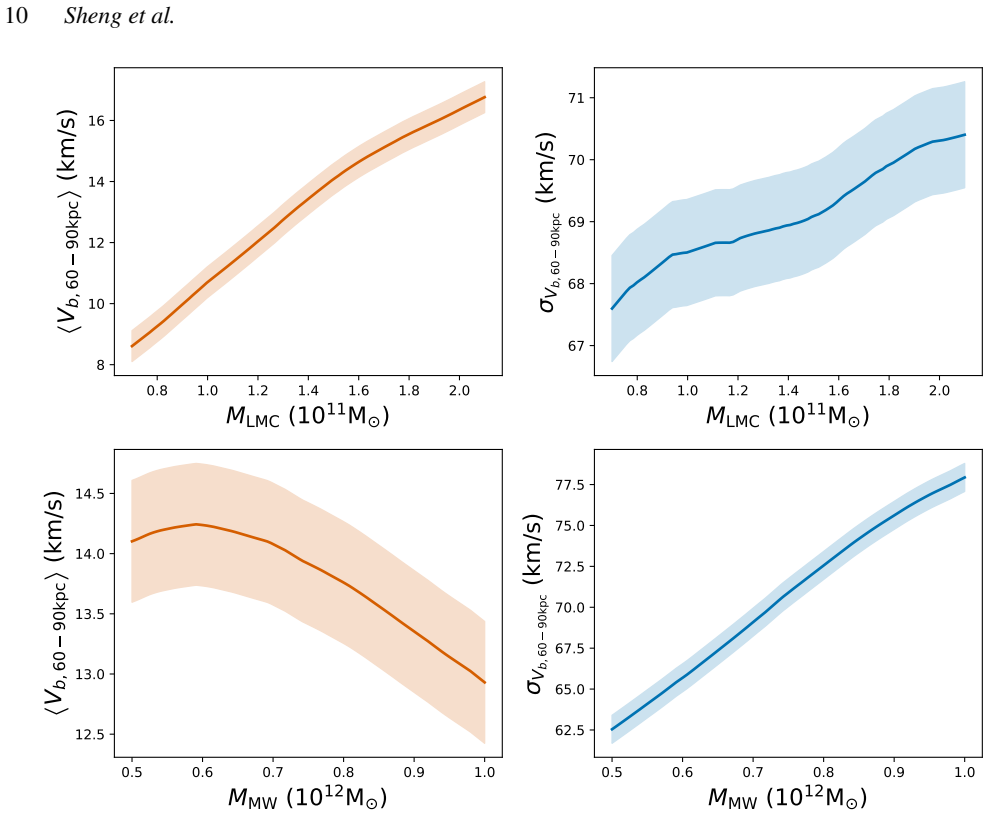
The load-bearing machinery is the pairing of the first velocity moment (mean velocities, which trace the reflex-motion dipole) with the second moment (velocity dispersions, which trace the equilibrium potential), evaluated through an energy-based particle-tagging scheme that converts dark-matter particles into a mock RR Lyrae stellar halo with an Einasto profile. This tagged halo is evolved in 2,848 self-consistent N-body simulations whose orbits are initialized by a neural-network inverse model that reconstructs the LMC's first-infall trajectory from present-day phase-space coordinates. A second neural network emulates the 18 kinematic summary statistics as smooth functions of the four parameters, and a Fisher matrix (validated against nested-sampling posteriors) converts observational error budgets into parameter uncertainties. The analytical dipole model (mean latitudinal velocity proportional to dipole amplitude, which scales with LMC mass) explains why the method works.
What would settle it
Measure the outer-halo velocity anisotropy beta(r) from a complete 6D sample of RR Lyrae or BHB stars beyond 30 kpc: if it matches beta=-0.15-0.2alpha(r) rather than zero, the paper's own cross-anisotropy test shows the recovered masses would be biased by ~40%, so the headline precision would not transfer to real data.
Extended reading notes
Core claim
The central discovery is that the first and second velocity moments of halo stars are complementary probes of the MW–LMC system. The LMC's recent infall sets the inner Milky Way moving relative to the outer halo, producing a coherent north–south dipole in mean radial velocities and a global positive bias in latitudinal velocities; these mean-velocity signals scale strongly with LMC mass. Velocity dispersions, by contrast, respond only weakly to the perturbation (typically <5 km/s) and essentially report the equilibrium structure of the Milky Way halo, so they constrain the Milky Way mass, concentration, and flattening. By feeding 18 summary statistics (three distance bins, three velocity components, hemisphere-separated radial means) through a neural-network emulator trained on the simulation grid, the authors show that the four parameters can be recovered from mock data and forecast the precision achievable with realistic observational errors. The headline numbers—0.11×$10^{12}$ Msun in M_MW, 2.33×$10^{10}$ Msun in M_LMC, 2.38 in c, 0.06 in q at 1-$\sigma$—assume an isotropic velocity anisotropy, and the paper explicitly shows that fitting the radially-varying anisotropy model to isotropic mock data biases the masses by ~40%.
Load-bearing premise
The headline precision assumes the stellar halo's velocity anisotropy is isotropic (beta=0), and the paper itself shows that fitting a radially varying anisotropy model to isotropic mock data biases the Milky Way mass high by ~40% and the LMC mass low by a similar amount, so the forecasts stand only if the real halo's anisotropy is close to what is assumed.
Editorial extensions
If this is right
- Radial velocities are the single most valuable addition: going from no radial velocities to 20 km/s precision improves the Milky Way mass, LMC mass, and concentration constraints by roughly 50–60%.
- Doubling the halo-tracer sample from ~4,000 to ~8,000 RR Lyrae stars yields about a 30% gain in precision, with the largest gains beyond 60 kpc where current samples are sparse.
- Distance precision is nearly irrelevant: worsening from 10% to 30% distance errors costs only ~10% in parameter precision, so numerous tracers with modest distances are preferable.
- Improved Gaia astrometry from DR3 to DR5 gives only modest gains (6–14% for masses and concentration), so astrometric precision is approaching diminishing returns when radial velocities are available.
- Ignoring the hemispheric dipole in radial velocities nearly doubles the forecast uncertainties on the two masses and concentration, so spatial binning carries real information.
Reading between the lines
- Because the paper demonstrates that a wrong anisotropy assumption biases masses by ~40%, a real-world application should marginalize over plausible beta(r) profiles; the headline 11%/16% uncertainties would likely inflate in that case.
- The sensitivity of the southern-hemisphere mean radial velocity to trajectory reconstruction (up to 8 km/s at 60–90 kpc) suggests that real analyses should either down-weight that statistic or propagate LMC orbital uncertainties into the likelihood.
- The same emulation-plus-Fisher pipeline could be turned around to design target selection for future surveys: the forecasts indicate that spending spectroscopic time on stars beyond 60 kpc is worth more than improving distances or proper motions.
- A natural next test, which the paper leaves to future work, is to feed the existing LAMOST and DESI radial-velocity catalogs plus Gaia astrometry through the pipeline and see whether the recovered masses are consistent with independent estimates; agreement would validate the framework, disagreement would point to the anisotropy or trajectory systematics.
Editorial analysis
A structured set of objections, weighed in public.
Referee Report
Summary. The paper presents HaloDance, a suite of 2,848 high-resolution N-body simulations of the MW-LMC interaction, varying MW virial mass, LMC virial mass, MW halo concentration, and halo flattening. The authors tag dark matter particles to build mock stellar halos, train neural-network emulators for kinematic summary statistics (mean velocities and dispersions) in three radial bins (30-60, 60-90, 90-120 kpc), validate parameter recovery with nested-sampling inference, and then use Fisher matrices to forecast constraints under different Gaia data releases, radial-velocity precisions, sample sizes, and distance errors. The headline result is that, with Gaia DR3-level astrometry, 20 km/s radial-velocity precision, 10% distance errors, and ~4,000 RR Lyrae stars, the 1-sigma uncertainties are 0.11 x 10^12 Msun in M_MW, 2.33 x 10^10 Msun in M_LMC, 2.38 in c, and 0.06 in q. The paper also demonstrates complementary sensitivity: mean velocities trace LMC-induced reflex motion, while dispersions constrain the MW potential.
Significance. If the underlying model assumptions are accepted, this is a valuable forecasting framework and the HaloDance suite will be a useful public resource. The paper's strengths include a large uniform simulation grid, careful validation of the emulator (residuals ~1 km/s), a Fisher-matrix forecast checked against full nested-sampling posteriors, and an explicit treatment of observational error propagation. The authors also include honest robustness tests, most notably for velocity-anisotropy misspecification and LMC trajectory reconstruction. However, the headline precision is conditional on assumptions that the paper itself shows to be fragile: the main grid fixes the halo velocity anisotropy to beta(r)=0, and Section 4.4.1 demonstrates ~40% mass biases under a plausible alternative anisotropy model. In addition, the abstract's fractional precision for M_MW is inconsistent with the fiducial mass used in the Fisher calculation. These issues materially affect the central forecast claim, so the paper needs revision before the quoted uncertainties can be taken at face value.
major comments (3)
- [Section 4.4.1, Figure 16] The main forecast grid fixes the stellar halo velocity anisotropy to beta(r)=0, and the abstract's headline uncertainties are computed from this grid. The paper's own robustness test in Section 4.4.1 and Figure 16 shows that when mock data generated with beta=0 are analyzed with the radially varying beta(r) model, M_MW is overestimated by about 40%, M_LMC is underestimated by about 40%, and c moves outside the 1-sigma interval. Because the real Milky Way halo is likely radially anisotropic (Section 2.2 cites beta ~ 0.8-0.9 inside 25-30 kpc), the quoted 1-sigma uncertainties are conditional on an assumption the paper itself demonstrates is fragile. The forecast should either marginalize over beta(r) with observational priors, or the abstract and conclusion should prominently state that the precision applies only under the beta=0 assumption and provide a systematic error budget for this effect.
- [Section 3.3.2, Abstract] There is an internal inconsistency in the fiducial MW mass used to quote fractional uncertainties. The fiducial model throughout the paper is M_MW = 0.7 x 10^12 Msun (Section 2.2, Figure 10, Section 3.2), but Section 3.3.2 states that fractional precisions are defined 'relative to the fiducial values of M_MW = 1.0 x 10^12 Msun.' This explains the abstract's 11% figure for M_MW (0.11 / 1.0), whereas at the actual fiducial mass of 0.7 x 10^12 Msun the same absolute uncertainty gives 0.11 / 0.7 = 16%, not 11%. This discrepancy propagates into the abstract and conclusion, which both quote 11% as a headline result, and should be corrected by either moving the Fisher evaluation to M_MW = 1.0 or quoting the correct fractional precision for the 0.7 fiducial.
- [Section 4.3, Table C1] The Fisher forecasts do not propagate LMC trajectory reconstruction systematics. Section 4.3 and Table C1 show that Gauss-Newton refinement of the LMC initial conditions changes the southern-hemisphere mean radial velocity at 60-90 kpc by up to 8 km/s, with several cases at 3-8 km/s. This statistic is one of the direct probes of the reflex motion that drives the M_LMC constraint, and the quoted statistical uncertainty for the mean in that bin is smaller than 8 km/s. The paper's statement that 'our overall parameter constraints remain reliable' is not demonstrated; the forecast should either include this systematic in the likelihood, down-weight the affected statistic, or quantify how it shifts the inferred parameters.
minor comments (5)
- [Abstract] The abstract's '107 particles' should read '10^7 particles'.
- [Section 2.3] The description of training data as 'seven forward-simulated orbits per parameter combination' is unclear; please specify how the six perturbed orbits are generated and how the approximate backward-integration starting points are chosen.
- [Figure 8, right panel] The caption defines SNR as the ratio of the physical tangential velocity dispersion to the 'statistical sampling uncertainty,' while the text says each curve incorporates the fixed measurement precision of the data release; the denominator of the SNR should be stated unambiguously.
- [Section 2.2] The first-infall assumption is a core condition for the entire forecast, but the abstract does not mention it; consider stating the first-infall condition in the abstract, since a second-infall LMC scenario remains debated (Section 1).
- [Section 4.4.1] The claim that the radially varying anisotropy model 'brackets the plausible range' of outer-halo beta(r) values is not supported by direct citations for the region beyond 30 kpc; please add references or soften the claim.
Circularity Check
No significant circularity: the forecasts are self-consistency tests of a forward model, not fitted predictions.
full rationale
The paper's central claims are design-study forecasts, not empirical measurements. The derivation chain is: (i) run N-body simulations over a Latin Hypercube grid; (ii) train a neural-network emulator on the resulting summary statistics and validate it on held-out simulations (Figure 6, residuals <1 km/s); (iii) generate mock observations from the fiducial model and show MCMC recovery within 1-2 sigma (Figure 9); (iv) compute Fisher forecasts from the emulator's local derivatives and validate them against those posteriors (Figure 10). None of these steps fits a parameter to real data and then renames it a prediction; the quoted 1-sigma uncertainties are the expected statistical precision conditional on the model and noise assumptions. The first-infall assumption is supported by external references as well as the authors' prior work, and it is a scenario choice rather than a result derived from the forecast. The beta(r)=0 grid is an explicit modeling assumption, and Section 4.4.1 quantifies the resulting bias when it is misspecified, which is a robustness limitation, not a circular step. Self-citations (Sheng et al. 2024) are used for simulation design and resolution validation, but the central forecast does not reduce to those citations. The paper is self-contained as a forward-modeling forecast.
Assumptions & free parameters
assumptions (8)
- domain assumption The LMC is on its first infall, with only one pericentric passage and an apocenter beyond the MW virial radius within the last 5 Gyr.
- domain assumption Dark matter-only N-body simulations, treating both galaxies as live collisionless systems, capture the LMC's dynamical influence on the MW halo; baryonic and hydrodynamical effects are ignored.
- domain assumption The MW halo is a smooth, axisymmetric NFW profile with constant flattening q aligned with the disk; no triaxiality, tilt, or radially varying shape.
- domain assumption The stellar halo can be represented by energy-based particle tagging with Eddington inversion, using a spherically averaged potential for non-spherical halos when computing the distribution function.
- domain assumption The halo velocity anisotropy is fixed to one of two profiles (beta=0 or Hansen-Moore), not varied as a free parameter or marginalized.
- domain assumption The LMC is modeled as a spherical Hernquist dark halo with no stellar disk and no Small Magellanic Cloud.
- standard math Summary statistics are independent and the Fisher matrix (Laplace approximation) describes the posterior; the neural network emulator residuals (about 1 km/s) are negligible compared to observational uncertainties including sampling noise.
- domain assumption The observational scenario (Gaia DR3/DR4/DR5 tangential errors, 20 km/s radial velocity, 10% distance, 4000 RR Lyrae in 30-120 kpc) is representative of current and near-future surveys.
Cite this review
Pith. "Pith review of LMC-induced Perturbations in the Milky Way Halo:I. HaloDance Simulation Suite and Observational Forecasts." pith.science (2026). https://pith.science/paper/2F7K3UOS
@misc{pith2026250703663,
  author       = {Pith},
  title        = {Pith review of: LMC-induced Perturbations in the Milky Way Halo:I. HaloDance Simulation Suite and Observational Forecasts},
  year         = {2026},
  howpublished = {\url{https://pith.science/paper/2F7K3UOS}},
  note         = {Machine review of arXiv:2507.03663}
}
abstract
The gravitational interaction between the Milky Way (MW) and the Large Magellanic Cloud (LMC) perturbs the MW halo's density and kinematics, encoding information about both galaxies' masses and structures. We present a suite of 2,848 high-resolution ($10^7$ particles) N-body simulations that systematically vary the mass and shape of both galaxies' haloes. We model how the mean velocities and velocity dispersions of halo stars (30--120 kpc) depend on system parameters, and forecast constraints achievable with current and future observations. Assuming Gaia DR3-level astrometry, 20 km/s radial velocity precision, 10% distance precision, and a sample of $\sim$4,000 RR Lyrae stars, we achieve 1$\sigma$ uncertainties of $0.11 \times 10^{12} M_\odot$ in MW mass, $2.33 \times 10^{10} M_\odot$ in LMC mass, 2.38 in halo concentration ($c$), and 0.06 in halo flattening ($q$). These correspond to fractional uncertainties of 11%, 16%, 25%, and 6% respectively, relative to fiducial values. Improved Gaia proper motions (DR5) yield modest gains (up to 14%), while adding radial velocities improves constraints by up to 60% relative to using Gaia astrometry alone. Doubling the sample size to $\sim$8,000 stars yields an additional 30% improvement, whereas reducing distance uncertainties has minimal impact ($\le$10%). Mean velocities trace LMC-induced perturbations, while velocity dispersions constrain MW halo properties, jointly breaking degeneracies. Our results demonstrate that combining Gaia astrometry with large spectroscopic surveys will enable precise characterization of the MW-LMC system. This methodology paper establishes the framework for interpreting observations; future work will apply these tools to existing spectroscopic datasets. The full simulation suite, HaloDance, will be made publicly available at: https://github.com/Yanjun-Sheng/HaloDance.
Figures


Figures from the paper (10 more)




Forward citations
Cited by 2 Pith papers
-
LMC-induced Perturbations in the Milky Way Halo II: Bridging Field-level Inference and Summary-level Simulation-Based Inference
A field-level flow-matching likelihood shows the raw 6D halo phase-space distribution carries 2.5-9.9x more MW-LMC parameter information than velocity moments; adding BFE+MOPED summaries recovers much of this gap.
-
The Milky Way - Large Magellanic Cloud Interaction with Simulation Based Inference
Simulation-based inference on outer-halo star velocities gives a Milky Way reflex speed of 26.4 km/s and an LMC enclosed mass of 9.2×10^10 solar masses within 50 kpc.
Reference graph
Works this paper leans on
-
[1]
write newline
" write newline "" before.all 'output.state := FUNCTION fin.entry write newline FUNCTION new.block output.state before.all = 'skip after.block 'output.state := if FUNCTION new.sentence output.state after.block = 'skip output.state before.all = 'skip after.sentence 'output.state := if if FUNCTION not #0 #1 if FUNCTION and 'skip pop #0 if FUNCTION or pop #1...
-
[2]
Alsing J., Charnock T., Feeney S., Wandelt B., 2019, @doi [ ] 10.1093/mnras/stz1960 , https://ui.adsabs.harvard.edu/abs/2019MNRAS.488.4440A 488, 4440
-
[3]
Amarante J. A. S., Koposov S. E., Laporte C. F. P., 2024, @doi [ ] 10.1051/0004-6361/202450351 , https://ui.adsabs.harvard.edu/abs/2024A&A...690A.166A 690, A166
-
[4]
Amorisco N. C., 2017, @doi [ ] 10.1093/mnras/stw2229 , https://ui.adsabs.harvard.edu/abs/2017MNRAS.464.2882A 464, 2882
-
[5]
Astropy Collaboration et al., 2013, @doi [ ] 10.1051/0004-6361/201322068 , http://adsabs.harvard.edu/abs/2013A
-
[6]
Behroozi P., Wechsler R. H., Hearin A. P., Conroy C., 2019, @doi [ ] 10.1093/mnras/stz1182 , https://ui.adsabs.harvard.edu/abs/2019MNRAS.488.3143B 488, 3143
-
[7]
Belokurov V., et al., 2014, @doi [ ] 10.1093/mnras/stt1862 , https://ui.adsabs.harvard.edu/abs/2014MNRAS.437..116B 437, 116
-
[8]
Belokurov V., Deason A. J., Erkal D., Koposov S. E., Carballo-Bello J. A., Smith M. C., Jethwa P., Navarrete C., 2019, @doi [ ] 10.1093/mnrasl/slz101 , https://ui.adsabs.harvard.edu/abs/2019MNRAS.488L..47B 488, L47
Show all 115 references
-
[9]
J., van der Marel R
Besla G., Kallivayalil N., Hernquist L., Robertson B., Cox T. J., van der Marel R. P., Alcock C., 2007, @doi [ ] 10.1086/521385 , https://ui.adsabs.harvard.edu/abs/2007ApJ...668..949B 668, 949
2007 doi
-
[10]
P., Cox T
Besla G., Kallivayalil N., Hernquist L., van der Marel R. P., Cox T. J., Kere s D., 2010, @doi [ ] 10.1088/2041-8205/721/2/L97 , https://ui.adsabs.harvard.edu/abs/2010ApJ...721L..97B 721, L97
2010 doi
-
[11]
Binney J., Tremaine S., 2008, Galactic Dynamics: Second Edition
2008
-
[12]
A., Xue X.-X., Liu C., Shen J., Flynn C., Yang C., 2019, @doi [ ] 10.3847/1538-3881/aafd2e , https://ui.adsabs.harvard.edu/abs/2019AJ....157..104B 157, 104
Bird S. A., Xue X.-X., Liu C., Shen J., Flynn C., Yang C., 2019, @doi [ ] 10.3847/1538-3881/aafd2e , https://ui.adsabs.harvard.edu/abs/2019AJ....157..104B 157, 104
2019 doi
-
[13]
Bland-Hawthorn J., Gerhard O., 2016, @doi [ ] 10.1146/annurev-astro-081915-023441 , https://ui.adsabs.harvard.edu/abs/2016ARA&A..54..529B 54, 529
2016 doi
-
[14]
Bovy J., 2015, @doi [ ] 10.1088/0067-0049/216/2/29 , https://ui.adsabs.harvard.edu/abs/2015ApJS..216...29B 216, 29
2015 doi
- [15]
-
[16]
Chandra V., et al., 2023, @doi [ ] 10.3847/1538-4357/acf7bf , https://ui.adsabs.harvard.edu/abs/2023ApJ...956..110C 956, 110
2023 doi
- [17]
-
[18]
Chandrasekhar S., 1943, @doi [ ] 10.1086/144517 , https://ui.adsabs.harvard.edu/abs/1943ApJ....97..255C 97, 255
1943 doi
- [19]
-
[20]
D., Katz N., 2009, @doi [ ] 10.1111/j.1365-2966.2009.15556.x , https://ui.adsabs.harvard.edu/abs/2009MNRAS.400.1247C 400, 1247
Choi J.-H., Weinberg M. D., Katz N., 2009, @doi [ ] 10.1111/j.1365-2966.2009.15556.x , https://ui.adsabs.harvard.edu/abs/2009MNRAS.400.1247C 400, 1247
2009
- [21]
-
[22]
G., Wishart J., 1934, @doi [Proceedings of the Cambridge Philosophical Society] 10.1017/S0305004100016595 , https://ui.adsabs.harvard.edu/abs/1934PCPS...30..178C 30, 178
Cochran W. G., Wishart J., 1934, @doi [Proceedings of the Cambridge Philosophical Society] 10.1017/S0305004100016595 , https://ui.adsabs.harvard.edu/abs/1934PCPS...30..178C 30, 178
1934 doi
-
[23]
O'Reilly
Collette A., 2013, Python and HDF5. O'Reilly
2013
-
[24]
Conroy C., et al., 2019, @doi [ ] 10.3847/1538-4357/ab38b8 , https://ui.adsabs.harvard.edu/abs/2019ApJ...883..107C 883, 107
2019 doi
-
[25]
P., Garavito-Camargo N., Besla G., Zaritsky D., Bonaca A., Johnson B
Conroy C., Naidu R. P., Garavito-Camargo N., Besla G., Zaritsky D., Bonaca A., Johnson B. D., 2021, @doi [ ] 10.1038/s41586-021-03385-7 , https://ui.adsabs.harvard.edu/abs/2021Natur.592..534C 592, 534
2021 doi
-
[26]
Correa Magnus L., Vasiliev E., 2022, @doi [ ] 10.1093/mnras/stab3726 , https://ui.adsabs.harvard.edu/abs/2022MNRAS.511.2610C 511, 2610
2022 doi
-
[27]
Cranmer K., Brehmer J., Louppe G., 2020, @doi [Proceedings of the National Academy of Sciences] 10.1073/pnas.1912789117 , 117, 30055
2020 doi
-
[28]
C., et al., 2020, @doi [ ] 10.3847/1538-4357/ab9b88 , https://ui.adsabs.harvard.edu/abs/2020ApJ...898....4C 898, 4
Cunningham E. C., et al., 2020, @doi [ ] 10.3847/1538-4357/ab9b88 , https://ui.adsabs.harvard.edu/abs/2020ApJ...898....4C 898, 4
2020 doi
-
[29]
J., 2016, @doi [ ] 10.1146/annurev-astro-081915-023251 , https://ui.adsabs.harvard.edu/abs/2016ARA&A..54..363D 54, 363
D'Onghia E., Fox A. J., 2016, @doi [ ] 10.1146/annurev-astro-081915-023251 , https://ui.adsabs.harvard.edu/abs/2016ARA&A..54..363D 54, 363
2016 doi
-
[30]
S., et al., 2016, in Ground-based and Airborne Instrumentation for Astronomy VI
De Jong R. S., et al., 2016, in Ground-based and Airborne Instrumentation for Astronomy VI. pp 473--490
2016
-
[31]
J., Belokurov V., Koposov S
Deason A. J., Belokurov V., Koposov S. E., G \'o mez F. A., Grand R. J., Marinacci F., Pakmor R., 2017, @doi [ ] 10.1093/mnras/stx1301 , https://ui.adsabs.harvard.edu/abs/2017MNRAS.470.1259D 470, 1259
2017 doi
-
[32]
P., Moore B., Quinn T., Kazantzidis S., Maas R., Mayer L., Read J., Stadel J., 2008, @doi [ ] 10.1086/587977 , https://ui.adsabs.harvard.edu/abs/2008ApJ...681.1076D 681, 1076
Debattista V. P., Moore B., Quinn T., Kazantzidis S., Maas R., Mayer L., Read J., Stadel J., 2008, @doi [ ] 10.1086/587977 , https://ui.adsabs.harvard.edu/abs/2008ApJ...681.1076D 681, 1076
2008 doi
-
[33]
Erkal D., et al., 2019, @doi [ ] 10.1093/mnras/stz1371 , https://ui.adsabs.harvard.edu/abs/2019MNRAS.487.2685E 487, 2685
2019 doi
-
[34]
Erkal D., et al., 2021, @doi [ ] 10.1093/mnras/stab1828 , https://ui.adsabs.harvard.edu/abs/2021MNRAS.506.2677E 506, 2677
2021 doi
-
[35]
Euclid Collaboration et al., 2025, @doi [ ] 10.1051/0004-6361/202450810 , https://ui.adsabs.harvard.edu/abs/2025A&A...697A...1E 697, A1
2025 doi
-
[36]
R., et al., 2023, @doi [ ] 10.3847/1538-4357/ace533 , https://ui.adsabs.harvard.edu/abs/2023ApJ...954..163F 954, 163
Foote H. R., et al., 2023, @doi [ ] 10.3847/1538-4357/ace533 , https://ui.adsabs.harvard.edu/abs/2023ApJ...954..163F 954, 163
2023 doi
-
[37]
Garavito-Camargo N., Besla G., Laporte C. F. P., Johnston K. V., G \'o mez F. A., Watkins L. L., 2019, @doi [ ] 10.3847/1538-4357/ab32eb , https://ui.adsabs.harvard.edu/abs/2019ApJ...884...51G 884, 51
2019 doi
-
[38]
Garavito-Camargo N., Besla G., Laporte C. F. P., Price-Whelan A. M., Cunningham E. C., Johnston K. V., Weinberg M., G \'o mez F. A., 2021, @doi [ ] 10.3847/1538-4357/ac0b44 , https://ui.adsabs.harvard.edu/abs/2021ApJ...919..109G 919, 109
2021 doi
-
[39]
E., Sarro L
Garofalo A., Delgado H. E., Sarro L. M., Clementini G., Muraveva T., Marconi M., Ripepi V., 2022, @doi [ ] 10.1093/mnras/stac735 , https://ui.adsabs.harvard.edu/abs/2022MNRAS.513..788G 513, 788
2022 doi
-
[40]
A., Besla G., Carpintero D
G \'o mez F. A., Besla G., Carpintero D. D., Villalobos \'A ., O'Shea B. W., Bell E. F., 2015, @doi [ ] 10.1088/0004-637X/802/2/128 , https://ui.adsabs.harvard.edu/abs/2015ApJ...802..128G 802, 128
2015 doi
-
[41]
Grand R. J. J., et al., 2017, @doi [ ] 10.1093/mnras/stx071 , https://ui.adsabs.harvard.edu/abs/2017MNRAS.467..179G 467, 179
2017 doi
-
[42]
M., Ting Y.-S., Kamdar H., 2023, @doi [ ] 10.3847/1538-4357/aca3a7 , https://ui.adsabs.harvard.edu/abs/2023ApJ...942...26G 942, 26
Green G. M., Ting Y.-S., Kamdar H., 2023, @doi [ ] 10.3847/1538-4357/aca3a7 , https://ui.adsabs.harvard.edu/abs/2023ApJ...942...26G 942, 26
2023 doi
-
[43]
J., et al., 2022a, @doi [ ] 10.3847/1538-3881/ac97e9 , https://ui.adsabs.harvard.edu/abs/2022AJ....164..249H 164, 249
Han J. J., et al., 2022a, @doi [ ] 10.3847/1538-3881/ac97e9 , https://ui.adsabs.harvard.edu/abs/2022AJ....164..249H 164, 249
-
[44]
J., et al., 2022b, @doi [ ] 10.3847/1538-4357/ac795f , https://ui.adsabs.harvard.edu/abs/2022ApJ...934...14H 934, 14
Han J. J., et al., 2022b, @doi [ ] 10.3847/1538-4357/ac795f , https://ui.adsabs.harvard.edu/abs/2022ApJ...934...14H 934, 14
-
[45]
H., Moore B., 2006, @doi [ ] 10.1016/j.newast.2005.09.001 , https://ui.adsabs.harvard.edu/abs/2006NewA...11..333H 11, 333
Hansen S. H., Moore B., 2006, @doi [ ] 10.1016/j.newast.2005.09.001 , https://ui.adsabs.harvard.edu/abs/2006NewA...11..333H 11, 333
2006 doi
-
[46]
Harris J., Zaritsky D., 2009, @doi [ ] 10.1088/0004-6256/138/5/1243 , https://ui.adsabs.harvard.edu/abs/2009AJ....138.1243H 138, 1243
2009 doi
-
[47]
R., et al., 2020, @doi [Nature] 10.1038/s41586-020-2649-2 , 585, 357
Harris C. R., et al., 2020, @doi [Nature] 10.1038/s41586-020-2649-2 , 585, 357
2020 doi
-
[48]
Hernitschek N., et al., 2018, @doi [ ] 10.3847/1538-4357/aabfbb , https://ui.adsabs.harvard.edu/abs/2018ApJ...859...31H 859, 31
2018 doi
-
[49]
Hernquist L., 1990, @doi [ ] 10.1086/168845 , https://ui.adsabs.harvard.edu/abs/1990ApJ...356..359H 356, 359
1990 doi
- [50]
-
[51]
D., 2007, @doi [Computing in Science & Engineering] 10.1109/MCSE.2007.55 , 9, 90
Hunter J. D., 2007, @doi [Computing in Science & Engineering] 10.1109/MCSE.2007.55 , 9, 90
2007 doi
-
[52]
Iorio G., Belokurov V., 2021, @doi [ ] 10.1093/mnras/stab005 , https://ui.adsabs.harvard.edu/abs/2021MNRAS.502.5686I 502, 5686
2021 doi
-
[53]
J., Chemin L., 2024, @doi [ ] 10.1051/0004-6361/202349058 , https://ui.adsabs.harvard.edu/abs/2024A&A...688A..51J 688, A51
Jim \'e nez-Arranz \'O ., Roca-F \`a brega S., Romero-G \'o mez M., Luri X., Bernet M., McMillan P. J., Chemin L., 2024, @doi [ ] 10.1051/0004-6361/202349058 , https://ui.adsabs.harvard.edu/abs/2024A&A...688A..51J 688, A51
2024 doi
-
[54]
Jin S., et al., 2024, @doi [ ] 10.1093/mnras/stad557 , https://ui.adsabs.harvard.edu/abs/2024MNRAS.530.2688J 530, 2688
2024 doi
-
[55]
P., Besla G., Anderson J., Alcock C., 2013, @doi [ ] 10.1088/0004-637X/764/2/161 , https://ui.adsabs.harvard.edu/abs/2013ApJ...764..161K 764, 161
Kallivayalil N., van der Marel R. P., Besla G., Anderson J., Alcock C., 2013, @doi [ ] 10.1088/0004-637X/764/2/161 , https://ui.adsabs.harvard.edu/abs/2013ApJ...764..161K 764, 161
2013 doi
-
[56]
E., et al., 2023, @doi [ ] 10.1093/mnras/stad551 , https://ui.adsabs.harvard.edu/abs/2023MNRAS.521.4936K 521, 4936
Koposov S. E., et al., 2023, @doi [ ] 10.1093/mnras/stad551 , https://ui.adsabs.harvard.edu/abs/2023MNRAS.521.4936K 521, 4936
2023 doi
-
[57]
Kravtsov A., Winney S., 2024, @doi [The Open Journal of Astrophysics] 10.33232/001c.120316 , https://ui.adsabs.harvard.edu/abs/2024OJAp....7E..50K 7, 50
2024 doi
-
[58]
Laporte C. F. P., White S. D. M., Naab T., Gao L., 2013, @doi [ ] 10.1093/mnras/stt912 , https://ui.adsabs.harvard.edu/abs/2013MNRAS.435..901L 435, 901
2013 doi
-
[59]
Laporte C. F. P., G \'o mez F. A., Besla G., Johnston K. V., Garavito-Camargo N., 2018a, @doi [ ] 10.1093/mnras/stx2146 , https://ui.adsabs.harvard.edu/abs/2018MNRAS.473.1218L 473, 1218
-
[60]
Laporte C. F. P., Johnston K. V., G \'o mez F. A., Garavito-Camargo N., Besla G., 2018b, @doi [ ] 10.1093/mnras/sty1574 , https://ui.adsabs.harvard.edu/abs/2018MNRAS.481..286L 481, 286
-
[61]
C., Johnson B
Leja J., Carnall A. C., Johnson B. D., Conroy C., Speagle J. S., 2019, @doi [ ] 10.3847/1538-4357/ab133c , https://ui.adsabs.harvard.edu/abs/2019ApJ...876....3L 876, 3
2019 doi
- [62]
-
[63]
S., et al., 2019, @doi [ ] 10.1093/mnras/stz2731 , https://ui.adsabs.harvard.edu/abs/2019MNRAS.490.3508L 490, 3508
Li T. S., et al., 2019, @doi [ ] 10.1093/mnras/stz2731 , https://ui.adsabs.harvard.edu/abs/2019MNRAS.490.3508L 490, 3508
2019 doi
-
[64]
C., Zhang H.-W., 2023, @doi [ ] 10.3847/1538-4357/acadd5 , https://ui.adsabs.harvard.edu/abs/2023ApJ...944...88L 944, 88
Li X.-Y., Huang Y., Liu G.-C., Beers T. C., Zhang H.-W., 2023, @doi [ ] 10.3847/1538-4357/acadd5 , https://ui.adsabs.harvard.edu/abs/2023ApJ...944...88L 944, 88
2023 doi
-
[65]
H., Putney E., Buckley M
Lim S. H., Putney E., Buckley M. R., Shih D., 2025, @doi [ ] 10.1088/1475-7516/2025/01/021 , https://ui.adsabs.harvard.edu/abs/2025JCAP...01..021L 2025, 021
2025 doi
-
[66]
R., et al., 2018, @doi [ ] 10.3847/1538-4357/aaa0d6 , https://ui.adsabs.harvard.edu/abs/2018ApJ...853..196L 853, 196
Loebman S. R., et al., 2018, @doi [ ] 10.3847/1538-4357/aaa0d6 , https://ui.adsabs.harvard.edu/abs/2018ApJ...853..196L 853, 196
2018 doi
-
[67]
J., 2021, @doi [ ] 10.3847/2041-8213/ac3338 , https://ui.adsabs.harvard.edu/abs/2021ApJ...921L..36L 921, L36
Lucchini S., D'Onghia E., Fox A. J., 2021, @doi [ ] 10.3847/2041-8213/ac3338 , https://ui.adsabs.harvard.edu/abs/2021ApJ...921L..36L 921, L36
2021 doi
-
[68]
Massana P., et al., 2022, @doi [ ] 10.1093/mnrasl/slac030 , https://ui.adsabs.harvard.edu/abs/2022MNRAS.513L..40M 513, L40
2022 doi
-
[69]
D., Beckman R
McKay M. D., Beckman R. J., Conover W. J., 1979, Technometrics, 21, 239
1979
-
[70]
J., 2011, @doi [ ] 10.1111/j.1365-2966.2011.18564.x , https://ui.adsabs.harvard.edu/abs/2011MNRAS.414.2446M 414, 2446
McMillan P. J., 2011, @doi [ ] 10.1111/j.1365-2966.2011.18564.x , https://ui.adsabs.harvard.edu/abs/2011MNRAS.414.2446M 414, 2446
2011
-
[71]
J., 2017, @doi [ ] 10.1093/mnras/stw2759 , https://ui.adsabs.harvard.edu/abs/2017MNRAS.465...76M 465, 76
McMillan P. J., 2017, @doi [ ] 10.1093/mnras/stw2759 , https://ui.adsabs.harvard.edu/abs/2017MNRAS.465...76M 465, 76
2017 doi
-
[72]
W., Moore B., Diemand J., Terzi \'c B., 2006, @doi [ ] 10.1086/508988 , https://ui.adsabs.harvard.edu/abs/2006AJ....132.2685M 132, 2685
Merritt D., Graham A. W., Moore B., Diemand J., Terzi \'c B., 2006, @doi [ ] 10.1086/508988 , https://ui.adsabs.harvard.edu/abs/2006AJ....132.2685M 132, 2685
2006 doi
-
[73]
L., Monelli M., Stetson P
Meschin I., Gallart C., Aparicio A., Hidalgo S. L., Monelli M., Stetson P. B., Carrera R., 2014, @doi [ ] 10.1093/mnras/stt2220 , https://ui.adsabs.harvard.edu/abs/2014MNRAS.438.1067M 438, 1067
2014 doi
-
[74]
Miyamoto M., Nagai R., 1975, , https://ui.adsabs.harvard.edu/abs/1975PASJ...27..533M 27, 533
1975
-
[75]
E., Clementini G., Sarro L
Muraveva T., Delgado H. E., Clementini G., Sarro L. M., Garofalo A., 2018, @doi [Monthly Notices of the Royal Astronomical Society] 10.1093/mnras/sty2241 , 481, 1195
2018 doi
-
[76]
Natarajan P., Hjorth J., van Kampen E., 1997, @doi [ ] 10.1093/mnras/286.2.329 , https://ui.adsabs.harvard.edu/abs/1997MNRAS.286..329N 286, 329
1997 doi
-
[77]
F., Frenk C
Navarro J. F., Frenk C. S., White S. D. M., 1997, @doi [ ] 10.1086/304888 , https://ui.adsabs.harvard.edu/abs/1997ApJ...490..493N 490, 493
1997 doi
-
[78]
Ogiya G., Burkert A., 2016, @doi [ ] 10.1093/mnras/stw091 , https://ui.adsabs.harvard.edu/abs/2016MNRAS.457.2164O 457, 2164
2016 doi
-
[79]
T., 2017, @doi [ ] 10.1093/mnras/stw2616 , https://ui.adsabs.harvard.edu/abs/2017MNRAS.464.3825P 464, 3825
Patel E., Besla G., Sohn S. T., 2017, @doi [ ] 10.1093/mnras/stw2616 , https://ui.adsabs.harvard.edu/abs/2017MNRAS.464.3825P 464, 3825
2017 doi
-
[80]
Patel E., et al., 2020, @doi [ ] 10.3847/1538-4357/ab7b75 , https://ui.adsabs.harvard.edu/abs/2020ApJ...893..121P 893, 121
2020 doi
-
[81]
A., Besla G., Erkal D., Ma Y.-Z., 2016, @doi [ ] 10.1093/mnrasl/slv160 , https://ui.adsabs.harvard.edu/abs/2016MNRAS.456L..54P 456, L54
Pe \ n arrubia J., G \'o mez F. A., Besla G., Erkal D., Ma Y.-Z., 2016, @doi [ ] 10.1093/mnrasl/slv160 , https://ui.adsabs.harvard.edu/abs/2016MNRAS.456L..54P 456, L54
2016 doi
-
[82]
E., 2007, @doi [Computing in Science & Engineering] 10.1109/MCSE.2007.53 , 9, 21
Perez F., Granger B. E., 2007, @doi [Computing in Science & Engineering] 10.1109/MCSE.2007.53 , 9, 21
2007 doi
-
[83]
S., Pe \ n arrubia J., 2020, @doi [ ] 10.1093/mnrasl/slaa029 , https://ui.adsabs.harvard.edu/abs/2020MNRAS.494L..11P 494, L11
Petersen M. S., Pe \ n arrubia J., 2020, @doi [ ] 10.1093/mnrasl/slaa029 , https://ui.adsabs.harvard.edu/abs/2020MNRAS.494L..11P 494, L11
2020 doi
-
[84]
S., Pe \ n arrubia J., 2021, @doi [Nature Astronomy] 10.1038/s41550-020-01254-3 , https://ui.adsabs.harvard.edu/abs/2021NatAs...5..251P 5, 251
Petersen M. S., Pe \ n arrubia J., 2021, @doi [Nature Astronomy] 10.1038/s41550-020-01254-3 , https://ui.adsabs.harvard.edu/abs/2021NatAs...5..251P 5, 251
2021 doi
-
[85]
S., Pe \ n arrubia J., Jones E., 2022, @doi [ ] 10.1093/mnras/stac1429 , https://ui.adsabs.harvard.edu/abs/2022MNRAS.514.1266P 514, 1266
Petersen M. S., Pe \ n arrubia J., Jones E., 2022, @doi [ ] 10.1093/mnras/stac1429 , https://ui.adsabs.harvard.edu/abs/2022MNRAS.514.1266P 514, 1266
2022 doi
-
[86]
F., Jenkins A., Frenk C
Power C., Navarro J. F., Jenkins A., Frenk C. S., White S. D. M., Springel V., Stadel J., Quinn T., 2003, @doi [ ] 10.1046/j.1365-8711.2003.05925.x , https://ui.adsabs.harvard.edu/abs/2003MNRAS.338...14P 338, 14
2003
-
[87]
M., 2017, @doi [The Journal of Open Source Software] 10.21105/joss.00388 , https://ui.adsabs.harvard.edu/abs/2017JOSS....2..388P 2, 388
Price-Whelan A. M., 2017, @doi [The Journal of Open Source Software] 10.21105/joss.00388 , https://ui.adsabs.harvard.edu/abs/2017JOSS....2..388P 2, 388
2017 doi
-
[88]
M., et al., 2018, @doi [ ] 10.3847/1538-3881/aabc4f , https://ui.adsabs.harvard.edu/#abs/2018AJ....156..123T 156, 123
Price-Whelan A. M., et al., 2018, @doi [ ] 10.3847/1538-3881/aabc4f , https://ui.adsabs.harvard.edu/#abs/2018AJ....156..123T 156, 123
2018 doi
-
[89]
Riello M., et al., 2021, @doi [ ] 10.1051/0004-6361/202039587 , https://ui.adsabs.harvard.edu/abs/2021A&A...649A...3R 649, A3
2021 doi
-
[90]
Sch \"o nrich R., Binney J., Dehnen W., 2010, @doi [ ] 10.1111/j.1365-2966.2010.16253.x , https://ui.adsabs.harvard.edu/abs/2010MNRAS.403.1829S 403, 1829
2010
-
[91]
Shen J., et al., 2022, @doi [ ] 10.3847/1538-4357/ac3a7a , https://ui.adsabs.harvard.edu/abs/2022ApJ...925....1S 925, 1
2022 doi
-
[92]
Sheng Y., Ting Y.-S., Xue X.-X., Chang J., Tian H., 2024, @doi [ ] 10.1093/mnras/stae2259 , https://ui.adsabs.harvard.edu/abs/2024MNRAS.534.2694S 534, 2694
2024 doi
-
[93]
Shipp N., et al., 2021, @doi [ ] 10.3847/1538-4357/ac2e93 , https://ui.adsabs.harvard.edu/abs/2021ApJ...923..149S 923, 149
2021 doi
-
[94]
S., 2020, @doi [ ] 10.1093/mnras/staa278 , https://ui.adsabs.harvard.edu/abs/2020MNRAS.493.3132S 493, 3132
Speagle J. S., 2020, @doi [ ] 10.1093/mnras/staa278 , https://ui.adsabs.harvard.edu/abs/2020MNRAS.493.3132S 493, 3132
2020 doi
-
[95]
Springel V., Pakmor R., Zier O., Reinecke M., 2021, @doi [ ] 10.1093/mnras/stab1855 , https://ui.adsabs.harvard.edu/abs/2021MNRAS.506.2871S 506, 2871
2021 doi
-
[96]
Sun Y., Deng D.-S., Yuan H.-B., 2021, @doi [Research in Astronomy and Astrophysics] 10.1088/1674-4527/21/4/92 , https://ui.adsabs.harvard.edu/abs/2021RAA....21...92S 21, 092
2021 doi
-
[97]
R., Capelo P
Tamfal T., Mayer L., Quinn T. R., Capelo P. R., Kazantzidis S., Babul A., Potter D., 2021, @doi [ ] 10.3847/1538-4357/ac0627 , https://ui.adsabs.harvard.edu/abs/2021ApJ...916...55T 916, 55
2021 doi
-
[98]
The VIA Project Collaboration 2025, The Via Project, https://via-project.org/
2025
-
[99]
Vasiliev E., 2023, @doi [Galaxies] 10.3390/galaxies11020059 , https://ui.adsabs.harvard.edu/abs/2023Galax..11...59V 11, 59
2023 doi
-
[100]
Vasiliev E., 2024, @doi [ ] 10.1093/mnras/stad2612 , https://ui.adsabs.harvard.edu/abs/2024MNRAS.527..437V 527, 437
2024 doi
-
[101]
Vasiliev E., Belokurov V., 2020, @doi [ ] 10.1093/mnras/staa2114 , https://ui.adsabs.harvard.edu/abs/2020MNRAS.497.4162V 497, 4162
2020 doi
-
[102]
Vasiliev E., Belokurov V., Erkal D., 2021, @doi [ ] 10.1093/mnras/staa3673 , https://ui.adsabs.harvard.edu/abs/2021MNRAS.501.2279V 501, 2279
2021 doi
-
[103]
Virtanen P., et al., 2020, @doi [Nature Methods] 10.1038/s41592-019-0686-2 , https://rdcu.be/b08Wh 17, 261
2020 doi
-
[104]
N., 2020, @doi [Science China Physics, Mechanics, and Astronomy] 10.1007/s11433-019-1541-6 , https://ui.adsabs.harvard.edu/abs/2020SCPMA..6309801W 63, 109801
Wang W., Han J., Cautun M., Li Z., Ishigaki M. N., 2020, @doi [Science China Physics, Mechanics, and Astronomy] 10.1007/s11433-019-1541-6 , https://ui.adsabs.harvard.edu/abs/2020SCPMA..6309801W 63, 109801
2020 doi
-
[105]
Wang Y., et al., 2022, @doi [ ] 10.3847/1538-4357/ac4973 , https://ui.adsabs.harvard.edu/abs/2022ApJ...928....1W 928, 1
2022 doi
-
[106]
L., van der Marel R
Watkins L. L., van der Marel R. P., Bennet P., 2024, @doi [ ] 10.3847/1538-4357/ad1f58 , https://ui.adsabs.harvard.edu/abs/2024ApJ...963...84W 963, 84
2024 doi
-
[107]
D., Katz N., 2007, @doi [ ] 10.1111/j.1365-2966.2006.11306.x , https://ui.adsabs.harvard.edu/abs/2007MNRAS.375..425W 375, 425
Weinberg M. D., Katz N., 2007, @doi [ ] 10.1111/j.1365-2966.2006.11306.x , https://ui.adsabs.harvard.edu/abs/2007MNRAS.375..425W 375, 425
2007
-
[108]
Wetzel A., et al., 2023, @doi [ ] 10.3847/1538-4365/acb99a , https://ui.adsabs.harvard.edu/abs/2023ApJS..265...44W 265, 44
2023 doi
-
[109]
S., Pe \ n arrubia J., 2024, @doi [ ] 10.1093/mnras/stae1363 , https://ui.adsabs.harvard.edu/abs/2024MNRAS.531.3524Y 531, 3524
Yaaqib R., Petersen M. S., Pe \ n arrubia J., 2024, @doi [ ] 10.1093/mnras/stae1363 , https://ui.adsabs.harvard.edu/abs/2024MNRAS.531.3524Y 531, 3524
2024 doi
-
[110]
Yurin D., Springel V., 2014, @doi [ ] 10.1093/mnras/stu1421 , https://ui.adsabs.harvard.edu/abs/2014MNRAS.444...62Y 444, 62
2014 doi
-
[111]
Zaritsky D., et al., 2020, @doi [ ] 10.3847/2041-8213/abcb83 , https://ui.adsabs.harvard.edu/abs/2020ApJ...905L...3Z 905, L3
2020 doi
-
[112]
Zhao G., Zhao Y.-H., Chu Y.-Q., Jing Y.-P., Deng L.-C., 2012, @doi [Research in Astronomy and Astrophysics] 10.1088/1674-4527/12/7/002 , https://ui.adsabs.harvard.edu/abs/2012RAA....12..723Z 12, 723
2012 doi
-
[113]
P., Cioni M.-R
van der Marel R. P., Cioni M.-R. L., 2001, @doi [ ] 10.1086/323099 , https://ui.adsabs.harvard.edu/abs/2001AJ....122.1807V 122, 1807
2001 doi
-
[114]
P., Kallivayalil N., 2014, @doi [ ] 10.1088/0004-637X/781/2/121 , https://ui.adsabs.harvard.edu/abs/2014ApJ...781..121V 781, 121
van der Marel R. P., Kallivayalil N., 2014, @doi [ ] 10.1088/0004-637X/781/2/121 , https://ui.adsabs.harvard.edu/abs/2014ApJ...781..121V 781, 121
2014 doi
-
[115]
P., Alves D
van der Marel R. P., Alves D. R., Hardy E., Suntzeff N. B., 2002, @doi [ ] 10.1086/343775 , https://ui.adsabs.harvard.edu/abs/2002AJ....124.2639V 124, 2639
2002 doi
Reviewed August 6, 2026 · model on record in the stance chip above.
Discussion (0). Sign in to comment.