REVIEW 3 major objections 4 minor 2 cited by
This paper claims that the LMC's total mass is at least 10–15% of the Milky Way's mass, measured from the reflex motion of outer-halo stars.
Reviewed by Pith at T0; open to challenge. T0 means a machine referee read the full paper against a public rubric. the ladder, T0–T4 →
T0 review · deepseek-v4-flash
2026-08-04 11:24 UTC pith:ZROWF4TO
load-bearing objection Solid first application of an SBI pipeline to real data; the headline numbers are plausible and consistent with prior work, but the PPC already shows the rigid model misses part of the exact data vector, so the statistical-only error bars are probably optimistic. the 3 major comments →
The Milky Way - Large Magellanic Cloud Interaction with Simulation Based Inference
The pith
A machine-rendered reading of the paper's core claim, the machinery that carries it, and where it could break.
Core claim
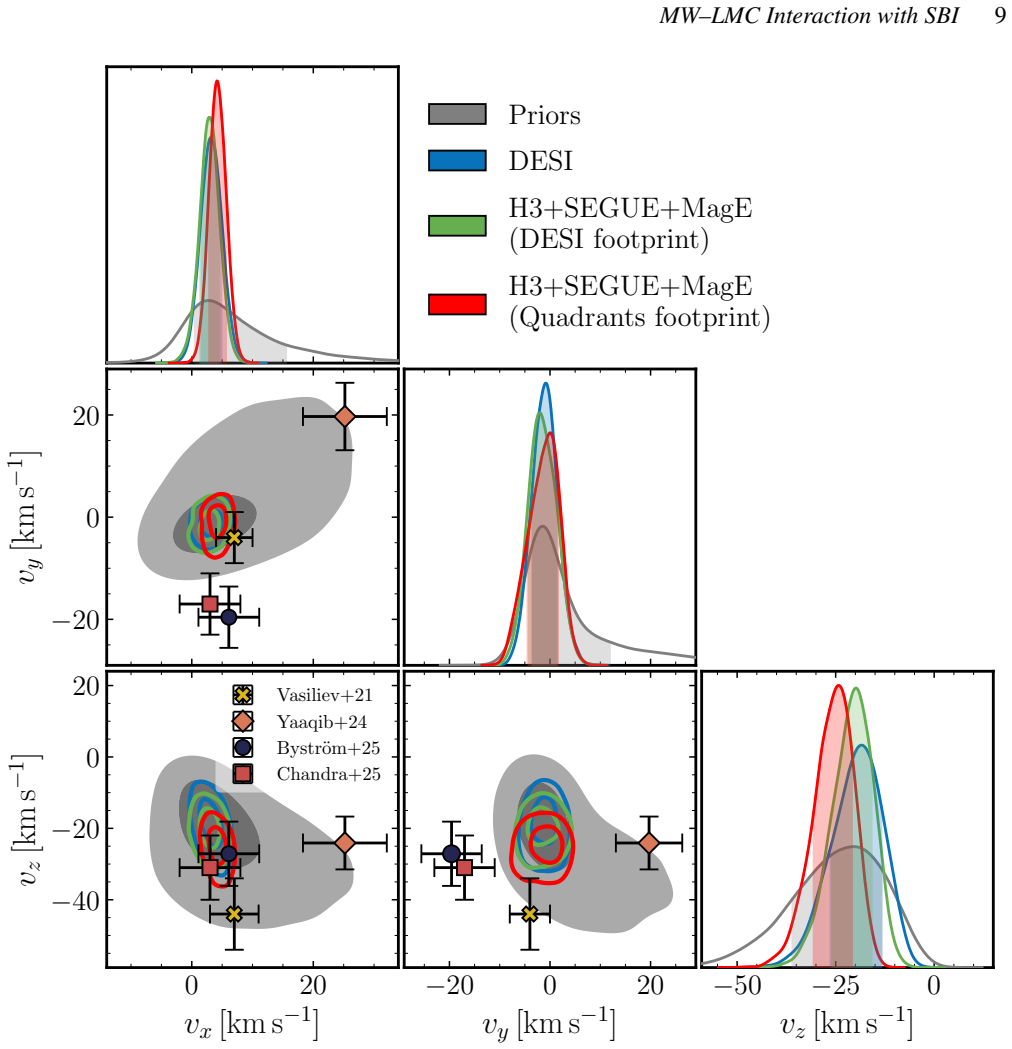
The authors report a distance-averaged reflex motion velocity of v_travel = 26.4^{+5.5}_{-4.4} km/s and an enclosed LMC mass of M_LMC(<50 kpc) = 9.2^{+1.9}_{-2.3} × 10^10 M_sun, using radial and tangential velocity data from the H3+SEGUE+MagE survey with on-sky quadrant footprints. They simultaneously find an enclosed MW mass of M_MW(<50 kpc) = 4.4^{+0.7}_{-0.7} × 10^11 M_sun. These values imply that the LMC's total mass is at least roughly 10–15% of the Milky Way's mass. The constraints are consistent whether radial velocities are used alone or together with tangential velocities, and the coverage tests validate the posterior distributions.
What carries the argument
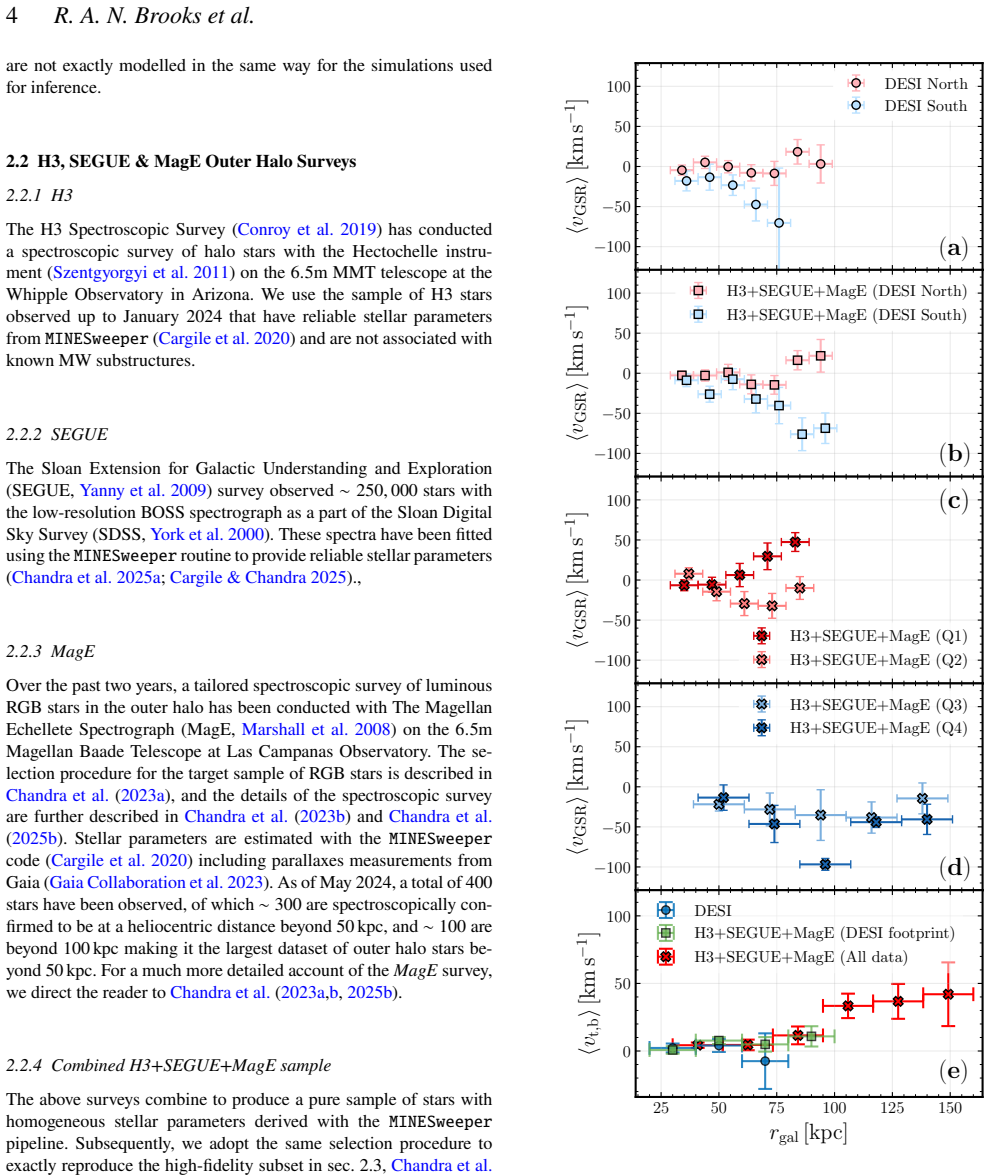
A neural density estimator (a masked autoregressive flow) trained on 128,000 rigid MW–LMC simulations. In each simulation, the MW stellar halo is represented by 20,000 particles, the MW and LMC are analytic potentials that move under mutual gravity plus Chandrasekhar dynamical friction, and the present-day halo velocities are integrated over the last 2.2 Gyr. The network learns the mapping from binned mean radial and tangential velocities of outer-halo stars to posterior distributions over enclosed masses, reflex-motion components, and the dynamical-friction strength.
Load-bearing premise
The rigid, non-self-gravitating simulation model (equilibrium Milky Way before infall, fixed stellar disk, Chandrasekhar dynamical friction) reproduces the observed outer-halo velocity field closely enough that model misspecification does not bias the inferred reflex velocity and LMC mass.
What would settle it
A measurement of the LMC's enclosed mass within 50 kpc from an independent tracer, such as the proper motions of its globular clusters or the timing argument, falling outside the quoted 9.2^{+1.9}_{-2.3} × 10^10 M_sun would directly contradict the central claim, as would a demonstration that the Q4 80–100 kpc radial-velocity outlier is a coherent substructure rather than a statistical fluke.
If this is right
- If the LMC is this massive, its gravitational influence on the Milky Way's dark matter halo and satellite population is substantial, and models of the MW's center-of-mass motion must account for the LMC's wake.
- The measured reflex velocity of about 26 km/s provides a direct kinematic anchor for the MW–LMC interaction, complementing constraints from stellar streams and the timing argument.
- At current measurement precision, tangential velocities add only marginal constraining power; upcoming proper-motion surveys should sharpen the constraints without requiring new simulations.
- The SBI framework is amortized: future outer-halo surveys can obtain parameter constraints by simply evaluating the trained flow on new velocity data.
Where Pith is reading between the lines
- The paper's own posterior predictive check shows the rigid model under-represents the northern quadrants (Q1/Q2) and misses the Q4 80–100 kpc radial-velocity point; if these residuals are real substructure rather than noise, the quoted v_travel could be biased, and rerunning the inference with a self-gravitating or deforming MW halo would be a natural test.
- Since the MW mass posterior closely tracks its prior, the binned mean velocities carry little information about the MW halo; extending the summary statistics to velocity dispersions or star-by-star likelihoods could break this degeneracy.
- If confirmed, this LMC mass strengthens the case that the LMC is a major perturber of the Local Group barycenter, so the MW's apparent acceleration and the orbits of dwarf galaxies should be re-evaluated in a frame tied to the MW–LMC barycenter.
Editorial analysis
A structured set of objections, weighed in public.
Referee Report
Summary. The paper presents a simulation-based inference (SBI) framework for the Milky Way–LMC interaction. Using 128,000 rigid, non-self-gravitating MW–LMC simulations, the authors train a neural posterior estimator on binned mean radial and tangential velocities of outer-halo stars, conditioned on DESI BHB and H3+SEGUE+MagE data. They report constraints on M_MW(<50 kpc), M_LMC(<50 kpc), the reflex-motion velocity components, and the dynamical friction strength. Their headline result uses H3+SEGUE+MagE data split into four on-sky quadrants and gives v_travel = 26.4^{+5.5}_{-4.4} km/s, M_LMC(<50 kpc) = 9.2^{+1.9}_{-2.3} x 10^10 M_sun, and M_MW(<50 kpc) = 4.4^{+0.7}_{-0.7} x 10^11 M_sun, from which they conclude the LMC total mass is at least approximately 10-15% of the Milky Way's mass. The posterior is validated with TARP coverage tests and posterior predictive checks.
Significance. If the methodology and results are accepted, the paper provides a fast, amortized inference framework for future outer-halo surveys and a new measurement of the LMC's gravitational influence on the Milky Way. The paper's strengths include the large simulation set (128,000), the explicit forward-modeling of survey-specific velocity uncertainties, and the inclusion of both TARP coverage calibration and posterior predictive checks in data space. The comparison across two datasets and several sky-footprint choices is also useful. However, the headline numbers rest on a rigid forward model that the paper's own PPC shows to be imperfect in precisely the bins that drive the quadrant result, and the MW mass posterior is explicitly prior-dominated. These issues need to be addressed before the quoted statistical intervals can be interpreted as complete uncertainty statements.
major comments (3)
- [§6.2, Fig. 8] The posterior predictive check for the headline quadrant analysis shows that the generated radial-velocity distributions systematically under-represent the observed Q1 and Q2 bins, and that the Q4 80-100 kpc point is inconsistent with the simulations. These bins are part of the exact data vector D_obs used to condition the posterior in Table 2, so this is not a peripheral residual but a misspecification of the forward model at the summary-statistic level. Because the abstract states 'Quoted uncertainties are statistical,' the reported 1-sigma intervals do not include any model-misspecification contribution. The paper should either quantify the potential bias (e.g., by performing inference on mock data generated from a higher-fidelity N-body simulation and comparing recovered parameters), add a model-discrepancy term, or explicitly weaken the headline claims to reflect that they are condi
- [§5.3.2 and Table 2] The LMC mass posterior for the quadrant case (9.2^{+1.9}_{-2.3} x 10^10 M_sun) is only modestly narrower than the adopted informative prior N(8.6, 2.9) x 10^10 M_sun, and the MW mass posterior (4.4 +/- 0.7) is essentially the prior (4.8 +/- 0.8). The paper itself states in §5.3.3 that the MW constraint is dominated by the prior. The 10-15% mass-ratio conclusion therefore depends heavily on the prior choices. The claim in §5.3.2 that a wide uninformative prior in Brooks et al. (2025) did not bias the LMC inference is not a substitute for performing the equivalent test with the current data vector and quadrant sky coverage. A wide-prior re-run for the quadrant setup, or an explicit quantitative demonstration of prior robustness, is needed to support the headline LMC mass and the mass-ratio statement.
- [§6.1 and §7.1] The TARP coverage test validates only that the neural density estimator correctly approximates the posterior of the forward model; it cannot detect whether the forward model is an adequate description of the observed data. The paper's own §7.1 lists several unmodeled effects—fixed disk, no self-gravity, equilibrium MW before infall, Chandrasekhar dynamical friction, and no non-uniform selection function—but none of these is propagated into the quoted uncertainties. This is especially important because the PPC failures in Fig. 8 are in the bins used for the headline result. The authors should either provide a quantitative robustness test (e.g., deforming N-body simulations as mock 'observations') or reframe the paper's results as model-conditional estimates with a clearly stated systematic error budget.
minor comments (4)
- [Table 2, H3+ DESI footprint row] The lower error on log lambda_DF is printed as -176; this appears to be a typo for -1.6. Please correct.
- [§6.2 and Fig. 7/8 captions] The text repeatedly writes 'PCC' where 'PPC' (posterior predictive check) is meant. Please fix.
- [§8, item (i)] Typo: 'on-sly quadrants' should be 'on-sky quadrants'.
- [§5.3.1] The comparison with literature values in Fig. 4 is clear, but the text could state more explicitly which posterior is used for the v_travel comparison in Fig. 5; the reader must infer it is the 'with v_t,b' quadrant case from Table 2.
Circularity Check
Two load-bearing validity claims rely on self-citation to Brooks et al. (2025); the SBI inference itself is not circular, but the reported MW-mass constraint is explicitly prior-dominated.
specific steps
-
self citation load bearing
[Sec. 1 (Introduction), paragraph following the SBI overview]
"In Brooks et al. (2025), we have previously shown for the MW-LMC system that inference on model parameters through an SBI framework trained on many, O(10^5), rigid simulations retains enough of the relevant physics that more complex simulations capture (e.g., deforming simulations, Garavito-Camargo et al. 2019) to avoid model misspecification and vastly improve the computational efficiency of the inference."
The key modeling assumption — that rigid, non-self-gravitating simulations are faithful enough to avoid model misspecification — is imported from the authors' own previous paper rather than established here. This assumption is load-bearing because every headline posterior is conditioned on these simulations. The current paper's PPC (Sec. 6.2, Fig. 8) shows the posterior-generated data under-represents Q1/Q2 and misses the Q4 80-100 kpc radial-velocity point, and Sec. 7.1 concedes that the fixed disc prevents separating reflex motion from internal halo motions. The TARP check (Sec. 6.1) only validates that the neural posterior matches the simulator, not that the simulator matches the Galaxy. Thus the central validity claim reduces to an unverified self-citation.
-
self citation load bearing
[Sec. 5.3.2 (The enclosed mass of the LMC)]
"Notably, the prior of the enclosed LMC mass could be biasing our results to agree with previous measurements. Yet, as shown in Brooks et al. (2025), adopting a wide uninformative prior instead of an informative Gaussian prior for the LMC mass did not bias our inference of the LMC mass. Therefore, we can take confidence that the choice of an informative prior is not significantly biasing the returned constraints in this work."
With prior M_LMC(<50 kpc) = N(8.6,2.9) x 10^10 Msun and posterior 9.2(+1.9,-2.3) x 10^10 Msun, the headline LMC mass overlaps the prior almost entirely. The only evidence that this is not prior pass-through is a statement about a different analysis in the authors' previous paper, Brooks et al. (2025), whose details are not reproduced here. This self-citation is doing the work of converting a prior-informed number into a claimed data-driven constraint.
-
other
[Sec. 5.3.3 (The enclosed mass of the Milky Way); Table 2 and abstract]
"For all constraints, the median and uncertainties are dominated the enclosed MW mass prior distribution. This implies that the radial and/or tangential velocity data points are not particularly constraining of the MW mass in this inference set-up."
The paper reports M_MW(<50 kpc)=4.4(+0.7,-0.7) x 10^11 Msun in the abstract, Table 2 and conclusions as one of its headline constraints, yet the text states this posterior is dominated by the N(4.8,0.8) x 10^11 Msun prior. The 'constraint' is therefore the input prior propagated through an essentially uninformative likelihood, not an inference from the outer-halo velocity data. Reporting it as a result is a prior-as-measurement reduction rather than an independent prediction.
full rationale
The core SBI machinery is not circular: the v_travel and M_LMC posteriors are obtained by training a neural density estimator on 128,000 rigid MW-LMC forward simulations and conditioning on observed binned radial and tangential velocities, which are not defined in terms of the target parameters. That part of the derivation chain is self-contained and independently checkable through the reported TARP coverage tests. However, two load-bearing claims are supported only by self-citation to Brooks et al. (2025), the authors' own prior work: (1) that rigid simulations 'avoid model misspecification,' and (2) that the informative LMC-mass prior does not bias the inference. The first is contradicted in tension by the paper's own posterior predictive check, which shows systematic under-representation of the northern quadrants and a failure at the Q4 80-100 kpc radial-velocity point; the TARP test cannot detect simulator bias. The second is important because the reported LMC-mass posterior (9.2 +/- ~2.1 x 10^10 Msun) is largely overlapping with its N(8.6,2.9) prior, so the self-citation is what turns a prior-informed number into a claimed constraint. Additionally, the MW enclosed mass is explicitly admitted to be prior-dominated, yet it is still presented in the abstract and conclusion among the headline results. These issues warrant a moderate circularity score: the central inference has independent content, but its most important validity defenses reduce to self-citation, and one reported 'constraint' is essentially the prior.
Axiom & Free-Parameter Ledger
free parameters (4)
- v_travel (reflex motion velocity) =
26.4^{+5.5}_{-4.4} km/s
- M_LMC(<50 kpc) =
9.2^{+1.9}_{-2.3} × 10^10 M_sun
- M_MW(<50 kpc) =
4.4^{+0.7}_{-0.7} × 10^11 M_sun
- log10 λ_DF =
-0.1^{+0.7}_{-1.6} (quadrant + vt,b)
axioms (7)
- domain assumption MW stellar halo is in dynamical equilibrium before the LMC infall; the only disequilibrium comes from the LMC.
- domain assumption LMC is on its first pericentric passage; no prior interactions matter.
- domain assumption Chandrasekhar dynamical friction with fixed σ_MW=120 km/s and Coulomb log ln(100 kpc/ε) describes the LMC orbital decay, modulated by scalar λ_DF.
- domain assumption The 128,000 rigid simulations are sufficient to avoid model misspecification, as argued in Brooks et al. (2025).
- ad hoc to paper Informative Gaussian priors on LMC and MW masses from previous literature do not dominate the posterior; the companion-paper test with a wide LMC prior transfers to this analysis.
- domain assumption Binned mean radial/tangential velocity summary statistics contain enough information for unbiased inference; star-by-star information is not required.
- domain assumption Survey selection functions are adequately modeled by sky footprint and distance cuts; non-uniform source density (e.g., DESI footprint edges) has negligible effect.
read the original abstract
The infall of the Large Magellanic Cloud (LMC) into the Milky Way (MW) has displaced the MW's centre of mass, manifesting as an observed reflex motion in the velocities of outer halo stars. We use a Simulation Based Inference framework to constrain properties of the MW, LMC and the induced reflex motion using the dynamics of outer MW halo stars. Specifically, we use the mean radial and tangential velocities of outer halo stars calculated in a set of distance and on-sky bins. We train neural networks to estimate parameter posterior distributions using a set of $128,000$ rigid MW--LMC simulations conditioned upon velocity data from the Dark Energy Spectroscopic Instrument (DESI) and the combined H3+SEGUE+MagE outer halo surveys. We constrain the reflex motion velocity and the enclosed LMC mass within $50 \, \rm kpc$ using the DESI or H3+SEGUE+MagE dataset while varying the survey sky coverage and depth. Using the radial and tangential velocity data from the H3+SEGUE+MagE survey and on-sky quadrants, we report a distance-averaged reflex motion velocity for the outer halo samples, the speed at which the MW lurches towards the LMC, of $v_{\rm{travel}} = 26.4^{+5.5}_{-4.4} \, \rm km \, \rm s^{-1}$, while simultaneously finding an enclosed LMC mass of $M_{\rm LMC}(< 50 \, \rm kpc) = 9.2^{+1.9}_{-2.3} \times 10^{10}\, \rm M_{\odot}$. Quoted uncertainties are statistical. Our results suggest that the LMC's total mass is at least $\approx 10-15 \%$ of that of the MW. This inference framework is flexible such that it can provide rapid constraints when applied to any future survey measuring the velocities of outer halo stars.
Figures




Forward citations
Cited by 2 Pith papers
-
LMC-induced Perturbations in the Milky Way Halo II: Bridging Field-level Inference and Summary-level Simulation-Based Inference
A field-level flow-matching likelihood shows the raw 6D halo phase-space distribution carries 2.5-9.9x more MW-LMC parameter information than velocity moments; adding BFE+MOPED summaries recovers much of this gap.
-
GSE vs. LMC: reshaping of radially biased stellar haloes by satellites
A highly radially anisotropic stellar halo, like Gaia Sausage-Enceladus, is reshaped by the LMC into a tilted triaxial distribution with overdensities matching the VOD and HAC.
Reference graph
Works this paper leans on
-
[1]
Alsing J., Wandelt B., 2019, @doi [ ] 10.1093/mnras/stz1900 , https://ui.adsabs.harvard.edu/abs/2019MNRAS.488.5093A 488, 5093
-
[2]
Alsing J., Wandelt B., Feeney S., 2018, @doi [ ] 10.1093/mnras/sty819 , https://ui.adsabs.harvard.edu/abs/2018MNRAS.477.2874A 477, 2874
-
[3]
Alsing J., Charnock T., Feeney S., Wandelt B., 2019, @doi [ ] 10.1093/mnras/stz1960 , https://ui.adsabs.harvard.edu/abs/2019MNRAS.488.4440A 488, 4440
-
[4]
Amarante J. A. S., Koposov S. E., Laporte C. F. P., 2024, @doi [arXiv e-prints] 10.48550/arXiv.2404.09825 , https://ui.adsabs.harvard.edu/abs/2024arXiv240409825A p. arXiv:2404.09825
work page internal anchor Pith review Pith/arXiv arXiv doi:10.48550/arxiv.2404.09825 2024
-
[5]
Arora A., Garavito-Camargo N., Sanderson R. E., Cunningham E. C., Wetzel A., Panithanpaisal N., Barry M., 2024, @doi [ ] 10.3847/1538-4357/ad7375 , https://ui.adsabs.harvard.edu/abs/2024ApJ...974..286A 974, 286
-
[6]
Astropy Collaboration et al., 2013, @doi [ ] 10.1051/0004-6361/201322068 , http://adsabs.harvard.edu/abs/2013A
-
[7]
Astropy Collaboration et al., 2018, @doi [ ] 10.3847/1538-3881/aabc4f , https://ui.adsabs.harvard.edu/abs/2018AJ....156..123A 156, 123
-
[8]
Astropy Collaboration et al., 2022, @doi [apj] 10.3847/1538-4357/ac7c74 , https://ui.adsabs.harvard.edu/abs/2022ApJ...935..167A 935, 167
-
[9]
Bairagi A., Wandelt B., Villaescusa-Navarro F., 2025, @doi [arXiv e-prints] 10.48550/arXiv.2503.13755 , https://ui.adsabs.harvard.edu/abs/2025arXiv250313755B p. arXiv:2503.13755
-
[10]
Belokurov V., Deason A. J., Erkal D., Koposov S. E., Carballo-Bello J. A., Smith M. C., Jethwa P., Navarrete C., 2019, @doi [ ] 10.1093/mnrasl/slz101 , https://ui.adsabs.harvard.edu/abs/2019MNRAS.488L..47B 488, L47
-
[11]
Benisty D., 2024, @doi [ ] 10.1051/0004-6361/202449884 , https://ui.adsabs.harvard.edu/abs/2024A&A...689L...1B 689, L1
-
[12]
Benisty D., Vasiliev E., Evans N. W., Davis A.-C., Hartl O. V., Strigari L. E., 2022, @doi [ ] 10.3847/2041-8213/ac5c42 , https://ui.adsabs.harvard.edu/abs/2022ApJ...928L...5B 928, L5
-
[13]
Bennett M., Bovy J., 2019, @doi [ ] 10.1093/mnras/sty2813 , https://ui.adsabs.harvard.edu/abs/2019MNRAS.482.1417B 482, 1417
-
[14]
Besla G., Kallivayalil N., Hernquist L., Robertson B., Cox T. J., van der Marel R. P., Alcock C., 2007, @doi [ ] 10.1086/521385 , https://ui.adsabs.harvard.edu/abs/2007ApJ...668..949B 668, 949
doi:10.1086/521385 2007
-
[15]
Besla G., Kallivayalil N., Hernquist L., van der Marel R. P., Cox T. J., Kere s D., 2010, @doi [ ] 10.1088/2041-8205/721/2/L97 , https://ui.adsabs.harvard.edu/abs/2010ApJ...721L..97B 721, L97
-
[16]
Binney J., Tremaine S., 2008, Galactic Dynamics: Second Edition
2008
-
[17]
Boylan-Kolchin M., Besla G., Hernquist L., 2011, @doi [ ] 10.1111/j.1365-2966.2011.18495.x , https://ui.adsabs.harvard.edu/abs/2011MNRAS.414.1560B 414, 1560
arXiv 2011
-
[18]
Brooks R. A. N., Sanders J. L., Dillamore A. M., Garavito-Camargo N., Price-Whelan A. M., 2025, @doi [arXiv e-prints] 10.48550/arXiv.2507.10667 , https://ui.adsabs.harvard.edu/abs/2025arXiv250710667B p. arXiv:2507.10667
-
[19]
Buch D., Nadler E. O., Wechsler R. H., Mao Y.-Y., 2024, @doi [arXiv e-prints] 10.48550/arXiv.2404.08043 , https://ui.adsabs.harvard.edu/abs/2024arXiv240408043B p. arXiv:2404.08043
-
[20]
Bystr \"o m A., et al., 2025, @doi [ ] 10.1093/mnras/staf1219 , https://ui.adsabs.harvard.edu/abs/2025MNRAS.542..560B 542, 560
-
[21]
Cargile P., Chandra V., 2025, The SEGUE-MINESweeper Catalog, @doi 10.5281/zenodo.16105186 , https://doi.org/10.5281/zenodo.16105186
-
[22]
Cargile P. A., Conroy C., Johnson B. D., Ting Y.-S., Bonaca A., Dotter A., Speagle J. S., 2020, @doi [ ] 10.3847/1538-4357/aba43b , https://ui.adsabs.harvard.edu/abs/2020ApJ...900...28C 900, 28
-
[23]
Cavieres M., et al., 2024, @doi [arXiv e-prints] 10.48550/arXiv.2410.00114 , https://ui.adsabs.harvard.edu/abs/2024arXiv241000114C p. arXiv:2410.00114
-
[24]
Chamberlain K., Price-Whelan A. M., Besla G., Cunningham E. C., Garavito-Camargo N., Pe \ n arrubia J., Petersen M. S., 2023, @doi [ ] 10.3847/1538-4357/aca01f , https://ui.adsabs.harvard.edu/abs/2023ApJ...942...18C 942, 18
-
[25]
Chandra V., et al., 2023a, @doi [ ] 10.3847/1538-4357/accf13 , https://ui.adsabs.harvard.edu/abs/2023ApJ...951...26C 951, 26
-
[26]
Chandra V., et al., 2023b, @doi [ ] 10.3847/1538-4357/acf7bf , https://ui.adsabs.harvard.edu/abs/2023ApJ...956..110C 956, 110
-
[27]
Chandra V., et al., 2025a, @doi [arXiv] 10.48550/arXiv.2508.00978 , https://ui.adsabs.harvard.edu/abs/2025arXiv250800978C p. arXiv:2508.00978
-
[28]
Chandra V., et al., 2025b, @doi [ApJ] 10.3847/1538-4357/addab6 , https://ui.adsabs.harvard.edu/abs/2025ApJ...988..156C 988, 156
-
[29]
Chandrasekhar S., 1943, @doi [ ] 10.1086/144517 , https://ui.adsabs.harvard.edu/abs/1943ApJ....97..255C 97, 255
doi:10.1086/144517 1943
-
[30]
Conroy C., et al., 2019, @doi [ ] 10.3847/1538-4357/ab38b8 , https://ui.adsabs.harvard.edu/abs/2019ApJ...883..107C 883, 107
-
[31]
P., Garavito-Camargo N., Besla G., Zaritsky D., Bonaca A., Johnson B
Conroy C., Naidu R. P., Garavito-Camargo N., Besla G., Zaritsky D., Bonaca A., Johnson B. D., 2021, @doi [ ] 10.1038/s41586-021-03385-7 , https://ui.adsabs.harvard.edu/abs/2021Natur.592..534C 592, 534
-
[32]
Cooper A. P., et al., 2023, @doi [ ] 10.3847/1538-4357/acb3c0 , https://ui.adsabs.harvard.edu/abs/2023ApJ...947...37C 947, 37
-
[33]
Correa Magnus L., Vasiliev E., 2022, @doi [ ] 10.1093/mnras/stab3726 , https://ui.adsabs.harvard.edu/abs/2022MNRAS.511.2610C 511, 2610
-
[34]
Cranmer K., Brehmer J., Louppe G., 2020, @doi [Proceedings of the National Academy of Science] 10.1073/pnas.1912789117 , https://ui.adsabs.harvard.edu/abs/2020PNAS..11730055C 117, 30055
-
[35]
Cunningham E. C., et al., 2020, @doi [ ] 10.3847/1538-4357/ab9b88 , https://ui.adsabs.harvard.edu/abs/2020ApJ...898....4C 898, 4
-
[36]
DESI Collaboration et al., 2016, @doi [arXiv e-prints] 10.48550/arXiv.1611.00036 , https://ui.adsabs.harvard.edu/abs/2016arXiv161100036D p. arXiv:1611.00036
-
[37]
DESI Collaboration et al., 2022, @doi [ ] 10.3847/1538-3881/ac882b , https://ui.adsabs.harvard.edu/abs/2022AJ....164..207D 164, 207
-
[38]
DESI Collaboration et al., 2025, @doi [arXiv e-prints] 10.48550/arXiv.2503.14745 , https://ui.adsabs.harvard.edu/abs/2025arXiv250314745D p. arXiv:2503.14745
-
[39]
Dehnen W., 1993, @doi [ ] 10.1093/mnras/265.1.250 , https://ui.adsabs.harvard.edu/abs/1993MNRAS.265..250D 265, 250
-
[40]
Eilers A.-C., Hogg D. W., Rix H.-W., Ness M. K., 2019, @doi [ ] 10.3847/1538-4357/aaf648 , https://ui.adsabs.harvard.edu/abs/2019ApJ...871..120E 871, 120
-
[42]
Erkal D., et al., 2019b, @doi [ ] 10.1093/mnras/stz1371 , https://ui.adsabs.harvard.edu/abs/2019MNRAS.487.2685E 487, 2685
-
[43]
Erkal D., et al., 2021, @doi [ ] 10.1093/mnras/stab1828 , https://ui.adsabs.harvard.edu/abs/2021MNRAS.506.2677E 506, 2677
-
[44]
Fearnhead P., Prangle D., 2010, @doi [arXiv e-prints] 10.48550/arXiv.1004.1112 , https://ui.adsabs.harvard.edu/abs/2010arXiv1004.1112F p. arXiv:1004.1112
-
[45]
Foote H. R., et al., 2023, @doi [ ] 10.3847/1538-4357/ace533 , https://ui.adsabs.harvard.edu/abs/2023ApJ...954..163F 954, 163
-
[46]
Foreman-Mackey D., 2016, @doi [The Journal of Open Source Software] 10.21105/joss.00024 , 1, 24
-
[47]
Fushimi K. J., Mosquera M. E., Dominguez M., 2024, @doi [ ] 10.1051/0004-6361/202347450 , https://ui.adsabs.harvard.edu/abs/2024A&A...688A.147F 688, A147
-
[48]
GRAVITY Collaboration et al., 2019, @doi [ ] 10.1051/0004-6361/201935656 , https://ui.adsabs.harvard.edu/abs/2019A&A...625L..10G 625, L10
-
[49]
Gaia Collaboration et al., 2018, @doi [ ] 10.1051/0004-6361/201832698 , https://ui.adsabs.harvard.edu/abs/2018A&A...616A..12G 616, A12
-
[50]
Gaia Collaboration et al., 2021, @doi [ ] 10.1051/0004-6361/202039588 , https://ui.adsabs.harvard.edu/abs/2021A&A...649A...7G 649, A7
-
[51]
Gaia Collaboration et al., 2023, @doi [ ] 10.1051/0004-6361/202243940 , https://ui.adsabs.harvard.edu/abs/2023A&A...674A...1G 674, A1
-
[52]
Garavito-Camargo N., Besla G., Laporte C. F. P., Johnston K. V., G \'o mez F. A., Watkins L. L., 2019, @doi [ ] 10.3847/1538-4357/ab32eb , https://ui.adsabs.harvard.edu/abs/2019ApJ...884...51G 884, 51
-
[54]
Garavito-Camargo N., Besla G., Laporte C. F. P., Price-Whelan A. M., Cunningham E. C., Johnston K. V., Weinberg M., G \'o mez F. A., 2021b, @doi [ ] 10.3847/1538-4357/ac0b44 , https://ui.adsabs.harvard.edu/abs/2021ApJ...919..109G 919, 109
-
[55]
Garavito-Camargo N., et al., 2024, @doi [ ] 10.3847/1538-4357/ad6e7e , https://ui.adsabs.harvard.edu/abs/2024ApJ...975..100G 975, 100
-
[56]
Grand R. J. J., et al., 2017, @doi [ ] 10.1093/mnras/stx071 , https://ui.adsabs.harvard.edu/abs/2017MNRAS.467..179G 467, 179
-
[57]
Grand R. J. J., Fragkoudi F., G \'o mez F. A., Jenkins A., Marinacci F., Pakmor R., Springel V., 2024, @doi [ ] 10.1093/mnras/stae1598 , https://ui.adsabs.harvard.edu/abs/2024MNRAS.532.1814G 532, 1814
-
[58]
R., et al., 2020, @doi [Nature] 10.1038/s41586-020-2649-2 , 585, 357
Harris C. R., et al., 2020, @doi [Nature] 10.1038/s41586-020-2649-2 , 585, 357
-
[59]
Hashimoto Y., Funato Y., Makino J., 2003, @doi [ ] 10.1086/344260 , https://ui.adsabs.harvard.edu/abs/2003ApJ...582..196H 582, 196
-
[60]
Heavens A. F., Sellentin E., Jaffe A. H., 2020, @doi [ ] 10.1093/mnras/staa2589 , https://ui.adsabs.harvard.edu/abs/2020MNRAS.498.3440H 498, 3440
-
[61]
Hermans J., Banik N., Weniger C., Bertone G., Louppe G., 2021, @doi [ ] 10.1093/mnras/stab2181 , https://ui.adsabs.harvard.edu/abs/2021MNRAS.507.1999H 507, 1999
-
[62]
Hernquist L., 1990, @doi [ ] 10.1086/168845 , https://ui.adsabs.harvard.edu/abs/1990ApJ...356..359H 356, 359
doi:10.1086/168845 1990
-
[63]
Hunt J. A. S., Vasiliev E., 2025, @doi [arXiv e-prints] 10.48550/arXiv.2501.04075 , https://ui.adsabs.harvard.edu/abs/2025arXiv250104075H p. arXiv:2501.04075
-
[64]
D., 2007, @doi [Computing in Science & Engineering] 10.1109/MCSE.2007.55 , 9, 90
Hunter J. D., 2007, @doi [Computing in Science & Engineering] 10.1109/MCSE.2007.55 , 9, 90
-
[65]
Jeffrey N., Alsing J., Lanusse F., 2021, @doi [ ] 10.1093/mnras/staa3594 , https://ui.adsabs.harvard.edu/abs/2021MNRAS.501..954J 501, 954
-
[66]
Jeffrey N., et al., 2025, @doi [ ] 10.1093/mnras/stae2629 , https://ui.adsabs.harvard.edu/abs/2025MNRAS.536.1303J 536, 1303
-
[67]
Jethwa P., Erkal D., Belokurov V., 2016, @doi [ ] 10.1093/mnras/stw1343 , https://ui.adsabs.harvard.edu/abs/2016MNRAS.461.2212J 461, 2212
-
[68]
Jimenez Rezende D., Mohamed S., 2015, @doi [arXiv e-prints] 10.48550/arXiv.1505.05770 , https://ui.adsabs.harvard.edu/abs/2015arXiv150505770J p. arXiv:1505.05770
-
[69]
Kallivayalil N., van der Marel R. P., Besla G., Anderson J., Alcock C., 2013, @doi [ ] 10.1088/0004-637X/764/2/161 , https://ui.adsabs.harvard.edu/abs/2013ApJ...764..161K 764, 161
-
[70]
Koposov S. E., et al., 2011, @doi [ ] 10.1088/0004-637X/736/2/146 , https://ui.adsabs.harvard.edu/abs/2011ApJ...736..146K 736, 146
-
[71]
Koposov S. E., et al., 2019, @doi [ ] 10.1093/mnras/stz457 , https://ui.adsabs.harvard.edu/abs/2019MNRAS.485.4726K 485, 4726
-
[72]
Koposov S. E., et al., 2023, @doi [ ] 10.1093/mnras/stad551 , https://ui.adsabs.harvard.edu/abs/2023MNRAS.521.4936K 521, 4936
-
[73]
Koposov S. E., et al., 2025, @doi [arXiv e-prints] 10.48550/arXiv.2505.14787 , https://ui.adsabs.harvard.edu/abs/2025arXiv250514787K p. arXiv:2505.14787
-
[74]
Kravtsov A., Winney S., 2024, @doi [arXiv e-prints] 10.48550/arXiv.2405.06017 , https://ui.adsabs.harvard.edu/abs/2024arXiv240506017K p. arXiv:2405.06017
work page internal anchor Pith review Pith/arXiv arXiv doi:10.48550/arxiv.2405.06017 2024
-
[75]
Lemos P., Jeffrey N., Whiteway L., Lahav O., Libeskind N., Hoffman Y., 2021, @doi [ ] 10.1103/PhysRevD.103.023009 , https://ui.adsabs.harvard.edu/abs/2021PhRvD.103b3009L 103, 023009
-
[76]
Lemos P., Coogan A., Hezaveh Y., Perreault-Levasseur L., 2023, @doi [40th International Conference on Machine Learning] 10.48550/arXiv.2302.03026 , https://ui.adsabs.harvard.edu/abs/2023PMLR..20219256L 202, 19256
-
[77]
Lilleengen S., et al., 2023, @doi [ ] 10.1093/mnras/stac3108 , https://ui.adsabs.harvard.edu/abs/2023MNRAS.518..774L 518, 774
-
[78]
Lilley E. J., Sanders J. L., Evans N. W., Erkal D., 2018a, @doi [ ] 10.1093/mnras/sty296 , https://ui.adsabs.harvard.edu/abs/2018MNRAS.476.2092L 476, 2092
-
[79]
Lilley E. J., Sanders J. L., Evans N. W., 2018b, @doi [ ] 10.1093/mnras/sty1038 , https://ui.adsabs.harvard.edu/abs/2018MNRAS.478.1281L 478, 1281
-
[80]
Lovell C. C., et al., 2024, @doi [arXiv e-prints] 10.48550/arXiv.2411.13960 , https://ui.adsabs.harvard.edu/abs/2024arXiv241113960L p. arXiv:2411.13960
-
[81]
130, Proceedings of The 24th International Conference on Artificial Intelligence and Statistics
Lueckmann J.-M., Boelts J., Greenberg D., Goncalves P., Macke J., 2021, in Banerjee A., Fukumizu K., eds, Proceedings of Machine Learning Research Vol. 130, Proceedings of The 24th International Conference on Artificial Intelligence and Statistics. PMLR, pp 343--351, https://proceedings.mlr.press/v130/lueckmann21a.html
2021
-
[82]
Majewski S. R., Skrutskie M. F., Weinberg M. D., Ostheimer J. C., 2003, @doi [ ] 10.1086/379504 , https://ui.adsabs.harvard.edu/abs/2003ApJ...599.1082M 599, 1082
doi:10.1086/379504 2003
discussion (0)
Sign in with ORCID, Apple, or X to comment. Anyone can read and Pith papers without signing in.