REVIEW 4 major objections 7 minor 26 references
Efficient Learning of A Unified Policy For Whole-body Manipulation and Locomotion Skills
T0 review · 4 major / 7 minor · reviewed 2026-08-06 · deepseek-v4-flash
Pith's one-line read A physical feasibility-guided reward, computed from the arm's kinematics, leads one reinforcement-learning policy to learn whole-body loco-manipulation without getting stuck in locomotion-first local optima.
desk verdict Useful reward-shaping idea with a real circularity problem in the headline metric; worth engaging for the hardware demos, but the workspace-expansion number is not independent evidence. read the letter →
The pith
A machine-rendered reading of the paper's core claim, the machinery that carries it, and where it could break.
The reading
What carries the argument
The load-bearing object is the physical feasibility-guided reward, defined by the feasible-state function $FS(s_{\text{torso}}, {}^W T)$, which is 1 exactly when an inverse-kinematics solver finds an arm joint configuration that places the end-effector at the target pose in the body frame. The paper strips the full-body model out of this check by expressing the target in the torso-dependent body frame, so only the arm's product-of-exponentials forward kinematics and a damped least-squares IK solver are needed. That boolean feasibility signal, added as a positive reward term $r_{\text{feasible}}$ with weight 0.16, is what biases exploration toward coordinated torso postures early in training. A cubic-polynomial command planner generates smooth reference trajectories in a body-projected coordinate system, which the paper argues reduces the learning burden of pose tracking while keeping trajectories within range as the robot moves.
What would settle it
Train the identical policy with the feasibility oracle changed from arm-only IK to a whole-body check that includes leg joint limits, contact constraints, and static balance for the commanded torso pose, keeping all reward weights and the command planner fixed; if the IK solution rate and 60th-percentile pose error do not worsen, the paper's claim that the arm-only kinematic model drives the improvement is falsified.
Extended reading notes
Core claim
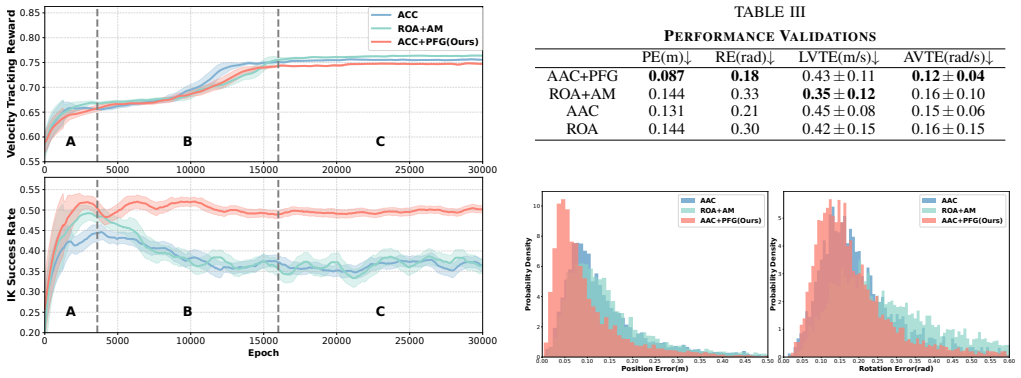
The central discovery is that the local-optima problem in whole-body loco-manipulation is, to a large degree, an exploration problem, and that a purely kinematic feasibility oracle can fix it. At each step the method checks whether, for the current torso pose, there exists an arm configuration $q_{\text{arm}} \in \Theta_{\text{arm}}$ such that the arm's forward kinematics reaches the target expressed in the torso frame, $FK_{\text{arm}}(q_{\text{arm}}) = {}^B T(s_{\text{torso}})$. The boolean $FS(s_{\text{torso}}, {}^W T)$ becomes a positive reward term, so the policy is rewarded for adopting torso postures that enlarge the arm's reach even before the arm can actually track the target. The paper reports that this reward keeps the inverse-kinematics solution rate stable during the phase when velocity-tracking rewards are growing, whereas the baselines see their IK solution rate drop from 43% to 37% in that phase. In the final evaluation the method reaches a 60th-percentile end-effector position error of 8.7 cm and rotation error of 0.18 rad, compared with 13.1-14.4 cm for the baselines, and the learned policy transfers zero-shot to the physical robot.
Load-bearing premise
The method assumes that an arm-only inverse-kinematics check on the body-relative target pose is a correct oracle for what the whole robot, including its legs, balance, and contacts, can actually reach.
Editorial extensions
If this is right
- A single actor network can output all 18 target joint positions for body and arm together, so no separate locomotion and manipulation controllers are needed for the demonstrated tasks.
- The PFG reward transfers across robots with different arm kinematics because it relies only on the arm's product-of-exponentials model, not on a hand-built whole-body model.
- Because the feasibility reward is always positive when the torso is useful, the policy keeps whole-body cooperative postures during the locomotion-learning phase, which is the mechanism the paper gives for avoiding local optima.
- The 34% workspace expansion, measured by IK solution rate, implies that substantially more end-effector targets are reachable through body cooperation than through the arm alone.
- The zero-shot hardware deployment supports the claim that the learned behavior, including adaptive body pitch during vertical arm movements, survives the sim-to-real gap under domain randomization.
Reading between the lines
- An implicit consequence of using an arm-only feasibility oracle is that the reward can be maximized by torso postures that the legs cannot actually hold; upgrading $FS$ to include leg joint limits, contact modes, and static balance would test whether the kinematic-only check is a lower or upper bound on the reported gains.
- The paper does not analyze how the always-positive feasibility reward distorts the value baseline; in principle it inflates the critic's value estimate in feasible regions, which could change exploration variance in ways unrelated to the geometric guidance.
- A natural distributional test would re-evaluate the 8.7 cm error on targets sampled densely near the ground and behind the torso, where the paper itself notes accuracy degrades; the headline percentile is defined over targets sampled from the arm's forward kinematics, so it is not a workspace-wide guarantee.
- Since the command planner and the PFG reward are introduced together, re-running the ablation with the planner removed, or with random waypoints, would isolate how much of the accuracy gain comes from smooth reference trajectories rather than from the feasibility signal.
Editorial analysis
A structured set of objections, weighed in public.
Referee Report
Summary. The paper proposes Physical Feasibility-Guided (PFG) reward shaping for training a unified reinforcement-learning policy for a quadruped robot with a manipulator. The key idea is to use an off-the-shelf arm inverse-kinematics solver as an oracle: if the current torso pose makes the arm's IK succeed for a given target, the policy receives a positive reward. This is intended to prevent the policy from abandoning whole-body cooperative postures (e.g., crouching) during early locomotion-focused optimization. The authors validate in simulation with PPO, comparing AAC+PFG against AAC and ROA+AM baselines, and report that PFG raises the IK solution rate by 34%, improves end-effector position/rotation error at the 60th percentile (0.087 m / 0.18 rad), and deploys zero-shot on a DeepRobotics X20-Z1 robot, with hardware experiments showing coordinated pitch/height tracking and velocity tracking.
Significance. If the claims held, the contribution would be a simple, portable way to inject kinematic priors into model-free RL for legged manipulators, with broad applicability. The hardware demonstrations (ribbon waving, object pickup, cart pushing) are a genuine strength, and the paper is clearly written. However, the central quantitative evidence is weakened by a circular evaluation: the headline workspace metric is the same quantity that the PFG reward optimizes. The evaluation also relies on an arm-only kinematic oracle and on target poses generated from the manipulator's forward kinematics, so the experiments do not yet independently establish that PFG expands the true whole-body workspace or avoids local optima. With an independent metric and appropriate caveats, the method could be a useful contribution.
major comments (4)
- [Section IV.A, Fig. 5, Eq. (2), Algorithm 1] The IK Solution Rate is the same feasibility condition used to define r_feasible in Table II. The PFG policy is rewarded exactly when FS(storso, W_T)=1, and the ablation metric reports the fraction of sampled targets for which the same damped-least-squares IK succeeds. The 34% workspace-expansion claim is therefore circular: it demonstrates that the policy increases the rewarded quantity, not that whole-body coordination improved. Please report an independent metric, such as the fraction of targets actually reached by the deployed end-effector within a tolerance, or a reachable-volume comparison computed with whole-body IK that includes leg joint limits and contact constraints.
- [Section IV.B, Table III] The performance evaluation uses 5000 target poses 'randomly generated based on the forward kinematics of the manipulator.' Because these targets are arm-reachable by construction, the improved PE/RE of AAC+PFG may reflect better tracking of arm-reachable targets rather than a genuinely expanded whole-body workspace. In addition, PE and RE are reported as single 60th-percentile values without error bars or number of seeds, so the comparison is not statistically grounded. Please evaluate on targets that are not filtered by the arm-only oracle and report variance over seeds.
- [Section III.B, Eq. (2)] The feasibility oracle eliminates the full-body model and checks only whether the arm IK can reach B_T(storso). It does not verify that the legs can realize storso or that the robot can maintain balance and contact. The motivating example in Section III.B (bending the front legs to reach a ground target) inherently depends on leg feasibility, so the PFG reward may systematically encourage torso postures that are not physically achievable. Please quantify the mismatch between the arm-only oracle and a whole-body reachability check, or at least discuss and bound this simplification.
- [Section IV.A, Fig. 5] The claim that PFG 'prevents convergence to local optima' is not directly supported. The comparison adds a reward term to the objective, so the observed Phase B drop in IK success for AAC and ROA+AM can be explained by a different reward trade-off rather than by a local optimum. To support the local-optima claim, show that a baseline with the same task rewards and comparable exploration converges to a strictly worse scalar objective, or provide additional diagnostics (e.g., multiple seeds, success-rate on the original task reward).
minor comments (7)
- [Throughout] Use 'AAC' consistently; Fig. 5 and some text use 'ACC'.
- [Section IV.A] Define how the 34% workspace expansion is computed from the IK solution rate, and whether the reported percentage is the final gap or an integral over training.
- [Section IV.B] Specify how the 5000 target poses are generated and whether they are filtered for arm reachability; the current wording is ambiguous.
- [Table III] Report the number of evaluation episodes/rollouts and include confidence intervals for PE and RE.
- [Algorithm 1, Table II] The notation is inconsistent ('ideal qt' vs 'ideal q(i)', 'kinematics max(...)'); please unify and define all symbols.
- [Section IV.A] There are typos such as 'velocoty tracking rewrad' and 'ACC' for 'AAC'; please proofread.
- [Title/Abstract] The title and abstract claim 'efficient learning,' but no wall-clock or sample-efficiency comparison with baselines is provided; consider adding such a comparison.
Circularity Check
The headline workspace-expansion metric is the PFG reward's own IK feasibility oracle, and the simulation test targets are arm-reachable by construction, so the central evidence partially reduces to the method's input.
-
self definitional
[Section IV-A (Ablation Studies) vs Section III-B/C]
"1. Inverse Kinematics(IK) Solution Rate: The command planner samples the end-effector’s target in real-time and calculates the proportion of successful inverse kinematics solutions during the training process. This metric reflects legged manipulator’s ability to achieve cooperative motion."
The PFG reward is defined by FS(storso,W_T)=1 iff the same damped least-squares arm-IK solver (Algorithm 1) finds qarm with FK_arm(qarm)=B_T(storso); Section III-C says r_feasible is awarded if and only if FS=1. The ablation metric 'IK Solution Rate' is therefore the empirical frequency of exactly the event that triggers the PFG reward. Reporting that AAC+PFG keeps this rate high while baselines drop restates that the policy was rewarded for that event; the paper's 'workspace by 34% (based on the IK solution rate)' conclusion is not independent evidence of whole-body coordination.
-
self definitional
[Section IV-B (Performance Validations)]
"In the simulation, 5000 target poses were randomly generated based on the forward kinematics of the manipulator."
Sampling targets from the manipulator's forward kinematics guarantees, by construction, that each target has a joint configuration qarm with FK_arm(qarm)=B_T, i.e. FS=1 in Eq. (2). The evaluation set is thus confined to the same arm-IK feasible set that the PFG reward and critic feature ('inverse kinematics solver status') are built on. Improved PE/RE on these arm-reachable targets cannot demonstrate that body-posture changes expanded the whole-body workspace; that claim rests entirely on the reward-identical IK solution rate.
full rationale
The central contribution is a reward-shaping term (PFG) built from an arm-IK feasibility oracle. The two main quantitative supports for the workspace-expansion claim are not independent of that oracle. First, the ablation metric 'IK Solution Rate' is the same feasibility test that defines the reward, so the observed 34% improvement is the policy optimizing its own reward signal. Second, the performance-validation targets are generated via the manipulator's forward kinematics, so they are arm-reachable by definition and do not test whether body posture extends reachability. Some independent evidence does exist: velocity-tracking rewards are roughly maintained, pose error on the generated targets is reported, and zero-shot real-robot demos are shown. These prevent the paper from being wholly circular; however, the load-bearing quantitative claim of 'expanding the workspace by 34%' reduces to the reward oracle's own output. The kinematic-only assumption in Eq. (2) (ignoring leg balance and contact constraints) is a modeling weakness rather than a circularity. No load-bearing self-citation chain was found. Score 6 reflects partial circularity in the headline evaluation, not total equivalence of method and result.
Assumptions & free parameters
free parameters (4)
- Reward weight set (Table II) =
w_feasible=0.16, w_linear=0.5, w_angular=0.3, w_pose=0.6, w_torque=-1.2e-5, etc.
- Feasible-state reward lower bound =
0.2
- IK convergence tolerance and iteration count =
e_t <= 0.001, max 10 iterations
- Command planner target sampling radius =
1.0 m sphere around body frame
assumptions (4)
- domain assumption Reachability of a target depends only on torso pose and manipulator kinematics, not on leg configuration or whole-body constraints.
- domain assumption Damped least-squares IK with 10 iterations and 0.001 threshold is a correct feasibility oracle.
- domain assumption Simulation with domain randomization transfers zero-shot to the real robot.
- standard math PPO with the specified observation spaces reliably optimizes this control problem.
Cite this review
Pith. "Pith review of Efficient Learning of A Unified Policy For Whole-body Manipulation and Locomotion Skills." pith.science (2026). https://pith.science/paper/ILYIZKUJ
@misc{pith2026250704229,
  author       = {Pith},
  title        = {Pith review of: Efficient Learning of A Unified Policy For Whole-body Manipulation and Locomotion Skills},
  year         = {2026},
  howpublished = {\url{https://pith.science/paper/ILYIZKUJ}},
  note         = {Machine review of arXiv:2507.04229}
}
read the original abstract
Equipping quadruped robots with manipulators provides unique loco-manipulation capabilities, enabling diverse practical applications. This integration creates a more complex system that has increased difficulties in modeling and control. Reinforcement learning (RL) offers a promising solution to address these challenges by learning optimal control policies through interaction. Nevertheless, RL methods often struggle with local optima when exploring large solution spaces for motion and manipulation tasks. To overcome these limitations, we propose a novel approach that integrates an explicit kinematic model of the manipulator into the RL framework. This integration provides feedback on the mapping of the body postures to the manipulator's workspace, guiding the RL exploration process and effectively mitigating the local optima issue. Our algorithm has been successfully deployed on a DeepRobotics X20 quadruped robot equipped with a Unitree Z1 manipulator, and extensive experimental results demonstrate the superior performance of this approach.
Figures


Figures from the paper (3 more)


Reference graph
Works this paper leans on
-
[1]
Alma-articulated locomotion and ma- nipulation for a torque-controllable robot,
C. D. Bellicoso, K. Kr ¨amer, M. St ¨auble, D. Sako, F. Jenelten, M. Bjelonic, and M. Hutter, “Alma-articulated locomotion and ma- nipulation for a torque-controllable robot,” in 2019 International conference on robotics and automation (ICRA) . IEEE, 2019, pp. 8477–8483
work page 2019
-
[2]
A unified mpc framework for whole-body dynamic locomotion and manipula- tion,
J.-P. Sleiman, F. Farshidian, M. V . Minniti, and M. Hutter, “A unified mpc framework for whole-body dynamic locomotion and manipula- tion,” IEEE Robotics and Automation Letters , vol. 6, no. 3, pp. 4688– 4695, 2021
work page 2021
-
[3]
Versatile multicontact planning and control for legged loco-manipulation,
J.-P. Sleiman, F. Farshidian, and M. Hutter, “Versatile multicontact planning and control for legged loco-manipulation,” Science Robotics, vol. 8, no. 81, p. eadg5014, 2023
work page 2023
-
[4]
Learning agile and dynamic motor skills for legged robots,
J. Hwangbo, J. Lee, A. Dosovitskiy, D. Bellicoso, V . Tsounis, V . Koltun, and M. Hutter, “Learning agile and dynamic motor skills for legged robots,” Science Robotics, vol. 4, no. 26, p. eaau5872, 2019
2019
-
[5]
Learning quadrupedal locomotion over challenging terrain,
J. Lee, J. Hwangbo, L. Wellhausen, V . Koltun, and M. Hutter, “Learning quadrupedal locomotion over challenging terrain,” Science robotics, vol. 5, no. 47, p. eabc5986, 2020
2020
-
[6]
Learning robust perceptive locomotion for quadrupedal robots in the wild,
T. Miki, J. Lee, J. Hwangbo, L. Wellhausen, V . Koltun, and M. Hutter, “Learning robust perceptive locomotion for quadrupedal robots in the wild,” Science robotics, vol. 7, no. 62, p. eabk2822, 2022
2022
-
[7]
Dtc: Deep tracking control,
F. Jenelten, J. He, F. Farshidian, and M. Hutter, “Dtc: Deep tracking control,” Science Robotics , vol. 9, no. 86, p. eadh5401, 2024
2024
-
[8]
Deep reinforcement learn- ing for robotic manipulation with asynchronous off-policy updates,
S. Gu, E. Holly, T. Lillicrap, and S. Levine, “Deep reinforcement learn- ing for robotic manipulation with asynchronous off-policy updates,” in 2017 IEEE international conference on robotics and automation (ICRA). IEEE, 2017, pp. 3389–3396
work page 2017
Show all 26 references
-
[9]
Scalable deep reinforcement learning for vision-based robotic manipulation,
D. Kalashnikov, et al. , “Scalable deep reinforcement learning for vision-based robotic manipulation,” in Conference on robot learning . PMLR, 2018, pp. 651–673
2018
-
[10]
A system for general in-hand object re-orientation,
T. Chen, J. Xu, and P. Agrawal, “A system for general in-hand object re-orientation,” in Conference on Robot Learning . PMLR, 2022, pp. 297–307
2022
-
[11]
Visual dexterity: In-hand reorientation of novel and complex object shapes,
T. Chen, M. Tippur, S. Wu, V . Kumar, E. Adelson, and P. Agrawal, “Visual dexterity: In-hand reorientation of novel and complex object shapes,” Science Robotics , vol. 8, no. 84, p. eadc9244, 2023
2023
-
[12]
Deep whole-body control: learning a unified policy for manipulation and locomotion,
Z. Fu, X. Cheng, and D. Pathak, “Deep whole-body control: learning a unified policy for manipulation and locomotion,” in Conference on Robot Learning . PMLR, 2023, pp. 138–149
2023
-
[13]
Learning force control for legged manipulation,
T. Portela, G. B. Margolis, Y . Ji, and P. Agrawal, “Learning force control for legged manipulation,” arXiv preprint arXiv:2405.01402 , 2024
2024 arXiv
-
[14]
Arm-constrained curriculum learning for loco-manipulation of a wheel-legged robot,
Z. Wang, Y . Jia, L. Shi, H. Wang, H. Zhao, X. Li, J. Zhou, J. Ma, and G. Zhou, “Arm-constrained curriculum learning for loco-manipulation of a wheel-legged robot,” in 2024 IEEE/RSJ International Conference on Intelligent Robots and Systems (IROS) . IEEE, 2024, pp. 10 770– 10 776
2024
-
[15]
Towards a multi-legged mobile manipulator,
B. U. Rehman, M. Focchi, J. Lee, H. Dallali, D. G. Caldwell, and C. Semini, “Towards a multi-legged mobile manipulator,” in 2016 IEEE International Conference on Robotics and Automation (ICRA) . IEEE, 2016, pp. 3618–3624
2016
-
[16]
Whole-body control for a torque-controlled legged mobile manipu- lator,
J. Li, H. Gao, Y . Wan, J. Humphreys, C. Peers, H. Yu, and C. Zhou, “Whole-body control for a torque-controlled legged mobile manipu- lator,” in Actuators, vol. 11, no. 11. MDPI, 2022, p. 304
2022
-
[17]
Teleoperating a legged manipulator through whole-body control,
J. Humphreys, C. Peers, J. Li, Y . Wan, J. Sun, R. Richardson, and C. Zhou, “Teleoperating a legged manipulator through whole-body control,” in Annual Conference Towards Autonomous Robotic Systems . Springer, 2022, pp. 63–77
2022
-
[18]
Combining learning-based locomotion policy with model-based manipulation for legged mobile manipulators,
Y . Ma, F. Farshidian, T. Miki, J. Lee, and M. Hutter, “Combining learning-based locomotion policy with model-based manipulation for legged mobile manipulators,” IEEE Robotics and Automation Letters , vol. 7, no. 2, pp. 2377–2384, 2022
2022
-
[19]
Proximal policy optimization algorithms,
J. Schulman, F. Wolski, P. Dhariwal, A. Radford, and O. Klimov, “Proximal policy optimization algorithms,” arXiv preprint arXiv:1707.06347, 2017
2017 arXiv
-
[20]
Asymmetric actor critic for image-based robot learning,
L. Pinto, M. Andrychowicz, P. Welinder, W. Zaremba, and P. Abbeel, “Asymmetric actor critic for image-based robot learning,” in 14th Robotics: Science and Systems, RSS 2018 . MIT Press Journals, 2018
2018
-
[21]
Learning arm-assisted fall damage reduction and recovery for legged mobile manipulators,
Y . Ma, F. Farshidian, and M. Hutter, “Learning arm-assisted fall damage reduction and recovery for legged mobile manipulators,” in 2023 IEEE International Conference on Robotics and Automation (ICRA). IEEE, 2023, pp. 12 149–12 155
2023
-
[22]
Robotic manipulators and the product of exponentials formula,
R. W. Brockett, “Robotic manipulators and the product of exponentials formula,” in Mathematical Theory of Networks and Systems: Proceed- ings of the MTNS-83 International Symposium Beer Sheva, Israel, June 20–24, 1983 . Springer, 2005, pp. 120–129
1983
-
[23]
General inverse kinematics with the error damped pseudoinverse,
S. K. Chan and P. D. Lawrence, “General inverse kinematics with the error damped pseudoinverse,” inProceedings. 1988 IEEE international conference on robotics and automation . IEEE, 1988, pp. 834–839
1988
-
[24]
Numerical method for inverse kine- matics using an extended angle-axis vector to avoid deadlock caused by joint limits,
M. Sekiguchi and N. Takesue, “Numerical method for inverse kine- matics using an extended angle-axis vector to avoid deadlock caused by joint limits,” Advanced Robotics , vol. 35, no. 15, pp. 919–926, 2021
2021
-
[25]
Manipulator differential kinematics: Part i: Kinematics, velocity, and applications,
J. Haviland and P. Corke, “Manipulator differential kinematics: Part i: Kinematics, velocity, and applications,” IEEE Robotics & Automation Magazine, 2023
2023
-
[26]
Per-contact iteration method for solving contact dynamics,
J. Hwangbo, J. Lee, and M. Hutter, “Per-contact iteration method for solving contact dynamics,” IEEE Robotics and Automation Letters , vol. 3, no. 2, pp. 895–902, 2018. [Online]. Available: www.raisim.com
2018
Reviewed August 6, 2026 · model on record in the stance chip above.
Discussion (0). Continue with ORCID to comment.