REVIEW 4 major objections 6 minor 66 references
FB-Diff: Fourier Basis-guided Diffusion for Temporal Interpolation of 4D Medical Imaging
T0 review · 4 major / 6 minor · reviewed 2026-08-06 · deepseek-v4-flash
Pith's one-line read FB-Diff interpolates 4D medical frames by conditioning a latent diffusion model on Fourier motion bases that merge learned physiological priors with case-specific spectral features, reporting better perceptual quality and temporal…
desk verdict FB-Diff is a real, bounded contribution for 4D medical VFI: the LPIPS gains over UVI-Net are credible, but FID/FVD are under-powered and the PSNR trade-off is spun. read the letter →
The pith
A machine-rendered reading of the paper's core claim, the machinery that carries it, and where it could break.
The reading
What carries the argument
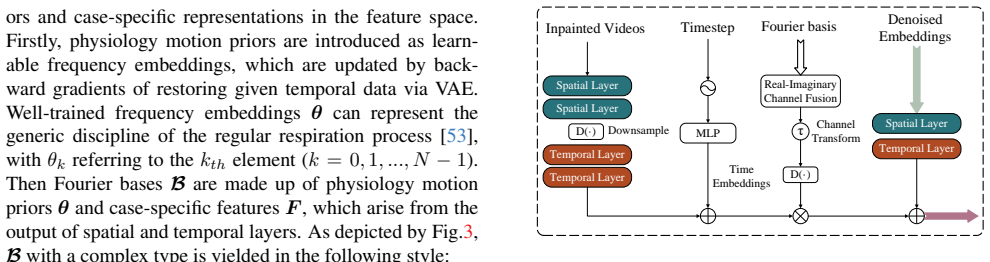
The Fourier motion operator $\mathcal{O}_{FM}$ builds a complex Fourier basis $B = M(\lVert \mathcal{O}_F(F)\rVert_2) e^{i U(\tau(\theta))}$ in the latent space of a VAE: the magnitude is derived from case-specific spectral features extracted by FFT, while the phase is set by learnable frequency embeddings $\theta$ that encode generic respiratory-motion patterns. A basis interaction operator then injects these bases, together with coarsely inpainted videos, into the latent diffusion UNet as conditional guidance, so that frequency-selective motion patterns steer the denoising of the intermediate frames.
What would settle it
Compute the dominant frequencies of the learned Fourier bases and compare them with independently measured breathing rates (roughly 0.2–0.33 Hz) or with the actual spectral content of the input frames; if the bases do not concentrate at respiratory-relevant frequencies, or if a variant that removes the FFT magnitude and uses only random frequencies produces no drop in performance, the central claim fails.
Extended reading notes
Core claim
FB-Diff resolves the medical video frame interpolation task by treating each temporal sequence as a quasi-periodic signal: the intermediate frames are generated by a denoising diffusion model conditioned on the two endpoint frames and on Fourier bases. The bases are produced in the VAE feature space, where the phase comes from learnable frequency embeddings (physiological motion priors) and the magnitude comes from the case-specific FFT of the input features; both are then adapted to the masked video domain before being injected into the diffusion model. The paper's reported result is that this conditioning yields state-of-the-art perceptual quality (LPIPS, FID, FVD) and better temporal consistency against the strong flow-based baseline UVI-Net, with competitive PSNR, and that the advantage grows on midmost frames where linear-motion assumptions fail most.
Load-bearing premise
The approach assumes the learned Fourier bases in the feature space really capture the quasi-periodic breathing frequencies with physiological meaning; if the learned embeddings are just fitted to training data without matching real respiratory spectra, the conditioning loses its claimed advantage over a generic learned feature.
Editorial extensions
If this is right
- On ACDC cardiac and 4D-Lung datasets, FB-Diff beats all ten baselines on perceptual metrics, including a 0.210 LPIPS and 5.3 FVD improvement over UVI-Net on ACDC.
- The hardest case, the midmost frame, shows the largest advantage: 4.3 better FID and 8.2 better FVD than UVI-Net, consistent with the claim that linear-motion assumptions fail centrally.
- Ablations show that both the learnable physiological priors and the Fourier bases are required: removing them lowers PSNR by up to 2.78 dB and increases LPIPS, and using fewer than 16 bases degrades performance.
- The approach transfers to cardiac ultrasound (EchoNet-Dynamic), where FB-Diff improves FVD over Voxelmorph, IFRNet, UVI-Net, and conditional diffusion baselines, although at a higher per-case inference cost (29.5 s versus 0.63 s for UVI-Net).
Reading between the lines
- If respiratory motion is genuinely quasi-periodic, the same phase-from-priors and magnitude-from-case decomposition could be applied to other cyclic medical motion (e.g., cardiac cycles) and to non-medical quasi-periodic video, with ECG or respiratory belts supplying the priors.
- The learned Fourier bases may serve as interpretable motion biomarkers: the visualizations show low-frequency bases highlighting static background and higher-frequency bases highlighting regional deformation boundaries, which could be used to localize abnormal motion.
- A direct test of the paper's premise would be to evaluate on patients with highly irregular breathing: if the quasi-periodicity assumption is doing the work, performance should degrade noticeably there relative to regular-breathing cases.
- The paper's claim that frequency conditioning beats linear flows could be stress-tested against a variant where Fourier bases are replaced by plain learned frequencies without the FFT magnitude; a gap there would prove the two-part construction matters.
Editorial analysis
A structured set of objections, weighed in public.
Referee Report
Summary. FB-Diff addresses temporal interpolation of 4D medical volumes by reformulating it as a frequency-domain conditioning problem. The paper introduces a Fourier motion operator that builds complex Fourier bases in a VAE latent space from learnable 'physiology motion priors' theta and case-specific FFT magnitude information, then adapts these bases through a masked-video inpainting stage and injects them into a latent diffusion model via a basis interaction operator. Experiments are reported on ACDC cardiac MRI and 4D-Lung CT, with additional generalization results on EchoNet cardiac ultrasound; the model is compared with ten baselines and achieves the lowest LPIPS, FID, and FVD in Table 1 while reporting PSNR values about 1.2-1.4 dB lower than UVI-Net. The paper claims SOTA perceptual performance and better temporal consistency due to nonlinear quasi-periodic motion modeling, and the code is released.
Significance. The contribution is potentially significant: a diffusion-based video frame interpolation model tailored to quasi-periodic medical motion, with an explicit mechanism for injecting spectral motion information, is a useful direction for 4D medical imaging. The paper has notable strengths: code release, comparisons against ten baselines, ablations of the main components, and a cross-modality generalization experiment. If the perceptual gains survive proper statistical evaluation, the method would be a credible SOTA for perceptual quality in this setting. However, the central claim currently rests on point estimates of FID and FVD without uncertainty quantification, and the reconstruction gap is larger than the text conveys.
major comments (4)
- [Section 4.2, Table 1] FID and FVD are reported as single point estimates for each model, with no confidence intervals, bootstrap uncertainty, repeated-seed variance, or significance tests. The test sets are small (30 cases for ACDC, 30 for 4D-Lung), and several differences are within what could plausibly be sampling noise: on 4D-Lung FB-Diff's FID (37.7) differs from UVI-Net's by 0.1, while its FVD advantage is 8.1; on ACDC the FID advantage is 1.5 and FVD 5.3. Because 'state-of-the-art perceptual performance' is the paper's central claim, this is load-bearing. Please report per-case or bootstrap distributions for FID and FVD, perform significance tests against UVI-Net, and ideally report multiple training seeds.
- [Section 4.2, Table 1 (Delta row)] FB-Diff's PSNR is 30.95 dB versus UVI-Net's 32.16 dB on ACDC (Delta = 1.21) and 30.18 versus 31.57 dB on 4D-Lung (Delta = 1.39), yet the text describes these as 'quite satisfactory' and 'promising.' A gap larger than 1 dB at this operating point is a material reconstruction degradation, and the phrase 'maintaining promising reconstruction metrics' understates it. The authors should quantify the trade-off explicitly, discuss whether the PSNR gap is acceptable for the intended clinical use, and temper or justify the claim.
- [Section 3.2, Eq. (4)] The 'physiology motion priors' theta are defined as learnable frequency embeddings trained by VAE reconstruction gradients, and the paper states that well-trained theta 'can represent the generic discipline of the regular respiration process.' No evidence links the optimized theta or the resulting Fourier bases to actual respiratory frequencies or to anatomical motion spectra. As written, theta is a learned latent code, and the claim that the bases encode physiologically meaningful motion is an unsupported interpretation. This matters because the paper's motivation is physiological quasi-periodicity rather than generic learned conditioning. Please validate the frequency content (for example, compare dominant basis frequencies with the temporal spectrum of the input volumes or with known respiratory rates) or add an ablation replacing theta with fixed analytical Fourier bases; otherwise, soften the physiological-prior terminology.
- [Section 4.3, Table 3] The ablations report only PSNR and LPIPS; FID and FVD are omitted. Since the paper's headline claim is perceptual SOTA, the ablations do not show which components drive the FID/FVD improvements. Adding FID and FVD, with the same uncertainty treatment requested for Table 1, would make the component analysis load-bearing rather than suggestive.
minor comments (6)
- [Abstract] The first sentence of the abstract contains a misplaced comma ('The temporal interpolation task for 4D medical imaging, plays a crucial role'); please fix the punctuation.
- [Section 3.2, Eq. (4)] The complex formulation would benefit from explicit dimension specifications for F, theta, tau(theta), U(tau(theta)), and M(.), so that the reader can see how the feature-space Fourier bases are broadcast across spatial and temporal axes.
- [Section 3.3, Eq. (6)] The notation theta-hat is introduced as 'well-trained general motions,' but it is unclear whether it is the same as the frozen theta from the VAE stage or a finetuned copy; please clarify the meaning of the hat and the copy/update relationship in Figure 2.
- [Table 2 caption] The sentence 'if the frame number N is odd, three intermediate frames are selected, otherwise only two frames are chosen' is ambiguous; if N is odd there is exactly one central frame, so please describe the actual selection rule.
- [Supplementary Table 5] The table is titled 'Model Efficiency' but its left half reports a generalization study on EchoNet-Dynamic; please separate or retitle the table, and clarify the units of FLOPs (T).
- [Section 4.4 and References] The phrase 'the most shadow layer' should read 'the most shallow layer', and reference [22] lacks a proper title and publisher in the bibliography; please complete the citation.
Circularity Check
No constructional circularity: the Fourier-basis conditioning is trained on data and evaluated on held-out test sets; the only circularity-adjacent element is a minor self-citation used to justify the physiological interpretation of the learned embeddings.
-
self citation load bearing
[Section 3.2, Eq. (4) context, paragraph after the Fourier Motion Operator definition]
"Well-trained frequency embeddings θ can represent the generic discipline of the regular respiration process [53], with θk referring to the kth element (k = 0, 1, ..., N− 1)."
Reference [53] is the authors' own SLORD vertebrae-segmentation paper, not a study establishing that learnable frequency embeddings encode respiratory physiology. The sentence uses this self-citation as the support for calling θ a physiological motion prior. The numerical interpolation claims do not reduce to this citation, since θ is simply trained on data and metrics are computed on held-out test cases, so this is a framing-level self-citation issue rather than a constructional circularity.
full rationale
The paper's derivation chain is a supervised learning pipeline rather than a first-principles prediction. Fourier bases B in Eq. (4) are computed from VAE features F and learnable embeddings θ, both optimized on training splits, and the reported metrics in Tables 1 and 2 are on held-out test cases (ACDC identities 121-150 and 4D-Lung 30 cases). During inference the conditioning inputs B_hat and V_hat are produced from only the starting and ending frames, so the interpolated outputs are not equal to the targets by construction. The feature refinement F_hat = F + σ(O_F^{-1}(B)) in Eq. (5) is a residual network operation, not a logical derivation of the prediction from the prediction itself. The only identified circularity-adjacent step is the self-citation [53] used to lend authority to the term 'physiological motion prior'; because the central empirical evaluation is independent of that label, the paper's main claim remains self-contained and not circular in a constructional sense.
Assumptions & free parameters
free parameters (3)
- Physiology motion priors θ (learnable frequency embeddings) =
learned during VAE training; exact values not reported
- Number of Fourier bases N_Fb =
16
- Channel transform τ, upsampling U, and conv mapping M in Fourier motion operator =
learned
assumptions (4)
- domain assumption Respiratory motion in 4D medical images is quasi-periodic with specific frequencies and can be decomposed into Fourier bases.
- ad hoc to paper Fourier bases computed in the VAE feature space correspond to anatomically meaningful motion patterns.
- ad hoc to paper Learned frequency embeddings θ encode a generic physiological motion prior shared across subjects.
- standard math Diffusion models conditioned on encoded start/end frames and Fourier bases can generate realistic intermediate frames.
Cite this review
Pith. "Pith review of FB-Diff: Fourier Basis-guided Diffusion for Temporal Interpolation of 4D Medical Imaging." pith.science (2026). https://pith.science/paper/O5O7Y2IO
@misc{pith2026250704547,
  author       = {Pith},
  title        = {Pith review of: FB-Diff: Fourier Basis-guided Diffusion for Temporal Interpolation of 4D Medical Imaging},
  year         = {2026},
  howpublished = {\url{https://pith.science/paper/O5O7Y2IO}},
  note         = {Machine review of arXiv:2507.04547}
}
read the original abstract
The temporal interpolation task for 4D medical imaging, plays a crucial role in clinical practice of respiratory motion modeling. Following the simplified linear-motion hypothesis, existing approaches adopt optical flow-based models to interpolate intermediate frames. However, realistic respiratory motions should be nonlinear and quasi-periodic with specific frequencies. Intuited by this property, we resolve the temporal interpolation task from the frequency perspective, and propose a Fourier basis-guided Diffusion model, termed FB-Diff. Specifically, due to the regular motion discipline of respiration, physiological motion priors are introduced to describe general characteristics of temporal data distributions. Then a Fourier motion operator is elaborately devised to extract Fourier bases by incorporating physiological motion priors and case-specific spectral information in the feature space of Variational Autoencoder. Well-learned Fourier bases can better simulate respiratory motions with motion patterns of specific frequencies. Conditioned on starting and ending frames, the diffusion model further leverages well-learned Fourier bases via the basis interaction operator, which promotes the temporal interpolation task in a generative manner. Extensive results demonstrate that FB-Diff achieves state-of-the-art (SOTA) perceptual performance with better temporal consistency while maintaining promising reconstruction metrics. Codes are available.
Figures


Figures from the paper (6 more)


Reference graph
Works this paper leans on
-
[54]
Temporal Differential Fields for 4D Motion Modeling via Image-to-Video Synthesis
Xin You, Minghui Zhang, Hanxiao Zhang, Jie Yang, and Nassir Navab. Temporal differential fields for 4d mo- tion modeling via image-to-video synthesis. arXiv preprint arXiv:2505.17333, 2025. 6
work page Pith review arXiv 2025
-
[1]
Condi- tional diffusion model for versatile temporal inpainting in 4d cerebral ct perfusion imaging
Juyoung Bae, Elizabeth Tong, and Hao Chen. Condi- tional diffusion model for versatile temporal inpainting in 4d cerebral ct perfusion imaging. In MICCAI, pages 67–77. Springer, 2024. 4
work page 2024
-
[2]
V oxelmorph: a learning framework for deformable medical image registration
Guha Balakrishnan, Amy Zhao, Mert R Sabuncu, John Gut- tag, and Adrian V Dalca. V oxelmorph: a learning framework for deformable medical image registration. IEEE transac- tions on medical imaging, 38(8):1788–1800, 2019. 1, 6, 7
work page 2019
-
[3]
Wenbo Bao, Wei-Sheng Lai, Xiaoyun Zhang, Zhiyong Gao, and Ming-Hsuan Yang. Memc-net: Motion estimation and motion compensation driven neural network for video inter- polation and enhancement. IEEE transactions on pattern analysis and machine intelligence, 43(3):933–948, 2019. 3
work page 2019
-
[4]
Olivier Bernard, Alain Lalande, Clement Zotti, Freder- ick Cervenansky, Xin Yang, Pheng-Ann Heng, Irem Cetin, Karim Lekadir, Oscar Camara, Miguel Angel Gonzalez Ballester, et al. Deep learning techniques for automatic mri cardiac multi-structures segmentation and diagnosis: is the problem solved? IEEE transactions on medical imaging, 37 (11):2514–2525, 2018. 6
work page 2018
-
[5]
4dct and vmat for lung patients with irregular breathing
Rhydian Caines, Naomi K Sisson, and Carl G Rowbottom. 4dct and vmat for lung patients with irregular breathing. Journal of Applied Clinical Medical Physics , 23(1):e13453,
-
[6]
Transmorph: Transformer for unsuper- vised medical image registration
Junyu Chen, Eric C Frey, Yufan He, William P Segars, Ye Li, and Yong Du. Transmorph: Transformer for unsuper- vised medical image registration. Medical image analysis , 82:102615, 2022. 6
work page 2022
-
[7]
Ultrasound image-to-video synthesis via latent dynamic diffusion mod- els
Tingxiu Chen, Yilei Shi, Zixuan Zheng, Bingcong Yan, Jingliang Hu, Xiao Xiang Zhu, and Lichao Mou. Ultrasound image-to-video synthesis via latent dynamic diffusion mod- els. In MICCAI, pages 764–774. Springer, 2024. 4, 6
work page 2024
Show all 66 references
-
[8]
Channel attention is all you need for video frame interpolation
Myungsub Choi, Heewon Kim, Bohyung Han, Ning Xu, and Kyoung Mu Lee. Channel attention is all you need for video frame interpolation. In AAAI, pages 10663–10671, 2020. 3
2020
-
[9]
Motion-aware dynamic architecture for ef- ficient frame interpolation
Myungsub Choi, Suyoung Lee, Heewon Kim, and Ky- oung Mu Lee. Motion-aware dynamic architecture for ef- ficient frame interpolation. In Proceedings of the IEEE/CVF International Conference on Computer Vision, pages 13839– 13848, 2021. 3
2021
-
[10]
Ldmvfi: Video frame interpolation with latent diffusion models
Duolikun Danier, Fan Zhang, and David Bull. Ldmvfi: Video frame interpolation with latent diffusion models. InProceed- ings of the AAAI Conference on Artificial Intelligence, pages 1472–1480, 2024. 1, 4, 6
2024
-
[11]
Flownet: Learning optical flow with convolutional networks
Alexey Dosovitskiy, Philipp Fischer, Eddy Ilg, Philip Hausser, Caner Hazirbas, Vladimir Golkov, Patrick Van Der Smagt, Daniel Cremers, and Thomas Brox. Flownet: Learning optical flow with convolutional networks. InICCV, pages 2758–2766, 2015. 3
2015
-
[12]
4D modeling and esti- mation of respiratory motion for radiation therapy
Jan Ehrhardt, Cristian Lorenz, et al. 4D modeling and esti- mation of respiratory motion for radiation therapy. Springer,
-
[13]
A spatiotemporal volumetric interpolation network for 4d dynamic medical image
Yuyu Guo, Lei Bi, Euijoon Ahn, Dagan Feng, Qian Wang, and Jinman Kim. A spatiotemporal volumetric interpolation network for 4d dynamic medical image. In CVPR, pages 4726–4735, 2020. 1, 4, 6, 7
2020
-
[14]
Gans trained by a two time-scale update rule converge to a local nash equilib- rium
Martin Heusel, Hubert Ramsauer, Thomas Unterthiner, Bernhard Nessler, and Sepp Hochreiter. Gans trained by a two time-scale update rule converge to a local nash equilib- rium. NeurIPS, 30, 2017. 6
2017
-
[15]
Denoising dif- fusion probabilistic models
Jonathan Ho, Ajay Jain, and Pieter Abbeel. Denoising dif- fusion probabilistic models. Advances in neural information processing systems, 33:6840–6851, 2020. 2, 4, 7
2020
-
[16]
Video dif- fusion models
Jonathan Ho, Tim Salimans, Alexey Gritsenko, William Chan, Mohammad Norouzi, and David J Fleet. Video dif- fusion models. NeurIPS, 35:8633–8646, 2022. 2, 4, 6
2022
-
[17]
Magnetic resonance derived my- ocardial strain assessment using feature tracking
Kan N Hor, Rolf Baumann, Gianni Pedrizzetti, Gianni Tonti, William M Gottliebson, Michael Taylor, D Woodrow Ben- son, and Wojciech Mazur. Magnetic resonance derived my- ocardial strain assessment using feature tracking. Journal of visualized experiments: JoVE, (48):2356, 2011. 1
2011
-
[18]
Image quality metrics: Psnr vs
Alain Hore and Djemel Ziou. Image quality metrics: Psnr vs. ssim. In 2010 20th international conference on pattern recognition, pages 2366–2369. IEEE, 2010. 6
2010
-
[19]
Spatial-temporal space hand-in- hand: Spatial-temporal video super-resolution via cycle- projected mutual learning
Mengshun Hu, Kui Jiang, Liang Liao, Jing Xiao, Junjun Jiang, and Zheng Wang. Spatial-temporal space hand-in- hand: Spatial-temporal video super-resolution via cycle- projected mutual learning. In Proceedings of the IEEE/CVF conference on computer vision and pattern recognition...
2022
-
[20]
Iq-vfi: Implicit quadratic motion es- timation for video frame interpolation
Mengshun Hu, Kui Jiang, Zhihang Zhong, Zheng Wang, and Yinqiang Zheng. Iq-vfi: Implicit quadratic motion es- timation for video frame interpolation. In Proceedings of the IEEE/CVF Conference on Computer Vision and Pattern Recognition, pages 6410–6419, 2024. 3 9
2024
-
[21]
Real-time intermediate flow estimation for video frame interpolation
Zhewei Huang, Tianyuan Zhang, Wen Heng, Boxin Shi, and Shuchang Zhou. Real-time intermediate flow estimation for video frame interpolation. In European Conference on Com- puter Vision, pages 624–642. Springer, 2022. 3
2022
-
[22]
Data from 4d lung imaging of nsclc patients
Geoffrey D Hugo, Elisabeth Weiss, William C Sleeman, Salim Balik, Paul J Keall, Jun Lu, and Jeffrey F Williamson. Data from 4d lung imaging of nsclc patients. (No Title),
-
[23]
Flownet 2.0: Evolu- tion of optical flow estimation with deep networks
Eddy Ilg, Nikolaus Mayer, Tonmoy Saikia, Margret Keuper, Alexey Dosovitskiy, and Thomas Brox. Flownet 2.0: Evolu- tion of optical flow estimation with deep networks. InCVPR, pages 2462–2470, 2017. 3
2017
-
[24]
Video interpolation with diffusion models
Siddhant Jain, Daniel Watson, Eric Tabellion, Ben Poole, Janne Kontkanen, et al. Video interpolation with diffusion models. In CVPR, pages 7341–7351, 2024. 1, 4, 6, 7
2024
-
[25]
Myocardial tag- ging with mr imaging: overview of normal and pathologic findings
Mi-Young Jeung, Philippe Germain, et al. Myocardial tag- ging with mr imaging: overview of normal and pathologic findings. Radiographics, 32(5):1381–1398, 2012. 1
2012
-
[26]
Super slomo: High quality estimation of multiple intermediate frames for video interpolation
Huaizu Jiang, Deqing Sun, Varun Jampani, Ming-Hsuan Yang, Erik Learned-Miller, and Jan Kautz. Super slomo: High quality estimation of multiple intermediate frames for video interpolation. In Proceedings of the IEEE/CVF Con- ference on Computer Vision and Pattern Recognition, p...
2018
-
[27]
A unified pyramid recurrent network for video frame interpolation
Xin Jin, Longhai Wu, Jie Chen, Youxin Chen, Jayoon Koo, and Cheul-hee Hahm. A unified pyramid recurrent network for video frame interpolation. In CVPR, pages 1578–1587,
-
[28]
Flavr: Flow-agnostic video representations for fast frame interpolation
Tarun Kalluri, Deepak Pathak, Manmohan Chandraker, and Du Tran. Flavr: Flow-agnostic video representations for fast frame interpolation. In Proceedings of the IEEE/CVF winter conference on applications of computer vision, pages 2071– 2082, 2023. 3
2023
-
[29]
Diffusion deformable model for 4d temporal medical image generation
Boah Kim and Jong Chul Ye. Diffusion deformable model for 4d temporal medical image generation. In MICCAI, pages 539–548. Springer, 2022. 1, 4, 6, 7
2022
-
[30]
Data-efficient unsupervised interpolation without any intermediate frame for 4d medical images
JungEun Kim, Hangyul Yoon, Geondo Park, Kyungsu Kim, and Eunho Yang. Data-efficient unsupervised interpolation without any intermediate frame for 4d medical images. In CVPR, pages 11353–11364, 2024. 1, 4, 6, 7
2024
-
[31]
Ifrnet: Intermediate feature refine network for efficient frame interpolation
Lingtong Kong, Boyuan Jiang, Donghao Luo, Wenqing Chu, Xiaoming Huang, Ying Tai, Chengjie Wang, and Jie Yang. Ifrnet: Intermediate feature refine network for efficient frame interpolation. In Proceedings of the IEEE/CVF Conference on Computer Vision and Pattern Recognition , p...
1969
-
[32]
Cpt-interp: Continuous spa- tial and temporal motion modeling for 4d medical image in- terpolation
Xia Li, Runzhao Yang, Xiangtai Li, Antony Lomax, Ye Zhang, and Joachim Buhmann. Cpt-interp: Continuous spa- tial and temporal motion modeling for 4d medical image in- terpolation. arXiv preprint arXiv:2405.15385, 2024. 2
2024 arXiv
-
[33]
Amt: All-pairs multi-field transforms for efficient frame interpolation
Zhen Li, Zuo-Liang Zhu, Ling-Hao Han, Qibin Hou, Chun- Le Guo, and Ming-Ming Cheng. Amt: All-pairs multi-field transforms for efficient frame interpolation. In CVPR, pages 9801–9810, 2023. 3
2023
-
[34]
Diffusion4d: Fast spatial-temporal consis- tent 4d generation via video diffusion models.arXiv preprint arXiv:2405.16645, 2024
Hanwen Liang, Yuyang Yin, Dejia Xu, Hanxue Liang, Zhangyang Wang, Konstantinos N Plataniotis, Yao Zhao, and Yunchao Wei. Diffusion4d: Fast spatial-temporal consis- tent 4d generation via video diffusion models.arXiv preprint arXiv:2405.16645, 2024. 4
2024 arXiv
-
[35]
Sora: A review on background, technology, limitations, and opportunities of large vision models
Yixin Liu, Kai Zhang, Yuan Li, Zhiling Yan, Chujie Gao, Ruoxi Chen, Zhengqing Yuan, Yue Huang, Hanchi Sun, Jian- feng Gao, et al. Sora: A review on background, technology, limitations, and opportunities of large vision models. arXiv preprint arXiv:2402.17177, 2024. 2, 4
2024 arXiv
-
[36]
Video frame interpolation with transformer
Liying Lu, Ruizheng Wu, Huaijia Lin, Jiangbo Lu, and Jiaya Jia. Video frame interpolation with transformer. In CVPR, pages 3532–3542, 2022. 3
2022
-
[37]
Phasenet for video frame interpolation
Simone Meyer, Abdelaziz Djelouah, Brian McWilliams, Alexander Sorkine-Hornung, Markus Gross, and Christo- pher Schroers. Phasenet for video frame interpolation. In Proceedings of the IEEE/CVF Conference on Computer Vi- sion and Pattern Recognition, pages 498–507, 2018. 1
2018
-
[38]
Preoperative evaluation of pleural adhesion in patients with lung tumors using four- dimensional computed tomography performed during natu- ral breathing
Kotaro Mizuno and Masahiro Muto. Preoperative evaluation of pleural adhesion in patients with lung tumors using four- dimensional computed tomography performed during natu- ral breathing. Medicine, 100(47):e27800, 2021. 1
2021
-
[39]
Softmax splatting for video frame interpolation
Simon Niklaus and Feng Liu. Softmax splatting for video frame interpolation. In Proceedings of the IEEE/CVF con- ference on computer vision and pattern recognition , pages 5437–5446, 2020. 1
2020
-
[40]
Video-based ai for beat-to-beat assessment of cardiac func- tion
David Ouyang, Bryan He, Amirata Ghorbani, Neal Yuan, Joseph Ebinger, Curtis P Langlotz, Paul A Heidenreich, Robert A Harrington, David H Liang, Euan A Ashley, et al. Video-based ai for beat-to-beat assessment of cardiac func- tion. Nature, 580(7802):252–256, 2020. 1
2020
-
[41]
Biformer: Learning bilateral motion estimation via bilateral trans- former for 4k video frame interpolation
Junheum Park, Jintae Kim, and Chang-Su Kim. Biformer: Learning bilateral motion estimation via bilateral trans- former for 4k video frame interpolation. In CVPR, pages 1568–1577, 2023. 1, 3
2023
-
[42]
Mednext: transformer-driven scal- ing of convnets for medical image segmentation
Saikat Roy, Gregor Koehler, Constantin Ulrich, Michael Baumgartner, Jens Petersen, Fabian Isensee, Paul F Jaeger, and Klaus H Maier-Hein. Mednext: transformer-driven scal- ing of convnets for medical image segmentation. InMICCAI, pages 405–415. Springer, 2023. 1
2023
-
[43]
Myocardial strain imaging: how use- ful is it in clinical decision making? European heart journal, 37(15):1196–1207, 2016
Otto A Smiseth, Hans Torp, Anders Opdahl, Kristina H Hau- gaa, and Stig Urheim. Myocardial strain imaging: how use- ful is it in clinical decision making? European heart journal, 37(15):1196–1207, 2016. 1
2016
-
[44]
Pwc-net: Cnns for optical flow using pyramid, warping, and cost volume
Deqing Sun, Xiaodong Yang, Ming-Yu Liu, and Jan Kautz. Pwc-net: Cnns for optical flow using pyramid, warping, and cost volume. In CVPR, pages 8934–8943, 2018. 3
2018
-
[45]
Raft: Recurrent all-pairs field transforms for optical flow
Zachary Teed and Jia Deng. Raft: Recurrent all-pairs field transforms for optical flow. In ECCV, pages 402–419. Springer, 2020. 3
2020
-
[46]
Fourier series
Georgi P Tolstov. Fourier series. Courier Corporation, 2012. 2, 4
2012
-
[47]
To- wards accurate generative models of video: A new metric & challenges
Thomas Unterthiner, Sjoerd Van Steenkiste, Karol Kurach, Raphael Marinier, Marcin Michalski, and Sylvain Gelly. To- wards accurate generative models of video: A new metric & challenges. arXiv preprint arXiv:1812.01717, 2018. 6
2018 arXiv
-
[48]
Lu Wang, Shelly Hayes, Kamen Paskalev, Lihui Jin, Mark K Buyyounouski, Charlie C-M Ma, and Steve Feigenberg. Dosimetric comparison of stereotactic body radiotherapy us- ing 4d ct and multiphase ct images for treatment planning of 10 lung cancer: evaluation of the impact on dai...
2009
-
[49]
Sea-raft: Simple, efficient, accurate raft for optical flow
Yihan Wang, Lahav Lipson, and Jia Deng. Sea-raft: Simple, efficient, accurate raft for optical flow. In ECCV, pages 36–
-
[50]
Mpvf: 4d medical image inpainting by multi-pyramid voxel flows
Tzu-Ti Wei, Chin Kuo, Yu-Chee Tseng, and Jen-Jee Chen. Mpvf: 4d medical image inpainting by multi-pyramid voxel flows. IEEE Journal of Biomedical and Health Informatics,
-
[51]
Semantic difference guidance for the uncertain boundary segmentation of ct left atrial appendage
Xin You, Ming Ding, Minghui Zhang, Yangqian Wu, Yi Yu, Yun Gu, and Jie Yang. Semantic difference guidance for the uncertain boundary segmentation of ct left atrial appendage. In MICCAI, pages 121–131. Springer, 2023. 1
2023
-
[52]
Learning with explicit shape priors for medical image segmentation
Xin You, Junjun He, Jie Yang, and Yun Gu. Learning with explicit shape priors for medical image segmentation. IEEE Transactions on Medical Imaging, 2024. 6
2024
-
[53]
Slord: Structural low-rank descriptors for shape consistency in vertebrae segmentation
Xin You, Yixin Lou, Minghui Zhang, Jie Yang, and Yun Gu. Slord: Structural low-rank descriptors for shape consistency in vertebrae segmentation. IEEE Journal of Biomedical and Health Informatics, 2025. 5
2025
-
[55]
Pass: test-time prompting to adapt styles and se- mantic shapes in medical image segmentation
Chuyan Zhang, Hao Zheng, Xin You, Yefeng Zheng, and Yun Gu. Pass: test-time prompting to adapt styles and se- mantic shapes in medical image segmentation. IEEE Trans- actions on Medical Imaging, 2024. 6
2024
-
[56]
Extracting motion and ap- pearance via inter-frame attention for efficient video frame interpolation
Guozhen Zhang, Yuhan Zhu, Haonan Wang, Youxin Chen, Gangshan Wu, and Limin Wang. Extracting motion and ap- pearance via inter-frame attention for efficient video frame interpolation. In Proceedings of the IEEE/CVF Conference on Computer Vision and Pattern Recognition , pages 5...
2023
-
[57]
4diffusion: Multi-view video dif- fusion model for 4d generation
Haiyu Zhang, Xinyuan Chen, Yaohui Wang, Xihui Liu, Yun- hong Wang, and Yu Qiao. 4diffusion: Multi-view video dif- fusion model for 4d generation. NeurIPS, 37:15272–15295,
-
[58]
The unreasonable effectiveness of deep features as a perceptual metric
Richard Zhang, Phillip Isola, Alexei A Efros, Eli Shechtman, and Oliver Wang. The unreasonable effectiveness of deep features as a perceptual metric. In CVPR, pages 586–595,
-
[59]
Clearer frames, anytime: Re- solving velocity ambiguity in video frame interpolation
Zhihang Zhong, Gurunandan Krishnan, Xiao Sun, Yu Qiao, Sizhuo Ma, and Jian Wang. Clearer frames, anytime: Re- solving velocity ambiguity in video frame interpolation. In ECCV, pages 346–363. Springer, 2024. 1, 6
2024
-
[60]
Exploring motion ambiguity and alignment for high-quality video frame interpolation
Kun Zhou, Wenbo Li, Xiaoguang Han, and Jiangbo Lu. Exploring motion ambiguity and alignment for high-quality video frame interpolation. In CVPR, pages 22169–22179,
-
[62]
The ACDC dataset contains 80% pathological cardiac cases, including pathologies with myocardial in- farction, cardiomyopathy
Dataset Settings ACDC. The ACDC dataset contains 80% pathological cardiac cases, including pathologies with myocardial in- farction, cardiomyopathy. All MRI volumes are resampled with a voxel space of 1.5 × 1.5 × 3.12mm3. Besides, all cardiac scans have been cropped with a cen...
-
[63]
For the first stage, the V AE is not to regulate the whole pipeline, but to utilize a MedNeXt
Implementation Details Network Details. For the first stage, the V AE is not to regulate the whole pipeline, but to utilize a MedNeXt
-
[64]
The V AE maps the image space into the downsampled latent space with a ratio of 1/8
structure for encoding temporal features and learning Fourier bases. The V AE maps the image space into the downsampled latent space with a ratio of 1/8. Specifically, the core component for MedNeXt is the MedNeXtBlock. For more details of the V AE, please refer to the source ...
-
[65]
Table 5 reports the training time, FLOPs, and per-case inference speed for models
Model Efficiency We have added the model efficiency metrics. Table 5 reports the training time, FLOPs, and per-case inference speed for models. Overall, FB-Diff offers a good trade-off in perfor- mance and model efficiency. Table 5. (a) Generalization on cardiac ultrasound in ...
-
[66]
Using the cardiac ultrasound dataset pro- posed by [40], FB-Diff achieves comparable or better per- formance than benchmark methods
Generalization to other modalities We tested FB-Diff on a different imaging modality to con- firm generality. Using the cardiac ultrasound dataset pro- posed by [40], FB-Diff achieves comparable or better per- formance than benchmark methods. As revealed in Table 5, FB-Diff ac...
-
[2023]
1 11 FB-Diff: Fourier Basis-guided Diffusion for Temporal Interpolation of 4D Medical Imaging Supplementary Material
Reviewed August 6, 2026 · model on record in the stance chip above.
Discussion (0). Sign in to comment.