REVIEW 5 major objections 5 minor 65 references
Hierarchical Intent-guided Optimization with Pluggable LLM-Driven Semantics for Session-based Recommendation
T0 review · 5 major / 5 minor · reviewed 2026-08-06 · deepseek-v4-flash
Pith's one-line read A session recommender that reads item descriptions and nearby sessions claims state-of-the-art next-item prediction on five datasets, with the largest gains on metadata-rich Amazon catalogs.
desk verdict Solid SBR assembly with a genuinely pluggable LLM embedding module, but the Amazon-derived 'sessions' are each user's review history, so the 28–79% gains likely reflect a task shift rather than session-modeling superiority. read the letter →
The pith
A machine-rendered reading of the paper's core claim, the machinery that carries it, and where it could break.
The reading
What carries the argument
The load-bearing object is the pluggable LLM-driven semantic embedding module: it turns item metadata into natural language, asks an LLM for embeddings, and maps them into the SBR hidden space with a projector, so items the model has never seen in co-occurrence can still be represented by meaning. Around it, the argument runs on three constructed graphs: a directed session graph for in-session item transitions, an undirected global session similarity graph weighted by Jaccard overlap of entire sessions, and a local session similarity graph weighted by overlap of the last $k$ items, capturing long-term versus short-term interest. A set of learnable intent queries attends over the session's items and is max-pooled into a session intent vector that gates an attention-based denoiser for both inter-session convolutions; finally, the current session representation is contrasted with the aggregated similar-session representation and hard negatives through InfoNCE. This machinery turns metadata, graph structure, intent, and contrast into one joint loss $L = L_{\text{pred}} + \lambda L_{\text{con}}$.
What would settle it
Run Atten-Mixer, GCE-GNN, and SR-GNN on Luxury Beauty, Musical Instruments, and Prime Pantry with the same LLM semantic embeddings fed through the same kind of projector, retraining each to its best epoch; if any baseline then reaches or passes HIPHOP's HR@20, the architecture's advantage is not what produced the headline gains.
Extended reading notes
Core claim
The central claim is that a single architecture can simultaneously fix three weaknesses of current session-based recommenders: reliance on item-ID co-occurrence, ignorance of cross-session structure, and sensitivity to noisy neighboring sessions. HIPHOP addresses the first with a pluggable module that converts item metadata into natural-language descriptions, embeds them with an LLM, and projects the embeddings into the recommender's hidden space. It addresses the second with two session-similarity graphs, one global and one local, whose convolutions are denoised by an attention mechanism conditioned on a learned session-intent vector. It addresses the third by using the aggregated similar-session representation as a positive sample in a contrastive loss with hard negatives. The paper's evidence is a five-dataset evaluation in which HIPHOP attains the best HR@20 and MRR@20 in every case, with the largest margins on the three Amazon-derived datasets that carry item metadata.
Load-bearing premise
The load-bearing premise is that the Amazon-derived experiments are a fair test: HIPHOP sees item metadata through LLM semantic embeddings while the baselines see only item IDs, so if the metadata rather than the model's architecture drives the large gains, the claimed superiority on those datasets is unsubstantiated.
Editorial extensions
If this is right
- On Diginetica and Yoochoose 1/64, HIPHOP sets the best HR@20 and MRR@20 among the compared methods, so future SBR comparisons on these benchmarks will need to include it.
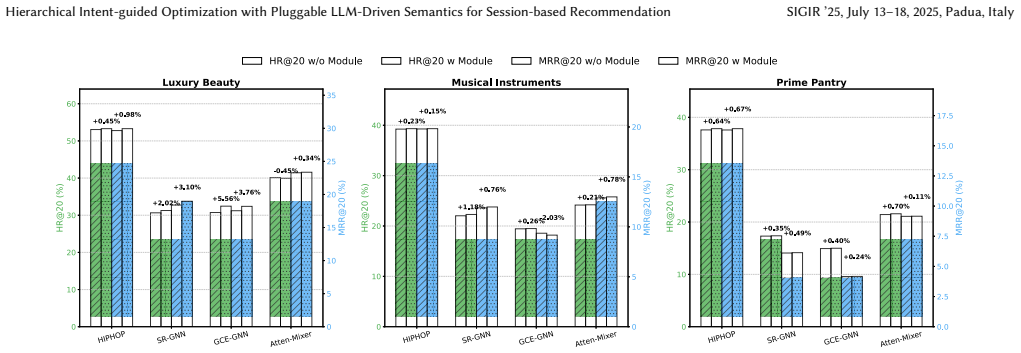
- The pluggable semantic module improves SR-GNN, GCE-GNN, and Atten-Mixer on at least some datasets, so existing GNN-based recommenders can be upgraded with metadata without a full architectural redesign.
- Removing inter-session similarity learning causes the largest ablation drop, meaning cross-session signals carry much of HIPHOP's accuracy.
- Hard negative contrastive sampling from similar sessions that share no items makes session representations more discriminative, which the paper associates with more stable training and faster convergence.
Reading between the lines
- The paper leaves implicit that the same semantic embedding module could be attached to non-GNN backbones such as RNN or Transformer session encoders; the pluggable design suggests those models would also gain from metadata.
- Because item embeddings are derived from metadata rather than interaction counts, cold-start items with no session history could be embedded and recommended immediately, but the paper does not evaluate this scenario.
- The three Amazon-derived datasets are small and category-specific, so an obvious extension is to test whether the 28–79% gains persist on larger and more diverse catalogs where metadata is noisier.
- A cleaner attribution test would compare HIPHOP against an equally strong multi-intent baseline that is given the same semantic embeddings, isolating the architecture's contribution from the information advantage; the paper's portability experiments move toward this but do not settle it.
Editorial analysis
A structured set of objections, weighed in public.
Referee Report
Summary. The paper proposes HIPHOP, a session-based recommendation (SBR) model that combines LLM-generated semantic item embeddings, GNN-based intra-session modeling, dynamic multi-intent capture, hierarchical inter-session similarity graphs, and contrastive learning. The model is evaluated on two standard SBR datasets (Diginetica and Yoochoose 1/64) and three Amazon-derived datasets, with reported improvements over strong baselines such as Atten-Mixer. The central claim is that HIPHOP consistently outperforms all baselines across all five datasets, establishing a new state of the art in SBR.
Significance. If the results hold on standard SBR benchmarks, the architectural combination of intent-guided hierarchical inter-session similarity and contrastive learning is a plausible contribution to session-based recommendation. The paper releases code and preprocessed datasets, and the ablation study (Section 5.3) supports the importance of the inter-session similarity module. However, the evaluation on the Amazon-derived datasets is confounded by the construction of 'sessions' from user review histories, which changes the task from anonymous-session SBR to user-level sequential recommendation, and the large gains on those datasets may reflect this task shift rather than superior session modeling.
major comments (5)
- [Section 5.1.1, Table 3] The Amazon-derived 'sessions' are formed by chronologically ordering each user's reviews, making them user-level interaction histories rather than anonymous browsing sessions. This is a task shift from SBR, and the large relative improvements (28.65-79.26% HR@20) over Atten-Mixer may reflect the model's ability to exploit user-level structure (e.g., hierarchical inter-session similarity effectively performing user-based collaborative filtering) rather than superior session modeling. The claim in Section 5.2 that HIPHOP 'consistently outperforms all baseline models across all datasets' in the SBR setting is therefore overstated; only Diginetica and Yoochoose provide standard SBR evidence. Please either re-run on properly constructed anonymous sessions (e.g., splitting by inactivity gaps) or present the Amazon results as a separate user-level sequential recommendation task with appropriate baseline comparisons.
- [Tables 2 and 3, Section 5.2] All results are reported as single runs without variance estimates or statistical significance tests, yet the abstract and Section 5.2 use 'significantly outperforms.' Given the modest improvement on Yoochoose (3.48% HR@20, 1.46% MRR@20), significance testing is essential to support this language. Provide mean and standard deviation over multiple seeds and, where appropriate, paired significance tests (e.g., bootstrap or t-test) to substantiate the claim of consistent and significant improvement.
- [Section 4.5.2, Eq. (20)] The prediction loss is formulated as binary cross-entropy over all items, while the predictions \hat{y}_{i,j} are outputs of a softmax (Eq. 19). This is inconsistent with the standard softmax cross-entropy used in next-item prediction, and the (1-y_{i,j}) log(1-\hat{y}_{i,j}) term is not standard for a single-target problem. Please clarify the exact training objective (e.g., is y a multi-hot vector? why not use -log \hat{y}_{i,target}?) and justify this choice; if this is a typographical error, correct it.
- [Sections 3.2.2 and 3.2.3] The global and local session similarity graphs G_g and G_l are defined as complete graphs over all sessions (edges connect every pair), which is computationally infeasible for datasets with hundreds of thousands of sessions (Diginetica has 719,470 training sessions). The paper does not describe how these graphs are actually constructed or approximated. Since the top-K selection in Section 4.4.3 appears to happen after graph convolution, the computational cost of the full graph construction is not addressed. Explain the actual implementation (e.g., approximate nearest neighbor search, sampling, or precomputation) and its complexity.
- [Section 5.1.1 and Table 3] In the Amazon experiments, HIPHOP is given LLM-generated semantic embeddings from item metadata, while the item-ID-only baselines are not. The ablation in Section 5.5 shows only a small drop when the semantic module is removed from HIPHOP on Luxury Beauty (53.30 vs 53.06 HR@20), which suggests metadata is not the main driver of the gains, but the comparison remains asymmetric. Either provide baselines with the same semantic features (as the portability experiments partially do) or explicitly state that the Amazon comparison includes the benefit of additional metadata, and restrict the claim of superior SBR architecture to the ID-only setting.
minor comments (5)
- [Section 5.2] The sentence 'positioning it most advanced method in SBR' should be 'positioning it as the most advanced method in SBR.'
- [Sections 3.1 and 3.2.2] The symbol S is used both for a single session in Section 3.1 and for the set of sessions in Section 3.2.2; this notation is confusing and should be disambiguated (e.g., use \mathcal{S} for the set).
- [Section 5.4] The hyperparameter study reports search ranges but not the final chosen values for all datasets; please include a table or a clear statement of the final hyperparameter settings used for each dataset.
- [Figure 2] Figure 2 is very dense and difficult to read; consider enlarging the figure, labeling components more clearly, and explaining the numbered steps (1-6) in the caption.
- [References [57] and [58]] References [57] and [58] appear to refer to the same paper (Beyond Co-Occurrence) with different years; please consolidate to a single reference.
Circularity Check
No circularity found; the paper's evaluation is a standard held-out empirical comparison with no load-bearing self-citation or construction-level reduction.
full rationale
HIPHOP is an empirical machine-learning paper, not a derivation, and I find no circular step. The core claims are supported by held-out test metrics on Diginetica and Yoochoose 1/64, where training, validation, and test sessions are separated following standard SBR preprocessing (Section 5.1.1). The prediction pipeline (Equations 18-21) uses cross-entropy on next-item labels, and the reported HR@20 and MRR@20 values are computed on test sessions not used for fitting. The LLM semantic embeddings are input features derived from item metadata, not fitted parameters that encode the ground-truth next-item label; moreover, Section 5.5 shows that removing this module barely changes performance on Luxury Beauty (53.30 to 53.06 HR@20), so the module is not the load-bearing mechanism behind the reported gains. The contrastive loss (Equation 15) maximizes similarity between a session anchor and an aggregated representation of top-K similar sessions; this is a self-supervised auxiliary objective, not a renaming of the prediction target. There are no self-citations by the present authors used as justification for any central premise, and no uniqueness theorem or ansatz is imported from prior work by the same authors. The Amazon-derived datasets constructed by chronological review ordering raise a legitimate question about whether those experiments measure session-based recommendation as conventionally defined, but that is an external-validity and fairness concern, not a circularity concern: the evaluation still uses genuinely held-out next-item labels. Therefore the appropriate circularity score is 0.
Assumptions & free parameters
free parameters (6)
- Number of intent queries M =
4
- Number of recent items k for local similarity =
3
- Contrastive loss weight lambda =
0.3 (Diginetica); 0.3-0.5 (Yoochoose)
- Number of negative samples N_neg =
8 (Diginetica); 16 (Yoochoose)
- Contrastive temperature tau =
not specified
- Embedding dimension =
100
assumptions (4)
- domain assumption Jaccard similarity of item sets captures relatedness between sessions
- domain assumption The last k clicked items define short-term user interest
- domain assumption LLM-generated semantic embeddings from item metadata improve next-item prediction beyond ID co-occurrence
- standard math Training and test sessions follow the same distribution
invented entities (1)
-
Learnable intent query vectors q_1..q_M
Cite this review
Pith. "Pith review of Hierarchical Intent-guided Optimization with Pluggable LLM-Driven Semantics for Session-based Recommendation." pith.science (2026). https://pith.science/paper/MQTSQEEL
@misc{pith2026250704623,
  author       = {Pith},
  title        = {Pith review of: Hierarchical Intent-guided Optimization with Pluggable LLM-Driven Semantics for Session-based Recommendation},
  year         = {2026},
  howpublished = {\url{https://pith.science/paper/MQTSQEEL}},
  note         = {Machine review of arXiv:2507.04623}
}
read the original abstract
Session-based Recommendation (SBR) aims to predict the next item a user will likely engage with, using their interaction sequence within an anonymous session. Existing SBR models often focus only on single-session information, ignoring inter-session relationships and valuable cross-session insights. Some methods try to include inter-session data but struggle with noise and irrelevant information, reducing performance. Additionally, most models rely on item ID co-occurrence and overlook rich semantic details, limiting their ability to capture fine-grained item features. To address these challenges, we propose a novel hierarchical intent-guided optimization approach with pluggable LLM-driven semantic learning for session-based recommendations, called HIPHOP. First, we introduce a pluggable embedding module based on large language models (LLMs) to generate high-quality semantic representations, enhancing item embeddings. Second, HIPHOP utilizes graph neural networks (GNNs) to model item transition relationships and incorporates a dynamic multi-intent capturing module to address users' diverse interests within a session. Additionally, we design a hierarchical inter-session similarity learning module, guided by user intent, to capture global and local session relationships, effectively exploring users' long-term and short-term interests. To mitigate noise, an intent-guided denoising strategy is applied during inter-session learning. Finally, we enhance the model's discriminative capability by using contrastive learning to optimize session representations. Experiments on multiple datasets show that HIPHOP significantly outperforms existing methods, demonstrating its effectiveness in improving recommendation quality. Our code is available: https://github.com/hjx159/HIPHOP.
Figures


Figures from the paper (3 more)


Reference graph
Works this paper leans on
-
[1]
Gediminas Adomavicius and Alexander Tuzhilin. 2005. Toward the next gen- eration of recommender systems: A survey of the state-of-the-art and possible extensions.IEEE transactions on knowledge and data engineering17, 6 (2005), 734–749
2005
-
[2]
Qian Chen, Zhiqiang Guo, Jianjun Li, and Guohui Li. 2023. Knowledge-enhanced multi-view graph neural networks for session-based recommendation. InProceed- ings of the 46th International ACM SIGIR Conference on Research and Development in Information Retrieval. 352–361
work page 2023
-
[3]
Qian Chen, Jianjun Li, Zhiqiang Guo, Guohui Li, and Zhiying Deng. 2023. Attribute-enhanced dual channel representation learning for session-based rec- ommendation. InProceedings of the 32nd ACM International Conference on Infor- mation and Knowledge Management. 3793–3797
work page 2023
-
[4]
Chen Cheng, Haiqin Yang, Michael R Lyu, and Irwin King. 2013. Where you like to go next: Successive point-of-interest recommendation. InTwenty-Third international joint conference on Artificial Intelligence
work page 2013
-
[5]
Chen Cheng, Haiqin Yang, Michael R. Lyu, and Irwin King. 2013. Where You Like to Go Next: Successive Point-of-Interest Recommendation. InIJCAI 2013, Proceedings of the 23rd International Joint Conference on Artificial Intelligence, Beijing, China, August 3-9, 2013, Francesca Rossi (Ed.). 2605–2611
work page 2013
-
[6]
Sunhao Dai, Ninglu Shao, Haiyuan Zhao, Weijie Yu, Zihua Si, Chen Xu, Zhongx- iang Sun, Xiao Zhang, and Jun Xu. 2023. Uncovering chatgpt’s capabilities in recommender systems. InProceedings of the 17th ACM Conference on Recom- mender Systems. 1126–1132
2023
-
[7]
Jiayan Guo, Peiyan Zhang, Chaozhuo Li, Xing Xie, Yan Zhang, and Sunghun Kim
-
[8]
Lei Guo, Hongzhi Yin, Qinyong Wang, Tong Chen, Alexander Zhou, and Nguyen Quoc Viet Hung. 2019. Streaming session-based recommendation. InProceedings of the 25th ACM SIGKDD international conference on knowledge discovery & data mining. 1569–1577
2019
Show all 65 references
-
[9]
Ruining He and Julian McAuley. 2016. Fusing similarity models with markov chains for sparse sequential recommendation. In2016 IEEE 16th international conference on data mining (ICDM). IEEE, 191–200
2016
-
[10]
B Hidasi. 2015. Session-based Recommendations with Recurrent Neural Networks. arXiv preprint arXiv:1511.06939(2015)
2015 arXiv
-
[11]
Balázs Hidasi, Alexandros Karatzoglou, Linas Baltrunas, and Domonkos Tikk
-
[12]
Yupeng Hou, Junjie Zhang, Zihan Lin, Hongyu Lu, Ruobing Xie, Julian McAuley, and Wayne Xin Zhao. 2024. Large language models are zero-shot rankers for recommender systems. InEuropean Conference on Information Retrieval. Springer, 364–381
2024
-
[13]
Wang-Cheng Kang and Julian McAuley. 2018. Self-attentive sequential recom- mendation. In2018 IEEE international conference on data mining (ICDM). IEEE, 197–206
2018
-
[14]
Yehuda Koren, Robert Bell, and Chris Volinsky. 2009. Matrix factorization tech- niques for recommender systems.Computer42, 8 (2009), 30–37
2009
-
[15]
Bell, and Chris Volinsky
Yehuda Koren, Robert M. Bell, and Chris Volinsky. 2009. Matrix Factorization Techniques for Recommender Systems.Computer42, 8 (2009), 30–37. https: //doi.org/10.1109/MC.2009.263
2009 doi
-
[16]
Sara Latifi, Noemi Mauro, and Dietmar Jannach. 2021. Session-aware recom- mendation: A surprising quest for the state-of-the-art.Information Sciences573 (2021), 291–315
2021
-
[17]
Jing Li, Pengjie Ren, Zhumin Chen, Zhaochun Ren, Tao Lian, and Jun Ma. 2017. Neural attentive session-based recommendation. InProceedings of the 2017 ACM on Conference on Information and Knowledge Management. 1419–1428
2017
-
[19]
Ruyu Li, Wenhao Deng, Yu Cheng, Zheng Yuan, Jiaqi Zhang, and Fajie Yuan
-
[20]
Xiangyang Li, Bo Chen, Lu Hou, and Ruiming Tang. 2023. Ctrl: Connect tabular and language model for ctr prediction.CoRR(2023)
2023
- [21]
-
[22]
Qiao Liu, Yifu Zeng, Refuoe Mokhosi, and Haibin Zhang. 2018. STAMP: short- term attention/memory priority model for session-based recommendation. In Proceedings of the 24th ACM SIGKDD international conference on knowledge dis- covery & data mining. 1831–1839
2018
-
[23]
arXiv:2305.11700
Exploring the Upper Limits of Text-Based Collaborative Filtering Using Large Language Models: Discoveries and Insights.CoRRabs/2305.11700 (2023). arXiv:2305.11700
2023
-
[24]
Yitong Pang, Lingfei Wu, Qi Shen, Yiming Zhang, Zhihua Wei, Fangli Xu, Ethan Chang, Bo Long, and Jian Pei. 2022. Heterogeneous global graph neural networks for personalized session-based recommendation. InProceedings of the fifteenth ACM international conference on web search ...
2022
-
[25]
Xiuyuan Qin, Huanhuan Yuan, Pengpeng Zhao, Junhua Fang, Fuzhen Zhuang, Guanfeng Liu, Yanchi Liu, and Victor Sheng. 2023. Meta-optimized contrastive learning for sequential recommendation. InProceedings of the 46th International ACM SIGIR Conference on Research and Development ...
2023
-
[26]
Ruihong Qiu, Jingjing Li, Zi Huang, and Hongzhi Yin. 2019. Rethinking the item order in session-based recommendation with graph neural networks. In Proceedings of the 28th ACM international conference on information and knowledge management. 579–588
2019
-
[27]
Haokai Ma, Ruobing Xie, Lei Meng, Xin Chen, Xu Zhang, Leyu Lin, and Jie Zhou
-
[28]
In Proceedings of the 17th ACM Conference on Recommender Systems
Exploring false hard negative sample in cross-domain recommendation. In Proceedings of the 17th ACM Conference on Recommender Systems. 502–514
-
[29]
Konstan, and John Riedl
Badrul Munir Sarwar, George Karypis, Joseph A. Konstan, and John Riedl. 2001. Item-based collaborative filtering recommendation algorithms. InProceedings of the Tenth International World Wide Web Conference, WWW 10, Hong Kong, China, May 1-5, 2001. ACM, 285–295. https://doi.or...
2001
-
[30]
Guy Shani, David Heckerman, and Ronen I. Brafman. 2005. An MDP-Based Recommender System.J. Mach. Learn. Res.6 (2005), 1265–1295
2005
-
[31]
Guy Shani, David Heckerman, Ronen I Brafman, and Craig Boutilier. 2005. An MDP-based recommender system.Journal of machine Learning research6, 9 (2005)
2005
-
[32]
Steffen Rendle, Christoph Freudenthaler, and Lars Schmidt-Thieme. 2010. Factor- izing personalized markov chains for next-basket recommendation. InProceedings of the 19th international conference on World wide web. 811–820
2010
-
[33]
Badrul Sarwar, George Karypis, Joseph Konstan, and John Riedl. 2001. Item-based collaborative filtering recommendation algorithms. InProceedings of the 10th international conference on World Wide Web. 285–295
2001
-
[34]
Jing Song, Hong Shen, Zijing Ou, Junyi Zhang, Teng Xiao, and Shangsong Liang
-
[35]
Jiajie Su, Chaochao Chen, Weiming Liu, Fei Wu, Xiaolin Zheng, and Haoming Lyu. 2023. Enhancing hierarchy-aware graph networks with deep dual clustering for session-based recommendation. InProceedings of the ACM Web Conference
2023
-
[36]
Zhi Rui Tam, Cheng-Kuang Wu, Yi-Lin Tsai, Chieh-Yen Lin, Hung-yi Lee, and Yun-Nung Chen. 2024. Let Me Speak Freely? A Study On The Impact Of Format Restrictions On Large Language Model Performance. InProceedings of the 2024 Conference on Empirical Methods in Natural Language P...
2024
-
[37]
Bo Shao, Dingding Wang, Tao Li, and Mitsunori Ogihara. 2009. Music recom- mendation based on acoustic features and user access patterns.IEEE Transactions on Audio, Speech, and Language Processing17, 8 (2009), 1602–1611
2009
-
[39]
Zhongwei Wan, Xin Liu, Benyou Wang, Jiezhong Qiu, Boyu Li, Ting Guo, Guangy- ong Chen, and Yang Wang. 2023. Spatio-temporal Contrastive Learning-enhanced GNNs for Session-based Recommendation.ACM Transactions on Information Systems42, 2 (2023), 1–26
2023
-
[40]
Haosen Wang, Surong Yan, Chunqi Wu, Long Han, and Linghong Zhou. 2023. Cross-view temporal graph contrastive learning for session-based recommenda- tion.Knowledge-Based Systems264 (2023), 110304
2023
-
[41]
InProceedings of the Twenty-Eighth International Joint Conference on Artificial Intelligence, IJCAI 2019, Macao, China, August 10-16, 2019
ISLF: Interest Shift and Latent Factors Combination Model for Session- based Recommendation. InProceedings of the Twenty-Eighth International Joint Conference on Artificial Intelligence, IJCAI 2019, Macao, China, August 10-16, 2019. 5765–5771. https://doi.org/10.24963/IJCAI.2019/799
2019 doi
-
[42]
Shoujin Wang and Longbing Cao. 2017. Inferring implicit rules by learning explicit and hidden item dependency.IEEE Transactions on Systems, Man, and Cybernetics: Systems50, 3 (2017), 935–946
2017
-
[43]
Shoujin Wang, Longbing Cao, Yan Wang, Quan Z Sheng, Mehmet A Orgun, and Defu Lian. 2021. A survey on session-based recommender systems.ACM Computing Surveys (CSUR)54, 7 (2021), 1–38
2021
-
[44]
Yong Kiam Tan, Xinxing Xu, and Yong Liu. 2016. Improved recurrent neural networks for session-based recommendations. InProceedings of the 1st workshop on deep learning for recommender systems. 17–22
2016
-
[45]
A Vaswani. 2017. Attention is all you need.Advances in Neural Information Processing Systems(2017)
2017
-
[46]
Xiao Wang, Tingting Dai, Qiao Liu, and Shuang Liang. 2024. Spatial-Temporal Per- ceiving: Deciphering User Hierarchical Intent in Session-Based Recommendation. InProceedings of the 33rd International Joint Conference on Artificial Intelligence. 2415–2423
2024
-
[47]
Ziyang Wang, Wei Wei, Gao Cong, Xiao-Li Li, Xian-Ling Mao, and Minghui Qiu. 2020. Global context enhanced graph neural networks for session-based recommendation. InProceedings of the 43rd international ACM SIGIR conference on research and development in information retrieval. 169–178
2020
-
[48]
Meirui Wang, Pengjie Ren, Lei Mei, Zhumin Chen, Jun Ma, and Maarten De Rijke
-
[49]
InProceedings of the 42nd international ACM SIGIR conference on research and development in information retrieval
A collaborative session-based recommendation approach with parallel memory modules. InProceedings of the 42nd international ACM SIGIR conference on research and development in information retrieval. 345–354
-
[50]
Xin Xia, Hongzhi Yin, Junliang Yu, Yingxia Shao, and Lizhen Cui. 2021. Self- supervised graph co-training for session-based recommendation. InProceedings of the 30th ACM international conference on information & knowledge management. 2180–2190
2021
-
[51]
Xin Xia, Hongzhi Yin, Junliang Yu, Qinyong Wang, Lizhen Cui, and Xiangliang Zhang. 2021. Self-supervised hypergraph convolutional networks for session- based recommendation. InProceedings of the AAAI conference on artificial intelli- gence, Vol. 35. 4503–4511
2021
-
[52]
Shoujin Wang, Liang Hu, Yan Wang, Quan Z Sheng, Mehmet Orgun, and Long- bing Cao. 2019. Modeling multi-purpose sessions for next-item recommendations via mixture-channel purpose routing networks. InInternational Joint Conference on Artificial Intelligence. International Joint ...
2019
-
[53]
Sheng, Mehmet A
Shoujin Wang, Liang Hu, Yan Wang, Quan Z. Sheng, Mehmet A. Orgun, and Longbing Cao. 2019. Modeling Multi-Purpose Sessions for Next-Item Recom- mendations via Mixture-Channel Purpose Routing Networks. InProceedings of the Twenty-Eighth International Joint Conference on Artifici...
2019
-
[54]
Yonghui Yang, Zhengwei Wu, Le Wu, Kun Zhang, Richang Hong, Zhiqiang Zhang, Jun Zhou, and Meng Wang. 2023. Generative-contrastive graph learning for recommendation. InProceedings of the 46th International ACM SIGIR Conference on Research and Development in Information Retrieval...
2023
-
[55]
Feng Yu, Yanqiao Zhu, Qiang Liu, Shu Wu, Liang Wang, and Tieniu Tan. 2020. TAGNN: Target attentive graph neural networks for session-based recommenda- tion. InProceedings of the 43rd international ACM SIGIR conference on research and development in information retrieval. 1921–1924
2020
-
[56]
Shu Wu, Yuyuan Tang, Yanqiao Zhu, Liang Wang, Xing Xie, and Tieniu Tan. 2019. Session-based recommendation with graph neural networks. InProceedings of the AAAI conference on artificial intelligence, Vol. 33. 346–353
2019
-
[57]
Yunjia Xi, Weiwen Liu, Jianghao Lin, Xiaoling Cai, Hong Zhu, Jieming Zhu, Bo Chen, Ruiming Tang, Weinan Zhang, and Yong Yu. 2024. Towards open-world recommendation with knowledge augmentation from large language models. In Proceedings of the 18th ACM Conference on Recommender ...
2024
-
[58]
Xiaokun Zhang, Bo Xu, Fenglong Ma, Chenliang Li, Liang Yang, and Hongfei Lin. 2024. Beyond Co-Occurrence: Multi-Modal Session-Based Recommendation. IEEE Trans. Knowl. Data Eng.36, 4 (2024), 1450–1462. https://doi.org/10.1109/ TKDE.2023.3309995
2024
-
[59]
Bowen Zheng, Yupeng Hou, Hongyu Lu, Yu Chen, Wayne Xin Zhao, Ming Chen, and Ji-Rong Wen. 2024. Adapting large language models by integrating collaborative semantics for recommendation. In2024 IEEE 40th International Conference on Data Engineering (ICDE). IEEE, 1435–1448
2024
-
[60]
Chengfeng Xu, Pengpeng Zhao, Yanchi Liu, Victor S Sheng, Jiajie Xu, Fuzhen Zhuang, Junhua Fang, and Xiaofang Zhou. 2019. Graph contextualized self- attention network for session-based recommendation.. InIJCAI, Vol. 19. 3940– 3946
2019
-
[61]
Sheng, Jiajie Xu, Fuzhen Zhuang, Junhua Fang, and Xiaofang Zhou
Chengfeng Xu, Pengpeng Zhao, Yanchi Liu, Victor S. Sheng, Jiajie Xu, Fuzhen Zhuang, Junhua Fang, and Xiaofang Zhou. 2019. Graph Contextualized Self- Attention Network for Session-based Recommendation. InProceedings of the Twenty-Eighth International Joint Conference on Artific...
2019
-
[64]
Peiyan Zhang, Jiayan Guo, Chaozhuo Li, Yueqi Xie, Jae Boum Kim, Yan Zhang, Xing Xie, Haohan Wang, and Sunghun Kim. 2023. Efficiently leveraging multi- level user intent for session-based recommendation via atten-mixer network. In Proceedings of the sixteenth ACM international ...
2023
-
[65]
Xiaokun Zhang, Bo Xu, Fenglong Ma, Chenliang Li, Liang Yang, and Hongfei Lin. 2023. Beyond co-occurrence: Multi-modal session-based recommendation. IEEE Transactions on Knowledge and Data Engineering(2023)
2023
-
[68]
Kun Zhou, Hui Wang, Wayne Xin Zhao, Yutao Zhu, Sirui Wang, Fuzheng Zhang, Zhongyuan Wang, and Ji-Rong Wen. 2020. S3-rec: Self-supervised learning for se- quential recommendation with mutual information maximization. InProceedings of the 29th ACM international conference on inf...
2020
-
[2016]
In4th International Conference on Learning Representations, ICLR 2016, San Juan, Puerto Rico, May 2-4, 2016, Conference Track Proceedings
Session-based Recommendations with Recurrent Neural Networks. In4th International Conference on Learning Representations, ICLR 2016, San Juan, Puerto Rico, May 2-4, 2016, Conference Track Proceedings
2016
-
[2019]
ISLF: Interest Shift and Latent Factors Combination Model for Session-based Recommendation.. InIJCAI. 5765–5771
-
[2022]
InProceedings of the 31st ACM international conference on information & knowledge management
Evolutionary preference learning via graph nested gru ode for session- based recommendation. InProceedings of the 31st ACM international conference on information & knowledge management. 624–634
Reviewed August 6, 2026 · model on record in the stance chip above.
Discussion (0). Continue with ORCID to comment.